Roast chicken with chickpea stuffing is Gordon Ramsay's answer to the Sunday bird: a whole chicken with tarragon butter pushed under the breast skin, its cavity filled with chickpeas, sliced red chilli, lemon zest and thyme, roasted on a bed of halved garlic heads. When it comes out, the stuffing is spooned into a bowl and mashed with the soft roasted garlic and the juice of the lemon that sealed the cavity, and the whole thing goes to the table with a big green salad. The recipe is published by his restaurant group as roast chicken with chickpea stuffing and big green salad, and it is a roast chicken with stuffing that needs no bread, no stock and no stovetop.
This version follows his method step for step and adds the parts a home cook needs to get it right every time: when the stuffing inside the bird is actually safe, how long a stuffed chicken really takes, and how to keep the breast juicy while the center catches up. If you would rather not cook the stuffing inside the bird at all, there is a bake-it-separately option further down that loses very little. To pick the bird itself, Ramsay's guide to choosing a fresh chicken covers what to look for at the counter.
What Makes Ramsay's Roast Chicken with Chickpea Stuffing Different
Ramsay's roast chicken with chickpea stuffing swaps the usual bread stuffing for a can of chickpeas, and it treats the stuffing as something you finish after roasting rather than serve straight from the bird. Inside the cavity, the chickpeas soak up the tarragon butter and chicken juices that run off the meat. Afterwards he squeezes the roasted garlic through a sieve over them, adds the roasted lemon juice and a spoonful of salad dressing, and mashes it all into a rough, savory mash. It is the same trick he uses for a pan sauce in his MasterClass, where he pushes roasted garlic through a sieve to thicken a chicken jus.
The other two moves are the butter under the skin, which keeps the breast in contact with fat the whole time, and the garlic heads used as a rack, which lift the bird off the tin and turn soft and sweet in the drippings. Here is how it lines up against the classic bread stuffing and the safer bake-on-the-side option:
| Factor | Ramsay's chickpea stuffing (in the bird) | Classic bread stuffing (in the bird) | Chickpea stuffing baked separately |
|---|---|---|---|
| Base | Canned chickpeas, chilli, lemon zest, thyme, olive oil | Bread, onion, celery, sage, butter, stock, often egg or sausage | Same chickpea mix in a small dish |
| Prep time | About 5 minutes, no cooking | 20 to 30 minutes, onions sweated first | About 5 minutes |
| Flavor from the bird | Full: catches butter and juices inside the cavity | Full | Partial: spoon pan juices over it |
| Effect on roasting time | Adds time; check the stuffing center | Adds time; dense and wet, slowest to heat | None; the bird roasts unstuffed |
| Safety check | 165°F in the center of the stuffing | 165°F in the center of the stuffing | 165°F, reached easily in a shallow dish |
| Finish | Mashed with roasted garlic, lemon and dressing | Served as is | Mashed the same way |
The takeaway: chickpea stuffing is quicker to make than bread stuffing and its ingredients are all ready to eat before they go in, but once it sits inside a raw chicken it has to be cooked to the same standard as the bird.
Is It Safe to Cook Stuffing Inside a Chicken?
Cooking stuffing inside a chicken is safe as long as the center of the stuffing reaches 165°F (74°C), the same temperature as the meat. The stuffing sits in the cavity soaking up raw chicken juices, so bacteria from the bird end up in it, and the middle of the cavity is the last place in the whole roast to heat through. The USDA Food Safety and Inspection Service says the safest choice is to cook stuffing separately, and if you do stuff a bird, to check the center of the stuffing with a food thermometer even when the meat is done.
The same USDA guidance sets the ground rules for a stuffed bird. Stuff it loosely, about 3/4 cup of stuffing per pound of chicken, so hot air can still move through the cavity. Mix and stuff it right before it goes into the oven, never the night before. Roast at an oven temperature of no less than 325°F, and let the bird stand for 20 minutes before you take the stuffing out. A 4½-pound chicken holds a bit more than 3 cups by that rule, which is roughly one can of chickpeas with the chilli and herbs, so Ramsay's quantity fits without packing.
Chickpea stuffing starts with an advantage over most bread stuffings: there is no raw egg, raw sausage or uncooked onion in it, and canned chickpeas are already fully cooked. The only risk it carries is what it picks up from the chicken, which is why the 165°F check still applies. If you want to skip the check entirely, bake the same mixture in a small oiled dish on the shelf beside the chicken for the last 25 to 30 minutes, spoon a few tablespoons of the pan juices over it, and mash it exactly as Ramsay does. You lose a little of the buttery flavor from the cavity, and the bird roasts faster and more evenly without it.
Why Stuffing Slows Down a Roast Chicken
A stuffed roast chicken takes longer because the stuffing replaces hot air in the cavity with a dense, cool mass that heat has to creep into. An empty cavity lets oven air reach the inside of the breast and thighs, so the bird cooks from both sides. Fill it, and the heat comes in from the outside only, travelling by slow conduction through the meat and then the chickpeas. The breast, which is the thinnest and most exposed part, keeps climbing past 165°F while the center of the stuffing is still catching up. That is the real trade-off of stuffing a bird: more flavor in the stuffing, and a narrower window for juicy white meat.
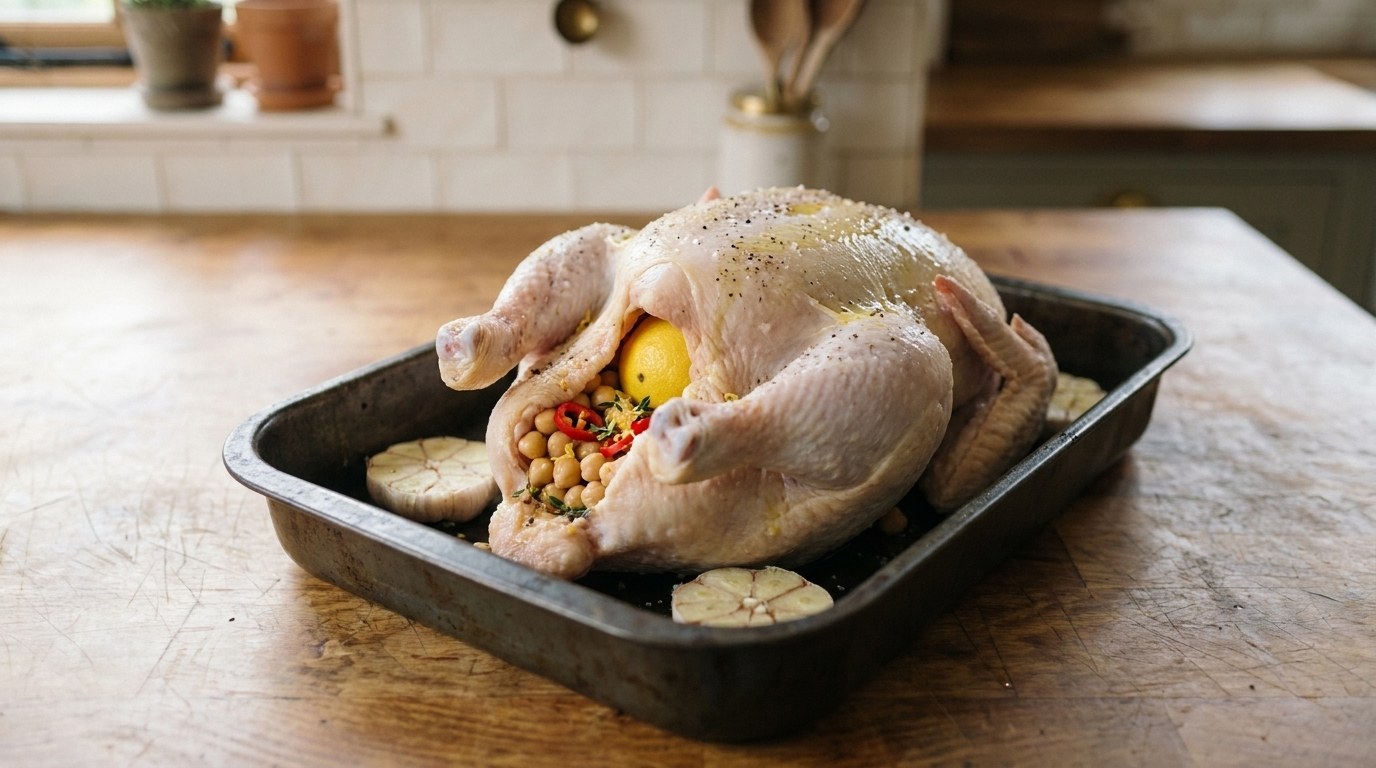
Three habits shrink the gap. Use chickpeas from the pantry, not the fridge, so the stuffing starts at room temperature instead of 40°F. Spoon it in loosely rather than packing it tight. And take the chicken out of the fridge about 30 minutes before roasting so the surface is not ice-cold. The lemon at the opening holds the stuffing in, and it also steams gently as it heats, which is where the bright juice for the mash comes from later.
Tarragon Butter Under the Skin, and How to Get the Skin Golden
Tarragon butter goes under the skin, not on top of it, because that puts the fat and the herb right against the breast meat, where it flavors the surface and bastes it as it melts. Ease your fingers in from the cavity end, between the skin and the breast, to loosen a pocket over both sides, then push the soft butter in and smooth it from outside until it covers the whole crown. Tarragon's mild aniseed flavor is the classic French partner for chicken, and the melted butter runs down into the tin, where it mixes with the chicken juices that end up in the stuffing.
Two honest notes on what the butter does and does not do. It does not soak deep into the breast or make the meat itself juicier; fat and herb flavors stay within a few millimeters of the surface, and salt is the only seasoning that travels further in. Season the cavity and the outside skin well for that reason. And butter is roughly 16 to 18 percent water, so skin sitting on a layer of butter crisps a little less than skin rubbed with oil, a point ThermoWorks makes in its roast chicken guide. Ramsay's fix is built into the method: olive oil drizzled over the outside and a hot start.
That hot start matters because of how browning works. Chicken skin is full of water, and wet skin cannot get hotter than 212°F (100°C) while that water is evaporating. The Maillard reaction that turns skin golden and savory only gets going from about 284°F (140°C), once the surface is dry. So pat the bird completely dry with paper towels, oil the outside, and give it 10 to 15 minutes at 400°F (200°C) to drive off the surface moisture and start the color, before dropping to 350°F (180°C) for the long, gentle part of the roast. The fat under the skin renders as it heats, which is what lets the skin blister and crisp in the second half.
How Long to Roast a Chicken with Stuffing
A 4½-pound (2 kg) chicken with chickpea stuffing takes about 1½ to 1¾ hours: 10 to 15 minutes at 400°F, then 1¼ to 1½ hours at 350°F. That is Ramsay's own timing, and it lines up with the USDA roasting chart, which gives 1¼ to 1½ hours at 350°F for an unstuffed 3- to 4-pound chicken and 2 to 2¼ hours for a 5- to 7-pound bird. Older versions of the USDA chart added 15 to 30 minutes for a stuffed bird, and that is a fair allowance to plan around.
| Chicken | Oven | Approximate time | Done when |
|---|---|---|---|
| About 4½ lb (2 kg), stuffed (Ramsay's) | 400°F for 10–15 min, then 350°F | 1½ to 1¾ hours total | 165°F in breast, thigh and stuffing center |
| 3 to 4 lb, unstuffed | 350°F | 1¼ to 1½ hours | 165°F in breast and thigh |
| 3 to 4 lb, stuffed | 350°F | 1½ to 2 hours | 165°F in breast, thigh and stuffing center |
| 5 to 7 lb, unstuffed | 350°F | 2 to 2¼ hours | 165°F in breast and thigh |
| 5 to 7 lb, stuffed | 350°F | 2¼ to 2¾ hours | 165°F in breast, thigh and stuffing center |
Use the times to plan dinner and the thermometer to decide when it is done, because ovens run hot or cold and birds vary. Start checking 15 minutes before the shortest time. Test three places: the thickest part of the breast, the innermost part of the thigh near the body (not touching bone), and the very center of the stuffing, pushing the probe in through the cavity opening. All three need to read at least 165°F, the USDA safe minimum for poultry. Juices running clear is not a reliable sign either way.

ThermoPro
ThermoPro TempSwift Instant-Read Digital Thermometer
- Reads in about 1 second, accurate to ±0.9°F, with a 4.3-inch food-grade stainless probe
- Hold and calibration functions, so you can lock a reading away from the heat
- NSF certified and IP65 waterproof, rinse it clean under the tap
An instant-read probe like this is the only honest way to cook a stuffed bird, because the outside can look perfect while the center of the stuffing is 20 degrees short. If the meat is done and the stuffing is not, do not keep roasting the whole chicken and dry out the breast: spoon the stuffing into a small dish and put it back in the oven while the chicken rests, until it reaches 165°F. The thighs, for what it is worth, eat better a little higher, around 175°F, because their collagen keeps melting into gelatin above about 154°F; ThermoWorks puts the ideal leg range at 170 to 175°F. In a stuffed bird the thighs usually get there on their own while you wait for the stuffing.
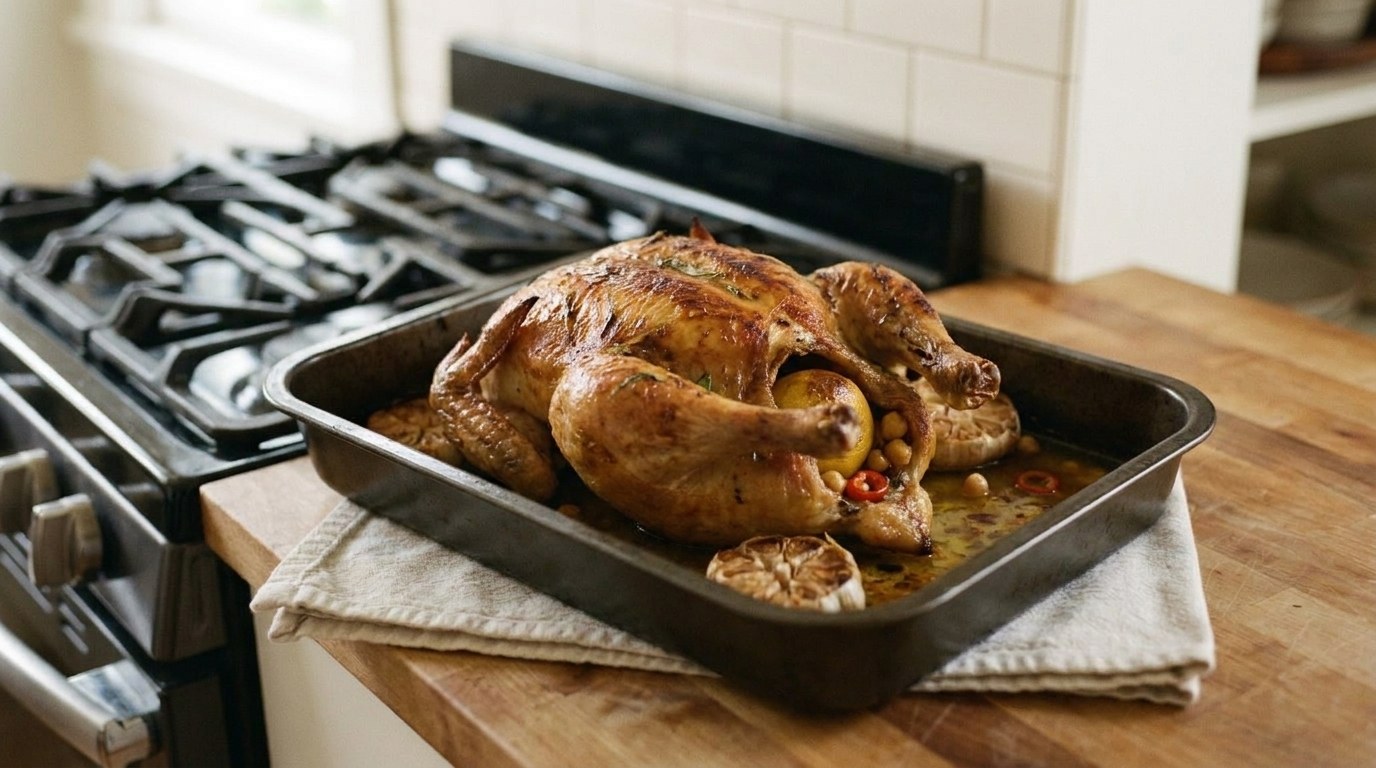
Rest the Chicken 20 Minutes Before Spooning Out the Stuffing
Rest a stuffed roast chicken for 20 minutes, loosely covered with foil on a warm platter, before you take out the stuffing or carve. Ramsay rests his for 10 to 15 minutes; the USDA's stuffing guidance says 20 minutes before the stuffing comes out, and the longer rest costs nothing because a whole bird holds its heat well. The heat stored in the outer layers keeps moving inward during that time. In a ThermoWorks test on a whole roast chicken, the coolest point in the breast kept rising from 145°F to 155°F after the bird left the oven, which is carryover cooking at work.
Resting does not "relax" the meat, which is a common myth: the muscle proteins have already set and that does not reverse. What changes is that the juices cool slightly and thicken, so less of them floods onto the board when you carve. Spoon the tin juices over the carved chicken rather than leaving them behind; the garlic and lemon already in the tin have flavored them.
Finish the Chickpea Stuffing: Mash It with Roasted Garlic and Lemon
The chickpea stuffing is finished after the roast by mashing it with the roasted garlic, the juice of the roasted lemon and a spoonful of the salad dressing. Pull the lemon out of the cavity and spoon the stuffing into a large bowl. Squeeze the soft garlic out of its skins through a sieve over the bowl, halve the roasted lemon and squeeze its juice over the garlic, then press the garlic and juice through the sieve with the back of a spoon. Mash everything coarsely with a potato masher, stir in a tablespoon of the dressing, taste for salt, and finish with a thin drizzle of olive oil.
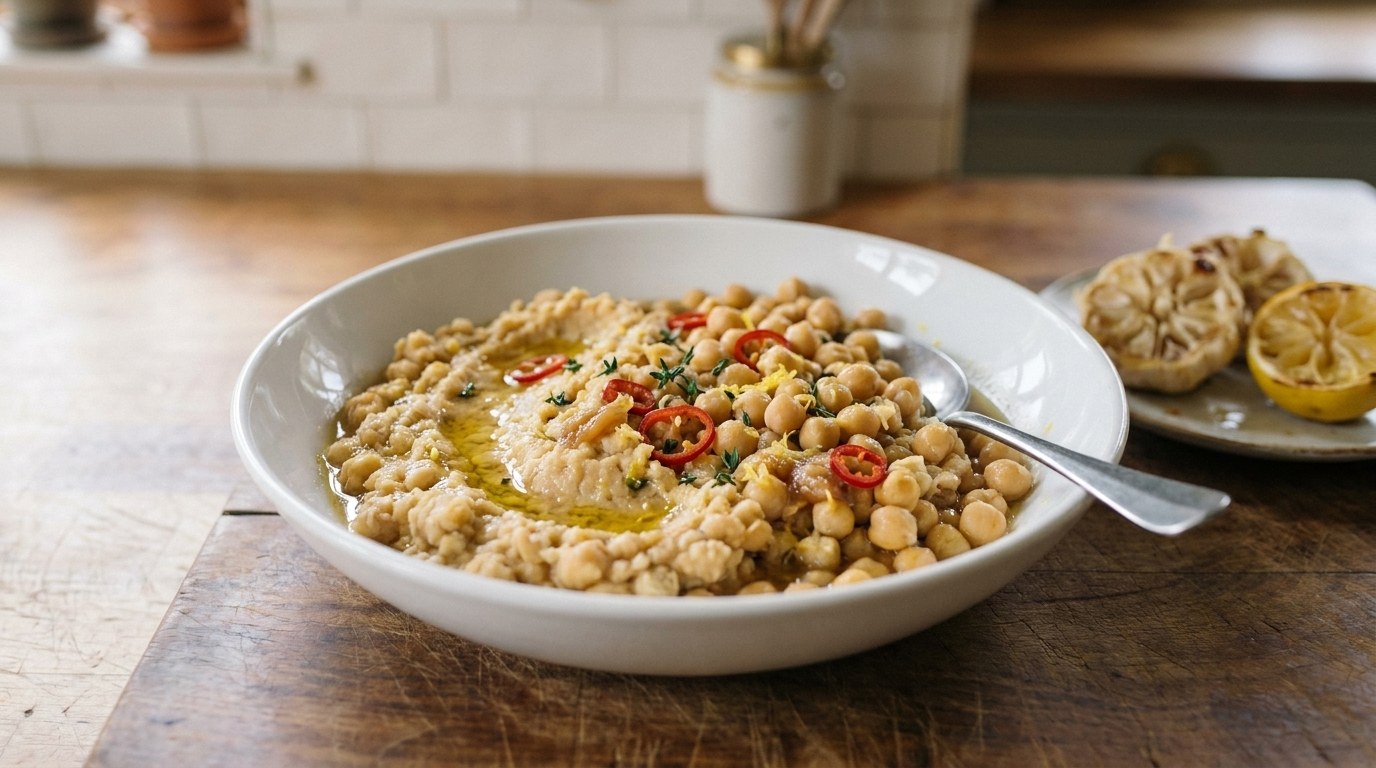
Each part of that finish has a reason. The garlic cloves spend more than an hour under the bird in hot butter and juices, so they turn soft and sweet as their sugars caramelize, mostly between 320 and 338°F at the cut faces. Canned chickpeas are already cooked, their starch swollen and softened, so they crush easily into a creamy, rough mash that holds the butter and juices instead of letting them pool. The roasted lemon juice and the dressing's vinegar bring the acid that a buttery mash needs. Keep it coarse, with plenty of whole chickpeas: you are making a stuffing, not hummus.
Use canned chickpeas or chickpeas you have cooked yourself until fully tender. Dried chickpeas that have only been soaked are still raw and hard, and the cavity of a roasting chicken never gets hot or wet enough to soften them. The Bean Institute notes that dry beans must be soaked and then cooked before they go into a recipe, and that draining and rinsing canned beans removes about 41 percent of their sodium, which helps here since the stuffing gets seasoned twice. One 15-ounce can equals about 1½ cups of home-cooked chickpeas.
The Big Green Salad and Honey Mustard Dressing
Ramsay serves the roast chicken with chickpea stuffing alongside a big green salad of butter lettuce, frilly lollo rosso, baby spinach and chopped avocado, dressed with a balsamic, Dijon and honey vinaigrette. Whisk the vinegar, mustard and honey with a pinch of salt and pepper first, then whisk in the olive oil slowly. The mustard is the emulsifier: compounds in the ground seed coat the oil droplets and keep them suspended in the vinegar, so the dressing stays thick and glossy instead of separating. Dress the leaves at the last minute with about 2 tablespoons and add more to taste, because soft lettuces wilt fast.
The salad's job is contrast. A rich bird and a buttery mash need something cold, crisp and sharp beside them, and the same dressing ties the plate together because a spoonful already went into the stuffing. Keep the leftover dressing in a screw-top jar in the fridge for the week. If you like a lighter, wine-based dressing, our Sauvignon Blanc honey vinaigrette works on the same leaves.
Stuffed Roast Chicken Troubleshooting, Leftovers and Sides
Most problems with a stuffed roast chicken come down to timing between the breast and the stuffing. If the breast is browning too fast, lay a loose piece of foil over it for the rest of the roast. If the skin is pale at the end, the bird was wet going in or the oven runs cool; an oven thermometer will tell you whether your 350°F is really 350°F. If the breast is dry, it overshot while the stuffing caught up, so next time stuff more loosely, start with room-temperature chickpeas, or bake the stuffing on the side.
For leftovers, take all the stuffing out of the bird and refrigerate the chicken and stuffing separately within 2 hours. Both keep for 3 to 4 days, and reheated leftovers should reach 165°F, per the FoodSafety.gov temperature chart. Then do what Ramsay would: strip the carcass and turn the bones into stock. Nothing about a whole chicken needs to go in the bin.
For a bigger spread, Yukon Gold mashed potatoes sit happily beside the bird. If you like the butter-under-the-skin idea, the Gordon Ramsay turkey applies it to the holiday bird, and for a weeknight chicken that is done in under an hour, brick chicken with herb gremolata spatchcocks the bird and presses it flat. Just want the white meat? The bone-in chicken breast method gives you the same crisp skin on one cut. Every roast chicken with stuffing on this site, and the rest of Ramsay's poultry, is gathered in the best Gordon Ramsay chicken recipes.
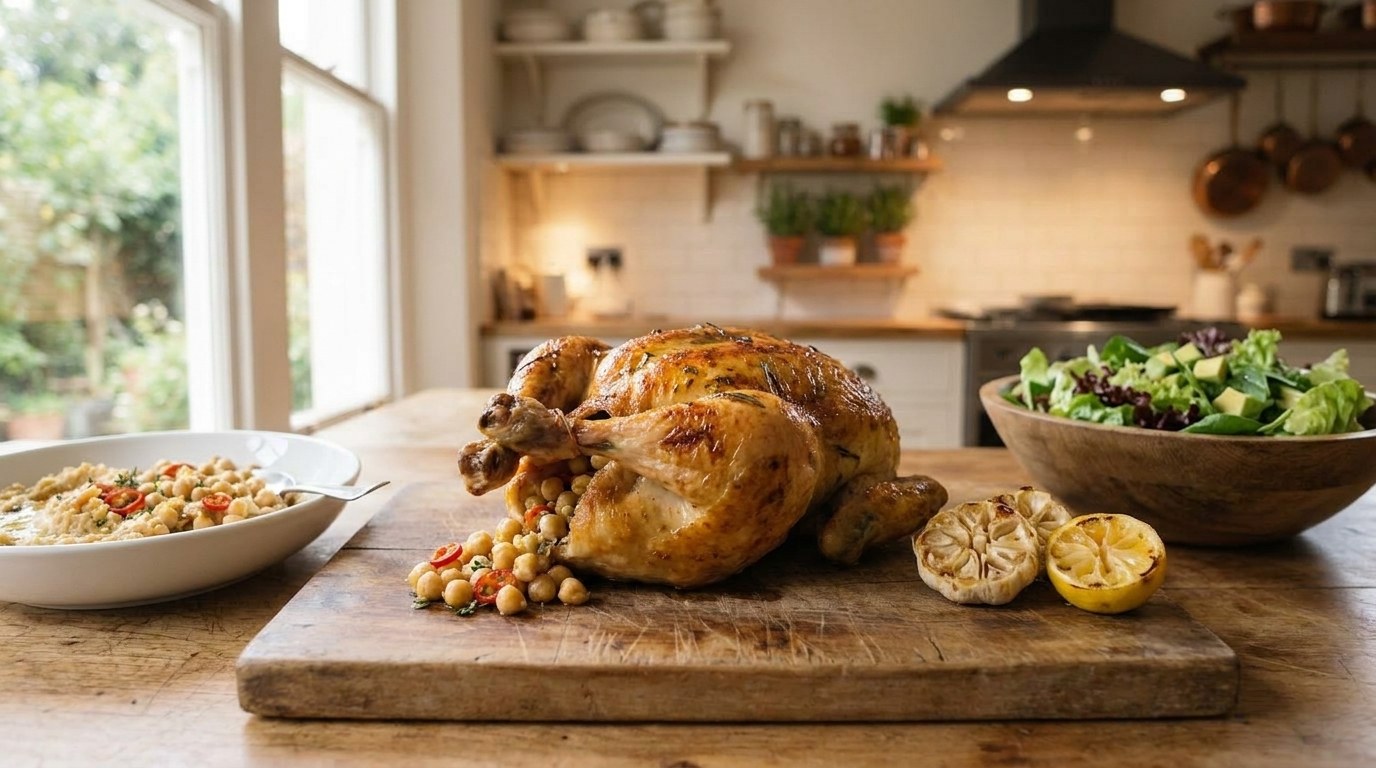
Gordon Ramsay Roast Chicken with Chickpea Stuffing and Big Green Salad
Ingredients
Roast chicken
- 1 whole free-range chicken, about 4½ lb (2 kg), giblets removed
- 1 small bunch of tarragon, leaves roughly chopped
- 7 oz butter (200 g, about 14 tbsp), softened
- 3 heads of garlic, halved horizontally
- olive oil, for drizzling
- sea salt and freshly ground black pepper
Chickpea stuffing
- 1 15-oz (400 g) can chickpeas, drained and rinsed
- 2 red chillies, thinly sliced
- 1 lemon, zested and kept whole
- 3 thyme sprigs, leaves only
- 1 tbsp olive oil, plus extra to finish
Big green salad
- 1 head butter lettuce, washed
- 1 head lollo rosso lettuce, washed
- 3½ oz baby spinach (100 g)
- 1 ripe avocado, peeled, pitted and chopped
Dressing
- 1 tbsp balsamic vinegar
- 1 tbsp Dijon mustard
- 1 tbsp runny honey
- 4 to 6 tbsp extra virgin olive oil
Instructions
- Take the chicken out of the fridge 30 minutes ahead and heat the oven to 400°F (200°C). Pat the chicken completely dry inside and out with paper towels and season the cavity with salt and pepper.
- Beat the tarragon into the softened butter with a pinch of salt and pepper. Working from the cavity end, slide your fingers under the skin of both breasts to loosen it, then push the tarragon butter under the skin and smooth it from the outside so it covers the whole crown.
- For the stuffing, season the chickpeas and toss them with the chillies, lemon zest, thyme leaves and 1 tbsp olive oil. Right before roasting, spoon the stuffing loosely into the cavity without packing it, and push the zested whole lemon into the opening.
- Set the garlic halves cut side down in a roasting tin and sit the chicken on top. Drizzle the outside with olive oil and season with salt and pepper. Roast for 10 to 15 minutes, until the skin starts to turn golden.
- Lower the oven to 350°F (180°C) and roast for 1¼ to 1½ hours more, until the skin is golden all over and an instant-read thermometer shows at least 165°F in the thickest part of the breast, the inner thigh and the center of the stuffing. If the breast browns too fast, cover it loosely with foil.
- While it roasts, tear any large lettuce leaves and put them in a salad bowl with the spinach and avocado. Whisk the vinegar, mustard and honey with a pinch of salt and pepper, then whisk in the olive oil until thick and emulsified.
- Move the chicken to a warm platter, cover it loosely with foil and rest for 20 minutes. Remove the lemon from the cavity and spoon the stuffing into a large bowl. If the stuffing is below 165°F, put it in a small dish and return it to the oven until it reaches 165°F.
- Squeeze the soft roasted garlic out of its skins through a sieve over the stuffing. Halve the roasted lemon, squeeze its juice over the garlic, and press the garlic and juice through the sieve with the back of a spoon. Mash coarsely with a potato masher, stir in 1 tbsp of the dressing, taste for salt, and drizzle with a little olive oil.
- Toss the salad with 2 tbsp of the dressing, adding more to taste. Carve the chicken, spoon the tin juices over it, and serve with the chickpea stuffing and salad.
Notes
Roast Chicken with Chickpea Stuffing FAQs
The questions that come up most: how long to roast a stuffed chicken, what temperature the stuffing needs to reach, whether stuffing a chicken is safe, whether you can use dried chickpeas, what to stuff a chicken with besides bread, whether butter goes under or on top of the skin, whether to cover the chicken with foil, and whether you can stuff it ahead of time.
How long do you roast a stuffed chicken?
A 4½-pound (2 kg) stuffed chicken takes about 1½ to 1¾ hours: 10 to 15 minutes at 400°F, then 1¼ to 1½ hours at 350°F, which is Gordon Ramsay's timing for this recipe. A stuffed bird generally needs 15 to 30 minutes more than an unstuffed one. It is done when the breast, the inner thigh and the center of the stuffing all read at least 165°F.
What temperature does stuffing inside a chicken need to reach?
The center of the stuffing must reach 165°F (74°C), the same as the meat. The USDA advises checking it with a food thermometer even when the chicken itself is done, because the middle of the cavity heats last. If the stuffing is short, spoon it into a dish and finish it in the oven while the bird rests.
Is it safe to stuff a chicken?
Yes, if you stuff it loosely just before roasting, roast at 325°F or higher, and confirm 165°F in the center of the stuffing. The USDA considers cooking stuffing separately the safest option, and a chickpea stuffing bakes well on its own in a small dish for the last 25 to 30 minutes of the roast.
Can I use dried chickpeas for chickpea stuffing?
Only after cooking them. Soak dried chickpeas and simmer them until fully tender before they go into the bird; soaked but uncooked chickpeas stay hard because the cavity never gets hot or wet enough to cook them. One 15-ounce can equals about 1½ cups of cooked chickpeas.
What can you stuff a roast chicken with besides bread?
Chickpeas with chilli, lemon zest and thyme, as in Ramsay's recipe, are one of the easiest options, along with cooked rice, quinoa, or simply aromatics such as a halved lemon, garlic and herbs. Anything that will be eaten must reach 165°F in its center; aromatics you discard need no check.
Should butter go under the skin or on top of a roast chicken?
Under the skin, over the breast, for flavor and to keep fat against the white meat as it roasts. Rub the outside with oil instead: butter is about 16 to 18 percent water, so oil gives crisper, more evenly golden skin.
Should you cover a roast chicken with foil?
Not while it roasts, unless the breast is browning too fast, in which case lay a loose sheet over just the breast. Do cover it loosely with foil while it rests for 20 minutes; a tight cover traps steam and softens the skin.
Can you stuff a chicken the night before?
No. The USDA advises mixing the stuffing and filling the bird right before it goes into the oven. You can zest the lemon, slice the chillies and pick the thyme ahead and keep them chilled, then mix and stuff just before roasting.

About the Author
John Siracusa is the founder of Hell’s Kitchen Recipes. He focuses on technique-first, reproducible home cooking and researches recipes & kitchen equipment from published food science and professional chef methods since 2016.