This Gordon Ramsay steak recipe is his pan method from start to finish: season the steak hard, get the pan hot before the oil goes in, turn the steak often instead of once, baste it with foaming butter, smashed garlic and thyme, then rest it and slice it across the grain. It works on any thick, tender steak, and a 1 1/2-inch strip or ribeye goes from fridge to plate in about 30 minutes, rest included. Below is each move with the reason it works, plus a doneness chart with the temperatures to pull at.
The method comes from what Ramsay teaches in his MasterClass cooking course (the pan lesson and the beef lesson) and from his much-shared perfect steak video. A couple of classic steak rules turn out not to hold up under measurement, so where the science says something different from kitchen folklore, you'll find that here too.
How Does Gordon Ramsay Cook Steak?
Gordon Ramsay cooks steak in a heavy pan on the stove in six moves: plenty of salt and pepper right before cooking, a very hot pan with a thin film of grapeseed oil, frequent turning so both sides brown evenly, a butter baste with garlic and thyme once the crust is set, a rest of 5 to 10 minutes, and slicing across the grain. For a steak much thicker than 1 1/2 inches, the pan builds the crust and a hot oven finishes the center.
He adjusts the heat to the cut. In his MasterClass beef lesson he describes a well-marbled ribeye as a steak that needs a heavy sear and the confidence to render its fat, since the harder the sear, the more flavor you get. A filet mignon is the opposite: a few minutes in the pan with a gentler sear, a touch of oil and butter at the end. Same sequence, different intensity.
Which Steak Works Best for the Gordon Ramsay Steak Recipe
A boneless strip steak (called sirloin in the UK) or a ribeye about 1 1/2 inches thick is the best fit for the Gordon Ramsay steak recipe. That thickness gives the crust time to build before the center overcooks, and both cuts are tender enough for fast, dry heat. A steak under an inch thick hits medium before it has much of a crust, so if that's what you have, cook it on the highest heat and skip the long baste.
Each cut has its own page if you want to go deeper: the cast iron ribeye covers rendering a thick fat cap, the Hell's Kitchen New York strip covers dry-aged strip with a demi-glace, and Gordon Ramsay filet mignon handles the lean tenderloin with an oven finish. Thin, loose-grained cuts like skirt steak and hanger steak cook differently, hot and fast. Ramsay himself came up through the cheaper cuts: in the beef lesson he recalls his first restaurant cooking oxtail, then skirt, hanger and strip, and waiting years before filet went on the menu. Our ranking of the most tender steak cuts shows where each one lands.
Before the Pan: Room Temperature, Salt and a Dry Surface
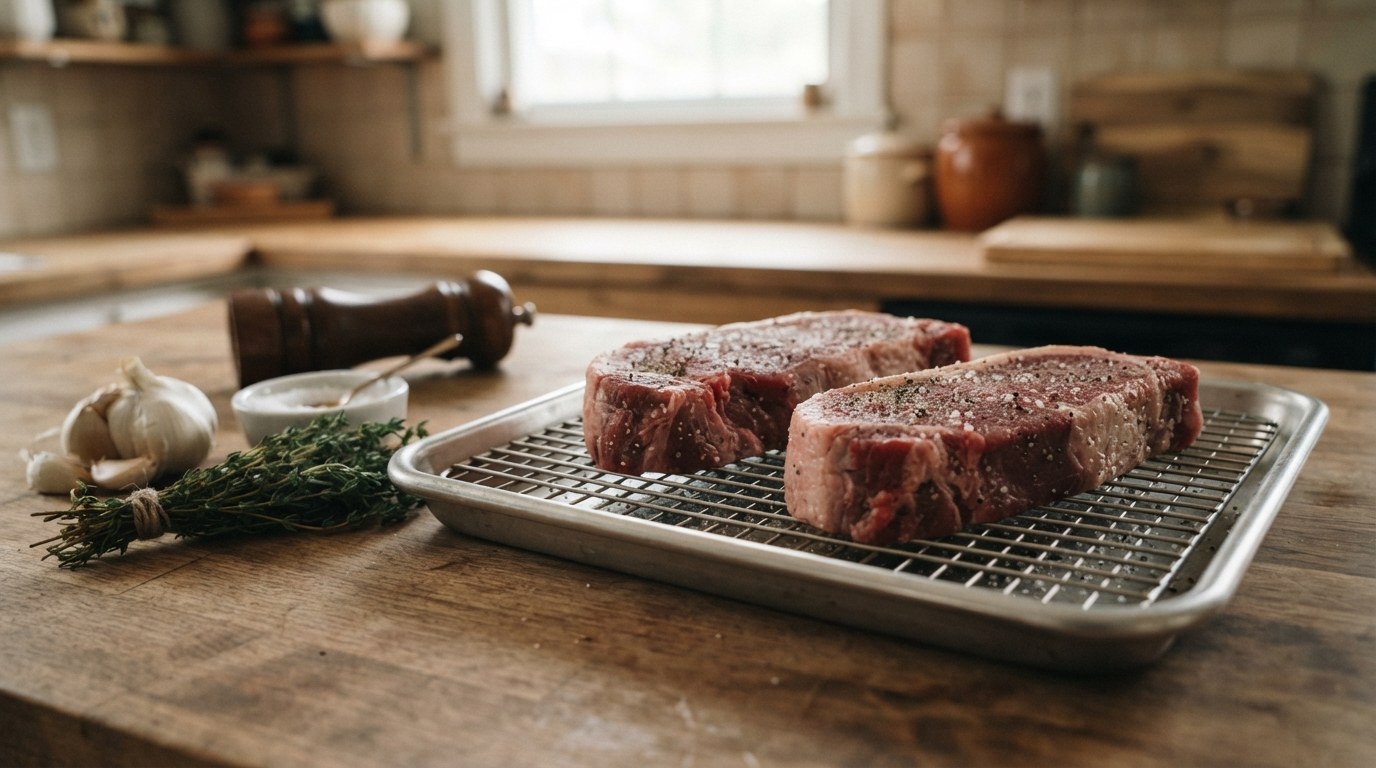
Take the steak out of the fridge while the pan heats, pat it completely dry, and season it heavily with salt and pepper on every side, either right before it goes in the pan or at least 45 minutes ahead. A dry surface matters far more for the crust than the temperature of the meat.
Letting the steak sit out is a fine habit, but it changes less than most people think. When Serious Eats measured a strip steak left on the counter, the center rose less than 2°F in 20 minutes and was still under 50°F after nearly two hours. The real enemy of a sear is surface water. Browning, the Maillard reaction, starts at about 284°F (140°C), and a wet surface can't climb past 212°F (100°C) until the water has boiled off, so a damp steak steams grey before it browns. A few paper towels do more for the crust than an hour on the counter.
Salt timing is the other half. Salt first draws moisture out to the surface, and America's Test Kitchen notes that around the 45-minute mark the brine starts moving back into the meat, seasoning it more deeply. Salt it 10 minutes ahead and the steak sits in its own puddle. So season just before cooking, or 45 minutes to a day ahead, uncovered on a rack in the fridge. Be generous, edges included. Ramsay makes the same point in his Beef Wellington lesson: once the meat is cooked, you can't get seasoning inside it.
Hot Pan, Then Oil: How Gordon Ramsay Sears a Steak
Heat a heavy skillet empty over high heat until it's very hot, then add a tablespoon of grapeseed oil, and lay the steak in only when the oil shimmers and gives off its first wisp of smoke. If the steak doesn't sizzle loudly the moment it lands, the pan wasn't ready; lift it out and wait.
In his MasterClass chicken lesson, Ramsay reaches for grapeseed oil for meat and poultry and keeps olive oil mostly for fish, because grapeseed has the higher smoke point. Heating the pan first means the oil isn't breaking down on the burner for minutes before the meat arrives. Lay the steak in away from you so any spatter goes the other way. Maillard browning runs about twice as fast at 302°F (150°C) as at 284°F, and its flavor peaks around 320°F (160°C), which is why a pan that hisses gives you a crust in minutes and a lukewarm one gives you grey meat.
Sear for flavor, not to lock in juices. Searing doesn't seal anything; in the Serious Eats comparison, a steak seared first ended up no juicier than one seared at the end. On a strip or ribeye, hold the steak on its fat edge with tongs for a minute so the fat renders and crisps instead of staying rubbery.
Turn the Steak Often, Not Once
Turn the steak about every minute instead of flipping it once. Frequent turning builds an even crust on both sides and cooks the center more evenly, with a thinner grey band under the crust.
Ramsay turns his steaks repeatedly in the pan, and the physics backs him up. Serious Eats found that flipping often cooks a steak up to 30% faster and more evenly, because neither side stays on the heat long enough to overcook underneath while the top cools off. Meat proteins denature and tighten between roughly 122°F and 140°F (50 and 60°C), so the goal is a gentle, even climb through that range in the center while the surface stays hot enough to keep browning.
For a 1 1/2-inch steak, that's about 6 to 8 minutes of searing and turning before the butter goes in. Use it as a guide, and let the thermometer make the call.
The Butter, Garlic and Thyme Baste
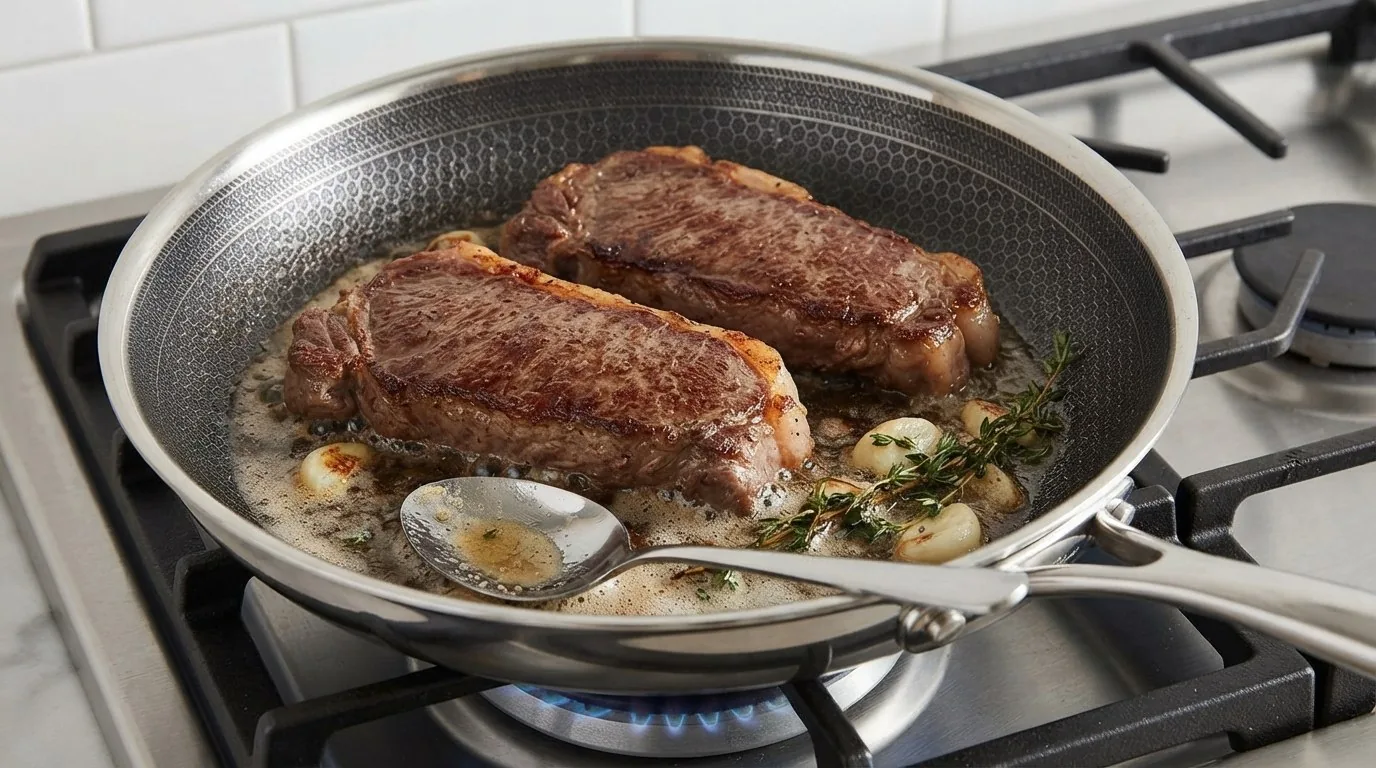
Once both sides are well browned, turn the heat down to medium, add a few tablespoons of butter, smashed garlic cloves and a small bunch of thyme, and when the butter foams and turns nut-brown, tilt the pan and spoon it over the steak for 1 to 2 minutes, turning once or twice.
That nut-brown stage is beurre noisette, and in his MasterClass pan lesson Ramsay bastes only once the butter reaches it, with whole smashed garlic cloves and a generous handful of thyme. The butter goes in late because its milk solids scorch at searing heat; burning sets in around 356°F (180°C), not far above the browning range. ATK holds its butter back until about 4 minutes into the sear for the same reason. Keep the garlic whole and smashed, so it perfumes the butter instead of blackening the way minced garlic would.
Basting won't add moisture to the meat, since the muscle is already full of water and being squeezed as it heats. What the hot butter does is cook the top of the steak while the bottom sears, brown any pale patches the pan missed, and leave you a garlic-thyme butter to pour over at the table.
Gordon Ramsay Steak Doneness Temperatures
For medium-rare, pull the steak off the heat at 125 to 130°F (52 to 54°C); it climbs about 5°F as it rests and finishes at 130 to 135°F. The USDA safe minimum for whole beef steaks is 145°F (63°C) with a 3-minute rest, which lands at medium on a steakhouse chart.
| Doneness | Pull it from the heat at | After resting | What the center looks like |
|---|---|---|---|
| Rare | 120°F (49°C) | 125°F (52°C) | Cool red center |
| Medium-rare | 125 to 130°F (52 to 54°C) | 130 to 135°F (54 to 57°C) | Warm red-pink center, the steakhouse default |
| Medium | 135 to 140°F (57 to 60°C) | 140 to 145°F (60 to 63°C) | Warm pink center, firmer bite |
| Medium-well | 145°F (63°C) | 150°F (66°C) | Slightly pink, noticeably drier |
| Well done | 155°F (68°C) | 160°F (71°C) | Little or no pink |
| USDA safe minimum (whole steaks) | 145°F (63°C) | Rest at least 3 minutes | Medium on this chart |
The finished temperatures follow Certified Angus Beef, which advises taking steaks off the heat 5°F below the doneness you want. ThermoWorks explains why: heat stored near the surface keeps moving toward the center after the pan, and a thick steak carries over more than a thin one. That carryover is also why a high-heat sear needs an earlier pull. The USDA Food Safety and Inspection Service sets 145°F plus a 3-minute rest as the safe minimum for whole cuts of beef, so cook to it for anyone pregnant, very young, older or immune-compromised. Past about 136°F (58°C), collagen in the meat contracts and squeezes out moisture, which is why medium-well eats so much drier than medium-rare.
A fast instant-read thermometer takes out the guesswork. Slide it in from the side into the thickest part, away from the fat edge, and check each steak on its own, since two steaks rarely finish together.
ThermoPro
ThermoPro TempSwift Instant-Read Digital Thermometer
- Reads in about 1 second, accurate to ±0.9°F, with a 4.3-inch food-grade stainless probe
- Hold and calibration functions, so you can lock a reading away from the heat
- NSF certified and IP65 waterproof, rinse it clean under the tap
When to Finish a Steak in the Oven
Finish a steak in the oven when it's thicker than about 1 1/2 inches, or whenever the crust is done but the center is still well below your pull temperature. Sear it in an ovenproof skillet, then slide the pan into a hot oven, around 400°F (200°C), and check the temperature every 2 to 3 minutes.
A thick steak in a pan has a steep temperature gradient: the outside races ahead while the middle lags. The oven's all-round heat lets the center catch up without scorching the crust, the same move the Gordon Ramsay filet mignon uses for a 2-inch tenderloin. Do the butter baste on the stove before it goes in, or spoon the pan butter over while it rests.
Resting and Slicing a Gordon Ramsay Steak
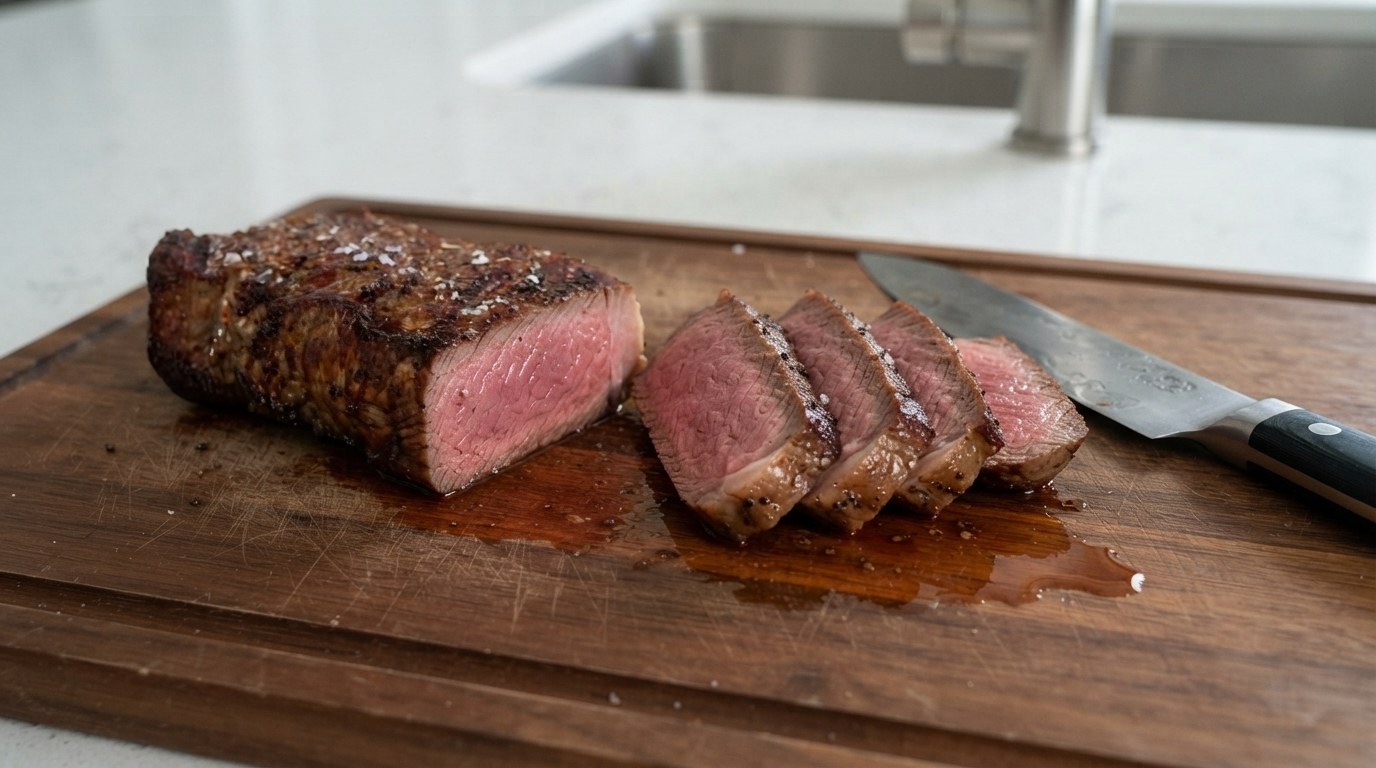
Rest the steak for 5 to 10 minutes on a board or warm plate, spoon the garlic-thyme butter over it, then slice it across the grain into thick slices and finish with a pinch of flaky salt.
Resting doesn't relax the muscle. What happens is that the juices thicken slightly as the meat cools a few degrees from the surface in, so less runs out when you cut. A steak sliced 2 minutes off the heat loses about 6% of its weight in juice, against about 2% after 10 minutes. Ramsay treats the rest as part of the cooking, the same way he rests chicken before carving. When you slice, look for the lines of muscle fiber and cut across them: short fibers are far easier to chew, and cutting across the grain takes about a tenth of the force of cutting along it.
What to Serve With Gordon Ramsay Steak
Serve it with a quick pan sauce made in the same skillet, creamy mashed potatoes and something green, such as wilted spinach or broccolini.
Don't wash the pan. Ramsay builds his sauces right where the meat cooked: pour off most of the fat, soften a sliced shallot with the roasted garlic from the baste, deglaze with a splash of brandy or red wine and let it bubble down, add a ladle of beef stock, reduce and season, then press the shallots and garlic through a sieve to thicken it. If you want something richer, try the green peppercorn sauce, Madeira sauce or béarnaise. On the side, Yukon Gold mashed potatoes and wilted sautéed spinach are the steakhouse pairing. Ramsay walks through the pan technique and the pan sauce himself in Gordon Ramsay Teaches Cooking on MasterClass.
That's the whole Gordon Ramsay steak recipe: a dry, well-salted steak, a hot pan, frequent turns, a nut-brown butter baste, a thermometer and a proper rest. After the second time, it's a weeknight dinner. For more, browse our recipes or read up on the cookware Gordon Ramsay uses.
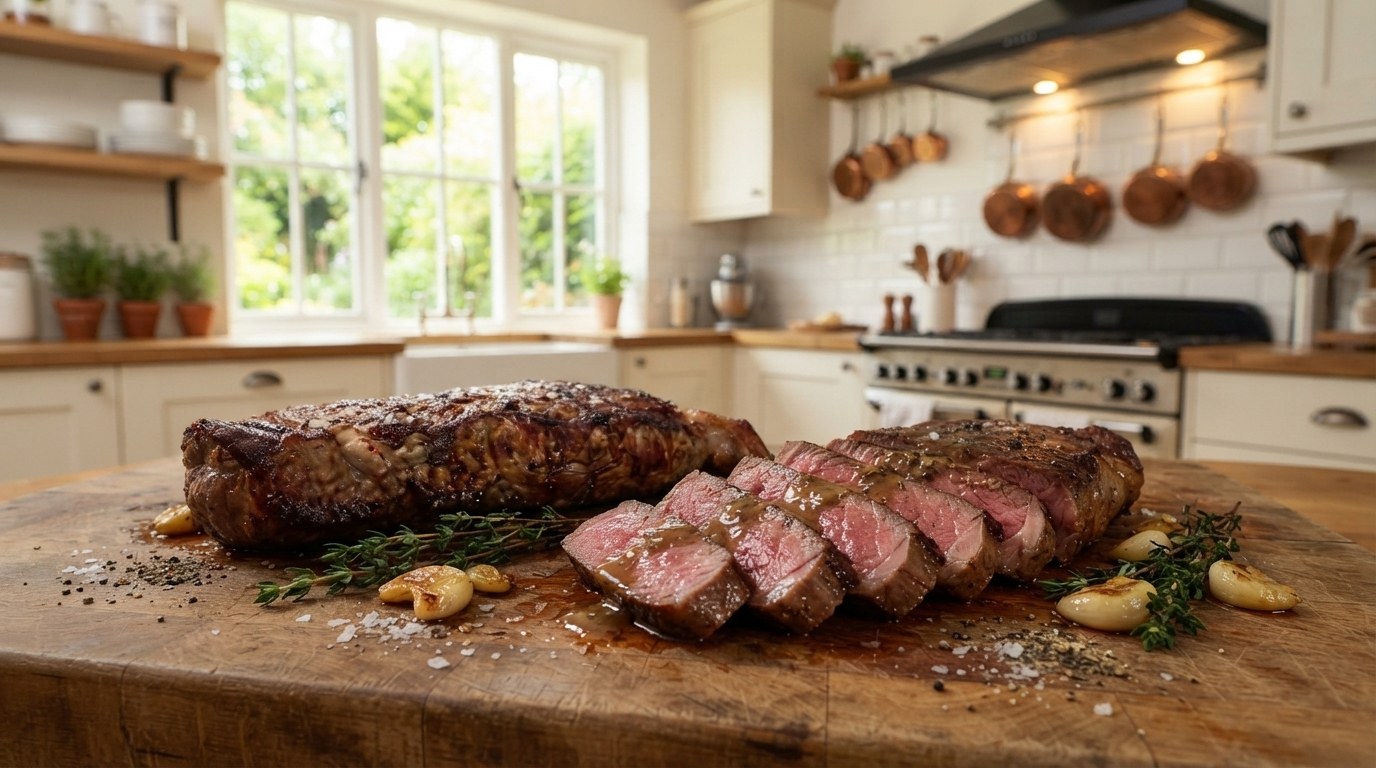
Gordon Ramsay Steak (Pan-Seared and Butter-Basted)
Ingredients
- 2 boneless strip (sirloin) or ribeye steaks, about 1 1/2 inches thick (10 to 12 oz each)
- 1 1/2 tsp kosher or coarse sea salt, plus flaky salt to finish
- 1 tsp freshly cracked black pepper
- 1 tbsp grapeseed oil
- 3 tbsp unsalted butter
- 4 garlic cloves, smashed, skin on
- 5 sprigs fresh thyme
Instructions
- Take the steaks out of the fridge and pat them completely dry with paper towels.
- Season heavily on every side, edges included, with the salt and pepper just before cooking (or 45 minutes to a day ahead, uncovered on a rack in the fridge).
- Heat a heavy skillet over high heat until very hot, then add the grapeseed oil. When it shimmers and starts to smoke, lay the steaks in, away from you. They should sizzle loudly.
- Sear for 1 minute, turn, and keep turning about every minute until both sides are deep brown, about 6 to 8 minutes for 1 1/2-inch steaks. Hold each steak on its fat edge for a minute to render the fat.
- Turn the heat to medium and add the butter, garlic and thyme. When the butter foams and turns nut-brown, tilt the pan and spoon it over the steaks for 1 to 2 minutes, turning them once or twice.
- Check with an instant-read thermometer in the thickest part: pull at 125 to 130°F for medium-rare, or cook to 145°F for the USDA safe minimum. If the crust is done before the center, finish the pan in a 400°F oven.
- Rest the steaks on a board for 5 to 10 minutes, spooning the garlic-thyme butter over them.
- Slice across the grain, sprinkle with flaky salt and serve with the pan butter.
Notes
Gordon Ramsay Steak FAQs
The questions that come up most: how Gordon Ramsay cooks his steak, what oil he uses, whether he adds butter, how long it takes, the medium-rare temperature, whether steak needs to come to room temperature, and flipping once or often.
How does Gordon Ramsay cook his steak?
In a very hot heavy pan: he seasons the steak generously with salt and pepper, heats the pan before adding grapeseed oil, turns the steak often, bastes it with foaming butter, smashed garlic and thyme, rests it and slices it across the grain. Thick steaks finish in the oven.
What oil does Gordon Ramsay use to cook steak?
Grapeseed oil. In his MasterClass he uses grapeseed for meat and poultry because of its high smoke point, and saves olive oil mostly for fish. Any neutral high-smoke-point oil works the same way.
Does Gordon Ramsay put butter on his steak?
Yes, near the end. Once the steak has a crust he adds butter, garlic and thyme and spoons the nut-brown butter over it for a minute or two. Added at the start, the butter would burn at searing heat.
How long does Gordon Ramsay cook a steak?
For a 1 1/2-inch strip or ribeye, about 6 to 8 minutes of searing and turning, 1 to 2 minutes of basting, then a 5 to 10 minute rest. Go by the thermometer: pull at 125 to 130°F for medium-rare.
What temperature should steak be for medium-rare?
Pull it at 125 to 130°F; it rises about 5°F while resting to finish at 130 to 135°F. The USDA safe minimum for whole beef steaks is 145°F with a 3-minute rest.
Should steak come to room temperature before cooking?
It helps less than you would expect. Serious Eats measured a steak rising under 2°F in 20 minutes on the counter. Drying the surface and salting at the right time matter far more for the crust.
Should you flip a steak once or many times?
Many times. Turning it about every minute cooks it up to 30% faster and more evenly, with a thinner grey band under the crust, and it is how Ramsay does it.

About the Author
John Siracusa is the founder of Hell’s Kitchen Recipes. He focuses on technique-first, reproducible home cooking and researches recipes & kitchen equipment from published food science and professional chef methods since 2016.