Gordon Ramsay banana bread, the one recipe Ramsay has actually published under his name, comes from the Gordon Ramsay Academy, his cookery school, and it is a richer loaf than the American standard: butter creamed with caster and light brown sugar, two eggs, self-raising flour with extra baking powder, chopped pecans and dark chocolate chips, three very ripe bananas with two mashed into the batter and the third split lengthwise and pressed into the top, a sprinkle of brown sugar, 50 minutes in a moderate oven and a brush of maple syrup while it is still hot. The Academy calls the result "a moist cake," which is honest; banana bread is a cake that borrows a loaf tin. The banana bread that made Ramsay swear on television is a different thing, a Maui farmstand loaf, and it gets its own section below.
The guide covers why the bananas have to be spotted, what creaming does, why the batter is folded and not beaten, how the leavening and the oven work, when the loaf is done, the glaze and cooling, and the Hawaiian loaf from the show. It sits in the site's baking and desserts section with the other Ramsay bakes, the blondies, the chocolate chip cookies and the banoffee pie.
The Bananas: Why Spotted Ones Make Better Bread
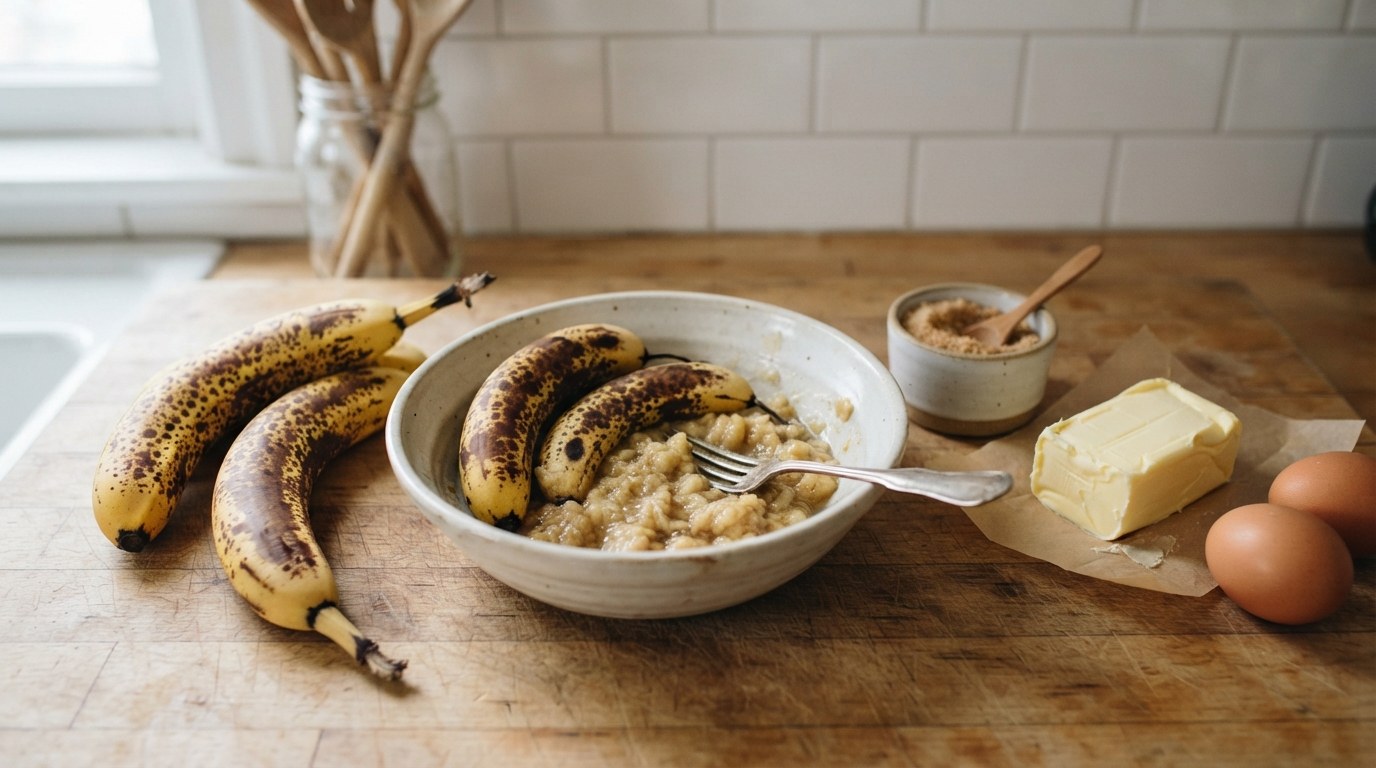
The Academy specifies "very ripe" bananas, and the brown spots are not cosmetic; they mark a chemical change that decides how the loaf tastes. A banana is picked green and starchy, and ripening is a burst of ethylene, the fruit's own hormone, that switches its enzymes to breaking that starch into sugar. A review of the process in Frontiers in Plant Science puts numbers on it: the pulp is 12 to 35 percent starch at harvest and falls to under 1 percent by late ripening, while soluble sugars, mostly sucrose, climb to as much as a fifth of the fruit's fresh weight. So a yellow banana with green shoulders is still largely starch, bakes into a dry, faintly chalky crumb and needs more sugar in the recipe; a heavily freckled or blackening one is sugar and water, mashes to a purée, and gives the loaf its sweetness, its moisture and most of its banana flavor. Two spotted bananas mashed with a fork and a third for the top is the whole fruit content, and there is no reason to add more.
Under-ripe bananas can be hurried: shut in a paper bag with an apple for two or three days, the trapped ethylene does the work. Overripe ones can be frozen whole in their skins and thawed for baking, which if anything improves them, since freezing breaks the cell walls and the thawed fruit is wetter and sweeter. The banana pressed onto the top of the loaf is the exception to "very ripe": pick the firmest of the three, or it slumps into the batter instead of caramelizing on it.
| Ingredient | What it does | Do not substitute with |
|---|---|---|
| Very ripe bananas, 3 (2 mashed, 1 halved for the top) | Sweetness, moisture and the flavor; starch already turned to sugar | Yellow-green bananas (dry, starchy loaf) |
| Unsalted butter, 140 g (10 tbsp), softened | Creamed with the sugars to trap the air the leavening expands | Melted butter or oil (no creaming, denser loaf) |
| Caster sugar 75 g and light brown sugar 75 g | Sharp crystals cut air into the butter; brown sugar adds moisture and toffee | All white sugar (drier, paler) |
| Eggs, 2, at room temperature | Structure and an emulsion that holds the fat and water together | Cold eggs (the batter splits) |
| Self-raising flour 140 g plus 1 tsp baking powder | Structure and a double lift, in the bowl and in the oven | Bread flour (too much gluten) |
| Pecans 75 g and dark chocolate chips 75 g | Crunch and bitterness against a sweet crumb | Milk chocolate (too sweet with the bananas) |
| Maple syrup, 1 to 2 tbsp | The glaze, brushed on hot so it soaks the crust | Pancake syrup (corn syrup and flavoring) |
Creaming, the Eggs, and Why the Flour Is Folded
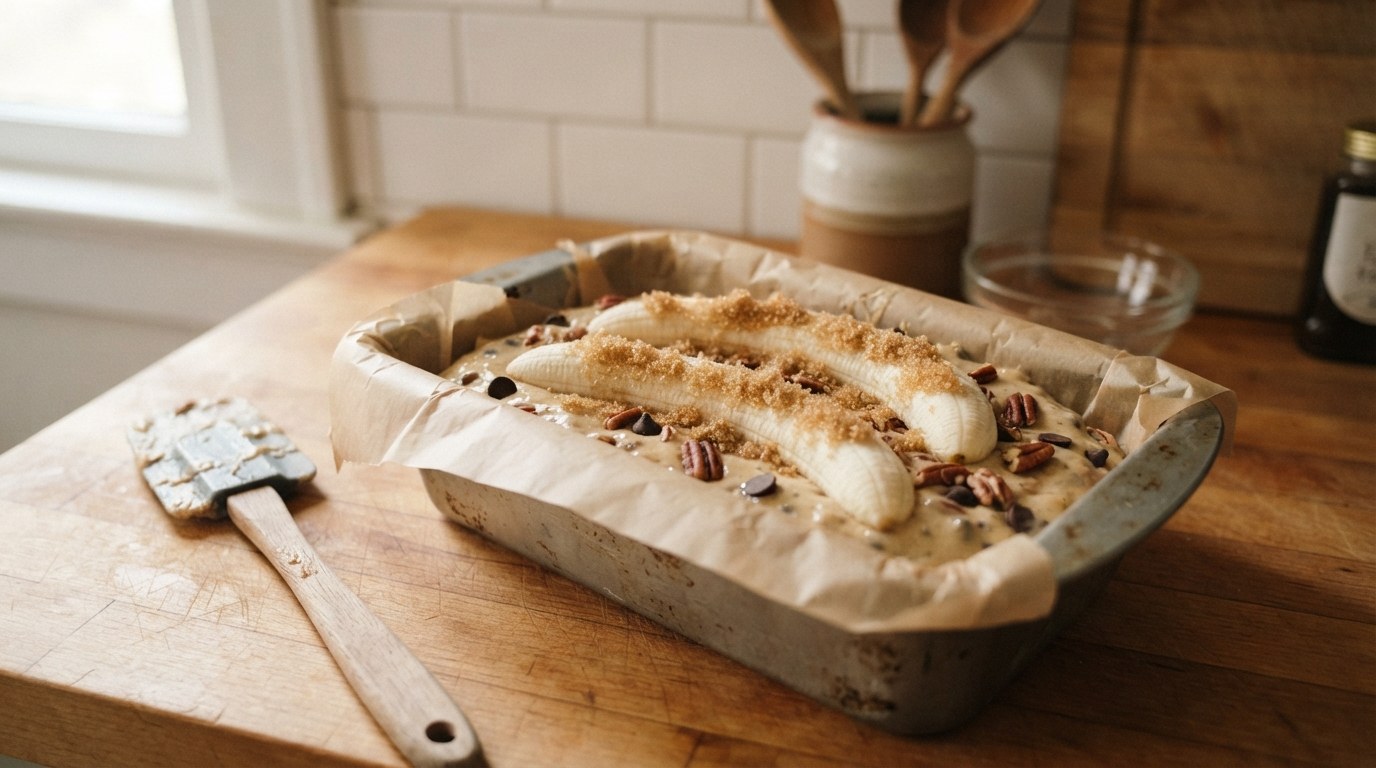
The Academy method starts by whisking the softened butter with both sugars until "light and fluffy," and that step is the loaf's first leavening. Creaming is mechanical: the sharp edges of the sugar crystals cut thousands of tiny air pockets into the plastic fat, and those pockets are the only bubbles the batter will ever have. Chemical leavening does not create new bubbles; it inflates the ones already there. Butter creams best between about 65 and 68°F, cool enough to hold its shape and soft enough to take a fingerprint; butter that has melted at the edges cannot hold air, which is why a banana bread made with melted butter, the American shortcut, is denser and closer to a true quick bread than to the Academy's cake.
The eggs go in one at a time, beaten well after each, and the Academy adds a practical note: if the mixture starts to split, add a spoonful of the flour. Splitting is the emulsion failing. Creamed butter is fat with air in it, an egg is mostly water, and the yolk's lecithin can only hold so much water in the fat at once; cold eggs or eggs added all together overwhelm it and the batter curdles. A spoon of flour absorbs the loose water and the starch stabilizes the mix. Then the flour, baking powder, salt, pecans, chocolate and mashed banana are folded in, and "folded" is the operative word. Flour makes gluten the moment it is wet and worked, and Utah State University Extension gives the quick-bread rule: overmixing develops the gluten and the bread turns tough and chewy, so mix only until the ingredients are combined and stop, lumps and all. A few streaks of flour are fine; a smooth, glossy batter has been beaten too long.
Leavening and the Oven: Two Lifts and a Caramelized Top
The loaf rises twice, and the recipe is built so both lifts happen. Self-raising flour already carries baking powder, and the Academy adds another teaspoon; baking powder is baking soda packaged with dry acids, and Kansas State University's extension explains the double action: one acid reacts with the soda as soon as the batter is wet, producing carbon dioxide in the bowl, and the second reacts only above about 170°F in the oven, producing the rest. That is why the batter goes into the tin and the tin into the oven without delay, before the first reaction is spent, and why the loaf still rises at the end. The mashed banana is acidic enough to help the first reaction along.
The oven is 180°C, which is 350°F, or 160°C in a fan oven, for 50 minutes in a 900-gram loaf tin, the British two-pound tin that matches a 9-by-5-inch American pan. The banana halves pressed cut side up into the top, with the teaspoon of brown sugar over them, are the reason the Academy loaf looks the way it does: on the dry surface of the loaf the banana's sugars caramelize from about 320°F and the Maillard reaction between its sugars and amino acids browns it from about 284°F, so the halves come out mahogany and jammy while the crumb underneath stays moist. Slide a skewer into the crumb between the banana halves to test; the Academy's cue is a golden top and a skewer that comes out clean, and King Arthur Baking adds the more reliable one, a thermometer reading of 200 to 205°F at the center, because a skewer that hits a pocket of banana or melted chocolate reads wet on a loaf that is done. A loaf pulled under 200°F is the gummy-centered banana bread everyone has made once.
| Stage | Number | What you see |
|---|---|---|
| Cream butter and sugars | 3 to 4 minutes, butter at 65 to 68°F | Pale, fluffy, almost white |
| Eggs | One at a time; a spoon of flour if it splits | Smooth, not curdled |
| Fold in the rest | Until just combined | A few streaks of flour left |
| Bake | 350°F (180°C / 160°C fan), 50 minutes | Golden top, banana halves caramelized |
| Test | Skewer clean; 200 to 205°F at the center | No wet batter, no gummy band |
| Glaze and cool | Maple syrup on the hot loaf; 10 to 20 minutes in the tin | Glossy top, loaf firm enough to lift |
The Maple Glaze, Cooling, and Keeping the Loaf
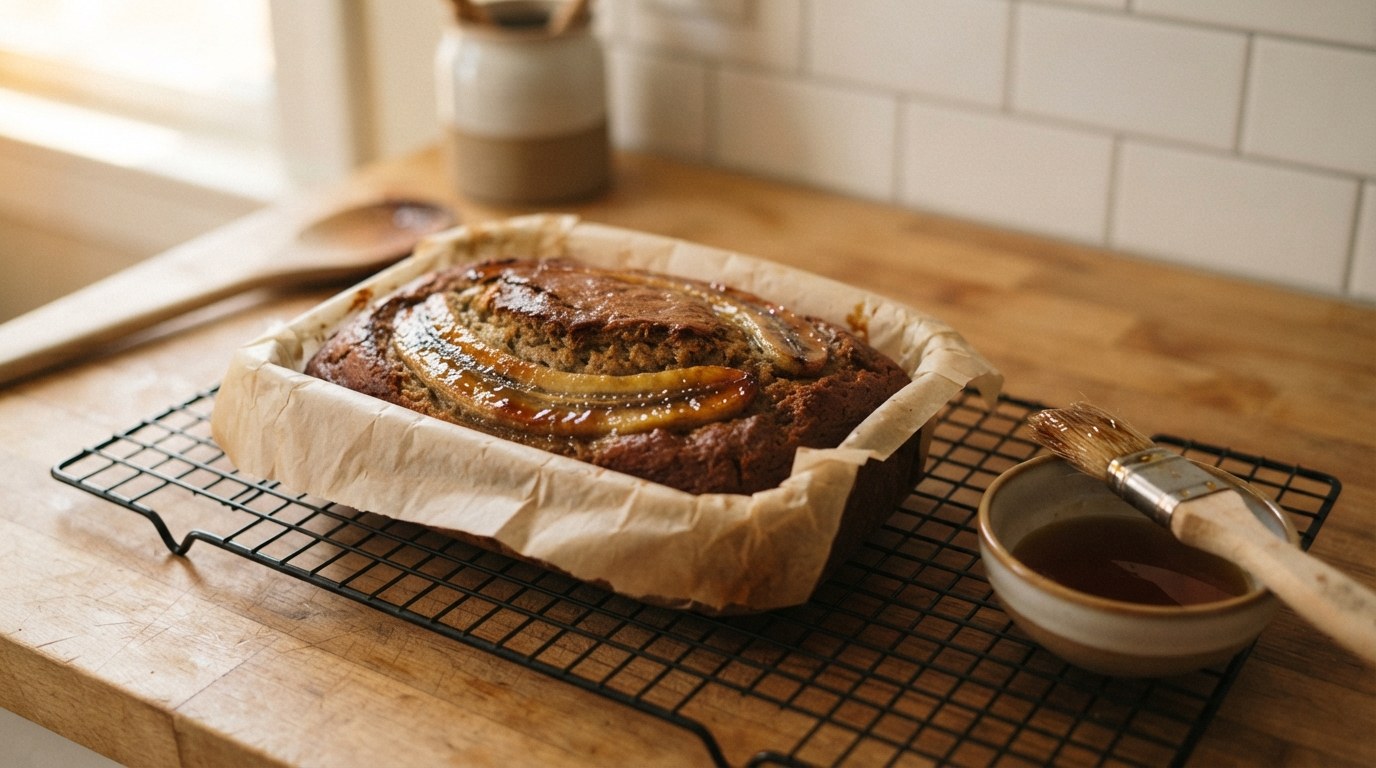
The maple syrup is brushed on the moment the loaf leaves the oven, while the crust is hot and porous, so it soaks in rather than sitting on top as a sticky skin; a tablespoon is enough for a sheen, two for a proper glaze. Then the loaf stays in its tin for 10 to 20 minutes before it is turned out, and that wait is structural. The crumb is held together by starch that gelatinized in the oven and egg proteins that set, and both are still soft at 200°F; the starch firms as it cools, and a loaf lifted out at once can crack or sag in the middle. Cutting it hot squashes the crumb into a gummy layer under the knife, so it cools completely on a rack before slicing, which the Academy states and every baker ignores at least once.
Kept wrapped at room temperature the loaf is at its best for two days and fine for four; the bananas and brown sugar keep it moist longer than a plain cake. Do not refrigerate it. Cold speeds up retrogradation, the recrystallizing of starch that stales bread and cake, so a refrigerated loaf goes dry and firm faster than one on the counter. Freeze it instead, whole or in slices, wrapped tightly, for up to three months, and thaw at room temperature or toast slices from frozen. The blondies on this site follow the same storage rules for the same reason.
The Hawaiian Banana Bread That Made Ramsay Swear
The other Gordon Ramsay banana bread is not a recipe but a roadside stand. In the first season of National Geographic's Gordon Ramsay: Uncharted, which premiered in 2019, Ramsay stopped at Aunty Sandy's Banana Bread in Keʻanae on Maui's Road to Hāna, and Hawaii Magazine reports his verdict: banana bread that makes you curse, it is that good. Sandy Hueu began baking in 1983, her daughter Tammy opened the farmstand in 2003, and the loaf is made from a family recipe with locally grown apple bananas, a small, tangy variety that is sweeter and denser than the Cavendish sold on the mainland; the magazine describes the bread as fluffy and cake-like, and the recipe has never been published.
The Academy loaf is not that bread, and the two make different things well. Aunty Sandy's is a plain, tender loaf that lets the apple bananas carry it; the Academy's is a loaded one with pecans, dark chocolate and a caramelized top. To lean the Academy recipe toward Hawaii, leave out the chocolate, use apple bananas if a market has them, swap the pecans for macadamia nuts and add a handful of shredded coconut. To lean it toward American banana nut bread, drop the chocolate and use walnuts. The method does not change either way, and neither does the rule about the bananas.

Gordon Ramsay Banana Bread (Academy Recipe)
Ingredients
- 140 g unsalted butter (10 tbsp), softened, plus extra for the tin
- 75 g caster or granulated sugar (⅓ cup plus 1 tbsp)
- 75 g light brown sugar (⅓ cup packed plus 1 tbsp), plus 1 tsp for the top
- 2 eggs, at room temperature
- 140 g self-raising flour (1 cup plus 2 tbsp), or all-purpose flour plus 1¾ tsp baking powder
- 1 tsp baking powder
- 1 pinch sea salt
- 75 g pecans (¾ cup), roughly chopped
- 75 g dark chocolate chips (½ cup)
- 3 very ripe bananas: 2 mashed, 1 halved lengthwise for the top
- 1-2 tbsp maple syrup, to glaze
Instructions
- Heat the oven to 350°F (180°C, or 160°C fan). Butter a 900 g (2-lb, about 9x5-inch) loaf tin and line it with baking parchment.
- In a large bowl, whisk the softened butter with the caster sugar and the 75 g of light brown sugar until light and fluffy, 3 to 4 minutes with an electric mixer.
- Add the eggs one at a time, beating well after each. If the mixture starts to split, beat in a spoonful of the flour.
- Add the flour, baking powder, salt, pecans, chocolate chips and the 2 mashed bananas and fold together with a spatula until just combined, with no dry flour left but no more mixing than that.
- Scrape the batter into the tin and smooth the top. Press the two banana halves cut side up lengthwise into the surface and sprinkle the teaspoon of brown sugar over them.
- Bake for 50 minutes, until the top is golden, a skewer pushed into the crumb between the banana halves comes out clean, and a thermometer reads 200 to 205°F at the center. Tent with foil for the last 10 minutes if the top is browning too fast.
- Brush the hot loaf with the maple syrup. Leave it in the tin for 10 to 20 minutes, then lift it out onto a wire rack and cool completely before slicing.
Notes
Gordon Ramsay Banana Bread FAQs
The questions that come up most: what is in Gordon Ramsay's banana bread, how ripe the bananas should be, how to make it with all-purpose flour, whether the nuts and chocolate can be left out, why banana bread comes out dense or gummy, how to tell when it is done, how to store and freeze it, and which Hawaiian banana bread Ramsay ate on Uncharted.
What is in Gordon Ramsay's banana bread?
The Gordon Ramsay Academy recipe: 140 g softened butter creamed with 75 g caster sugar and 75 g light brown sugar, 2 eggs, 140 g self-raising flour with 1 teaspoon baking powder and a pinch of salt, 75 g chopped pecans, 75 g dark chocolate chips, 3 very ripe bananas (2 mashed in, 1 halved on top), a teaspoon of brown sugar over the top and 1 to 2 tablespoons of maple syrup brushed on after baking. It bakes 50 minutes at 180°C (350°F) in a 900 g loaf tin.
How ripe should bananas be for banana bread?
Heavily brown-spotted or blackening, soft enough to mash with a fork. Ripening converts the fruit's starch to sugar, from as much as a third of the pulp down to under 1 percent, so a spotted banana is sweeter, wetter and more banana-flavored than a yellow one and a green-shouldered banana bakes into a dry, starchy loaf. Keep the firmest of the three for the halves on top so they caramelize instead of collapsing.
Can I make Gordon Ramsay's banana bread with all-purpose flour?
Yes. Replace the 140 g self-raising flour with 140 g (1 cup plus 2 tablespoons) all-purpose flour plus 1¾ teaspoons of baking powder, and keep the extra teaspoon of baking powder the recipe already calls for. Do not use bread flour; its higher protein makes more gluten and a tougher loaf.
Can I leave out the pecans and chocolate chips?
Yes, the loaf works as a plain banana bread. Leave them both out for a plain loaf, keep the pecans and drop the chocolate for a classic banana nut bread, or swap the pecans for walnuts or macadamia nuts. Do not replace them with more banana; the extra moisture makes the center gummy.
Why is my banana bread dense or gummy in the middle?
Three usual causes. The butter was melted or too warm to cream, so the batter never trapped air. The batter was overmixed after the flour went in, developing gluten. Or the loaf came out early: a skewer that hits banana or chocolate reads wet on a done loaf and dry on a raw one, so trust a thermometer reading of 200 to 205°F at the center. Cutting the loaf hot also compresses the crumb into a gummy band.
How do I know when banana bread is done?
The Academy cue is a golden top and a skewer from the center that comes out clean, at about 50 minutes. The reliable cue is temperature: 200 to 205°F at the center of the loaf, with no part of the crumb under 200°F. If the top is browning before the center is done, tent it loosely with foil for the last 10 to 15 minutes.
How should I store banana bread, and can I freeze it?
Wrapped at room temperature for up to four days, best in the first two. Do not refrigerate it; cold speeds up starch retrogradation and the loaf goes dry and firm. Freeze it whole or in slices, tightly wrapped, for up to three months, and thaw at room temperature or toast slices from frozen.
What is the Hawaiian banana bread Gordon Ramsay ate on Uncharted?
Aunty Sandy's Banana Bread, a farmstand in Keʻanae on Maui's Road to Hāna, which Ramsay visited in the first season of Gordon Ramsay: Uncharted in 2019 and declared good enough to make you curse. It is a plain loaf made from a family recipe with locally grown apple bananas, and the recipe has not been published; the Academy recipe on this page is the only banana bread Ramsay has put his name to.

About the Author
John Siracusa is the founder of Hell’s Kitchen Recipes. He focuses on technique-first, reproducible home cooking and researches recipes & kitchen equipment from published food science and professional chef methods since 2016.