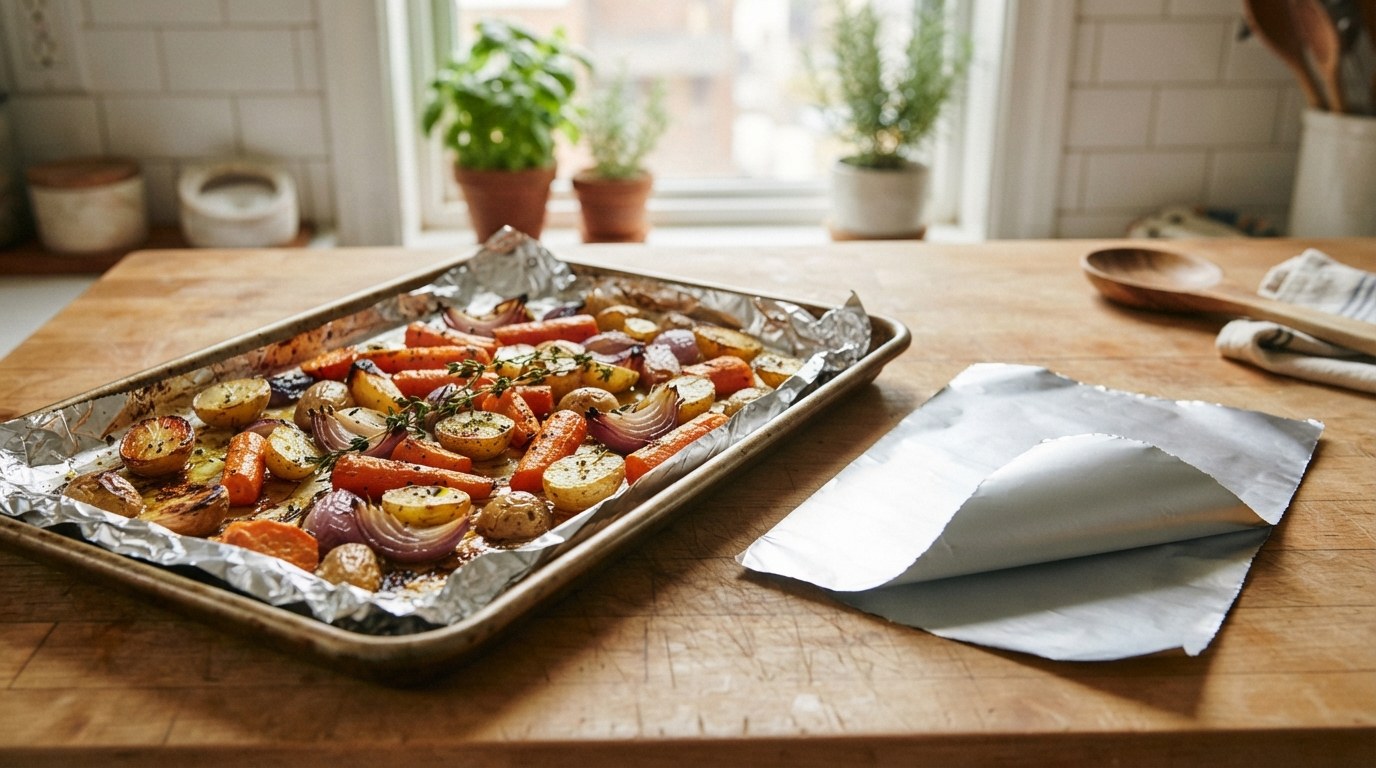
Aluminum foil shiny side up or down? For regular and heavy-duty foil it makes no difference which side faces the food. The shiny side and the dull side come from the last pass through the rolling mill, and both reflect heat at almost exactly the same rate, so your roast, your baked potato and your sheet-pan vegetables cook the same either way. The one exception is non-stick foil: its coating is on the dull side, and that side goes toward the food.
So the side is a non-question most nights. What does change dinner is how you use the foil: covering versus leaving food open, tenting a roast loosely versus wrapping it tight, and knowing where foil doesn't belong at all, like the bottom of most air fryer baskets and the inside of a microwave. This guide covers all of that, plus why Gordon Ramsay keeps his foil shiny side up, what salty and acidic foods do to foil, and when parchment is the better sheet. It sits with the rest of the site's cooking techniques.
Why Aluminum Foil Has a Shiny Side and a Dull Side
Aluminum foil has a shiny side and a dull side because of how the thinnest foil is made. In the final rolling step, two sheets of foil go through the mill together, pressed against each other. The side that touches the mill's polished steel rollers comes out bright, and the side that was pressed against the other sheet of foil comes out matte. The USDA Food Safety and Inspection Service describes exactly that process and says it makes no difference which side of the foil touches the food.
In other words, the two finishes are a side effect of rolling foil that thin, and neither side is coated or treated differently on a standard roll. Both faces are the same bare aluminum. The matte face just has a slightly rougher surface, which scatters light instead of mirroring it back, and that is all you are seeing when you tear off a sheet.
Does the Shiny Side Reflect More Heat?
The shiny side doesn't reflect enough extra heat to change how anything cooks. Reynolds, which makes Reynolds Wrap, says in its aluminum foil guide that both sides reflect heat and heat food at virtually identical rates, and that everyday, heavy-duty and recycled foil can go either way up. Bare aluminum is a strong reflector of radiant heat on both faces; a matte finish scatters that heat in more directions but doesn't soak up much more of it.
It helps to remember how an oven heats food. Some heat comes from hot air moving over the surface, which is convection. Some comes through direct contact with the pan, which is conduction. The rest radiates off the hot walls and elements. Foil only changes that last share, and both sides handle it about the same, so flipping the sheet doesn't move your cooking time.
Whether you cover the food at all matters far more. Under a sheet of foil, the water leaving the food turns to steam and stays trapped, and a wet surface can't climb past 212°F, the boiling point of water. Browning, the Maillard reaction, only gets going once a dry surface passes about 284°F. That gap is the whole story: food under foil stays pale and soft, food uncovered browns. It's why a baked potato wrapped in foil, shiny side in or out, comes out with a soft, steamed skin, and why you skip the foil if you want a crisp, salty jacket.
Gordon Ramsay's Shiny-Side-Up Habit
Gordon Ramsay keeps his foil shiny side up. In the root-vegetable part of his MasterClass cooking course, he lays herbs and vegetables in a tray, covers it with foil, and tells viewers to use foil shiny side up with the dull side in, because he believes the dull side holds in heat better. That is where this page's old title came from, and it's a common kitchen habit.
The foil maker and the USDA both say the side makes no real difference, so follow the habit if you like it, but don't worry if you get it backwards. The useful part of what he's doing there is covering the tray at all. Root vegetables that start under foil steam in their own moisture, and in the 110°F to 150°F range an enzyme firms up the pectin in their cell walls, so the pieces hold their shape instead of going mushy. Take the foil off for the last stretch and the surfaces dry, pass 284°F and brown. Cover first, uncover to finish: that sequence is worth copying, whichever side is facing up.
Non-Stick Foil: Which Side Faces the Food
On non-stick foil, the dull side is the non-stick side, and it goes toward the food. This is the one time the aluminum foil shiny side up or down question has a real answer. Reynolds puts its food-safe non-stick coating on the dull side of its Non-Stick Foil and Grill Foil, prints "NON-STICK Side" on that face of the Non-Stick roll, and rates Non-Stick Foil for use from -40°F to 650°F, according to the same Reynolds guide.
Face the food toward the shiny side of non-stick foil and you've lined the pan with plain aluminum, and melted cheese or a sugary glaze will weld itself on just as it would to regular foil. Sugar is the usual culprit: a brown-sugar barbecue sauce caramelizes from around 320°F and turns into glue as it cools. Save non-stick foil for exactly those jobs, sheet-pan nachos, sticky wings, glazed salmon, and use regular foil for the rest.
Foil on the Grill and in Packets
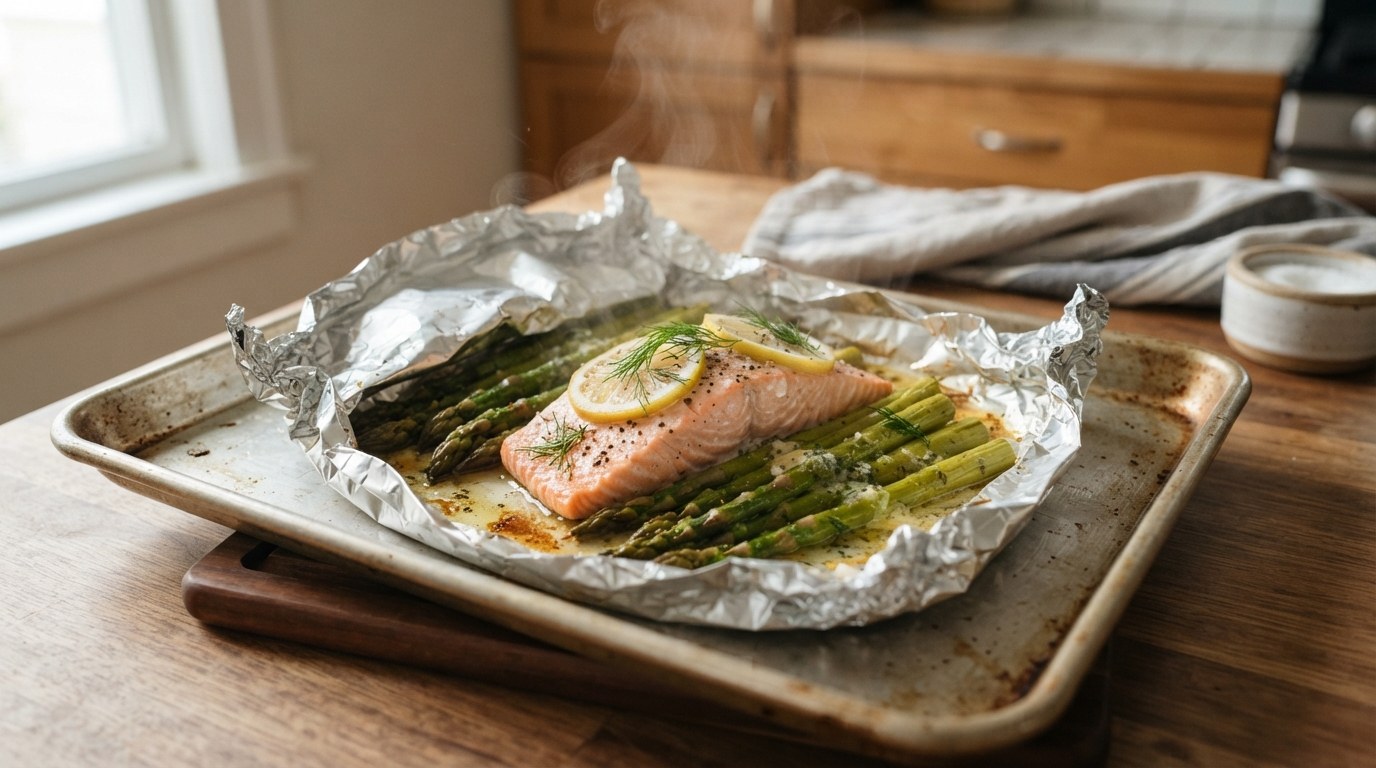
For the grill, reach for heavy-duty foil, and either side can face the food. It's thicker, so it survives grill grates and the weight of a rack of ribs. Reynolds advises poking holes throughout the foil when you use it to line grill grates or a broiler pan, so hot air can still move up through the grates.
Foil packets are a different animal. A sealed packet of fish, vegetables and a little butter is a small steamer, and the food inside cooks in its own vapor, near 212°F, which is gentle on delicate fish and never browns. That's also the thinking behind wrapping ribs partway through a long cook: the wrap traps moisture and speeds things through the stall, at the cost of a softer bark. The guide to grilling ribs walks through when to wrap and when to leave them bare.
Tenting Meat with Foil to Rest
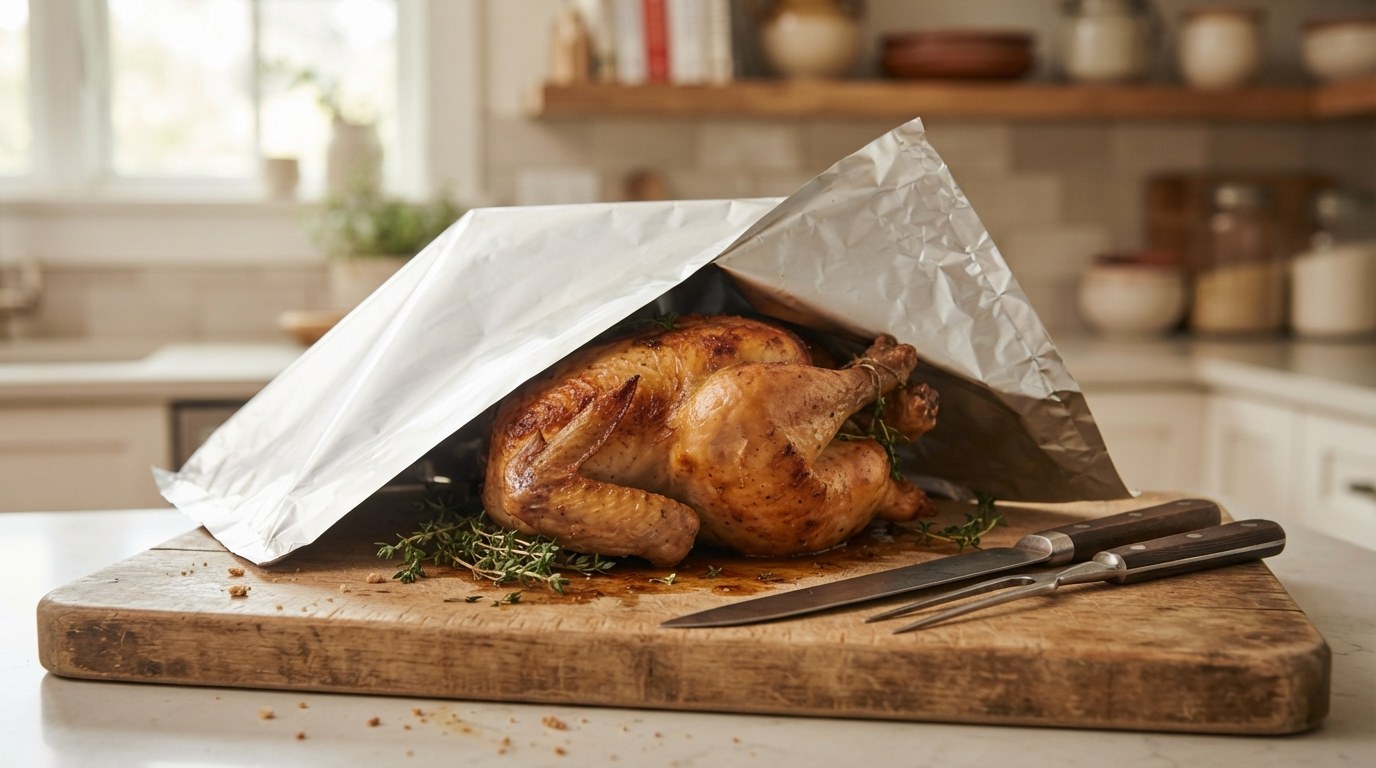
Tent a roast loosely with foil while it rests; don't wrap it. A loose tent, folded into a peak and open at the ends, slows the heat loss while steam can still escape. ThermoWorks describes a foil tent the same way, conserving some heat while letting enough air move to avoid steaming the surface, and suggests extra care for anything with a crisp exterior. Press the foil tight against a turkey and the trapped steam will soften the skin you spent hours crisping.
The rest matters because of what happens to the juices as the meat cools a little: they thicken, so less runs out when you slice. A steak cut after 2 minutes loses about 6 percent of its weight onto the board; after 10 minutes, about 2 percent. Resting doesn't "relax" the muscle, whatever you've heard; it just gives the juices time to set up. The heat already inside keeps moving to the center while it rests, too, which is carryover cooking, and ThermoWorks notes that the bigger the roast, the more its core temperature climbs. A whole bird or a big rib roast can rise several degrees under the tent.
That's why the thermometer, rather than the foil, decides when a roast is done. Pull a big roast a few degrees shy of your target and let the rest finish it, but make sure poultry still ends up at the USDA's 165°F minimum, measured in the thickest part of the breast and thigh. The Gordon Ramsay turkey recipe times the rest for a whole bird, and the oven thermometer guide covers the other gauge worth owning.

ThermoPro
ThermoPro TempSwift Instant-Read Digital Thermometer
- Reads in about 1 second, accurate to ±0.9°F, with a 4.3-inch food-grade stainless probe
- Hold and calibration functions, so you can lock a reading away from the heat
- NSF certified and IP65 waterproof, rinse it clean under the tap
Can You Put Aluminum Foil in an Air Fryer?
You can put aluminum foil in some air fryers, but only if your model's manual allows it, only under food that weighs it down, and never covering the whole bottom of the basket. Brands differ here, so the manual wins. Philips, for one, advises against foil and baking paper in its Airfryers: covering the bottom of the basket cuts the airflow and hurts the cooking, and a loose sheet with no food on it can get sucked up into the heating element and burn.
The airflow point is the science of the machine. An air fryer is a small, fast convection oven, and it browns food by blowing hot air across every surface so the moisture evaporates and the outside can climb past 284°F. Seal the underside of the food against a sheet of foil and that side sits in its own juices at 212°F or below, and it comes out soft. If you want easier cleanup, a perforated liner or a small piece of foil that stops short of the basket edges keeps most of the air moving. Which side faces up doesn't matter here either. If you're shopping, the portable glass air fryers roundup covers models whose baskets clean up without liners.
Aluminum Foil in the Microwave
Leave aluminum foil out of the microwave unless your oven's manual says otherwise. The FDA explains that microwaves are reflected by metal, so metal pans or aluminum foil generally shouldn't go in, because the reflected energy makes food cook unevenly and can damage the oven. The FDA also points to the instructions that come with each microwave as the final word on which containers are safe.
Foil also defeats the point of microwaving. Microwaves heat food by getting absorbed into it, reaching only about an inch below the surface, and the rest of the heat spreads by conduction. Anything under foil gets shielded, so a covered patch stays cold while the uncovered edges overcook. Cover microwaved food with a microwave-safe lid, a plate or a damp paper towel instead.
Acidic and Salty Foods on Aluminum Foil
Acidic and salty foods can react with aluminum foil, leaving tiny pinholes in the foil and sometimes a grayish or bluish residue on the food, and that residue is harmless. The USDA fact sheet cited above says these reactions happen when salt, vinegar, highly acidic or highly spicy foods touch foil, and that the deposit is an aluminum salt that poses no safety problem if eaten. Tomato sauce under a foil-covered lasagna is the classic case.
On the broader health question, the CDC's toxic substances agency (ATSDR) says very little aluminum enters the body from aluminum cooking utensils. If the pinholes bother you, the fix is simple: lay a sheet of parchment over the sauce before the foil goes on for baking, and store leftover lasagna or chili under a lid or plastic wrap instead of foil, so the acid and the metal aren't sitting together for days in the fridge. A squeeze of lemon inside a foil packet for a 15-minute bake is fine.
Aluminum Foil vs Parchment Paper
Use aluminum foil when you need to cover, wrap, shape or go above parchment's heat limit, and use parchment when you need food to release cleanly or you're baking something sticky, acidic or delicate. Foil holds any shape you crimp it into and handles the grill and the broiler. Reynolds rates its parchment paper oven-safe up to 425°F, so it's the wrong sheet under a broiler or on a hot grill, but it's the better one for cookies, roasted fish and anything with a sugary glaze. The table sorts out the common kitchen jobs, and which side matters for each.
| Job | Best sheet | Which side faces the food | Why |
|---|---|---|---|
| Covering roast vegetables or a casserole | Regular foil | Either side | Traps steam so food cooks through; uncover at the end to brown |
| Tenting a roast or turkey to rest | Regular or heavy-duty foil, loose | Either side | Slows heat loss while steam escapes, so the skin stays crisp |
| Lining a sheet pan for roasting | Regular foil or parchment | Either side (regular foil) | Easier cleanup; parchment releases better |
| Cheese, sticky glazes, BBQ sauce | Non-stick foil | Dull side toward the food | The non-stick coating is on the dull side only |
| Grill grates and broiler pans | Heavy-duty foil, poked with holes | Either side | Thicker, resists tearing; holes keep the airflow |
| Fish or vegetable packets | Heavy-duty foil or parchment | Either side | Sealed steam cooks gently near 212°F |
| Cookies and delicate baking | Parchment | Either side | Clean release; oven-safe to 425°F |
| Air fryer | Only if the manual allows; a liner is safer | Either side | Covering the basket blocks the hot air that browns food |
| Microwave | Neither; use a lid or paper towel | Not applicable | Metal reflects microwaves and can damage the oven |
| Storing tomato-based leftovers | Lid or plastic wrap | Not applicable | Acid pits foil over time |
The pattern in the table is that the side of the foil only shows up once, on the non-stick row. Every other decision comes down to which sheet you pick and whether the food should steam or brown. So the next time you tear off a sheet and wonder about aluminum foil shiny side up or down, put it down whichever way it lands, and spend the thought on whether to cover the dish at all.
Aluminum Foil Shiny Side FAQs
The questions that come up most: whether it matters which side of aluminum foil you use, which side of foil is non-stick, shiny side up or down for baking, which side keeps heat in, and whether foil is safe in the air fryer, the microwave and with acidic foods.
Does it matter which side of aluminum foil you use?
Not for regular or heavy-duty foil. The shiny and dull sides come from the final rolling step, where two sheets pass through the mill together and only the side touching the polished rollers comes out shiny. The USDA says it makes no difference which side touches the food, and Reynolds says both sides reflect heat at virtually identical rates. The only exception is non-stick foil.
Which side of foil is non-stick?
The dull side. On Reynolds Non-Stick Foil and Grill Foil the food-safe non-stick coating is on the dull side, and the Non-Stick roll is printed with "NON-STICK Side" on that face. Place the food against the dull side; if you use the shiny side you get no non-stick benefit.
Should aluminum foil go shiny side up or down when baking?
Either way. For regular foil, the side makes no measurable difference to baking or roasting times. What changes the result is whether the food is covered: covered food steams and stays pale because a wet surface stays at or below 212°F, while uncovered food dries and browns once the surface passes about 284°F.
Which side of aluminum foil keeps heat in?
Neither side meaningfully. Both faces are bare aluminum and reflect heat almost equally. Foil keeps food warm mainly by trapping a layer of warm air and steam around it, so a loose tent over a resting roast works the same whichever side faces out. Wrap tightly only if you do not mind a softer crust.
Can you put aluminum foil in an air fryer?
Only if your model's manual allows it, only under food heavy enough to hold it down, and never covering the whole basket bottom. Philips advises against foil in its Airfryers because it blocks the airflow, and a loose sheet can be pulled into the heating element and burn. A perforated liner is the safer choice for cleanup.
Can you put aluminum foil in the microwave?
Generally no. The FDA says metal pans and aluminum foil should generally not be used in a microwave oven because metal reflects microwaves, which cooks food unevenly and can damage the oven. Follow your microwave's instructions and cover food with a microwave-safe lid or a damp paper towel instead.
Is it safe to cook acidic foods in aluminum foil?
Yes, for normal cooking. Salty or acidic foods like tomato sauce can pit the foil and leave a grayish residue, which the USDA describes as a harmless aluminum salt, and the CDC's ATSDR says very little aluminum enters the body from aluminum cookware. To avoid the pitting, put parchment between the sauce and the foil, and store acidic leftovers under a lid or plastic wrap.

About the Author
John Siracusa is the founder of Hell’s Kitchen Recipes. He focuses on technique-first, reproducible home cooking and researches recipes & kitchen equipment from published food science and professional chef methods since 2016.