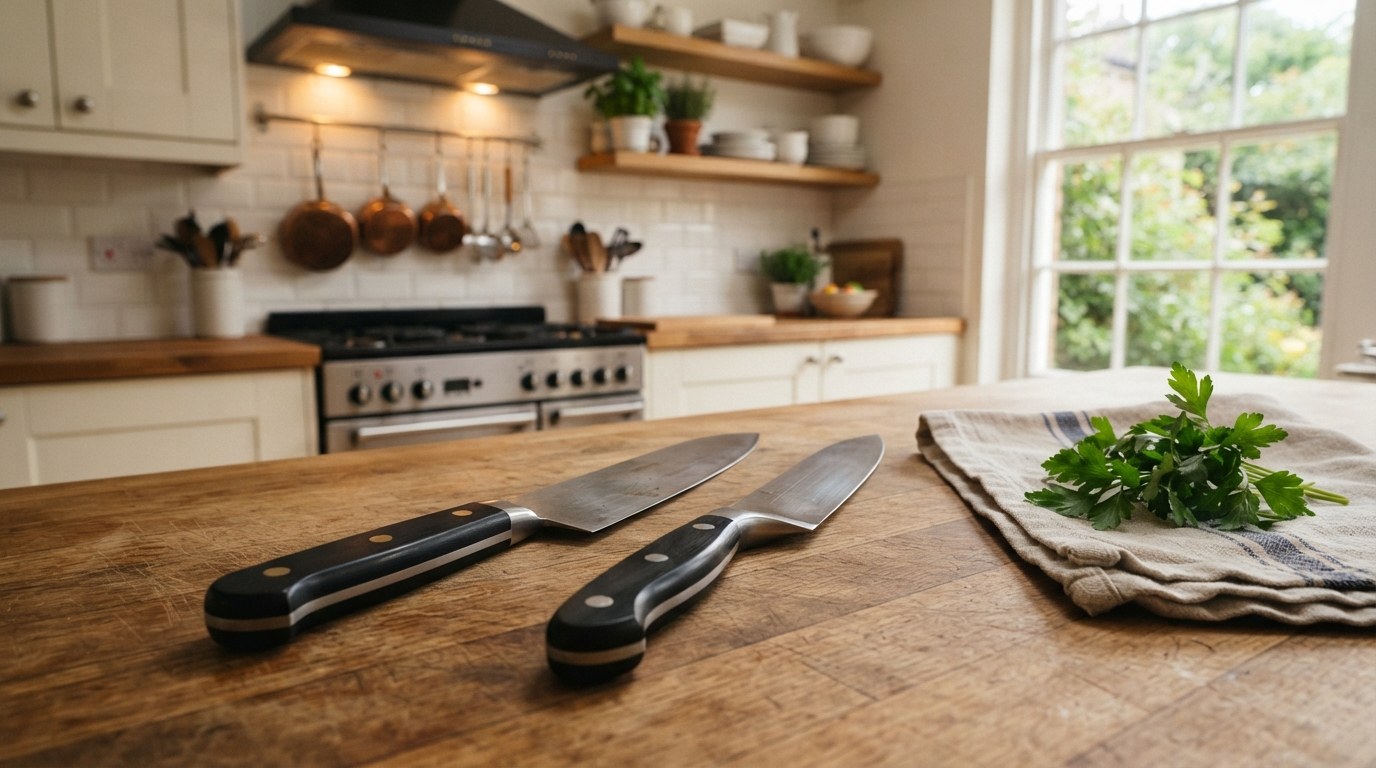
Wüsthof vs Zwilling is a choice between two Solingen-forged German knives that are closer in steel than they are in feel. Wüsthof grinds its Classic to 14 degrees a side on X50CrMoV15 steel hardened to about 58 on the Rockwell scale, with a heavy full bolster and a straight triple-riveted handle. Zwilling ice-hardens its FRIODUR blades to about 57, grinds the Pro to a slightly wider edge, and gives it a curved bolster and a contoured handle you can pinch-grip. In independent tests the Wüsthof cuts a little more easily and the Zwilling is a little more comfortable, and the honest verdict is the one this guide lands on: the Wüsthof Classic for a traditional, heavier knife that stays sharp longest; the Zwilling Pro for a lighter, more ergonomic one; the Wüsthof Classic Ikon if you want Wüsthof steel with Zwilling-style ergonomics.
This guide compares the two brands where the decision actually gets made: the flagship 8-inch chef's knives, the steel and edge numbers behind them, the bolster and handle differences you can feel, the premium Ikon-vs-Pro question, the block sets, and where Zwilling's cheaper Henckels brand fits. Five in-stock picks are carded along the way. It is part of the site's kitchen gear guides; the sibling pages cover Wüsthof Classic vs Henckels Pro, which Wüsthof Classic set and the best Zwilling knives line by line.
Wüsthof vs Zwilling at a Glance
| Spec | Wüsthof Classic | Zwilling Pro |
|---|---|---|
| Founded | 1814, Solingen | 1731, Solingen |
| Steel | X50CrMoV15 high-carbon stainless | Zwilling special-formula stainless, FRIODUR ice-hardened |
| Hardness (maker's figure) | About 58 HRC | About 57 HRC |
| Factory edge | 14° per side (PEtec, computer-controlled) | V-edge, slightly wider than Wüsthof's |
| Construction | Precision-forged from one block, full tang, triple rivet | SIGMAFORGE, forged from one piece, exposed tang |
| Bolster | Full, spine to edge | Curved half bolster; the whole edge can be sharpened |
| Handle | Straight, synthetic, three rivets | Contoured, rounded, encourages a pinch grip |
| Feel | Heavier, traditional, keeps a keen edge longest | Lighter in the hand, more comfortable over a long prep |
| Best for | The one-knife buy; cooks who want the classic German feel | Smaller hands, long prep sessions, matched sets |
Wüsthof Classic vs Zwilling Pro Chef's Knife: Head to Head
For most people asking "Wüsthof or Zwilling," the choice is between these two 8-inch chef's knives, and two independent tests point the same way. Food & Wine tested both and needed more force on the Zwilling when coring a tomato and slicing an onion, while the Wüsthof glided through, and still called the verdict a hard one because of how comfortable the Zwilling's curved bolster and finished spine felt. Reviewed weighed the Wüsthof at about 9 ounces with a straight bolster that gives a solid grip and heft for hard ingredients, and singled out the Zwilling's curved bolster for letting you pinch the blade between thumb and forefinger for more control while chopping.
That is the whole comparison in miniature. The Wüsthof is the sharper, heavier, more traditional knife; the Zwilling is the lighter, more ergonomic one. Neither is a bad first knife, and both are forged in Solingen from steel in the same hardness band. If you have never held either, go by your hands: a large hand and a preference for a knife that does the work with its weight points to Wüsthof, a smaller hand or a long nightly prep points to Zwilling.
Wüsthof
WÜSTHOF Classic 8-Inch Chef's Knife
- Precision-forged from a single block of high-carbon stainless steel; full tang, triple-riveted handle
- Full bolster and finger guard; 8-inch blade, 5-inch handle, about 8.5 oz in the hand
- Made in Solingen, Germany; the Classic has been Wüsthof's best-selling line for generations
ZWILLING
ZWILLING Pro Le Blanc 8-Inch Chef's Knife
- The Pro line's curved bolster and contoured handle in the white Le Blanc finish; same blade as the black Pro
- FRIODUR ice-hardened, forged from a single piece of special-formula steel
- Made in Germany; V-edge, gently curved belly for rocking cuts
Steel, Hardness and the Edge: 58 vs 57, 14° vs the Pro
Both companies publish their numbers. Wüsthof's FAQ names its steel as X50CrMoV15, says every forged knife gets its Precision Edge Technology edge, a computer-controlled grind, and gives the standard blade angle as 14 degrees per side (10 for its santokus and nakiris); its Classic listings put the hardness at 58 Rockwell. Zwilling describes its Pro chef's knife as fully forged from a single piece of special-formula high-carbon stainless steel, ice-hardened by its FRIODUR process so the blade is "harder, sharper, and holds its edge longer," with a V-edge, and its listings put FRIODUR blades at 57 Rockwell. One point of hardness and a degree or so of edge angle is the entire difference in the steel, and it is why the Wüsthof feels a shade keener out of the box.
What the numbers mean in use: hardness is resistance to the edge deforming, so a harder blade holds a thin edge longer, while a softer one rolls sooner but bends rather than chips. Both brands sit in the German middle of the range; Cutlery and More puts kitchen knives between 52 and 66 HRC and Japanese knives above 60, and notes German steel needs sharpening more often but is more forgiving of twisting and abuse. Ice-hardening is a cryogenic step after heat treatment; deep-freezing the steel completes the change to its hard crystal structure, which is what lets Zwilling claim a harder, more corrosion-resistant blade from a similar alloy. A steel realigns the rolled edge of either knife in ten strokes; a stone every few months restores it. The edge angle matters when you sharpen: set a guided sharpener to 14 for the Wüsthof and 15 for the Zwilling, or you will grind a new bevel rather than refresh the old one.
Bolster and Handle: The Difference You Can Feel
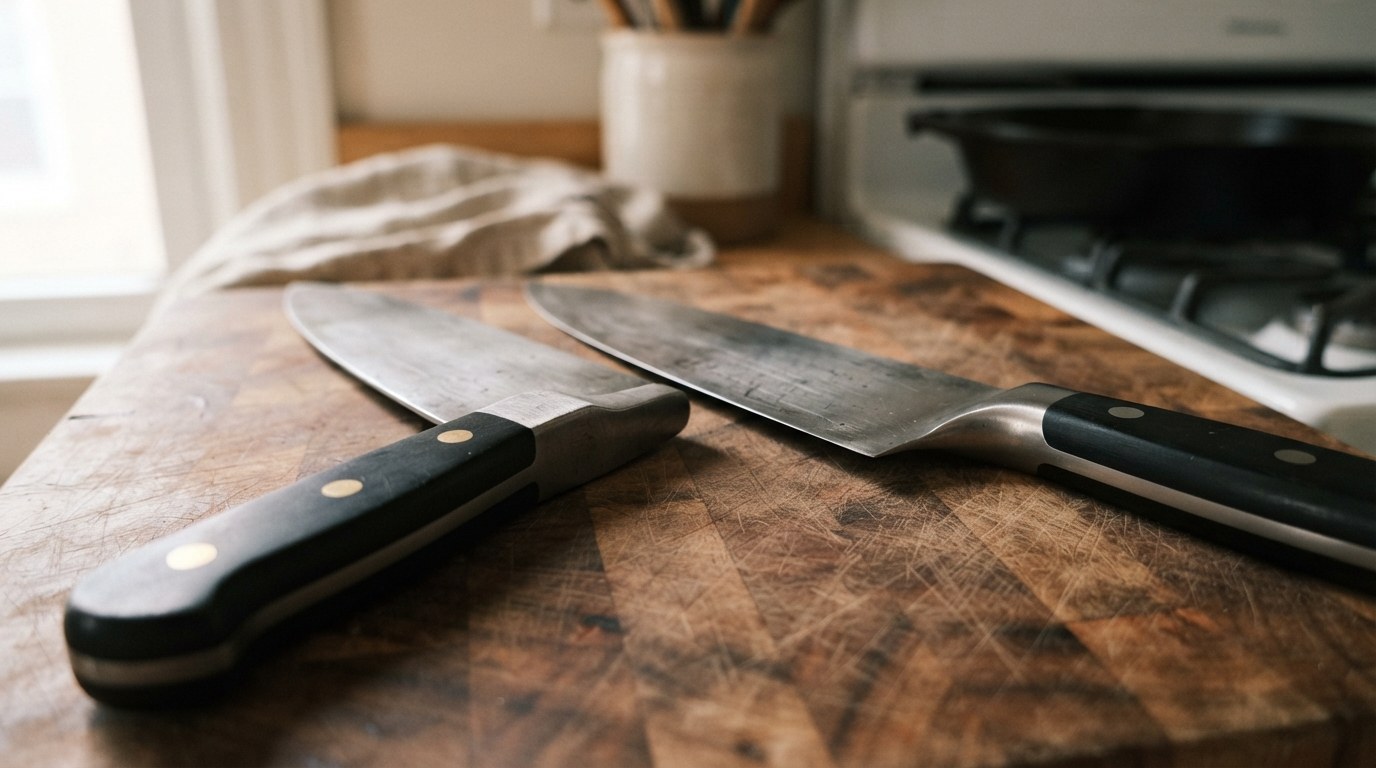
The bolster is the thick collar of steel where a forged blade meets its handle, and the two brands treat it differently. Wüsthof's Classic has a full bolster that runs from spine to edge: it adds weight behind the heel, keeps fingers off the blade and gives the knife its forward-leaning, chopping feel. It also means the last half inch of edge at the heel cannot be sharpened on a stone without eventually grinding the bolster back, which is the one long-term complaint about full-bolster knives. Zwilling's Pro bolster is curved and stops short of the edge, so the whole edge sharpens evenly and your thumb and forefinger sit naturally on the blade in a pinch grip.
Handles follow the same split. The Wüsthof Classic handle is straight, synthetic and triple-riveted, the same shape it has had for decades; it fills a large hand and reads as the classic German chef's knife. The Zwilling Pro handle is contoured, rounder and narrower at the front, which is what testers mean by comfortable over a long session. Mass is the physics behind both: a full bolster and a straight handle put the balance point forward, so the knife falls through food; a half bolster and a curved handle move it back toward the hand, so the knife feels lighter and turns faster. Neither is right; one of them is right for you.
Wüsthof Classic Ikon vs Zwilling Pro: The Premium Question
Once a buyer decides the Classic's straight handle is not for them, the comparison becomes Wüsthof Classic Ikon vs Zwilling Pro, and it is a much closer call. The Ikon is Wüsthof's ergonomic line: the same forged X50CrMoV15 blade, PEtec edge and 58 HRC, with a contoured handle and a double bolster, a finger guard at the heel plus a small bolster at the butt for balance, that leaves the entire cutting edge free to sharpen. That removes the two objections people have to the Classic and keeps the Wüsthof edge.
Against the Pro, the differences come down to hand feel and money. The Ikon handle is firmer and more angular; the Pro handle is softer-edged and rounder. The Ikon is the heavier of the two and the Pro the lighter. Both are premium Solingen forgings that will outlast the cook, so this is a buy-what-fits-your-hand decision, and the safe way to make it is to hold both at a kitchen store before ordering. If you cannot, the Ikon is the pick for someone who liked the Wüsthof edge in the head-to-head above but wanted the Zwilling comfort, and the Pro for someone who liked the Zwilling and wants the lighter knife.
Wüsthof
WÜSTHOF Classic Ikon 8-Inch Chef's Knife
- The Classic's forged blade with a contoured handle and a double bolster that leaves the whole edge free to sharpen
- Full tang; the same X50CrMoV15 steel and PEtec edge as the Classic
- The Wüsthof answer to the Zwilling Pro's ergonomics
Wüsthof vs Zwilling Knife Sets
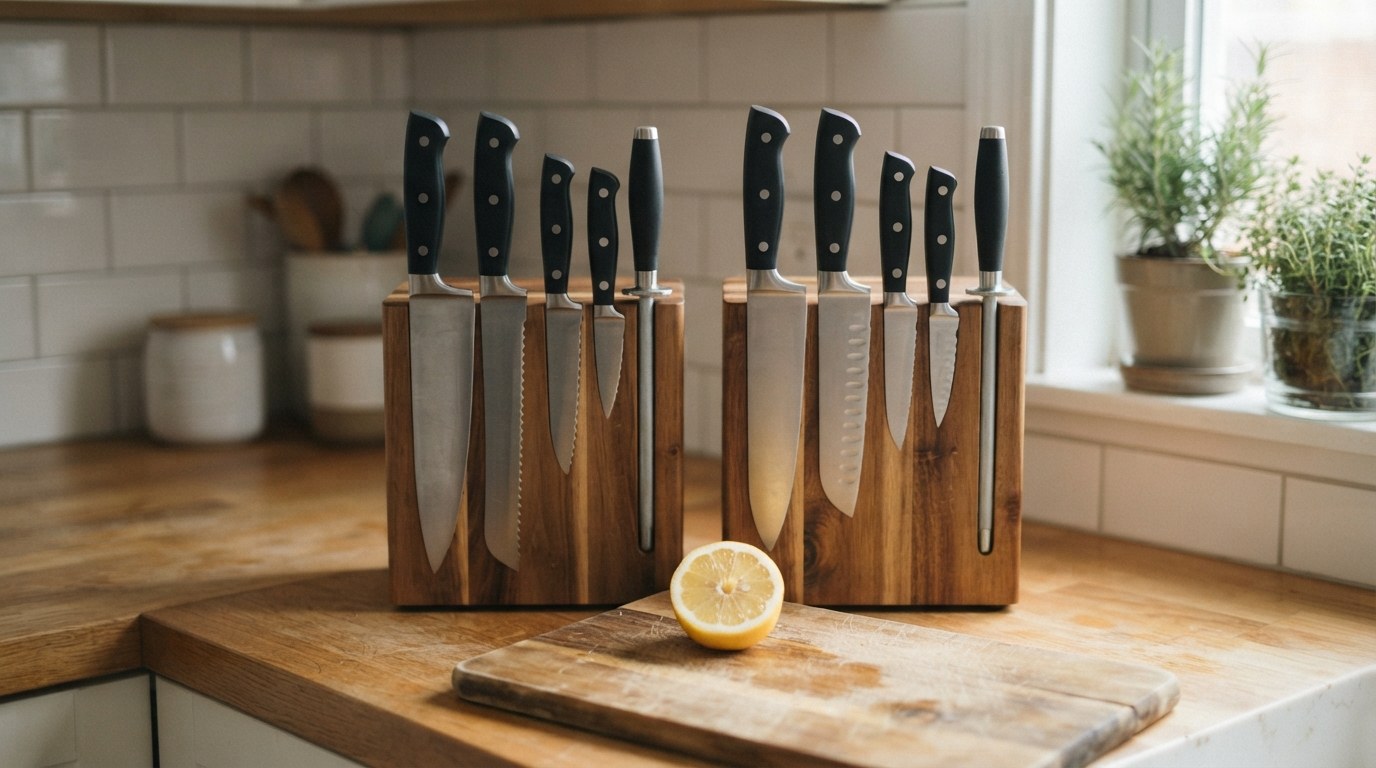
The set decision changes the picture, because the two brands compose their blocks differently. Wüsthof's Classic 9-piece acacia block is the standard home setup: a 3.5-inch paring, 4.5-inch utility, 5-inch serrated utility, 6-inch kiritsuke prep knife, 8-inch bread, 8-inch chef's, a 9-inch honing steel, come-apart shears and a 17-slot block, every blade forged with the same 58 HRC steel and PEtec edge as the single chef's knife. It covers everything a home cook does and leaves eight slots for a santoku or steak knives later. Zwilling's Pro and Professional S blocks tend to run larger, with a santoku, a boning knife and matched steak knives in the 16-piece, which is the more complete purchase if you want every knife at once; both of the Pro S blocks were out of stock or on backorder when this guide was updated, so check the best Zwilling knives guide for the current sets.
The honest rule for either brand is to buy the set only if you will use the pieces. Ramsay's working kit is four knives, a chef's, a bread knife, a flexible boning knife and a paring knife, and a block that adds ten more you never pick up is money that should have gone into a better chef's knife. The Wüsthof Classic set comparison walks the 5-, 7-, 9-, 10- and 15-piece options; the best kitchen knife sets guide compares across brands.
Wüsthof
Wüsthof Classic 9-Piece Knife Block Set (Acacia)
- 3.5" paring, 4.5" utility, 5" serrated utility, 6" kiritsuke prep, 8" bread, 8" chef's, 9" honing steel, come-apart shears, 17-slot acacia block
- Fully forged, full-tang high-carbon stainless with bolster; 58 Rockwell hardness
- PEtec edge on every forged blade
Wüsthof vs Henckels vs Zwilling: Where Henckels Fits
Zwilling J.A. Henckels sells two brands, which is where the confusion starts. ZWILLING is the premium, Solingen-forged, ice-hardened line this guide has compared to Wüsthof. HENCKELS, sold in older packaging as J.A. Henckels International, is the company's value brand: German-designed, made mostly outside Germany, and priced well under the Zwilling lines. The Henckels International Classic 8-inch chef's knife is forged, full-tang, with a full bolster and a triple-riveted handle, a real German-pattern knife at an entry price; what you give up against a Wüsthof Classic or a Zwilling Pro is the Solingen forging, the ice-hardening and the edge life that comes with them.
So "Wüsthof or Henckels" is a budget question, not a quality tie. If the money is there, Wüsthof Classic or Zwilling Pro; if it is not, Henckels Classic gets a new cook most of the way for a fraction, and Zwilling J.A. Henckels is the brand Hell's Kitchen contestants are given (see Hell's Kitchen knives). The Wüsthof Classic vs Henckels Pro guide takes that pair apart in detail, and best Henckels knife sets covers the blocks. For which of all of these Gordon Ramsay actually uses, see Gordon Ramsay knives.
HENCKELS
J.A. Henckels International Classic 8-Inch Hollow Edge Chef's Knife
- Forged full-tang blade of high-carbon, no-stain steel with a full bolster
- Triple-riveted Classic handle; hollow-edge dimples reduce sticking on wet slices
- Zwilling's value-tier brand: the German design at an entry price
How to Choose Between Wüsthof and Zwilling
Three questions settle it. First, how does the handle feel: straight and substantial (Wüsthof Classic) or contoured and light (Zwilling Pro), with the Wüsthof Ikon as the middle path. Second, how will you sharpen: if you plan to keep a stone and sharpen the full edge for years, the half-bolster Zwilling Pro or Wüsthof Ikon avoids the heel problem of a full bolster; if you will hone on a steel and send the knife out once a year, the Classic's full bolster never becomes an issue. Third, single knife or set: a single 8-inch chef's knife from either brand plus a paring knife is the better buy for most kitchens, and the block only pays if the extra blades get used.
Care is identical for both. Hand-wash and dry at once, cut on wood or plastic, hone before or after every use as Ramsay does, store in a block or on a strip, and keep either knife off bones and frozen food; German steel forgives a lot, but not that. Treated that way, a Wüsthof or a Zwilling is a purchase you make once. For the Japanese alternative to this whole debate, Shun vs Zwilling covers harder steel and thinner edges, and best German knife brands ranks the rest of Solingen.
Wüsthof vs Zwilling FAQs
The questions that come up most: whether Wüsthof is better than Zwilling, whether they are the same company, which is better for a beginner, which has the better steel, how the Ikon compares to the Pro, whether either can go in the dishwasher, how Shun compares, and which sets are worth it.
Is Wüsthof better than Zwilling?
Different rather than better. Wüsthof Classic has a slightly harder blade (about 58 HRC to Zwilling's 57), a 14-degree factory edge, a full bolster and a heavier, straight handle; in Food & Wine's test it cut with less force. Zwilling Pro is lighter, with a curved bolster and contoured handle that testers found more comfortable. Pick by hand feel; the steel quality is a near tie.
Are Wüsthof and Zwilling the same company?
No. Wüsthof, founded in 1814, is a family-owned company; Zwilling J.A. Henckels, founded in 1731, is a separate company that owns both the ZWILLING and HENCKELS brands. Both forge in Solingen, Germany, and they are direct competitors.
Is Wüsthof or Zwilling better for a beginner?
Either 8-inch chef's knife is a good first forged knife. A beginner with larger hands who wants a knife that does the work with its weight will likely prefer the Wüsthof Classic; one with smaller hands or who preps for long stretches will likely prefer the Zwilling Pro. If the budget is tight, the Henckels International Classic is Zwilling's value version of the same design.
Which has the better steel, Wüsthof or Zwilling?
They are within a point of each other. Wüsthof publishes X50CrMoV15 steel at about 58 HRC with a 14-degree PEtec edge; Zwilling publishes a special-formula stainless, FRIODUR ice-hardened to about 57 HRC. The Wüsthof holds a keen edge a little longer; the Zwilling is a shade tougher. Both are far above the stamped knives in most blocks.
Wüsthof Classic Ikon vs Zwilling Pro, what is the difference?
Same tier, different handles. The Ikon keeps Wüsthof's forged blade and edge but adds a contoured handle and a double bolster that leaves the whole edge sharpenable; the Pro has a curved bolster and a rounder, softer handle and is the lighter knife. Both are premium Solingen forgings; hold both if you can and buy the one that fits your hand.
Can Wüsthof or Zwilling knives go in the dishwasher?
Neither should, even where a listing says dishwasher safe. Detergent is abrasive, the rack knocks edges against other steel, and the heat dries out the handles. Hand-wash, dry at once, and store in a block or on a magnetic strip.
How do Wüsthof and Zwilling compare to Shun?
Wüsthof and Zwilling are German: softer steel in the high 50s HRC, thicker edges, tougher and more forgiving of bones and twisting. Shun is Japanese: harder steel above 60 HRC and a thinner edge that is keener but chips more easily. Precision slicing favours Shun; hard everyday work favours the Germans.
Are the Wüsthof and Zwilling block sets worth it?
Only if you will use the pieces. The Wüsthof Classic 9-piece covers a home kitchen with forged blades and room to grow; the larger Zwilling Pro S blocks add a santoku, a boning knife and steak knives. A chef's knife and a paring knife from either brand, plus a honing steel, is the better buy for most cooks.

About the Author
John Siracusa is the founder of Hell’s Kitchen Recipes. He focuses on technique-first, reproducible home cooking and researches recipes & kitchen equipment from published food science and professional chef methods since 2016.