Gordon Ramsay asparagus skips the pot of boiling water. He sears thick green and white spears in a smoking-hot pan, browns a little butter around them, then splashes in vegetable stock and covers the pan with foil so the spears finish in their own steam. It is the side dish from his sautéed asparagus recipe on MasterClass, it takes about 20 minutes, and it gives you spears that are charred in spots, tender all the way through and still bright green.
Below is why each step works, how to trim the woody ends without wasting half the bunch, which spears to buy, how to stop asparagus turning olive green, and what to serve it with. If you want asparagus cut small and folded into something, his omelette with asparagus and shiitake and the creamy asparagus risotto use the same vegetable a different way, and every dish on the site lives in Recipes.
How Gordon Ramsay Cooks Asparagus
Gordon Ramsay cooks asparagus in three quick moves in one pan: a hard sear in smoking olive oil for 90 seconds, a flip with butter for another 90 seconds while it browns, then a splash of vegetable stock, the heat off and a folded sheet of foil on top for 2 to 5 minutes. Before any of that, he trims the woody ends, cuts every spear to about 5 inches so they cook evenly, and seasons them on a tray with coarse black pepper and lemon salt, so the seasoning goes in the pan with them.
He calls the idea starving the asparagus of water. Boiled or steamed asparagus leaves much of its flavor in the cooking water, so he cooks it in fat first and adds only a cupful of stock at the end, which the spears soak up rather than lose flavor to. The skins stay on, too. Tasting Table describes the same method, and Chowhound points to a video on his Hell's Kitchen YouTube channel where he blisters unpeeled spears in a smoking pan, keeps the seasoning to salt and pepper, and finishes them with Parmesan and lemon zest.
In his second MasterClass, Gordon Ramsay Teaches Cooking II, this asparagus is part of lesson 2, "Red Wine Poached Egg, Asparagus, and Mushrooms". MasterClass says he plates it with a red wine poached egg, king trumpet mushrooms and an asparagus purée made from the thin slices he trims off the spears. The recipe card here is the asparagus on its own, the part that works as a side for almost anything.
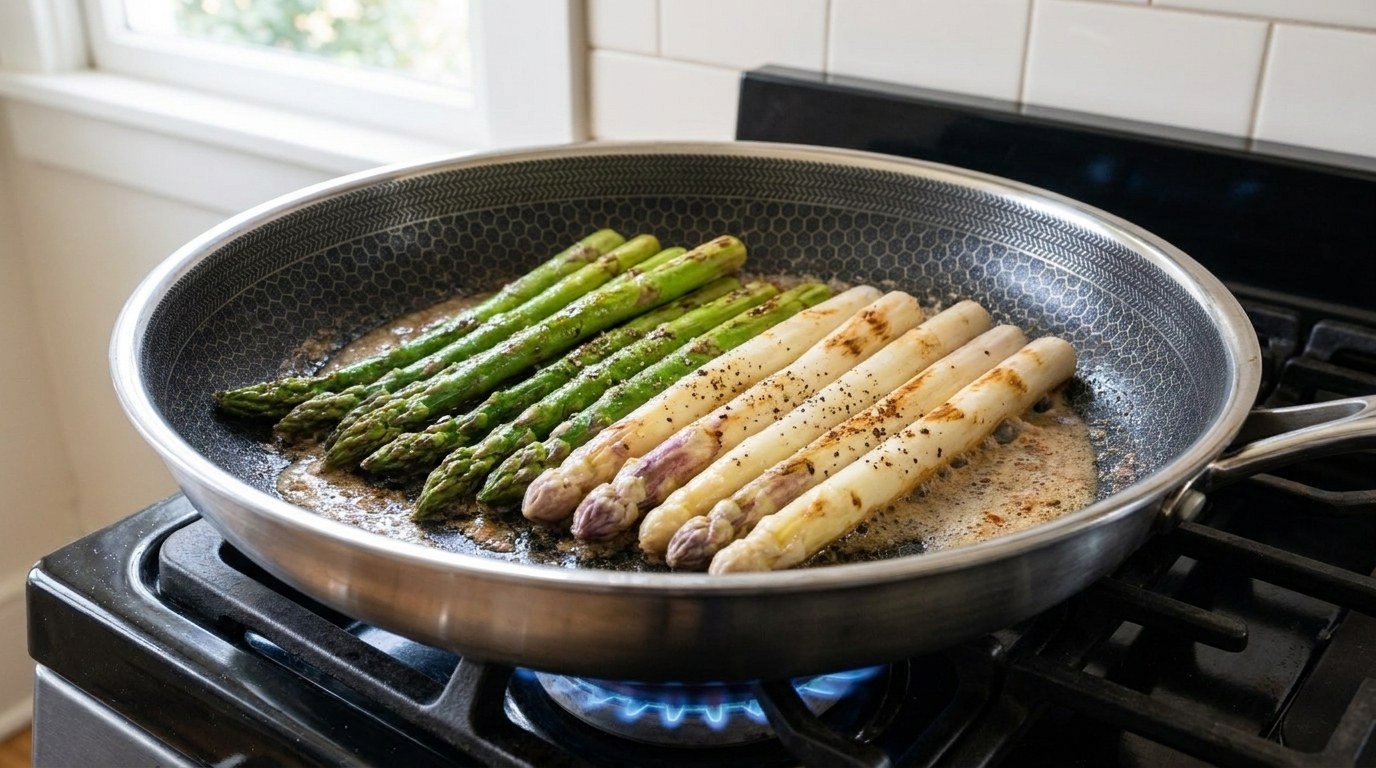
The pan matters more than usual, because two bunches of cold spears drop the temperature the moment they go in. Ramsay uses a large cast-iron pan in the lesson. Any heavy 12-inch skillet that holds its heat works, including a hybrid stainless pan like the HexClad line he partners with (our guide to Gordon Ramsay cookware covers it). Get the pan hot first, then add the oil and wait until it just starts to smoke. If your spears don't fit in a single layer with a little room between them, cook them in two batches, because a crowded pan steams instead of searing.
HexClad
HexClad 12-Inch Hybrid Nonstick Frying Pan
- Stainless steel and ceramic nonstick hybrid surface, built to sear hard and release easily
- Tri-ply with an aluminum core for quick, even heat; works on induction
- Oven safe to 900°F and metal-utensil safe (lid not included)
Why Gordon Ramsay Sears Asparagus Instead of Boiling It
Searing asparagus gives it flavor that boiling never can, because browning needs a surface far hotter than water allows. Water boils at 212°F (100°C), so a spear sitting in a pot of it can never get hotter on the outside. Maillard browning, the reaction that turns sugars and amino acids into toasty, savory flavors, only starts at about 284°F (140°C) and builds fastest from about 320°F (160°C). A dry spear in smoking oil gets there in seconds, which is where the blistered, nutty spots on Ramsay's asparagus come from.
Boiling also costs you flavor and nutrients. The University of Illinois Extension notes that the longer vegetables cook, the more flavor compounds dissolve into the cooking liquid or evaporate, and that vitamin C leaches into the water. Its advice is to cook vegetables quickly in as little liquid as possible, which is exactly what a 3-minute sear and a short steam in a cup of stock do. That is also why seasoning the spears before they go in matters: the salt and pepper cling to the dry skin and toast in the oil instead of washing off into a pot.
You don't need to blanch asparagus before you sauté it. Blanching helps when you want spears ahead of time or for a cold salad, and Ramsay does blanch them for his asparagus with lemon and tarragon hollandaise, 2 to 3 minutes in boiling salted water. For this dish, the stock and foil at the end soften the inside, so a separate pot only adds water and washing up.
How to Trim Woody Asparagus Ends (and Whether to Peel)
Trim asparagus by finding where the tough base ends rather than cutting a fixed amount: on most spears that is about 2 inches from the bottom. Ramsay calls it feeling for the asparagus. Chowhound describes him tapping down the spear with his knife until the blade meets soft flesh instead of fiber, then cutting there. The classic home method is to bend a spear until it snaps, but a snap often breaks higher than it needs to and throws away good asparagus, so use one snapped spear as a guide and cut the rest of the bunch to match.
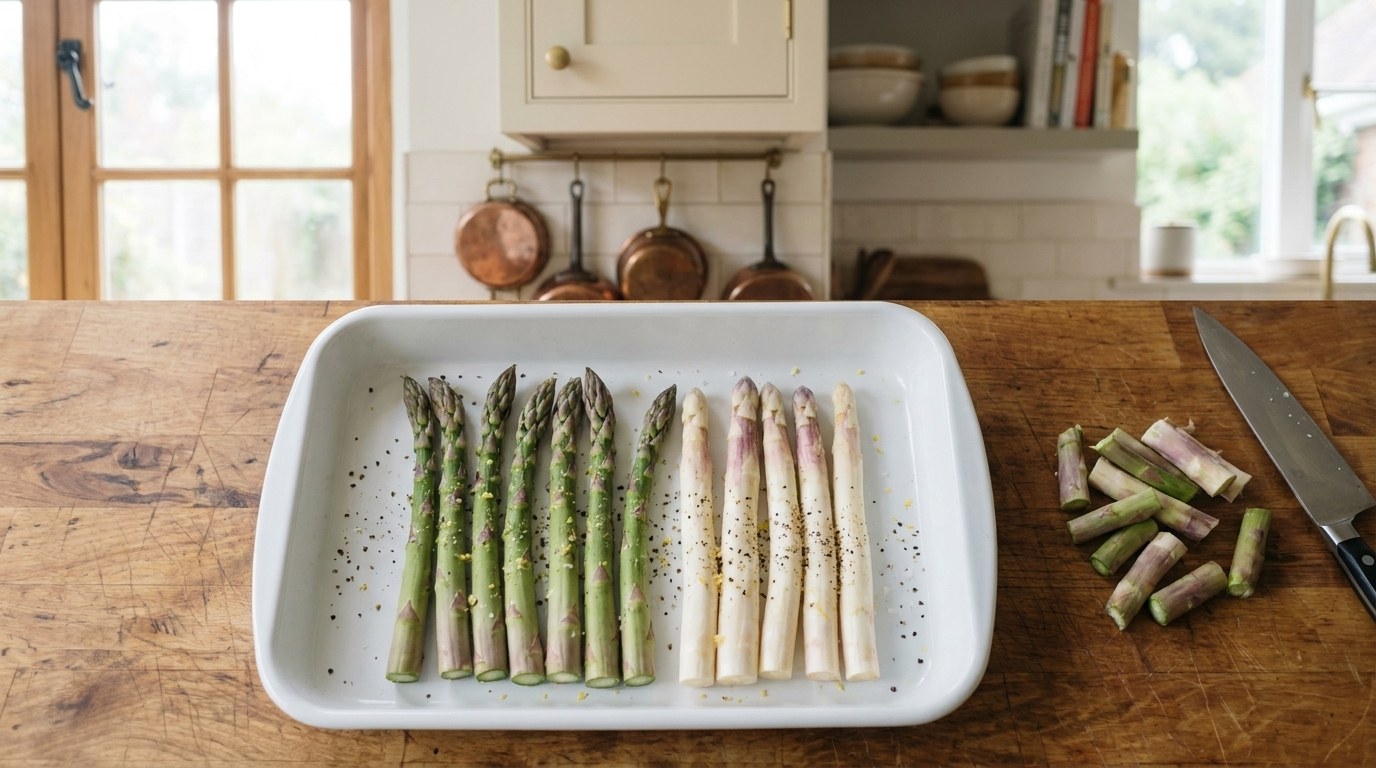
The woody end is fiber, and fiber doesn't soften with cooking the way the rest of the spear does. Asparagus also gets tougher after it is picked. Iowa State University Extension says spears deteriorate quickly after harvest and recommends storing them at 32 to 35°F (0 to 2°C) to slow that fiber development, which is why older, warm-stored asparagus needs a bigger trim. Ohio State University Extension calls a tough, woody base normal and fine to cut off before cooking.
Keep the trimmings. Ramsay saves the woody ends for stock, and the thin slices he shaves off to even the spears go into his asparagus purée. Simmer the ends with an onion and a few peppercorns for 20 minutes for a quick vegetable stock you can use in this recipe next time. Don't peel green asparagus: the skin holds a lot of the flavor and Ramsay leaves it on. White asparagus is different. Its skin is thicker and more fibrous, so if your white spears are thick and the skin feels tough under a fingernail, take a thin layer off the lower half with a vegetable peeler.
Thick or Thin Asparagus, Green or White?
Buy thick spears for Gordon Ramsay asparagus. The recipe calls for a bunch of thick green asparagus, and thick spears take a hard sear without going limp before the inside is cooked. Ohio State University Extension notes that thicker stalks end up more tender than thin ones once cooked. Thin, pencil spears still work, but give them about half the time in the pan and skip the foil, or they turn floppy.
Ramsay mixes green and white for the contrast. White asparagus is the same plant grown without sunlight, so it never develops its green color, and MasterClass describes it as sweeter and creamier, with green being earthier and brighter. White has a short season of about seven to eight weeks; in the US, green runs from roughly February to June and white from April to June. If you can't find white, use two bunches of green. Whatever you buy, look for straight, firm spears with compact, pointed tips, which OSU Extension gives as the signs of quality.
The table compares Ramsay's method with the other common ways to cook asparagus, so you can pick by the texture you want.
| Method | Heat and time | Texture | Color | Best for |
|---|---|---|---|---|
| Gordon Ramsay's sear, butter and stock | Smoking oil, 90 s a side, then 2 to 5 min under foil off the heat | Charred spots, tender through | Bright green with browned blisters | A side for steak, fish or eggs |
| Blanched (Ramsay's hollandaise version) | Boiling salted water, 2 to 3 min, drained | Crisp, clean | Vivid green | Hollandaise or cold salads; making ahead |
| Roasted | 450°F oven about 15 min, turned once (OSU Extension) | Soft inside, crisp tips | Green with browned tips | Hands-off, large batches |
| Steamed | Over boiling water, a few minutes | Tender, no browning | Green | Plain, light vegetables |
| Boiled a long time | In a full pot of water, well past tender | Soft to mushy | Drab olive | Nothing; it loses flavor to the water |
Ramsay's version is the only one that gets both browning and a tender middle out of one pan. Blanching is the one to use when you need the asparagus cold or made ahead.
Why Asparagus Turns Olive Green (and How to Keep It Bright)
Asparagus turns olive green when it cooks too long or meets acid too early, because both change its green pigment. The University of Illinois Extension explains that chlorophyll, the pigment in asparagus, is destroyed by acids such as lemon juice and vinegar, and that acid plus prolonged heat turns it into pheophytin, a drab olive green. Vegetables release their own acids as they cook, so time alone does it too.
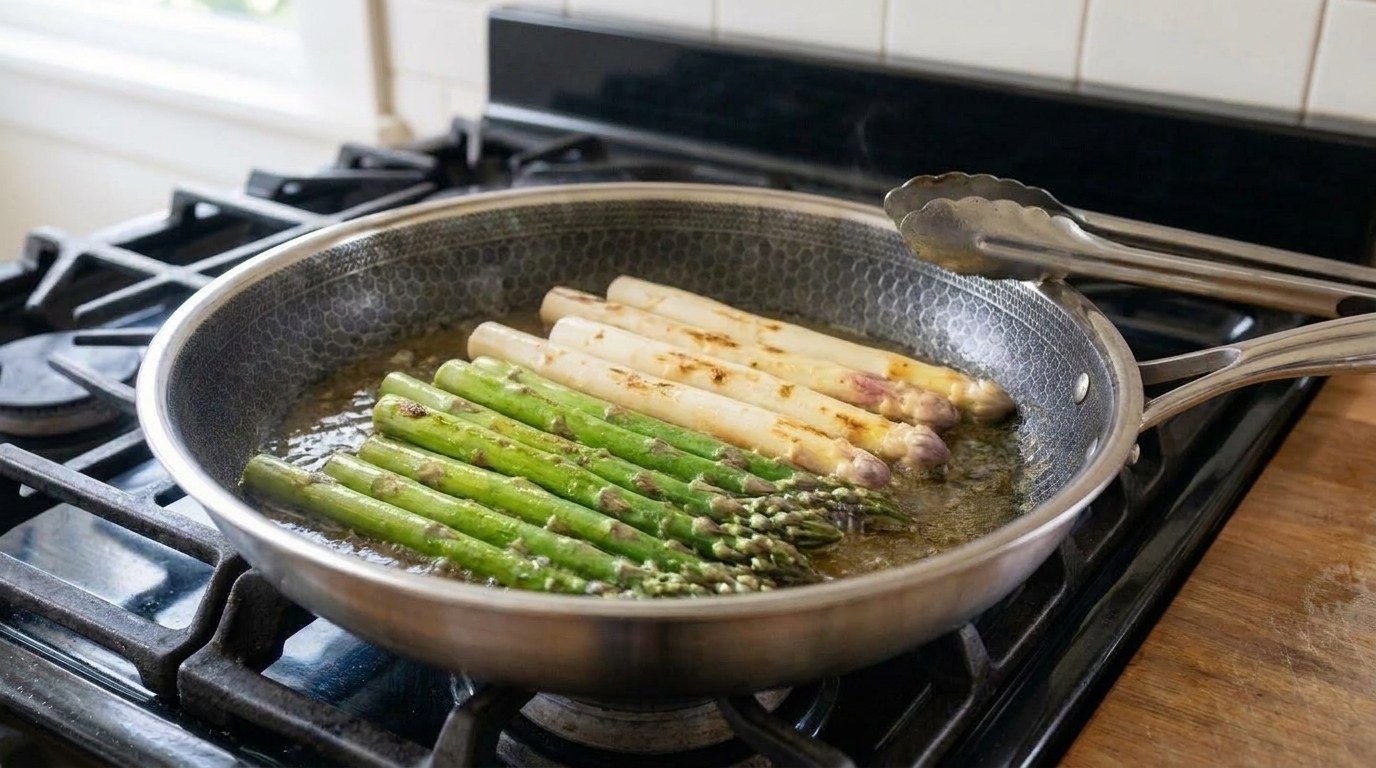
That is why the foil only stays on for 2 to 5 minutes. A covered pan traps steam and the acids that come off the vegetables, and the Illinois guide advises cooking green vegetables uncovered and fast for that reason. A few minutes under foil is enough to soften the inside without dulling the color; 15 minutes would not be. Lift the foil as soon as the knife slides in, and get the spears out of the hot pan.
Add any lemon at the very end. Acid also firms the pectin that holds plant cells together, so the same guide notes that acids make vegetables take longer to soften, and it recommends adding most of the acid after they are tender. A squeeze of lemon on the plate gives you the brightness without the color loss. Skip the old trick of a pinch of baking soda in the water: bases do keep chlorophyll bright, but they break down the cell walls so fast that the spears go mushy.
When Is the Asparagus Done? The Knife Test
Asparagus is done when the tip of a knife slides into the thickest part of a spear with almost no resistance, and the spear bends slightly when you lift it but doesn't flop. Ramsay checks with the edge of his knife after the foil comes off: if it resists, the pan goes back on low for another 2 minutes; if it slides through easily, the asparagus is ready. OSU Extension describes cooked asparagus as tender-crisp and bright green, which is the same target.
What you are feeling is pectin, the glue between the plant's cells. Heat dissolves it, and salt speeds that up, which is one more reason the spears are seasoned before they go in. A thick spear needs about 5 to 8 minutes in total in this method; thin spears need about half that. The tips are always the most tender part, so test the stalk, not the tip. Pull the asparagus a little early if anything, because it keeps cooking for a minute on the hot platter.
Brown Butter and Lemon Salt: How Ramsay Seasons Asparagus
Ramsay seasons asparagus with three things: coarse black pepper and lemon salt on the raw spears, and butter that browns in the pan after the flip. The butter goes in late on purpose. Butter is part water, and that water has to boil off before anything browns. Then its milk solids toast to a nutty, golden brown, the French beurre noisette. Left too long in a smoking pan, those solids go past about 356°F (180°C), where food starts to burn and taste bitter, which is why the butter only gets 90 seconds before the stock goes in and cools everything down.
Lemon salt is salt mixed with lemon zest, and you can buy it or make it in a minute: rub the finely grated zest of half a lemon into a tablespoon of flaky sea salt with your fingers. It gives the citrus smell without acid, so it doesn't dull the green the way lemon juice in the pan would. Use plain flaky salt and a little zest at the end if you don't want to make it. Taste a spear before serving, as Ramsay always does, and add a pinch more salt if it needs it.
For variations, finish the spears with finely grated Parmesan and a little lemon zest, as he does in the Hell's Kitchen video. For a richer plate, spoon béarnaise or hollandaise over the blanched version. To make the full MasterClass plate, add a soft poached egg; the poaching method on our eggs Benedict page works for any poached egg.
How to Store, Make Ahead and Reheat Asparagus
Fresh asparagus keeps best cold and unwashed: wrap the bottoms of the spears in a damp paper towel, put the bunch in a bag in the fridge, and cook it within one to two days. OSU Extension advises against washing it before storing because moisture encourages bacterial growth, and rinse it just before cooking instead. Asparagus is perishable, and Iowa State's 32 to 35°F (0 to 2°C) target means the coldest part of your fridge, not the door.
To get ahead, trim and cut the spears and season them on the tray up to an hour before cooking, then do the sear, butter and stock at the last minute; the whole cook takes under 10 minutes. Cooked asparagus can go in the fridge within 2 hours of cooking and keeps for 3 to 4 days, in line with the USDA guidance on leftovers. Reheat it in a hot pan for a minute or two rather than the microwave, which steams it soft, or eat it cold, chopped into a salad or folded into an omelette.
What to Serve With Gordon Ramsay Asparagus
Gordon Ramsay asparagus goes with almost any main that has its own sauce or juices, because the brown butter and stock in the pan act as a light sauce of their own. It is a spring classic next to fish: try it with pan-seared halibut and beurre blanc, crispy-skin salmon or crab cakes. With steak, serve it beside a basted filet mignon and a spoon of pomme purée for a steakhouse plate.
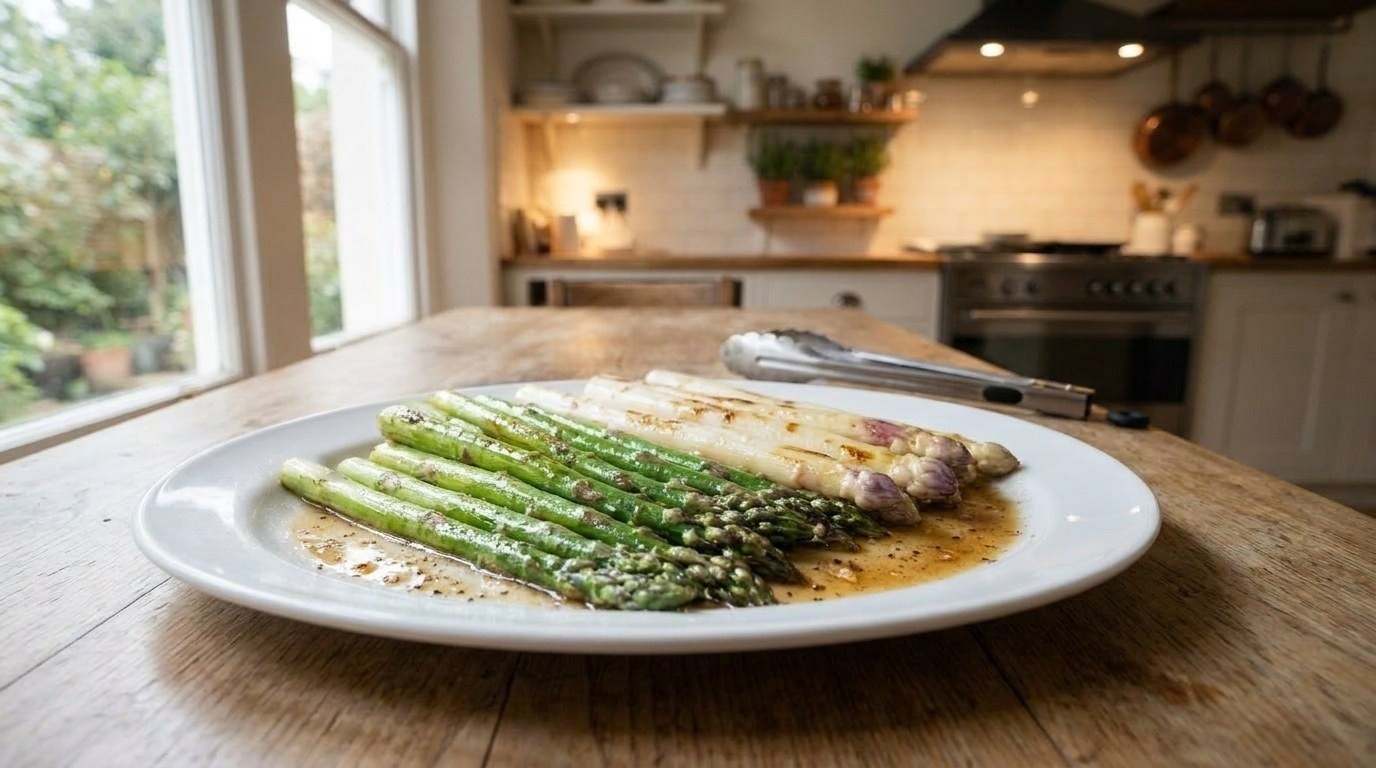
Two bunches serve four as a side. Put the spears on a warm platter, spoon the pan juices over them, and serve them straight away while the char is still crisp. Cook Gordon Ramsay asparagus once and you will reach for the same three moves every spring: sear hard, brown the butter, then let a splash of stock and a sheet of foil finish the job.
Gordon Ramsay Asparagus (Pan-Seared with Brown Butter and Stock)
Ingredients
- 1 bunch thick green asparagus (about 1 lb / 450 g)
- 1 bunch white asparagus (about 1 lb / 450 g), or a second bunch of green
- Coarsely ground black pepper
- Lemon salt (or 1 tbsp flaky sea salt rubbed with the grated zest of 1/2 lemon)
- 1 tbsp olive oil
- 2 tbsp unsalted butter
- 1 cup vegetable stock (240 ml)
Instructions
- Rinse the asparagus. Find where each spear turns woody, about 2 inches from the bottom, by tapping down the stalk with a knife or snapping one spear as a guide, and cut off the ends. Save them for stock.
- Even the spears: shave thin slices off the cut end until all the green and white spears are about 5 inches long. If the white spears are thick and the skin feels tough, peel the lower half thinly.
- Lay the spears on a tray and season them well on all sides with coarse black pepper and lemon salt.
- Heat a large heavy skillet or cast-iron pan over medium-high heat. Add the olive oil and wait until it just starts to smoke.
- Add the spears in a single layer with any seasoning left on the tray. Cook for 90 seconds, without moving them, until the green brightens and the white starts to char. Cook in two batches if they do not fit in one layer.
- Flip the spears, add the butter and shake the pan so it melts underneath them. Cook for another 90 seconds, until the butter turns nutty brown and the spears char in spots.
- Pour in the vegetable stock, turn off the heat and lay a folded piece of foil over the asparagus. Leave it for 2 to 5 minutes.
- Lift the foil and test the thickest spear with the tip of a knife. If it resists, cook on low heat for another 2 minutes. When the knife slides in easily, taste, adjust the salt, and serve on a warm platter with the pan juices spooned over.
Notes
Gordon Ramsay Asparagus FAQs
The questions that come up most: how Gordon Ramsay cooks asparagus, whether he peels it, how long to sauté it, whether to blanch it first, why asparagus turns olive green, where to trim the woody ends, whether thick or thin spears are better, and what lemon salt is.
How does Gordon Ramsay cook asparagus?
He trims the woody ends, cuts the spears to about 5 inches and seasons them with coarse pepper and lemon salt. He sears them in smoking olive oil for 90 seconds, flips them, adds butter and lets it brown for another 90 seconds, then adds vegetable stock, turns off the heat and covers the pan with foil for 2 to 5 minutes until a knife slides in easily.
Does Gordon Ramsay peel asparagus?
No, not green asparagus. He leaves the skins on because they hold much of the flavor and blister nicely in a hot pan. Thick white asparagus can have a tough, fibrous skin, so peel a thin layer off the lower half of white spears if it feels tough.
How long do you sauté asparagus?
For thick spears, about 3 minutes in the pan (90 seconds a side) plus 2 to 5 minutes under foil with a splash of stock, so 5 to 8 minutes in total. Thin spears need about half that and can skip the foil. They are done when a knife slides into the thickest part with almost no resistance.
Should you blanch asparagus before sautéing?
No. The stock and foil at the end of this method cook the inside through, so blanching first only adds water and dulls the browning. Blanch asparagus for 2 to 3 minutes in boiling salted water when you want it cold, made ahead, or served with hollandaise.
Why did my asparagus turn olive green?
It cooked too long or met acid too early. Acid and prolonged heat turn the green chlorophyll into pheophytin, which is olive brown. Keep the cooking short, keep the pan uncovered except for a few minutes under foil, and add lemon juice only on the plate.
Where do you cut the woody ends off asparagus?
Usually about 2 inches from the bottom, where the tough, pale fiber gives way to tender flesh. Ramsay finds the spot by tapping down the spear with his knife. Snap one spear to see where it breaks, cut the rest of the bunch to match, and save the ends for stock.
Is thick or thin asparagus better?
Thick asparagus is better for searing, because it browns on the outside before the inside overcooks, and it ends up more tender than thin spears once cooked. Thin spears work for quick sautés, stir-fries and omelettes but need about half the cooking time.
What is lemon salt?
Salt mixed with lemon zest. Make it by rubbing the finely grated zest of half a lemon into a tablespoon of flaky sea salt. It adds a citrus smell without the acid of lemon juice, so it seasons the asparagus without dulling its green color.

About the Author
John Siracusa is the founder of Hell’s Kitchen Recipes. He focuses on technique-first, reproducible home cooking and researches recipes & kitchen equipment from published food science and professional chef methods since 2016.