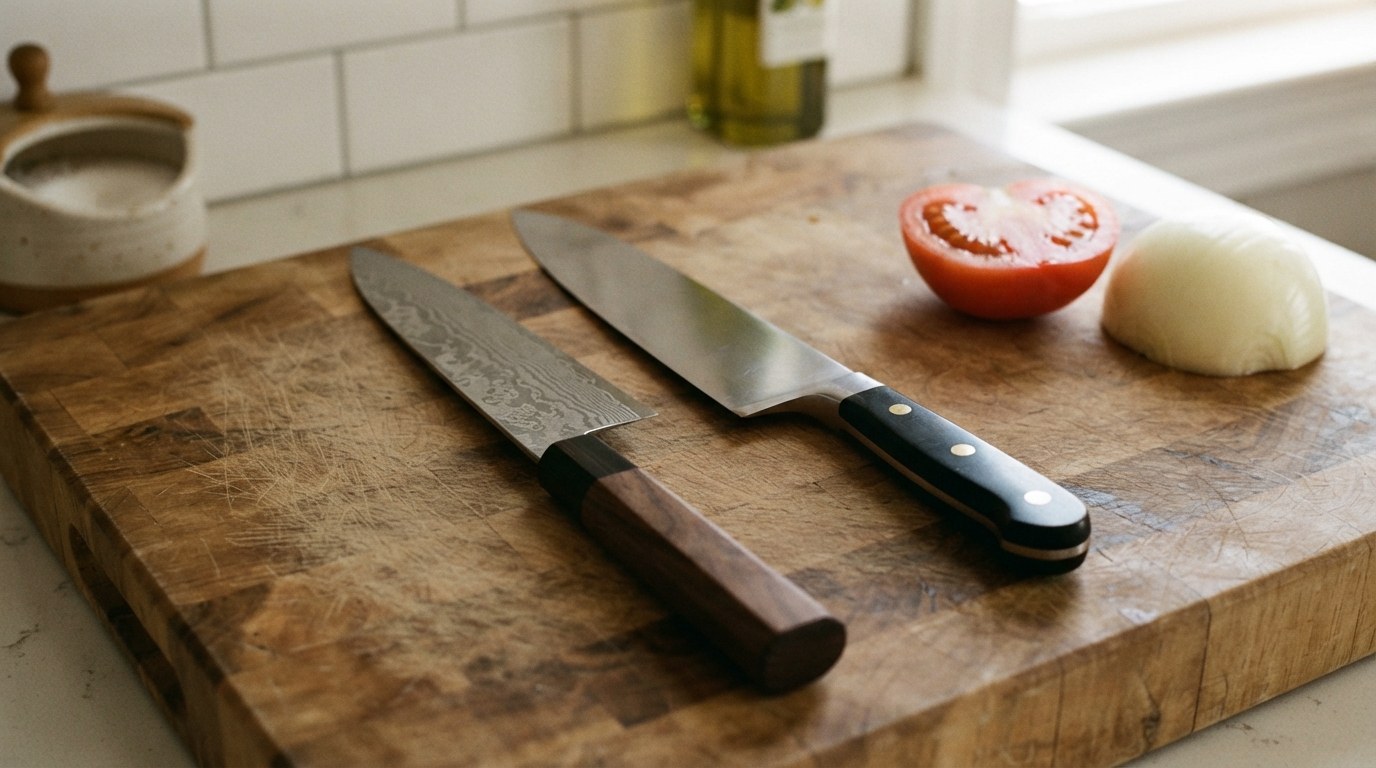
Shun vs Zwilling is the Japanese-versus-German knife question in its purest form, and the makers' own spec sheets settle most of it. Shun's Classic 8-inch chef's knife runs a VG-MAX steel core that Shun hardens to 60 to 61 on the Rockwell C scale, ground to 16 degrees a side and weighing 6.7 ounces. Zwilling's Pro 8-inch is forged from a special-formula steel ice-hardened to 55 to 58 HRC, with a curved forged bolster, at 0.58 pounds, which is 9.3 ounces. Those three numbers, hardness, edge angle and weight, explain almost everything you will feel on the board: the Shun takes and holds a keener edge and glides through push cuts but chips if abused; the Zwilling is a heavier, tougher rock-chopper that forgives careless technique and sharpens on anything.
This guide compares the two where the decision actually gets made, the flagship 8-inch chef's knives, then the steel and hardness, the edge geometry and how each wants to be used, handles and balance, sharpening and care, the other lines in each range, and which cook each brand suits. Four in-stock picks are carded along the way. It is part of the site's kitchen gear guides; the sibling pages compare Wüsthof vs Zwilling within Germany and rank the best Japanese knife brands and the best Zwilling knives line by line.
| Spec (8-inch chef's knife) | Shun Classic | Zwilling Pro |
|---|---|---|
| Steel | VG-MAX core, 34 layers of stainless Damascus cladding per side | Special-formula high-carbon stainless, FRIODUR ice-hardened |
| Hardness | 60 to 61 HRC (Shun FAQ) | 55 to 58 HRC (Zwilling) |
| Edge angle | 16° per side | V-edge; Professional S is 15° per side |
| Construction | Clad blade, D-shaped PakkaWood handle | SIGMAFORGE one-piece forging, curved bolster, triple rivet |
| Weight | 6.7 oz | 9.3 oz (0.58 lb) |
| Made in | Seki City, Japan | Solingen, Germany |
| Warranty | Limited lifetime, free sharpening service | Lifetime |
| Suits | Push cuts, slicing, precision | Rock chopping, dense vegetables, hard use |
Read the table as two philosophies rather than a scoreboard. Shun spends its steel on hardness and thinness for the sharpest possible edge; Zwilling spends it on toughness and mass for a knife that shrugs off a chicken bone. Neither is the "better" knife until you say what you cut and how you treat it.
Shun
Shun Classic 8" Chef's Knife
- VG-MAX cutting core hardened to 60 to 61 HRC, clad in 34 layers of stainless Damascus per side
- 16-degree edge per side; 6.7 oz; D-shaped ebony PakkaWood handle
- Handcrafted in Seki City, Japan; limited lifetime warranty with free sharpening
ZWILLING
ZWILLING Pro Le Blanc 8-Inch Chef's Knife
- The Pro blade in the white Le Blanc handle: FRIODUR ice-hardened special-formula steel, 55 to 58 HRC
- SIGMAFORGE one-piece forging; curved bolster built for a pinch grip; 0.58 lb
- Made in Solingen, Germany; lifetime warranty
Steel and Hardness: 60 to 61 HRC Against 55 to 58
The hardness gap is the single most important difference between the two brands, and it cuts both ways. Rockwell C measures how far a diamond cone presses into the steel under a fixed load; the higher the number, the harder the steel and the finer the edge it can hold. Shun's FAQ puts VG-MAX at 60 to 61 HRC and explains why: the alloy carries more chromium and vanadium than the VG10 it evolved from, and those elements form hard carbides that resist wear, so the apex of the edge stays keen through weeks of use. Zwilling's Pro and Professional S sit at 55 to 58 HRC after the FRIODUR ice-hardening step, a sub-zero treatment after heat-treating that converts more of the steel's structure to the hard martensite phase and, in the company's words, makes the blade start sharper, stay sharper longer and resist corrosion.
The cost of hardness is brittleness. A harder steel bends less before it breaks, so a very fine edge at 61 HRC that meets a frozen carrot, a bone, or a twist on a glass board chips a small crescent out of the apex, where a 57 HRC German edge under the same abuse rolls over instead and can be pushed back with a honing steel. That is the whole reason Shun clads its hard core: the 34 layers of softer stainless Damascus on each side are not decoration but a laminate that supports the thin, hard core and adds corrosion resistance, the way plywood is stronger than a single veneer. It also means the two brands fail differently. A neglected Shun is sharp but chipped; a neglected Zwilling is intact but dull.
Edge Geometry: Push Cuts Against the Rock Chop
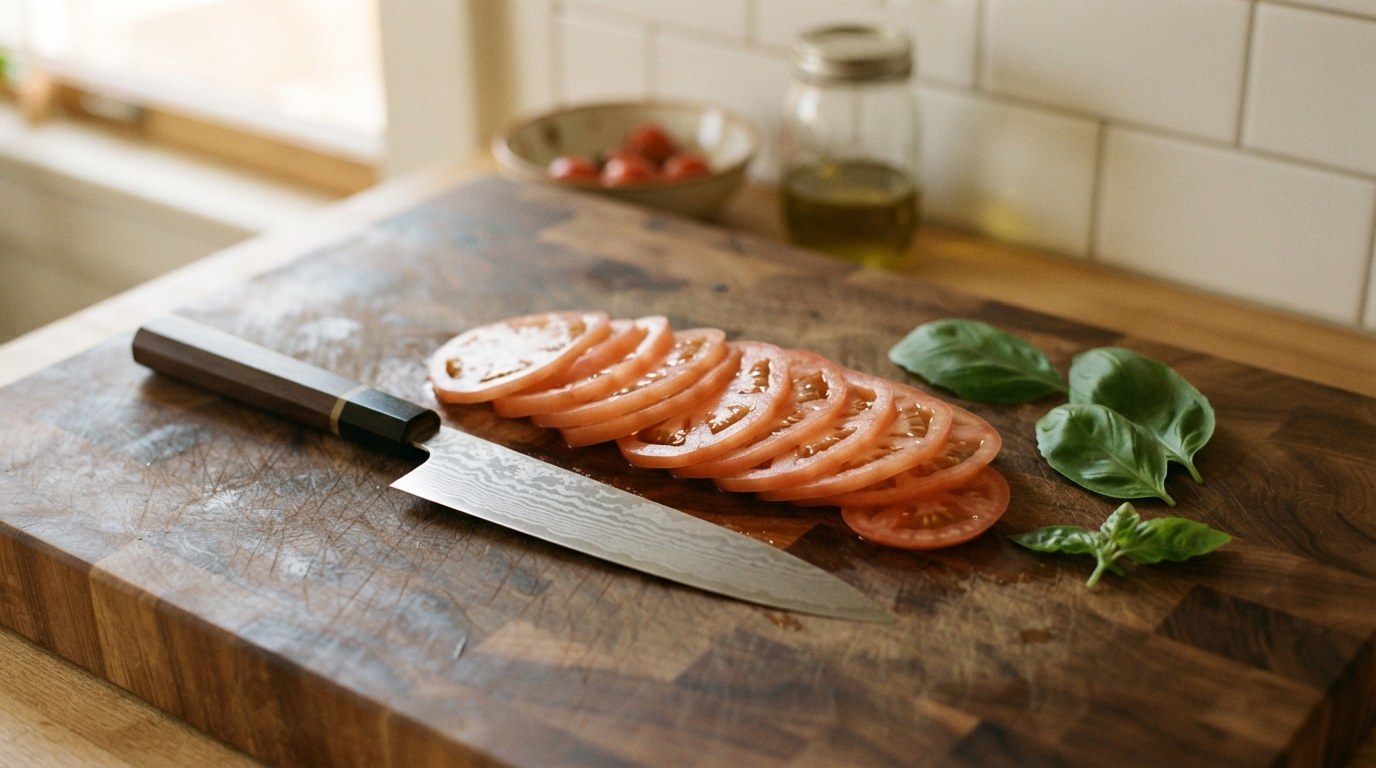
Shun grinds the Classic at 16 degrees a side and Zwilling grinds the Professional S at 15, so the angles are nearly the same; the difference in how the knives cut comes from blade thickness and profile, not the bevel. The Shun's blade is thinner behind the edge, and a thin blade wedges less: as the edge parts a tomato or an onion, less steel has to push the halves apart, so the cut needs less force and the slices come off cleaner. Its flatter profile and lighter weight suit the Japanese push cut, in which the knife moves forward and down through the food and lifts clear, and the pull slice for proteins. Ramsay's knife lesson on MasterClass, with the guiding knuckle and the blade riding the board, is push-cut technique, and the Shun rewards it.
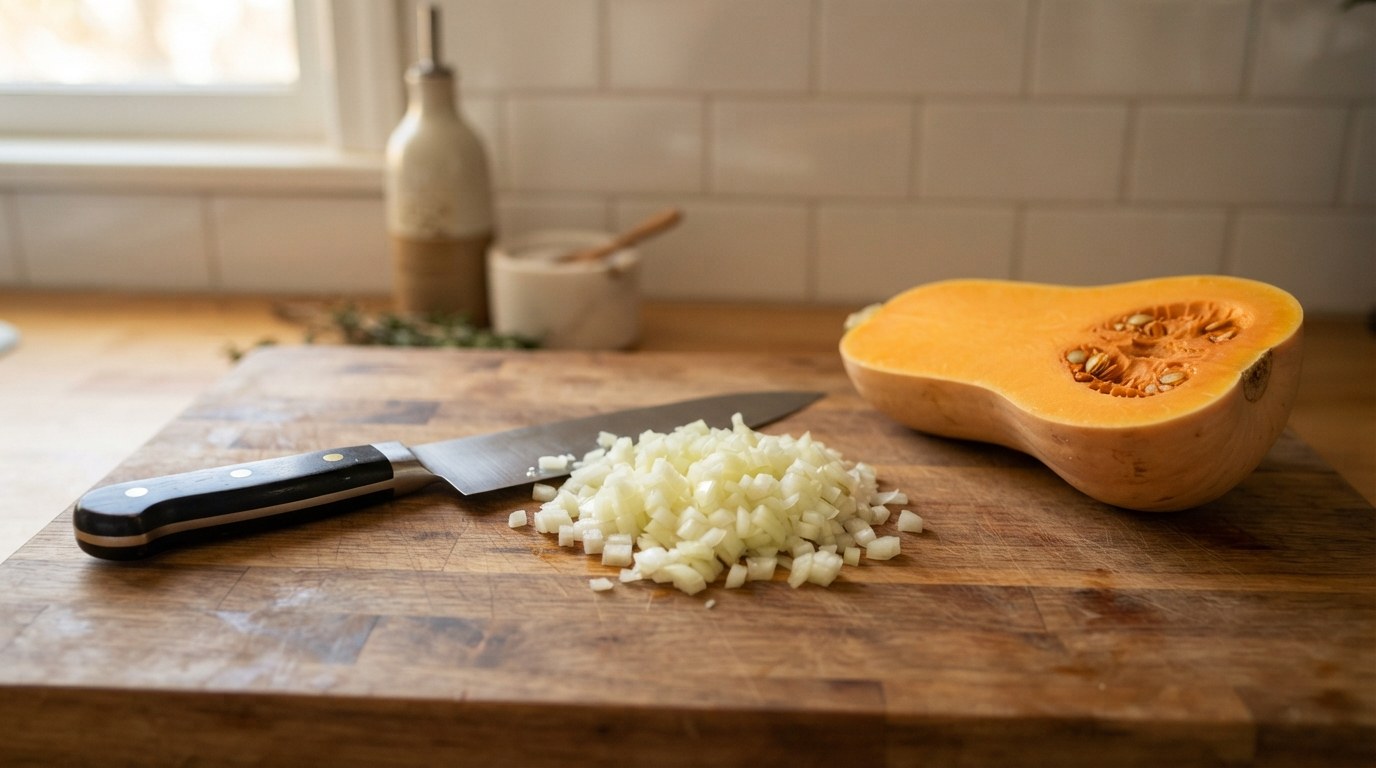
The Zwilling Pro has a more curved belly, a thicker spine and 2.6 more ounces of steel, and that combination is built for the Western rock chop, in which the tip stays on the board and the heel rocks down through a pile of herbs or an onion. The extra mass gives the blade momentum, so a squash or a sweet potato splits under the knife's own weight rather than the cook's wrist, and the thicker spine keeps the edge from flexing or chipping in dense food. The curved bolster on the Pro, which Zwilling designed for a pinch grip, puts the hand right over the heel where that force is applied. Push cuts with the Zwilling are fine; rock chops with the Shun's flatter, thinner blade feel awkward and, on hard food, are how tips get snapped.
Handles, Weight and Balance
Shun's Classic handle is a D-shaped PakkaWood, a resin-impregnated hardwood laminate that will not absorb water or harbor bacteria, and the D profile settles into a right-handed grip and indexes the blade's orientation without looking. Shun makes left-handed versions of the Classic for that reason. The Premier line switches to a contoured, ambidextrous handle in walnut-colored PakkaWood and adds a hammered tsuchime finish to the blade face, which creates tiny air pockets that stop starchy slices sticking. Zwilling's Pro and Professional S use a triple-riveted polymer handle over an exposed full tang, with the Pro's bolster curved and the Professional S's traditional full bolster acting as a finger guard.
Weight changes how long you can work. At 6.7 ounces the Shun is light enough that an hour of prep does not tire the forearm, and its balance point sits near the blade's heel; at 9.3 ounces the Zwilling is a quarter heavier and balances at the bolster, which feels planted and confident but asks more of the wrist over a long session. Cooks moving from a heavy German knife to a Shun often overcut for the first week because they are still applying German force to a blade that does not need it.
Shun
Shun Premier 8" Chef's Knife
- Same VG-MAX core as the Classic with a hammered (tsuchime) finish that helps food release
- Contoured walnut-colored PakkaWood handle; 16-degree edge per side
- Handcrafted in Seki City, Japan; limited lifetime warranty
Sharpening and Care: Whetstone Against Honing Steel
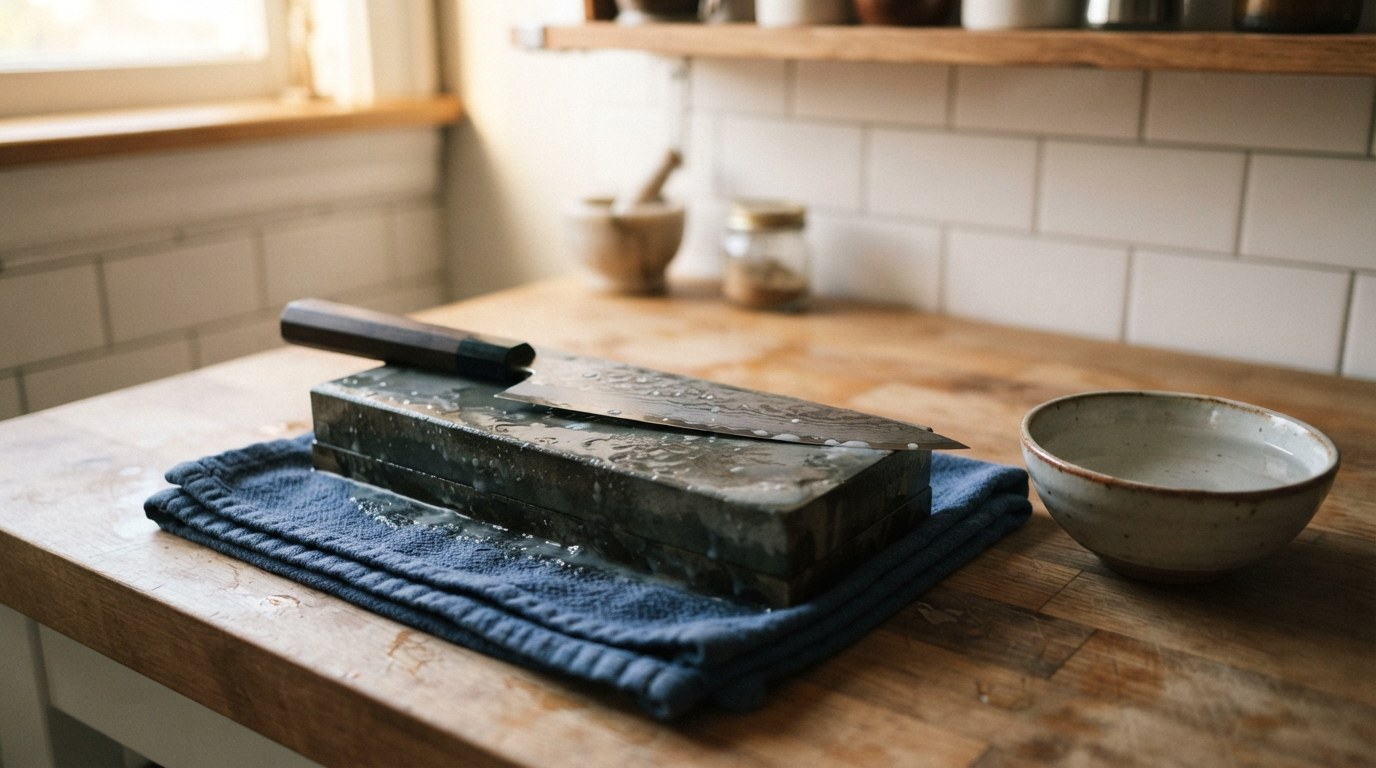
The hardness numbers dictate the maintenance. A rolled edge on Zwilling's 55 to 58 HRC steel realigns with a few passes on a honing steel, which removes almost no metal, and when it finally dulls it sharpens quickly on a pull-through sharpener or a coarse stone because the softer steel abrades easily. Shun's harder VG-MAX does not roll; it stays straight until it wears or chips, so a steel does little for it, and it wants a whetstone, 1000 grit for sharpening and 4000 to 6000 for polishing, held at the 16-degree factory angle with light pressure. Pull-through sharpeners with fixed carbide teeth are wrong for Shun: they gouge the hard steel and can chip the edge. Shun's limited lifetime warranty includes a free sharpening service, and the brand sells a combination honing steel with a smooth side for its own knives.
Both brands are dishwasher-hostile in practice. Zwilling's Professional S page lists it as dishwasher safe but recommends hand washing; detergent dulls any edge and heat cycles loosen handles. For either knife: wash by hand, dry at once, store in a block or on a magnetic strip rather than loose in a drawer, and cut on wood or soft plastic, never glass, stone or ceramic, which is the fastest way to chip a 61 HRC edge or dull a 57.
ZWILLING
ZWILLING 4-Stage Ultra-Sharp Knife Sharpener
- Coarse and fine stages for both Western and Asian-style edges
- Non-slip base and a guard for the fingers; sharpens in a few pulls
- For Zwilling and other German steel; use a whetstone for Shun
The Lines: Classic, Premier and Kanso Against Pro, Professional S and Four Star
Shun's core ranges all share the VG-MAX steel and differ in blade finish and handle: the Classic is the Damascus-clad, D-handled original; the Premier adds the hammered finish and contoured handle; the Kanso strips the Damascus for a plain, matte AUS10A blade with a tagayasan wood handle at a lower price point; the Sora is the entry line with a VG10 edge welded to a stainless upper blade. Zwilling's German-made ranges all use the same FRIODUR special-formula steel and differ in forging and handle: the Pro with its curved bolster; the Professional S with a traditional full bolster and a 15-degree edge; the Four Star with a one-piece molded handle; the Twin Signature as the stamped, lighter value line; and the Kramer collaborations at the top, which use a harder steel than the standard range. Wüsthof, Zwilling's Solingen neighbor, publishes a 14-degree edge and 58 HRC for its Classic, which places it between the two brands here and is the reason the Wüsthof-vs-Zwilling question deserves its own page.
| If you… | Buy | Because |
|---|---|---|
| Slice, dice and want the sharpest edge | Shun Classic 8" | 60 to 61 HRC holds a keen apex; thin blade wedges less |
| Want Shun with less sticking and an ambidextrous grip | Shun Premier 8" | Hammered finish releases food; contoured handle |
| Rock-chop, break down squash, cook for a crowd | Zwilling Pro 8" | Mass and a tough 55 to 58 HRC edge; curved bolster |
| Want a full bolster and finger guard | Zwilling Professional S 8" | Forged guard, 15° edge, same steel |
| Hate sharpening | Zwilling | A honing steel keeps it going for months |
| Cut on glass, hit bones, or share the knife | Zwilling | Softer steel rolls instead of chipping |
Which to Buy
Buy the Shun Classic if you cook with technique and like a light, keen knife: the 16-degree VG-MAX edge slices tomatoes, fish and onions with less effort than any German knife, and if you own a whetstone and a wooden board it will stay that way for years. Buy the Zwilling Pro if the knife has to survive a busy family kitchen, dense vegetables, the occasional bone and other people's habits: the 55 to 58 HRC steel bends rather than breaks, the weight does the work in a rock chop, and a steel plus any sharpener keeps it working. A serious cook eventually owns one of each, the Shun for precision and the Zwilling for force, and the santoku vs chef's knife guide covers the shorter Japanese blade that many people buy as their second knife.
Shun vs Zwilling FAQs
The questions that come up most: whether Shun stays sharper than Zwilling, whether Shun knives chip, whether Zwilling is better than Henckels, how Shun compares with Wüsthof and Global, whether Zwilling knives are good quality, how to sharpen each, and which is better for a beginner.
Do Shun knives stay sharper than Zwilling?
Yes. Shun hardens its VG-MAX core to 60 to 61 HRC, against 55 to 58 for Zwilling's FRIODUR steel, and harder steel holds a fine apex longer. The trade is brittleness: the Shun edge chips where the Zwilling edge rolls, and a rolled edge can be honed back in seconds.
Are Shun knives too fragile for everyday use?
Not for everyday cutting on a wooden or plastic board. They are fragile against bones, frozen food, glass or stone boards, twisting cuts and pull-through sharpeners, all of which can chip a 61 HRC edge. Treat a Shun as a slicing and dicing knife and keep a tougher knife for bones and squash.
Is Zwilling better than Henckels?
They are two brands from one company. Zwilling J.A. Henckels knives are forged in Solingen, Germany from FRIODUR steel; the plain "Henckels" brand (Henckels International, Statement, Classic) is the value line, mostly stamped and made outside Germany. Zwilling is the better knife; Henckels is the cheaper one.
Shun vs Wüsthof: which is better?
The same trade as Shun vs Zwilling. Wüsthof's Classic is 58 HRC with a 14-degree edge, so it sits between the two brands here: sharper out of the box than Zwilling, tougher than Shun. Choose Shun for the lightest, keenest knife and Wüsthof for a German knife with a finer factory edge.
Shun vs Global: what is the difference?
Both are Japanese, but Global uses a softer CROMOVA 18 stainless around 56 to 58 HRC in a one-piece all-steel body with a dimpled hollow handle, while Shun uses a harder 60 to 61 HRC VG-MAX core in a clad blade with a wood handle. Shun holds an edge longer; Global is tougher and lighter still.
Are Zwilling knives good quality?
Yes. The Pro, Professional S and Four Star lines are forged in one piece in Zwilling's Solingen factory from ice-hardened special-formula steel at 55 to 58 HRC, with full tangs and a lifetime warranty. The steel is chosen for toughness and easy sharpening rather than maximum hardness.
How do I sharpen a Shun compared with a Zwilling?
Shun: a whetstone at about 16 degrees a side with light pressure, never a carbide pull-through, and Shun's free sharpening service under its warranty. Zwilling: a honing steel between uses to realign the edge, then a pull-through sharpener or a coarse stone when it finally dulls.
Which is better for a beginner, Shun or Zwilling?
Zwilling. Its softer steel forgives a wobbly stroke, a glass board or a bone, and it can be kept sharp with a steel. A Shun rewards good technique and punishes bad, and it needs a whetstone. Start with the Zwilling Pro and add a Shun once the push cut is second nature.

About the Author
John Siracusa is the founder of Hell’s Kitchen Recipes. He focuses on technique-first, reproducible home cooking and researches recipes & kitchen equipment from published food science and professional chef methods since 2016.