Gordon Ramsay's five-spice duck breast is the duck he teaches in his second MasterClass, Gordon Ramsay Teaches Cooking II: Restaurant Recipes at Home, and it comes down to four things on the plate: duck, cherries, endive and spinach. The breasts get a crosshatch score and a rub of salt and Chinese five-spice, render skin side down in a dry cast-iron pan brought slowly up to medium, then roast skin side down at 375°F for 8 to 10 minutes to 135°F. While they rest, a glaze of honey, red wine vinegar, stock and soy reduces in the same pan and finishes with black cherries. It serves four and takes about 45 minutes.
This page is about the five-spice version and the plate that goes with it. For the long cold-pan render and the red wine and blackcurrant plate, see our crispy duck breast recipe, which covers duck skin in full. If you want the lesson itself, with Ramsay cooking it start to finish, it's part of his cooking course on MasterClass, the same class that teaches his pomme purée and raspberry soufflé. More duck and dinner-party mains live in our recipes section.
What Is in Five-Spice, and Why It Works on Duck
Chinese five-spice is a ground blend of star anise, cloves, Chinese cinnamon (cassia), Sichuan pepper and fennel seed, and on duck breast it gives the rich, fatty meat a warm, sweet, licorice-edged crust. Jar blends vary more than you'd think: McCormick's Chinese five spice, for example, lists anise, cinnamon, star anise, clove and ginger, with no Sichuan pepper at all. Either kind works here. Read the label, and if yours is heavy on clove, use a little less.
The reason five-spice suits duck so well is the fat. Most of the aroma in these spices (the licorice note of star anise and fennel, the warmth of clove and cassia) comes from oils that dissolve in fat far better than in water. As the duck skin renders, those compounds bloom into the hot fat and coat the whole breast, which is why a spiced duck breast smells stronger in the pan than the raw rub ever did. It's the same pairing behind Chinese roast duck, just done on one breast in a skillet.
| Spice in the blend | What it tastes like | What it does on duck |
|---|---|---|
| Star anise | Sweet licorice | The main note; stands up to the rich fat |
| Fennel seed | Milder licorice, a little green | Rounds out the star anise |
| Cloves | Warm, sharp, numbing in large amounts | Depth; the one to cut back if your jar is strong |
| Chinese cinnamon (cassia) | Sweet, woody warmth | Links the spice rub to the honey and cherry glaze |
| Sichuan pepper (or ginger in some jars) | Citrusy tingle, or gentle heat | Brightness against the fat |
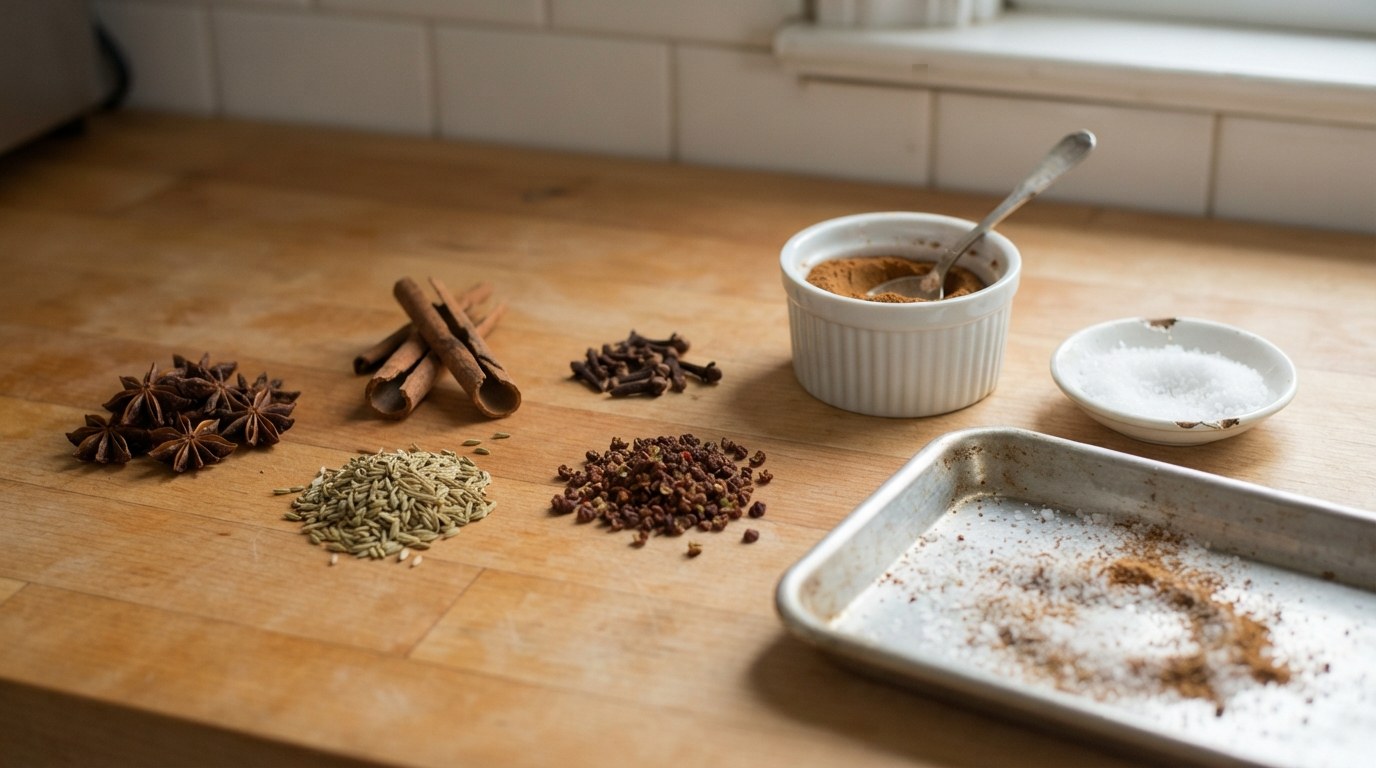
Ramsay's rub is simple and a little unusual. Scatter kosher salt and five-spice over a tray, lay the scored breasts in skin side up, season the tops heavily with more five-spice, salt and pepper, and rub it all in. Give them two minutes, then shake off whatever is loose before they hit the pan. The salt starts pulling water out of the skin right away, and a drier skin browns sooner. The shake-off matters too: ground spice is a fine powder that sits on the hottest surface in the pan, and above about 356°F it scorches and turns bitter. Heavy loose spice in a hot pan is where a five-spice duck goes acrid.
Before the rub, trim the skin so it matches the shape of the breast and keep the trimmings; they go into the pan to render with the duck. Score through the skin and most of the fat in a crosshatch, one third to one half an inch apart, without cutting into the meat. Leave the small tenderloin attached to the underside. Take the breasts out of the fridge about 10 minutes before cooking so the center isn't fridge-cold when the outside is done.
How Gordon Ramsay Cooks Five-Spice Duck Breast
Gordon Ramsay cooks five-spice duck breast in a dry cast-iron pan with no oil or butter, warmed on low for about three minutes, then brought gradually up to medium with the breasts skin side down and the skin trimmings in the pan beside them. The duck brings its own fat. After 3 to 5 minutes most of the fat has run out and the skin is golden, with a quick turn or two to color the flesh side. Thyme sprigs and crushed garlic go in for a minute, get laid on top of the breasts, and the whole pan goes into a 375°F oven with the breasts skin side down again for 8 to 10 minutes.
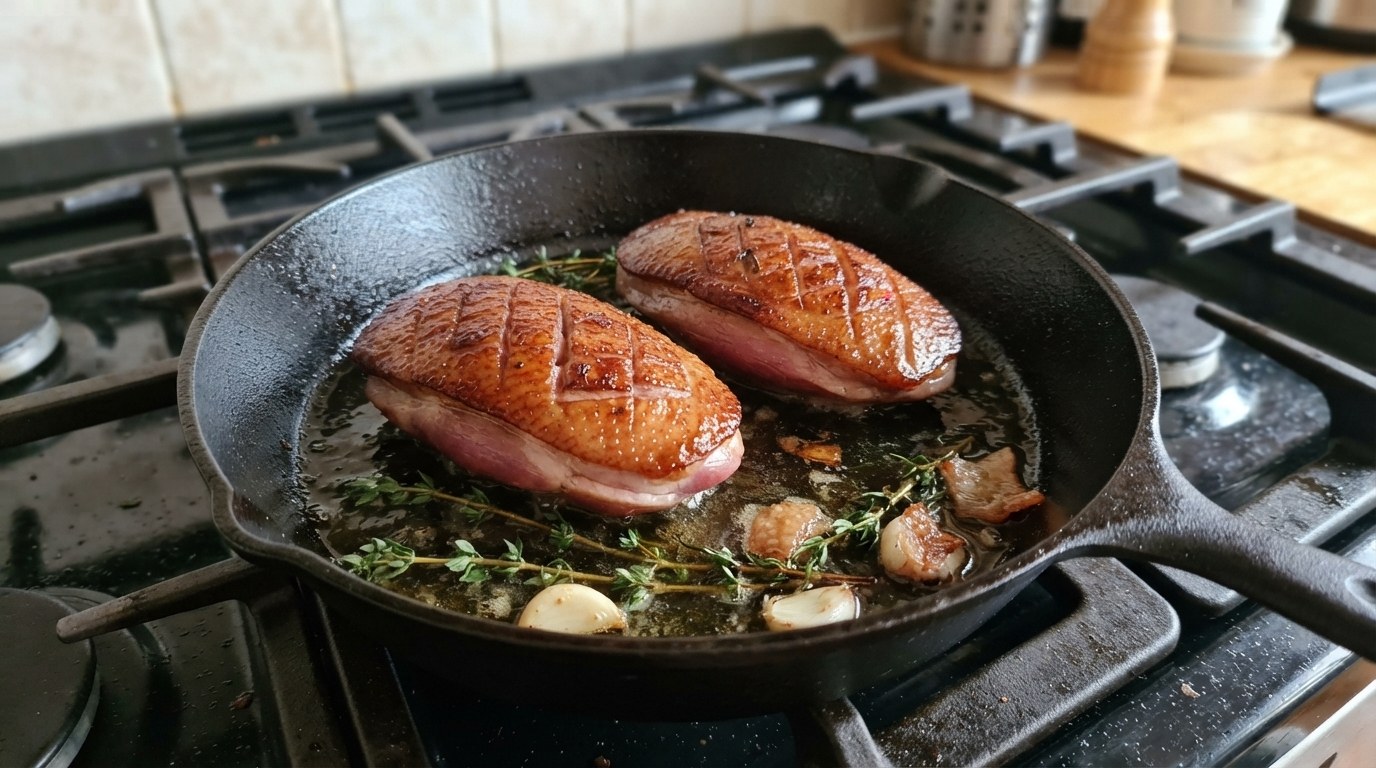
The gentle start is the whole trick, and it's the same idea as the cold-pan method. Duck fat melts at a low temperature, well before the skin can brown, so a pan that heats slowly gives the fat time to run out through the score lines. The skin then fries in that fat. Crank the heat and two things go wrong: the skin, which is mostly collagen, contracts hard once it passes about 136°F and shrinks into a tight, chewy band, and the surface browns before the thick fat under it has melted. Maple Leaf Farms, the big US duck producer, gives the same advice: a cool pan, medium-low, about 10 minutes, with a quarter-inch score.
Ramsay's pan time is short because the oven keeps the render going. Roasting skin side down on hot cast iron means the skin keeps crisping and dripping fat while the meat cooks through gently from the top. Pour the extra fat into a jar as you go and keep it; it's the best fat there is for roasting potatoes or sautéing mushrooms. The quick all-over color adds browned flavor from the Maillard reaction, which only starts once a dry surface passes 284°F (a wet one is stuck at 212°F until the water boils off). It doesn't seal juices in, so the thermometer, not the crust, tells you when to stop.
Five-Spice Duck Breast Temperature: 135°F vs USDA's 165°F
The MasterClass recipe pulls five-spice duck breast at 135°F for medium-rare, which is how restaurants serve duck breast, and that is below the USDA's safe temperature. The USDA Food Safety and Inspection Service says duck, breasts included, should reach 165°F. Both facts are true, and you should pick knowingly. A breast cooked to 165°F is safe and noticeably grayer and firmer. Most chefs, Ramsay included, treat duck breast like a steak because it's a dense red muscle, and many home cooks follow them. If you're cooking for anyone pregnant, older, very young or immunocompromised, go to 165°F.

ThermoPro
ThermoPro TempSwift Instant-Read Digital Thermometer
- Reads in about 1 second, accurate to ±0.9°F, with a 4.3-inch food-grade stainless probe
- Hold and calibration functions, so you can lock a reading away from the heat
- NSF certified and IP65 waterproof, rinse it clean under the tap
Whichever number you choose, measure it in the thickest part of the breast. The course's guide for resting is as long as the duck roasted, so 8 to 10 minutes, skin side up on a plate so the skin stays dry. The internal temperature climbs a few degrees during that rest from carryover heat, so pull a degree or two early if you like it on the rare side. Resting doesn't relax the meat. It gives the juices inside time to thicken as the meat cools slightly, so less of them runs out when you slice. A steak cut after 2 minutes loses about 6% of its weight in juice against about 2% after 10, and duck breast behaves the same way.
| Stage | Heat and time | What you should see |
|---|---|---|
| Rub and rest | Salt and five-spice rubbed in, 2 minutes | Spice settled into the score lines; loose excess shaken off |
| Pan render | Dry cast iron, low 3 minutes, then up to medium; 3 to 5 minutes skin down | Clear fat in the pan; skin golden, not dark |
| Aromatics | Thyme and crushed garlic, 1 minute | Garlic sizzling; herbs laid on top of the breasts |
| Oven | 375°F, center rack, 8 to 10 minutes, skin side down | 135°F in the thickest part (USDA: 165°F) |
| Rest | 8 to 10 minutes, skin up | A few degrees of carryover; juices set |
| Glaze | Honey 2 minutes, vinegar, stock 3 to 5 minutes, soy, cherries 1 to 2 minutes | Syrupy, glossy, coats a spoon |
The Black Cherry Glaze: Honey, Vinegar, Soy and Stock
The black cherry glaze for five-spice duck is a quick pan reduction made while the duck rests: drain the fat from the duck pan, caramelize honey in it for about 2 minutes, deglaze with red wine vinegar and reduce to a syrup, add chicken stock and reduce again for 3 to 5 minutes, then add soy sauce, reduce once more and stir in the resting juices. Halved black cherries go in last for a minute or two, and the pan comes off the heat so they soften without collapsing. Cherry takes the place of the plum sauce that usually goes with roast duck, and the tart fruit cuts the fat the same way orange does in duck à l'orange.
Watch the honey closely, because it browns much faster than table sugar. Honey is mostly fructose, and fructose starts to caramelize at a lower temperature than sucrose, which is why the National Honey Board tells bakers to drop the oven by 25°F when they swap honey in. In a hot cast-iron pan that means about 2 minutes, until it darkens a shade and thickens. Past that point it heads toward the burning range above 356°F and turns bitter. The vinegar stops the browning, lifts the browned bits off the pan and brings acidity, and the reductions concentrate everything. Soy adds salt and savory depth, so taste before you add any more salt.
The glaze keeps up to five days in the fridge in a sealed container, so you can make it ahead and warm it gently. Frozen cherries work if fresh ones aren't in season; thaw them and drain off the juice first, or the extra water thins the glaze. The body comes from reduction rather than the fruit, since cherries are low in pectin, which is also why the cherries go in at the end instead of being cooked down. If you'd rather a wine-based sauce, the red wine reduction on this site is the classic alternative.
Caramelized Red Endive and Sautéed Spinach
The sides for five-spice duck are chosen for contrast: red endive, halved and caramelized in a non-stick pan until it turns sweet and nutty, and spinach wilted quickly with garlic. Endive and radicchio both belong to the chicory family, which the University of California extension gardeners in Sonoma County describe as having an appealing bitter flavor, milder in some varieties than others. That bitterness is the point against rich duck and a sweet glaze, as long as it's tamed. Red endive holds together well in the pan; white Belgian endive works the same way.
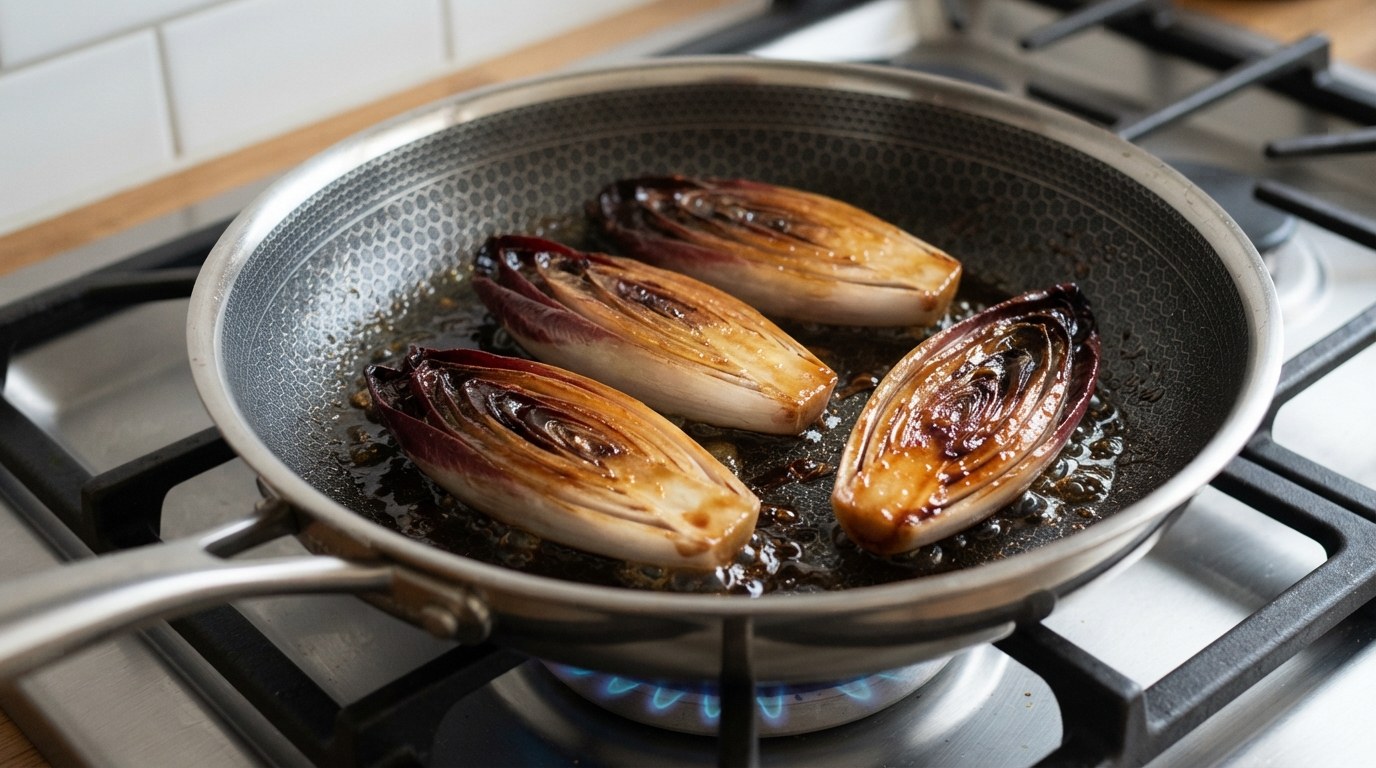
Ramsay's endive method starts before the pan. Season the cut halves with salt and a little powdered sugar and leave them to sit while the duck cooks. The salt draws water out of the cut cells by osmosis, so the endive weeps a little liquid, and salt also dulls how bitter the leaves taste. A few drops of aged balsamic go on top. Then the halves go cut side down into a non-stick pan with a little olive oil, along with their juices. The powdered sugar dissolves into that liquid and caramelizes once the water has cooked off and the pan climbs past about 320°F, which is where the golden color and the sweet edge come from. He finishes the plate with an orange-zest salt, a nod to the duck, cherry and orange combination.
The spinach takes two minutes. Warm a spoon of the rendered duck fat with a crushed garlic clove, add a big handful of baby spinach, and toss just until it collapses; the leaves are mostly water, so they shrink to a fraction of their volume as the heat breaks down their cell walls. Season, then drain off the liquid before plating so it doesn't run into the glaze. Our sautéed spinach with garlic has the full method.
How to Serve Five-Spice Duck Breast, and Making It Ahead
Serve five-spice duck breast sliced across the grain into half-inch slices, fanned skin side up next to a caramelized endive half and a small mound of spinach, with the cherry glaze spooned beside the duck rather than over the skin, which softens the moment sauce touches it. A Pinot Noir suits both the spice and the cherries. For a bigger dinner, add the pomme purée from the same course.
For a dinner party, MasterClass's write-up of the recipe suggests searing the breasts ahead to render the fat, undercooking them slightly, and finishing them to medium-rare in the oven when you're ready to eat. The glaze can be made days ahead, and the endive can sit in its salt and sugar until the pan is free. Frozen supermarket duck breasts are a fine stand-in; thaw them overnight in the fridge and pat them very dry before scoring. Cooked leftovers are best sliced cold into a salad, because reheating takes them past the temperature you pulled them at.
Once you've made five-spice duck breast this way, the crispy skin method carries over to any duck recipe, and our crispy duck breast guide goes deeper on the render. To see which of his courses cover which dishes, read our review of every MasterClass cooking course.
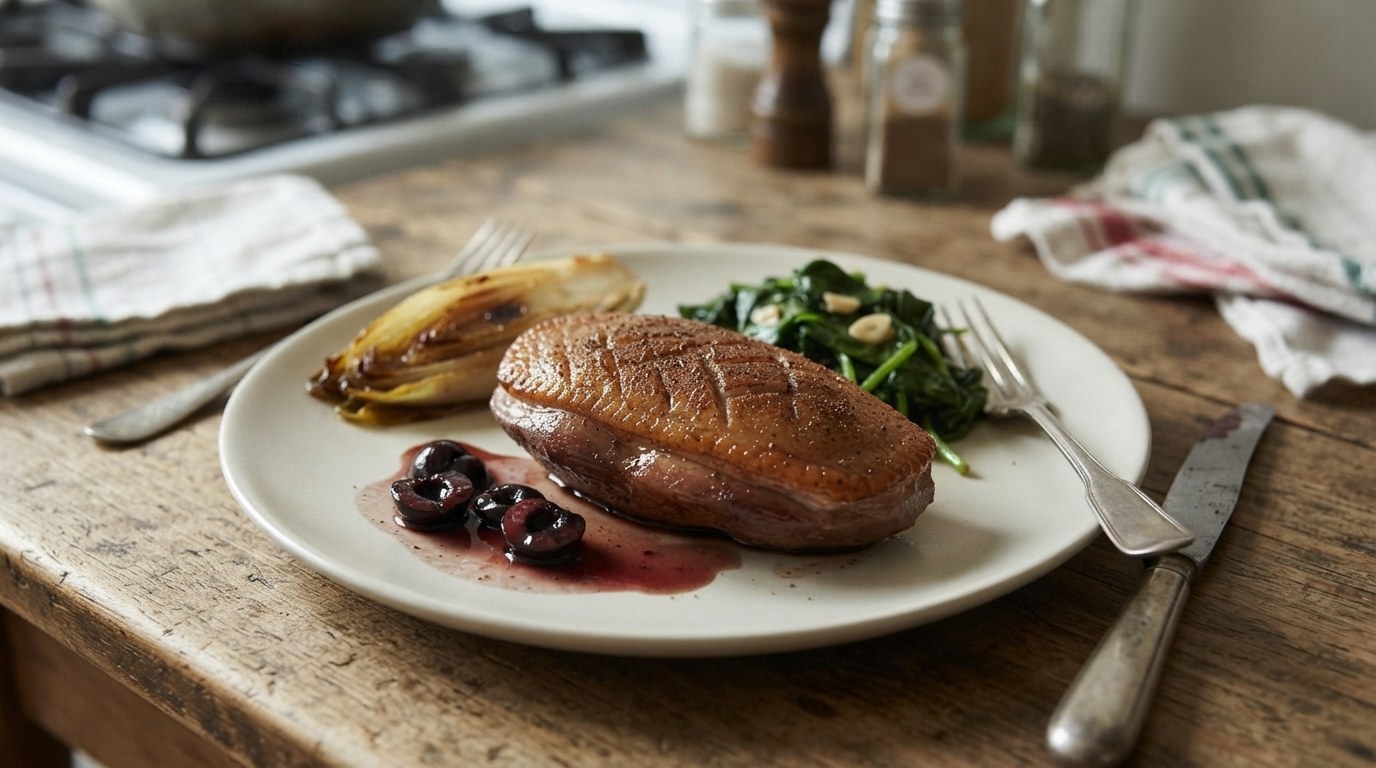
Gordon Ramsay Five-Spice Duck Breast with Black Cherry Glaze
Ingredients
Duck
- 4 duck breasts, about 9 oz each, skin on
- 2 tbsp kosher salt
- 4 tbsp Chinese five-spice powder (for the tray and the tops; not all of it sticks)
- freshly ground black pepper
- 16 sprigs thyme
- 6 garlic cloves, peeled and lightly crushed
Black cherry glaze
- 3 tbsp honey
- 3 tbsp red wine vinegar
- 3/4 cup chicken stock (6 oz)
- 1 1/2 tbsp soy sauce
- 1 cup black cherries, pitted and halved (frozen: thawed and drained)
Endive
- 4 heads red endive (or white Belgian endive), halved lengthwise
- 1 tsp powdered sugar
- 2 tsp aged balsamic vinegar
- 1 tbsp olive oil
- 1 orange, zest only, mixed with 1 tsp flaky salt
Spinach
- 10 oz baby spinach
- 1 tbsp rendered duck fat (from the pan)
- 1 garlic clove, crushed
Instructions
- Take the duck out of the fridge 10 minutes before cooking and heat the oven to 375°F. Trim the excess skin so it matches the shape of each breast and keep the trimmings. Leave the small tenderloin on the underside attached.
- Score the skin and fat in a crosshatch, 1/3 to 1/2 inch apart, without cutting into the meat.
- Scatter some of the salt and five-spice over a tray, lay the breasts in skin side up, season the tops heavily with the rest plus pepper, and rub it in. Rest 2 minutes, then shake off any loose spice.
- Season the cut faces of the endive with salt and the powdered sugar, drizzle with the balsamic, and leave cut side up while the duck cooks.
- Warm a large dry cast-iron skillet over low heat for 3 minutes. Lay the breasts in skin side down, add the skin trimmings, and raise the heat gradually to medium. Cook 3 to 5 minutes, turning briefly once or twice to color the flesh side, until most of the fat has rendered and the skin is golden. Pour the excess fat into a jar and keep it.
- Add the thyme and garlic and cook 1 minute. Turn the breasts skin side down again, pile the thyme, garlic and trimmings on top, and roast on the center rack for 8 to 10 minutes, until the thickest part reads 135°F for medium-rare (USDA safe temperature for duck: 165°F).
- Move the duck to a plate, skin side up, and rest 8 to 10 minutes.
- Heat the olive oil in a non-stick skillet over medium-high heat and add the endive cut side down with any juices. Cook 3 to 4 minutes per side until deep golden and tender. Sprinkle with the orange salt.
- For the glaze, drain the fat from the duck pan, set it over medium heat and add the honey. Let it caramelize about 2 minutes, until slightly darker and thicker. Add the vinegar and shake the pan until it reduces to a syrup. Add the stock and reduce 3 to 5 minutes, then add the soy sauce and reduce until syrupy. Stir in the duck resting juices, taste, add the cherries for 1 to 2 minutes, and take the pan off the heat.
- Warm the duck fat with the crushed garlic in a skillet, add the spinach and toss just until wilted, 1 to 2 minutes. Season and drain.
- Slice the duck across the grain into 1/2-inch slices. Plate with the endive and spinach and spoon the glaze and cherries beside the duck, not over the skin.
Notes
Gordon Ramsay Five-Spice Duck FAQs
The questions that come up most: what Gordon Ramsay's five-spice duck is, what oven temperature and internal temperature he uses, whether pink duck breast is safe, whether it starts in a cold pan, what is in five-spice, whether the cherry glaze can be made ahead, and what to serve with it.
What is Gordon Ramsay's five-spice duck?
It's the duck breast dish he teaches in Gordon Ramsay Teaches Cooking II: Restaurant Recipes at Home. Scored breasts are rubbed with salt and Chinese five-spice, rendered skin side down in cast iron, roasted at 375°F, and served with a honey, soy and red wine vinegar glaze with black cherries, caramelized red endive and sautéed spinach.
What temperature does Gordon Ramsay cook duck breast at?
The oven is 375°F. After the pan render, the breasts roast skin side down on the center rack for 8 to 10 minutes until the thickest part reads 135°F for medium-rare, then rest for 8 to 10 minutes. The USDA's safe temperature for duck is 165°F.
Is it safe to eat duck breast pink?
The USDA says duck, including the breast, should reach 165°F. Restaurants and chefs like Ramsay serve duck breast pink at around 135°F because it's a dense red muscle cooked like steak, and many home cooks do the same. Cook to 165°F for anyone pregnant, older, very young or immunocompromised.
Does Gordon Ramsay start duck breast in a cold pan?
Close to it. In this recipe the dry cast-iron pan is warmed on low for about three minutes, the breasts go in skin side down, and the heat is raised gradually to medium. The slow start melts the fat before the skin browns. High heat shrinks the skin and leaves it chewy.
What is in Chinese five-spice powder?
Traditionally star anise, cloves, Chinese cinnamon (cassia), Sichuan pepper and fennel seed. Some supermarket blends swap in ginger or anise seed for the Sichuan pepper and fennel, so check the label. Any of them works on duck.
Can I make the cherry glaze ahead or use frozen cherries?
Yes to both. The glaze keeps up to five days in a sealed container in the fridge; warm it gently. Frozen cherries work if you thaw them and drain off the juice first, since the extra water thins the glaze.
What goes with five-spice duck breast?
Ramsay serves it with caramelized red endive and sautéed spinach, which bring bitterness and freshness against the rich duck and sweet glaze. Pomme purée or roast potatoes cooked in the rendered duck fat round it out, and a Pinot Noir suits the cherries.

About the Author
John Siracusa is the founder of Hell’s Kitchen Recipes. He focuses on technique-first, reproducible home cooking and researches recipes & kitchen equipment from published food science and professional chef methods since 2016.