Pomme purée is the silky French potato purée Gordon Ramsay teaches in his MasterClass, and you can make it at home with one pot, one small saucepan and a potato ricer. His version comes down to four moves: Yukon Gold potatoes started in cold salted water, a gentle simmer instead of a hard boil, a ricer instead of a masher, and a finish of garlic-and-bay-infused cream followed by cold butter. It's smoother and looser than everyday mash, and it needs less butter than the famous Paris versions.
What Is Pomme Purée?
Pomme purée is French for potato purée: potatoes cooked, pressed very fine and beaten with dairy until they're smooth enough to slowly run off a spoon. The dish is tied to Joël Robuchon, whose version at his Paris restaurant Jamin became famous in the 1980s, according to the Michelin Guide. Ramsay cooked in Robuchon's kitchen in Paris before opening his own restaurants, and he walks through his own version in the pomme purée lesson of Gordon Ramsay Teaches Cooking II on MasterClass.
The difference from mashed potatoes is texture and finish. Mash is fluffy and can have a little body or even a few lumps; pomme purée is lump-free, glossy and soft enough to pool on the plate under a piece of fish or steak.
Pomme Purée vs Mashed Potatoes
Pomme purée is smoother, looser and richer than mashed potatoes, and it's always pressed through a ricer, food mill or sieve rather than mashed. Here is how Ramsay's version compares with the classic Paris purée Robuchon made famous and a regular home mash.
| What differs | Ramsay's pomme purée | Classic Paris purée (Robuchon) | Mashed potatoes |
|---|---|---|---|
| Potato | Yukon Gold, peeled and diced | La Ratte, a small firm French potato, boiled whole | Russet or Yukon Gold |
| Tool | Potato ricer | Food mill, then dried over low heat | Hand masher |
| Dairy | Infused heavy cream, then cold butter | A lot of cold butter, then very hot milk | Butter and milk or cream |
| Fat | About 10% of the finished dish | About 40% butter and cream | Varies, usually moderate |
| Texture | Silky, glossy, runs off a spoon | Silky and very rich | Fluffy, holds its shape |
| Best with | Fish, scallops, duck, steak | Small portions beside roasts | Gravy, roast chicken, turkey |
The ratios come from MasterClass's write-up of Ramsay's recipe, which notes the Paris version he learned ran about 60 percent potato to 40 percent butter and cream, while his modern method uses dense potatoes and only about 10 percent fat. If you want a fluffier, everyday side instead, our Yukon Gold mashed potatoes use the same ricer with a simpler butter-and-cream finish.
The Best Potatoes for Pomme Purée
Yukon Gold is the best potato for pomme purée at home, and it's the one Ramsay uses. University of Minnesota Extension describes Yukon Gold as an all-purpose potato with a balance of waxy and mealy starches, sitting between dry, mealy russets and moist, waxy reds that turn sticky when mashed. That middle ground gives you a dense, buttery purée with real potato flavor, and Potatoes USA points to the naturally smooth, buttery texture of yellow potatoes as the reason they mash so well.
Ramsay's point about dense yellow potatoes is that they carry a lot of cream and butter and still taste like potato, so you need less fat to get a silky result. Russets work too; they purée lighter and fluffier and drink up more dairy, so expect to use a little extra cream. Robuchon used La Ratte, a small fingerling-type potato that's hard to find in US stores, and Yukon Gold is the closest easy swap.
Why Pomme Purée Starts in Cold Salted Water
Start the diced potatoes in cold salted water, bring them to a boil, then drop straight to a gentle simmer. Heat moves into a potato slowly from the outside in. Drop cubes into boiling water and the outside overcooks, softens and sloughs off into the pot while the center is still hard; start them cold and the whole cube warms together. Potato starch begins to gelatinize, soaking up water and swelling, at around 150°F (65°C), and a slow rise gives every granule the same gentle treatment.
Keep it at a simmer, not a rolling boil at 212°F (100°C). Boiling tumbles the cubes against each other and waterlogs the edges, which is how you end up with a watery purée. MasterClass notes Ramsay seasons at every stage, starting with the cooking water, and the salt also speeds cooking a little by weakening the pectin that holds the potato's cells together. The potatoes are done when a cube crushes easily under the back of a spoon, usually 10 to 15 minutes for 3/4-inch dice.
Drain them, tip them back into the hot pan and let them steam over low heat with the lid on for a minute or two. That short evaporation step drives off surface water, so the potatoes take on cream and butter instead of diluting them.
Infuse the Cream While the Potatoes Cook
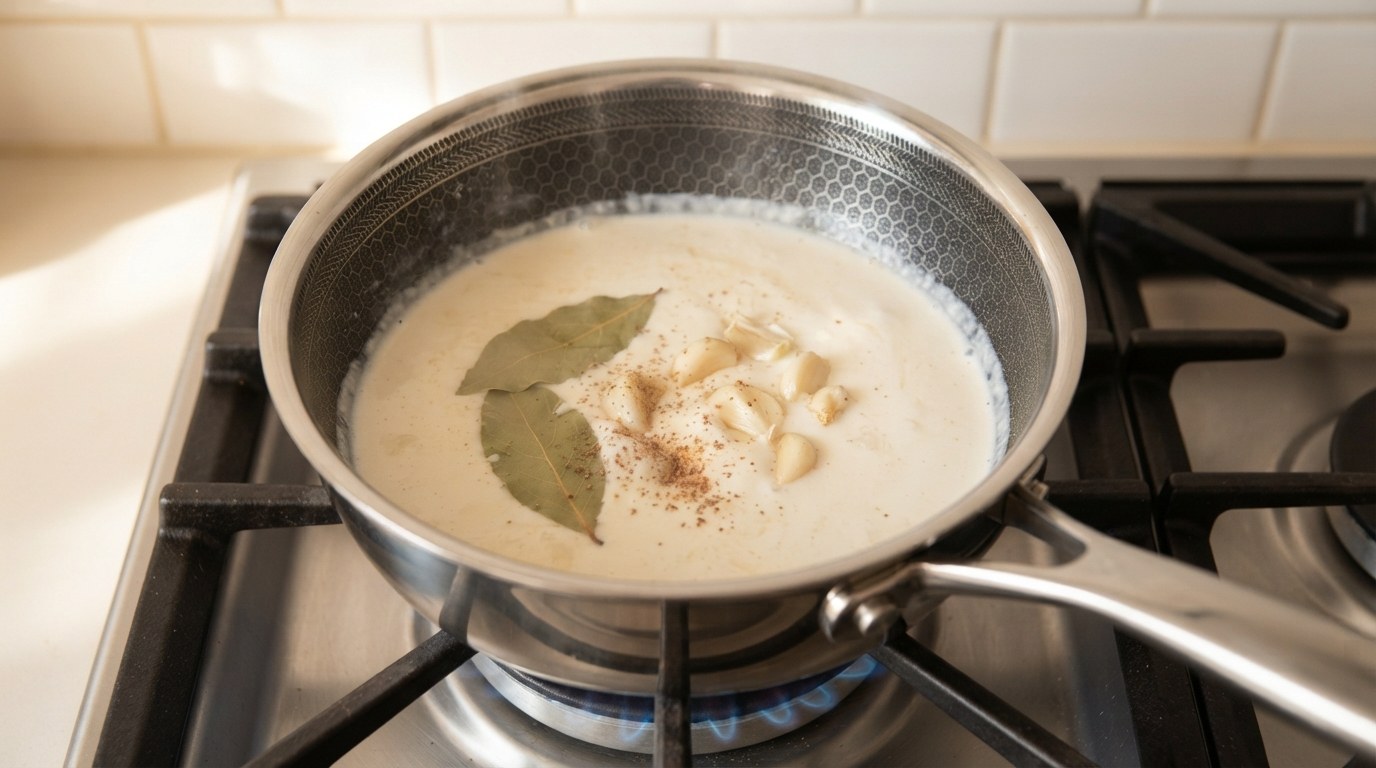
Ramsay flavors the cream before it ever touches the potatoes: heavy cream brought to a boil with bay leaves, lightly crushed garlic and a little nutmeg, reduced by about a quarter, seasoned and strained. He treats that cream as the finish that gives the purée its shine. Young garlic with small cloves is milder, so it perfumes the cream without taking over. Press the garlic against the sieve when you strain so its soft flesh goes in with the cream.
Heavy cream holds up to this because of its fat. Under federal standards, heavy cream must contain at least 36 percent milkfat, and dairy above about 25 percent fat can boil without curdling. Reducing it concentrates that fat even further. Keep the cream warm until you use it: cold cream chills the potatoes, the starch firms up as it cools, and you end up beating the purée longer to smooth it out, which is the one thing you want to avoid.
Rice Your Pomme Purée, Never Blend It
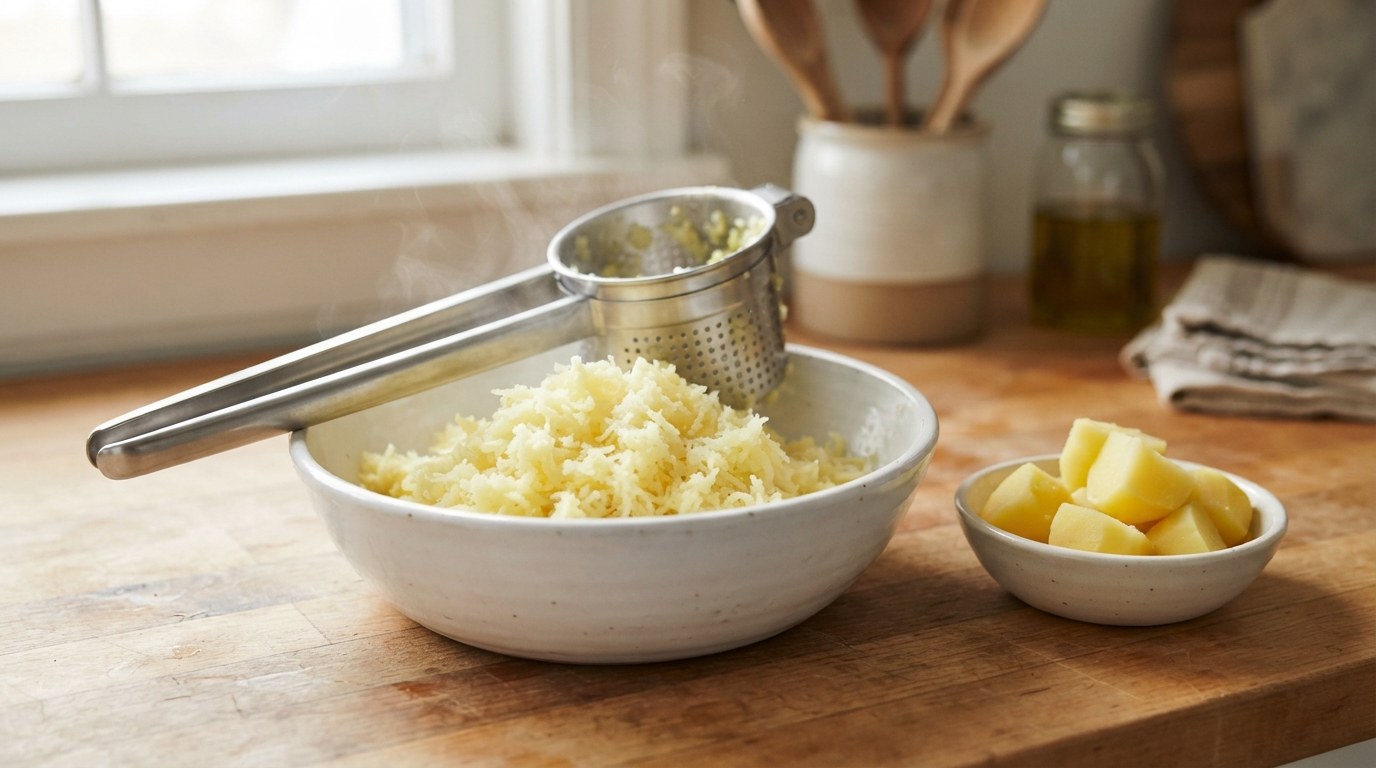
A potato ricer is the tool that makes pomme purée possible at home. Once cooked, each potato cell is packed with swollen, gelatinized starch. A ricer pushes the potato through small holes and separates the cells without tearing them open. A blender, food processor or electric mixer does the opposite: the blades rupture the swollen starch granules, the free starch strands tangle together, and the purée turns gluey and elastic in seconds. No amount of cream fixes that.
Rice the potatoes while they're hot, when the cells separate most easily. For the Robuchon level of silk, push the riced potato through a fine-mesh sieve with a flexible scraper as well; it's slower, but it catches every last fiber. No ricer? A food mill on its finest disk works, and a fine sieve and a spatula work on their own with more elbow grease.
OXO
OXO Good Grips Stainless Steel Potato Ricer
- Stainless steel basket presses cooked potato into fine, even strands without smearing the starch
- Soft handles absorb the pressure, and a non-slip knob hooks the ricer over a bowl or pot
- Also rices carrots, cauliflower and yams; dishwasher safe
Add the Cream First, Then Cold Butter
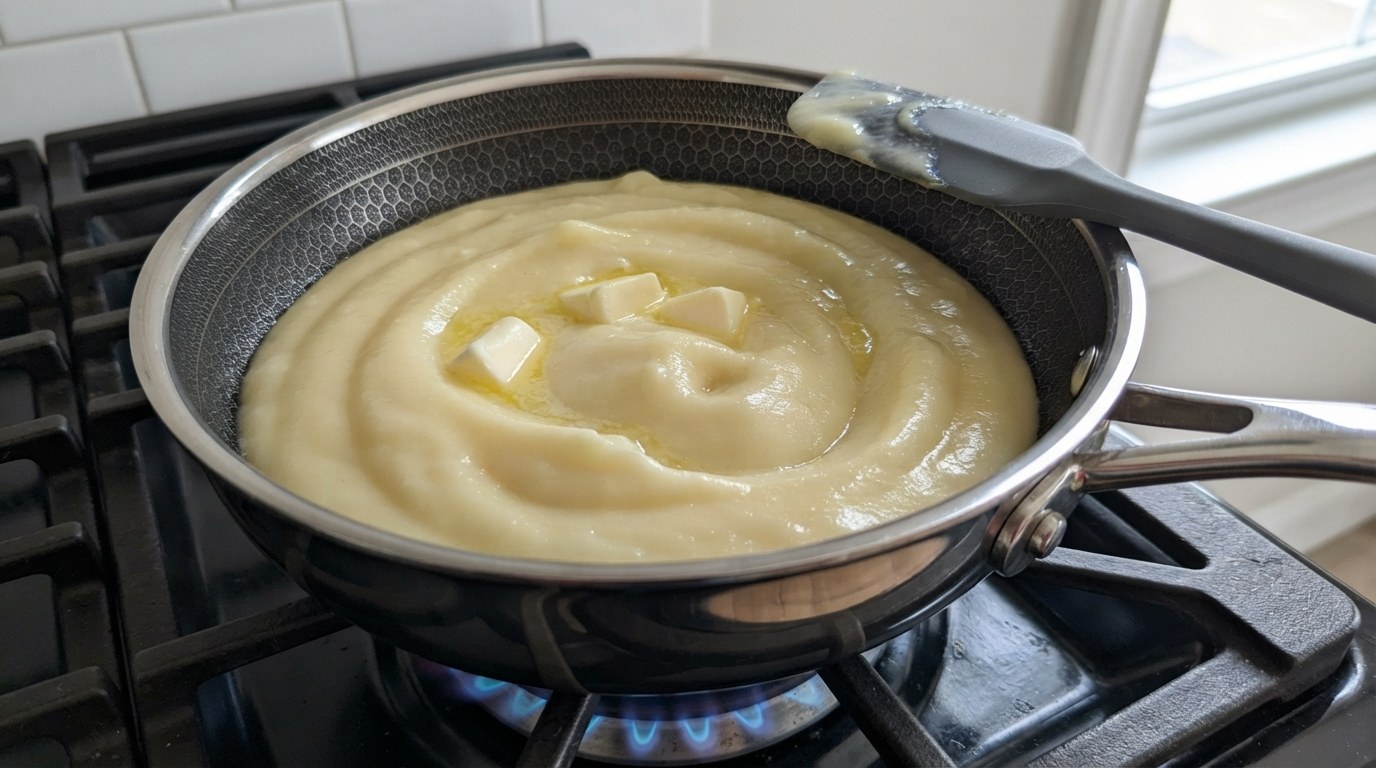
Fold the warm infused cream into the riced potatoes in thirds, then work in cold, cubed butter a few pieces at a time. That's the order Ramsay teaches, and it fits the old rule of fat before liquid, because what goes into the potato first is a cream that's more than 40 percent fat once reduced. The fat coats the starch and keeps it from turning pasty as you stir. Cold butter melts slowly as you beat it in, so it emulsifies into the purée and turns it glossy instead of leaving it greasy.
Stir with a rubber spatula or a wooden spoon, gently at first and then more briskly once the butter goes in. Stop when the purée is smooth, glossy and just loose enough to slide off the spatula. Taste, then season with salt and white pepper (black specks show in a pale purée), and fold in a few thinly sliced scallions if you like.
How much butter is up to you. This recipe keeps close to Ramsay's lighter ratio, about 4 tablespoons of butter for 2 pounds of potatoes plus the cream. For the richer Paris style, keep beating in cold butter until you reach a full stick or more; the purée will be silkier and heavier, and you'll want smaller portions.
How to Make Pomme Purée Ahead and Reheat It
You can make pomme purée a couple of hours ahead: keep it hot in a covered pot, then loosen it with a splash of warm cream before serving, the approach MasterClass describes for Ramsay's version. As cooked potato cools, its starch retrogrades, slowly recrystallizing and firming, which is why cold purée turns stiff and grainy. Fat gets in the way of that process, so a buttery purée comes back to life far better than a lean mash.
For food safety, hold it at 140°F (60°C) or above, or cool it and refrigerate it within 2 hours, per the USDA's danger zone guidance. Leftovers keep 3 to 4 days in the fridge, and the USDA leftovers guide says to reheat them to 165°F (74°C). Warm the purée slowly over low heat with a little cream, stirring gently, or it will scorch on the bottom.
What to Serve With Pomme Purée
Pomme purée goes under anything with a sauce or a crisp skin. MasterClass notes Ramsay likes this garlic version with fish and infuses the cream with basil when it goes with steak. Try it with our pan-roasted halibut, crispy skin salmon or a filet mignon, or spoon it beside the crispy five-spice duck from the same MasterClass course. For another silky side in the same style, see the Gordon Ramsay cauliflower purée or the sweet potato purée, and if you're weighing the course itself, read whether MasterClass is worth it for cooking.
Get the potato, the gentle simmer, the ricer and the order of cream and butter right, and Gordon Ramsay's pomme purée comes out silky every time. Browse more recipes for the main course to go with it.
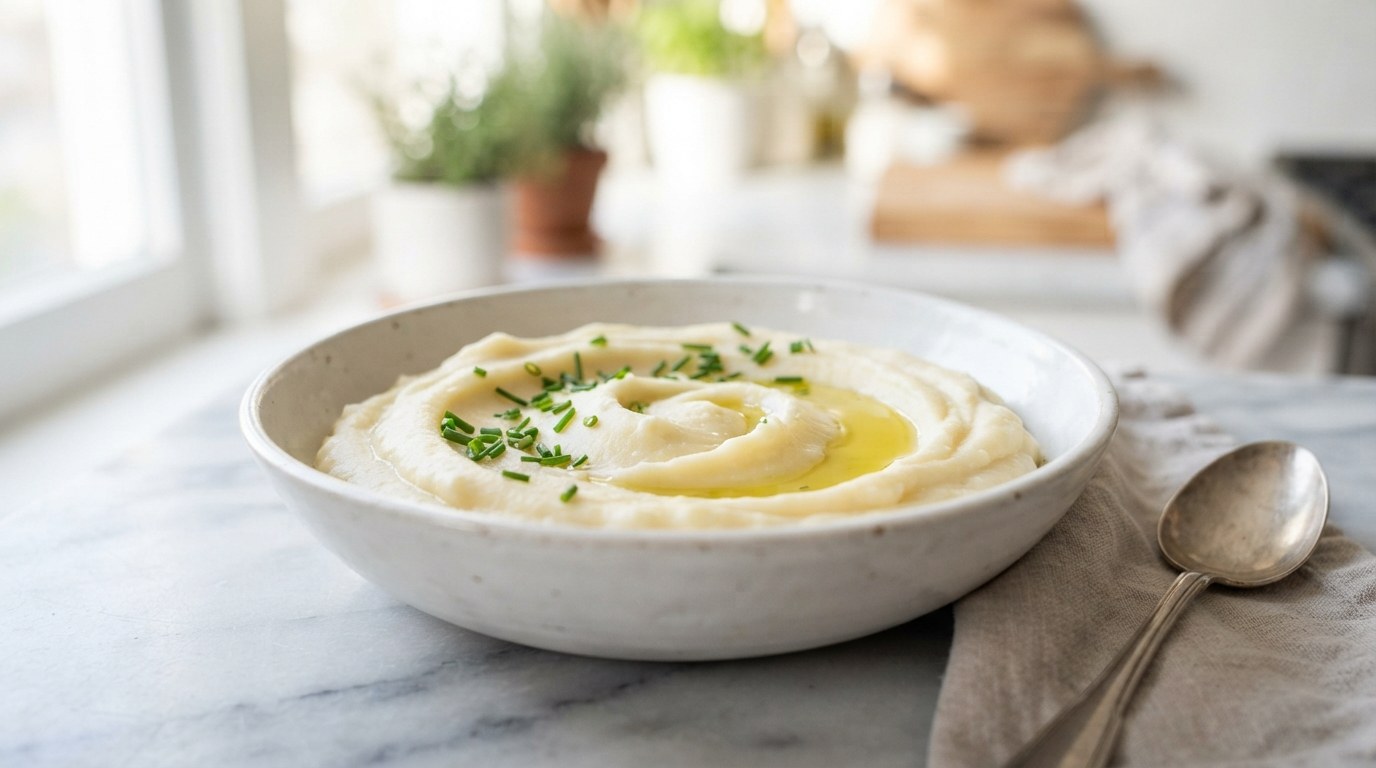
Gordon Ramsay's Pomme Purée
Ingredients
Infused cream
- 1 1/4 cups heavy cream
- 2 bay leaves
- 6 garlic cloves, lightly crushed
- 1/4 tsp freshly grated nutmeg
- Kosher salt, to taste
Potatoes
- 2 lb Yukon Gold potatoes (900 g), peeled and cut into 3/4-inch dice
- 1 Tbsp kosher salt, for the cooking water
- 4 Tbsp cold unsalted butter, cubed
- 2 scallions, thinly sliced (optional)
- Ground white pepper, to taste
To finish
- 2 Tbsp finely sliced chives
- 1 Tbsp extra-virgin olive oil
Instructions
- Rinse the diced potatoes in cold water. Put them in a saucepan, cover with cold water by about an inch and add the tablespoon of salt.
- Cover and bring to a boil over medium-high heat, then turn the heat down to a gentle simmer. Cook 10 to 15 minutes, until a cube crushes easily under the back of a spoon. Do not let it boil hard.
- Meanwhile, put the cream, bay leaves, garlic and nutmeg in a small saucepan. Bring to a boil, then simmer 3 to 5 minutes, until reduced by about a quarter. Season lightly with salt, strain into a jug, pressing the garlic through the sieve, and keep warm.
- Drain the potatoes for 30 seconds, return them to the hot pan, cover and set over low heat for 1 to 2 minutes to steam off the excess water.
- Press the hot potatoes through a ricer into a warm bowl or back into the dry pan off the heat. For an extra-silky finish, push them through a fine-mesh sieve as well.
- Fold in a third of the warm cream with a rubber spatula, then another third. Beat in the cold butter a few cubes at a time until the purée is glossy, adding the rest of the cream as needed until it slowly slides off the spatula.
- Season with salt and white pepper and fold in the scallions, if using. Spoon into a warm bowl, scatter with chives, drizzle with olive oil and serve hot.
Notes
Pomme Purée FAQs
The questions that come up most: what pomme purée is, how it differs from mashed potatoes, which potatoes to use, the butter ratio, making it without a ricer, making it ahead, and why it turns gluey.
What is pomme purée?
Pomme purée is French for potato purée: potatoes cooked, pressed very fine through a ricer, food mill or sieve, and beaten with cream and butter until silky and loose enough to run off a spoon. Joël Robuchon made it famous in Paris, and Gordon Ramsay teaches his own version in his MasterClass.
What is the difference between pomme purée and mashed potatoes?
Pomme purée is smoother, glossier and looser than mashed potatoes. It is always riced or sieved rather than mashed, so it has no lumps, and it is finished with more cream and butter. Mashed potatoes are fluffier and hold their shape.
What are the best potatoes for pomme purée?
Yukon Gold. It is an all-purpose potato with a balance of waxy and mealy starches, so it purées dense, buttery and smooth. Russets also work but come out lighter and need a little more cream. Robuchon used the French La Ratte potato.
What is the butter ratio for pomme purée?
Ramsay's modern method keeps fat to about 10 percent of the dish, roughly 4 tablespoons of butter plus about a cup of reduced cream for 2 pounds of potatoes. The classic Paris version ran closer to 60 percent potato and 40 percent butter and cream.
Can you make pomme purée without a ricer?
Yes. Use a food mill on its finest disk, or push the cooked potatoes through a fine-mesh sieve with a spatula. Never use a blender or food processor; the blades burst the starch granules and turn the purée gluey.
Can you make pomme purée ahead of time?
Yes, a couple of hours ahead. Keep it hot (140°F or above) in a covered pot and loosen it with warm cream before serving. Leftovers keep 3 to 4 days in the fridge; reheat gently to 165°F with a splash of cream.
Why is my pomme purée gluey?
It was overworked, usually in a blender, food processor or mixer, which ruptures the swollen starch granules and releases sticky starch. Boiling the potatoes too hard or adding cold cream, which means more beating, can also push it that way. Rice the potatoes hot and fold in warm cream.

About the Author
John Siracusa is the founder of Hell’s Kitchen Recipes. He focuses on technique-first, reproducible home cooking and researches recipes & kitchen equipment from published food science and professional chef methods since 2016.