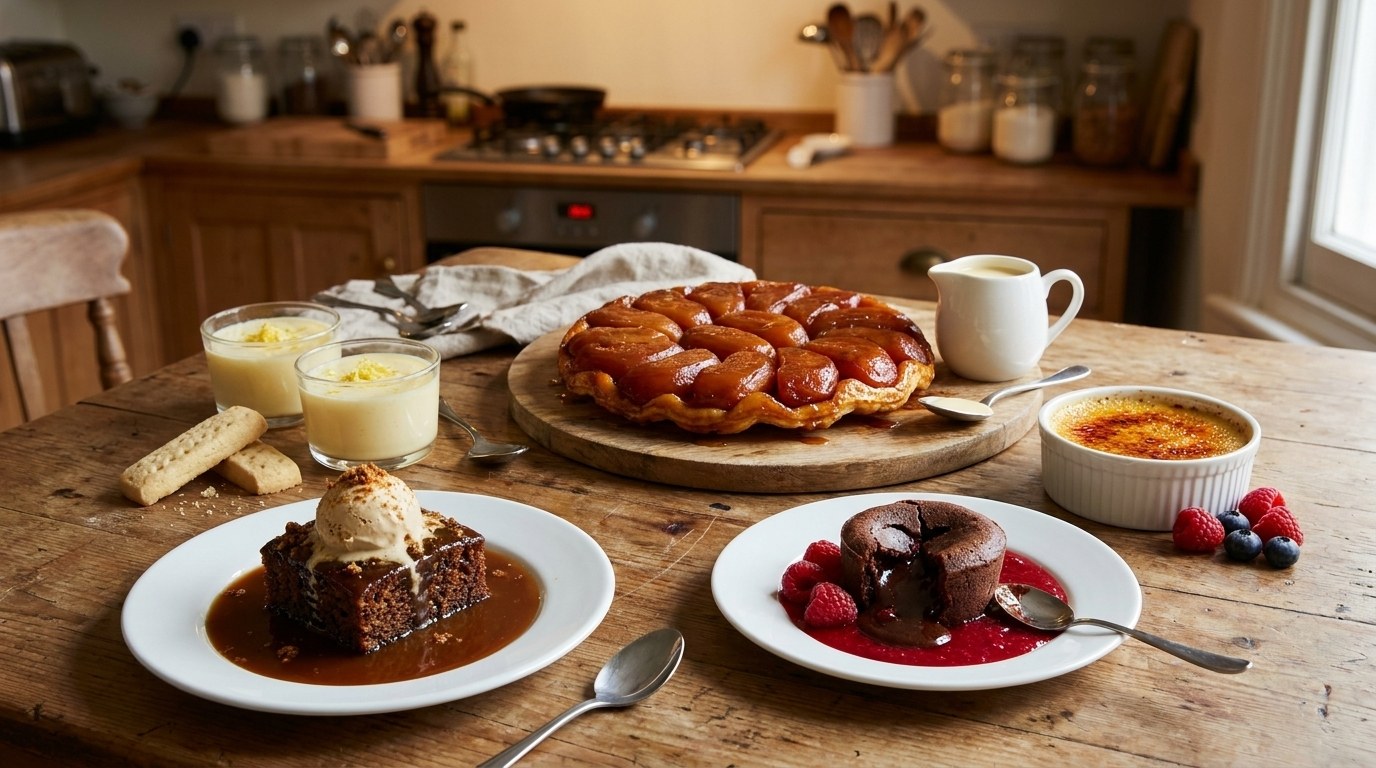
These five Gordon Ramsay desserts are the ones worth making for a dinner party: sticky toffee pudding, a chocolate fondant with a molten center and raspberry coulis, lemon posset with shortbread, vanilla crème brûlée with fresh berries, and an apple tarte tatin with crème anglaise. All five are desserts Ramsay has published or served: the sticky toffee pudding and chocolate fondant from his recipes, the lemon posset from his F Word cookbook, a crème brûlée from his restaurant kitchens, and the apple tarte tatin from his Bread Street Kitchen book and the Savoy Grill menu. Each has its own full recipe on this site, linked below.
What they share is the reason they suit a dinner party. Four of the five are made hours or days ahead, and the fifth, the fondant, can be mixed and sitting in its ramekins in the fridge before anyone arrives. Each entry below gives the key numbers, the one bit of kitchen science that makes the dessert work, and the make-ahead window. Where Hell's Kitchen Recipes already has the full recipe, you get a summary and a link rather than a second copy.
Gordon Ramsay Desserts at a Glance: What to Make Ahead
The easiest dinner party dessert is the one that is finished before the doorbell rings. Lemon posset and crème brûlée are fully made a day or two ahead and only need the torch or a garnish; sticky toffee pudding is baked ahead and rewarmed; the tarte tatin is baked that afternoon; and the chocolate fondant is mixed ahead but baked in the 10 to 12 minutes while you clear the main course. This table sorts the five by how far ahead you can go and the one temperature each one turns on.
| Dessert | Served | Make ahead | Last-minute job | The number that matters |
|---|---|---|---|---|
| Sticky toffee pudding | Warm | Sponge 1 day; sauce several days, chilled | Rewarm, pour the sauce | Bake at 350°F until a skewer is clean (about 200 to 205°F inside) |
| Chocolate fondant | Hot | Batter in the ramekins, up to 1 day, chilled | Bake 10 to 12 minutes, turn out | Edges past 144 to 158°F (egg sets), center still liquid |
| Lemon posset | Cold | Fully, up to 2 days | Plate the shortbread | Cream at least 36% fat, boiled 3 minutes |
| Vanilla crème brûlée | Cold top, torched | Custards up to 2 days | Sugar and torch, 1 to 2 minutes each | Custard sets around 170 to 180°F; sugar caramelizes from about 320°F |
| Apple tarte tatin | Warm | Bake that afternoon; crème anglaise 1 to 2 days | Rewarm in the pan, turn out | Caramel to light amber, about 355 to 360°F |
If you can only make one, make the posset: three ingredients, ten minutes of work, and nothing to do on the night. If you want one dramatic moment at the table, the fondant is it, and its batter waits happily in the fridge. Serving a pregnant guest, a young child or anyone with a weakened immune system? Read the safety note in the fondant section first.
Sticky Toffee Pudding
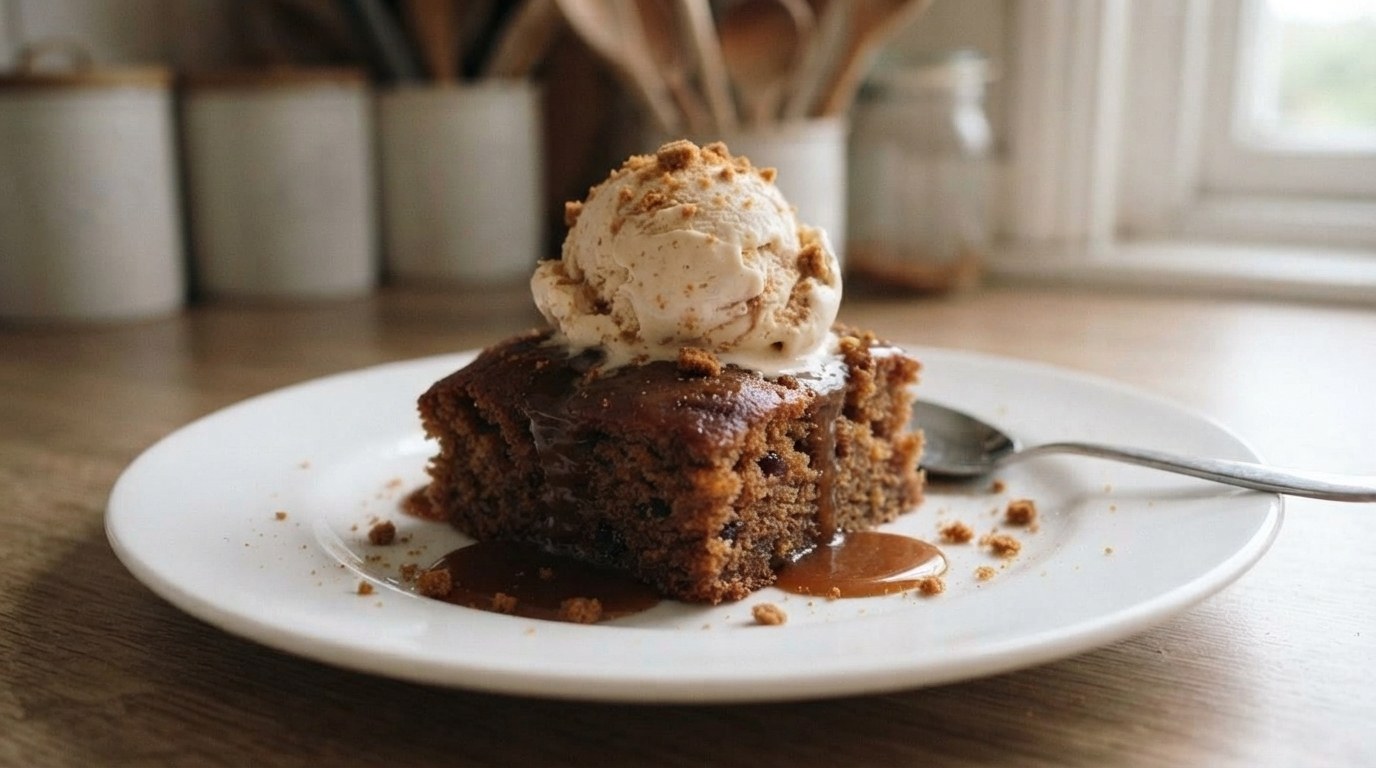
Sticky toffee pudding is the dessert most tied to Gordon Ramsay: it sits on the dessert menu at his Hell's Kitchen restaurant in Lake Tahoe, served with Biscoff ice cream, and he publishes his own versions of it. It is a moist date sponge, baked in an 8-inch square pan at 350°F for 30 to 35 minutes, poked all over and soaked with a butter, dark brown sugar and cream toffee sauce, then served warm. The version most people know was made famous in the 1970s at the Sharrow Bay hotel in England's Lake District, though exactly where it started is still argued over.
The science sits in the dates. They soak in boiling water with baking soda, and the alkaline water breaks down pectin, the glue between plant cells, so the tough skins melt into the batter. That same alkalinity speeds Maillard browning, which starts around 284°F at the surface, so the sponge bakes up a deep mahogany instead of tan. For a dinner party it may be the most forgiving dessert on this list: bake the sponge a day ahead, keep the sauce in a jar in the fridge, and rewarm both before serving. The unsauced sponge also freezes for up to 3 months.
Full recipe: Gordon Ramsay Sticky Toffee Pudding (Hell's Kitchen-Style) (with no-churn Biscoff ice cream, 9 squares)
Chocolate Fondant with Raspberry Coulis
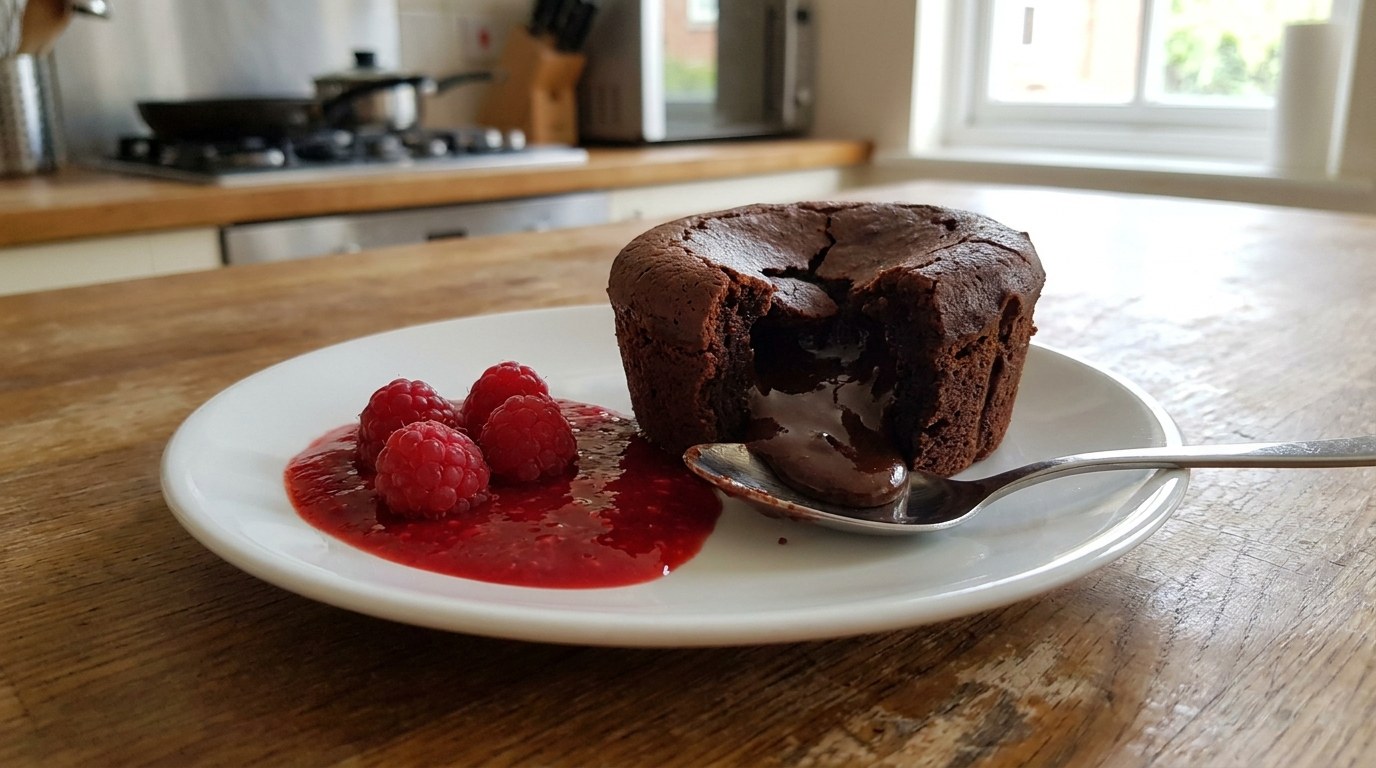
A chocolate fondant (the American name is molten lava cake) is a small chocolate cake baked just long enough for the outside to set while the middle stays liquid, so it pours out when you cut in. Ramsay's own fondant recipe bakes it at 190°C (375°F) for about 9 minutes and calls it ready when only the very middle moves as you shake the mold. That shake test is the whole technique; the clock only gets you close.
Why it works: egg proteins set at fixed temperatures. According to the American Egg Board, egg white sets between 144 and 149°F and yolk between 149 and 158°F. In a hot oven the batter near the ramekin walls passes that range within minutes and turns to cake, while heat is still traveling toward the center, which stays below it and molten. Leave it two minutes too long and the set layer reaches the middle, and you have a perfectly nice chocolate cake with no lava. That is why the ramekins are buttered and dusted with cocoa (a clean release), filled to the same level (even timing), and why it pays to bake one test fondant in your oven first.
- 4 oz (115 g) dark chocolate, 60 to 70% cocoa, chopped
- 1/2 cup (115 g) unsalted butter, plus extra for the ramekins
- 2 large eggs and 2 large egg yolks (pasteurized if needed, see below)
- 1/4 cup (50 g) sugar and a pinch of salt
- 2 Tbsp all-purpose flour, plus cocoa powder for the ramekins
- For the coulis: 2 cups (250 g) raspberries, 3 Tbsp sugar, 1 tsp lemon juice, plus a few whole raspberries to serve
Butter four 6-ounce ramekins well and dust them with cocoa. Melt the chocolate and butter together over barely simmering water, then cool for 5 minutes. Whisk the eggs, yolks, sugar and salt until pale and thick, fold in the chocolate, then fold in the flour until no streaks remain. Divide among the ramekins (they can now be covered and chilled for up to a day). Bake on a sheet pan at 375°F for 10 to 12 minutes, a minute or two longer if fridge-cold, until the tops are set and only the center wobbles. Rest 1 minute, run a thin knife around the edge and turn each one out onto a plate. For the coulis, blend the raspberries with the sugar and lemon juice, push through a sieve to remove the seeds, and spoon a pool beside each fondant with a few whole berries.
Food safety: the liquid center is egg that has not reached the 160°F the FDA recommends for egg dishes. For most healthy adults that is a familiar, accepted risk, but the FDA advises using pasteurized shell eggs or pasteurized egg products in any recipe served raw or undercooked, and it names children, older adults, pregnant women and people with weakened immune systems as the groups at greater risk. If any of them are at the table, use pasteurized eggs, which many US supermarkets stock, or bake their fondant a few minutes longer until set through.
Lemon Posset with Shortbread
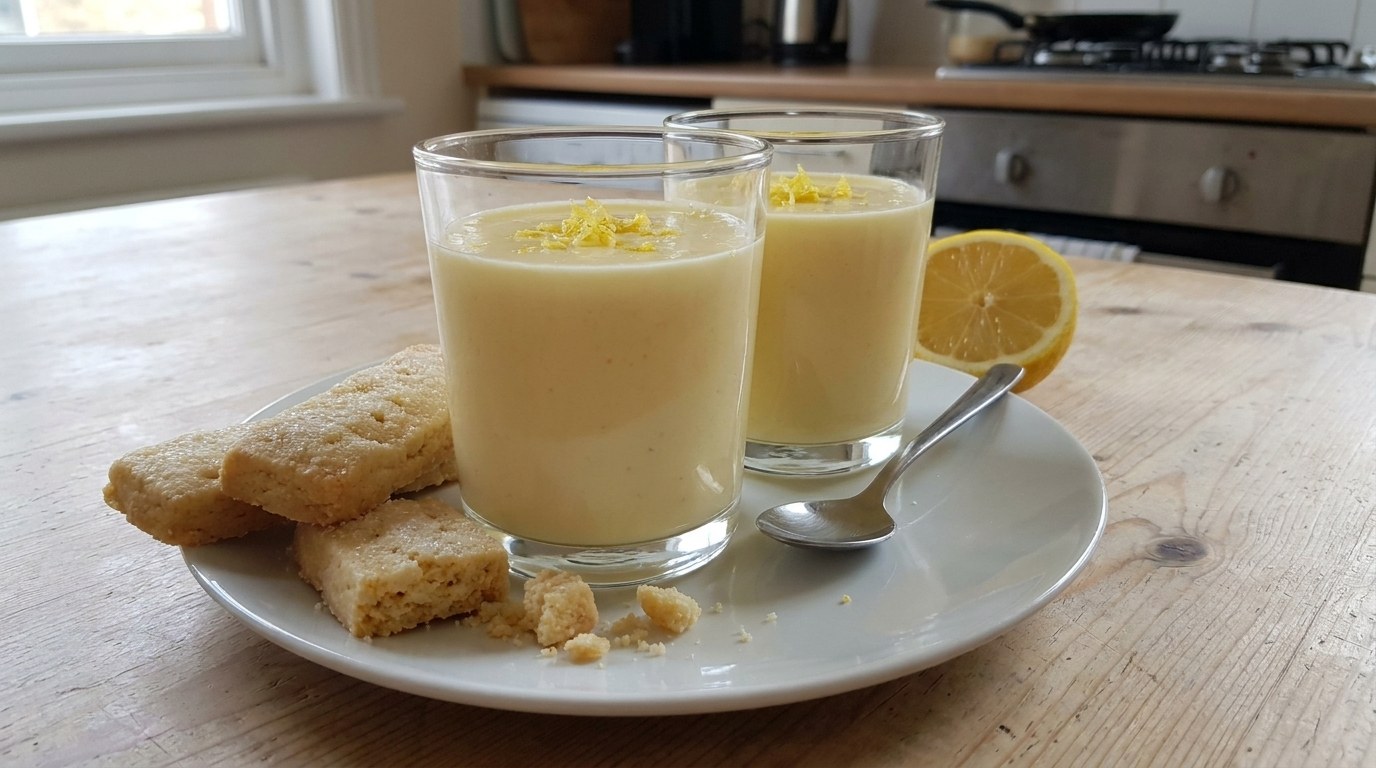
Lemon posset is a British set cream made from just heavy cream, sugar and lemon juice: you boil the sweetened cream for a few minutes, stir in the juice, pour it into glasses and chill it, and it sets silky and spoonable with no eggs or gelatin. Served with a crisp shortbread finger for contrast, it is the easiest impressive dessert on this page, and it has to be made ahead, which is exactly what a dinner party needs.
It sets because of acid, and it only sets smoothly because of fat. Lemon juice drops the pH of the hot cream and the milk's casein proteins unwind and link into a soft gel, the same denaturing that heat does by a different route. America's Test Kitchen explains that the cream's fat, at least 36%, gets between those proteins and stops them clumping into curds, so you get a set cream instead of cottage cheese. That 36% is the legal minimum for heavy cream in the US (21 CFR 131.150), so buy heavy cream or heavy whipping cream; half-and-half or light cream will curdle or stay runny. Boiling for 3 minutes matters too: it evaporates water and denatures the whey proteins, which gives a firmer set. A posset that won't set has almost always had too little boil, too little lemon, or too lean a cream.
- 2 cups (480 ml) heavy cream, 36% fat or more
- 2/3 cup (130 g) sugar
- 1/3 cup (80 ml) fresh lemon juice (about 2 lemons) and the finely grated zest of 1 lemon
- For the shortbread: 1 cup (225 g) softened unsalted butter, 1/2 cup (100 g) sugar, 2 cups (250 g) all-purpose flour, 1/4 tsp salt
Bring the cream and sugar to a boil in a large saucepan (it rises, so give it room), stirring until the sugar dissolves, then let it bubble steadily for 3 minutes, stirring. Take it off the heat, stir in the lemon juice and most of the zest, and rest 10 minutes. Pour into four to six small glasses, cool, cover and chill at least 3 hours, or up to 2 days; scatter the last of the zest on top to serve. For the shortbread, beat the butter and sugar, work in the flour and salt, press into an 8-inch square pan, prick all over with a fork and bake at 325°F for 30 to 35 minutes until pale gold. Cut into fingers while warm and let them cool in the pan. For a lemon posset brûlée, sprinkle a thin layer of sugar on the chilled posset and torch it just before serving, the same way as the crème brûlée below.
Full recipe: Gordon Ramsay Lemon Posset (with shortbread, set in 3 hours, citrus swaps and the brûlée version)
Vanilla Crème Brûlée with Fresh Berries
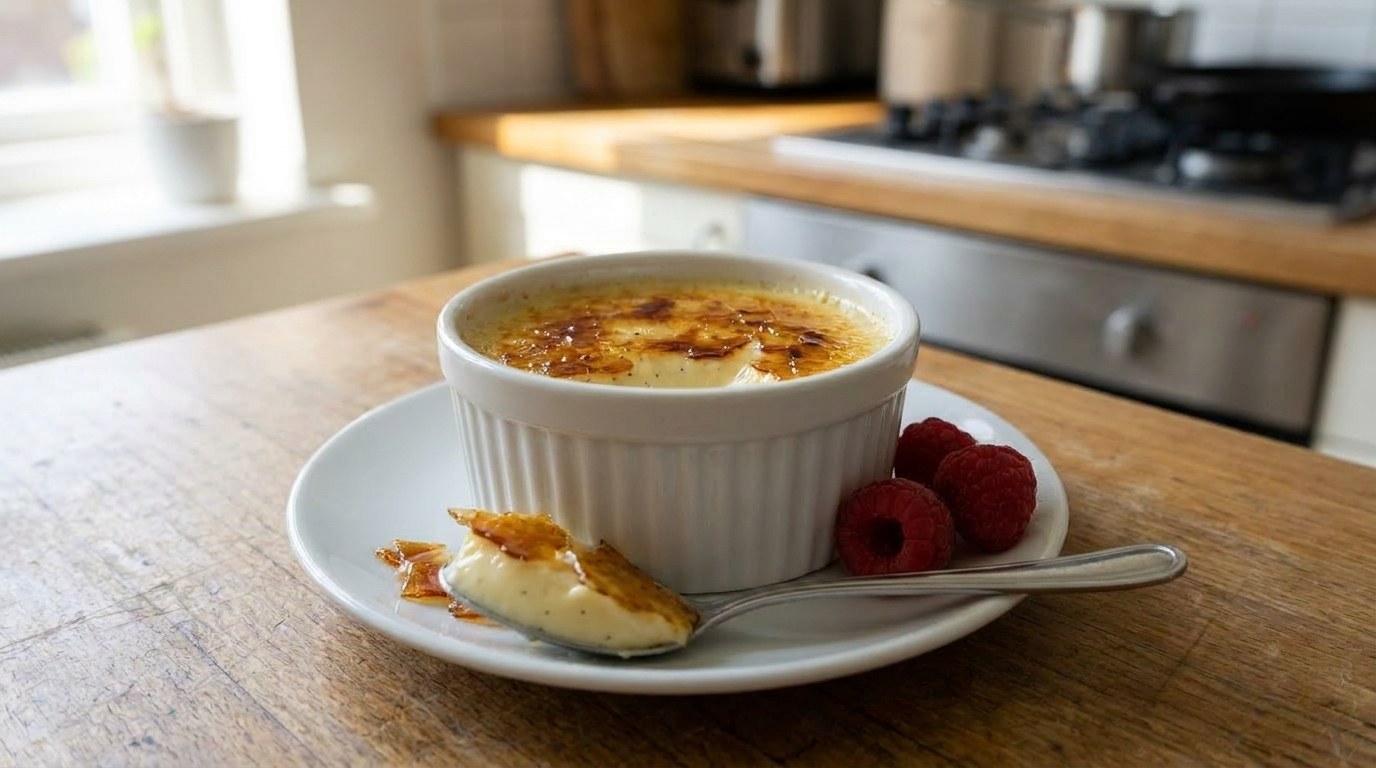
Vanilla crème brûlée is a baked custard of cream, egg yolks, sugar and vanilla, chilled until cold and firm, then covered with a thin layer of sugar that you caramelize with a torch into a glassy top that cracks under the spoon. Our full recipe bakes the custards in a water bath at 300°F for 30 to 35 minutes, until the edges are set and the centers still jiggle, and a handful of fresh raspberries and blueberries on the side cuts through the richness.
Two temperatures decide it. The custard sets at around 170 to 180°F, well above the 144 to 158°F where plain egg sets, because sugar and cream dilute the yolk proteins and push their setting point up (the American Egg Board notes that sugar raises the coagulation temperature). That higher, wider window plus the gentle water bath, which can't climb past 212°F, is what keeps it silky instead of scrambled. The top is the opposite job: table sugar starts to caramelize from about 320°F and burns from around 356°F, so the torch has to deliver a lot of heat to the surface fast without warming the custard underneath. Keep the flame moving and stop at deep amber.
Iwatani
Iwatani PRO2 Culinary Butane Torch
- Adjustable flame size and shape, so you can spread a soft flame over a whole ramekin of sugar or narrow it for one dark spot
- One-touch piezo ignition and a stabilizing stand, so it sits upright on the counter between custards
- Also browns meringue and crisps cheese toppings; refills with standard butane (fuel sold separately)
For a dinner party, bake the custards up to 2 days ahead and keep them covered in the fridge. Torch them no more than an hour before serving: sugar is hygroscopic, meaning it pulls in water, so a caramel top left sitting on cold custard slowly draws moisture from it and turns soft and weepy. No torch? A very hot broiler for 1 to 2 minutes works, watched constantly, though it warms the custard more. For an autumn menu, our pumpkin crème brûlée uses the same method with pumpkin and spice.
Full recipe: Gordon Ramsay's Crème Brûlée (water bath at 300°F, start checking at 25 minutes, chill at least 4 hours)
Apple Tarte Tatin with Crème Anglaise
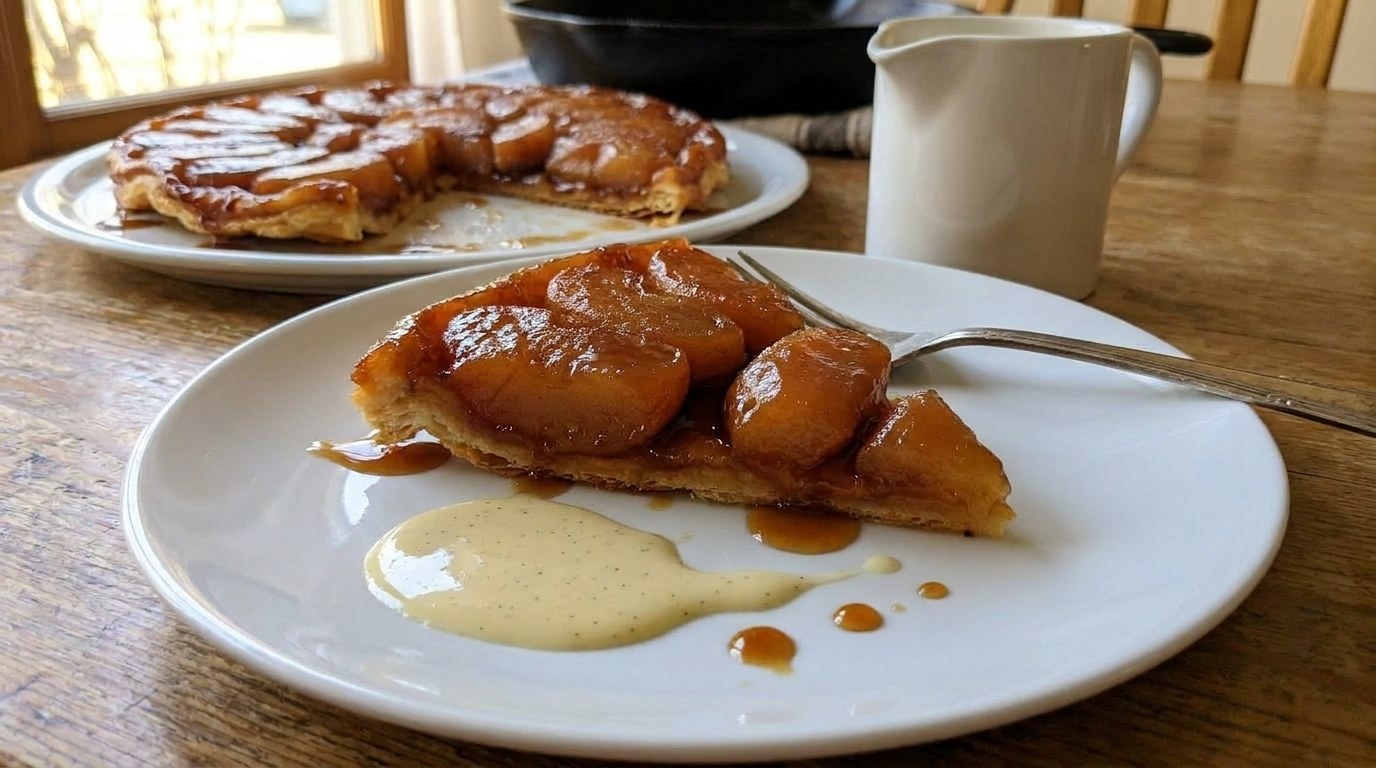
Apple tarte tatin is a French upside-down tart: apples are cooked in caramel in an oven-safe skillet, covered with a round of puff pastry, baked, and then turned out so the glossy caramelized apples end up on top of a crisp pastry base. Poured with cold crème anglaise, a thin vanilla custard sauce, it gives you warm and cold, crisp and soft on one plate, and it bakes in the afternoon while you get the rest of dinner ready.
The caramel is the flavor and the risk. Sugar caramelizes, breaking down into hundreds of new aroma compounds, from roughly 320 to 338°F, and America's Test Kitchen takes its tatin caramel to a light amber at 355 to 360°F before the apples go in. Much past 400°F it turns bitter, and because it keeps cooking with the apples, stop at light amber rather than dark. The apples need to hold their shape through all that heat, which comes down to pectin, the glue between their cells. Heat dissolves it, but acid and sugar firm it up, so tart, firm apples (Granny Smith, Braeburn, Honeycrisp, or the Gala and Golden Delicious ATK uses) cooked in a heavy sugar syrup stay in wedges where a soft eating apple would turn to sauce. Cooking them on the stovetop first also drives off water, so the finished tart isn't swimming in juice.
- 6 to 7 firm apples, peeled, quartered and cored
- 3/4 cup (150 g) sugar
- 4 Tbsp (60 g) unsalted butter, cubed, and a pinch of salt
- 1 sheet all-butter puff pastry, thawed and cut to an 11-inch round
- For the crème anglaise: 1 1/2 cups whole milk, 1/2 cup heavy cream, 4 large egg yolks, 1/3 cup sugar, 1 tsp vanilla extract
Spread the sugar evenly in a 10-inch cast-iron or other oven-safe skillet over medium heat and cook, swirling rather than stirring, until it melts and turns light amber. Off the heat, stir in the butter and salt (it will foam). Pack the apple quarters in tightly, rounded side down, in circles, since they shrink. Return to medium heat for 12 to 15 minutes, spooning the caramel over, until the juices have cooked down and the caramel is thick and deep amber. Cool 10 minutes, lay the pastry over the top, tuck the edge down inside the pan and cut three small vents. Bake at 400°F for 25 to 30 minutes, until the pastry is puffed and deep golden. Rest 5 minutes, run a knife around the edge, set a plate over the skillet and, wearing oven mitts, turn it over in one confident move. To make it ahead, leave it in the skillet and rewarm on the stovetop for a few minutes to loosen the caramel before turning it out.
For the crème anglaise, heat the milk and cream until steaming, whisk the yolks with the sugar, then whisk the hot milk into the yolks in a thin stream. Return it to low heat and stir constantly until it thickens enough to coat a spoon, about 170 to 175°F; take it off at that point, because the yolks start to scramble as it climbs toward 180°F. Strain it into a cold bowl, stir in the vanilla, and chill, covered, for up to 2 days. It has passed the 160°F the FDA sets for egg dishes, so it is safe for every guest.
Full recipe: Gordon Ramsay Apple Tarte Tatin (puff pastry, which apples to use, when to flip it, crème anglaise)
How to Plan Gordon Ramsay Desserts for a Dinner Party
Plan one dessert per guest at a sit-down dinner and pick it by what the rest of the menu needs from your oven. After a rich main such as a beef Wellington, the cold, sharp lemon posset is the lightest finish; after a lighter meal, the sticky toffee pudding or tarte tatin carries the evening. If you started with one of our Gordon Ramsay appetizers that needs the oven at the last minute, choose a dessert that is already done, like the posset or the crème brûlée.
A workable timeline for these make-ahead desserts: two days out, make the posset or bake the crème brûlée custards and the crème anglaise. The day before, bake the sticky toffee sponge and the shortbread, or fill the fondant ramekins. That afternoon, bake the tarte tatin. During the main course, take the fondants out of the fridge and heat the oven; once the plates are cleared, bake them, torch the brûlées or rewarm the pudding and sauce. Keep anything with cream or eggs in the fridge at 40°F or below until it's served, and don't leave it out more than 2 hours, the FDA's limit for egg dishes.
More Gordon Ramsay Desserts on Hell's Kitchen Recipes
Beyond these five, Hell's Kitchen Recipes has more Gordon Ramsay desserts with full recipe cards. The raspberry soufflé from his MasterClass is the last-minute showpiece, the banoffee pie is a no-bake make-ahead, and the French toast bread pudding and apple crisp with oats are the relaxed, family-style options. For something to pass around with coffee, try the blondies. Every dessert on the site is collected in our baking and desserts section.
Gordon Ramsay Dessert FAQs
The questions that come up most: what dessert Gordon Ramsay is known for, which desserts can be made ahead for a dinner party, what the easiest impressive dessert is, whether chocolate fondant can be made ahead, whether the runny center is safe, why a lemon posset won't set, and how to make crème brûlée without a torch.
What dessert is Gordon Ramsay known for?
Sticky toffee pudding is the dessert most tied to him: it is on the dessert menu at his Hell's Kitchen restaurant in Lake Tahoe, served with Biscoff ice cream, and he publishes his own recipes for it. His restaurant group also publishes a recipe for chocolate fondant, the molten-centered chocolate cake.
What are the best make-ahead desserts for a dinner party?
Lemon posset and crème brûlée can be finished up to 2 days ahead and only need a garnish or a quick torch. Sticky toffee pudding can be baked a day ahead and rewarmed with its sauce, a tarte tatin can be baked that afternoon, and chocolate fondant batter can wait in its ramekins in the fridge for up to a day before a 10 to 12 minute bake.
What is the easiest impressive dessert to make?
Lemon posset. It is heavy cream and sugar boiled for 3 minutes, stirred with lemon juice and chilled in glasses for at least 3 hours. There are no eggs or gelatin, it can be made 2 days ahead, and with a shortbread finger on the side it looks like a restaurant dessert.
Can you make chocolate fondant ahead of time?
Yes. Mix the batter, fill buttered and cocoa-dusted ramekins, cover and refrigerate for up to 24 hours. Bake straight from the fridge at 375°F, adding a minute or two to the usual 10 to 12 minutes, until the tops are set and only the center wobbles. Bake one test fondant first, because ovens vary.
Is the runny center of a chocolate fondant safe to eat?
The center is egg that has not reached the 160°F the FDA recommends for egg dishes. The FDA advises pasteurized eggs or egg products for any dish served undercooked, and says children, older adults, pregnant women and people with weakened immune systems are at greater risk. Use pasteurized eggs for those guests, or bake their fondant until set through.
Why didn't my lemon posset set?
Usually one of three things: the cream was too lean (use heavy cream with at least 36% fat; half-and-half won't set), it wasn't boiled long enough (3 minutes evaporates water and firms the set), or there wasn't enough lemon juice to drop the pH. Give it at least 3 hours in the fridge, ideally overnight.
Can I make crème brûlée without a torch?
Yes. Put the chilled, sugared custards under a very hot broiler for 1 to 2 minutes, watching constantly and turning them so the sugar caramelizes evenly. A torch gives more control and heats only the sugar, while the broiler warms the custard too, so chill them again briefly if they soften.
Is chocolate fondant the same as lava cake?
For practical purposes, yes. Chocolate fondant is the British and French name and molten lava cake the American one for a small chocolate cake baked so the edge sets and the center stays liquid. Recipes differ a little in how much flour and egg they use, but the timing trick is the same.

About the Author
John Siracusa is the founder of Hell’s Kitchen Recipes. He focuses on technique-first, reproducible home cooking and researches recipes & kitchen equipment from published food science and professional chef methods since 2016.