This apple crisp with oats has a topping that stays crunchy and a filling that holds together on the spoon, because the two problems that ruin most crisps, a soft topping and a watery layer underneath, both have plain causes. Cold butter rubbed into rolled oats, flour and brown sugar bakes into a craggy crust; firm apples tossed with a little cornstarch and lemon juice cook down into a filling that sets instead of running. It bakes at 350°F in a 9x13 dish and feeds eight to ten.
This guide covers which apples to use and why, what each ingredient in the topping is doing, why the filling gets cornstarch, how to know when the crisp is actually done, and how to store it without losing the crunch.
What Makes This Apple Crisp Crunchy on Top and Set Underneath
Four decisions matter. The apples are a mix of a tart, firm variety and a sweet, crisp one, so the filling has flavor and the slices keep some shape. The topping uses cold butter cut into the dry ingredients rather than melted butter stirred in, which bakes up craggy and open instead of dense and sandy. The filling is tossed with cornstarch and lemon juice, so the juice the apples release thickens into a glaze rather than pooling. And the crisp bakes until the filling bubbles in the center, not just at the edges, then rests 20 minutes so that glaze can set before anyone cuts into it.
Get organized before the oven goes on: peel and slice the apples last, right before they are tossed, because cut apple flesh starts browning within minutes once its cells are opened to the air. Everything else, the topping included, can be made ahead.
The Best Apples for Apple Crisp
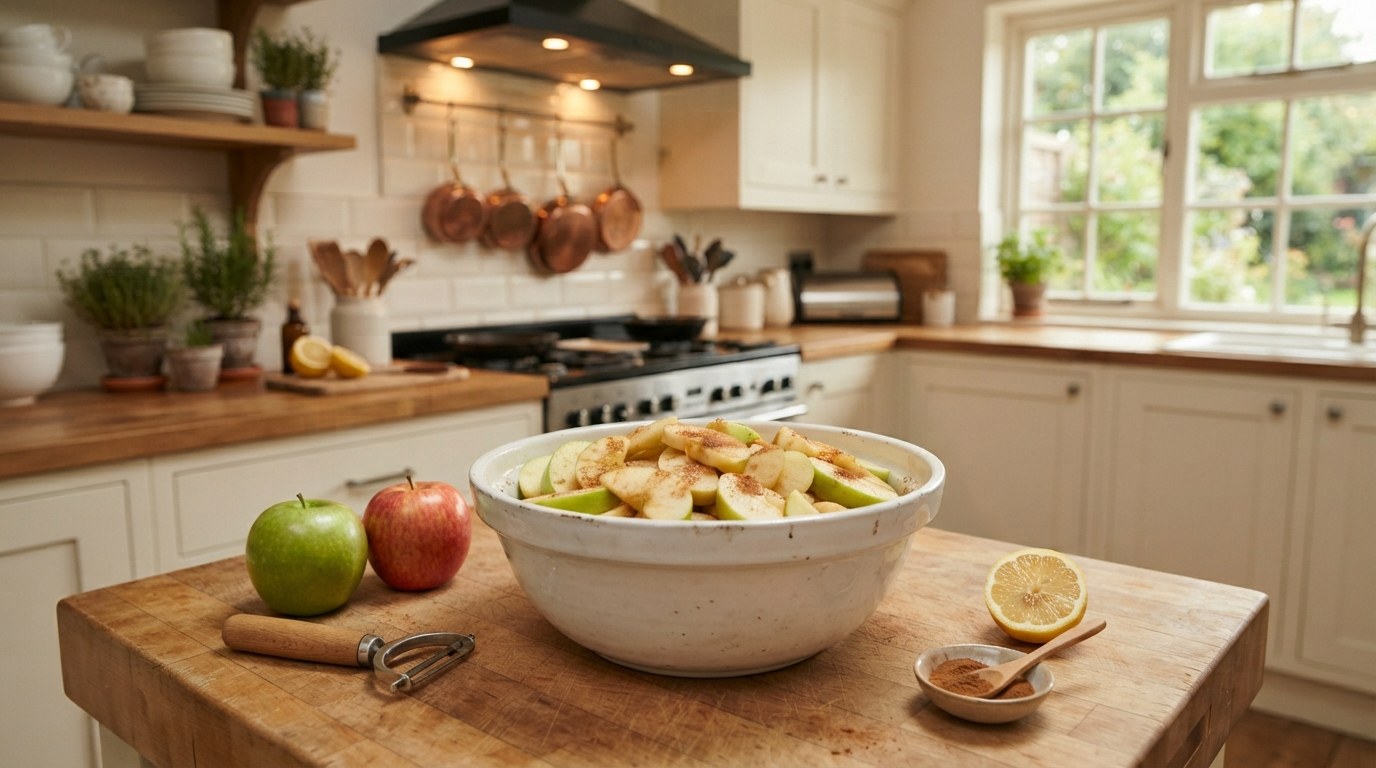
Use half Granny Smith and half Honeycrisp, about 3½ pounds in total for a 9x13 dish. Granny Smith is the backbone: USApple describes it as very tart and an all-purpose apple that works in pies and sauce, and it is one of the firmest apples in the store, so the slices soften without collapsing. Honeycrisp brings the sweetness and juice; USApple's variety page calls its crispness explosive, and it holds its shape in the oven better than most sweet apples. Braeburn, Jonagold and Pink Lady are good stand-ins for either.
The reason firmness matters is pectin, the glue between the cells of the fruit. Heat dissolves pectin, which is how any apple turns to sauce if you cook it long enough; acid and sugar strengthen it, which is why the lemon juice and sugar in the filling help the slices keep an edge. A soft, mealy apple like Red Delicious or a McIntosh has weak pectin to begin with and breaks down into mush in a 45-minute bake. If you like a saucier filling, use more McIntosh on purpose; if you want distinct slices, stay with the firm ones.
Peel the apples. The skin does not soften at the same rate as the flesh and turns into curled, leathery ribbons in the filling. Slice them about ¼ inch thick and try to keep the slices even, since thin slices dissolve while thick chunks stay crunchy in the same dish. Once they are cut, toss them with the lemon juice straight away; the acid slows the browning enzyme, and Utah State University Extension notes that ascorbic acid mixed with water does the same job if you are prepping fruit ahead.
| Ingredient | What it does | Watch out for |
|---|---|---|
| Granny Smith + Honeycrisp apples | Tart + sweet; firm pectin so the slices hold their shape | Red Delicious or McIntosh alone turn to sauce |
| Lemon juice | Slows browning; acid strengthens pectin; brightens the sugar | Skipping it makes the filling flat and one-note sweet |
| Cornstarch | Thickens the released juice into a glaze as it gelatinizes | Flour needs twice as much and tastes pasty |
| Brown sugar | Sweetens and caramelizes on the topping; adds molasses flavor | It pulls moisture from the air, so a covered crisp softens overnight |
| Old-fashioned rolled oats | Whole flakes toast into the crunch | Quick oats go pasty; steel-cut stay hard |
| Cold unsalted butter | Its water steams the crumb open; its fat blocks gluten | Melted butter makes a flat, sandy, cookie-like top |
| Cinnamon, nutmeg, salt | Season the fruit and the crust; salt sharpens the sweetness | Nutmeg past ¼ teaspoon takes over |
The Oat Topping: Cold Butter, Rolled Oats, Brown Sugar
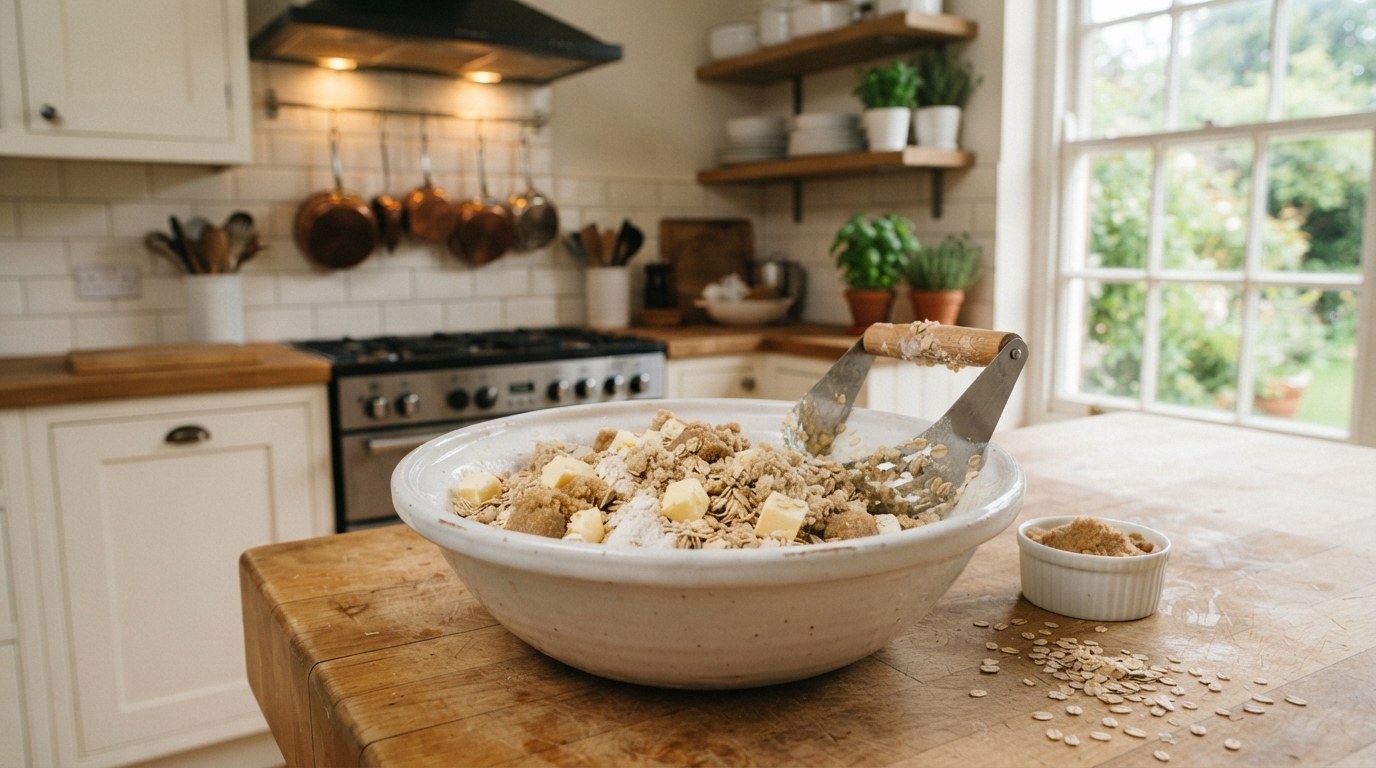
Cut ¾ cup of cold butter into 1½ cups of old-fashioned rolled oats, 1 cup of flour, 1 cup of packed brown sugar, a teaspoon of cinnamon and half a teaspoon of salt until the butter is in pea-sized pieces and the mixture clumps when you squeeze a handful. Cold butter is the whole point. Butter is roughly 16 to 18 percent water, and in the oven those small pockets of cold butter melt and steam, pushing the crumb apart into the craggy, open texture that reads as crunchy; the fat coating the flour also keeps gluten from forming, so the topping stays tender rather than tough. Melted butter stirred in coats everything evenly and bakes into a flat, sandy layer that is closer to a cookie than a crisp.
Old-fashioned rolled oats are the only oats that work here. They are whole flakes, thick enough to toast and stay distinct. Quick oats are cut smaller and rolled thinner, so they absorb the butter and juice and bake into a paste, and steel-cut oats will still be hard after an hour. A handful of chopped pecans or walnuts mixed into the topping is a good addition, and the topping can be made up to three days ahead and kept in the refrigerator, or frozen for a month; scatter it on cold, straight from the fridge.
What turns the top golden is the same chemistry as a crust on bread: once the surface of the topping dries out, it climbs past the 212°F ceiling that water imposes and into the range where Maillard browning starts, around 284°F, with the brown sugar caramelizing on the hottest ridges from about 320°F. That is why the topping goes on in loose clumps rather than pressed flat. Pressed flat, it traps steam from the fruit underneath and stays pale and soft in the middle.
Why the Filling Gets Cornstarch and Lemon Juice
Toss the sliced apples with ½ cup of brown sugar, 1½ tablespoons of cornstarch, a tablespoon of lemon juice, 1½ teaspoons of cinnamon, a pinch of nutmeg and a quarter teaspoon of salt, and let the bowl sit for 10 minutes while you make the topping. The sugar draws juice out of the apples through osmosis, and that juice is exactly what makes a crisp watery if nothing thickens it. Cornstarch thickens as its granules absorb that liquid and swell, starting around 150°F and reaching full strength close to a boil, which is why the crisp has to bubble all the way to the center before it comes out. A filling that only bubbled at the edges will run when cut.
Cornstarch over flour because it thickens with about half the amount and bakes clear rather than cloudy, so the glaze looks like apple, not gravy. Half a cup of brown sugar in the filling is deliberately less than most recipes use; the topping carries a full cup and the Honeycrisp is sweet, and too much sugar in the filling draws out more juice than the cornstarch can hold. Taste a slice of the raw tossed apple before it goes in the dish. If your apples are very tart, add another tablespoon or two of sugar; if they are sweet, leave it.
Bake at 350°F Until It Bubbles in the Center
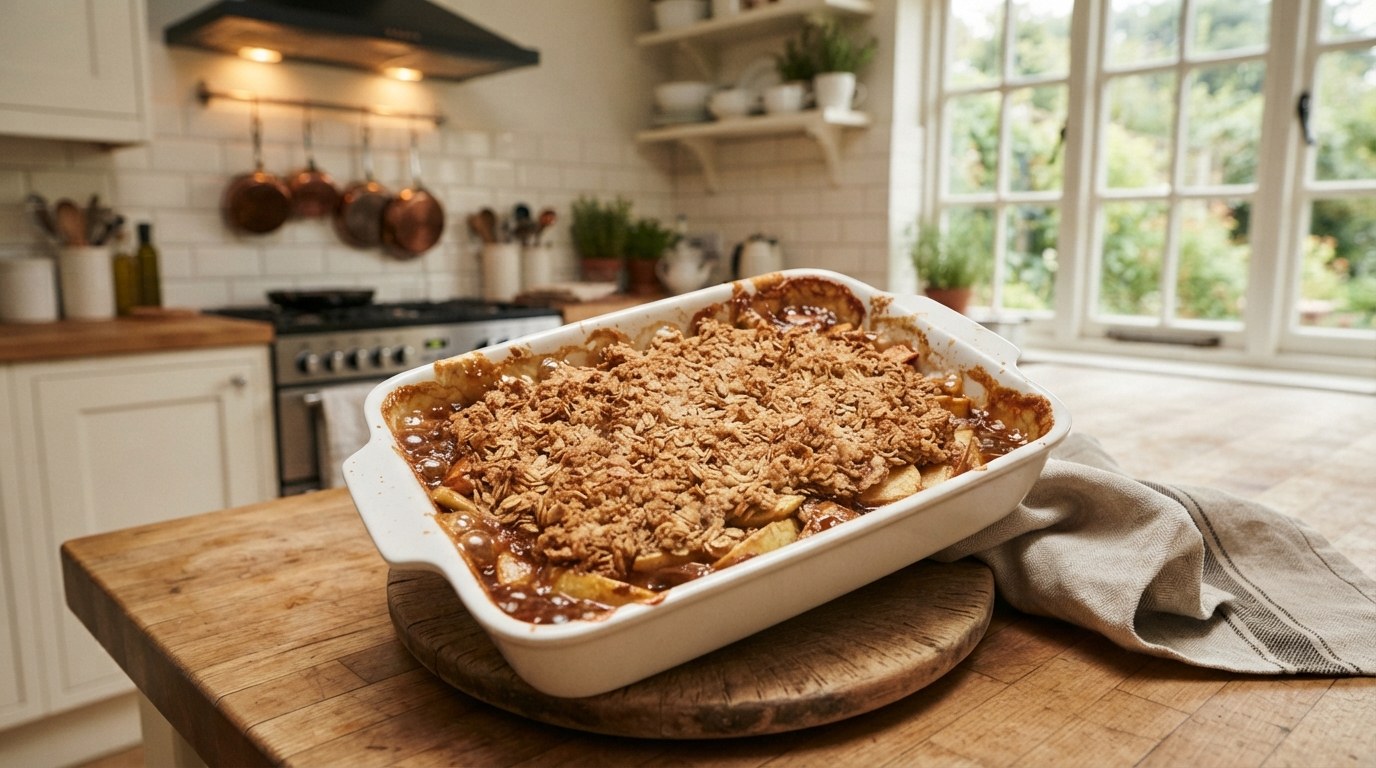
Spread the apples in a buttered 9x13 baking dish, scatter the topping over in loose clumps without pressing it down, and bake at 350°F on the middle rack for 45 to 55 minutes. It is done when the topping is deep golden brown and you can see thick juices bubbling up through the topping in the middle of the dish, not just at the corners. A thermometer in the center of the filling should read around 200°F. If the topping is browning faster than the filling is bubbling, lay a sheet of foil loosely over the top for the last 15 minutes.
The 350°F oven is a compromise on purpose. Hotter, and the sugar on the topping burns before the apples in the middle soften; cooler, and the topping never dries out enough to crisp, since it sits over a filling that is steaming at 212°F the whole time. For an 8x8 dish, halve everything and start checking at 40 minutes. Glass and ceramic dishes hold heat and give a well-set filling; a metal pan browns the bottom faster and can come out 5 minutes earlier.
Let It Rest 20 Minutes Before Serving
Let the crisp stand 20 to 30 minutes before serving. The cornstarch glaze is thin and runny at oven temperature and thickens as it cools, so a crisp cut straight from the oven floods the plate and the same crisp 20 minutes later holds a clean scoop. It also drops from scalding to the range where the flavor actually reads, since taste receptors are most active around 86 to 95°F and a filling at 200°F mostly registers as heat. Serve it warm with vanilla ice cream, the cold against the warm fruit, or with lightly whipped cream.
Apple Crisp vs. Crumble vs. Cobbler
The names get used interchangeably, but they describe different toppings on the same fruit. A crisp has oats in the topping, which is what gives it the crunch; a crumble is the same idea without oats, a flour-butter-sugar streusel that bakes sandier; a cobbler is fruit under dollops of biscuit dough or a batter, soft on top rather than crunchy; a brown betty layers the fruit with buttered breadcrumbs. This site's Dutch apple crumble cobbler is the crumble side of that family.
| Dessert | Topping | Texture on top | Bake |
|---|---|---|---|
| Apple crisp | Oats, flour, brown sugar, cold butter | Crunchy, craggy | 350°F, 45–55 min |
| Apple crumble | Flour, sugar, butter (no oats) | Sandy, short | 350–375°F, 40–50 min |
| Apple cobbler | Biscuit dough or batter | Soft, cakey | 375°F, 35–45 min |
| Apple brown betty | Layers of buttered breadcrumbs | Soft, pudding-like | 350°F, 45–60 min |
Make Ahead, Storage and Re-Crisping
The crisp can be assembled a day ahead and refrigerated unbaked; add 10 minutes to the baking time. A baked crisp can sit out for two hours after it comes out of the oven, which is the FDA's limit for cooked food at room temperature, then it should be refrigerated at 40°F or below, where it keeps for four days. It freezes well for up to three months, baked or unbaked, wrapped tightly.
The topping will soften overnight in the refrigerator no matter what you do, and sealing the dish makes it worse. Brown sugar is hygroscopic, meaning it pulls moisture from the air and from the steam rising off the fruit, so a tightly covered warm crisp turns its own crust soft by morning. Let it cool completely before covering, and to bring the crunch back, reheat it uncovered at 350°F for 15 to 20 minutes, which dries and re-toasts the surface. A microwave heats the fruit but leaves the topping limp. Whole apples, for what it is worth, keep longest in the refrigerator at 33 to 38°F in a perforated bag, per the University of Minnesota Extension, so a bag of Granny Smiths bought now will still be firm for a second crisp in a month.
What to Serve With Apple Crisp
Vanilla ice cream is the classic, and the no-churn pumpkin pie ice cream on this site turns it into a fall plate without an ice cream maker. For a dinner-party spread, the Gordon Ramsay dessert picks pair well with it, and a crisp is the easy make-ahead alongside a showpiece. The baking and desserts collection has the rest of the sweet table, the holiday and seasonal guides cover Thanksgiving, and the full recipes index is where the mains live.
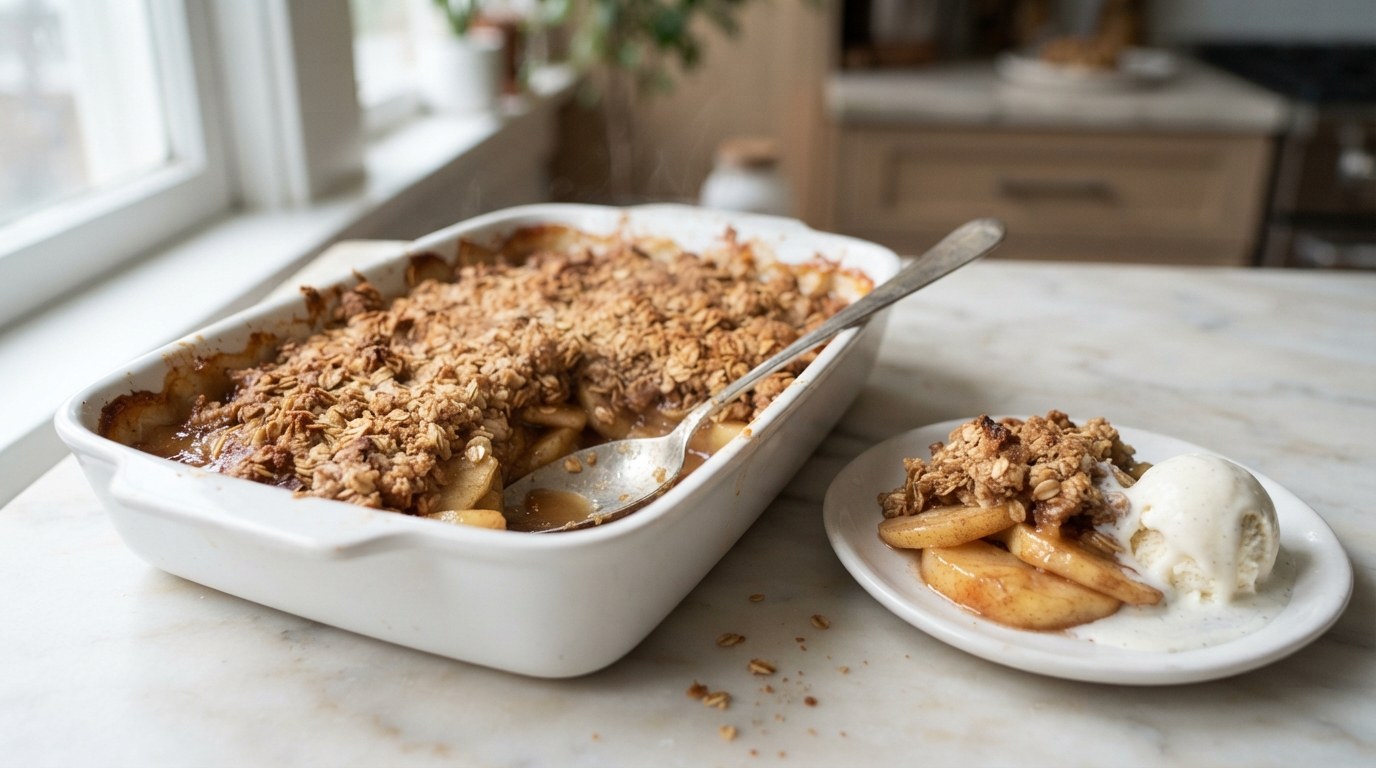
Apple Crisp with Oats (Crunchy Topping, Set Filling)
Ingredients
- 3 1/2 lb apples, half Granny Smith and half Honeycrisp (7 to 8 medium), peeled, cored and sliced 1/4 inch thick
- 1/2 cup packed light brown sugar, for the filling
- 1 1/2 Tbsp cornstarch
- 1 Tbsp fresh lemon juice
- 1 1/2 tsp ground cinnamon, for the filling
- 1/4 tsp ground nutmeg
- 1/4 tsp fine sea salt, for the filling
- 1 1/2 cups old-fashioned rolled oats (not quick or steel-cut)
- 1 cup all-purpose flour
- 1 cup packed light brown sugar, for the topping
- 1 tsp ground cinnamon, for the topping
- 1/2 tsp fine sea salt, for the topping
- 3/4 cup cold unsalted butter (1 1/2 sticks), cut into 1/2-inch cubes, plus more for the dish
- Vanilla ice cream or lightly whipped cream, to serve (optional)
Instructions
- Heat the oven to 350°F (175°C) with a rack in the middle. Butter a 9x13-inch baking dish.
- Make the topping first: in a large bowl, stir together the oats, flour, 1 cup brown sugar, 1 teaspoon cinnamon and 1/2 teaspoon salt. Add the cold butter cubes and cut them in with a pastry blender or your fingertips until the butter is in pea-sized pieces and the mixture clumps when squeezed. Refrigerate while you prepare the apples.
- Peel, core and slice the apples about 1/4 inch thick, dropping them into a large bowl and tossing with the lemon juice as you go so they do not brown.
- Add the 1/2 cup brown sugar, cornstarch, 1 1/2 teaspoons cinnamon, nutmeg and 1/4 teaspoon salt to the apples and toss until every slice is coated. Taste a slice; add 1 to 2 tablespoons more sugar only if the apples are very tart. Let stand 10 minutes.
- Spread the apples and all their juice evenly in the buttered dish. Scatter the cold topping over the top in loose clumps, covering the fruit without pressing it down.
- Bake 45 to 55 minutes, until the topping is deep golden brown and thick juices are bubbling up through the topping in the center of the dish, not just at the edges (about 200°F on a thermometer in the filling). If the top browns before the center bubbles, lay foil loosely over it for the last 15 minutes.
- Cool on a rack for 20 to 30 minutes so the filling sets, then serve warm with vanilla ice cream or whipped cream.
Notes
Apple Crisp with Oats FAQs
The questions that come up most: which apples to use, whether quick oats work, why the topping goes soft, how long to bake it at 350°F, whether to peel the apples, how to make it ahead, and whether it needs refrigerating.
What are the best apples for apple crisp?
A mix of a firm tart apple and a firm sweet one: Granny Smith with Honeycrisp is the pairing in this recipe, and Braeburn, Jonagold or Pink Lady stand in for either. Firm apples have strong pectin and keep their shape through a 45-minute bake. Red Delicious and McIntosh break down into sauce, which is fine only if that is what you want.
Can I use quick oats instead of old-fashioned oats?
Old-fashioned rolled oats are the ones that stay crunchy. Quick oats are cut smaller and rolled thinner, so they absorb the butter and fruit juice and bake into a soft paste; steel-cut oats stay hard. If quick oats are all you have, the crisp will taste fine but the topping will be softer and more uniform.
Why is my apple crisp topping not crispy?
Usually one of three things: melted butter instead of cold butter, the topping pressed flat so it steamed over the fruit, or the crisp covered while still warm. Cut cold butter into the dry mix until it clumps, scatter it loosely, bake until the center bubbles, and cool it uncovered. To revive a soft top, reheat uncovered at 350°F for 15 to 20 minutes.
How long do you bake apple crisp at 350°F?
About 45 to 55 minutes for a 9x13 dish, or 40 to 45 minutes for an 8x8. It is done when the topping is deep golden and thick juices bubble in the center of the dish, not just at the edges, and a thermometer in the filling reads around 200°F. Tent with foil if the top browns before the middle bubbles.
Do you have to peel apples for apple crisp?
Yes, for a filling that eats well. Apple skin does not soften at the same rate as the flesh and ends up as leathery curls in the filling. Peel, core and slice the apples about ¼ inch thick, and toss them with the lemon juice right away so they do not brown.
Can apple crisp be made ahead and frozen?
Yes. Assemble it up to a day ahead and refrigerate unbaked, adding 10 minutes to the bake. It freezes for up to three months either baked or unbaked; bake from frozen with 15 to 20 extra minutes, or thaw a baked one and reheat uncovered at 350°F until the top re-crisps. The topping alone keeps three days in the fridge or a month frozen.
Does apple crisp need to be refrigerated?
After two hours at room temperature, yes; that is the FDA limit for cooked food, and the crisp keeps four days at 40°F or below. Cool it completely before covering, or the trapped steam and hygroscopic brown sugar soften the topping. Reheat uncovered in a 350°F oven rather than the microwave.

About the Author
John Siracusa is the founder of Hell’s Kitchen Recipes. He focuses on technique-first, reproducible home cooking and researches recipes & kitchen equipment from published food science and professional chef methods since 2016.