This raspberry soufflé is the one Gordon Ramsay teaches in his MasterClass, made in a home kitchen: a thick, reduced raspberry purée loosened with a spoonful of pastry cream, a glossy meringue folded through it, and ramekins buttered twice and lined with grated dark chocolate so the batter climbs straight up. It bakes in 10 to 12 minutes at 355°F and comes out tall, pink and crisp at the edges. Every step has a reason, and once you know the reasons, a soufflé stops being scary.
What Makes Gordon Ramsay's Raspberry Soufflé Work
Gordon Ramsay's raspberry soufflé works because every part of it protects the air in the egg whites: a base with most of its water cooked off, a meringue whipped in the right order, ramekins prepared so the batter can grip the sides, and a hot oven that sets the structure before the bubbles give out. He calls this set of habits the science of soufflé, and MasterClass lays out his recipe in grams, since weighing beats converting cups for a dessert this precise.
He picked up soufflés while cooking in Paris, and according to that same MasterClass write-up, his flagship Chelsea restaurant makes three for every one ordered: one for the guest, one to taste and one spare. At home you only need one good batch. The lesson sits in his Restaurant Recipes at Home course on MasterClass, and if you're weighing whether the course is worth it, our review of every MasterClass cooking course covers it.
How to Prepare Ramekins for a Raspberry Soufflé
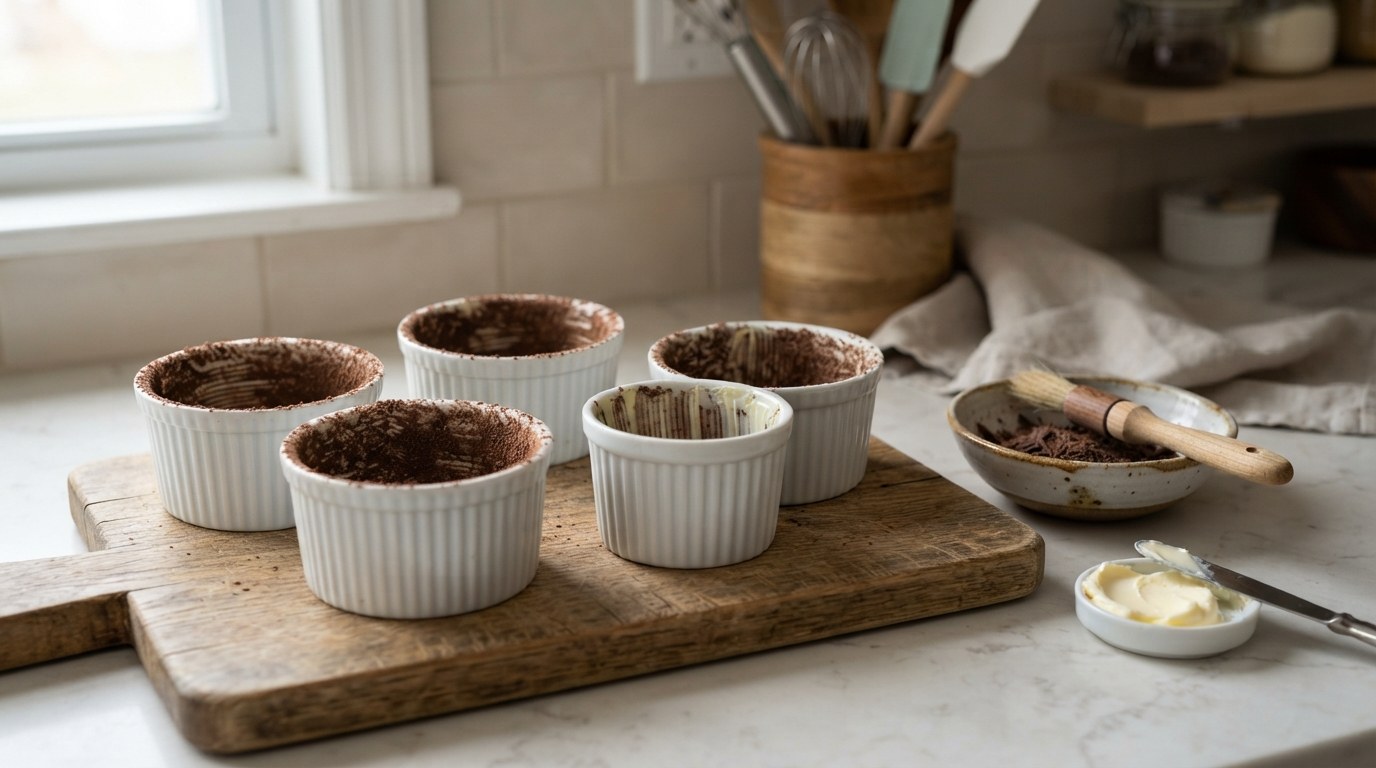
Prepare the ramekins by brushing soft butter over the base and then in straight strokes up the sides, chilling them for a minute so it firms, brushing a second thin coat, and rolling grated dark chocolate around the inside until every surface is covered. Ramsay calls this a double varnish. The upward strokes leave tiny vertical lanes, so the rising batter slides straight up the wall instead of catching and tilting. The chocolate (or granulated sugar, the classic alternative) gives the batter something dry to cling to as it climbs, and it bakes into the crisp collar that should hang just over the rim.
Tip the loose chocolate from one ramekin into the next so nothing goes to waste, then park them in the fridge. You can prepare them a day or two ahead, which takes one job off the list on the night.
DOWAN
DOWAN 6 oz Ceramic Ramekins, Set of 6
- Six 6-ounce ramekins, the size this souffle bakes in (10 to 12 minutes at 355°F)
- Oven safe to 500°F and rated for thermal shock, so they go from fridge to hot oven
- Smooth glazed ceramic; dishwasher, freezer and microwave safe
The Raspberry Soufflé Base: Reduce It So It Cannot Sink the Foam
The raspberry soufflé base has to be thick and concentrated, because water is the enemy of a foam. Ramsay steams the berries with sugar and a little water under a lid until they collapse, then takes the lid off and lets the excess liquid evaporate until the purée turns syrupy and jam-like, without letting it color. Heat breaks down the pectin that holds the fruit's cells together, so the berries give up their juice fast; boiling it off at 212°F (100°C) is what keeps the finished purée from thinning the meringue. Blend it and push it through a fine sieve to catch the seeds. Frozen raspberries work just as well as fresh here, since they are going to be cooked down anyway.
A spoonful of pastry cream goes in with the purée to give it body. It only works if it boils: King Arthur Baking has you whisk until bubbles burst in the center of the pan, then keep going for one more minute. That full bubble lets the cornstarch finish gelatinizing, its starch granules swelling to thicken the custard, and it knocks out an enzyme in the yolk that would otherwise break the starch down and leave the cream runny by the next day. The recipe makes more than you need; the rest is great spooned over berries.
How to Whip Egg Whites for Soufflé
Whip the egg whites in a spotless, dry bowl until foamy, add a few drops of lemon juice, then add the sugar a little at a time once the whites have built most of their volume, and keep whisking to stiff, glossy peaks. According to the Iowa State University food science lab manual, whites foam because beating denatures their proteins, which unfold and form a film around each air bubble. Fat of any kind, a trace of yolk included, gets in the way of that film, which is why the bowl has to be clean and grease-free.
The acid helps too. Iowa State notes that cream of tartar stabilizes the foam, and the squeeze of lemon Ramsay adds does the same job, so either works. The American Egg Board adds three practical points: separate the eggs cold, when the yolks hold together best, then let the whites warm for 20 to 30 minutes so they whip to more volume; skip plastic bowls, which can hold a film of grease; and add sugar only after the whites are foamy, because sugar added at the start costs you volume. Well-beaten whites grow six to eight times in size. Stop at stiff and glossy. Beat past that point and the foam turns dry and grainy, and the soufflé shrinks as it bakes.
Folding: Keep the Air You Just Whipped
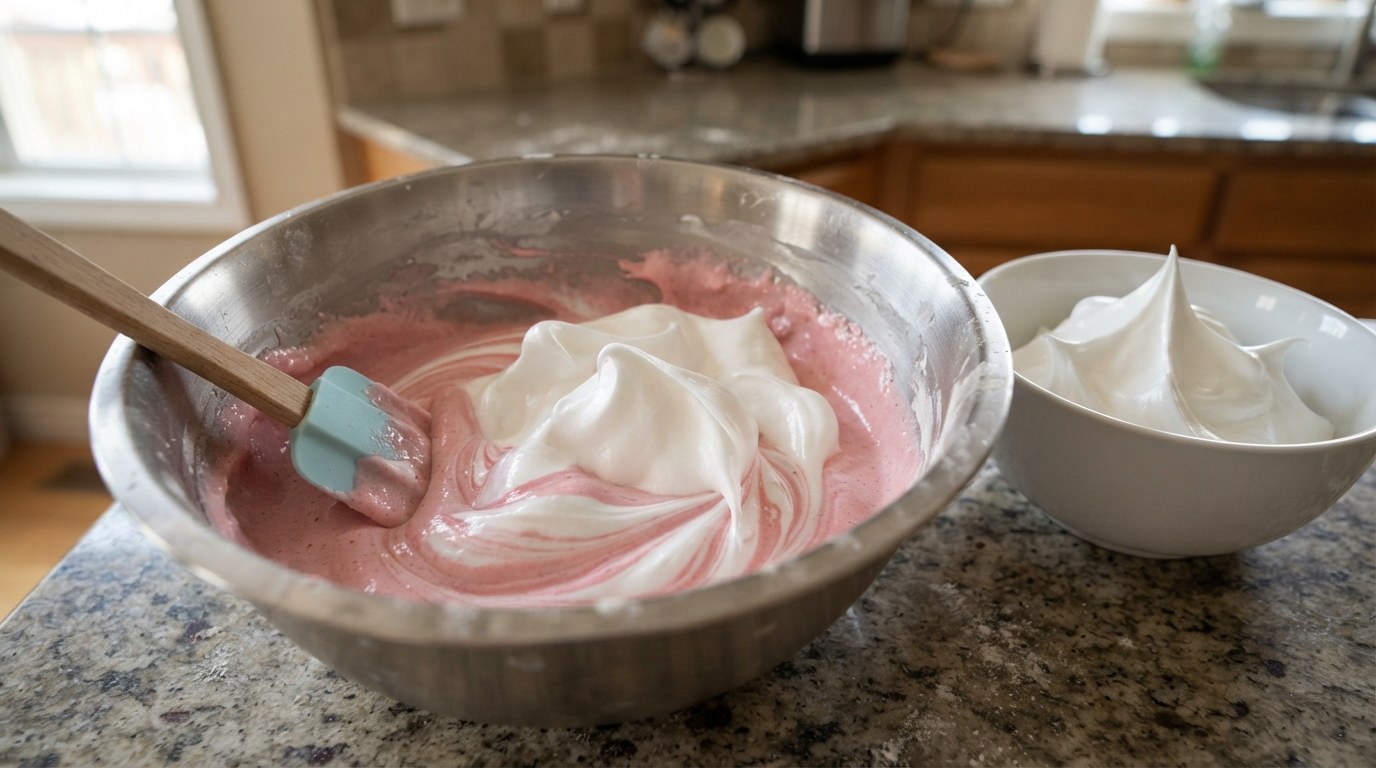
Fold in stages: stir about a third of the meringue into the raspberry base to loosen it, then fold in the rest in two additions with a rubber spatula, cutting down through the middle and lifting from the bottom while you turn the bowl. The first third is a sacrifice. It thins the dense base so the remaining meringue can blend in with only a few strokes. Stop as soon as the white streaks disappear, because every extra turn pops bubbles you need in the oven.
Level, Groove and Bake at 355°F
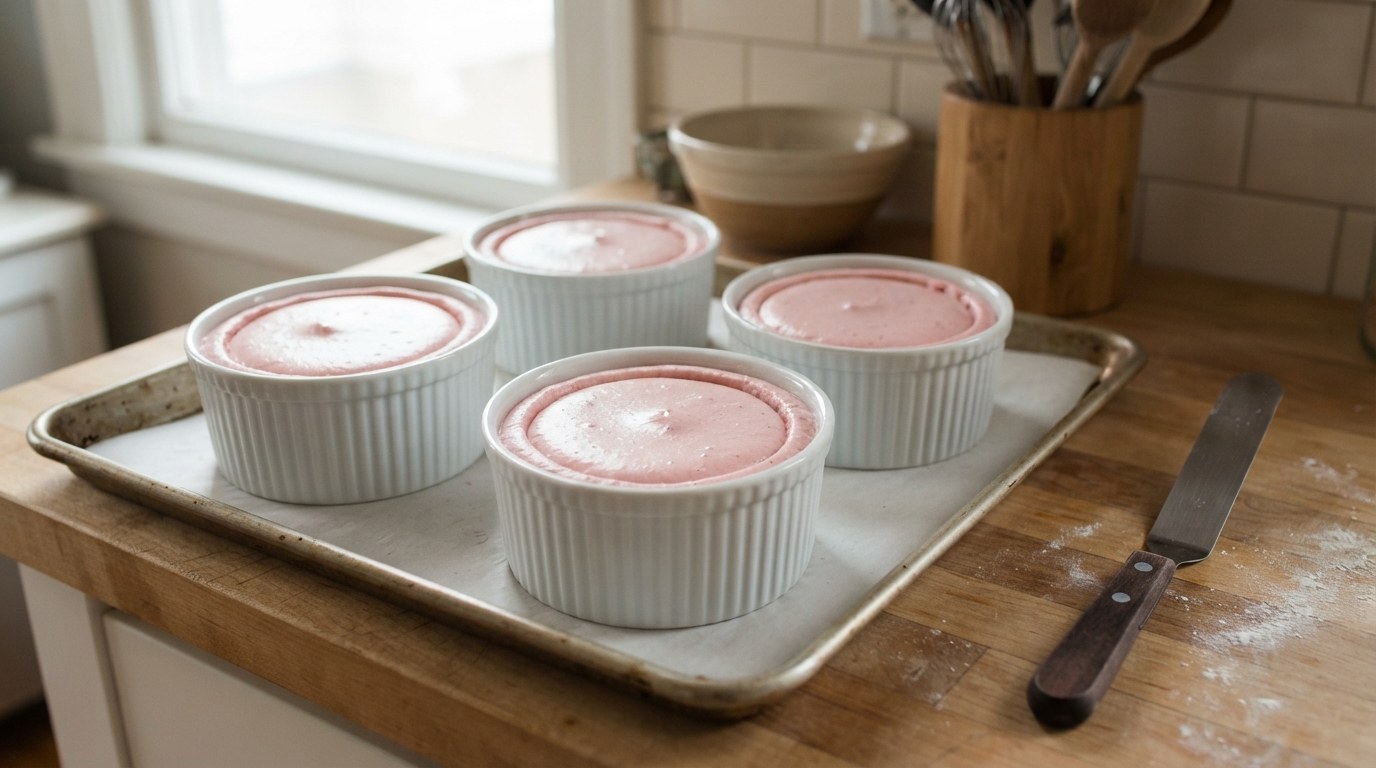
Fill each ramekin to the top, tap it on the counter, scrape the surface flat with an offset spatula and wipe the outside clean. Then run your thumb around the inside edge to press a shallow groove between the batter and the rim. That little channel lets the soufflé rise straight up in a clean column, like a top hat, instead of doming and spilling over one side.
Bake on a sheet tray in the middle of a 355°F (180°C) oven: 10 to 12 minutes for 6-ounce ramekins, 14 to 17 minutes for 10-ounce ones, until well risen and golden on top. As the batter heats, the air in every bubble expands and pushes the soufflé up. Egg proteins start to set from about 140°F (60°C), and the whole structure firms by roughly 176°F (80°C), so the oven has to be hot enough to lock the walls in place while the bubbles are still big. The top browns because the surface dries out and passes 284°F (140°C), where Maillard browning begins. A cold or inaccurate oven is the most common reason a soufflé sinks, so an oven thermometer is worth hanging in there.
A classic soufflé stays soft and a little wet in the center. The USDA Food Safety and Inspection Service advises cooking egg dishes until the center reaches 160°F (71°C), so if you are serving anyone who should avoid undercooked eggs, give the soufflé a few more minutes and check the center with an instant-read thermometer.
Why Soufflés Fall
Every soufflé falls after it leaves the oven, because the hot gas inside contracts as it cools and the steam in the bubbles condenses back to water. That is why a soufflé goes from the oven to the table without a pause. Loud noises and a bumped counter will not collapse it; the Iowa State defect chart puts collapse down to underbaking, when the walls have not set enough to hold up the air. The same chart ties a dense layer at the bottom to batter that sat before baking, an oven that was not preheated, or whites that were underbeaten or underfolded. The table covers the fixes.
| Problem | Likely cause | Fix |
|---|---|---|
| Collapses in the oven or the moment it comes out | Underbaked; the structure had not set | Bake the full time until golden on top and check your oven with a thermometer |
| Barely rises | Grease or yolk in the whites, or sugar added too early | Use a spotless steel or glass bowl and add the sugar only once the whites have volume |
| Shrinks and looks grainy | Whites beaten past stiff peaks | Stop at stiff and glossy; the tips should stand straight up |
| Rises crooked or domes over one side | Butter missed a patch, or no thumb groove | Butter twice in vertical strokes and press a groove around the rim |
| Dense layer at the bottom | Batter sat before baking, oven not preheated, or underfolded | Heat the oven first, fold until no streaks remain, bake straight away |
| Base tastes weak or batter is runny | Purée not reduced enough | Cook the purée down until jammy before measuring it |
Most soufflé failures come back to the egg whites or the oven, so those are the two places to look first.
How to Serve Raspberry Soufflé
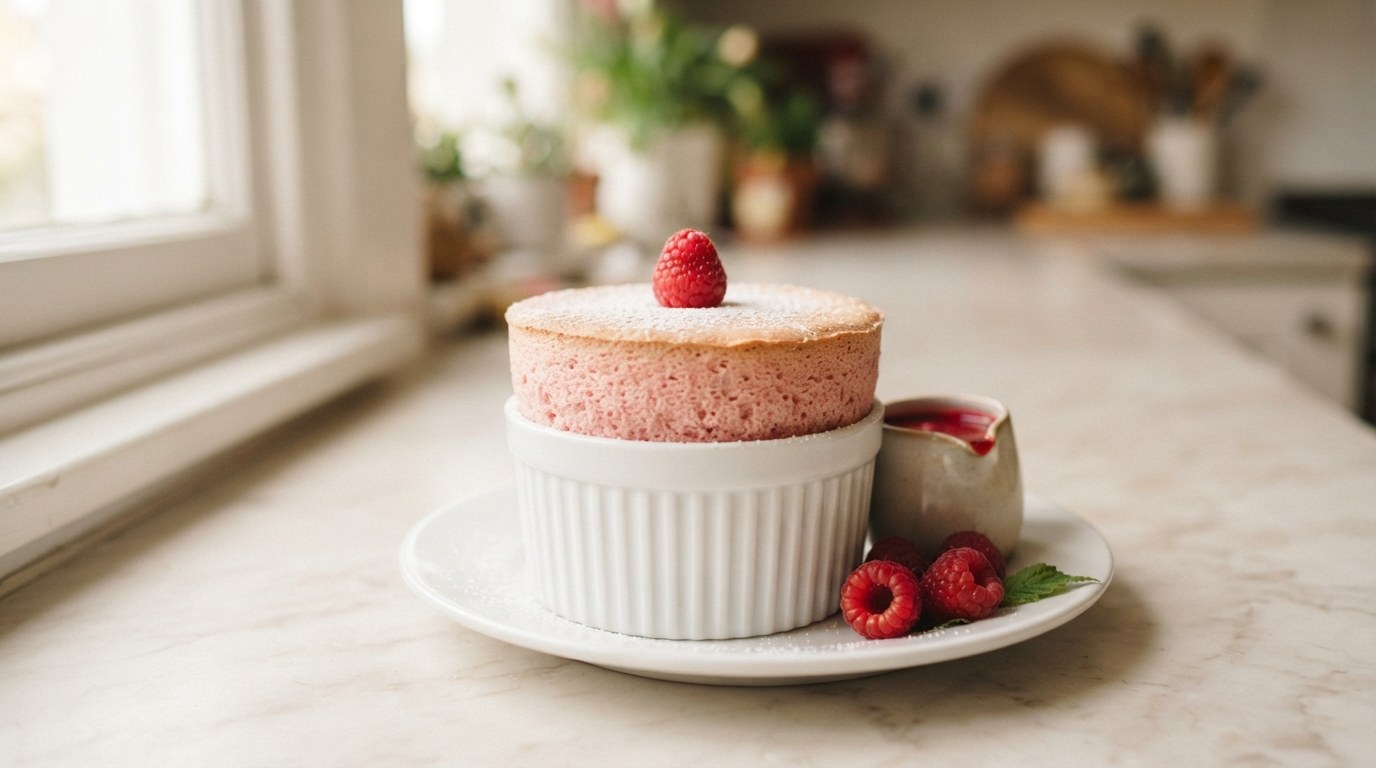
Serve raspberry soufflé the second it comes out: dust the top with powdered sugar, set a fresh raspberry in the center and carry it straight to the table. For the restaurant finish Ramsay uses, spoon a small hole into the top at the table and pour in some of the warm raspberry coulis you kept back, so the hot soufflé and the sauce meet in the middle. A scoop of vanilla ice cream on the side works too.
If you want a ramekin dessert that can be made the day before, our Gordon Ramsay crème brûlée is the natural partner to this one, and there are more showstoppers in our roundup of Gordon Ramsay desserts to impress your guests. For the savory side of the same course, try his pomme purée, and browse every sweet recipe in Baking & Desserts.
Gordon Ramsay Raspberry Soufflé
Ingredients
Raspberry purée
- 12 oz fresh or frozen raspberries (340 g)
- 3 tbsp granulated sugar
- 3 tbsp water
Pastry cream
- 1/2 cup whole milk (120 ml)
- 1 large egg yolk
- 1 tbsp granulated sugar
- 1 1/2 tbsp cornstarch
- 1/4 tsp vanilla extract
Ramekins
- 2 tbsp unsalted butter, very soft
- 1 oz dark chocolate, finely grated (30 g), or 3 tbsp granulated sugar
Soufflés
- 6 large egg whites (about 7 oz / 210 g), at room temperature
- 3 1/2 tbsp granulated sugar (45 g)
- 1/2 tsp lemon juice (or 1/4 tsp cream of tartar)
- powdered sugar and fresh raspberries, to finish
Instructions
- Make the purée: put the raspberries, sugar and water in a small saucepan, cover and cook over medium-low for 5 to 8 minutes until the berries collapse. Uncover and simmer about 5 minutes more, until thick, syrupy and jam-like; do not let it color. Blend until smooth, then press through a fine sieve to remove the seeds. Measure 1/3 cup (100 g) for the soufflés and chill it; keep the rest warm as coulis.
- Make the pastry cream: heat the milk until it just starts to simmer. Whisk the yolk, sugar, cornstarch and vanilla in a bowl, then slowly whisk in half the hot milk. Pour it all back into the pan and whisk over medium heat until thick and bubbling in the center, then whisk 1 minute more. Transfer to a bowl, press plastic wrap onto the surface and chill until cold, at least 30 minutes.
- Prepare four 6-ounce ramekins: brush the base and then the sides with a thin layer of soft butter, always stroking straight up to the rim. Chill for a minute or two, brush a second thin coat, then add the grated chocolate and turn each ramekin to coat the inside completely, tipping the excess into the next one. Keep them in the fridge.
- Heat the oven to 355°F (180°C) with a rack in the middle.
- In a large bowl, whisk the 1/3 cup raspberry purée with 3 tablespoons (about 40 g) of the pastry cream until smooth.
- In a spotless, dry bowl, whisk the egg whites on medium speed until foamy, then add the lemon juice. When the whites have built most of their volume, add the sugar a little at a time, then turn the speed to medium-high and whisk to stiff, glossy peaks.
- Stir about a third of the meringue into the raspberry base to loosen it, then gently fold in the rest in two additions, just until no white streaks remain.
- Fill the ramekins to the top, tap each one on the counter, and scrape the tops flat with an offset spatula. Wipe the outsides clean, then run your thumb around the inside edge to make a shallow groove.
- Set the ramekins on a baking sheet and bake on the middle rack for 10 to 12 minutes, until well risen and golden on top (14 to 17 minutes for 10-ounce ramekins).
- Dust with powdered sugar, top with a raspberry and serve immediately. At the table, spoon a small hole in each and pour in a little warm coulis.
Notes
Raspberry Soufflé FAQs
The questions that come up most: why a soufflé collapses, why it won't rise, whether you can make it ahead, what to use instead of cream of tartar, and how long to bake it.
Why did my soufflé collapse?
Usually because it was underbaked, so the egg structure had not set before it came out. Bake it the full time until golden on top and check your oven temperature. Every soufflé sinks a little as it cools, which is why it goes straight to the table.
Why didn't my raspberry soufflé rise?
The whites did not hold enough air. Common causes are a greasy bowl or a trace of yolk, sugar added before the whites were foamy, heavy folding, or a runny purée that was not reduced enough.
Can you make raspberry soufflé ahead of time?
Partly. The ramekins can be buttered and lined a day or two ahead, and the purée and pastry cream keep in the fridge for a few days. Whip the whites, fold and bake at the last minute; batter left to sit loses its air.
Can I make a soufflé without cream of tartar?
Yes. Gordon Ramsay stabilizes his whites with a few drops of lemon juice, added once they start to foam. Both are acids and do the same job.
What temperature and how long do you bake a raspberry soufflé?
At 355°F (180°C): 10 to 12 minutes in 6-ounce ramekins, or 14 to 17 minutes in 10-ounce ramekins, until well risen and golden on top.
Can you use frozen raspberries for soufflé?
Yes. The berries are cooked down into a thick purée and sieved, so frozen raspberries work as well as fresh. Store-bought frozen raspberry purée is another shortcut.
How do you know when a soufflé is done?
It has risen well above the rim, the top is golden and it wobbles only slightly when you nudge the tray. For a fully set center, an instant-read thermometer should read 160°F.

About the Author
John Siracusa is the founder of Hell’s Kitchen Recipes. He focuses on technique-first, reproducible home cooking and researches recipes & kitchen equipment from published food science and professional chef methods since 2016.