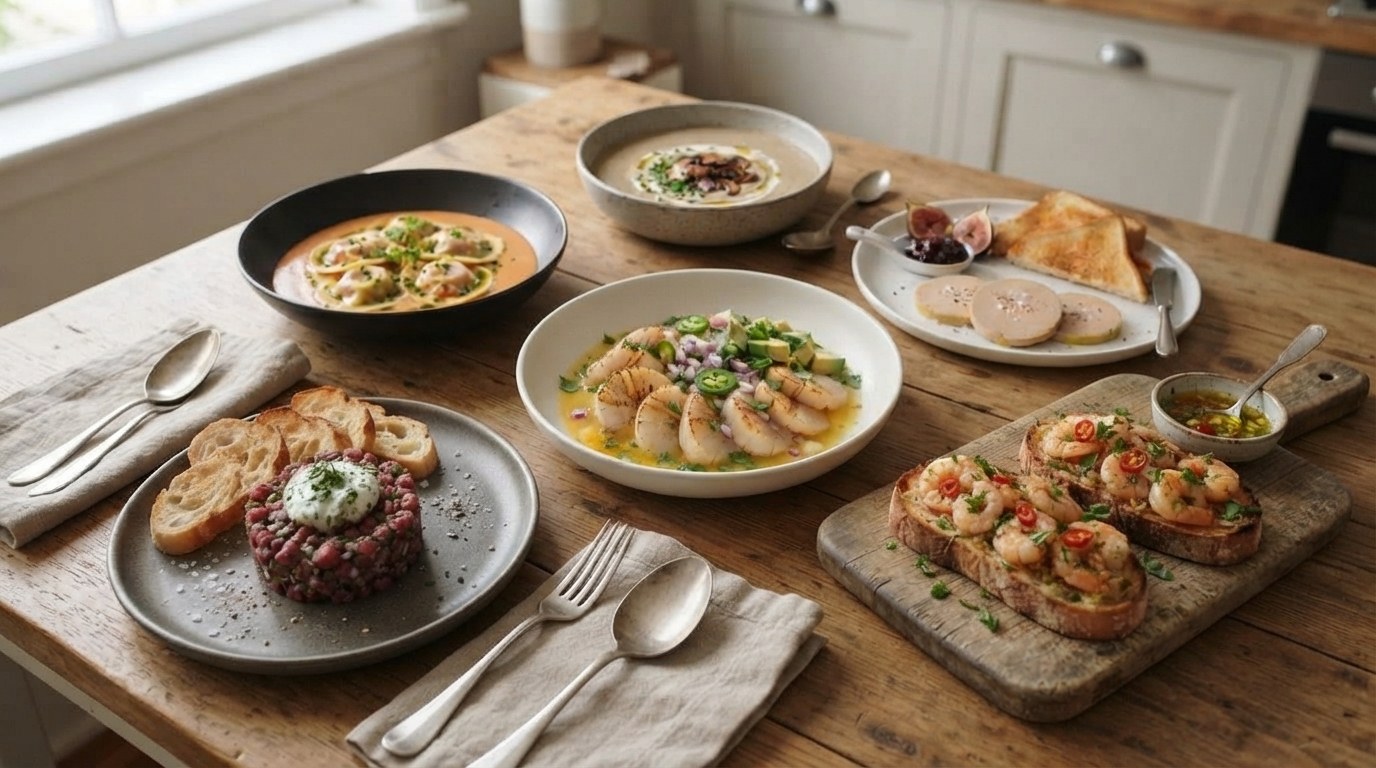
These six Gordon Ramsay appetizers are fine-dining starters you can make at home for a dinner party: hand-cut beef tartare with herb crème fraîche, seared scallop ceviche with citrus, garlic and chili shrimp on sourdough, lobster ravioli in shellfish bisque, foie gras torchon with toasted brioche, and a wild mushroom velouté. Two of them are finished before the doorbell rings, one is prepped a day ahead, and the other three take ten minutes or less at the last moment.
Each one below gets a short ingredient list for four people, the method, the bit of kitchen science that makes it work, and the food-safety line it needs. That last part matters here, because two of these starters are served raw and one is made from poultry liver. The techniques come from the Ramsay playbook: season early, get the pan properly hot before the oil goes in, never let scallops sit in water, and waste nothing, so the lobster shells end up in the bisque.
Gordon Ramsay Appetizers at a Glance: What to Make Ahead
The calmest dinner party pairs one make-ahead starter with one quick plate. The mushroom velouté and a store-bought foie gras torchon are ready before guests arrive, the lobster bisque and filled ravioli are made the day before and finished in a few minutes, and the tartare, ceviche and shrimp are cut, dressed or cooked in the last ten minutes. This table sorts all six by how they're served, what you can do in advance, and the one safety point each needs.
| Appetizer | Served | Make ahead | Last-minute work | Food-safety note |
|---|---|---|---|---|
| Beef tartare with herb crème fraîche | Cold | Herb crème fraîche up to 2 days | Trim, dice and dress the beef, 10 minutes | Raw beef: a whole-muscle cut, kept cold, eaten within 2 hours |
| Seared scallop ceviche | Cold | Citrus juice and diced vegetables that morning | Sear, slice, 5 minutes in the citrus | Rare center: buy scallops sold for raw use, or cook them through |
| Garlic and chili shrimp | Hot | Peel and devein that morning | 5 minutes in the pan | Cook until the flesh is pearly and opaque |
| Lobster ravioli in bisque | Hot | Bisque and filled ravioli, 1 day ahead | Simmer the ravioli 2 to 3 minutes | Filling steaming hot, 145°F; reheat the bisque to 165°F |
| Foie gras torchon with brioche | Chilled | Buy it ready to eat; slice up to 1 hour ahead | Toast the brioche | Buy it cooked; a home-poached liver rarely reaches 165°F |
| Wild mushroom velouté | Hot | Fully, up to 2 days | Reheat, stir in the cream | Chill in shallow containers; reheat to 165°F |
If you only make two, pair the velouté with the garlic chili shrimp: one is done in advance, the other is five minutes of noise and garlic right as everyone sits down. For a showpiece evening, lead with the lobster ravioli, since almost all of its work happens the day before. Serving a pregnant guest, young children or anyone with a weakened immune system? Skip the tartare and keep the scallops fully cooked; the safety notes in each section explain why.
Beef Tartare with Herb Crème Fraîche
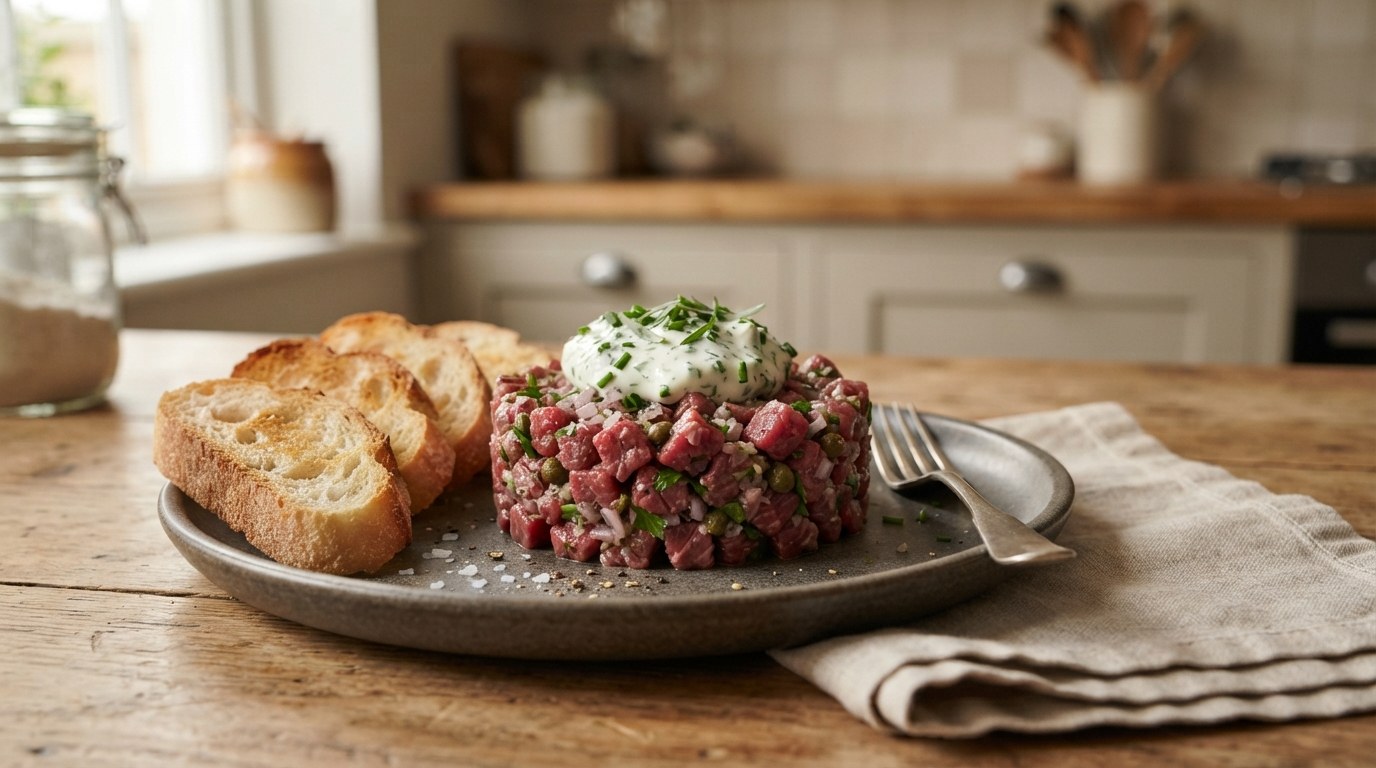
Beef tartare is raw beef hand-diced from one whole-muscle cut just before serving, and that choice of cut is the safety plan as much as the flavor. According to Public Health Ontario's evidence review of raw meat dishes, bacteria such as E. coli O157 picked up at slaughter generally stay on the surface of intact cuts, and trimming or searing that surface ("sear and shave") lowers the load. Pre-ground beef is the opposite case: grinding spreads surface bacteria through the whole batch, and McGill University's Office for Science and Society notes that commercial ground beef can come from many animals at once. So buy a piece of center-cut tenderloin or top sirloin from a butcher you trust, tell them it's for tartare, and do the cutting yourself.
Be plain with your guests about the risk. The same review is clear that careful handling reduces it but can't eliminate it, and it names the people who should pass: pregnant women, young children, older adults and anyone immunocompromised. Keep the beef in the fridge at 40°F or below until the moment you cut it, work on a clean board with a clean knife, and eat it within 2 hours. Leftover tartare goes in the bin, not the fridge.
- 8 oz center-cut beef tenderloin or top sirloin, in one piece
- 1 small shallot, very finely minced
- 1 Tbsp capers, chopped
- 1 tsp Dijon mustard and 1 tsp Worcestershire sauce
- 1 Tbsp olive oil, flaky salt and black pepper
- 1/2 cup crème fraîche, 1 Tbsp chopped chives, 1 tsp each chopped tarragon and parsley, a squeeze of lemon
- Toasted baguette slices to serve
Stir the crème fraîche with the herbs, lemon and a pinch of salt, and chill it (it keeps 2 days). Put the beef in the freezer for 15 minutes so it firms up, then shave a thin layer off every outside face with a clean knife and move the trimmed piece to a clean board. Slice it into 1/8-inch planks, then strips, then small even cubes. Fold in the shallot, capers, Dijon, Worcestershire and oil, season, and shape into four neat mounds with a spoonful of herb crème fraîche on each. Serve with the toast right away.
Two small details decide the texture. A sharp knife cuts clean cubes that stay distinct, while a food processor tears and smears the meat into paste. And season at the very end: salt dissolves some of the proteins on the cut faces (the same reason salted burger mince sticks together), so tartare salted half an hour early turns pasty. The crème fraîche can take the lemon because at around 30% fat it holds together where 20% sour cream would curdle with acid.
Seared Scallop Ceviche with Citrus
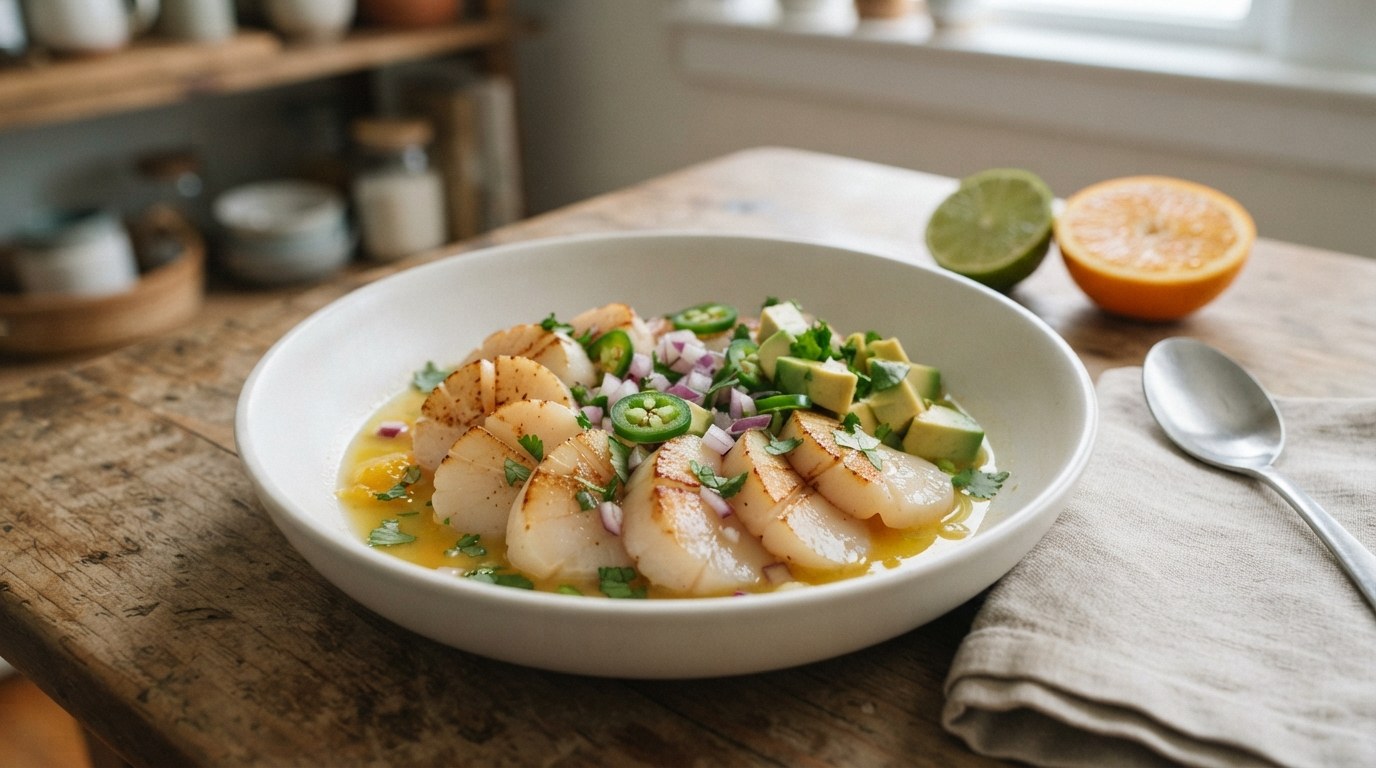
Ceviche "cooks" seafood with acid: citric acid denatures the proteins, so the flesh turns opaque and firm the way it would in a hot pan. What acid does not do is make raw seafood safe. As chef instructors at the Institute of Culinary Education point out, citrus changes the look and texture of fish but doesn't rid it of parasites, and the FDA lists ceviche among the raw seafood dishes that pregnant women, young children, older adults and people with weakened immune systems should avoid. This version sears the scallops first for a caramelized edge, but the center stays rare, so it is still a lightly cooked dish.
For that reason, buy scallops your fishmonger sells for raw use (often labeled sashimi or sushi grade, and usually previously frozen; the FDA notes freezing kills parasites, though not all germs). The part of the scallop we eat is the adductor muscle, the one the animal uses to snap its shell shut, and it is dense and sweet enough to take a hard sear. If any guest is in an at-risk group, cook their scallops 2 to 3 minutes a side until they're milky white and opaque all the way through, the FDA's doneness sign for scallops, and spoon the citrus over just before serving.
- 12 large dry sea scallops, side muscle removed
- 1 Tbsp olive oil and a pinch of salt
- Juice of 2 limes, 1 lemon and 1/2 orange
- 1/2 small red onion, finely diced
- 1 jalapeño, seeded and thinly sliced
- 1 ripe avocado, diced, and 2 Tbsp chopped cilantro
Pat the scallops very dry and season them. Heat a heavy skillet over high heat until a drop of water skitters and vanishes, add the oil, then lay the scallops in without crowding and leave them alone for 90 seconds, until the underside is deep gold. Flip for 30 to 60 seconds, then move them to a plate. Slice each into three coins, toss with the citrus juices, onion and jalapeño, and give it 5 minutes, no more, before folding in the avocado and cilantro and serving.
HexClad
HexClad 12-Inch Hybrid Nonstick Frying Pan
- Stainless steel and ceramic nonstick hybrid surface, built to sear hard and release easily
- Tri-ply with an aluminum core for quick, even heat; works on induction
- Oven safe to 900°F and metal-utensil safe (lid not included)
The browning is the Maillard reaction, the chemistry C&EN credits for a sear's flavor and aroma, and it only starts once the surface passes about 284°F. A wet scallop can't get there: water holds the surface at 212°F until it has boiled off, so a damp scallop steams pale while the inside overcooks. Gordon Ramsay warns never to leave scallops sitting in water, because they soak it up like sponges. Keep the citrus time short too. The acid keeps denaturing the rare center the longer it sits, and past 10 minutes the slices go chalky. For a full breakdown of the sear itself, see our pan-seared scallop appetizer guide.
Garlic and Chili Shrimp with Sourdough
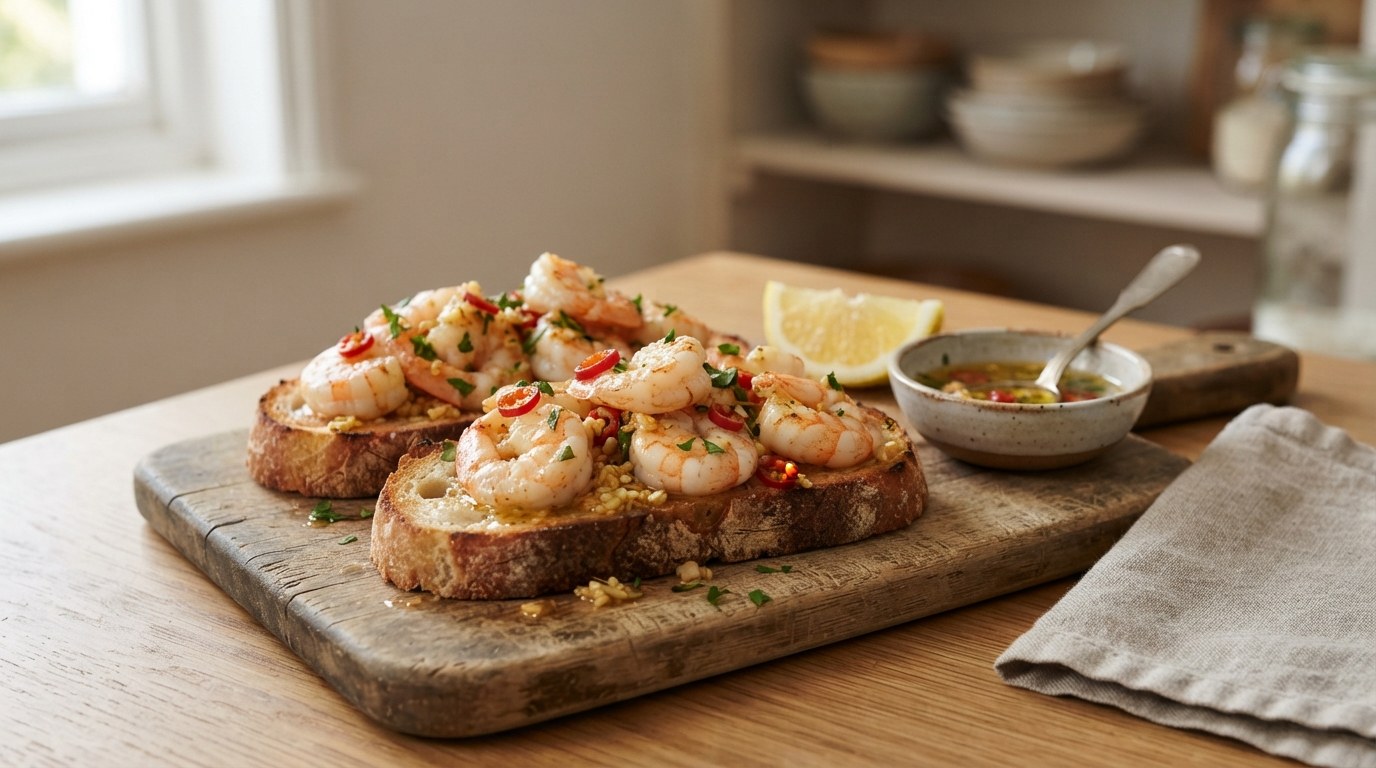
Garlic and chili shrimp is the fastest hot starter here, about five minutes from pan to plate: sear the shrimp hot and fast until the flesh is pearly and opaque, which is the FDA's sign of doneness for shrimp (it gives 145°F for most seafood), then add the garlic for the last 30 seconds so it turns golden instead of bitter. Don't go by the shell color. Shrimp turn pink early, well before the thickest part is cooked, so cut one open and check the center is white all the way through.
- 1 lb large shrimp (16 to 20 per pound), peeled and deveined
- 4 garlic cloves, thinly sliced or minced
- 1 or 2 red chilies, thinly sliced
- 2 Tbsp olive oil and 3 Tbsp cold butter, cubed
- 1/4 cup dry white wine and the juice of 1/2 lemon
- Chopped parsley, salt, and 4 thick slices of toasted sourdough
Pat the shrimp dry and season them. Get a wide skillet very hot, add the oil, and lay the shrimp in one layer; cook 1 to 2 minutes a side until just opaque, working in two batches if the pan is crowded. Push them to the side, add the garlic and chili for 30 seconds, then pour in the wine and let it bubble down by half. Take the pan off the heat, swirl in the cold butter a few cubes at a time until the sauce is glossy, add the lemon and parsley, and spoon it all over the toast.
Shrimp go rubbery fast because shellfish and fish proteins start to set at around 104 to 122°F, far lower than beef, so the window between just cooked and overcooked is a minute or less. Crowding the pan drops it toward 212°F, the shrimp stew in their own liquid, and you lose both the browning and the timing. Garlic is the other trap: thin slices hit the scorching point (burning starts around 356°F) in well under a minute in a hot pan, which is why it goes in last. The butter goes in off the heat because it's building an emulsion, tiny drops of fat held in the wine; boil it and the sauce breaks into grease. Our 10-minute garlic butter shrimp runs the same method as a main course.
Lobster Ravioli in Shellfish Bisque
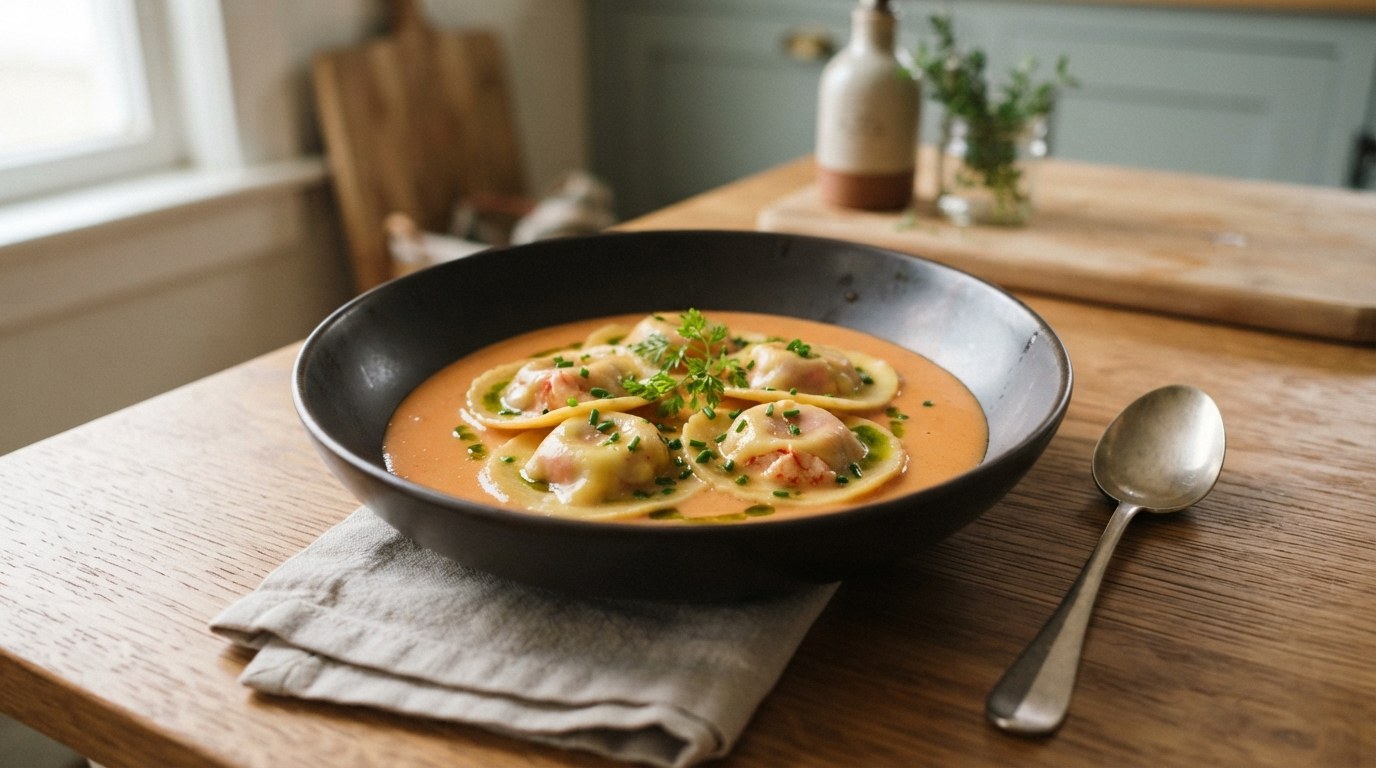
Lobster ravioli in shellfish bisque is the showpiece of these fancy appetizers and, oddly, one of the easiest to time, because the bisque and the filled ravioli both keep a day in the fridge. It's also the most Ramsay dish on the list: he teaches lobster ravioli in his MasterClass, using the claws, knuckles and leg meat most cooks would throw away, bound with a spoonful of puréed salmon and an egg white, perfumed with basil and a little lemon zest and juice. The shells go into the bisque, so one lobster gives you the filling and the sauce.
- 2 live lobsters (about 1 1/4 lb each), or 10 oz cooked lobster meat plus shells from your fishmonger
- 1 batch fresh egg pasta dough ("00" flour, 4 eggs plus 2 yolks, a little olive oil)
- 2 oz skinless salmon, puréed, 1 egg white, a few basil leaves, 1 lemon
- For the bisque: 1 onion, 1 carrot, 1 celery stalk, 2 Tbsp tomato paste, 1/2 cup white wine or brandy, 4 cups fish or shellfish stock, 1/2 cup heavy cream
- 1 egg yolk to seal, salt and white pepper, chives
Cook the lobsters in salted boiling water until the flesh is pearly and opaque, about 8 minutes, chill them in ice water, and pick out all the meat. For the bisque, roast the shells in a hot pot with a little oil until they turn deep red-brown and smell toasty, add the chopped vegetables and tomato paste, deglaze with the wine, add the stock and simmer 30 minutes. Strain through a fine sieve, pressing hard on the shells, then reduce by a third and add the cream. For the filling, chop the lobster, bind it with the salmon purée and egg white, add finely sliced basil, lemon zest and a squeeze of juice, and chill 10 minutes. Roll the pasta thin, cut rounds, spoon the filling on, brush the edges with egg yolk, and fold, pinching and twisting out every pocket of air. Chill the ravioli on a floured tray, covered, until needed.
The science is in three places. Roasting the shells dry is Maillard browning again, and it's why a good bisque tastes of roasted shellfish rather than just cream. The dough needs kneading until smooth to build its gluten network, then a 20-minute rest wrapped in plastic so it relaxes and rolls thin without springing back (our fresh pasta guide walks through the rolling). And the air you squeeze out matters: any trapped pocket turns to steam in the water, expands and bursts the seam. Cook them at a gentle simmer, never a rolling boil; Ramsay's paper-thin restaurant ravioli take about 90 seconds, while home-rolled ones need 2 to 3 minutes, until they float and a test ravioli is steaming hot in the center (145°F on a thermometer, since the salmon and egg white binder start raw). Reheat the bisque until it's steaming, 165°F, and ladle it around the ravioli.
Foie Gras Torchon with Toasted Brioche
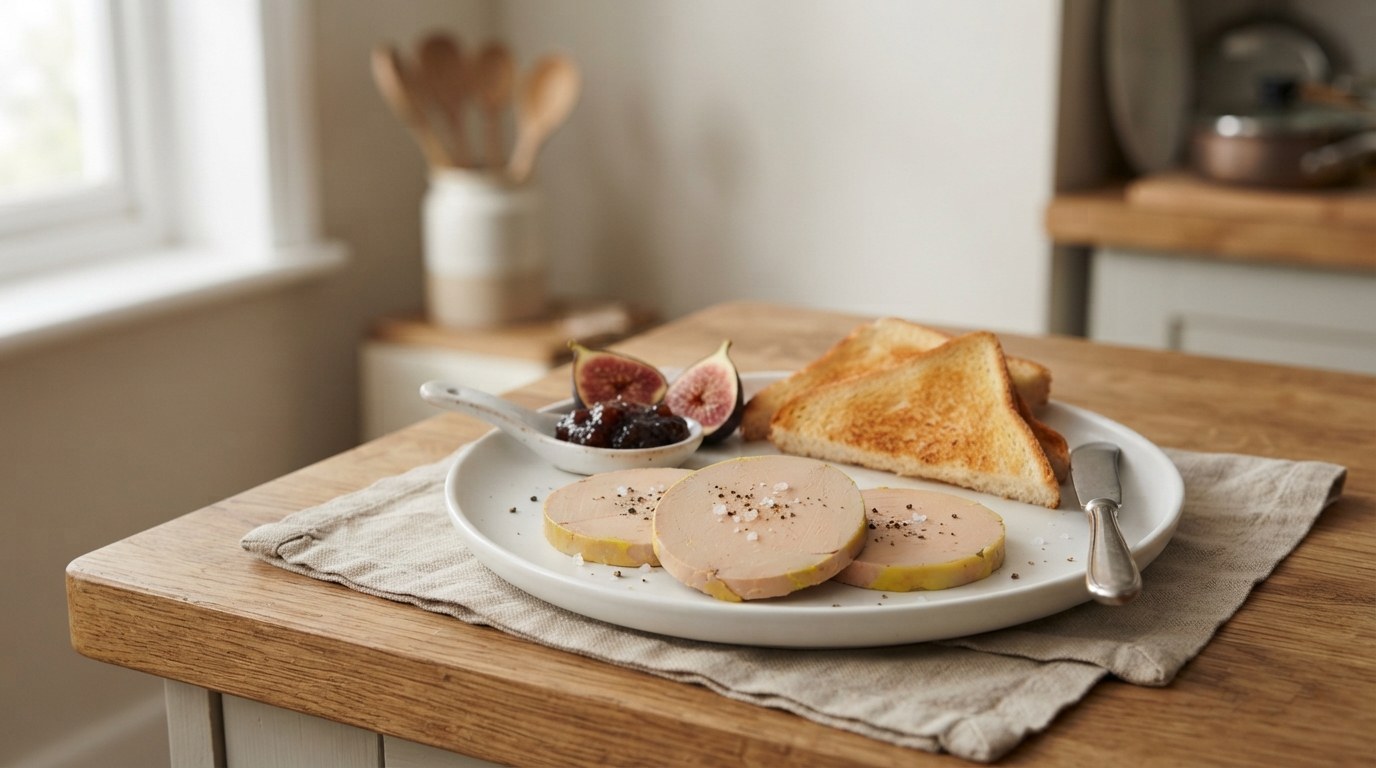
The foie gras torchon on this menu is bought ready to eat, and your effort goes into the plate: a cold, clean slice on warm toasted brioche with fig jam and flaky salt is one of the most luxurious starters there is, and it's finished before anyone arrives. A torchon is fattened duck or goose liver, seasoned, rolled tight in a cloth and gently poached, then chilled for a day or more. That gentle poach is the whole point of its silky texture, and it's also why this page doesn't send you to make one from raw liver at home.
Here's the safety reasoning. The CDC tells cooks to take chicken liver to 165°F, measured with a thermometer, because Campylobacter can live inside the liver and survives a rare center; it specifically warns about pâté made with the middle left pink. Duck and goose liver are poultry liver too, and a classic torchon is cooked far more gently than 165°F to keep it smooth. A commercially made torchon, mousse or parfait labeled ready to eat has been cooked and handled under controlled conditions, so buy one from a specialty butcher or a reputable online supplier and keep it refrigerated.
- 6 to 8 oz ready-to-eat foie gras torchon (or foie gras mousse)
- 4 thick slices of brioche
- 1 Tbsp butter
- 3 Tbsp fig jam, a few fresh figs
- Flaky sea salt and cracked black pepper
Keep the torchon in the fridge until 15 minutes before serving. Dip a thin knife in hot water, wipe it dry, and cut 1/2-inch slices, rinsing and drying the blade between cuts. Toast the brioche in the butter in a skillet until golden on both sides, cut it into triangles, and plate two slices of torchon per person with the toast, a spoonful of fig jam and a pinch of flaky salt on the foie gras. The warm blade works because foie gras is mostly fat: cold, it's firm and would crack under a cold knife, while the heated edge melts a clean line through it. Those 15 minutes out of the fridge let the fat soften just enough to taste rich instead of waxy, but don't leave it out much longer, since it counts as a perishable under the 2-hour rule.
Wild Mushroom Velouté
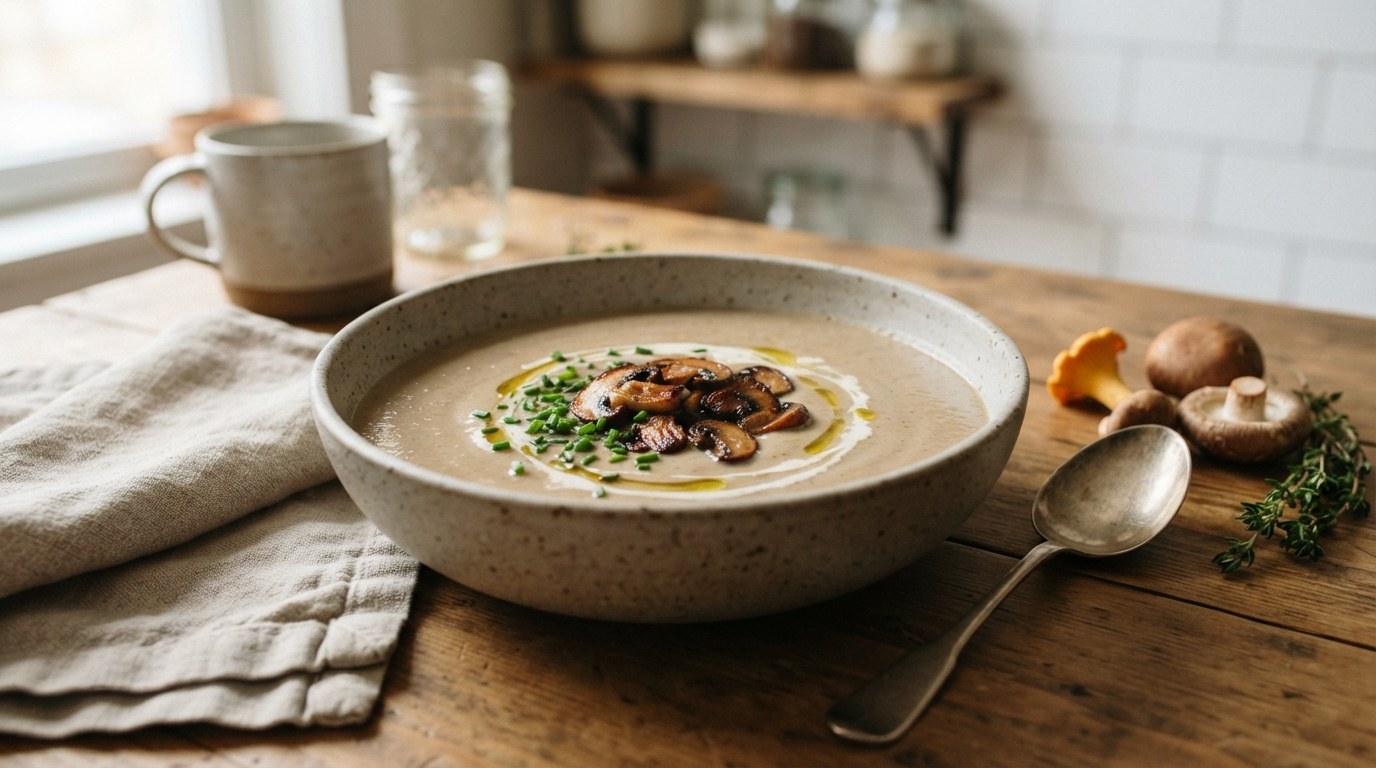
Mushroom velouté is the easiest make-ahead of the six elegant appetizers: a mushroom stock thickened with a butter-and-flour roux, blended smooth, finished with cream, and happy in the fridge for 2 days. Serve it in small bowls as a plated starter or in espresso cups for a standing crowd. The flavor comes almost entirely from how dark you brown the mushrooms at the start, so that is the step to spend time on.
- 1 lb mixed mushrooms (cremini, shiitake, oyster, plus a few dried porcini soaked in hot water)
- 4 Tbsp butter, 1 onion, 2 garlic cloves
- 1/3 cup all-purpose flour
- 5 cups vegetable or chicken stock (use the strained porcini water as part of it)
- 1/2 cup heavy cream or crème fraîche, a few thyme sprigs
- Salt, white pepper, chives, and a few drops of truffle oil (optional)
Melt half the butter in a wide pot over medium-high heat and cook the mushrooms in two batches, stirring only now and then, until their liquid has cooked off and they're deep brown. Set a few aside for garnish. Add the rest of the butter with the onion and garlic and cook until soft, stir in the flour and cook 2 minutes, then whisk in the stock a ladle at a time. Add the thyme and porcini, simmer 20 to 25 minutes, fish out the thyme, and blend until silky. Stir in the cream, season, and serve with the reserved mushrooms, chives and a few drops of truffle oil if you like it. It's potent, so a few drops per bowl is plenty.
Mushrooms release a lot of water as they heat, and nothing browns until that water has evaporated, because a wet pan sits at 212°F while Maillard browning needs about 284°F. So use a wide pan, don't crowd it, and salt at the end of browning, since salt pulls more water out by osmosis. The roux thickens because the starch granules in the flour swell and gelatinize as the stock heats toward a simmer; adding the stock gradually lets each granule hydrate separately instead of clumping into lumps. Finish with heavy cream or crème fraîche rather than milk or sour cream: dairy with more than about 25% fat stays smooth when reheated, while leaner dairy can split. To make it ahead, cool the soup in shallow containers and refrigerate within 2 hours, as the FDA's safe food handling guidance advises, then reheat to 165°F and stir in the cream just before serving.
How to Serve Gordon Ramsay Appetizers at a Dinner Party
Serve one plated starter per guest at a sit-down dinner, or three to five small bites per person before the meal if people are standing and mingling. Any of these Gordon Ramsay appetizers shrinks to one bite: tartare on a crostini, a single ceviche coin in a spoon, velouté in an espresso cup, a small square of torchon on brioche, one shrimp on a round of toasted sourdough. For six guests at a sit-down dinner, one starter is enough; for a longer drinks hour, pick two, one cold and one hot, so the oven and stove aren't both needed at once.
A dry sparkling wine suits almost everything here, from the tartare to the lobster ravioli, and the classic match for foie gras is a sweet wine such as Sauternes. For guests who aren't drinking, our party mocktails can be batched hours ahead on the same make-ahead plan. After the starters, a beef Wellington is the natural main, and the rest of the menu is in our recipe collection.
Keeping Fancy Appetizers Safe on the Party Table
Perishable appetizers can sit out for 2 hours at most, or 1 hour when it's above 90°F, and then they go back in the fridge or in the bin; the FDA's seafood guidance adds that cold seafood staying out longer should be served on ice. On a party table that means the tartare and ceviche are plated at the last minute and eaten, not left on a buffet. Set the cold starters over a tray of ice if they'll sit, keep the fridge at 40°F or below, and hold the soups on the stove over the lowest heat rather than in a bowl on the table.
Leftovers follow the same rule. Cooked dishes (the velouté, the bisque, the shrimp) go into shallow containers and into the fridge within 2 hours and get reheated to 165°F. Raw dishes don't get saved at all: leftover tartare and ceviche are thrown out at the end of the night. None of this takes the shine off these Gordon Ramsay appetizers; it just means the plates that start the dinner party don't end it badly.
Gordon Ramsay Appetizer FAQs
The questions that come up most: which fancy appetizers suit a dinner party, what a fancy name for appetizers is, how many to make per guest, which starters can be made ahead, whether beef tartare is safe at home, whether lime juice makes ceviche safe, and whether you can make a foie gras torchon at home.
What are some fancy appetizers for a dinner party?
Restaurant-style starters that look finished on a small plate: hand-cut beef tartare, seared scallops with citrus, garlic and chili shrimp on toasted sourdough, lobster ravioli in bisque, foie gras torchon with brioche, and a smooth mushroom velouté. Pair one you can make ahead with one quick last-minute plate.
What is a fancy name for appetizers?
Hors d'oeuvres is the French term for small bites served before a meal, and an amuse-bouche is a single bite sent out by the kitchen. In Britain a plated first course is called a starter, and in France an entrée.
How many appetizers do I need per guest?
For a sit-down dinner, one plated starter per guest, or three to five small bites each before the meal. If appetizers are the whole party, plan on six to eight bites per person over a couple of hours and offer at least three kinds.
Which dinner party starters can be made ahead?
Mushroom velouté can be made fully 2 days ahead and reheated to 165°F. Lobster bisque and filled ravioli keep a day in the fridge and are finished in a few minutes. A ready-to-eat foie gras torchon only needs slicing. Tartare, ceviche and garlic shrimp are best done in the last ten minutes.
Is beef tartare safe to make at home?
It carries a real risk that careful handling lowers but cannot remove. Use a whole-muscle cut from a trusted butcher (not pre-ground beef), trim the outer surface, dice it just before serving, keep it at 40°F or colder and eat it within 2 hours. Pregnant women, young children, older adults and anyone immunocompromised should skip it.
Does lime juice make ceviche safe to eat?
No. Citric acid denatures the proteins so seafood looks and feels cooked, but it does not reliably kill bacteria or parasites the way heat does. Use seafood sold for raw use (freezing kills parasites), keep it cold, and for at-risk guests cook scallops until milky white and opaque.
Can I make a foie gras torchon at home?
Chefs do, but a classic torchon is poached gently and stays well below the 165°F the CDC sets for poultry liver, so it carries the same risk as rare-centered liver pâté. For a party, buy a torchon, mousse or parfait labeled ready to eat and serve it chilled with toasted brioche.

About the Author
John Siracusa is the founder of Hell’s Kitchen Recipes. He focuses on technique-first, reproducible home cooking and researches recipes & kitchen equipment from published food science and professional chef methods since 2016.