Gordon Ramsay apple tarte tatin is the French upside-down tart done his way: apples cooked in a dark caramel, covered with store-bought all-butter puff pastry, baked, then turned out so the glossy apples sit on top of a crisp pastry base. Ramsay prints a Cox's apple version in his Bread Street Kitchen cookbook, his Savoy Grill in London serves an apple tart tatin for two, and on MasterChef he set the tatin, with crème anglaise, as an elimination challenge.
This apple tarte tatin is built for a home kitchen. One 10-inch cast-iron skillet takes it from the burner to the oven, the pastry comes from the freezer aisle, and the crème anglaise can be made two days ahead. It takes about 30 minutes of hands-on work and an hour of cooking. Below is why each step works, from the color of the caramel to the moment you flip it. If you want an apple dessert with no caramel and no flip, our apple crisp with oats is the easy weeknight one; the rest of the sweet side of the site lives in Baking & Desserts.
What Is Apple Tarte Tatin?
Apple tarte tatin is an upside-down apple tart: the apples cook in butter and caramel in the pan, the pastry goes on top, and the whole thing is inverted after baking so the fruit ends up on top. It is named for Stéphanie and Caroline Tatin, who ran the Hôtel Tatin in Lamotte-Beuvron, south of Paris, in the 1880s. The popular story is that Stéphanie left the apples in the butter and sugar too long, put the pastry on top to save them, and served it upside down. The Paris restaurant Maxim's later made it famous. The sisters used local Reine des Reinettes and Calville apples.
It differs from an apple pie in three ways. There is no bottom crust, only a lid that becomes the base. The apples are cooked in caramel, not tossed in sugar and spices raw. And it is turned out, so the caramel glazes the fruit instead of soaking into pastry. That is why the apple choice and the caramel color matter far more here than in a pie.
How Gordon Ramsay Makes Tarte Tatin
Gordon Ramsay makes tarte tatin with firm dessert apples, a caramel taken to a rich dark color, and ready-made all-butter puff pastry, then serves it with vanilla ice cream or custard. In the Bread Street Kitchen version he quarters Cox's Orange Pippins and leaves them uncovered in the fridge overnight to dry, cooks sugar and a little water to a dark caramel in a saucepan, adds the apples and then butter, packs them into a 9-inch ovenproof pan, tops them with puff pastry rolled to about 5 mm, and bakes at 400°F for about 20 minutes before a 5-minute rest and the flip. On MasterChef season 10 he demonstrated a pear tatin with cinnamon, star anise and vanilla under a shortcrust lid, finished with a cognac flambé and a crème anglaise. Here is how those versions line up with this one:
| Version | Fruit | Caramel | Pastry | Bake | Served with |
|---|---|---|---|---|---|
| Ramsay, Bread Street Kitchen | Cox's Orange Pippin, dried in the fridge overnight | Sugar and water in a saucepan to a rich dark color, then butter | Store-bought all-butter puff, 5 mm | 9-inch pan, 400°F, about 20 min | Vanilla or cinnamon ice cream |
| Savoy Grill, London | Apple | Not listed | Not listed | A tart for two | Tahitian vanilla ice cream, salted caramel sauce |
| MasterChef US season 10 demo | Halved pears | Butter, sugar, cinnamon, star anise and vanilla, caramelized in the pan | Shortcrust | About 18 min, then flambéed with cognac | Crème anglaise |
| America's Test Kitchen | Gala or Golden Delicious | Separate saucepan, light amber at 355 to 360°F | Puff pastry | 10-inch nonstick skillet | Not part of the recipe |
| This recipe | Granny Smith with Braeburn or Golden Delicious | In the skillet, deep amber at 355 to 360°F, butter off the heat | Store-bought all-butter puff, about 1/8 inch | 10-inch cast iron, 400°F, 25 to 30 min | Crème anglaise or crème fraîche |
The flambé is showmanship and it is optional. Setting the brandy alight does not burn off all of the alcohol, so leave it out if anyone at the table avoids alcohol. Ramsay's overnight drying is worth copying when you can plan ahead, and the reason is in the caramel section below.
The Best Apples for Apple Tarte Tatin
The best apples for apple tarte tatin are firm, tart-to-sweet varieties that hold their shape through an hour of heat: Granny Smith, Braeburn and Golden Delicious are the easy US choices, and Gala works too. Penn State Extension lists Granny Smith and Golden Delicious among the crisp, firm, non-mealy apples and Braeburn among those that retain their shape and texture when processed; America's Test Kitchen builds its tatin on Gala and Golden Delicious for the same reason. A mix of a tart Granny Smith with a sweeter Braeburn or Golden Delicious gives the best flavor against all that caramel.
The reason comes down to pectin, the glue that holds apple cells together. Heat slowly dissolves it, but acid, sugar and calcium strengthen it. A firm, tart apple has strong cell walls and plenty of acid, and in a heavy sugar syrup its pectin holds, so the quarters turn soft and translucent without falling apart. A soft, mealy apple such as McIntosh, which Penn State lists for applesauce, already has cells pulling apart and collapses into mush that floods the pan with juice.
| Apple | After an hour in caramel | Flavor | Use it? |
|---|---|---|---|
| Granny Smith | Holds its shape; firm, crisp, not mealy (Penn State) | Sharp and tart | Yes, ideally mixed with a sweeter apple |
| Braeburn | Retains shape and texture (Penn State) | Sweet-tart, aromatic | Yes |
| Golden Delicious | Firm, holds its shape (Penn State, ATK) | Mild and sweet | Yes |
| Gala | Holds its shape (ATK) | Mild and sweet | Yes |
| Cox's Orange Pippin | Ramsay's choice | Sweet with light acidity | Yes, if you can find it (mostly UK) |
| McIntosh | Breaks down; an applesauce apple (Penn State) | Soft and tangy | No |
Do you peel apples for tarte tatin? Yes. The peel stays leathery against the soft fruit and keeps the caramel from soaking in. Quarter and core them, and plan on seven or eight medium apples for a 10-inch skillet; they shrink as they cook, so pack them in tighter than looks sensible.
How to Make Tarte Tatin Caramel Without Burning It
Tarte tatin caramel is sugar cooked until it breaks down and turns deep amber, at about 355 to 360°F, which is the target America's Test Kitchen uses. Sugar does not just melt; between roughly 320 and 338°F it decomposes into hundreds of new aroma compounds, which is caramelization. Push it much past about 356°F and burnt, bitter notes start to creep in, and by around 410°F the caramel is ruined. So the window is narrow, and the caramel keeps cooking once the apples go in.
Start with sugar and a little water in the skillet over medium heat and stir only until the sugar is wet. After that, swirl the pan instead of stirring. A spoon scraping through dissolved syrup seeds sugar crystals, and one crystal can turn the whole batch grainy. The water boils off first, the syrup climbs past 300°F, and then the color comes fast: pale straw, gold, then the color of dark honey or a copper penny. In a black cast-iron pan that color is hard to read, so drip a little onto a white plate, or use an instant-read thermometer. Take it off the heat a shade early and whisk in the butter: it foams up hard, drops the temperature, and stops the browning.
A heavy cast-iron skillet suits this method because its thick, dense metal stores a lot of heat. That thermal mass keeps the caramel bubbling when a pile of cold apples goes in, and it goes straight into a 400°F oven with no plastic handle to worry about. It also means the caramel keeps darkening for a minute after you take it off the burner, which is why you pull it early. A heavy stainless-steel ovenproof skillet works too and makes the color easier to see; any nonstick pan has to be rated oven-safe to 400°F.
Lodge
Lodge 10.25-Inch Pre-Seasoned Cast Iron Skillet
- A 10-inch cooking surface that fits one sheet of store-bought puff pastry and seven or eight quartered apples
- Goes straight from the burner to a 400°F oven, which is the whole tarte tatin method in one pan
- Pre-seasoned cast iron with a teardrop handle; made in the USA
Treat hot caramel with respect. It runs at well over 300°F and sticks to skin, so it burns far worse than boiling water. Keep a bowl of cold water nearby; if caramel lands on your hand, plunge it straight in rather than wiping it off. Never taste it from the spoon, and keep children and pets out of the way while you cook and flip.
Why the Caramel Thins Out and Then Thickens Again
The caramel turns thin and watery when the apples go in because apples are mostly water, and it thickens again as that water boils off. Packed into the hot caramel and set back over medium heat, the quarters start to release their juice. That juice dilutes the sugar, and while there is free water in the pan the syrup cannot climb much above the boiling point, so it stops browning and looks loose and pale. Keep it bubbling for 15 to 20 minutes and evaporation does the reducing: the bubbles change from big and watery to small, slow and glossy, and the juices turn back into a thick amber syrup that coats the apples.
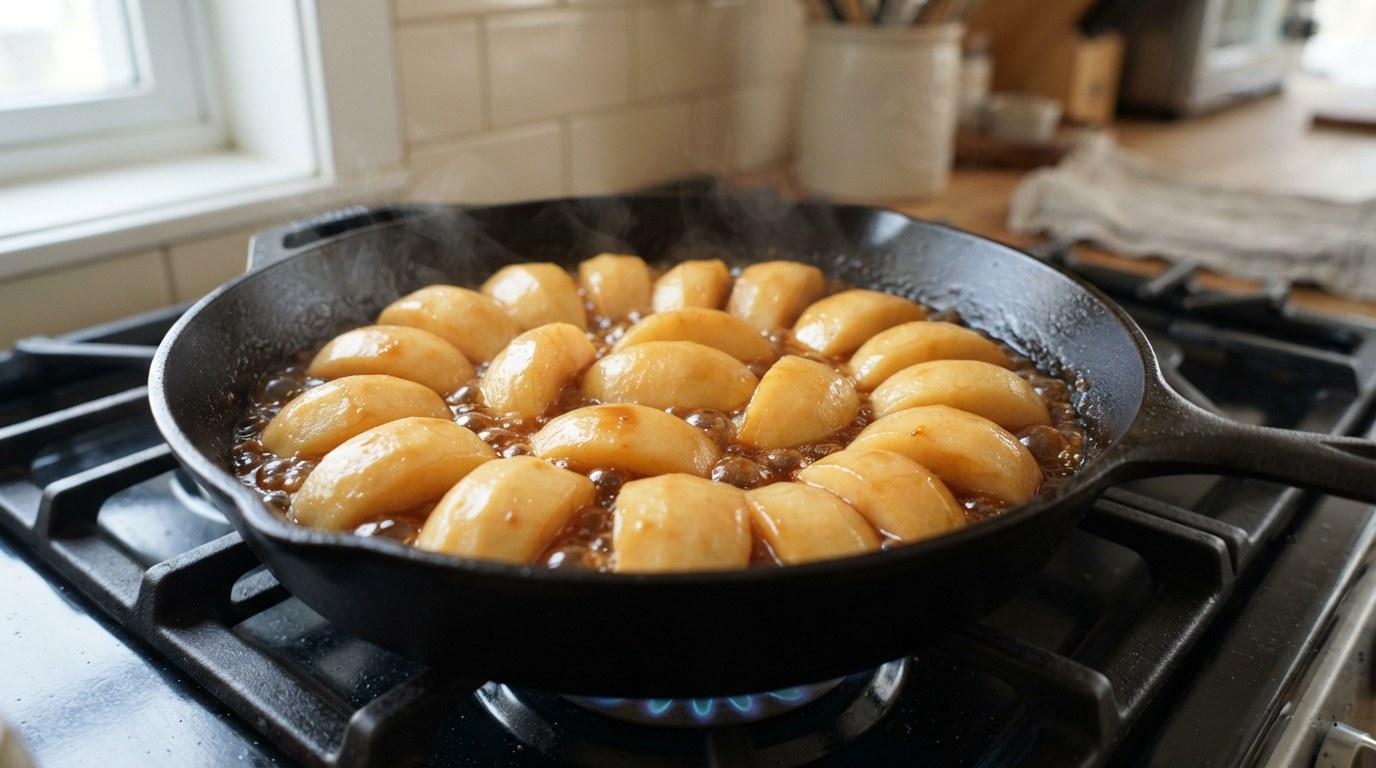
This is the step that decides whether the finished tart is glossy or runny. Cut it short and all that juice ends up on the serving plate. Tilt the pan: when no thin liquid pools at the edge and the apples are tender at the edges but still offer a little resistance in the middle to the tip of a knife, they are ready. This is also where Ramsay's overnight drying pays off. Apples left uncovered in the fridge lose surface water, so there is less to cook off and the caramel stays darker. They turn brown as they sit, which is enzymatic browning on the cut faces; it is harmless, the enzyme responsible is destroyed by about 194°F, and the caramel covers the color anyway.
Puff Pastry: Why It Rises and Which One to Buy
Puff pastry rises because it is hundreds of thin layers of dough separated by butter, and in a hot oven the water in that butter turns to steam and pushes the layers apart. A classic six-turn puff pastry has 729 butter layers. At 400°F the water in each one hits 212°F and flashes to steam fast, before the butter has time to melt into the dough, so each sheet lifts off the one below; then the dough sets and browns. In a cool oven the butter leaks out first and the pastry bakes flat and greasy.
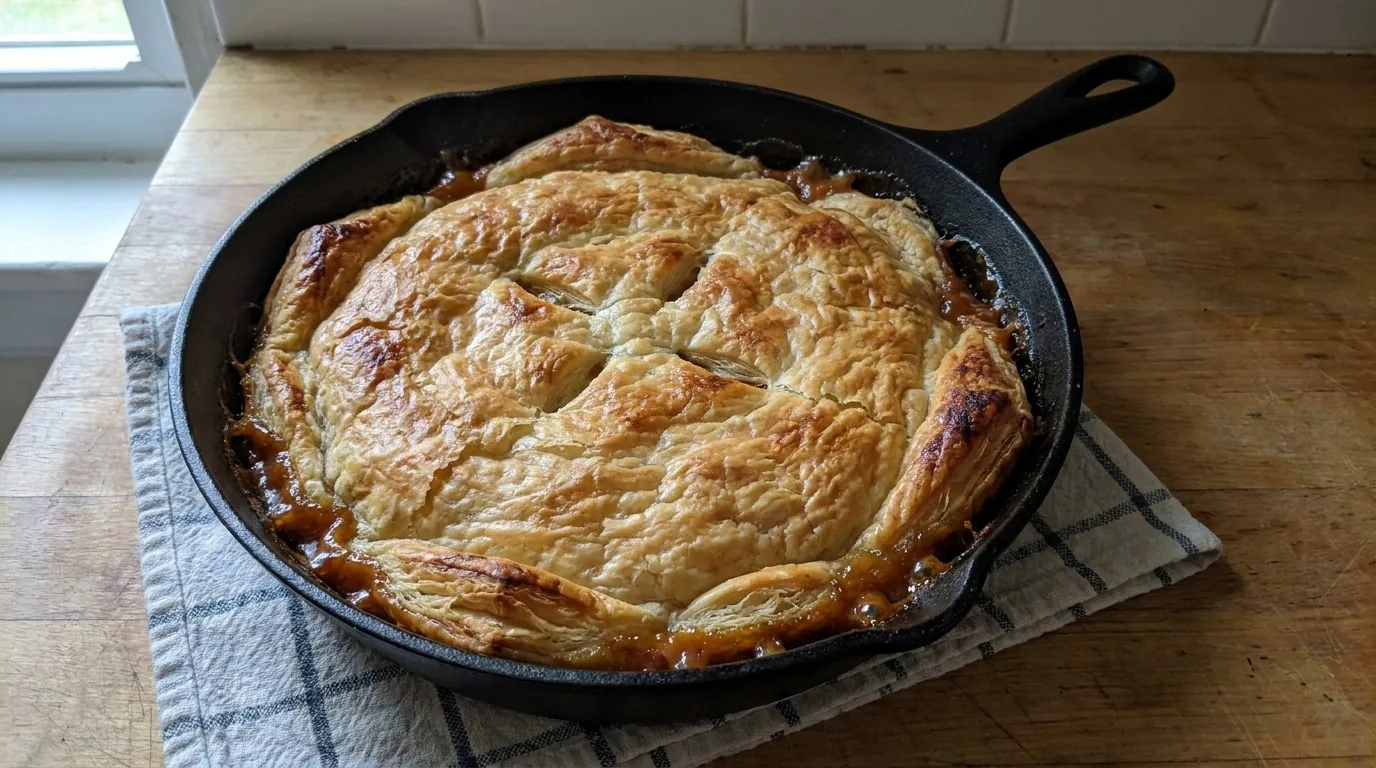
Store-bought all-butter puff pastry is the realistic home route, and it is what Ramsay calls for. All-butter sheets taste better and brown more deeply than shortening-based ones. Thaw it in the fridge so the butter layers stay cold and separate, roll it to about 1/8 inch and an inch wider than the pan, and chill the round while the apples cook. Let the apples stop bubbling for a few minutes before the pastry goes on so the butter does not melt on contact, tuck the edge down between the apples and the pan wall so it forms a rim, and cut a few slits so steam can escape instead of lifting the pastry into a dome. Bake until it is puffed and deep golden, 25 to 30 minutes.
How to Flip an Apple Tarte Tatin Safely
Flip an apple tarte tatin 5 to 10 minutes after it comes out of the oven, while the caramel is still warm and fluid but has stopped bubbling hard. Timing matters because caramel changes texture fast as it cools. Straight from the oven it is close to boiling and runny, so flipping right away floods the plate and can splash. Left too long, it cools and sets into a hard layer that cements the apples to the pan. Ramsay rests his for 5 minutes; America's Test Kitchen, working in a nonstick skillet, waits 20 to 30 minutes until the pan is cool enough to handle. In cast iron, which stays hot longer and has no nonstick coating, the 5-to-10-minute window is the safest.
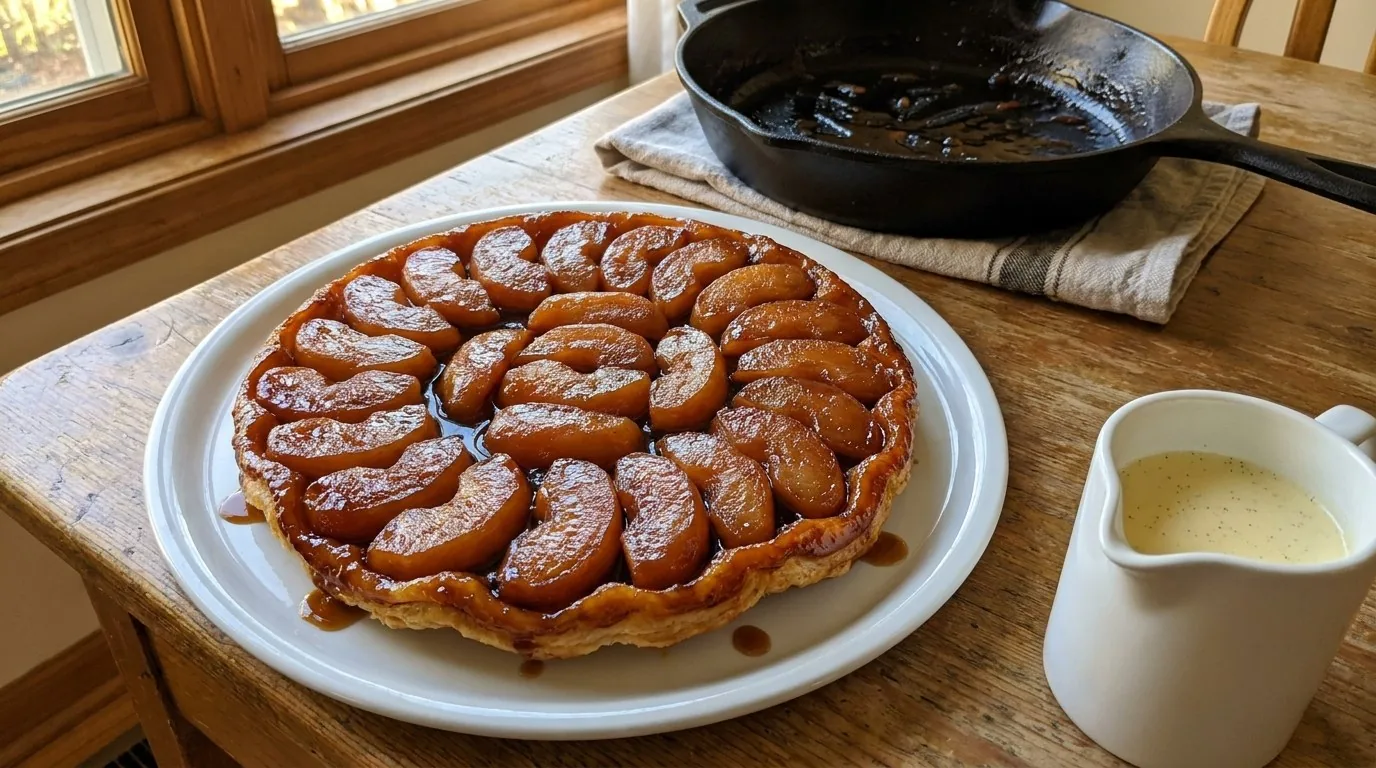
Run a thin knife around the edge first. Use a flat serving plate at least an inch wider than the skillet, set it upside down on the pan, and put oven mitts on both hands. Hold the plate and the handle together firmly and turn them over in one quick, confident motion, away from your body, over the counter. Set it down and lift the skillet straight up. If a few apples stick, lift them out with a knife and press them back into place, then scrape any caramel left in the pan over the top. If the whole tart refuses to release, set the skillet back on a medium burner for a minute or two to melt the caramel and try again.
Crème Anglaise: The Classic Sauce for Tarte Tatin
Crème anglaise is a thin vanilla custard sauce of milk, cream, egg yolks and sugar, cooked gently until it coats a spoon, and it is the sauce Ramsay paired with tarte tatin on MasterChef. Egg yolk proteins on their own start to set around 140°F, but diluted with milk, cream and sugar they thicken between roughly 170 and 180°F. That higher range is what gives you control. Stir constantly over low heat and take it off at about 175°F, when it coats the back of a spatula and a finger drawn through it leaves a clean line, the stage cooks call nappe. That is comfortably past the 160°F the USDA sets for egg dishes, so it is fully cooked.
Go past about 180°F and the proteins clump into scrambled egg instead of a smooth sauce. If you see the first grainy specks, pull the pan off, pour the sauce through a fine sieve into a cold bowl, and whisk; a quick buzz with a stick blender saves a lightly curdled batch. It is the same egg-yolk custard that sets under the sugar crust of a Gordon Ramsay crème brûlée, only stirred instead of baked. Serve it cold or at room temperature against the warm tart.
No time for custard? Crème fraîche is the classic French alternative. Its tang cuts through the sweetness, and at around 30 percent fat it is heat-stable, so it softens on the warm tart without splitting. Vanilla ice cream, which is how both Ramsay's cookbook and the Savoy Grill serve it, is the other easy choice.
Make Apple Tarte Tatin Ahead and Reheat It
Apple tarte tatin is best eaten within a few hours of baking, but it is easy to stage. Make the crème anglaise up to 2 days ahead and keep it covered in the fridge at 40°F or below. Peel and quarter the apples the night before and dry them uncovered in the fridge the way Ramsay does. On the day, bake the tart in the afternoon and leave it in the skillet. Just before serving, warm the skillet over medium-low heat for 2 to 3 minutes, or in a 350°F oven for about 10 minutes, until the caramel loosens and you can see it bubble at the edge, then flip it. Turning it out at the last minute keeps the pastry crisp, because once it sits under the wet apples it starts to soften.
Leftovers keep, though the pastry will soften. The USDA advises refrigerating leftovers within 2 hours and eating them within 3 to 4 days, and the custard sauce falls under the same rule. Reheat slices on a baking sheet in a 350°F oven for about 10 minutes to warm the apples and re-crisp the base; the microwave warms it but leaves the pastry soggy. Freezing is not worth it: the apples weep as they thaw.
Tarte Tatin Troubleshooting
Most tarte tatin problems come from the caramel color, the apple juice, or the timing of the flip. A pale, runny tart means the apples went into the oven before their juice had reduced; next time keep them bubbling on the stove until the syrup is thick and glossy. A bitter, dark tart means the caramel went past deep amber, so pull it earlier and remember cast iron keeps cooking it. Apples that turned to mush were too soft a variety or were sliced too thin; quarters of a firm apple hold.
A tart stuck to the pan was left too long before the flip; rewarm the skillet on the burner and try again. A soggy, pale pastry means the oven was not hot enough or the pastry went onto apples that were still bubbling hard, melting its butter before it could puff. Grainy, sandy caramel was stirred after the sugar dissolved; swirl instead, and if it seizes, add a splash of water and cook it back down.
Gordon Ramsay apple tarte tatin is a dessert that looks like a restaurant plate and needs one pan, a sheet of good pastry and a bit of nerve for the flip. For more of his dessert menu, try the Gordon Ramsay sticky toffee pudding, whose toffee sauce dissolves brown sugar instead of caramelizing it, and our Gordon Ramsay desserts to impress for a full dinner-party plan. If you are kitting out the kitchen, our guide to Gordon Ramsay cookware covers the pans.
Gordon Ramsay Apple Tarte Tatin with Crème Anglaise
Ingredients
Crème anglaise (up to 2 days ahead)
- 1 cup whole milk
- 1 cup heavy cream
- 1 vanilla bean, split and seeds scraped (or 2 tsp vanilla extract)
- 5 large egg yolks
- 1/3 cup granulated sugar (65 g)
- pinch of fine salt
Tarte tatin
- 7 to 8 medium firm apples (about 3 1/2 lb), such as Granny Smith mixed with Braeburn or Golden Delicious
- 1 tbsp lemon juice
- 1 cup granulated sugar (200 g)
- 1/4 cup water
- 6 tbsp unsalted butter (85 g), cut into pieces
- 1/4 tsp fine salt
- 1 sheet store-bought all-butter puff pastry (about 9 to 10 oz), thawed in the fridge
- flour, for rolling
- crème fraîche or vanilla ice cream, to serve (optional, instead of the crème anglaise)
Instructions
- Make the crème anglaise: heat the milk, cream and vanilla bean and seeds in a saucepan until steaming with small bubbles at the edge. Whisk the yolks, sugar and salt in a bowl, then slowly whisk in half the hot milk. Pour it all back into the pan and cook over low heat, stirring constantly with a spatula, until it reaches about 175°F and coats the spatula so a finger line holds, 4 to 6 minutes. Do not let it boil. Strain into a bowl set over ice (stir in the extract now if using), cool, press plastic wrap on the surface and refrigerate.
- Peel, quarter and core the apples and toss them with the lemon juice. (Optional, Ramsay's way: spread them on paper towels on a tray and refrigerate uncovered overnight to dry out; they will brown, which is fine.)
- Heat the oven to 400°F with a rack in the middle and a sheet pan on the rack below to catch drips. Roll the puff pastry on a floured surface to about 1/8 inch thick and cut an 11-inch round. Slide it onto a parchment-lined plate and refrigerate.
- Put the sugar and water in a 10-inch cast-iron or heavy ovenproof skillet over medium heat and stir just until the sugar is evenly wet. Then cook without stirring, swirling the pan now and then, until the caramel turns deep amber, like dark honey, about 355 to 360°F, 8 to 12 minutes. Take it off the heat and whisk in the butter and salt (it will foam up).
- Carefully pack the apple quarters into the caramel standing on their curved sides in tight concentric circles, filling every gap. Return the skillet to medium heat and cook, spooning caramel over the apples now and then, for 15 to 20 minutes, until the juices have reduced to a thick, glossy amber syrup and the apples are tender at the edges but still hold their shape. Take it off the heat for 5 minutes.
- Lay the chilled pastry over the apples and tuck the edge down between the apples and the side of the pan with the handle of a spoon. Cut 4 short slits in the center. Bake for 25 to 30 minutes, until the pastry is puffed and deep golden brown.
- Let the tart rest on a rack for 5 to 10 minutes, until the caramel stops bubbling hard but is still fluid. Run a thin knife around the edge. Put a flat plate at least an inch wider than the skillet upside down on top, and with oven mitts on both hands, hold the plate and handle together and flip in one quick motion, away from you. Lift off the skillet, press any stuck apples back into place and scrape the remaining caramel over the top.
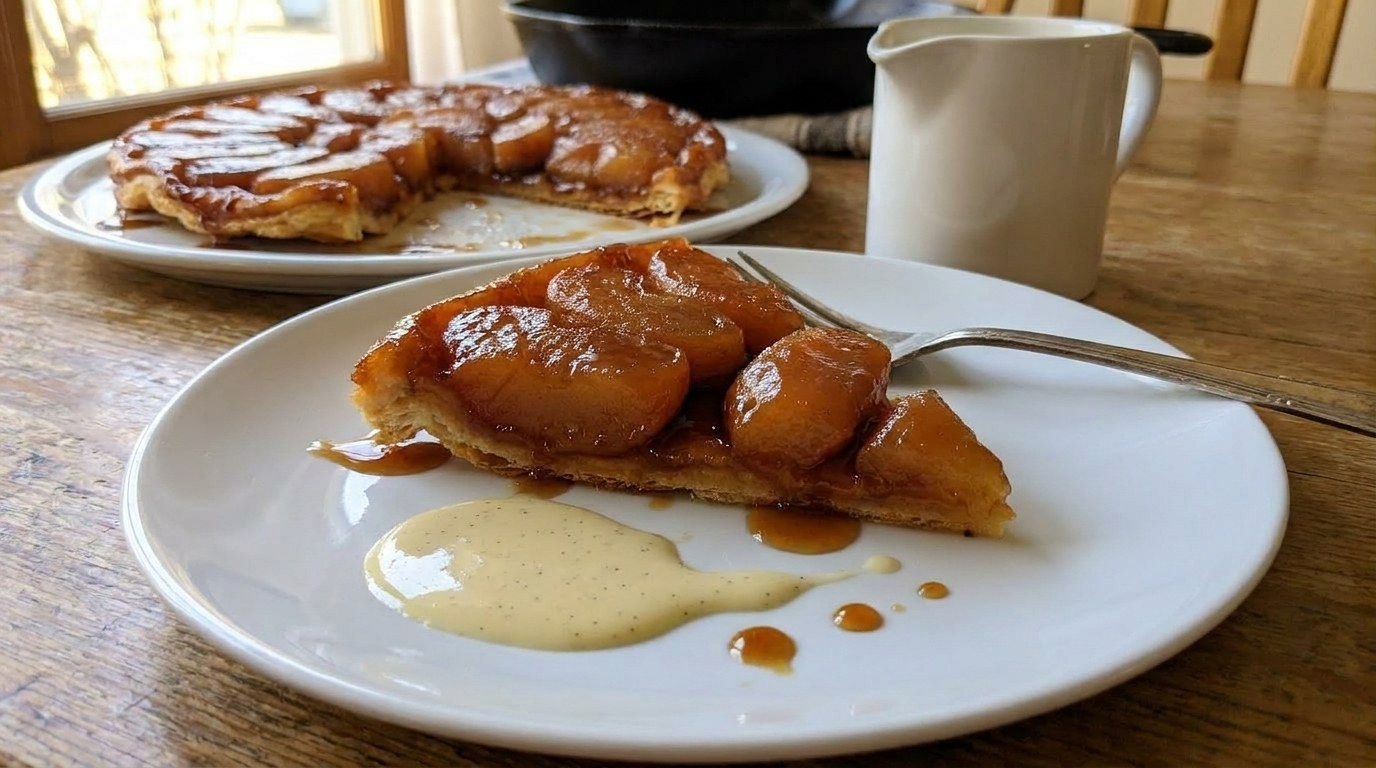
- Serve warm, cut into wedges, with the cold crème anglaise, or with crème fraîche or vanilla ice cream.
Notes
Apple Tarte Tatin FAQs
The questions that come up most: which apples to use, whether to peel them, puff pastry or shortcrust, how far ahead you can make it, whether it is served hot or cold, why it turns out runny, why it sticks to the pan, and how it differs from apple pie.
What apples are best for tarte tatin?
Firm apples that hold their shape: Granny Smith, Braeburn, Golden Delicious and Gala are the easiest to find in the US, and Gordon Ramsay uses Cox's Orange Pippin. Mixing a tart Granny Smith with a sweeter Braeburn or Golden Delicious gives the best flavor. Avoid soft apples such as McIntosh, which break down into sauce.
Do you peel apples for tarte tatin?
Yes. Peel, quarter and core them. The peel stays tough against the soft cooked fruit and stops the caramel soaking in. Plan on seven or eight medium apples for a 10-inch skillet and pack them in tightly, because they shrink as they cook.
Is tarte tatin made with puff pastry or shortcrust?
Either works. Puff pastry is the most common choice and the one Gordon Ramsay uses in his Bread Street Kitchen recipe; store-bought all-butter puff pastry rises into crisp, flaky layers. A shortcrust lid, which Ramsay used in his MasterChef demonstration, bakes into a firmer, more biscuit-like base.
Can you make tarte tatin ahead of time?
Yes, within the day. Bake it in the afternoon and leave it in the skillet, then warm the pan on the stove for 2 to 3 minutes or in a 350°F oven for about 10 minutes to loosen the caramel and turn it out just before serving. Crème anglaise can be made up to 2 days ahead and kept in the fridge.
Is tarte tatin served hot or cold?
Warm is best, turned out 5 to 10 minutes after baking or rewarmed before serving, with cold crème anglaise, crème fraîche or vanilla ice cream. It is still good at room temperature later the same day; cold from the fridge, the caramel firms and the pastry softens.
Why is my tarte tatin runny?
The apples went into the oven before their juice had cooked off. Apples release a lot of water into the caramel; keep them bubbling on the stove for 15 to 20 minutes until the juices reduce to a thick, glossy syrup and no thin liquid pools when you tilt the pan. Soft apple varieties also release more juice.
Why did my tarte tatin stick to the pan?
It cooled too long before the flip, and the caramel set like glue. Turn it out 5 to 10 minutes after it leaves the oven. If it still sticks, put the skillet back on a medium burner for a minute or two to melt the caramel, then flip again and press any stray apples back into place.
What is the difference between tarte tatin and apple pie?
Tarte tatin has no bottom crust: the apples cook in caramel in the pan, the pastry goes on top, and the tart is turned upside down after baking so the caramelized apples end up on top. Apple pie bakes raw, spiced apples between two crusts and is served the right way up.
About the Author
John Siracusa is the founder of Hell’s Kitchen Recipes. He focuses on technique-first, reproducible home cooking and researches recipes & kitchen equipment from published food science and professional chef methods since 2016.