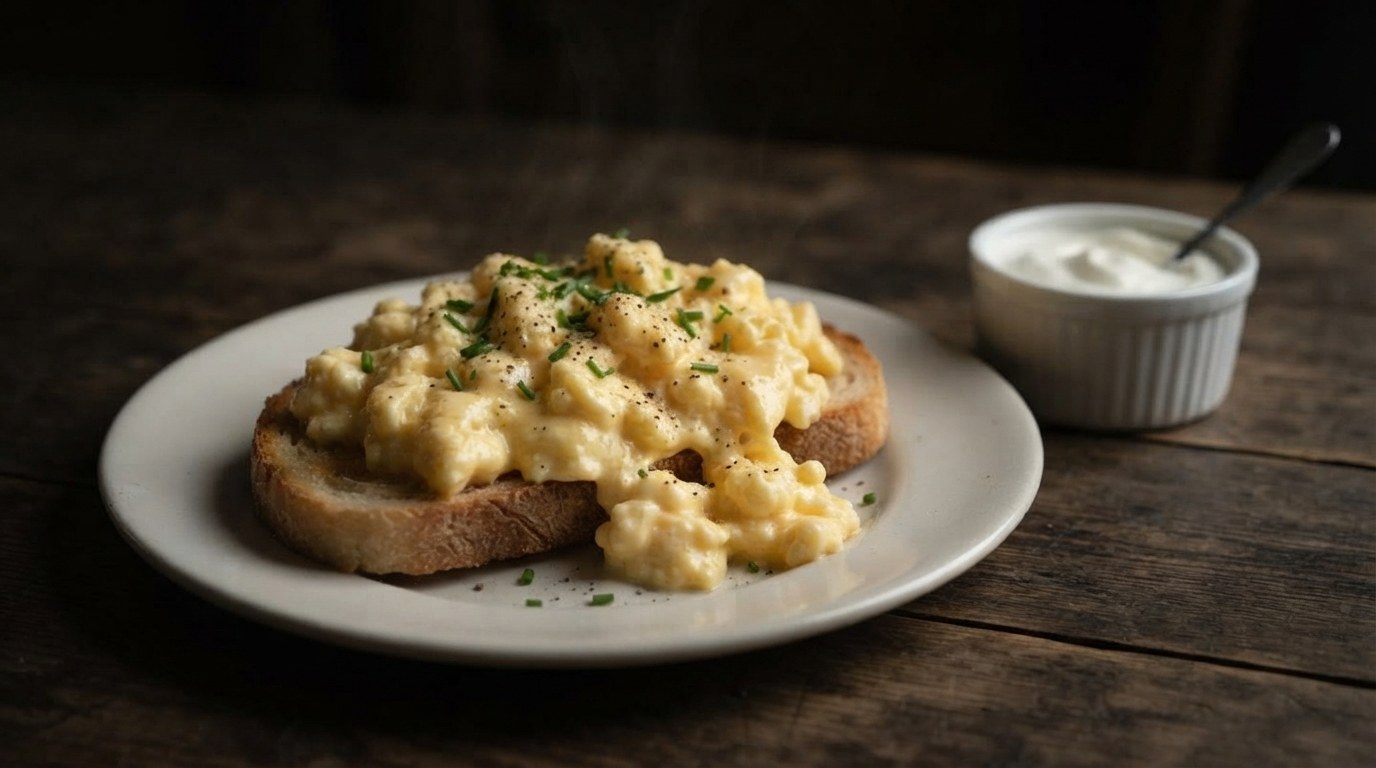
Making Gordon Ramsay scrambled eggs without crème fraîche? Use a teaspoon of full-fat sour cream for every two or three eggs, or a little softened cream cheese, and stir it in only once the pan is off the heat and the eggs have sat for about 30 seconds. Skip light sour cream, nonfat yogurt and milk: they carry too little fat to stay smooth in hot eggs, so they leave grainy white flecks or a watery plate.
Everything else about the method stays the same: cold pan, butter, a rubber spatula, the pan lifted on and off the heat, salt only at the end. The full six-egg version with the recipe card is our Gordon Ramsay scrambled eggs, and the three-egg, single-serving take is the no-whisk scrambled eggs. This page covers the one ingredient people tend not to have, ranks the swaps by fat, and explains why the timing matters more than the tub you reach for. It sits with the site's other cooking techniques.
What Crème Fraîche Does in Gordon Ramsay's Scrambled Eggs
Crème fraîche does two jobs in Gordon Ramsay's scrambled eggs: it adds a little rich, tangy creaminess, and, stirred in cold at the end, it stops the eggs from cooking any further. Any swap has to do both, or at least the second, without splitting. That is a shorter list than it sounds.
The dish also leans on it less than its fame suggests. On the recipe published by his restaurant group, the crème fraîche is a single teaspoon added in the last minute for a creamier texture, after 15 grams of butter has already gone into the pan with six cold eggs. In the scrambled-egg lesson of his MasterClass cooking course, he describes it as the thing that keeps the eggs from overcooking, folded in with the chives, salt and pepper once the eggs are nearly done. So without it, you lose a little tang and your safety brake, and the eggs still come out soft if the heat is handled well.
The brake works because of temperature. Egg proteins start to set into curds at about 140°F, and the heat already in the pan and in the eggs keeps pushing them firmer after you stop stirring, which is carryover cooking. A spoonful of something cold from the fridge drops that temperature the moment it goes in. Any cold, high-fat dairy does the same, and that is why the best swaps below are the fattiest ones.
The Best Crème Fraîche Substitutes for Scrambled Eggs, Ranked by Fat
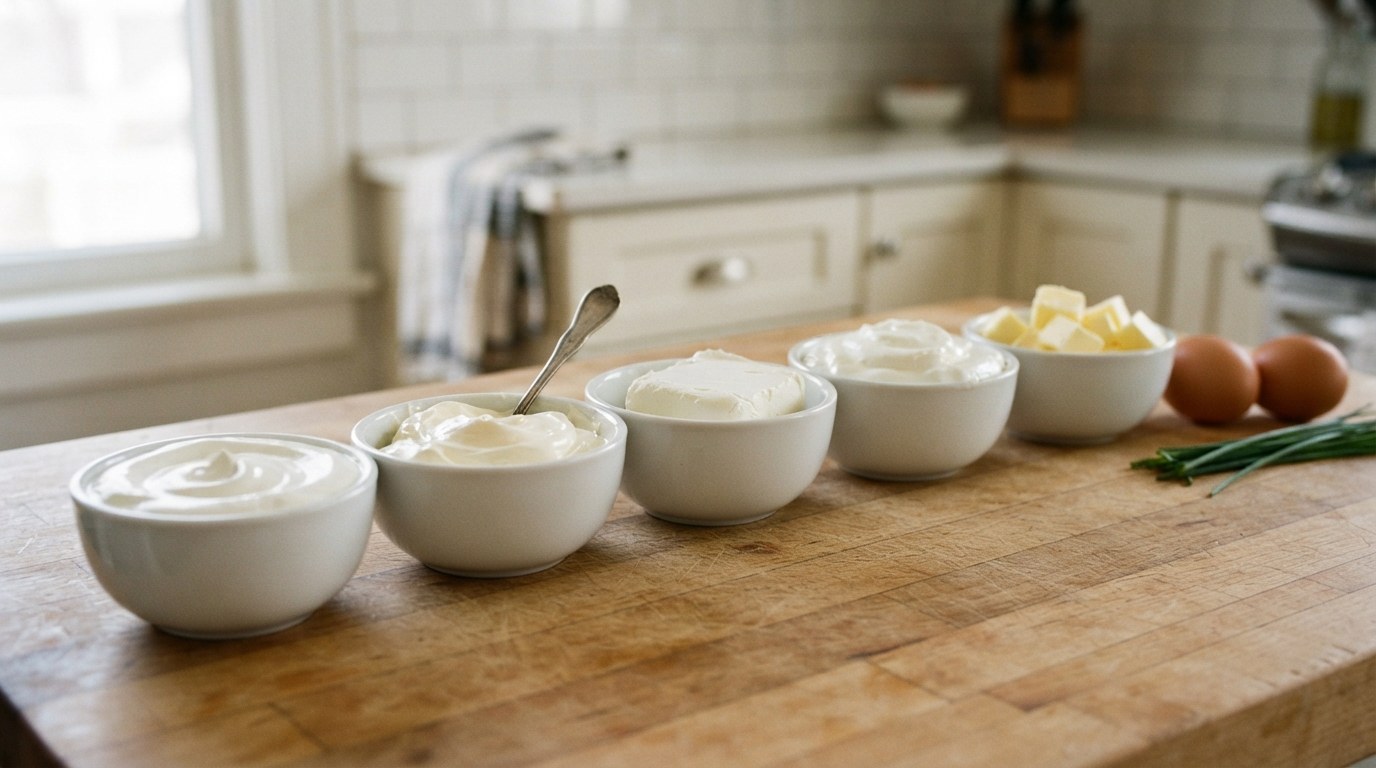
The best crème fraîche substitutes for scrambled eggs are the ones with the most fat: mascarpone, cream cheese, heavy cream and cold butter all hold up in hot eggs, and full-fat sour cream works if it goes in late. Greek yogurt and milk are the weakest. The table puts the common swaps side by side, with roughly how much fat each carries and when to add it.
| Substitute | Approx. fat | Holds up to heat? | When and how to add | Result |
|---|---|---|---|---|
| Crème fraîche (the original) | 30%+ (US brands about 37 to 40%) | Yes | 1 tsp per 2 to 3 eggs, off the heat, at the very end | Glossy and rich with a gentle tang; stops the cooking |
| Full-fat sour cream | About 19% (18% legal minimum) | Partly: can split if the eggs are very hot | Off the heat, wait 30 seconds, fold in 1 tsp per 2 to 3 eggs | Closest flavor; creamy if added late, grainy flecks if added on the heat |
| Cream cheese | 33%+ (legal minimum) | Yes | Softened, in small pieces, off the heat; fold until melted | Thick and rich, milder tang, slightly denser eggs |
| Mascarpone | About 40 to 50% | Yes | 1 tsp per 2 to 3 eggs, off the heat | Closest texture to crème fraîche; mild and sweet, no tang |
| Heavy cream | About 36% | Yes | 1 to 2 tsp, cold, off the heat | Rich and loose, no tang; too much makes the eggs runny |
| A knob of cold butter only | About 81% | Yes | A small cold cube, off the heat | Glossy and rich; the brake without the tang |
| Greek yogurt (full-fat) | About 4 to 5% | No: low fat plus acid splits easily | Off the heat, wait up to a minute, fold in a little at a time | Tangy but thin; weeps whey and turns grainy if the eggs are hot |
| Milk | About 3.25% | No: thins rather than enriches | Skip it | The weakest swap; the water dilutes the eggs and can weep onto the plate |
The fat figures are per 100 grams. Measured values come from USDA FoodData Central: cultured sour cream at 19.4 grams of fat, plain whole-milk Greek yogurt at 4.4 to 5 grams, heavy whipping cream at 36.1 grams and unsalted butter at 81.1 grams, with branded US crème fraîche entries listing about 37 to 40 grams and mascarpone about 40 to 50. Legal minimums come from the FDA's standards of identity: sour cream needs at least 18 percent milkfat, cream cheese at least 33 percent, and whole milk at least 3.25 percent. Read down the "holds up to heat" column and the pattern is plain: everything above about a quarter fat says yes.
Why Fat Decides Whether the Swap Splits
Fat decides whether a crème fraîche swap stays smooth in hot scrambled eggs. Dairy that is more than about 25 percent fat is heat-stable: the fat droplets keep the milk proteins, mostly casein, spread apart, so they can't clump. Below that line, heat and acid pull the casein together into small, firm curds, the grainy white flecks people find in sour-cream eggs. Crème fraîche, at 30 percent or more, sits above the line. Sour cream, at about 19 to 20 percent and cultured to be acidic, sits just below it, and Greek yogurt sits far below it with even more acid.
That is the whole reason the swap goes in off the heat. The eggs are hottest the moment you pull the pan. The American Egg Board puts egg-white setting at 144 to 149°F and the yolk at 149 to 158°F, so soft scrambled eggs leave the stove somewhere in that range, with the pan underneath hotter still. Giving them 30 seconds off the burner lets that heat ease before a lower-fat dairy touches them, and folding gently keeps the sour cream in larger, cooler pockets that blend in instead of curdling on contact. A spoonful of crème fraîche can skip the wait; sour cream can't.
Fat helps the eggs too. The butter that goes into Ramsay's cold pan at the start coats and thins the egg proteins, and diluted proteins need more heat before they bind. It is the same effect that lets a custard of eggs and cream cook to about 174 to 181°F without curdling, while plain egg starts to scramble near 140°F. You get a wider window between just-set and overcooked, which is why the butter should never be the thing you leave out.
Scrambled Eggs With Sour Cream: the Best Everyday Swap
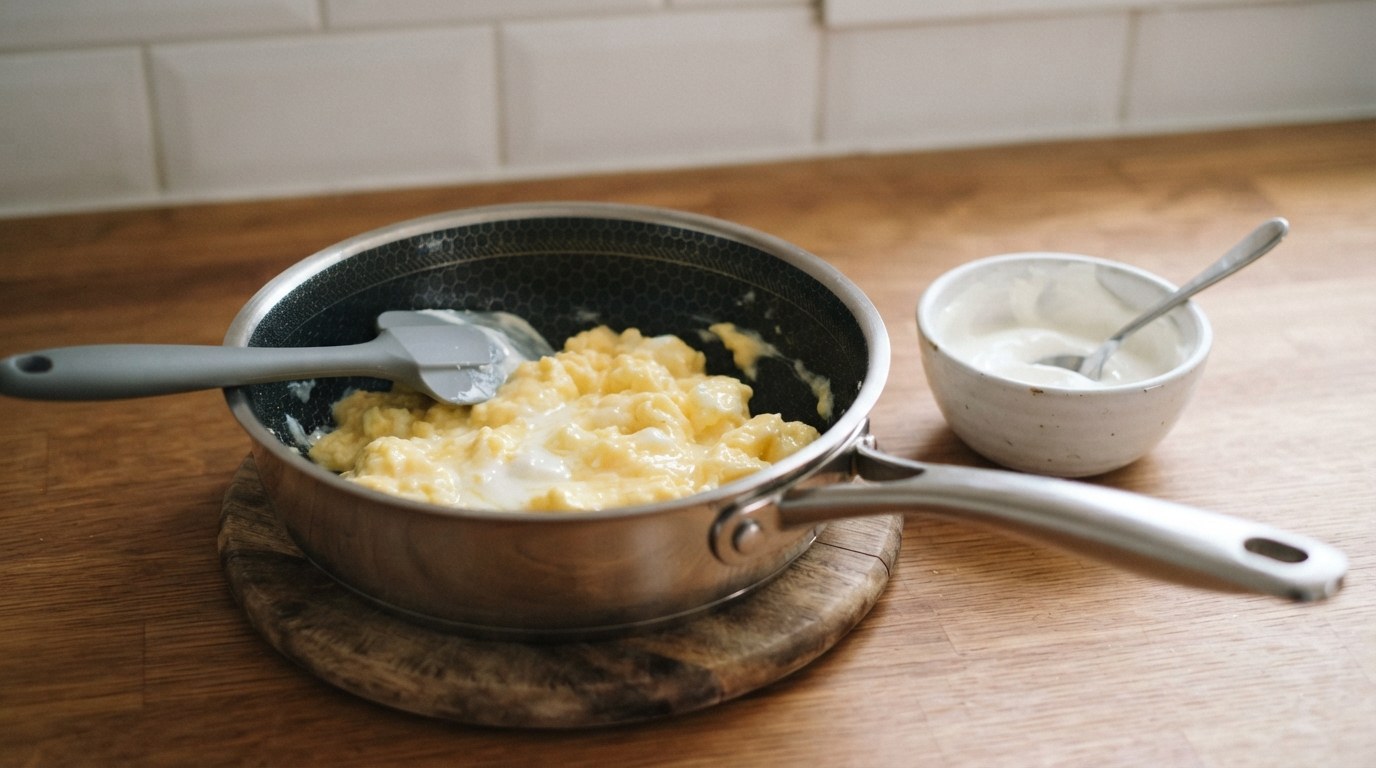
Full-fat sour cream is the swap to reach for when Gordon Ramsay's scrambled eggs call for crème fraîche and the fridge doesn't have any. It is the closest match in flavor, because both are cream soured by cultures, so it brings the same gentle tang that cuts through the butter. Most kitchens already have a tub. Its one weakness, about ten points less fat, is fixed entirely by timing.
Use about a teaspoon for every two or three eggs, a heaped teaspoon for a six-egg batch. Pull the pan when the eggs are soft and still look a touch wet, set it on a board or trivet, wait about 30 seconds, then fold the sour cream through with the spatula in a few slow turns. Add the salt, pepper and chives at the same time, taste, and plate straight away. Full-fat only: light sour cream has even less fat to protect it and splits far more readily.
The most common mistake is adding the sour cream while the pan is still on the burner, or beating it into the raw eggs before they cook. Either way, the sour cream meets full heat, its casein clumps, and you get those white flecks and a thin, whey-colored liquid around the curds. If it happens, the eggs are still fine to eat. Next time, give them the half-minute off the heat first.
Scrambled Eggs With Cream Cheese
Cream cheese works well in scrambled eggs because, at 33 percent fat or more, it holds up to the heat just like crème fraîche. It is firmer and milder, though, so it needs a little handling. Let it soften on the counter while the toast is going, then dot it over the eggs in small pieces, a teaspoon or two for six eggs, once the pan is off the heat. Fold until no white streaks remain; the eggs' own heat melts it in about 20 seconds.
Expect slightly thicker, denser eggs with less tang than sour cream gives. That makes cream cheese the better pick if sour cream's sharpness isn't your thing, or if smoked salmon is going on the plate, since the two are an old pairing. Whipped cream cheese melts in faster than a block. Leave out the reduced-fat kind, which drops below the heat-stable line and turns grainy.
Mascarpone, Heavy Cream, Butter and Greek Yogurt
Mascarpone is the closest swap to crème fraîche in texture, and both of our Ramsay egg pages name it as an easy stand-in. At about 40 percent fat or more, it melts into hot eggs smoothly and acts as a good brake; it just has no tang, so a few extra chives help. Heavy cream, at about 36 percent fat, is heat-stable too, but it is a liquid: a teaspoon or two stirred in cold, off the heat, makes the eggs richer, and more than that makes them runny.
A small cube of cold butter is the swap you always have. It is about 81 percent fat, so it never splits, and stirred in at the end it gives the eggs gloss and drops their temperature the same way crème fraîche does. It adds no tang, which is the only thing missing. Greek yogurt is the one to treat carefully: full-fat versions sit around 4 to 5 percent fat and are strongly acidic, which is exactly the mix that curdles. If yogurt is all you have, let the eggs rest off the heat for up to a minute and fold it in a little at a time, or simply finish with cold butter instead.
Why Milk Is the Weakest Swap for Gordon Ramsay's Scrambled Eggs
Milk is the weakest swap for crème fraîche in Gordon Ramsay's scrambled eggs, and his own recipe leaves it out entirely. Whole milk is only about 3.25 percent fat, so it is mostly water. Stirred in at the end it just thins the eggs. Whisked in at the start, it does soften the set, because, like butter, it dilutes the egg proteins, but its water turns to steam and seeps back out as the curds tighten, which leaves pale eggs sitting in a puddle.
If milk is the only dairy in the house, use it sparingly and lean on the butter instead: a little extra cold butter at the end does more for creaminess than any amount of milk. The main Gordon Ramsay scrambled eggs page covers the milk question in full, including why softness comes from heat control rather than added liquid.
Keep the Rest of Gordon Ramsay's Scrambled Egg Method the Same
Swapping the crème fraîche changes only the last 30 seconds; the rest of Gordon Ramsay's scrambled egg method stays exactly as written. Crack cold eggs into a cold pan with the butter, without beating or salting them. Set it over high heat and stir constantly with a rubber spatula, then work the heat on and off: his restaurant recipe gives 30 seconds on and about 10 seconds off for roughly three minutes, while in the MasterClass lesson he talks through longer 90-second stretches with 20-second breaks. Pull the eggs while they still look a little loose, and finish with your swap, the seasoning and the chives together.
Season last. In the lesson, Ramsay says salting raw eggs makes them grey and runny. The chemistry behind his habit is that salt, like heat and acid, unwinds egg proteins, so salt sitting on raw eggs starts changing them before they reach the pan; added at the end, it simply seasons. The Institute of Food Science and Technology describes that same coagulation process, proteins thickening and turning solid as they heat, which is why soft eggs are all about stopping it early.
Use a nonstick pan. Ramsay warns against stainless steel for scrambled eggs, because setting egg protein bonds to bare metal and a good part of the batch ends up stuck to the base, while a nonstick surface gives the protein nothing to grip, so every curd folds back into the eggs. A deep pan, as his recipe specifies, keeps the eggs in a thicker layer that heats more gently.

HexClad
HexClad 12-Inch Hybrid Nonstick Frying Pan
- Stainless steel and ceramic nonstick hybrid surface, built to sear hard and release easily
- Tri-ply with an aluminum core for quick, even heat; works on induction
- Oven safe to 900°F and metal-utensil safe (lid not included)
Soft Scrambled Eggs and Food Safety
Soft, glossy scrambled eggs are a choice for healthy adults, and the safety advice is the same whichever finisher you use. The FDA advises cooking eggs until the white and yolk are firm, says scrambled eggs should not be runny, and names young children, older adults, pregnant women and people with weakened immune systems as most at risk from Salmonella. The USDA's Food Safety and Inspection Service gives 160°F as the safe temperature for egg dishes. For anyone in those groups, cook the eggs until set, or use pasteurized shell eggs. Keep the dairy cold in the fridge until the moment it goes in, too; that is what makes it a brake.
So if you're making Gordon Ramsay scrambled eggs without crème fraîche, reach for full-fat sour cream, give the eggs half a minute off the heat, and fold it in with the salt and chives. Cream cheese, mascarpone or a cube of cold butter are the next best, and milk is the one to leave out. Once the finish is sorted, the same gentle-heat habit carries straight into eggs Benedict and a silky pasta carbonara.
Gordon Ramsay Scrambled Eggs Without Crème Fraîche FAQs
The questions that come up most: whether sour cream can replace crème fraîche, the best substitute, sour cream versus cream cheese, Greek yogurt, using milk, making them without butter, what heat Ramsay uses, and how much butter goes in.
Can I use sour cream instead of crème fraîche in scrambled eggs?
Yes. Use full-fat sour cream, about a teaspoon for every two or three eggs, and add it off the heat after the eggs have rested for about 30 seconds. Sour cream has roughly 19 to 20 percent fat against crème fraîche's 30 percent or more, so it can split into grainy flecks if it hits very hot eggs. Added late and folded in gently, it stays smooth.
What is the best substitute for crème fraîche in Gordon Ramsay's scrambled eggs?
Full-fat sour cream is the best everyday swap because it has the same cultured tang and most kitchens have it. Mascarpone is the closest in texture and never splits, cream cheese works well if softened first, and a small cube of cold butter does the cooling job with no tang. Avoid light sour cream, nonfat yogurt and milk.
Is sour cream or cream cheese better in scrambled eggs?
Sour cream gives the tangier, looser result closest to crème fraîche; cream cheese gives thicker, milder eggs. Cream cheese is more forgiving with heat, since at 33 percent fat or more it will not split, while sour cream needs the pan off the heat first. Use about a teaspoon of either per two or three eggs.
Can I use Greek yogurt instead of crème fraîche?
Only with care. Full-fat Greek yogurt is about 4 to 5 percent fat and quite acidic, the combination most likely to curdle in hot eggs. Let the eggs rest off the heat for up to a minute and fold it in a little at a time. A cube of cold butter is the safer swap.
Can you make Gordon Ramsay scrambled eggs with milk?
You can, but it is the weakest swap and his recipe uses none. Milk is about 3.25 percent fat and mostly water, so it thins the eggs, and the water can weep out as the curds firm up. For creaminess, add a little extra cold butter at the end instead.
Can you make Gordon Ramsay scrambled eggs without butter?
Yes, but they set faster and are easier to overcook, because the butter thins the egg proteins so they need more heat to bind. Without it, lift the pan off the heat more often, use a nonstick pan, and finish with a high-fat dairy such as sour cream, cream cheese or mascarpone for richness.
What heat does Gordon Ramsay cook scrambled eggs on?
High heat, but never for long. His restaurant recipe puts the pan on high and takes it off every 30 seconds or so for about 10 seconds, stirring the whole time, for roughly three minutes. Egg proteins start to set around 140°F, and lifting the pan keeps them soft instead of rubbery.
How much butter is in Gordon Ramsay's scrambled eggs?
His restaurant group's recipe uses 15 grams of butter, about a tablespoon, for six cold eggs, added to the cold pan with the eggs before the heat goes on. The single-serving no-whisk version uses the same tablespoon of cold butter for three eggs.
About the Author
John Siracusa is the founder of Hell’s Kitchen Recipes. He focuses on technique-first, reproducible home cooking and researches recipes & kitchen equipment from published food science and professional chef methods since 2016.