This bone-in ribeye recipe is a 20-ounce, 2-inch steak cooked the way a steakhouse gets it even from edge to edge: salted ahead, brought slowly to 115°F in a 250°F oven, then seared hard in a hot skillet and basted with butter, garlic and thyme. It is the steak Hell's Kitchen serves in Washington, DC, and the plate comes with it: a head of roasted garlic, glazed maitake mushrooms, blistered cherry tomatoes and a black peppercorn sauce made in the steak pan. One steak feeds two people, and the thermometer, not the clock, tells you when it is done.
The Hell's Kitchen Bone-In Ribeye, Made at Home
Hell's Kitchen in Washington, DC lists a 20-ounce Prime bone-in ribeye with roasted garlic, glazed maitake mushrooms, blistered tomatoes and peppercorn sauce among the mains on its official menu, beside an 8-ounce filet mignon with a truffle peppercorn sauce. The restaurant does not publish its recipe, so this is a home version of that plate, built from the method Gordon Ramsay teaches for a well-marbled steak and from the cooking science behind each part. Our Hell's Kitchen menu guide compares what the DC kitchen serves with the other six US locations.
It is a different steak from our cast iron ribeye, which cooks a 1½-inch steak start to finish in the pan. At 2 inches thick with a rib bone attached, a ribeye needs a gentler first stage, or the outside overcooks long before the center gets to medium-rare. The steak also comes with its own side: spicy Brussels sprouts with a chili glaze and pickled Fresnos, the Brussels sprouts dish on the same DC menu.
Choosing a Bone-In Ribeye: Prime, Thickness and the Bone
Choose a bone-in ribeye by thickness first, about 1¾ to 2 inches, which puts a single-bone steak at roughly 18 to 24 ounces, and by marbling second. USDA Prime is the top quality grade: the USDA's beef grading guide describes Prime as having slightly abundant to abundant marbling, from young, well-fed cattle, sold mostly to hotels and restaurants, and ideal for high-heat cooking because the marbling helps it stay moist. A well-marbled Choice ribeye cooked this way is still excellent; look for fine white flecks spread through the eye rather than a few thick seams.
Gordon Ramsay picks the ribeye as the chef's dream cut in his MasterClass lesson on beef, judging it by the spread of the marbling and the dark red of the meat, and he says a steak this rich needs a proper sear and the confidence to render its fat. The most prized part sits on top: the curved ribeye cap, or spinalis, the loose, heavily marbled muscle wrapped around the eye. Ask for a steak with a thick cap.
Is a bone-in ribeye better than boneless? It cooks a little differently rather than tasting different. The bone conducts heat poorly, so the meat right against it stays cooler and cooks more slowly, which is why a bone-in steak can read rare at the bone and medium-rare in the middle; take every temperature in the thickest part, away from the bone. The bone does not send flavor into the meat in the hour it cooks. What it gives you is the slightly juicier meat beside it, the rib meat to pick off, and the look of the plate.
Salt it early. Sprinkle about 1½ teaspoons of kosher salt over the whole steak, edges included, and set it on a rack in the fridge, uncovered, for at least 45 minutes and up to overnight. Salt draws water to the surface, and after about 40 minutes that brine is drawn back into the meat, seasoning it deeper and leaving the outside dry, which is what you want when the steak hits the pan.
How to Cook a Bone-In Ribeye: Reverse Sear vs Sear Then Oven
The best way to cook a 2-inch bone-in ribeye is the reverse sear: roast it on a rack in a 250°F oven until the center reads 115°F, about 40 to 60 minutes, then sear it in a very hot skillet for 60 to 90 seconds a side. Cooking it low first brings the whole steak up together, so you get an even pink from crust to crust instead of a thick grey ring under the crust, and the low, dry oven air also dries the surface. A dry surface browns fast: browning, the Maillard reaction, starts above about 285°F, according to the science of the Maillard reaction, and a wet surface is stuck at 212°F until its water boils off, so a pre-dried steak crusts in a minute where a damp one would steam first.
Meat proteins start to tighten and squeeze out juice between about 122°F and 140°F. In a hot pan, the outer half-inch of a thick steak blows through that range while the center is still cold. In a 250°F oven the outside and the center climb nearly together, so very little of the steak overshoots. ThermoWorks describes the reverse sear in its steak temperature guide as exactly that: low heat to near the target, then a sear for the last few degrees.
The traditional order, sear first and finish in the oven, still works, and it is what most restaurant lines do with a steady stream of steaks. Sear both sides and the fat edge, then move the skillet into a 400°F oven for 6 to 10 minutes until the center reads 125°F. It is faster, but the gradient is steeper, so expect a wider grey band and more carryover after it comes out.
| Method | Best thickness | Heat | Pull for medium-rare | Time | Result |
|---|---|---|---|---|---|
| Reverse sear (this recipe) | 1½ to 2½ inches | 250°F oven, then a very hot skillet | 115°F out of the oven; about 125°F after the sear | 40-60 min + 4 min sear | Even pink edge to edge, dry surface, fast crust |
| Sear, then oven | 1½ to 2 inches | Hot skillet, then 400°F oven | 125°F | 6 min sear + 6-10 min oven | Good crust, wider grey band, more carryover |
| Pan only, butter-basted | Up to 1½ inches | Medium-high skillet | 125°F | 8-10 min | Deep crust; a 2-inch steak overcooks outside first |
| Grill, two-zone | 1½ to 2½ inches | Indirect side, then direct | 115°F indirect; sear to 125°F | 30-45 min | Smoky char; the outdoor version of the reverse sear |
For a single thick bone-in steak at home, the reverse sear wins on evenness and on margin for error; for anything thinner than an inch and a half, skip the oven and use the pan method.
Bone-In Ribeye Temperature: When to Pull It
For a medium-rare bone-in ribeye, take it out of the 250°F oven at 115°F, sear it to about 125°F, and let it rest to a final 130°F to 135°F, the range ThermoWorks gives for medium-rare in its steak temperature chart. For medium, pull from the oven at 125°F and finish around 135°F to 140°F. The low oven keeps carryover small: ThermoWorks notes that low-heat cooking carries over only 2°F to 5°F, while a steak taken off high heat can climb 10°F to 15°F, so the reverse sear is the most predictable way to land a thick steak where you want it.
| Doneness | Out of the 250°F oven | After the sear | After resting |
|---|---|---|---|
| Rare | 105°F | About 115°F | 120-125°F |
| Medium-rare | 115°F | About 125°F | 130-135°F |
| Medium | 125°F | About 132°F | 135-140°F |
| USDA minimum | 135°F | About 140°F | 145°F, held 3 minutes |
Food safety, stated plainly: the USDA's safe minimum internal temperature for beef steaks is 145°F followed by a 3-minute rest, which on a ribeye reads as medium to medium-well. Rare and medium-rare steaks are cooked below that minimum; that is a choice for healthy adults with an intact whole steak from a source you trust, and the safer one for young children, pregnant people, older adults and anyone with a weakened immune system is the full 145°F. Slide the probe in from the side into the thickest part of the eye, away from the bone and the fat cap, and check in two spots.
ThermoPro
ThermoPro TempSwift Instant-Read Digital Thermometer
- Reads in about 1 second, accurate to ±0.9°F, with a 4.3-inch food-grade stainless probe
- Hold and calibration functions, so you can lock a reading away from the heat
- NSF certified and IP65 waterproof, rinse it clean under the tap
The Sear, the Fat Edge and the Butter Baste
Sear a reverse-seared bone-in ribeye in a 12-inch skillet heated over high until it just begins to smoke, with a tablespoon of grapeseed or canola oil added to the hot pan, for 60 to 90 seconds a side, then stand it on its fat edge for a minute. This is Ramsay's order for any steak: hot pan first, then oil, and nothing goes in unless it sizzles. Because the surface is already dry and the meat warm, the crust forms in about the time a cold, wet steak would spend just steaming.
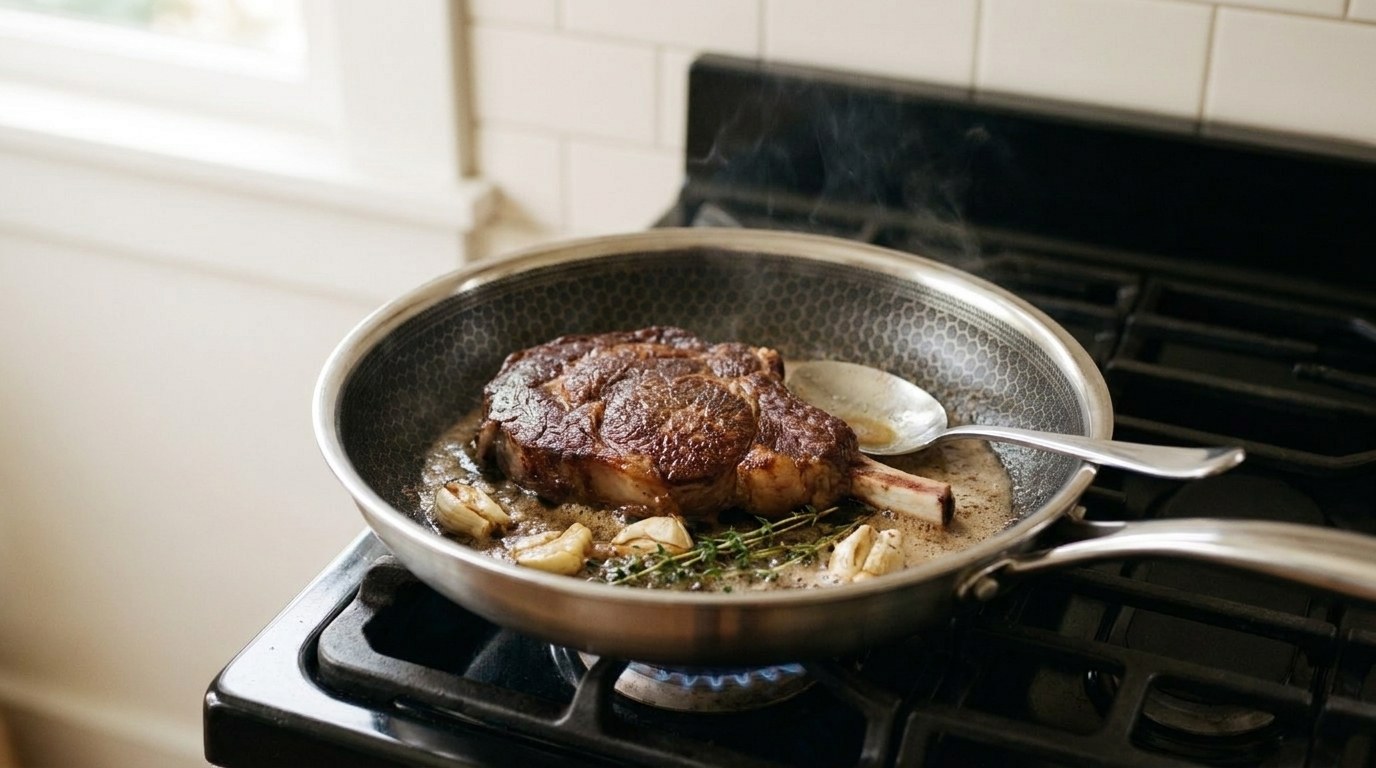
The fat edge needs its own time. In a 250°F oven the outer fat only softens; it needs direct contact with the hot metal to render out and turn golden and crisp, so hold the steak upright with tongs and let the edge cook for 60 seconds, then give the bone side 30 seconds too. Then lower the heat to medium, add 2 tablespoons of butter, four smashed garlic cloves and a few thyme sprigs, and once the butter foams and turns nut-brown, tilt the pan and spoon it over the steak for 30 to 60 seconds. Lay the roasted garlic halves cut side down in the butter at the same time so their faces caramelize.
Two pieces of steakhouse lore are worth correcting here. Searing does not seal in juices; a seared steak actually loses moisture faster, and the sear is there for the crust and its flavor. Basting does not moisten the meat either, since the muscle is already full of water and being squeezed by the heat. What the foaming butter does is brown the surface, coat it in the garlic and thyme flavor, and finish the crust evenly over the bumps the pan cannot reach. Our guide to thyme or rosemary for steak covers which herb to baste with and why the butter carries it.
Roasted Garlic, Glazed Maitake and Blistered Tomatoes
The three garnishes on the Hell's Kitchen bone-in ribeye are quick once the steak is in the oven: a garlic head halved crosswise and roasted in foil at 400°F for 35 to 40 minutes before the oven goes down to 250°F, maitake mushrooms seared in clusters and glazed with butter, honey and soy, and cherry tomatoes blistered in the same hot skillet for 2 to 3 minutes. All three can sit in the 250°F oven beside the steak to stay warm.
Roasted whole, garlic turns sweet and soft instead of sharp, and the reason is an enzyme. Garlic's bite comes from allicin, which forms only when a clove is crushed or cut and an enzyme called alliinase is released, within 10 to 60 seconds, as the Linus Pauling Institute at Oregon State University explains; heat inactivates that enzyme. A head roasted whole, its cloves intact, never makes much allicin, so it cooks into a mild, spreadable paste with caramelized edges. Squeeze it onto the steak or stir a clove into the sauce.
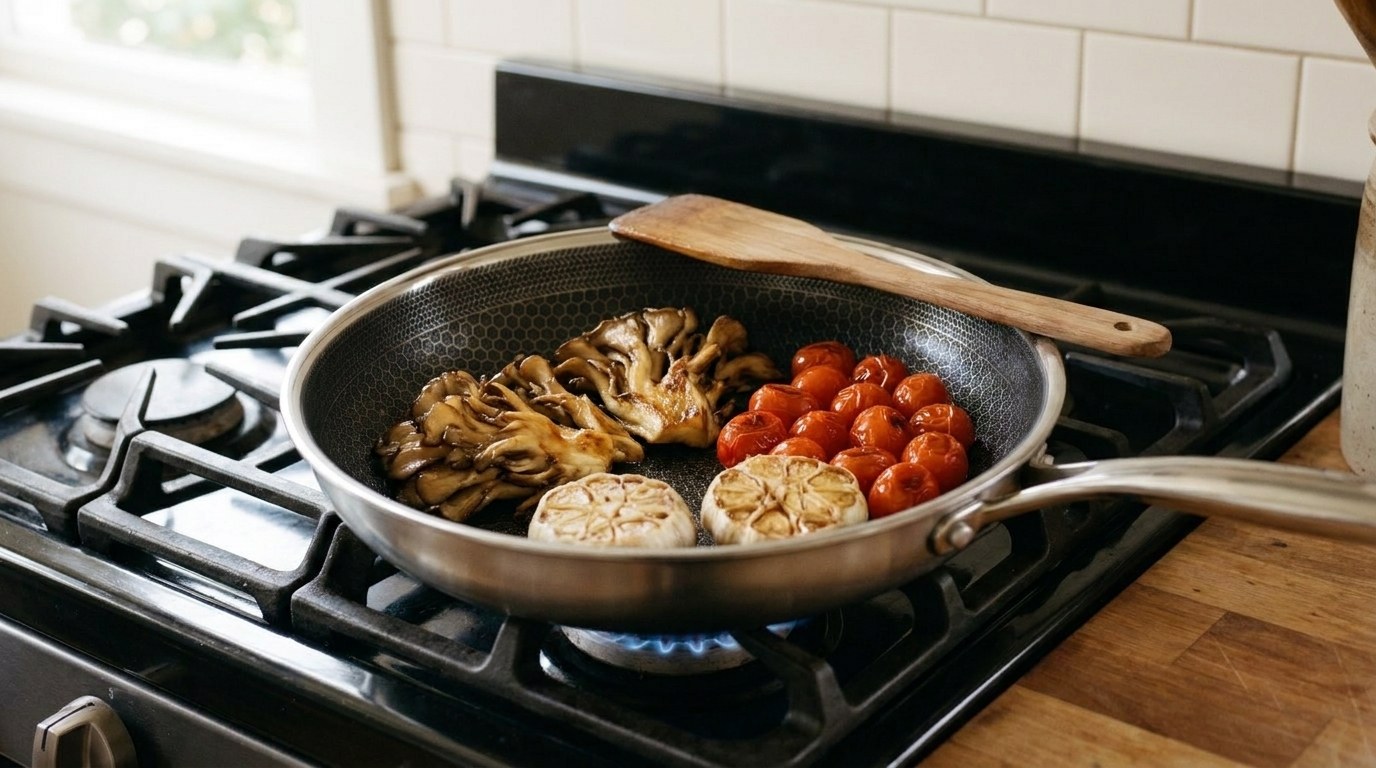
Maitake, also called hen-of-the-woods, grows in ruffled clusters of thin caps, and it browns best kept in large pieces pressed flat in a hot pan. Like all mushrooms it is mostly water, and it cannot brown until that water has cooked off; crowd the pan or stir too soon and it steams grey. Leave the clusters for 3 to 4 minutes until the frilly edges crisp, turn them once, then add a tablespoon of butter with a teaspoon each of honey and soy sauce and toss for 30 seconds. The honey's sugars caramelize and the soy adds salt and savory depth, giving the glossy, slightly sticky finish of a glazed maitake. Use tamari to keep the plate gluten-free.
Blistered tomatoes need the pan as hot as it gets. Cherry tomatoes hit a very hot skillet, the water just under the skin flashes to steam, the skin tightens, splits and chars in spots, and the inside stays juicy and barely warm. Shake the pan for 2 to 3 minutes, take them off the moment the first skins burst, and season with flaky salt. They bring the acid that cuts through a fatty ribeye.
Black Peppercorn Pan Sauce in the Same Pan
Make the peppercorn sauce for a bone-in ribeye in the skillet the steak came out of, while it rests: pour off all but a tablespoon of fat, soften a minced shallot, add 1½ teaspoons of coarsely crushed black peppercorns, deglaze with 3 tablespoons of brandy, reduce ¾ cup of beef stock by half, then finish with 3 tablespoons of heavy cream, a knob of cold butter and the steak's resting juices. It takes about 6 minutes and turns the brown film on the pan floor, the fond, into the base of the sauce. Building the sauce in the same pan is a Ramsay rule; washing that pan would throw the flavor away.
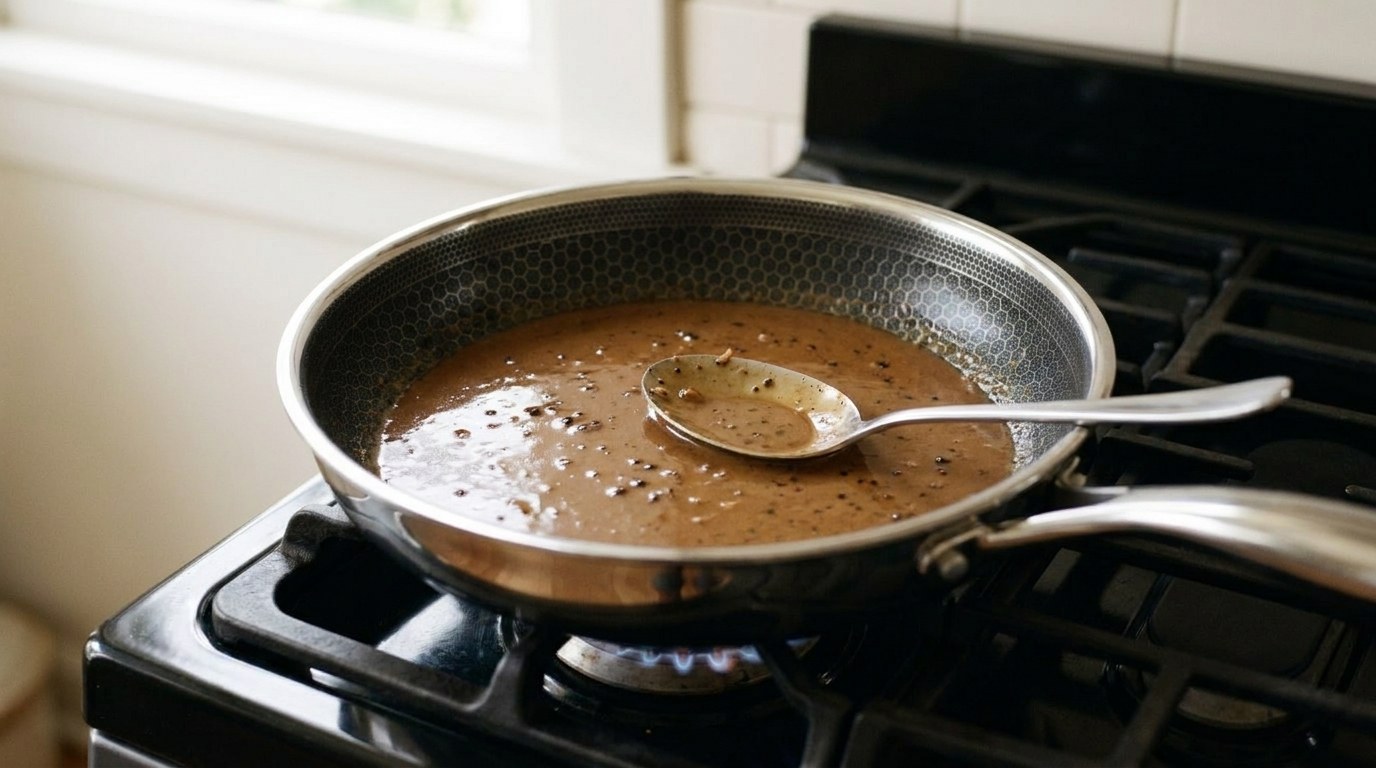
Crush the peppercorns coarsely, in a mortar or under the bottom of a heavy pan, and add them only for the last few minutes. Crushing releases piperine, the compound behind pepper's heat, along with its aroma oils, and long simmering turns that aroma flat and the heat harsh. Take the pan off the burner before the brandy goes in. Flaming it is optional and does not burn the alcohol away: the flame dies once the vapor thins out, leaving most of the alcohol in the pan, so it is the simmer and reduction that soften it. Heavy cream, at around 36% fat, can boil without curdling because dairy above about 25% fat is heat-stable, which is why the sauce can bubble hard to thicken.
This is a darker, stock-forward black peppercorn sauce that matches the deep brown cup on the DC plate, with just enough cream to round it off. For a full batch for four steaks, plus no-cream and no-alcohol versions, see our black peppercorn sauce recipe. For the classic creamy version built on brined green peppercorns and Dijon, see our green peppercorn sauce; for a wine-based alternative, the red wine reduction sauce works the same way in the same pan.
Resting, Carving and Plating a Bone-In Ribeye
Rest a bone-in ribeye for 5 to 10 minutes on a warm board, which is just long enough to make the sauce, then cut it off the bone and slice it across the grain. Resting does not relax the muscle; it lets the juices inside thicken as the meat cools slightly, so they stay in the slices instead of running across the board. A steak cut after 2 minutes loses about 6% of its weight in juice, and one rested 10 minutes about 2%. A reverse-seared steak has less to lose, since its outer layers were never pushed far past the center's temperature.
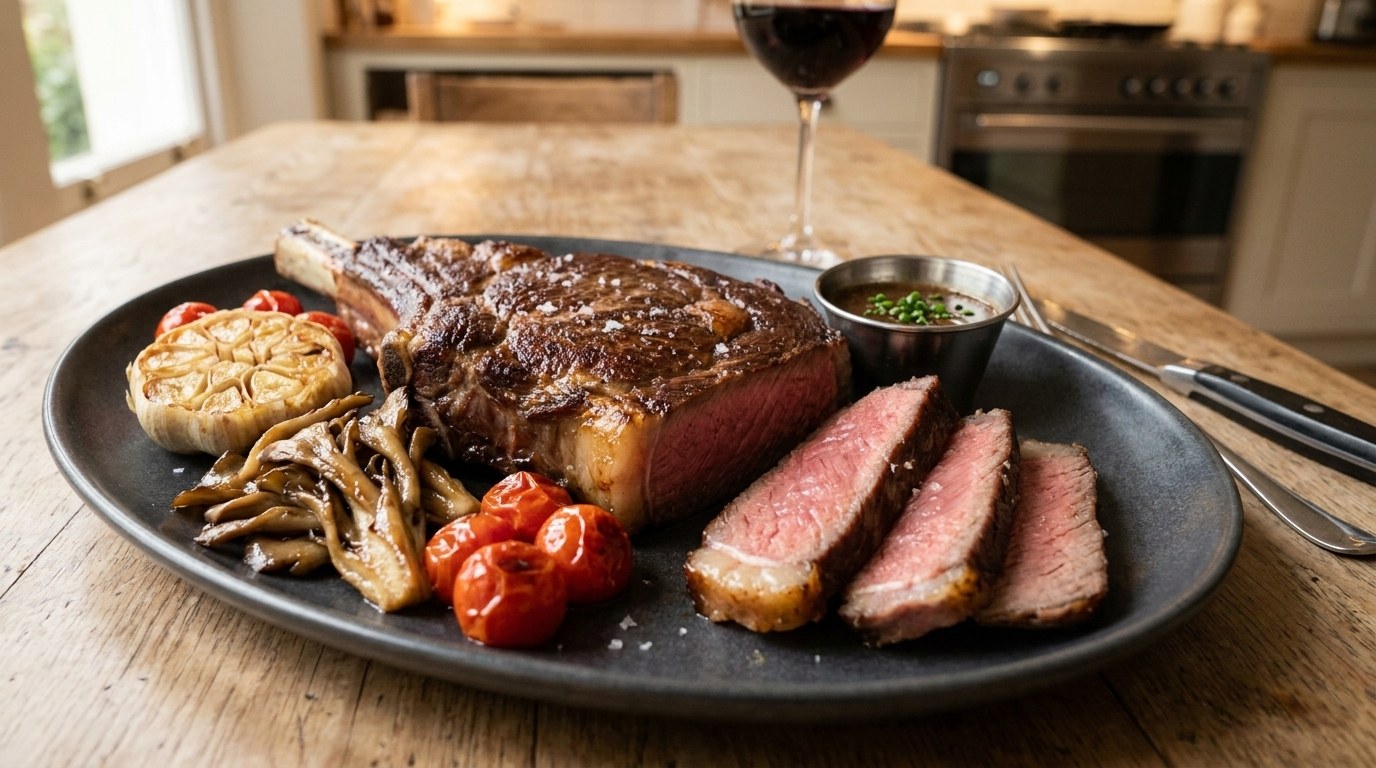
To carve, run a sharp knife along the curve of the bone to lift the eye away in one piece, then cut it into ½-inch slices across the grain; cutting across the muscle fibers means each bite chews through short lengths of fiber rather than long ones, which takes around a tenth of the force. Set the slices back against the bone so the steak keeps its shape, add half a garlic head, the maitake and tomatoes, and serve the sauce in a small cup with chives on top, the way the DC kitchen plates it. Give the bone to whoever wants to pick it clean.
For sides, the restaurant's own pairing is the spicy Brussels sprouts, roasted at 425°F while the steak sits in its low oven. A spoon of pomme purée catches the peppercorn sauce. For more steak cuts and how they compare, our most tender steaks guide ranks them, and the Gordon Ramsay steak guide covers his pan method on any cut. Salt it ahead, cook it low, sear it hard and pull it by the number, and a bone-in ribeye comes out like the one on the Hell's Kitchen plate.
Bone-In Ribeye with Peppercorn Sauce (Hell's Kitchen-Style)
Ingredients
Steak
- 1 bone-in ribeye steak, about 20 oz and 1 3/4 to 2 inches thick (Prime or well-marbled Choice)
- 1 1/2 tsp kosher salt (Diamond Crystal; use 1 tsp Morton)
- 1/2 tsp freshly ground black pepper
- 1 tbsp grapeseed or canola oil
- 2 tbsp unsalted butter
- 4 garlic cloves, smashed, skins on
- 4 fresh thyme sprigs
Roasted garlic
- 1 whole head of garlic
- 1 tsp olive oil, plus a pinch of salt
Maitake and tomatoes
- 6 to 8 oz maitake (hen-of-the-woods) mushrooms, torn into 4 to 6 clusters
- 1 tbsp grapeseed or canola oil, plus a few drops
- 1 tbsp unsalted butter
- 1 tsp honey
- 1 tsp soy sauce or tamari
- 1 cup cherry tomatoes (about 10)
- flaky salt
Black peppercorn sauce
- 1 small shallot, finely minced
- 1 1/2 tsp black peppercorns, coarsely crushed
- 3 tbsp brandy or Cognac
- 3/4 cup low-sodium beef stock
- 3 tbsp heavy cream
- 1 tbsp cold unsalted butter
- 1 tbsp finely snipped chives
Instructions
- At least 45 minutes and up to a day ahead, pat the steak dry and season it all over, edges included, with the kosher salt. Set it on a wire rack over a rimmed sheet pan and refrigerate, uncovered.
- Heat the oven to 400°F. Cut the garlic head in half crosswise, drizzle the cut sides with the olive oil and a pinch of salt, press the halves back together, wrap in foil and roast for 35 to 40 minutes, until soft and golden. Unwrap and set aside, then lower the oven to 250°F, leaving the door open for a minute to let it cool.
- Season the steak with the pepper, leave it on the rack and roast it in the 250°F oven until the thickest part, away from the bone, reads 115°F for medium-rare (125°F for medium), about 40 to 60 minutes for a 2-inch steak. Start checking at 30 minutes.
- While the steak roasts, heat a 12-inch skillet over medium-high, add 1 tablespoon oil and the maitake clusters, press them flat and cook undisturbed for 3 to 4 minutes, until browned and crisp at the edges. Turn, cook 2 minutes more, then add the 1 tablespoon butter, the honey and soy sauce and toss for 30 seconds, until glossy. Move to an oven-safe plate.
- Add a few drops of oil to the hot skillet and the tomatoes. Cook over high heat, shaking the pan, for 2 to 3 minutes, until the skins blister and start to split. Add them to the plate with the maitake, season with flaky salt and keep warm in the oven beside the steak. Wipe out the skillet.
- When the steak reaches temperature, heat the skillet over high heat until it just starts to smoke, add the 1 tablespoon oil, then the steak. Sear 60 to 90 seconds per side, until deep brown, then hold it on its fat edge for 60 seconds and on the bone side for 30 seconds.
- Lower the heat to medium, add the 2 tablespoons butter, smashed garlic, thyme and the roasted garlic halves cut side down. When the butter foams and smells nutty, tilt the pan and spoon it over the steak for 30 to 60 seconds. The center should read about 125°F. Move the steak and garlic halves to a warm board and rest 5 to 10 minutes.
- For the sauce, pour off all but about 1 tablespoon of fat (discard the smashed garlic and thyme). Over medium heat, cook the shallot for 1 minute, add the crushed peppercorns for 30 seconds, then take the pan off the heat and add the brandy. Return to the heat and boil until almost dry, scraping up the browned bits.
- Add the stock and boil until reduced by about half, 3 to 4 minutes. Stir in the cream and simmer 1 minute, until the sauce coats a spoon. Off the heat, swirl in the cold butter and any juices from the resting steak. Taste, add salt if needed, and pour into a small warm cup; top with the chives.
- Cut along the bone to remove the eye in one piece, slice it ½ inch thick across the grain and set the slices back against the bone. Serve with the roasted garlic, maitake, tomatoes and peppercorn sauce.
Notes
Bone-In Ribeye FAQs
The questions that come up most: the best way to cook a bone-in ribeye, how long it takes in the oven, what temperature it should be, whether bone-in is better than boneless, how long to sear and rest it, and what Hell's Kitchen serves with it.
What is the best way to cook a bone-in ribeye?
For a steak 1½ inches or thicker, the reverse sear: roast it on a rack in a 250°F oven until the center reads 115°F, then sear it in a very hot skillet for 60 to 90 seconds a side and baste it with butter, garlic and thyme. It cooks evenly from edge to edge and crusts fast because the surface is already dry.
How long do you cook a bone-in ribeye in the oven?
At 250°F, a 2-inch, 20-ounce bone-in ribeye takes about 40 to 60 minutes to reach 115°F in the center; a 1½-inch steak about 30 to 40 minutes. Start checking at 30 minutes. If you sear first and finish in a 400°F oven, it takes about 6 to 10 minutes to reach 125°F.
What temperature should a bone-in ribeye be for medium-rare?
About 130°F to 135°F after resting. With the reverse sear, take it out of the oven at 115°F; the sear brings it to about 125°F and the rest finishes it. The USDA minimum for beef steaks is 145°F with a 3-minute rest. Measure in the thickest part, away from the bone.
Is a bone-in ribeye better than boneless?
It is the same muscle, so the eating quality is close. The bone conducts heat poorly, so the meat beside it cooks more slowly and stays a little juicier, and you get the rib meat to pick at. The bone does not add noticeable flavor to the steak in the time it cooks.
How long do you sear a bone-in ribeye?
After a reverse sear, 60 to 90 seconds per side in a skillet heated until it just smokes, plus about a minute on the fat edge and 30 seconds on the bone side, then 30 to 60 seconds of butter basting. A cold steak seared first needs 2 to 3 minutes a side.
How long should a bone-in ribeye rest?
5 to 10 minutes, loosely tented on a warm board, which is time to make the pan sauce. Resting lets the juices thicken so they stay in the slices: a steak cut at 2 minutes loses about 6 percent of its weight, one rested 10 minutes about 2 percent.
What does Hell's Kitchen serve with the bone-in ribeye?
At the Washington, DC restaurant the 20-ounce Prime bone-in ribeye comes with roasted garlic, glazed maitake mushrooms, blistered tomatoes and peppercorn sauce, and the menu lists roasted Brussels sprouts with a chili glaze, pickled Fresnos and micro cilantro among the sides.

About the Author
John Siracusa is the founder of Hell’s Kitchen Recipes. He focuses on technique-first, reproducible home cooking and researches recipes & kitchen equipment from published food science and professional chef methods since 2016.