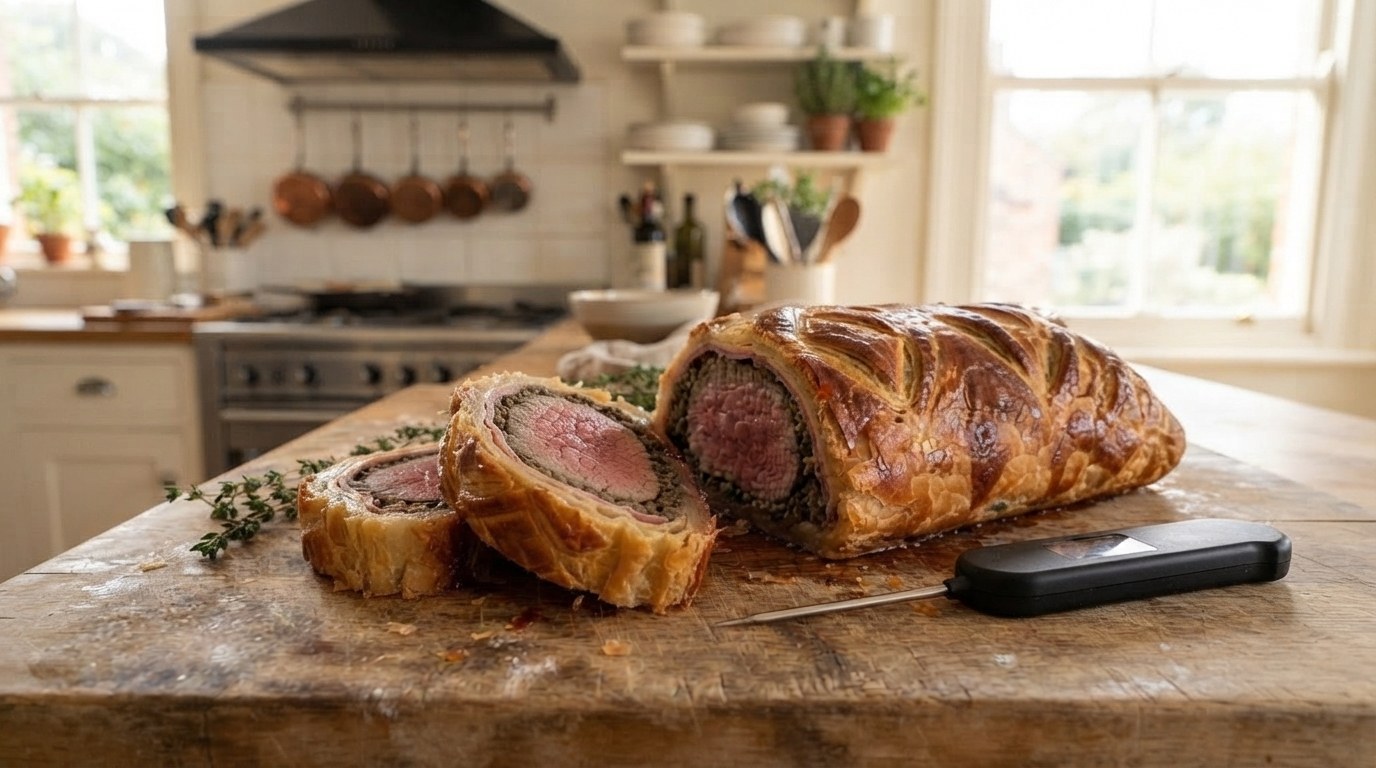
Beef Wellington cook time: bake a 2 lb center-cut tenderloin Wellington at 425°F (220°C) for about 35 to 45 minutes, until the pastry is deep gold and a probe in the center of the beef reads 95 to 100°F (35 to 38°C). Rest it 10 minutes and carryover heat lifts the center to about 125°F (52°C), a pink medium-rare.
That pull temperature looks wrong the first time you see it, and it is the number most Wellingtons get wrong. Puff pastry wraps the beef in a jacket of hot, trapped air, so the center keeps climbing long after it leaves the oven. Below are the beef Wellington cook time by weight, the pull and final temperatures for every doneness, Gordon Ramsay's own published times, the crêpe question, and a fix for each of the usual failures. For the full build, the step-by-step lives in the Gordon Ramsay beef Wellington recipe, the individual restaurant version in Hell's Kitchen beef Wellington, and the holiday centerpiece in Christmas beef Wellington. This page sits with the site's other cooking techniques.
Beef Wellington Cook Time by Weight
At 425°F (220°C), a center-cut tenderloin Wellington takes about 30 to 55 minutes depending on size, and a 2 lb one takes 35 to 45. ThermoWorks bakes its 2 lb Wellington at 425°F for about 35 to 45 minutes with a probe alarm set at 95 to 100°F, and the rows below scale from that. Start checking at the time in the fourth column; the thermometer decides, not the clock.
| Trimmed tenderloin | Serves | Bake at 425°F (220°C) | Start checking at | Pull for medium-rare |
|---|---|---|---|---|
| 1.5 lb (680 g) | 4 | 30 to 40 min | 25 min | 95-100°F (35-38°C) |
| 2 lb (900 g) | 4 to 6 | 35 to 45 min | 30 min | 95-100°F (35-38°C) |
| 2.5 lb (1.1 kg) | 6 | 40 to 50 min | 35 min | 95-100°F (35-38°C) |
| 3 lb (1.4 kg) | 6 to 8 | 45 to 55 min | 40 min | 95-100°F (35-38°C) |
| Individual 6 oz (170 g) filet | 1 | 18 to 22 min | 15 min | 115-120°F (46-49°C) |
The times assume a center-cut piece about 3 inches thick, wrapped, chilled and baked straight from the fridge on the middle rack. Thickness sets the time more than weight does: heat has to travel the same 1½ inches to the center whether the log is 10 inches long or 14, so a longer 3 lb piece of the same girth needs only a little more time than a 2 lb one. A fat butt end or a tail folded under adds thickness and time. An individual Wellington has so little mass that it carries over only about 10°F, which is why its pull temperature is higher; the Hell's Kitchen beef Wellington is built around that size.
Beef Wellington Internal Temperature for Each Doneness
Pull a whole beef Wellington about 25°F (14°C) below the temperature you want to eat it at. ThermoWorks measured about 25°F of carryover on a 2 lb Wellington baked at 425°F and rested 10 minutes, and America's Test Kitchen took one out of a 450°F oven at just 85°F and watched it climb to a 130°F medium-rare over a 45-minute rest. The pull temperatures below assume a 1.5 to 3 lb center-cut Wellington at 425°F and a 10 to 15 minute rest.
| Doneness | Pull from the oven | After a 10-15 min rest | What the center looks like |
|---|---|---|---|
| Rare | 90°F (32°C) | 115-120°F (46-49°C) | Deep red, barely warm |
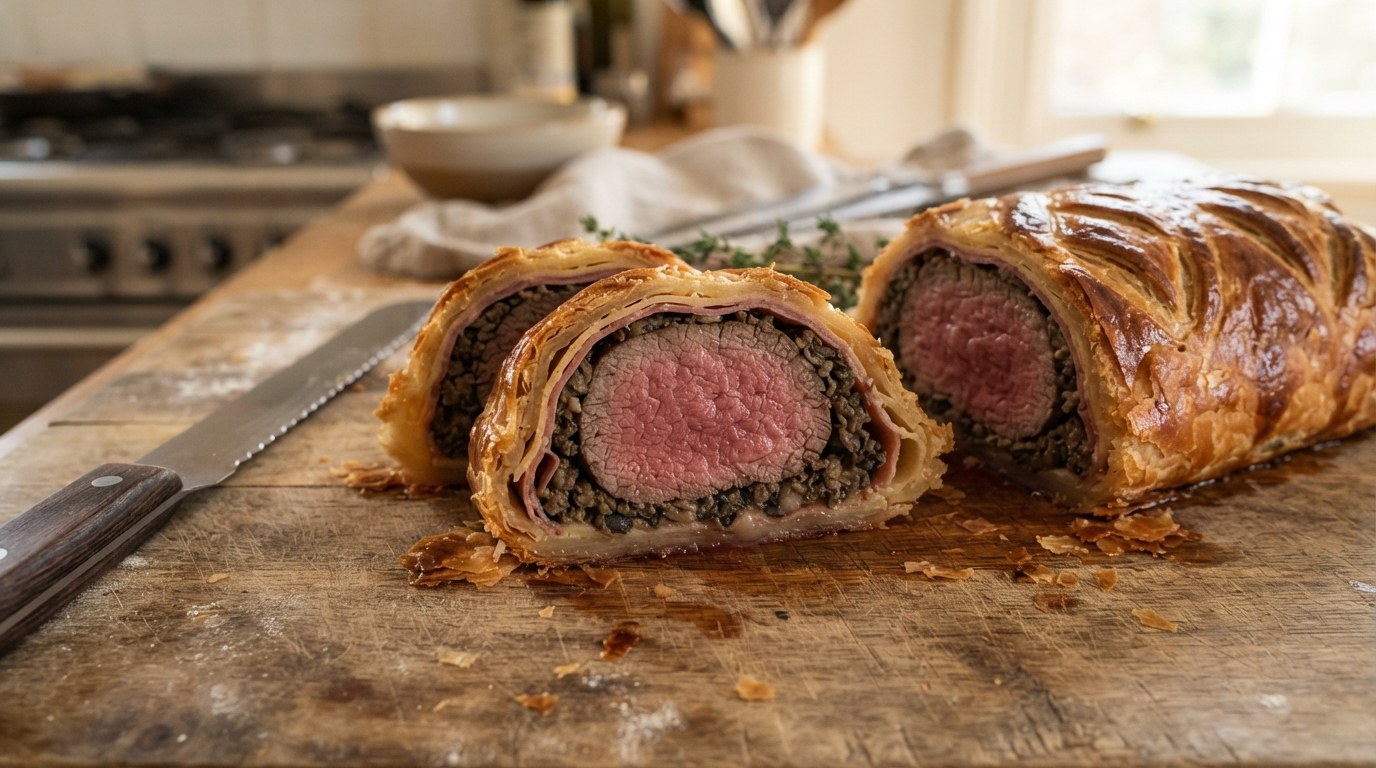
| Medium-rare | 95-100°F (35-38°C) | 120-130°F (49-54°C) | Rosy pink edge to edge |
| Medium | 105-110°F (41-43°C) | 130-140°F (54-60°C) | Pink center, tan edges |
| Medium-well | 115-120°F (46-49°C) | 140-150°F (60-66°C) | Faint pink, mostly tan |
| USDA safe minimum (whole beef) | About 120°F (49°C) | 145°F (63°C), held 3 minutes | Tan with a trace of pink |
The food-safety number is plain: the USDA Food Safety and Inspection Service lists 145°F (63°C) with a 3-minute rest as the safe minimum for whole cuts of beef, including roasts. Rare and medium-rare Wellingtons sit below that line. Restaurants serve them pink because a whole, intact tenderloin carries its bacteria on the outside, and the hard sear before wrapping takes that surface far past 145°F; it is still a choice you make with good beef, not a USDA standard.
Those doneness colors come straight from the proteins. Beef muscle proteins start to set at about 122°F (50°C) and are firm by 140°F (60°C), so the difference between a rosy slice and a tan one is a band of only about 20 degrees. Hit 145°F and the center has firmed, paled and squeezed out more of its juice.
Why the Pull Temperature Is So Low: Carryover Under Pastry
A beef Wellington keeps cooking for 10 to 15 minutes after it leaves the oven because the pastry holds the heat in. Once puff pastry rises, ThermoWorks notes, it turns into a coat of insulation around the meat, and the hot outer layers (pastry, duxelles, the outer half-inch of beef) keep pushing heat toward the cooler center with nowhere else for it to go. A bare roast tenderloin might rise 5 to 10°F as it rests; a Wellington roughly doubles or triples that.
That is also why pulling at a normal roast-beef number overshoots. Take a whole Wellington out at 125°F because a steak chart said medium-rare, and the rest carries it into the high 140s or 150s: medium-well under a beautiful crust. The hotter the oven and the longer the rest, the bigger the climb, which is how America's Test Kitchen got 45 degrees out of a 45-minute rest.
Our recommendation: pull a whole Wellington when the center reads 100°F (38°C), rest it 10 minutes, then slice. That lands a pink, warm medium-rare at about 125°F with no grey band, and it leaves a few degrees of margin if the probe wasn't quite in the coolest spot. If your crowd wants it closer to medium, go to 105°F, not higher.
How to Check Beef Wellington Temperature Through Pastry
Check a beef Wellington's temperature by pushing the probe in through one short end, or low through the side, so the tip sits in the center of the thickest part of the beef. Going in from the top punches a hole in the crust and lets steam out where everyone can see it. ThermoWorks puts a leave-in probe through the short end before the Wellington goes in the oven and sets the alarm, so the door never opens.
- Aim the tip at the geometric center of the beef, not the duxelles or the pastry.
- Take two readings a half-inch apart and trust the lower one.
- A leave-in probe with an alarm lets you keep the oven door shut.
- An instant-read probe is fine for spot checks from the "start checking" time onward.
- Check your oven's real heat with an oven thermometer; a home oven can run hot or cool of its dial.

ThermoPro
ThermoPro TempSwift Instant-Read Digital Thermometer
- Reads in about 1 second, accurate to ±0.9°F, with a 4.3-inch food-grade stainless probe
- Hold and calibration functions, so you can lock a reading away from the heat
- NSF certified and IP65 waterproof, rinse it clean under the tap
Gordon Ramsay Beef Wellington Cook Time and Temp
Gordon Ramsay bakes his beef Wellington hot and fast: 200 to 210°C (about 400 to 410°F) for 15 to 25 minutes, then rests it 5 to 10 minutes. His three published versions differ in size, layers and oven, and the short times make sense once you see the size of the beef in each.
| Ramsay version | Beef | Inside the pastry | Oven | Bake | Rest |
|---|---|---|---|---|---|
| gordonramsay.com recipe | 2 fillets, 400 g (14 oz) each | Parma ham, mushroom duxelles | 200°C (about 400°F) | 15 to 20 min | 10 min |
| Gordon Ramsay Restaurants classic | 500 g (1.1 lb) fillet | Two crêpes, mushroom duxelles | 210°C (about 410°F) | 20 to 25 min, or to 32°C (90°F) on a probe | 10 min |
| MasterClass lesson | Center-cut fillet for 4 to 6, rolled long and thin | Crêpe, Parma ham, mushrooms | 380°F | 18 to 20 min | 5 min |
Ramsay's times are shorter than the weight chart above because his pieces are smaller and thinner: two 400 g fillets bake faster than one 900 g log, and in his MasterClass he rolls the fillet tight in plastic wrap so it stretches longer and slimmer. The restaurant recipe's 32°C (90°F) probe target is the same idea as the 95 to 100°F pull here, low on purpose, with the rest finishing the job. If your tenderloin is a single 2 lb piece, use the 425°F weight chart and the thermometer rather than his 20-minute clock. His full method, from the 60-second sear to the egg-yolk glaze, is on the Gordon Ramsay beef Wellington page, and the lesson itself is covered in our Gordon Ramsay MasterClass overview.
Crêpes or No Crêpes? What Ramsay Puts Inside
Gordon Ramsay's restaurant beef Wellington uses crêpes, his home recipe uses Parma ham instead, and in his MasterClass he uses both. The Gordon Ramsay Restaurants classic wraps the seared fillet in two thin chive crêpes with the duxelles and no ham; the gordonramsay.com home recipe shingles four slices of Parma ham under the mushroom paste and skips the crêpe; the MasterClass build layers crêpe, then Parma ham, then mushrooms.
Both layers do the same job: they stand between the wet filling and the pastry. A crêpe soaks up juice before it can reach the dough, and in the MasterClass Ramsay says you can leave the crêpes out but the pastry comes out soggier for it; he also keeps them paper-thin so they don't turn spongy. Parma ham is a drier, salty sheet that seasons the outside of the beef, which a crêpe can't do. If you skip both, the duxelles sits right against the pastry and the base has nothing to protect it. Crêpes also make the Wellington pork-free, the swap the Hell's Kitchen version suggests.
Why You Chill a Beef Wellington Before Baking
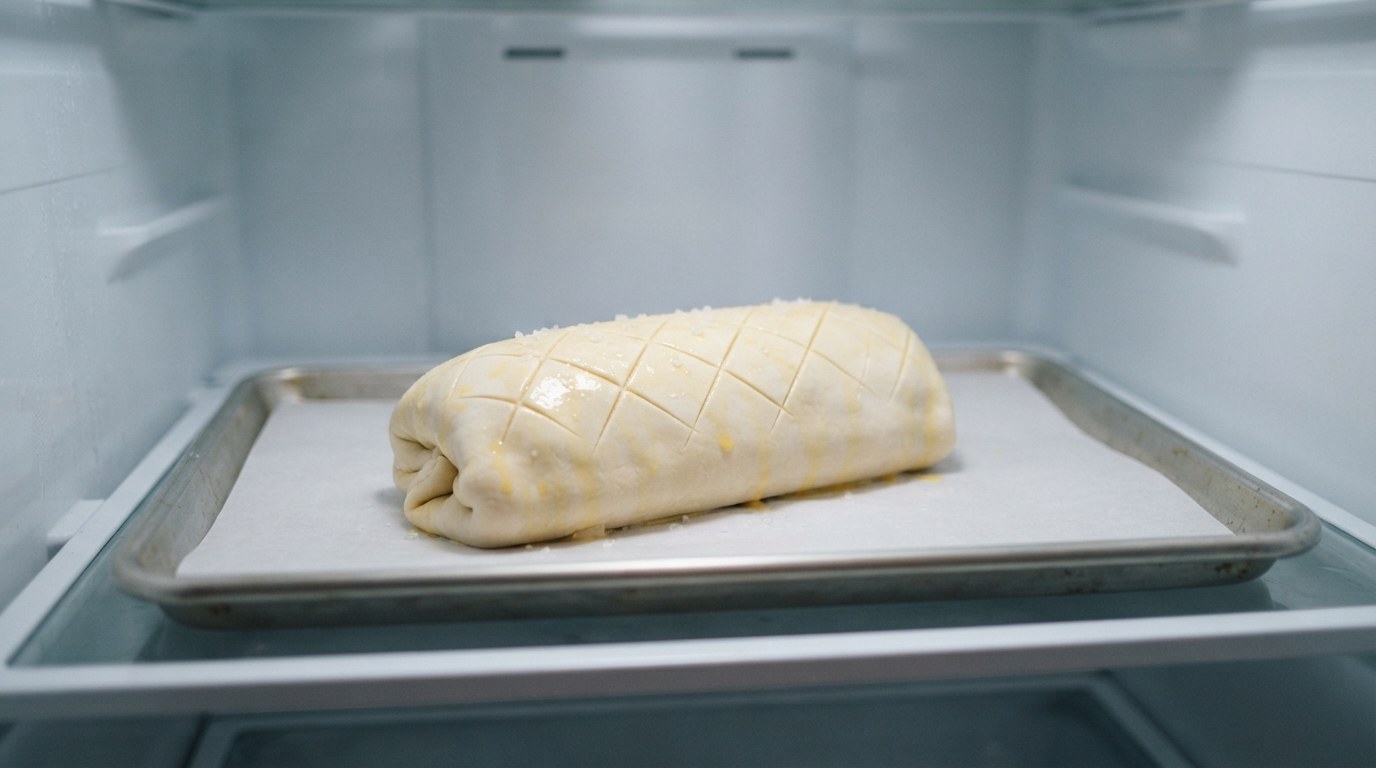
Chill a wrapped beef Wellington for at least 30 minutes before baking so the pastry's butter is solid and the beef is cold. Ramsay's home recipe chills the ham-wrapped beef overnight, then again for at least 30 minutes after the pastry goes on; the restaurant recipe chills the seared beef 20 to 30 minutes before wrapping. Both chills serve the timing.
Cold butter is what makes the pastry rise. Puff pastry is hundreds of thin layers of dough and butter, as King Arthur Baking explains, and the water in that butter turns to steam in the oven and pushes the layers apart. If the butter has already softened, it melts into the dough before the steam can lift it, and you get a flat, greasy crust. Cold beef protects the center: the pastry needs 35 to 45 minutes to brown at 425°F, and a center that starts at fridge temperature uses that time to warm up slowly instead of overshooting. That is also the answer to whether a Wellington should come to room temperature before cooking: no, bake it straight from the fridge.
How Long to Rest Beef Wellington
Rest a beef Wellington for 10 minutes before slicing, up to 15 for a large one. Ramsay's home and restaurant recipes and ThermoWorks all give 10 minutes; his MasterClass lets it sit 5. The rest is when the carryover in the doneness chart happens, so cutting early leaves the center underdone as well as wet.
Resting also keeps the juice in the slice. As the meat cools a little, its juices thicken, so less runs out when you cut: a steak sliced after 2 minutes loses about 6 percent of its weight to the board, and after 10 minutes about 2 percent. One correction while we're here: searing the tenderloin before wrapping doesn't seal the juices in either. A seared surface loses moisture as fast as a raw one; the sear is there for the browned flavor under the pastry. Leave the Wellington uncovered while it rests, because a foil tent traps steam against the crust you just baked crisp, and slice it with a serrated knife.
Total Time: From Searing to Slicing
A whole beef Wellington takes about 3 hours from the first sear to the first slice, and less than an hour of that is hands-on. Most of the clock is chilling, which you can do the day before.
- Sear the tenderloin: about 5 minutes, 60 seconds a side plus the ends.
- Cook the duxelles dry: 10 to 15 minutes.
- Wrap in crêpe or ham and chill: 30 minutes, or overnight.
- Wrap in pastry, egg-wash and chill again: 30 minutes.
- Bake at 425°F: 35 to 45 minutes for 2 lb.
- Rest: 10 minutes.
Beef Wellington Troubleshooting: Soggy Bottom, Pale Pastry, Grey Edges
Almost every beef Wellington failure comes down to water or timing: water from the filling softening the pastry, or the pastry and the beef reaching done at different moments. The physics is simple. Any surface that is still wet can't climb past 212°F (100°C), the boiling point of water, and pastry only browns once it is dry and past about 284°F (140°C), where the Maillard reaction starts. Match the symptom to the row.
| Problem | Why it happens | Fix |
|---|---|---|
| Soggy bottom | Water from the duxelles or beef turns to steam under the base, which stays at 212°F and never browns | Cook the duxelles until the pan is dry; use a crêpe or ham barrier; season the inside of the pastry, as Ramsay does; bake seam-down on a preheated sheet pan |
| Pastry brown, center still under temperature | A very thick log, or beef that went in nearly frozen | Lay foil loosely over the top and keep baking to the pull temperature; next time chill until firm, not frozen |
| Center done, pastry still pale | Oven running cool, or a thin whole-egg wash | Pull on temperature anyway and don't chase color; next time verify 425°F with an oven thermometer and use two coats of yolk-only wash, which browns faster |
| Grey band under the pastry | Oven too cool so the bake ran long, or the sear went past 60 seconds a side | Sear hard and briefly; bake at a true 425°F so the pastry finishes before heat creeps inward |
| Whole center overcooked | Pulled at a bare-roast number like 125-130°F | Pull a whole Wellington at 95-100°F for medium-rare; carryover adds about 25°F |
| Pastry raw and gummy inside | Butter softened before baking, or pastry rolled too thick | Roll it thin, keep it cold, chill 30 minutes after wrapping |
| Juice floods the board | Sliced too soon | Rest 10 minutes, uncovered, then cut with a serrated knife |
The soggy bottom gets the most questions, and it is the duxelles nine times out of ten. Mushrooms are mostly water, and every drop still in the paste when the pastry closes turns to steam in the oven. Cook them until a spoon dragged through the pan leaves a clean trail. Salt on the inside face of the pastry pulls a little surface moisture out, the step Ramsay points out few cooks bother with. Serve the sauce beside the slice, not over it: a red wine reduction and a spoon of pomme purée are the classic plate.
Get the beef Wellington cook time and temperature right and the rest of the dish follows: 425°F, a probe in the center, out at 100°F, 10 minutes on the board. For the full recipe, go to the Gordon Ramsay beef Wellington; for the holidays, the Christmas beef Wellington.
Beef Wellington Cook Time and Temperature FAQs
The questions that come up most: what temperature to cook beef Wellington at, how long a 2 lb Wellington takes, the internal temperature for medium-rare, how long to rest it, whether Gordon Ramsay uses crêpes, whether medium-rare is safe, and whether it should sit at room temperature first.
What temperature do you cook beef Wellington at?
Bake a whole beef Wellington at 425°F (220°C). That is hot enough to puff and brown the pastry before the beef overcooks. Gordon Ramsay's published recipes use 200 to 210°C (about 400 to 410°F) for smaller fillets, and his MasterClass uses 380 degrees for a long, thin fillet.
How long does it take to cook a 2 lb beef Wellington?
About 35 to 45 minutes at 425°F (220°C), baked straight from the fridge. Start checking at 30 minutes and pull it when the center of the beef reads 95 to 100°F for medium-rare. A 1.5 lb Wellington takes about 30 to 40 minutes and a 3 lb one about 45 to 55.
What internal temperature should beef Wellington be for medium-rare?
Pull a whole Wellington at 95 to 100°F (35 to 38°C) and rest it 10 minutes; carryover under the pastry lifts the center about 25°F to roughly 120 to 130°F (49 to 54°C), a pink medium-rare. An individual 6 oz Wellington carries over less, so pull it at 115 to 120°F.
How long should beef Wellington rest before cutting?
Ten minutes, or up to 15 for a large one. Gordon Ramsay's recipes and ThermoWorks both give 10 minutes. The rest finishes the carryover cooking and thickens the juices so they stay in the slice. Leave it uncovered so the crust stays crisp, then slice with a serrated knife.
Does Gordon Ramsay's beef Wellington have crêpes?
His restaurant version does: the Gordon Ramsay Restaurants classic wraps the beef in two thin crêpes and no ham. His home recipe on gordonramsay.com uses Parma ham instead, and his MasterClass uses a crêpe and Parma ham together. Both layers keep moisture from the mushroom duxelles away from the pastry.
Is medium-rare beef Wellington safe to eat?
The USDA safe minimum for whole cuts of beef is 145°F (63°C) with a 3-minute rest, so a medium-rare Wellington sits below the official number. Restaurants serve it pink because bacteria on a whole, intact tenderloin are on the surface, which the sear heats well past 145°F. To meet the USDA number, pull at about 120°F and let the rest carry it to 145°F.
Should beef Wellington be at room temperature before baking?
No. Bake it straight from the fridge. Cold butter in the puff pastry is what makes it rise, and cold beef gives the pastry time to brown before the center overcooks. Ramsay only takes the beef out about 10 minutes before searing, and chills it again after each wrap.
Why is my beef Wellington soggy on the bottom?
Water from the filling. Wet duxelles or beef juice turns to steam under the base, and a wet surface cannot get past 212°F, so the pastry never crisps. Cook the duxelles until the pan is dry, wrap the beef in a crêpe or Parma ham, season the inside of the pastry, and bake seam-down on a preheated sheet pan.

About the Author
John Siracusa is the founder of Hell’s Kitchen Recipes. He focuses on technique-first, reproducible home cooking and researches recipes & kitchen equipment from published food science and professional chef methods since 2016.