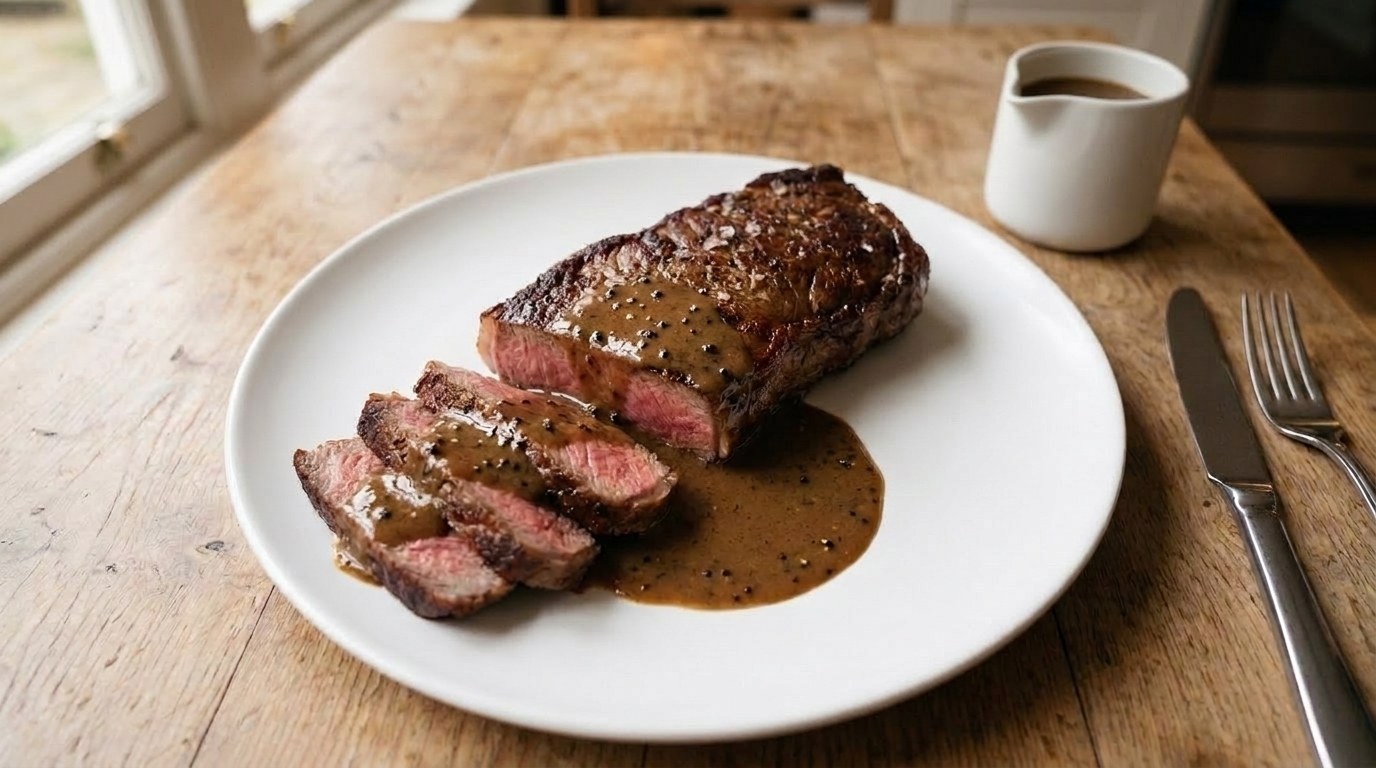
This black peppercorn sauce is the creamy steakhouse sauce made in the pan the steak just came out of: coarsely cracked black pepper toasted with a minced shallot in the leftover fat, a splash of brandy to lift the browned bits, a cup of beef stock boiled down by half, then heavy cream and a knob of cold butter. It takes about 12 minutes while the steak rests, makes a cup for four steaks, and the brandy is optional. Cracked pepper gives it a warm, roasted bite that the cream rounds off, and the stock gives it the deep coffee-brown color of a real pan sauce.
What Is Black Peppercorn Sauce?
Black peppercorn sauce is a pan sauce for steak built on cracked black pepper, shallot, brandy or Cognac, beef stock and cream, and it is the sauce side of the French steak au poivre. In steak au poivre the cracked pepper is pressed onto the steak as a crust before searing and the sauce is made in the pan afterward; a peppercorn sauce keeps all the pepper in the sauce, so the steak can be seared plain. The ingredients are the same in both, and so is the order: brown the meat, keep the pan, build the sauce on what is left in it.
It is also the sauce Hell's Kitchen puts on its biggest steaks. The Washington, DC menu lists a 20-ounce Prime bone-in ribeye with peppercorn sauce and an 8-ounce filet mignon with a truffle peppercorn sauce, and the Las Vegas menu serves its 16-ounce rib eye with peppercorn sauce and grilled broccolini. Our bone-in ribeye recipe recreates the DC plate and makes a small batch of this sauce in the steak pan; this page is the full recipe, with the variations and the fixes.
Black, Green, White and Pink Peppercorns for Peppercorn Sauce
Black peppercorns are the right choice for a classic black peppercorn sauce: they are the hottest and most aromatic of the common peppercorns, and that roasted, resinous bite is the whole point of the dish. Black, green and white pepper all come from the same vine, Piper nigrum, and differ only in when the berry is picked and how it is dried. Kerala Agricultural University's pepper processing guide describes black pepper as mature but unripe berries that are blanched briefly and sun-dried until they darken and wrinkle, and white pepper as ripe berries, or black pepper, with the outer skin removed, about 25 kilograms of white pepper from 100 kilograms of ripe berries.
| Peppercorn | What it is | Flavor in a sauce | Best use |
|---|---|---|---|
| Black (this recipe) | Mature unripe Piper nigrum berries, blanched and sun-dried with the skin on | Hot, roasted, resinous; the strongest aroma | Black peppercorn sauce and the au poivre crust; crack coarsely |
| Green | The same berry picked unripe, kept in brine or freeze-dried | Mild, fruity, tangy from the brine | Whole soft berries in our green peppercorn sauce |
| White | Ripe berries with the outer skin removed | Hot but flat, slightly earthy, little aroma | Pale sauces where black specks are unwanted; not a substitute here |
| Pink | Dried berries of the Schinus pepper tree, a cashew relative, not true pepper | Sweet, piney, barely hot | A garnish scattered on at the end; skip for anyone with a tree-nut allergy |
| Au poivre crust vs sauce | Cracked black pepper pressed onto the steak, or stirred into the sauce | Crust: louder heat on every bite. Sauce: rounder, cream-softened | Use both for a full steak au poivre; the sauce alone for a milder plate |
Green peppercorns make the gentler cousin of this sauce, and our green peppercorn sauce covers that version with Dijon and whole brined berries. Pink peppercorns are a different plant entirely: they belong to the same family as cashew and pistachio, and in a study published in Asia Pacific Allergy 16 of 21 children allergic to cashew or pistachio showed skin-test cross-sensitization to pink peppercorn, so leave them out when anyone at the table has a tree-nut allergy.
How to Crack and Toast the Peppercorns
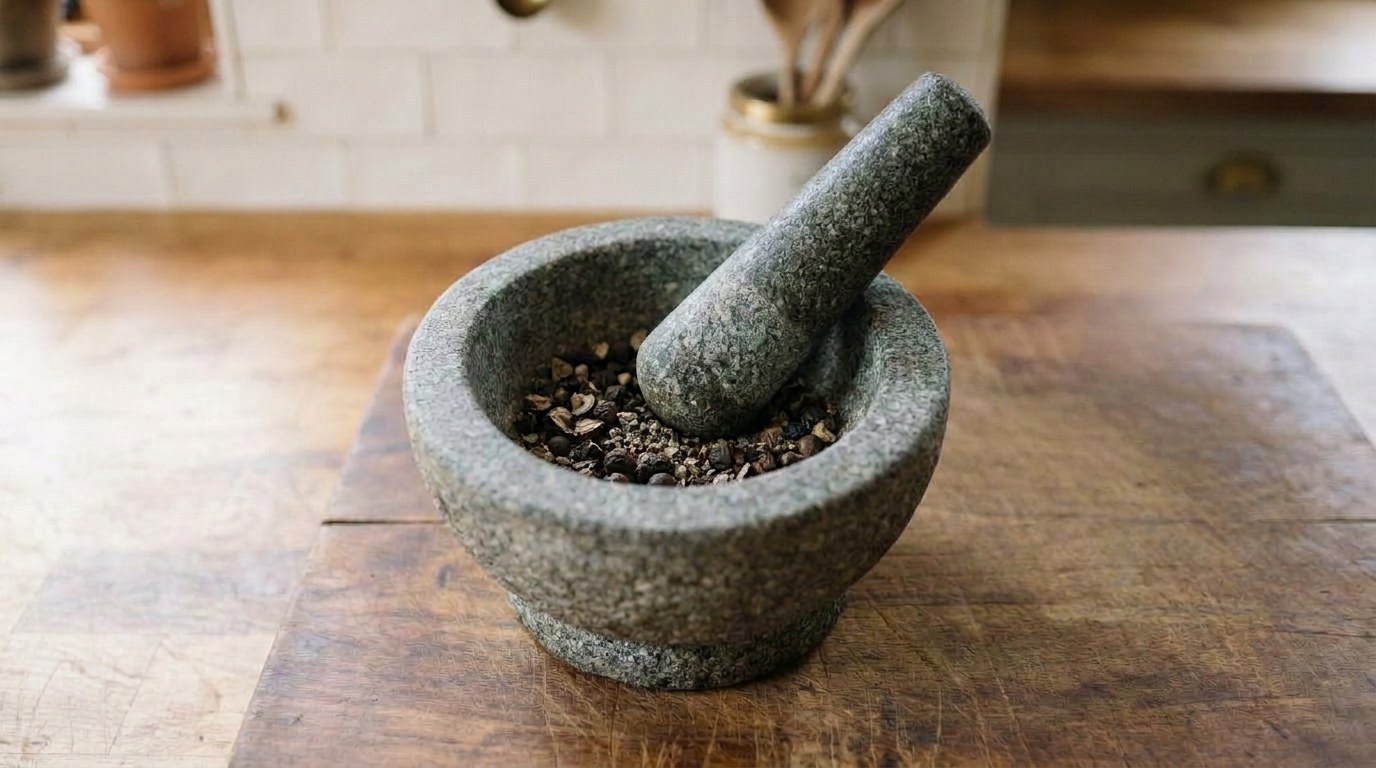
Crack the peppercorns coarsely, into halves, quarters and grit, rather than grinding them fine, then toast them in the pan fat for 30 to 45 seconds before any liquid goes in. Coarse pieces season the sauce with distinct warm bites; fine powder spreads the same heat through every spoonful and makes the sauce taste harsh. The heat comes from piperine, which acts on TRPV1, the same heat receptor capsaicin triggers in chili, according to pharmacology research on piperine, and the more surface you expose by grinding, the faster it reaches the tongue. A granite mortar and pestle gives the most control: a few firm taps, then stop. The coarsest setting on a pepper mill, or the bottom of a heavy pan pressed down on peppercorns on a board, also works. For a gentler sauce, shake the cracked pepper in a fine sieve and leave the dust behind.
ChefSofi
ChefSofi Mortar and Pestle Set, 2-Cup Unpolished Granite
- Unpolished granite bowl grips whole peppercorns, so they crack under the pestle instead of skating around
- Heavy 6-inch, 2-cup stone that stays put on the counter while you pound
- Also handles toasted whole spices, garlic pastes and herbs
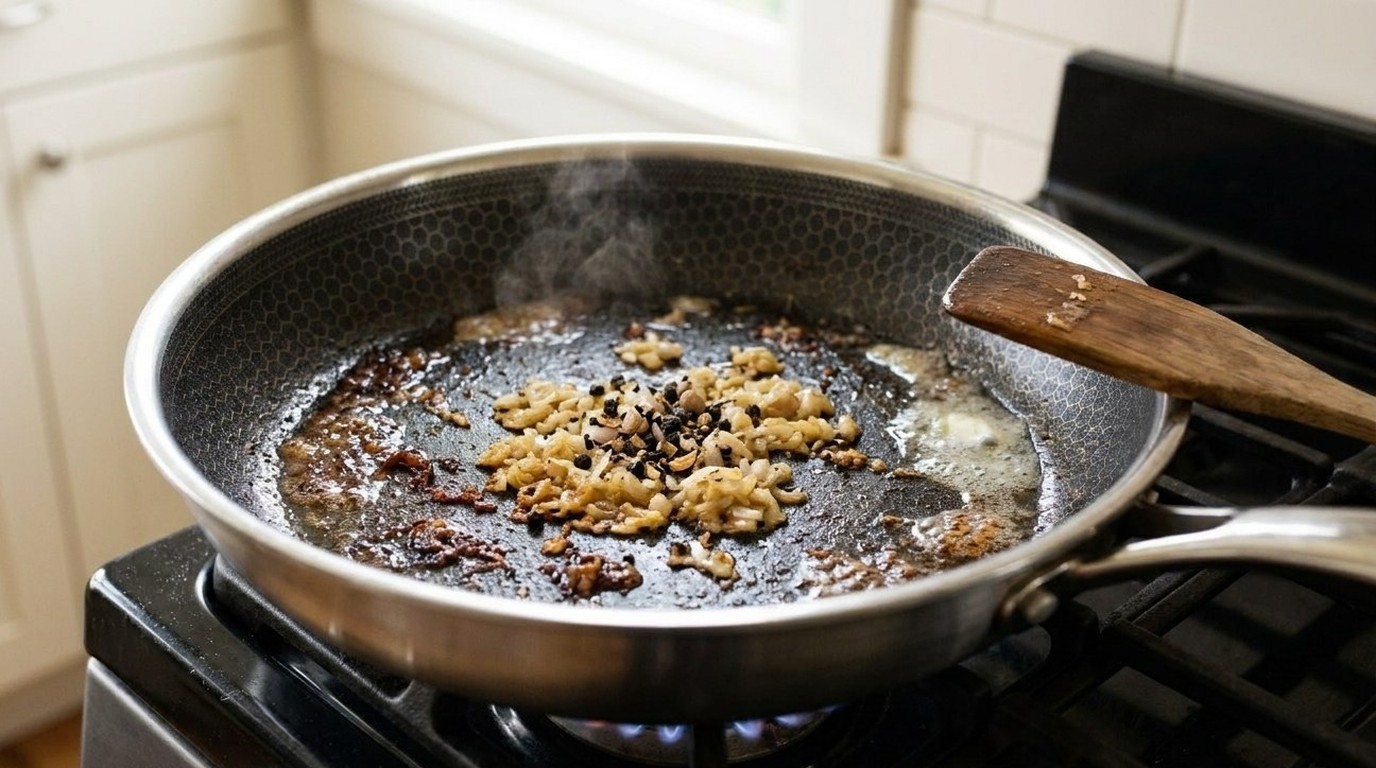
Gordon Ramsay tells home cooks in his MasterClass to spend money on a decent pepper mill, and the reason shows up in this sauce: pepper's aroma lives in volatile oils inside the berry that start to fade the moment it is broken, so pepper cracked a minute before cooking smells far brighter than a jar of pre-ground. Toasting it in fat over medium heat draws those oils out into the fat, which then carries them through the whole sauce. Keep it brief and keep the pan at medium. Above roughly 356°F, food stops browning and starts to burn, and scorched pepper turns acrid; add it once the shallot has softened, stir for 30 to 45 seconds until it smells strongly of pepper, and move straight on to the liquid.
Building the Sauce: Fond, Brandy and the Stock Reduction
A black peppercorn sauce gets its depth from the fond, the brown film the steak leaves stuck to the pan, so it should always be made in the steak pan with the fat poured off and the browned bits kept. That film is the Maillard reaction at work: on a dry surface above about 284°F, the meat's amino acids and sugars react and form hundreds of roasted flavor compounds, and a wet surface never gets there because water holds it at 212°F until it boils off. In his pan-sauce lesson Ramsay treats washing that pan as the one real mistake, since the flavor is stuck to its floor. Soften the shallot in butter first, about 2 minutes; he adds shallots before anything else because they bring sweetness to the sauce.
Brandy goes in with the pan off the flame, and Ramsay's lesson has him turning the gas down for this step. The alcohol dissolves the fond as it bubbles, and in about a minute the pan holds a dark glaze. Setting it alight is optional and mostly theater: the flame burns only the vapor above the pan and goes out once that vapor thins, and the USDA nutrient retention table lists 75 percent of the alcohol still present after flaming and about 40 percent after 15 minutes of simmering. The flavor comes from the reduction either way. If you do flame it, take the pan off the burner, keep your face back and have a lid within reach.
The stock reduction gives the sauce its body. Pour in a cup of low-sodium beef stock and boil it hard until about half remains, 4 to 5 minutes in a 10- to 12-inch skillet; a wide pan exposes more surface, so evaporation runs faster than in a small saucepan. Boiling off water concentrates the gelatin in real stock, the protein that dissolved out of bones and connective tissue as their collagen converted at about 154°F during the long simmer, and gelatin is what makes a reduced sauce coat a spoon. Some boxed stocks carry little of it and stay thin however far they reduce, then turn salty. If yours does not set to a soft jelly in the fridge, bloom 1 teaspoon of unflavored gelatin in a tablespoon of water and stir it into the stock.
| Stage | Heat and time | What you should see |
|---|---|---|
| Steak out, fat poured off | Keep 1 tbsp fat and every browned bit | A speckled brown film on the pan floor |
| Shallot in butter | Medium, about 2 minutes | Soft and translucent, just golden at the edges |
| Toast the cracked pepper | Medium, 30 to 45 seconds | Strong pepper smell, nothing blackened |
| Brandy deglaze | Off the flame, then back on, about 1 minute | Fond dissolved, liquid almost gone |
| Stock reduction | High, 4 to 5 minutes | 1 cup down to about ½ cup, bubbling, slightly syrupy |
| Cream | Medium, 2 to 3 minutes | Coffee-brown; coats the back of a spoon |
| Finish off the heat | Cold butter, resting juices, salt | Glossy, smooth, pepper flecked all through |
Why Black Peppercorn Sauce Holds: Cream and Cold Butter
Heavy cream keeps a black peppercorn sauce smooth even at a rolling boil, because cream with more than about 25 percent fat is heat-stable: there is enough fat around the milk proteins to stop them clumping into curds. Federal standards require heavy cream to contain not less than 36 percent milkfat, well past that line, so it can bubble hard beside a reduced stock and the brandy's acidity without splitting. Half-and-half and milk sit well below 25 percent and turn grainy in the same pan. Add the cream only after the stock has reduced; cream thins a sauce, so the liquid under it has to be thick already.
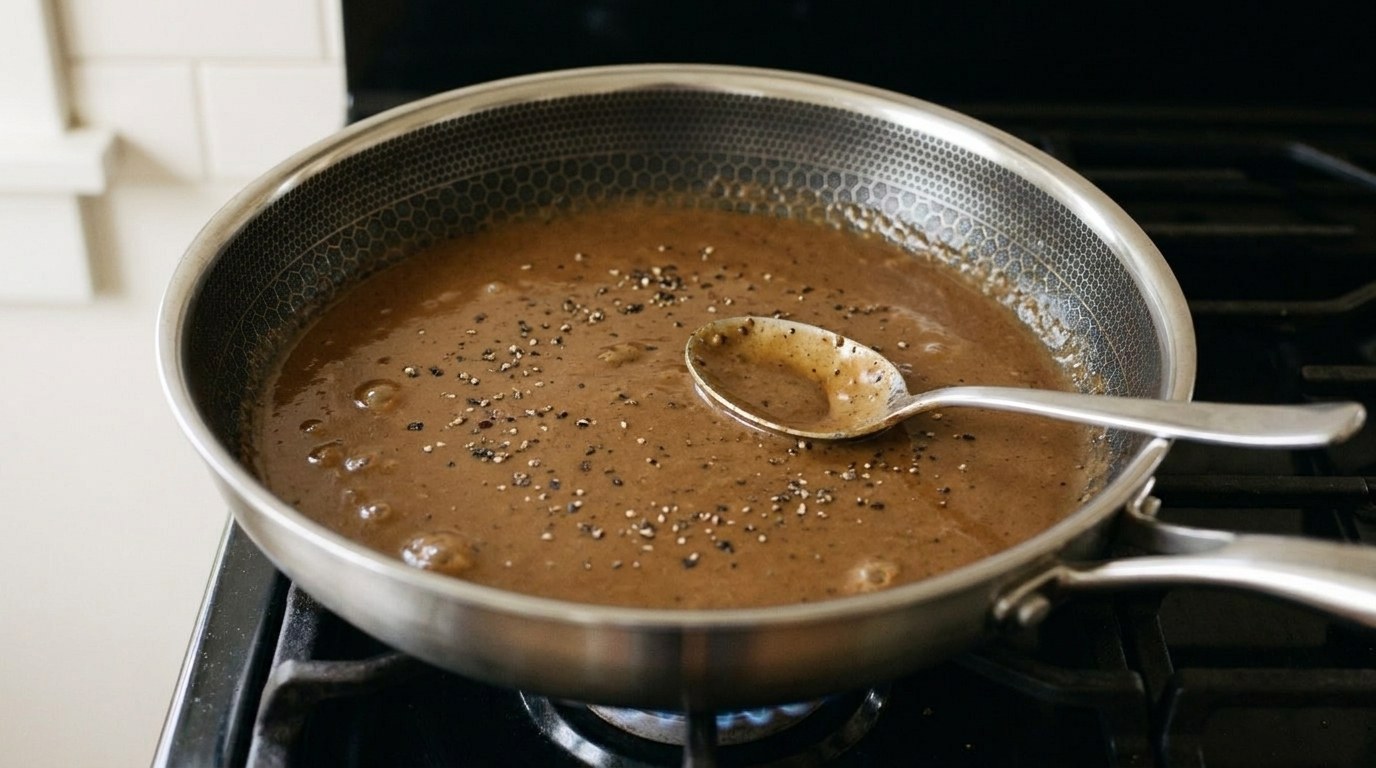
The cold butter at the end is a small emulsion. Swirled into the sauce off the heat, the butter melts slowly and its fat disperses as tiny droplets held by its own milk proteins, which gives the sauce its gloss and a rounder feel; dropped into a boiling pan, the same butter separates into a slick of oil. The steak's resting juices go in at the same moment, then salt, and only now: the stock, the reduction and the pan drippings are all salty, and a sauce seasoned early is over-salted once it has concentrated. Taste it, as Ramsay does at every stage of a pan sauce, and adjust.
Variations: No Cream, No Brandy, Dairy-Free and Steak Au Poivre
Black peppercorn sauce adapts easily, because the pepper, the fond and the reduced stock carry most of the flavor. Without cream, reduce the stock further, to about a third of a cup, until it is syrupy, then whisk in 2 tablespoons of cold butter off the heat for a glossy brown pepper jus. Without brandy or alcohol, deglaze with a quarter cup of the stock instead and add a teaspoon of Dijon mustard or a few drops of sherry vinegar at the end for the brightness the brandy would have given. Cognac, bourbon, whiskey and dry sherry all work in place of brandy, each with its own accent; a red-wine version is closer to our red wine reduction sauce.
Dairy-free, skip the cream and finish the reduced stock with a tablespoon of good olive oil whisked in off the heat, or use an unsweetened plant-based cooking cream; those are stabilized with emulsifiers rather than milk fat, so follow the carton's heating advice and simmer gently. Steak au poivre uses the same sauce with a pepper crust: press a tablespoon of coarsely cracked pepper into both sides of each steak along with the salt, sear over medium-high rather than high so the crust browns without burning, then make the sauce with half the pepper in the pan. The cast iron ribeye and the Gordon Ramsay steak guide cover the sear itself, and the Madeira sauce is another way to use the same pan.
Troubleshooting Black Peppercorn Sauce: Split, Too Thin, Too Sharp
Most problems with a black peppercorn sauce come down to one of three things: the wrong dairy, too little reduction, or pepper that was ground too fine or cooked too long. Each has a quick fix, and none of them means starting over.
| Problem | Why it happens | Fix |
|---|---|---|
| Split or grainy | Milk or half-and-half (under 25% fat) curdled; or the butter went into a boiling pan | Whisk in 2 tbsp heavy cream off the heat; next time use heavy cream and add butter off the heat |
| Too thin | Stock not reduced far enough, or a boxed stock with little gelatin | Simmer 2 more minutes; or whisk in ½ tsp cornstarch mixed with 1 tsp cold water and boil 30 seconds |
| Too sharp or too peppery | Pepper ground to powder, or simmered too long | Add 2 tbsp cream and a pinch of sugar; sieve out the dust next time |
| Bitter or acrid | Pepper or fond scorched over high heat | Hard to rescue; keep the pan at medium for the shallot and pepper |
| Too salty | Salted before reducing, or salty stock or drippings | Dilute with a splash of unsalted stock and cream; salt only at the end |
| Sauce looks grey | Too little stock, or no fond in the pan | Reduce a little more stock in it; make it in the steak pan |
If the sauce tastes flat rather than wrong, it usually needs salt or acid. A pinch of salt and a few drops of lemon juice or sherry vinegar wake it up; Ramsay's lesson on pan sauces also has him pushing the softened shallot through a sieve with the back of a spoon, which thickens the sauce naturally and leaves it silky.
What to Serve with Black Peppercorn Sauce, and How to Store It
Black peppercorn sauce is made for seared beef: strip, ribeye, filet mignon and tenderloin, rested and sliced across the grain. For medium-rare, ThermoWorks' steak temperature guide puts the finished steak at 130°F to 135°F, so pull it from the pan about 5°F early; the USDA's safe minimum for beef steaks is 145°F with a 3-minute rest. Rest the steak 5 to 10 minutes while the sauce cooks: a steak cut after 2 minutes loses about 6 percent of its weight in juice, and one rested 10 minutes about 2 percent, because the juices thicken as the meat cools slightly. Our Hell's Kitchen New York strip and filet mignon guides cover those cuts, and a spoon of pomme purée catches every drop of the sauce. It also suits pork chops, pan-roasted chicken breast and burgers.
Black peppercorn sauce keeps well for 3 to 4 days in the fridge. The USDA leftovers guidance is to refrigerate cooked food within 2 hours, use it within 3 to 4 days, and reheat sauces to a rolling boil; heavy cream can take that boil, so reheat it in a small pan, whisking, with a spoon of stock to loosen it as the gelatin will have set it soft, then swirl in a fresh knob of butter off the heat. It freezes for up to 3 months, though a cream sauce can look a little separated after thawing; whisk it hard as it warms and it comes back. For dinner parties, make it through the stock reduction up to a day ahead, then add the cream and butter while the steaks rest. Made in the steak pan with pepper cracked fresh, black peppercorn sauce turns a plain seared steak into the plate Hell's Kitchen serves.
Black Peppercorn Sauce for Steak
Ingredients
- 1 tbsp whole black peppercorns
- fat and browned bits left in the skillet from 2 to 4 seared steaks (or 1 tbsp grapeseed oil if making the sauce on its own)
- 1 tbsp unsalted butter
- 1 large shallot, finely diced (about ¼ cup)
- ¼ cup brandy or Cognac (or more beef stock for no alcohol)
- 1 cup low-sodium beef stock
- ½ cup heavy cream (36% fat)
- 1 tbsp cold unsalted butter, cubed
- resting juices from the steaks
- kosher salt, to taste
Instructions
- Crack the peppercorns coarsely in a mortar and pestle, on the coarsest setting of a pepper mill, or under the bottom of a heavy pan on a board, into halves, quarters and grit. For a milder sauce, shake them in a fine sieve and discard the dust.
- Move the seared steaks to a warm plate to rest. Pour off all but about 1 tablespoon of fat from the skillet, keeping every browned bit, and set the pan over medium heat. (Without steaks, heat the grapeseed oil in a 10- to 12-inch skillet over medium heat.)
- Add the 1 tablespoon butter and the shallot and cook, stirring, until soft and translucent and just golden at the edges, about 2 minutes. Add the cracked pepper and stir for 30 to 45 seconds, until it smells strongly of pepper.
- Take the pan off the heat and pour in the brandy. Return it to medium-high heat and let it bubble, scraping up the browned bits with a wooden spoon, until the liquid is almost gone, about 1 minute.
- Add the stock, raise the heat to high and boil until reduced by about half, 4 to 5 minutes.
- Lower the heat to medium, stir in the cream and simmer for 2 to 3 minutes, until the sauce turns coffee-brown and coats the back of a spoon.
- Take the pan off the heat. Swirl in the cold butter a cube at a time and pour in any juices from the resting steaks. Taste, season with salt, and spoon over the sliced steaks.
Notes
Black Peppercorn Sauce FAQs
The questions that come up most: what black peppercorn sauce is made of, whether it is spicy, how to make it without cream or without brandy, how to thicken it, how it differs from green peppercorn sauce and steak au poivre, and whether it can be made ahead or frozen.
What is black peppercorn sauce made of?
Coarsely cracked black peppercorns, a minced shallot, butter, brandy or Cognac, beef stock and heavy cream, built in the pan a steak was seared in so the browned bits flavor it. The stock is reduced by half before the cream goes in, and a knob of cold butter, the steak's resting juices and salt finish it. This recipe makes about a cup for four steaks in 12 minutes.
Is black peppercorn sauce spicy?
Warm rather than hot. Pepper's heat comes from piperine, which acts on the same receptor as chili but much more weakly, and the cream softens it further. A tablespoon of coarsely cracked pepper in a cup of sauce gives a clear, warm bite; grinding it to powder makes the sauce noticeably sharper, so crack it coarsely and sieve out the dust for a milder sauce.
Can you make peppercorn sauce without cream?
Yes. Reduce the stock further, to about a third of a cup, until it is syrupy, then take the pan off the heat and whisk in 2 tablespoons of cold butter for a glossy pepper jus. Do not swap in milk or half-and-half; dairy under about 25 percent fat curdles when it boils with a reduced stock.
Can you make peppercorn sauce without brandy or alcohol?
Yes. Deglaze with a quarter cup of beef stock instead of the brandy, scraping up the browned bits the same way, and add a teaspoon of Dijon mustard or a few drops of sherry vinegar at the end for brightness. Cooking does not remove all the alcohol from a sauce that uses it: USDA data shows 75 percent remains after flaming and about 40 percent after 15 minutes of simmering.
How do you thicken peppercorn sauce?
Reduce it longer: simmer for 1 to 2 more minutes and it will coat a spoon. If the stock had little gelatin, whisk in ½ teaspoon of cornstarch mixed with 1 teaspoon of cold water and boil for 30 seconds, or push the softened shallot through a sieve into the sauce with the back of a spoon. Cream goes in only after the stock has reduced, or the sauce stays thin.
What is the difference between black peppercorn sauce and green peppercorn sauce?
The berry. Black peppercorns are mature unripe berries dried until dark and wrinkled, hot and roasted in flavor, and they are cracked for this sauce. Green peppercorns are picked earlier and kept in brine or freeze-dried, so they are mild, fruity and tangy and go into the sauce whole. Both are made in the steak pan with brandy, stock and cream.
Is peppercorn sauce the same as steak au poivre?
Nearly. Steak au poivre presses cracked black pepper onto the steak as a crust before searing, then makes a brandy, stock and cream sauce in the pan. A peppercorn sauce puts all the pepper in the sauce and leaves the steak seared plain, which is milder. Use both together for the full au poivre.
Can black peppercorn sauce be made ahead or frozen?
Yes. Refrigerate it within 2 hours and use it within 3 to 4 days; reheat it in a small pan to a boil, whisking, with a spoon of stock, and swirl in a little cold butter off the heat. It freezes for up to 3 months, though it may look separated after thawing until it is whisked hot. You can also make it through the stock reduction a day ahead and add the cream at the last minute.

About the Author
John Siracusa is the founder of Hell’s Kitchen Recipes. He focuses on technique-first, reproducible home cooking and researches recipes & kitchen equipment from published food science and professional chef methods since 2016.