Green peppercorn sauce is the creamy steakhouse pan sauce built on the soft, unripe berries of the pepper vine, and it is a ten-minute recipe if the pan the steak was seared in is still on the stove. Gordon Ramsay makes it the way he makes every pan sauce: the steaks come out to rest, the fat is poured off and the browned bits stay, shallots soften in butter, brined green peppercorns go in lightly crushed, Cognac deglazes the pan, beef stock reduces by half, and heavy cream and a spoon of Dijon finish it. The sauce is milder than a black-pepper steak au poivre and fruitier, with a brine tang in place of a cracked-pepper burn, and the whole peppercorns pop under the teeth.
The guide covers what green peppercorns are and which kind to buy, the fond and shallot base, why the Cognac step does not do what people think, the stock reduction, why the cream holds and when it would split, and what to serve it with. It sits in the site's recipes section with the other pan sauces, the Madeira sauce and the red wine reduction, and it is the sauce Hell's Kitchen plates with the rib eye in the cast iron ribeye guide.
What Green Peppercorns Are, and Which Kind to Buy
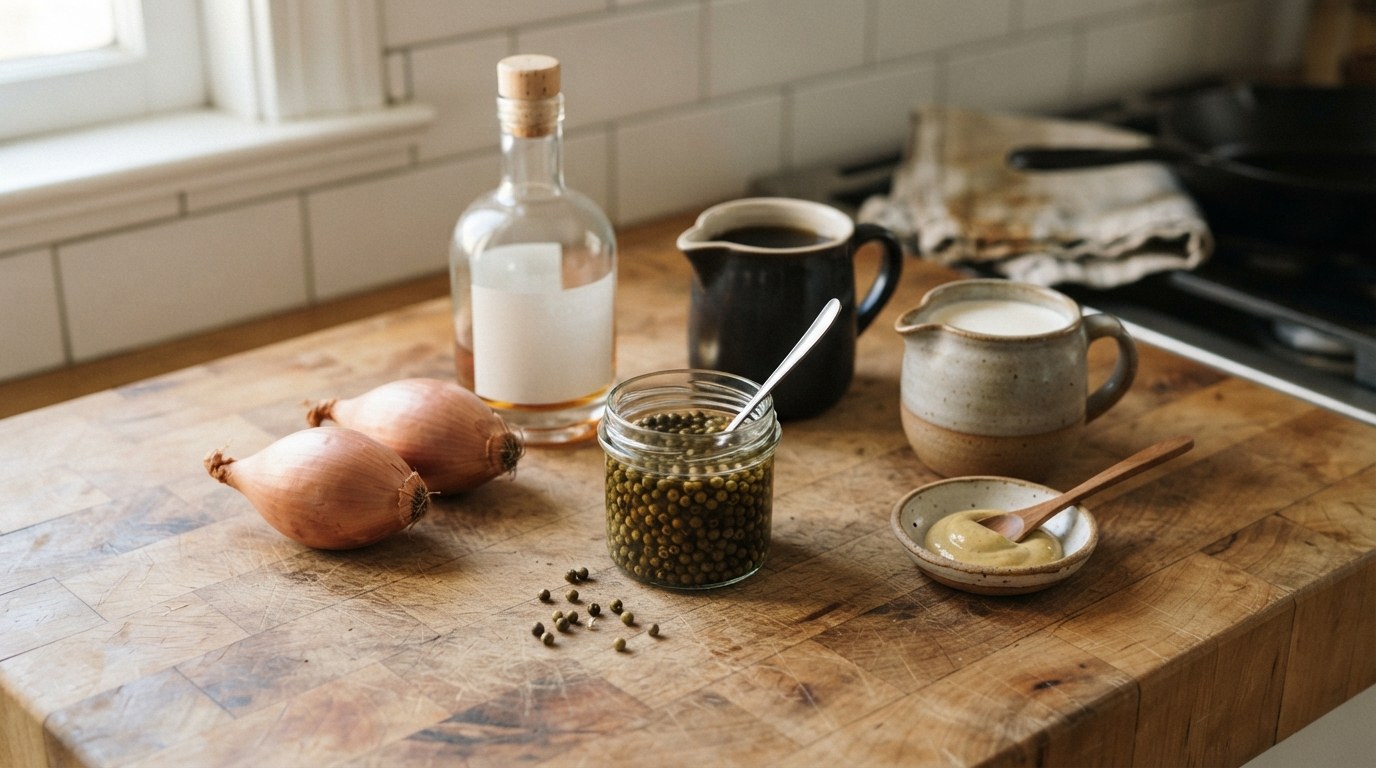
Green peppercorns are the same fruit as black peppercorns, picked before it ripens. Black, green and white pepper all come from the berries of Piper nigrum; a black peppercorn is a green one that was left to ripen and then dried and oxidized until its skin wrinkled and darkened, as The Kitchn's ingredient explainer puts it. Picked green, the berry is soft, perishable and mild, so it is preserved one of two ways: packed in brine, which keeps it plump and adds a vinegary tang, or freeze-dried, which locks the color and gives a light, crunchy berry that rehydrates in a sauce within minutes; the spice merchant Woodland Foods describes its freeze-dried berries as a fresher, brighter alternative to the brined kind. Air-dried green peppercorns, hard and olive-dark, are a third option with a duller flavor.
The heat in any peppercorn is piperine, and it explains why green pepper sauce is gentler than steak au poivre. Piperine is a full agonist at the same TRPV1 receptor that capsaicin fires, but its pungency threshold is about 10.5 micromolar against 0.6 for capsaicin, so pepper reads as warmth rather than chili burn, per the pharmacology paper by McNamara and colleagues in the British Journal of Pharmacology. A green berry has less of it than a ripened black one and none of the roasted, harsh notes that drying and oxidation add, which is why a sauce built on two whole tablespoons of green peppercorns tastes fruity and warm where two tablespoons of cracked black pepper would be punishing.
| Peppercorn | What it gives the sauce | How to prepare it |
|---|---|---|
| Green, in brine (Ramsay's choice) | Soft, juicy berries with a mild warmth and a brine tang | Drain, rinse, crush lightly with the flat of a knife |
| Green, freeze-dried | Brighter, sharper, slightly crunchy | Soak 10 minutes in warm water or stock, then crush |
| Green, air-dried | Concentrated but flat | Soak 20 minutes; use a little less |
| Black, cracked | Classic au poivre: hot, roasted, aggressive | Coarse-crack and press onto the steak, not into the sauce |
The table is a ranking as well as a list: the brined berries make the sauce this page describes, the freeze-dried ones make a very close second, and cracked black pepper makes a different dish. Whatever the form, crush the berries only lightly. A whole green peppercorn releases its piperine slowly and stays a pleasant soft pop; a peppercorn ground to powder dumps it all at once and turns a mild sauce hot.
The Base: The Fond, the Shallots and the Crush
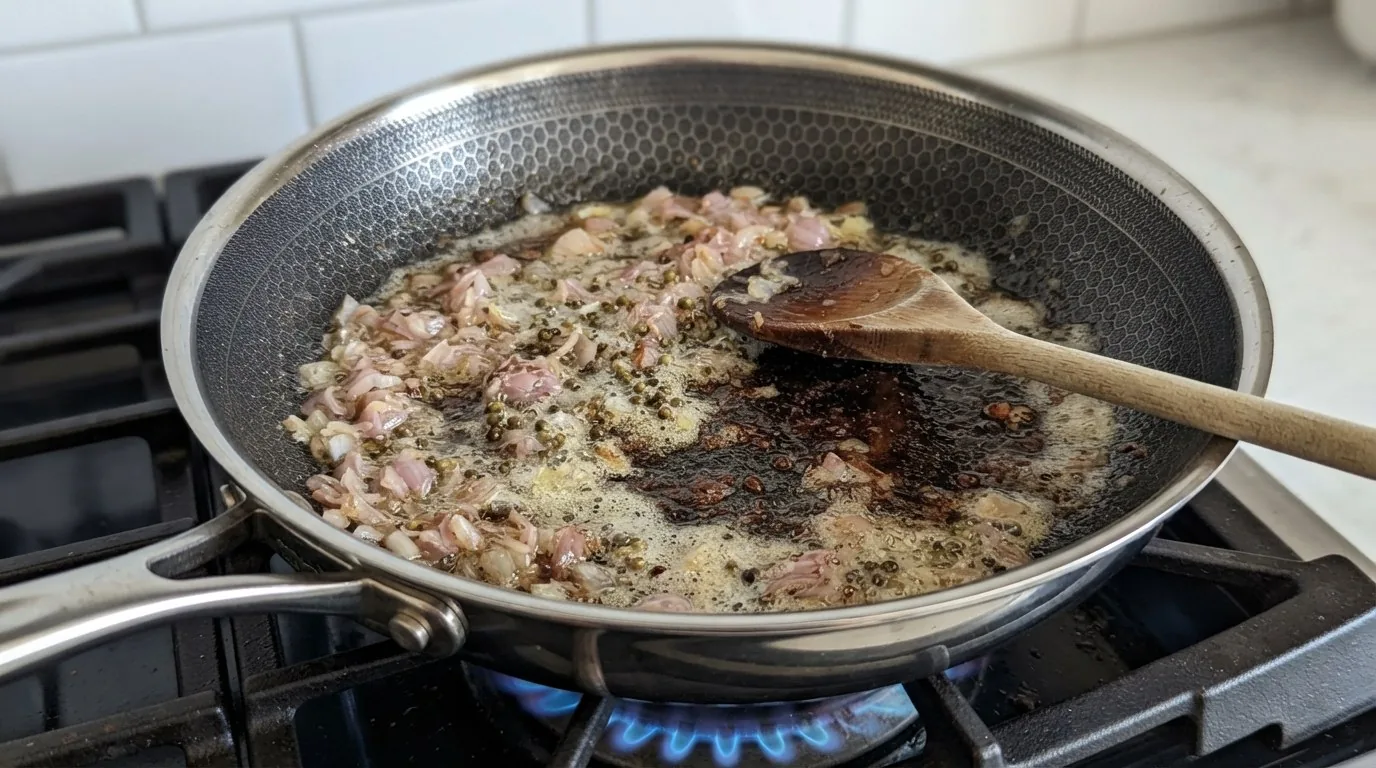
The sauce starts in the pan the steaks came out of, and that is the single largest flavor decision in the recipe. Ramsay's method in his MasterClass is hot pan, then oil, sear the meat, rest it, and build the sauce on what is left in the pan rather than washing it. What is left is the fond, the browned crust stuck to the steel, and it is pure Maillard flavor: the reaction between the meat's amino acids and sugars that begins at about 284°F on a dry surface and produces the hundreds of roasted compounds a steak tastes of. It is stuck to the pan because it is dry, and it comes off the moment liquid hits it. Pour off all but a spoonful of fat, keep every brown speck, and put the pan back over medium heat.
Sweat the shallot in a tablespoon of butter for 2 to 3 minutes until soft and translucent, without color, then add the crushed peppercorns and cook them a minute until they smell fresh and peppery. Crushing matters more than time: piperine sits inside the berry's cells, and a light press with the flat of a knife ruptures enough of them to season the sauce while leaving most berries whole. Escoffier, writing the rulebook for French pepper sauces, added his peppercorns only in the last ten minutes for a reason that still holds.
"Ten minutes before straining the sauce, put in a few crushed peppercorns. If the pepper were put in the sauce earlier, it might make it bitter."
Auguste Escoffier, Poivrade Sauce, A Guide to Modern Cookery
A long simmer draws bitter compounds out of pepper along with the heat, so this sauce is short by design: the peppercorns go in after the shallots, the whole thing is done inside ten minutes, and nothing about it improves with an extra half hour on the stove. That is also why a peppercorn sauce built from a two-day demi-glace is not better than one built from a good boxed stock; the reduction is brief, and it is the pan, the berries and the cream that the sauce tastes of.
Cognac, the Flambé Myth, and the Stock Reduction
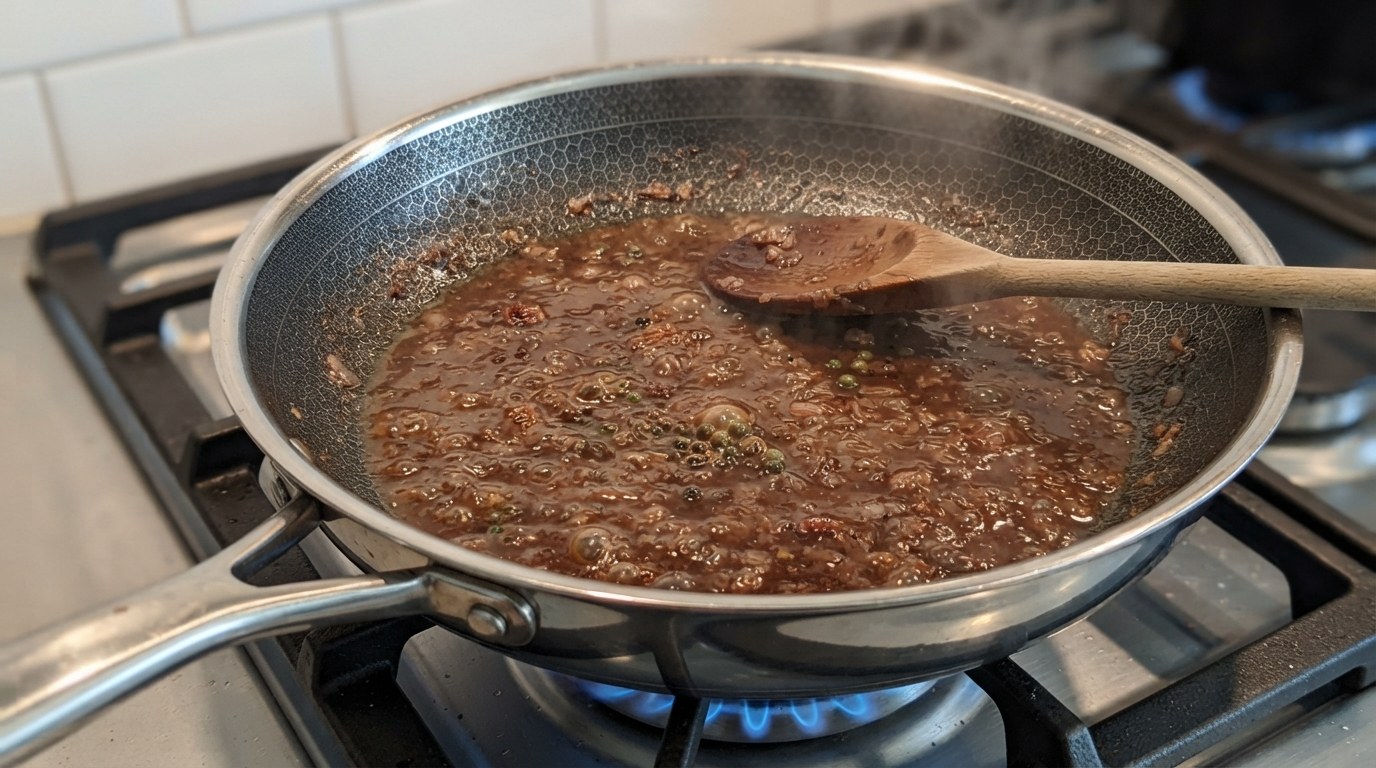
The Cognac is a deglaze first and a flavor second. Take the pan off the flame, pour in a quarter cup, put it back and let it bubble hard while a wooden spoon scrapes the fond loose; in about a minute the spirit has all but cooked away and the pan holds a dark, syrupy glaze of dissolved crust. Brandy is the traditional spirit because its grape-and-oak sweetness matches pepper; bourbon, dry sherry or a dry white wine all work with a different accent, and a sauce for someone avoiding alcohol simply skips the step and deglazes with stock.
Setting the Cognac on fire does not burn the alcohol off, whatever the tableside show suggests. A flambé burns only the vapor above the pan and dies the moment the vapor falls below about 3 percent alcohol, leaving more than two-thirds of the spirit in the sauce; the same thing happens quietly without a match once the pan is hot. Simmering removes more, and slowly: the USDA nutrient retention table puts alcohol retention at about 40 percent after 15 minutes of simmering, 35 percent after 30 minutes and 25 percent after an hour. A quarter cup of Cognac in a sauce that simmers ten minutes leaves a real share of its alcohol behind, and the flame adds nothing but a scorched note on the shallots. Ramsay flames his; the sauce is the same either way.
The stock is where the body comes from. Add a cup of low-sodium beef stock, bring it to a boil and reduce it by half, 3 to 4 minutes in a wide skillet. Reduction concentrates flavor by driving off water, and it concentrates the one thing in real stock that thickens: gelatin, the protein that dissolved out of bone and connective-tissue collagen during the stock's long simmer above about 154°F. A bouillon cube has salt and color and no gelatin, and a sauce built on it stays thin however long it reduces, then turns salty. Use stock that sets to a soft jelly when cold, or add a pinch of unflavored gelatin bloomed in a spoon of water if the box you have is thin.
Cream and Dijon: Why the Sauce Holds and When It Would Split
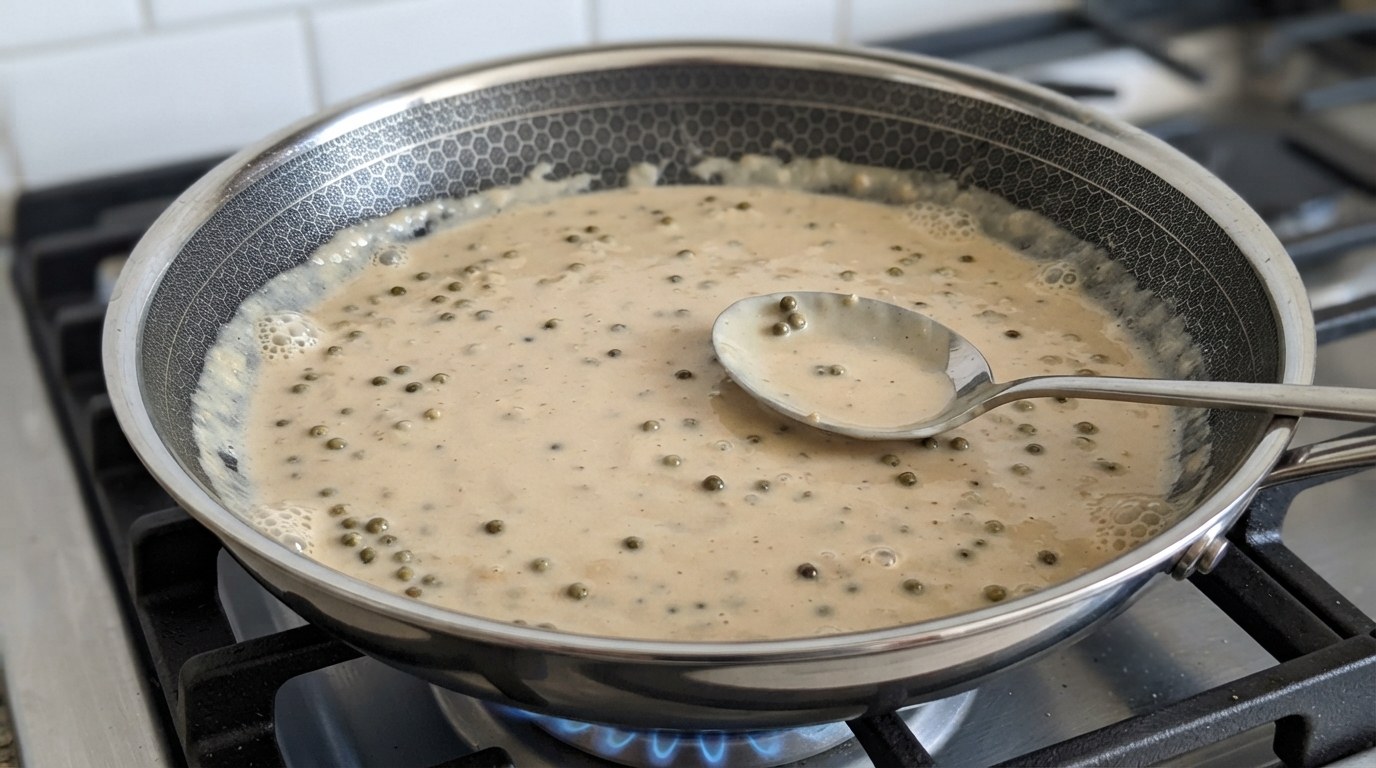
Heavy cream goes in once the stock has reduced, never before, and the order is about the emulsion. Cream is fat droplets dispersed in water, held apart by the milk proteins around them, and the rule for cooking with it is a fat percentage: dairy above roughly 25 percent fat is stable under heat and acid, and dairy below it curdles when the two arrive together. Heavy whipping cream is about 36 grams of fat per 100 grams in the USDA FoodData Central entry, which is why it can meet the vinegar carried over from the brined peppercorns and boil beside a reduced stock without breaking, and why half-and-half at about 12 percent, or milk, would split into grainy curds in the same pan. Add the cream and the Dijon, lower the heat and simmer 3 to 4 minutes until the sauce coats the back of a spoon and a finger dragged across it leaves a line that holds.
The mustard does two jobs. It seasons the sauce with a sharpness that cuts the cream, and its mucilage is an emulsifier, the same property that lets a vinaigrette hold, so a teaspoon of Dijon makes the finished sauce glossier and more forgiving of a hard boil. Reducing the stock before the cream matters for the same reason the stock must be real: cream thins a sauce, so the liquid under it has to be already thick with gelatin, or the finish is a soup. The last additions are the juices the steaks released while resting, tipped in from the plate, and salt, which goes in only now: the brine, the reduced stock and the Dijon are all salty, and a sauce seasoned earlier ends up over-salted once it has concentrated.
| Stage | Number | What you see |
|---|---|---|
| Steaks out, fat poured off | Keep about 1 tbsp fat and all the fond | Dark speckled crust stuck to the pan |
| Sweat the shallot | 2 to 3 minutes, medium | Soft, translucent, no color |
| Peppercorns in | 1 minute | Fresh, peppery smell; berries still whole |
| Cognac deglaze | ¼ cup, about 1 minute, off the flame then back on | Fond dissolves; spirit nearly gone |
| Stock reduction | 1 cup to ½ cup, 3 to 4 minutes | Bubbling, slightly syrupy |
| Cream and Dijon | ¾ cup cream, 1 tsp Dijon, 3 to 4 minutes, low | Coats the back of a spoon; line holds |
| Finish | Resting juices, salt to taste | Pale tan, glossy, whole berries suspended |
Serving: Steak Temperatures, Pairings and Storage
The sauce is made for steak, and the steak should be rested before it is sauced. A pan-seared strip or rib eye pulled at 125°F and rested 5 to 10 minutes lands at medium-rare, and the resting is what keeps the plate clean: a steak cut two minutes off the heat loses about 6 percent of its weight in juice, one rested ten minutes about 2 percent, because the juices thicken as the meat cools, not because the muscle relaxes. The USDA safe-temperature chart lists 145°F with a three-minute rest for whole cuts of beef; the Hell's Kitchen New York strip and filet mignon guides cover the sear and the pull temperatures by doneness. At the Hell's Kitchen Las Vegas restaurant the peppercorn sauce is the one that comes with the 16-ounce rib eye and grilled broccolini.
Beyond steak the sauce suits anything that leaves a fond: pan-roasted chicken breasts, pork chops and pork tenderloin, seared duck breast, and a thick salmon fillet, where the cream and the mild pepper flatter the fish better than a black-pepper sauce would. It keeps 3 days in the refrigerator, where it sets soft from the gelatin; reheat it gently in a small pan, whisking, and loosen it with a spoon of stock. It can be frozen for a month, though a cream sauce may separate on thawing; whisk it hard over low heat and it usually comes back. A version without cream is the classic brown au poivre: reduce the stock further, to a coating glaze, and whisk in 2 tablespoons of cold butter off the heat instead, the way the Madeira sauce finishes.
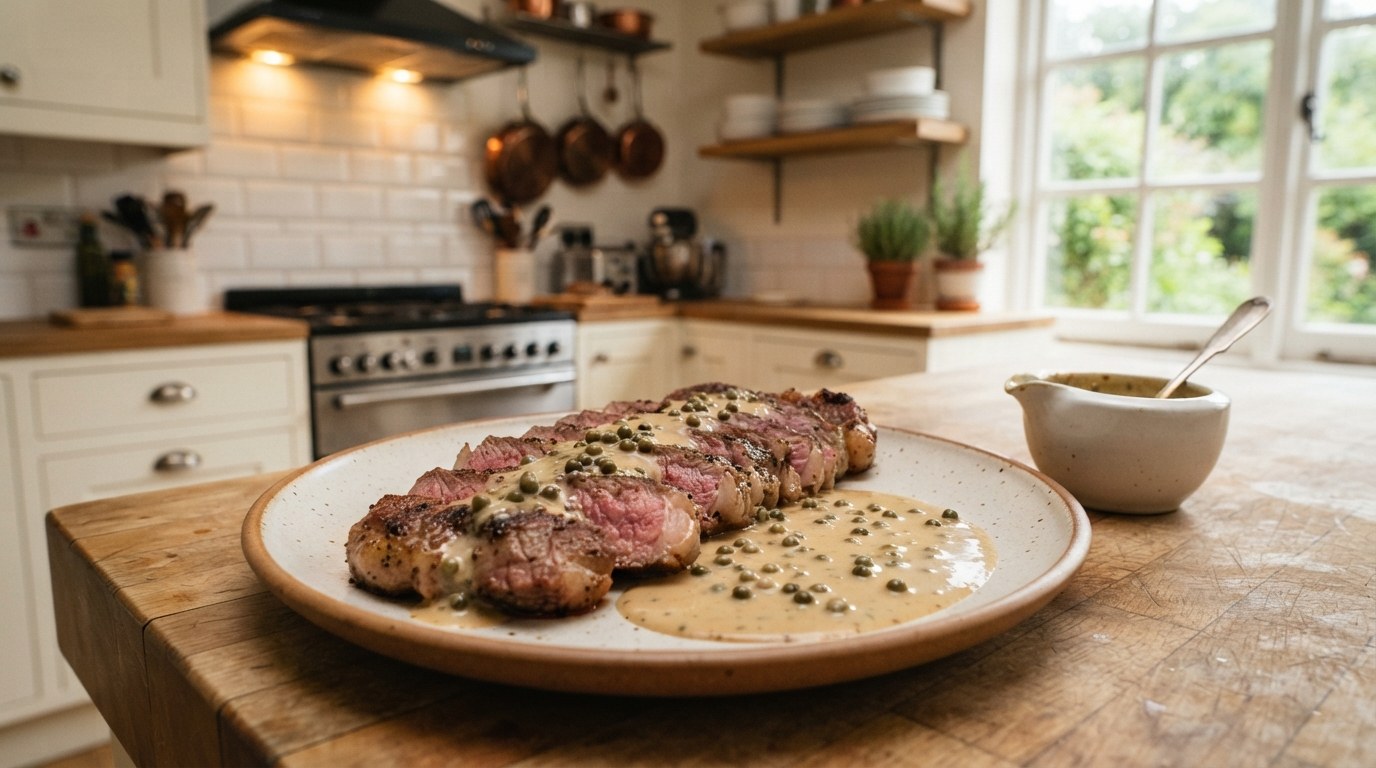
Green Peppercorn Sauce (Gordon Ramsay Style)
Ingredients
- pan drippings from 4 seared steaks (fat poured off, browned bits kept)
- 1 tbsp unsalted butter
- 1 large shallot, finely chopped
- 1 clove garlic, smashed
- 2 tbsp green peppercorns in brine, drained, rinsed and lightly crushed (or 1½ tbsp freeze-dried, soaked 10 minutes)
- ¼ cup Cognac or brandy
- 1 cup low-sodium beef stock
- ¾ cup heavy cream (36% fat)
- 1 tsp Dijon mustard
- kosher salt, to taste
Instructions
- Move the seared steaks to a warm plate to rest. Pour off all but about 1 tablespoon of fat from the skillet, leaving every browned bit, and return the pan to medium heat.
- Add the butter, shallot and garlic and cook, stirring, until the shallot is soft and translucent with no color, 2 to 3 minutes. Add the crushed green peppercorns and cook 1 minute more, until fragrant.
- Take the pan off the flame, pour in the Cognac, return it to the heat and let it bubble hard while you scrape the browned bits loose with a wooden spoon, until the liquid has almost cooked away, about 1 minute.
- Add the stock, raise the heat and boil until reduced by half, 3 to 4 minutes.
- Lower the heat, stir in the cream and Dijon, and simmer gently until the sauce coats the back of a spoon and a finger dragged across it leaves a line that holds, 3 to 4 minutes. Discard the garlic clove.
- Pour in any juices from the resting steaks, taste, and season with salt. Spoon over the sliced steaks and serve at once.
Notes
Green Peppercorn Sauce FAQs
The questions that come up most: what green peppercorn sauce is made of, how it differs from black peppercorn sauce and steak au poivre, whether it is spicy, how to make it without cream or without brandy, whether dried green peppercorns work, whether it can be made ahead or frozen, and what to serve it with.
What is green peppercorn sauce made of?
Shallots softened in butter in the steak pan, brined green peppercorns lightly crushed, a quarter cup of Cognac or brandy to deglaze, a cup of beef stock reduced by half, then heavy cream and a teaspoon of Dijon simmered until the sauce coats a spoon. The resting juices from the steaks and salt finish it. It makes about a cup for four steaks in ten minutes.
What is the difference between green peppercorn sauce and black peppercorn sauce?
The berry. Green peppercorns are the unripe fruit of the pepper vine, preserved in brine or freeze-dried, and they are soft, mild and fruity; black peppercorns are the same fruit ripened, dried and oxidized, and they are hot and roasted-tasting. Steak au poivre presses cracked black pepper onto the steak itself; green peppercorn sauce puts whole soft berries into a cream sauce, so it is gentler and tangier.
Is green peppercorn sauce spicy?
Warm rather than hot. Pepper's heat compound, piperine, fires the same receptor as chili capsaicin but at roughly seventeen times the concentration, and an unripe green berry carries less of it than a black one, so two tablespoons of whole green peppercorns give a mild, fruity warmth. Crushing the berries to powder makes the sauce noticeably hotter; a light press keeps it mild.
Can I make green peppercorn sauce without cream?
Yes. Reduce the stock further, to a coating glaze rather than by half, then take the pan off the heat and whisk in 2 tablespoons of cold butter a cube at a time. That is the classic brown au poivre finish. Do not substitute milk or half-and-half for the cream; below about 25 percent fat, dairy curdles when it meets the reduced stock and the brine's acidity.
Can I make it without brandy or alcohol?
Yes. Deglaze with the stock instead and go straight to the reduction. The Cognac adds a grape-and-oak sweetness but its main job is dissolving the fond, which stock does as well. Note that simmering does not remove all the alcohol from a sauce that uses it: USDA data shows about 40 percent remains after 15 minutes, so an alcohol-free sauce has to leave the spirit out, not cook it longer.
Can I use dried green peppercorns instead of brined?
Yes. Freeze-dried green peppercorns are the closest match: soak them 10 minutes in warm water or stock so they plump, then crush lightly and use the same amount. Hard air-dried green peppercorns need 20 minutes of soaking and a little less quantity because their flavor is more concentrated and flatter. Brined berries are drained and rinsed to shed some of their vinegar.
Can green peppercorn sauce be made ahead or frozen?
It keeps 3 days refrigerated and sets soft from the stock's gelatin; reheat gently in a small pan, whisking, with a spoon of stock to loosen it. Freezing works for about a month, but a cream sauce can separate on thawing; whisk it hard over low heat to bring it back. Because the sauce takes ten minutes in the steak pan, making it fresh while the steaks rest is the better plan.
What do you serve green peppercorn sauce with?
Steak first: strip, rib eye, filet mignon and beef tenderloin, and it is the sauce Hell's Kitchen serves with its rib eye. It also suits pan-roasted chicken breast, pork chops and pork tenderloin, seared duck breast and a thick salmon fillet, anything seared in a pan that leaves a fond to build on.

About the Author
John Siracusa is the founder of Hell’s Kitchen Recipes. He focuses on technique-first, reproducible home cooking and researches recipes & kitchen equipment from published food science and professional chef methods since 2016.