
The most tender cut of steak is filet mignon, cut from the beef tenderloin, and the flat iron is a close second. A University of Nebraska review that pooled 60 years of meat-science research ranked 40 beef muscles by the force it takes to shear through them, and the tenderloin and the flat iron's muscle came out as the two most tender. Ribeye, the porterhouse and T-bone, and the New York strip follow, with hanger and top sirloin close behind if you cook them right.
Tenderness is only half of it, though. A tender cut cooked past medium, sliced with the grain, or cut straight off the heat still eats tough. Below is the ranking, why each cut is tender, and how to cook each one so it stays that way.
The Most Tender Steak Cuts, Ranked
Here are the seven most tender steak cuts, from most to least tender, with where each comes from and the best way to cook it. The top two come straight from the University of Nebraska ranking; from third place down, grade, marbling and aging can shuffle the order, so treat it as a guide.
| Rank | Cut | Also sold as | Where it comes from | Why it's tender | Best way to cook it |
|---|---|---|---|---|---|
| 1 | Filet mignon | Tenderloin steak, filet | Tenderloin, tucked under the spine | A muscle that barely works: fine fibers, very little connective tissue | Hard sear, then finish in the oven; medium-rare |
| 2 | Flat iron | Top blade steak | Chuck (shoulder), with the tough center strip removed | Fine-grained and well marbled once that strip is cut out | Hot and fast on the grill or in a pan; medium-rare |
| 3 | Ribeye | Rib steak (bone-in), Delmonico | Rib section | The most marbling of the premium steaks; the curved cap is the softest part | Cast iron or grill; medium-rare to medium |
| 4 | Porterhouse / T-bone | Tenderloin plus strip on one bone | Short loin | One side is tenderloin; a porterhouse carries more of it | Sear, then finish on the cooler side of the grill |
| 5 | New York strip | Strip loin, Kansas City strip | Short loin | Tender with a firmer, beefier chew than ribeye | Grill or pan-sear; medium-rare |
| 6 | Hanger | Butcher's steak, onglet | Plate, hanging from the diaphragm | Loose, open grain; tender if kept to medium and sliced across | Marinate, sear hard, slice thin |
| 7 | Top sirloin | Sirloin steak | Sirloin, behind the short loin | Leaner and firmer, but good value | Grill; no further than medium-rare |
The porterhouse and T-bone are the same cut at different points along the loin: Certified Angus Beef notes that in a porterhouse the tenderloin side is 1 1/4 inches or wider, which is why a porterhouse gives you more of the most tender meat on the animal.
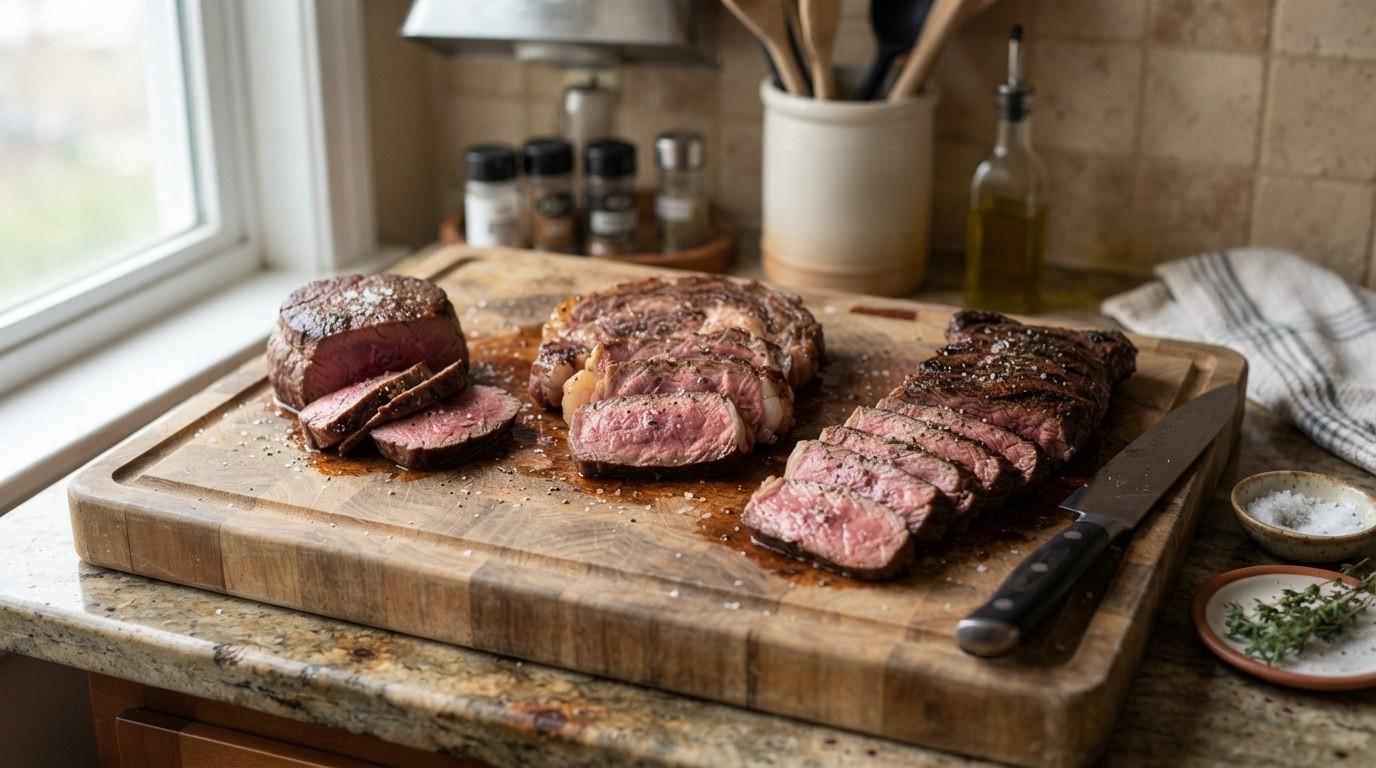
What Makes a Steak Tender?
A steak's tenderness comes down to how hard the muscle worked, how much connective tissue runs through it, and how much fat is marbled into it. Muscles that move the animal all day, like the leg and shoulder, are packed with connective tissue called collagen and have coarse, tightly bundled fibers. The tenderloin runs along the spine and does almost nothing, so its fibers stay fine and its collagen stays low. That is the whole reason filet mignon is the benchmark for tender.
The flat iron is the interesting exception. It comes from the shoulder, a hard-working area, but the muscle itself is tender; the toughness is concentrated in one thick strip of connective tissue down its center. Butchers cut that strip out and sell the two halves as flat irons, which is why the University of Nebraska ranking placed that muscle second only to the tenderloin, as reported in the 2007 Nebraska Beef Cattle Report.
Marbling, the white flecks of fat inside the muscle, adds the rest. As the steak cooks, that fat melts and renders between the fibers, so each bite feels softer and juicier. It is also what the USDA grades on: Prime has the most marbling, Choice less, and Select is leaner. A Prime strip can eat more tender than a Select ribeye, which is why the middle of the ranking moves around.
How to Keep a Tender Steak Tender
Cook tender steaks hot and fast to medium-rare, rest them, and slice them across the grain. The meat proteins in a steak start to tighten between about 122 and 140°F (50 to 60°C), and around 136°F (58°C) the collagen contracts and squeezes moisture out of the fibers. That is why a filet or ribeye taken past medium turns firm and dry no matter how good the cut was. Pull them at 125 to 130°F (52 to 54°C) for medium-rare; the temperature climbs about 5°F as the steak rests. For food safety, the USDA recommends 145°F (63°C) for whole beef steaks with a 3-minute rest.

ThermoPro
ThermoPro TempSwift Instant-Read Digital Thermometer
- Reads in about 1 second, accurate to ±0.9°F, with a 4.3-inch food-grade stainless probe
- Hold and calibration functions, so you can lock a reading away from the heat
- NSF certified and IP65 waterproof, rinse it clean under the tap
Salt the steak at least 40 minutes ahead, or right before it goes in the pan. Salt draws out moisture at first, then dissolves into it and travels back in, seasoning deeper than any marinade can. Pat the surface dry before searing: browning, the Maillard reaction, only starts once the surface passes about 284°F (140°C), and a wet steak can't get hotter than 212°F (100°C) until the water boils off. Follow Gordon Ramsay's order: a hot pan first, then oil with a high smoke point, then the steak, and baste with butter, garlic and thyme at the end.
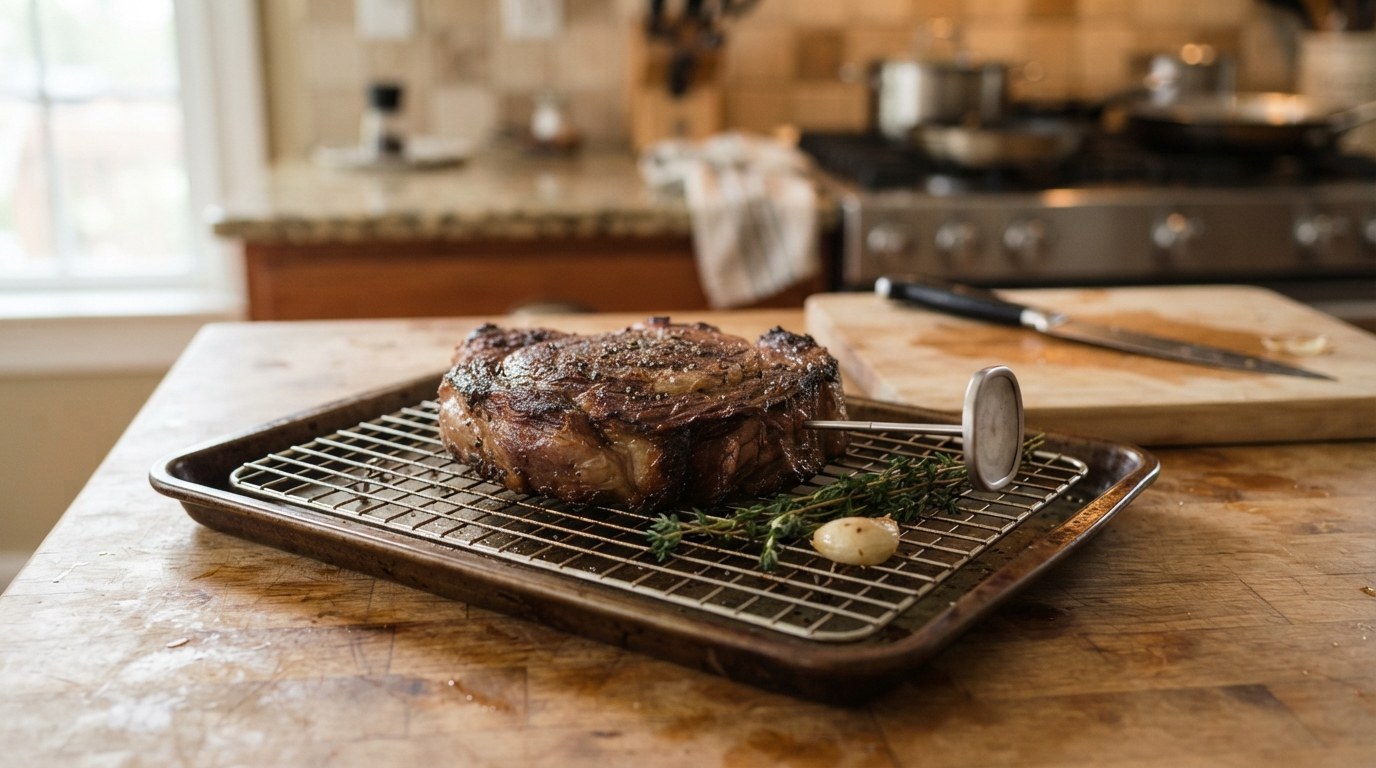
Rest the steak for about 10 minutes. Resting doesn't relax the muscle; it lets the juices thicken slightly as the meat cools, so a steak cut after 2 minutes loses roughly three times as much juice as one rested for 10. Then slice across the grain, at right angles to the lines of fiber, which leaves each bite with short fibers that take a fraction of the force to chew.

HexClad
HexClad 12-Inch Hybrid Nonstick Frying Pan
- Stainless steel and ceramic nonstick hybrid surface, built to sear hard and release easily
- Tri-ply with an aluminum core for quick, even heat; works on induction
- Oven safe to 900°F and metal-utensil safe (lid not included)
Checking Doneness Without a Thermometer
The finger test compares the steak's firmness to the base of your thumb as you touch your thumb to each finger in turn: index finger for rare, middle for medium-rare, ring for medium, little finger for well-done. It is a rough guide, since hands and steaks vary, and a thermometer is always more accurate, but it is a good habit for grilling.

Tender Steaks That Cost Less
The most tender steak for the money is the flat iron, which eats nearly as tenderly as filet mignon at a fraction of the price. Hanger steak is the other value pick, with a rich, beefy flavor; marinate it, sear it hard and slice it thin, as in our Haitian-spiced hanger steak. Skirt steak is chewier but excellent sliced across the grain, like our chimichurri skirt steak.
Truly tough cuts like chuck roast, brisket and short ribs are a different story. Their collagen only melts into soft gelatin after hours of moist heat at around 154°F (68°C) and above, so they belong in a braise or a slow cooker, never on the grill as a steak. Marinades won't rescue them either: their flavor only reaches a few millimeters into the meat, and acid left too long turns the surface mushy rather than tender.

For more on premium beef, see how Kobe beef compares with Wagyu, and for the pans that sear best, our Gordon Ramsay cookware guide.
Most Tender Steak FAQs
The questions that come up most: the most tender cut of steak, the second most tender, filet versus ribeye, the top five, the most tender cheap steak, how to keep steak tender, and whether marinating tenderizes it.
What is the most tender cut of steak?
Filet mignon, cut from the tenderloin. The muscle does almost no work, so it has fine fibers and very little connective tissue. A University of Nebraska review of 40 beef muscles ranked the tenderloin the most tender.
What is the second most tender steak?
The flat iron, also called top blade steak. It comes from the shoulder, but once the tough strip down its center is removed, the muscle ranks second only to the tenderloin.
Is ribeye or filet mignon more tender?
Filet mignon is more tender. Ribeye has more marbling, so it is juicier and more flavorful, and many people prefer it for that reason.
What are the top 5 most tender steaks?
Filet mignon, flat iron, ribeye, porterhouse or T-bone, and New York strip. Grade and marbling can move the last three around.
What is the most tender cheap steak?
The flat iron. Hanger steak is the other good value, as long as you cook it no further than medium and slice it thin across the grain.
How do you keep steak tender when cooking?
Salt it ahead, pat it dry, sear it hot, pull it at 125 to 130°F for medium-rare, rest it for about 10 minutes, and slice it across the grain.
Does marinating make steak more tender?
Only at the surface. Marinade flavor reaches just a few millimeters into the meat, and acid left too long makes the outside mushy. Salt is what seasons deeper, and slicing across the grain does the most for tenderness.

About the Author
John Siracusa is the founder of Hell’s Kitchen Recipes. He focuses on technique-first, reproducible home cooking and researches recipes & kitchen equipment from published food science and professional chef methods since 2016.