Hell's Kitchen beef wellington is the dish the show is built around: a portion of beef tenderloin seared hard, painted with Dijon, wrapped in a dry mushroom duxelles and Prosciutto di Parma, sealed in puff pastry and baked until the pastry is deep gold and the center is pink. It is the plate contestants are judged on at every dinner service and the one Caesars Palace calls Gordon Ramsay's most talked-about signature dish, served medium rare in flaky, golden-brown puff pastry. This page is the home version of that petite Wellington, built for four, with the restaurant's plate of potato purée, glazed root vegetables and red wine demi-glace, and the reasons each step exists.
This guide covers what the Hell's Kitchen Wellington actually is and what is inside it, the sear and the mustard, the duxelles and why it has to be dry, the prosciutto and pastry wrap, the bake and the two temperatures that matter, the sauce and plate, and how the kitchen gets one to the pass in minutes. It is the restaurant-style sibling of the site's Gordon Ramsay beef wellington, which covers the whole-fillet version for a table of six, and it sits in the recipes section beside the other Hell's Kitchen dishes.
What Hell's Kitchen Beef Wellington Is
The restaurant serves a petite, individual Wellington rather than slices from a whole fillet, and the plate is fixed: the Hell's Kitchen Las Vegas menu lists beef wellington with potato purée, glazed root vegetables and red wine demi-glace. Inside the pastry, Ramsay's own published versions agree on the core and differ on one layer. His gordonramsay.com recipe wraps each 400-gram fillet in a mushroom paste and four overlapping slices of Parma ham; the restaurant group's classic recipe brushes the seared beef with mustard, wraps it in two thin crêpes instead of ham, and bakes at 210°C for 20 to 25 minutes. In his MasterClass he uses all of it: crêpe, Parma ham, mushrooms, Dijon. The version below is the ham-and-mustard one, which is what most people mean by the Hell's Kitchen Wellington and the one that needs no crêpe batter.
Two questions come up constantly and both have a plain answer. Yes, it contains pork: the Prosciutto di Parma layer is cured pork leg, so the dish is not halal or kosher as made; swap the ham for a thin savory crêpe and it is pork-free, at the cost of the salty seasoning the ham gives the outside of the beef. And yes, it contains mushrooms, as the duxelles, which is a full layer rather than a garnish and cannot be left out without replacing it (a spinach and shallot paste cooked equally dry is the usual substitute).
| Layer, outside in | What it is | What it does |
|---|---|---|
| Puff pastry, ¼ inch | All-butter laminated pastry, cold | Puffs into a crisp golden shell; insulates the beef |
| Egg-yolk wash and salt | Yolk plus a spoon of cream; flaky salt | Deep gloss and browning; salt pulls surface moisture |
| Prosciutto di Parma | Pork and salt, cured 14 months minimum | Seasons the outside of the beef; a salt barrier under the pastry |
| Duxelles | Cremini, shallot, garlic, thyme cooked dry | Earthy flavor; must be dry or the pastry steams |
| Dijon mustard | Brushed on while the seared beef is warm | Heat and tang under the ham; absorbed as the beef cools |
| Beef tenderloin, center cut | 6-ounce filets, about 2 inches thick | Lean, tender, no connective tissue to break down |
The Sear and the Mustard
Everything starts with a dry, well-seasoned filet and a smoking cast-iron pan. Ramsay's rule in his MasterClass is 60 seconds a side and no more, ends included, then out. Sixty seconds is enough because the point is color, not cooking: water on the surface of meat cannot exceed 212°F, so a wet filet steams gray, while a dry one in a pan well past 284°F browns through the Maillard reaction and picks up the roasted flavor the whole dish is built on. Pat the beef dry, press the salt and pepper in, and let the pan get properly hot before the oil goes in. One correction to the way Ramsay describes it: searing does not lock in juices. A seared piece of meat loses moisture at the same rate as an unseared one, and the pink center you see on the plate is a matter of pulling it at the right temperature, not sealing it. Sear for the crust and the flavor.
Advertisement
Off the heat, brush the filet generously with Dijon while it is still warm. Ramsay's reasoning is that warm meat takes the mustard in as it cools, and the layer of acid and heat sits right against the beef where the ham and pastry will otherwise mute it. Let the filets cool to room temperature on a rack; wrapping warm beef in ham and pastry would start the puff pastry's butter melting before the oven, and the steam from a warm center is exactly what makes a soggy bottom.
The Duxelles: Cook It Until It Is Dry
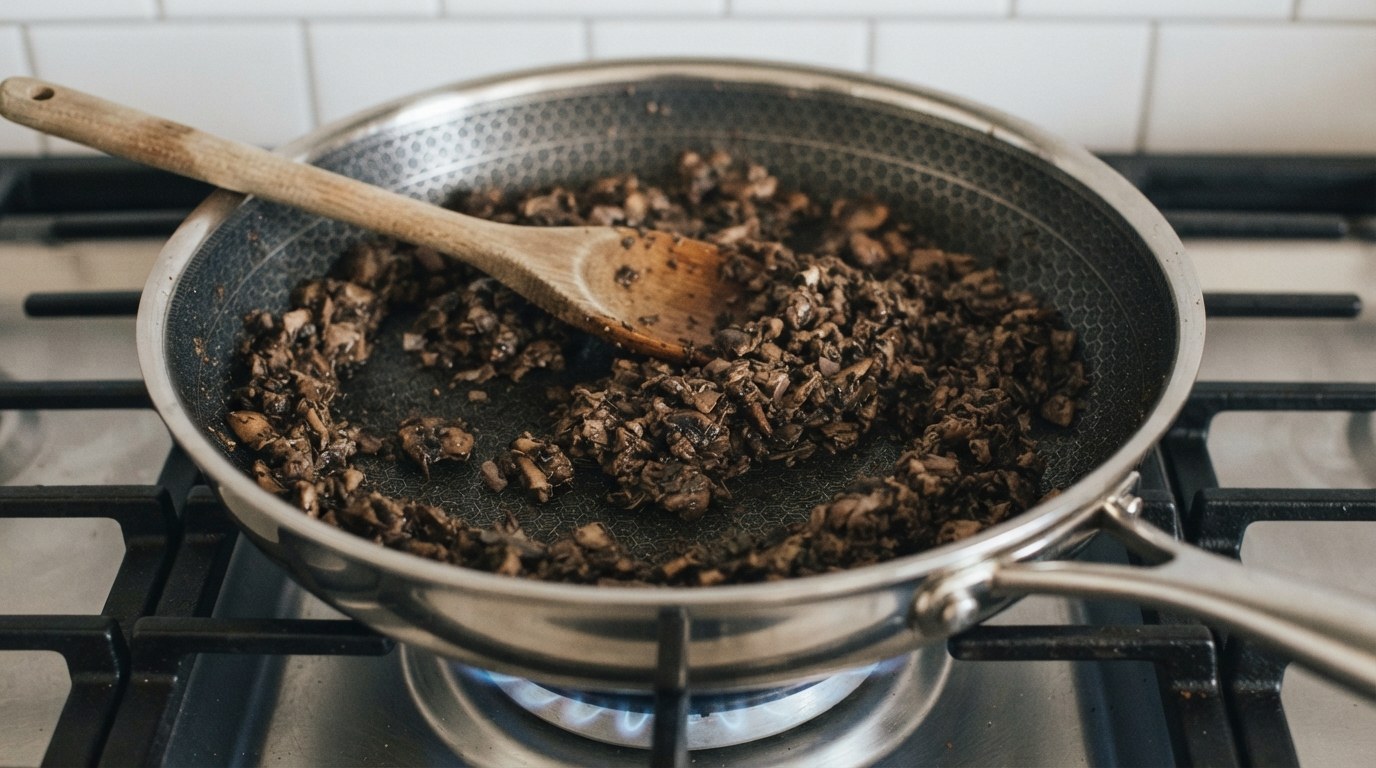
The duxelles decides whether the pastry is crisp. Mushrooms are about 92 percent water by weight, according to USDA Agricultural Research Service composition data, and every gram of that water that is still in the paste when it goes under the pastry turns to steam in the oven and soaks the bottom crust. Pulse a pound of cremini with a shallot, two garlic cloves and thyme to a coarse crumb, then cook it in a wide pan over medium-high heat, spread out and stirred, until it stops steaming and the mass darkens and pulls together like a paste, 12 to 15 minutes. Ramsay's own recipe gives 10 minutes over high heat until all the excess moisture has evaporated; the test is a spoon dragged through the pan leaving a clean trail with no liquid running back. Season it at the end, once the volume has shrunk, and cool it completely before it touches the ham.
Use the resting juices. The beef leaks a spoonful of concentrated juice onto the plate as it cools, and Ramsay spoons it over the duxelles before the wrap rather than wasting it. It is a small amount and it goes on the paste, not the ham, so it does not undo the drying.
The Wrap: Prosciutto, Then Pastry, Then Cold
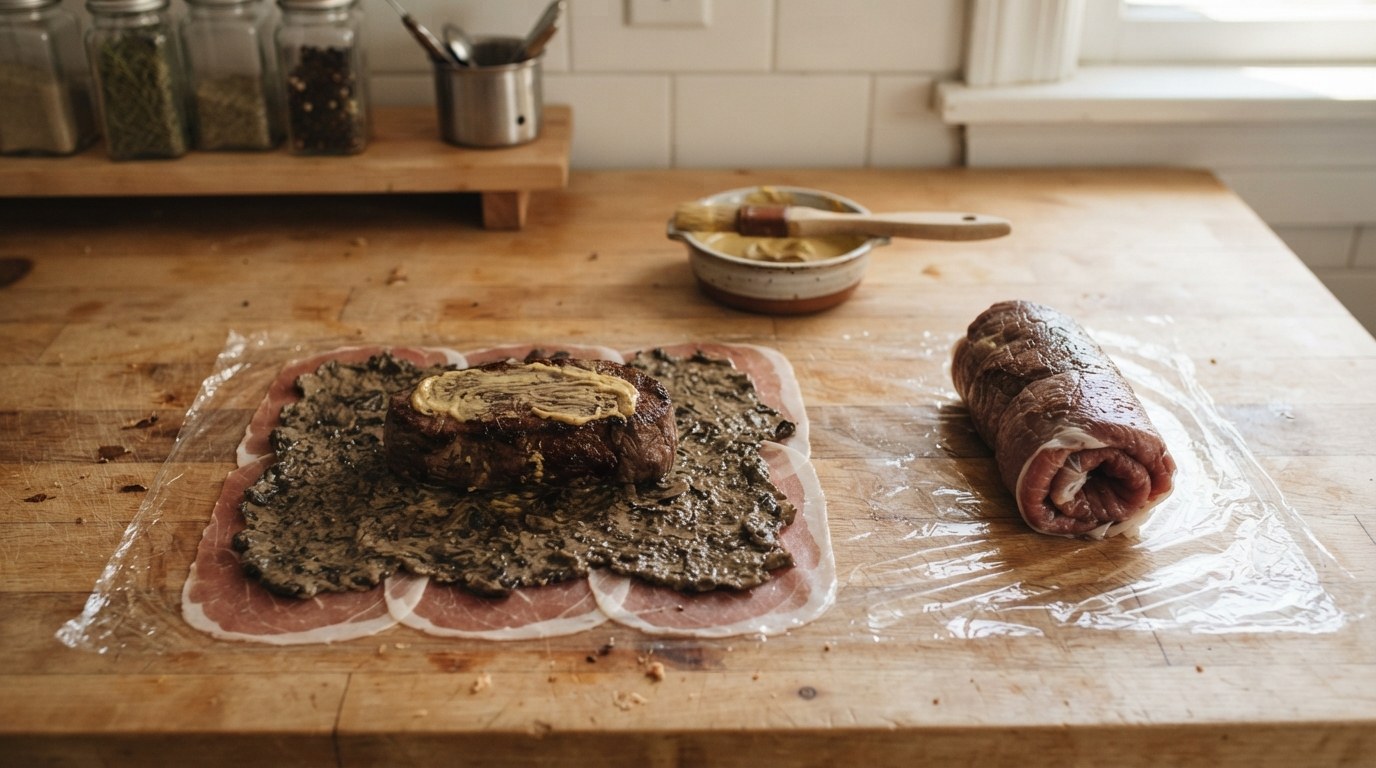
Prosciutto di Parma is the right ham for the job because of what it is: by the consortium's production rules it is pork and sea salt only, no nitrites and no additives, cured for at least 14 months. Sliced paper-thin and shingled into a rectangle on plastic wrap, it seasons the outside of the filet the way Ramsay wants ("there's no seasoning around the outside of that beautiful steak" without it) and it is a salty, fat-dry sheet between the wet duxelles and the pastry. Spread the cooled duxelles thin over the ham, set the filet in the middle, and use the plastic wrap to roll it into a tight cylinder, twisting the ends like a candy wrapper. Tight matters: a loose roll leaves air pockets that become gaps between beef and pastry, and an even cylinder cooks evenly. Chill 20 minutes, or 5 in the freezer, so the layers set to the beef.
Advertisement
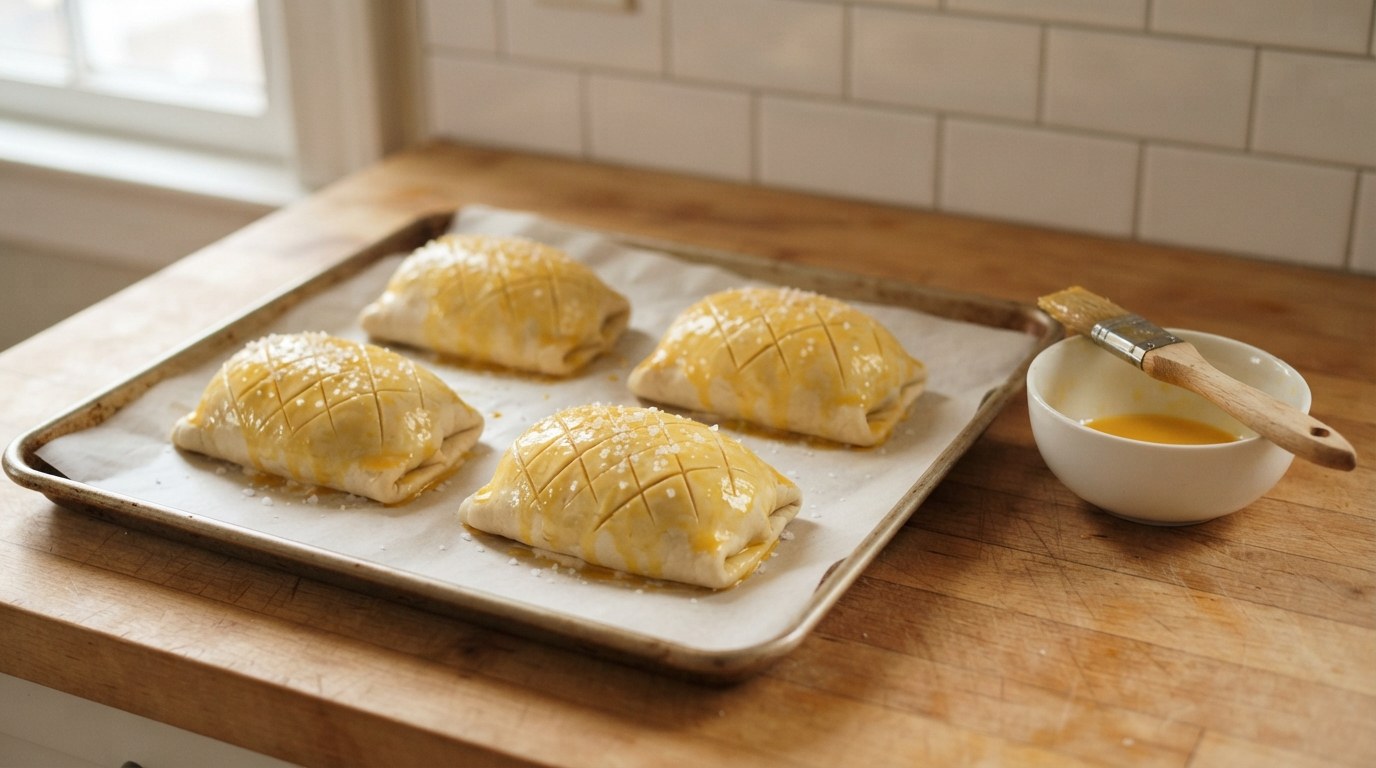
Puff pastry rises the way it does because of lamination: King Arthur Baking describes the dough and butter folded into hundreds of alternating layers, and Pepperidge Farm explains the lift: moisture in the fat turns to steam between the layers and forces them apart. That only works if the butter is still solid when the oven heat hits it, which is why the pastry is worked cold and fast and the wrapped Wellington goes back into the refrigerator before baking. Roll each sheet to a quarter inch, cut squares large enough to enclose a filet, and do the thing Ramsay says few cooks do: season the inside face of the pastry with salt and pepper. The salt draws moisture out of the surface it touches by osmosis and keeps the inner layer from going gummy. Unwrap a chilled filet, set it on the pastry, egg-wash the edges, fold the pastry over and seal it, trim the excess, and place it seam side down on a parchment-lined sheet. Chill again, 15 to 30 minutes.
Just before the oven, brush the tops with egg yolk thinned with a spoon of cream, twice for the deep varnish, score a light crosshatch without cutting through, and scatter flaky salt. Ramsay uses yolk only for the darker color: the yolk's proteins and fat brown faster than whole egg, so the pastry comes out mahogany rather than pale gold.
The Bake: Two Temperatures Decide It
Bake on a preheated sheet at 425°F, in the center of the oven, 18 to 22 minutes for a 6-ounce petite Wellington. The pastry is done when it is deep gold and crisp on the base, and the beef is done by the thermometer, not the clock. The target for medium rare is 125 to 130°F at the center after resting, and the number to pull at is lower than instinct says. Once the pastry has puffed it is a jacket of trapped air, and ThermoWorks measured about 25°F of carryover on a whole Wellington baked at 425°F, which is why they set their alarm at 95 to 100°F for a whole fillet. A petite Wellington has less mass and carries over less, roughly 10°F, so pull it when a probe through the side reads 115 to 120°F and rest it 8 to 10 minutes. It rises to the mid-120s as it sits.
The rest is not optional and it is not about relaxing the muscle, which heat has already set for good; resting lets the juices thicken and redistribute so they stay in the slice instead of running across the plate, and it finishes the carryover. Cut with a serrated knife straight down through the pastry. For a well-done Wellington, which the show gets asked for and delivers, bake to a 145°F pull and accept a paler, drier center; the USDA minimum for whole cuts of beef is 145°F with a 3-minute rest, and a medium-rare Wellington from a whole, intact tenderloin is the standard restaurant service below that line. Beef proteins begin to set at about 122°F and are fully firm by 140°F, which is the whole difference between the pink slice and the gray one.
| Stage | Number | What you see |
|---|---|---|
| Sear | 60 seconds a side, ends too, smoking pan | Mahogany crust, raw center |
| Dijon | While the beef is warm; cool 15 minutes | Mustard disappears into the surface |
| Duxelles | 12 to 15 minutes, until no liquid runs | Dark, dry, paste-like |
| Wrap and chill | Tight roll; 20 minutes cold (5 in the freezer) | Firm cylinder that holds its shape |
| Pastry and chill | ¼-inch pastry, seam down; 15 to 30 minutes cold | Butter firm, pastry matte |
| Bake | 425°F, 18 to 22 minutes; pull at 115 to 120°F | Deep gold, crisp base |
| Rest | 8 to 10 minutes | 125 to 130°F center, juices held |
The Plate: Potato Purée, Root Vegetables, Red Wine Demi-Glace
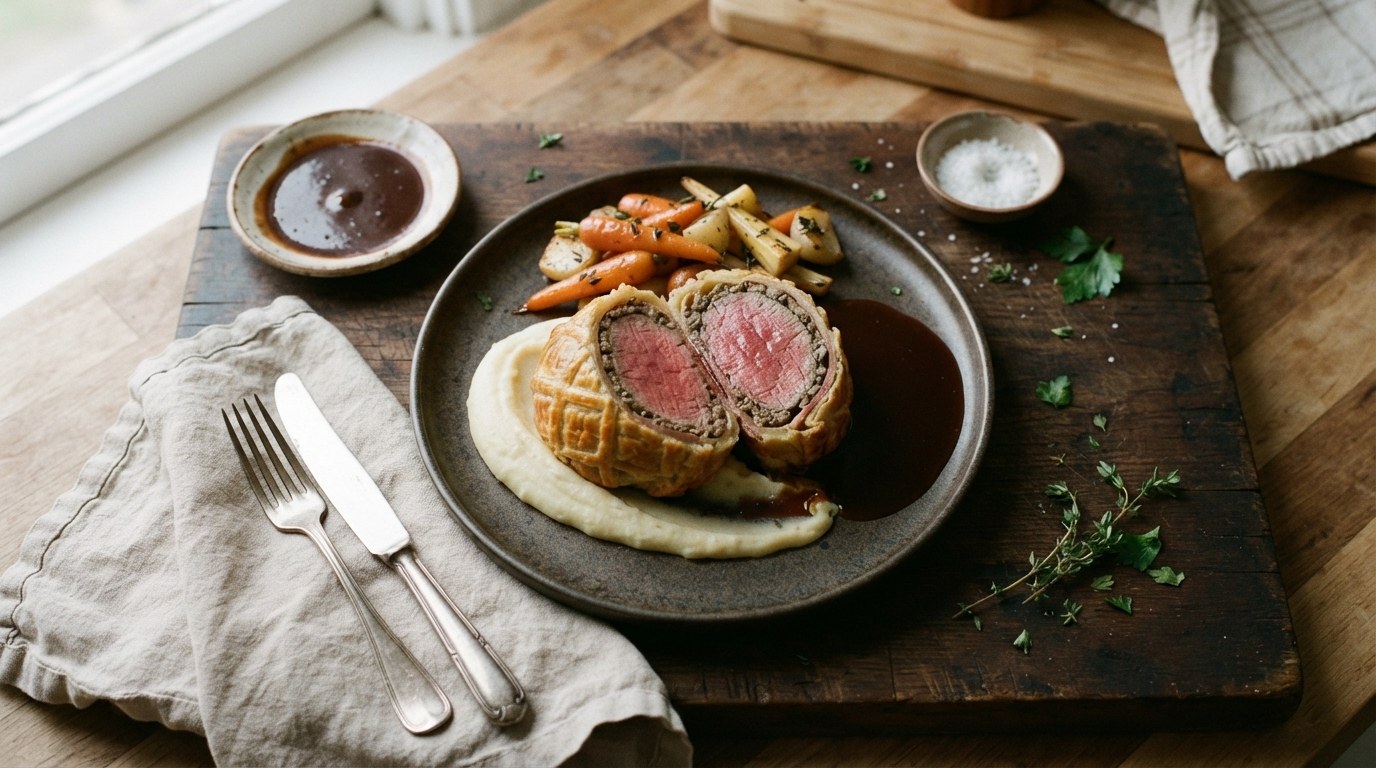
The Hell's Kitchen plate is a swoosh of potato purée, glazed root vegetables and a red wine demi-glace, and it is built while the Wellingtons chill and bake. The purée is the smooth, buttery kind from the site's Yukon Gold potato purée, passed through a ricer so the starch is not overworked into glue. The vegetables are baby carrots and small turnips or parsnips, blanched and then glazed in butter, a spoon of honey and a splash of stock until the liquid reduces to a coat; the honey-glazed carrots page has the method. The sauce here is the quick version of a demi-glace: shallot, garlic and thyme sweated in butter, a cup of dry red wine reduced by three-quarters to cook off its alcohol and sharpen it, two cups of good beef stock reduced by half, then cold butter swirled in off the heat so the sauce holds a gloss. The emulsion breaks if it boils after the butter goes in. The site's red wine reduction sauce covers the longer, stock-from-bones route.
Advertisement
Serve the Wellington cut in half on the bias so the cross-section faces up, the purée under it, the vegetables beside, and the sauce pooled rather than poured over the pastry, which would soften it. A Hell's Kitchen dinner that starts with the pan-seared scallops and ends here is the show's menu in two courses.
How the Show Does It So Fast, and Making Ahead
The reason a Wellington reaches the pass in minutes on television is that almost none of the work happens during service. The beef is seared, wrapped, pastried and chilled during afternoon prep, and a chilled petite Wellington needs only its 20-minute bake and a short rest. That is also the home strategy: assemble through the pastry stage the morning of, or the day before, and keep the wrapped Wellingtons refrigerated on their tray. Ramsay goes further and says the wrapped beef is better for a day in the refrigerator, because the layers set to it. Do not freeze an assembled raw Wellington; the beef sweats as it thaws and the pastry goes soft. What freezes well is the duxelles, for a month.
Two timings the show's cooks get wrong under pressure and home cooks can avoid: raw pastry, which comes from a Wellington that went into the oven with a cold, wet center and too little time, and is cured by chilling the beef only until firm, not frozen, and by a preheated sheet under the seam; and a gray band, which comes from an oven that was not hot enough, so the beef sat in a warm oven while the pastry took too long to color. Get the oven to a true 425°F, checked with an oven thermometer, and both problems go away. The holiday Wellington page scales this to a whole fillet for a table.
Hell's Kitchen Beef Wellington (Petite, for Four)
Ingredients
- For the beef
- 4 center-cut beef tenderloin filets, 6 oz each and about 2 inches thick
- 1½ tsp kosher salt, plus more for the pastry
- 1 tsp freshly ground black pepper
- 1 tbsp grapeseed oil
- 2 tbsp Dijon mustard
- For the duxelles
- 1 lb cremini mushrooms, wiped clean
- 1 large shallot, roughly chopped
- 2 cloves garlic
- 1 tbsp fresh thyme leaves
- 1 tbsp olive oil
- For the wrap
- 8 slices Prosciutto di Parma, sliced thin
- 1 package all-butter puff pastry (17.3 oz, 2 sheets), thawed in the refrigerator and kept cold
- 2 egg yolks
- 1 tbsp heavy cream
- 1 tsp flaky sea salt
- For the red wine demi-glace
- 3 tbsp unsalted butter, cold, divided
- 1 shallot, finely chopped
- 1 clove garlic, smashed
- 2 sprigs thyme
- 1 cup dry red wine
- 2 cups beef stock
- To serve
- 4 cups potato purée (see the Yukon Gold potato purée recipe)
- 2 cups glazed baby carrots and small turnips or parsnips
Instructions
- Take the filets out of the refrigerator 10 minutes ahead, pat them dry, and press the salt and pepper into every surface. Heat a cast-iron skillet over high heat until it smokes, add the grapeseed oil, and sear the filets 60 seconds per side, standing them on their ends with tongs to sear those too. Transfer to a plate and immediately brush all over with the Dijon. Cool to room temperature, saving any juices.
- Pulse the mushrooms, shallot, garlic and thyme in a food processor to a coarse crumb. Heat the olive oil in a wide skillet over medium-high heat, add the mushroom mixture, spread it out, and cook, stirring often, until it stops steaming and forms a dark, dry paste that leaves a clean trail behind a spoon, 12 to 15 minutes. Season with salt and pepper and cool completely.
- Lay a sheet of plastic wrap on the counter and shingle 2 slices of prosciutto into a rectangle large enough to wrap one filet. Spread a quarter of the duxelles thinly over the ham, spoon over a little of the reserved beef juices, set a filet in the center, and use the plastic wrap to roll the ham tightly around it, twisting the ends to tighten. Repeat for the remaining filets. Refrigerate 20 minutes (or freeze 5).
- On a lightly floured surface, roll each pastry sheet to ¼ inch thick and cut into 2 squares large enough to enclose a filet. Season the inside face of each square with salt and pepper. Beat the yolks with the cream. Unwrap a filet, set it in the center of a square, brush the pastry edges with egg wash, fold the pastry over to enclose it, press to seal, and trim the excess. Place seam side down on a parchment-lined sheet pan and repeat. Refrigerate 15 to 30 minutes. Heat the oven to 425°F with a second sheet pan inside.
- Brush the Wellingtons with the egg wash, let it set a minute, and brush again. Score a light crosshatch on top without cutting through, and sprinkle with flaky salt. Slide the parchment onto the preheated pan and bake 18 to 22 minutes, until the pastry is deep gold and an instant-read probe pushed through the side into the center reads 115 to 120°F. Rest 8 to 10 minutes; the center rises to 125 to 130°F for medium rare.
- While they bake, make the sauce: melt 1 tablespoon of the butter in a saucepan over medium heat and sweat the shallot, garlic and thyme 3 minutes. Add the wine and reduce by three-quarters, then add the stock and reduce by half, 12 to 15 minutes, to about ¾ cup. Strain, return to the pan off the heat, and swirl in the remaining 2 tablespoons cold butter until glossy. Season to taste.
- Cut each Wellington in half on the bias with a serrated knife. Spoon the potato purée onto warm plates, set the halves on top cut side up, add the glazed vegetables, and pool the sauce beside the pastry.
Notes
Advertisement
Hell's Kitchen Beef Wellington FAQs
The questions that come up most: what is in the Hell's Kitchen beef wellington, whether it has pork or mushrooms, what temperature it is cooked to, whether it can be well done, how the show cooks it so fast, whether it can be made ahead, what sauce and sides go with it, and what it costs at the restaurant.
What is in Hell's Kitchen beef wellington?
A center-cut beef tenderloin filet seared and brushed with Dijon mustard, wrapped in a dry mushroom duxelles and Prosciutto di Parma, then sealed in puff pastry and baked until golden. At the restaurant it is a petite, individual Wellington served medium rare with potato purée, glazed root vegetables and red wine demi-glace.
Does Hell's Kitchen beef wellington have pork in it?
Yes. The prosciutto layer is cured pork leg, so the dish is not halal or kosher as made. For a pork-free Wellington, replace the ham with a thin savory crêpe, which Ramsay's restaurant recipe uses instead of ham; the outside of the beef will be less seasoned, so salt it a little harder before the sear.
What internal temperature should beef wellington be?
For medium rare, 125 to 130°F at the center after resting. Pull a petite Wellington from the oven when a probe reads 115 to 120°F, since the puffed pastry insulates the beef and carryover adds about 10°F (ThermoWorks measured about 25°F on a whole one). Rest 8 to 10 minutes before cutting.
Can beef wellington be cooked well done?
Yes, though it is a different dish. Bake to a 145°F pull, which meets the USDA minimum for whole cuts of beef with its 3-minute rest, and expect a paler, firmer, drier center; beef proteins are fully set by about 140°F. Medium rare is how the restaurant serves it.
How do they cook beef wellington so fast on Hell's Kitchen?
The Wellingtons are seared, wrapped, pastried and chilled during afternoon prep, before service. A chilled petite Wellington only needs its 18 to 22 minutes at 425°F and a short rest, so it can reach the pass in about 25 minutes from the order. Raw pastry on the show comes from rushing that bake.
Can I make beef wellington ahead?
Yes, through the pastry stage. Assemble the wrapped, egg-washed Wellingtons the morning of or the day before and refrigerate them on their tray; the layers set better with time. Do not freeze the assembled raw Wellington, because the thawing beef sweats into the pastry. The duxelles freezes for a month.
What sauce and sides go with Hell's Kitchen beef wellington?
Red wine demi-glace, potato purée and glazed root vegetables, which is the restaurant's plate. A quick demi-glace is shallot, thyme, red wine reduced by three-quarters, beef stock reduced by half, and cold butter swirled in off the heat. Pool the sauce beside the pastry, not over it, so the crust stays crisp.
How much is beef wellington at Hell's Kitchen?
It is a prix-fixe course at the restaurants and the price differs by location and menu, so check the current menu for the Hell's Kitchen you are visiting. Making the petite version at home for four costs a fraction of one restaurant plate, and the technique above is the same one the line uses.

About the Author
John Siracusa is the founder of Hell’s Kitchen Recipes. He focuses on technique-first, reproducible home cooking and researches recipes & kitchen equipment from published food science and professional chef methods since 2016.