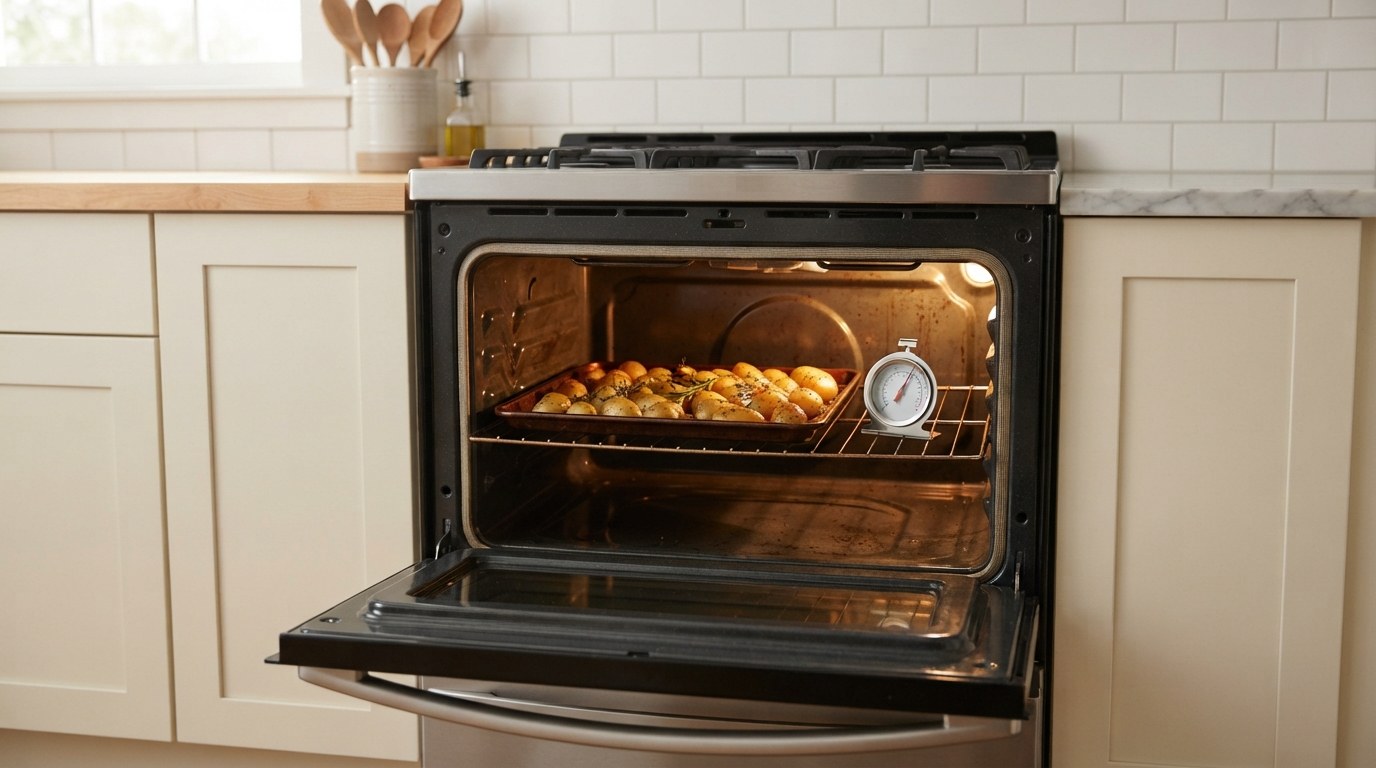
An oven thermometer is a small dial or digital probe that lives inside the oven and reports the temperature the food is actually sitting in, as opposed to the number on the control panel. The two are rarely the same. GE Appliances tells owners that an oven cycling around its set point can vary by plus or minus 30 degrees, a total swing of 60 degrees, and that is a working oven; one whose thermostat has drifted can run 25°F to 50°F off all the time and never tell you. A thermometer that costs less than a pound of good butter is the only way to know which oven you have, and it is the first thing to hang on the rack before a turkey, a batch of cookies or a Wellington goes in.
This guide covers what a wrong oven does to food and why 25°F matters, how the dial and probe types work and where each one falls short, how to test your oven with one in 20 minutes, the three models in stock right now that are worth the money, and how to calibrate the oven once you have the number. It sits in the site's kitchen gear guides beside the Gordon Ramsay cookware and knives pages, and it is the tool the Ramsay turkey recipe assumes you own.
Why 25 Degrees Matters: What a Lying Oven Does to Food
Twenty-five degrees is the difference between a recipe working and a recipe failing, because the reactions that make food brown and set all switch on at fixed temperatures. Browning, the Maillard reaction between proteins and sugars, does not start until a dry surface passes about 284°F and runs fastest around 320°F; sugar begins to caramelize at roughly 320°F and is ruined past 410°F. An oven set to 350°F that actually holds 325°F will bake a cake that is pale, sunken and gummy at the center, because its crust never set before the batter finished rising; the same oven set to 425°F for roast potatoes gives you steamed potatoes that never crisp. Run the other way, an oven 25°F hot burns cookie bottoms while the tops are raw and dries the breast of a turkey before the thigh is safe.
Thermostats drift because they are simple. Most home ovens control temperature with a sensor in the cavity wall and a switch that turns the heating element on when the air drops below the set point and off when it climbs above it, and Whirlpool's product help explains that the elements cycle on and off and may run slightly hot or cool at any point because of that cycling. Over years the sensor ages, the door seal sags and the calibration walks away from the number on the panel. Ramsay's first rule in any kitchen is to get organized before the pan goes on, and knowing your oven's real temperature is part of that: it is one number, checked once, that stops a dozen recipes from being blamed for a fault in the appliance.
| Oven reads | Actually holds | What happens |
|---|---|---|
| 350°F | 325°F | Cakes and quick breads sink and stay gummy; cookies spread; roasts take 20 percent longer |
| 350°F | 375°F | Cookie bottoms burn before centers set; custards curdle at the edge; bread crusts too fast |
| 425°F | 400°F | Potatoes and vegetables steam instead of crisping; puff pastry rises weakly |
| 425°F | 450°F | Sugar on a glaze passes 410°F and turns bitter; pastry scorches before the filling is hot |
| Any | Swinging ±30°F | Normal cycling; average it over 20 minutes rather than reading the peaks |
Dial vs Digital Probe: How Each Type Reads the Oven
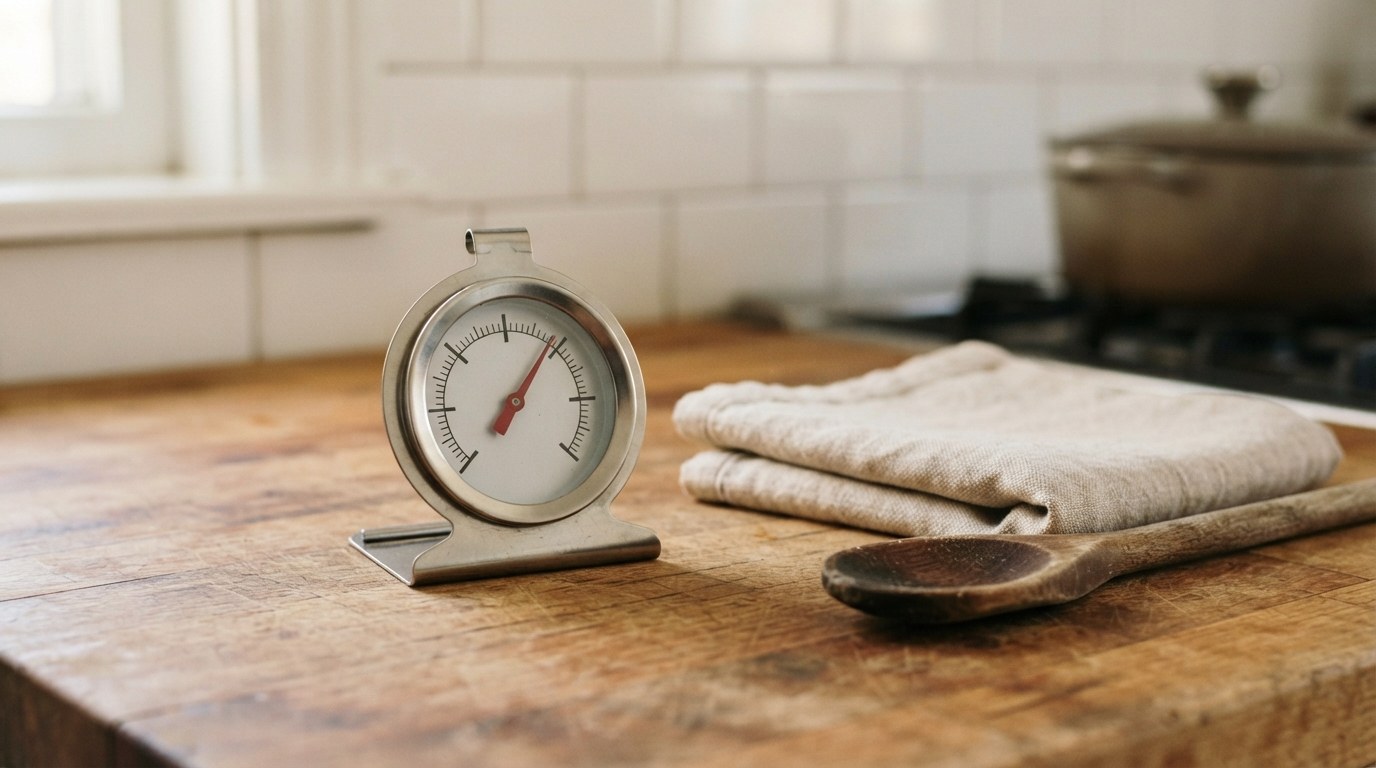
A dial oven thermometer is a bimetallic coil in a steel case. Two metals with different expansion rates are bonded into a coil; as the oven warms, one metal expands more than the other, the coil winds tighter and turns the needle on the face. The USDA describes the same mechanism in its guide to kitchen thermometers, where it appears in oven-safe meat thermometers and in the dial units that hang from a rack. There is nothing to go wrong: no battery, no wire, nothing that melts. The weakness is speed. A coil in a steel case takes minutes to follow a change in air temperature, so a dial reads the average of the last few minutes of cycling rather than the instant. Whirlpool goes as far as telling owners not to trust a thermometer for the cycling itself, because most are slow to react. That lag is a feature for the job that matters: telling you what the oven averages once it has settled, which is the number food actually experiences.
Advertisement
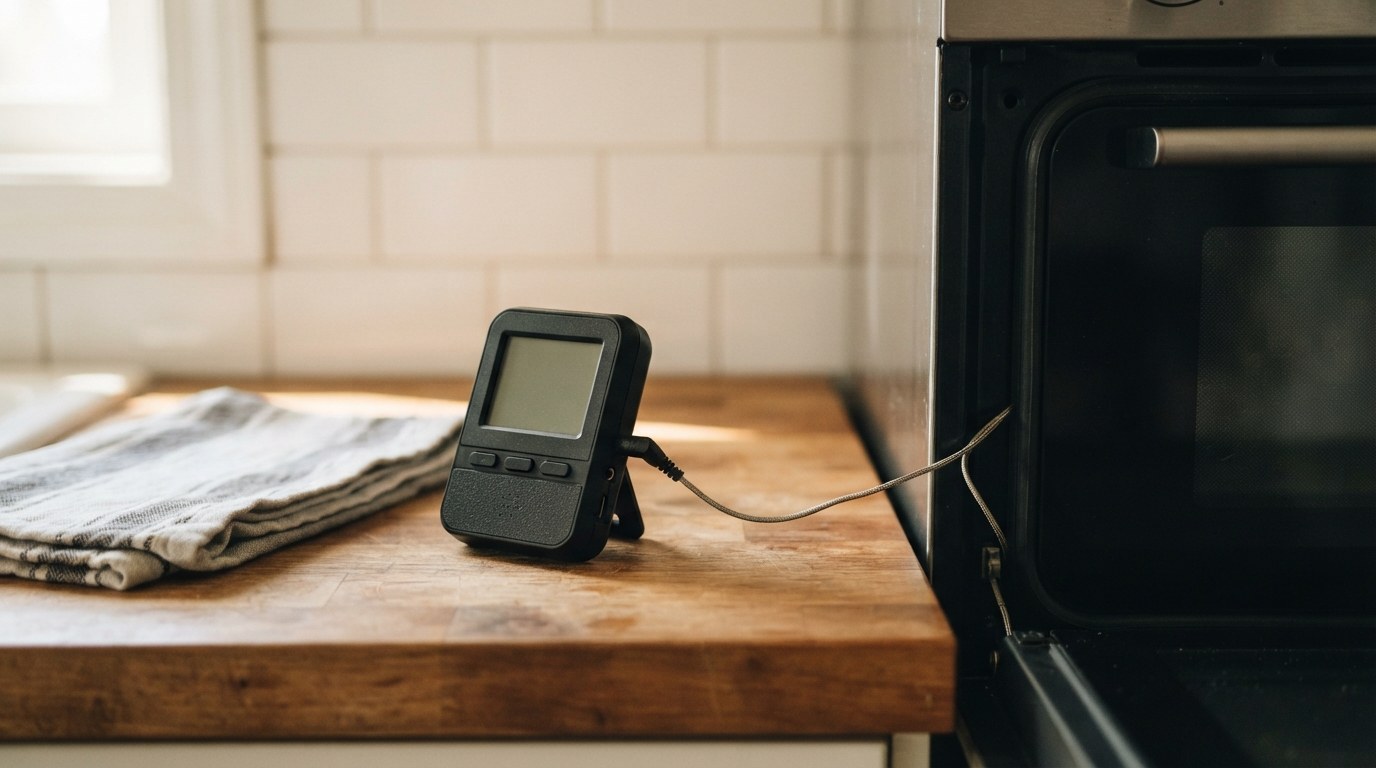
A digital probe thermometer reads with a thermistor at the tip of a steel cable that runs out through the door seal to a base unit on the counter. It updates every second or two, which makes it the tool for watching an oven cycle in real time, for reading a roast without opening the door, and for the alarm that goes off when the meat is done. The USDA lists these oven-cord thermometers as the type that lets you check food temperature without opening the door and notes they cannot be calibrated. Most are sold as meat thermometers, and the trick is that a two-probe unit does both jobs at once: one probe clipped to the rack reads the oven air while the other sits in the turkey. What they cannot do is survive the broiler or a self-clean cycle, and a cable pinched hard in the door seal will eventually fail.
| Type | How it senses | Reads | Best at | Weak at |
|---|---|---|---|---|
| Dial (bimetal coil) | Two bonded metals expand at different rates and turn the needle | Slowly; an average over minutes | Checking the oven's true set point; living on the rack permanently | Showing the cycling; small dials are hard to read through the door |
| Digital probe (thermistor on a cable) | Resistance changes with temperature; base unit on the counter | Every 1 to 2 seconds | Tracking cycling; reading a roast with the door shut; alarms | Broil and self-clean; cable wear at the door seal; batteries |
| Infrared gun | Surface radiation | Instant, surfaces only | Pizza stones and cast iron | Air temperature (it cannot read it) |
The Oven Thermometers Worth Buying
Three units cover what most kitchens need: a large dial that can be read through the door glass, a compact professional dial with labeled zones, and a two-probe digital that reads the oven and the roast together. All three are in stock on Amazon as of this writing, and the maker specifications below are from the makers' own product pages, not from the listings.
Taylor
Taylor Precision Products Large Dial Oven Thermometer
- Extra-large 3¼-inch dial with a red pointer behind a glass lens
- Reads 100°F to 600°F; stainless steel body, NSF certified
- Hangs from a rack or stands on its base
Taylor's Large Dial is the one most cooks picture when they hear the words oven thermometer, and its product page gives the reasons: a 3-inch dial, which is the largest of the common units and the only one comfortably readable through a closed door, a range of 100°F to 600°F, stainless steel construction, NSF certification and a base that either hangs or stands. The wide range matters more than it sounds. A dial that tops out at 550°F sits at its stop during a broil or a pizza bake, while 600°F leaves headroom. The 3-inch face is also why this thermometer stays on the rack rather than in a drawer: you can check it through the glass without opening the door and losing 25°F to 50°F of heat.
CDN
CDN DOT2 ProAccurate Oven Thermometer
- 2-inch dial with labeled zones from Warm to Broil across 150°F to 550°F
- 304 stainless steel housing and laboratory glass lens; NSF certified
- Stands or hangs; 5-year limited warranty
CDN's DOT2 is the professional-kitchen version of the same idea, smaller and built to be dropped. Its product page specifies a 2-inch dial, a 304 stainless steel housing, a laboratory glass lens, a range of 150°F to 550°F with labeled temperature zones from Warm to Broil, two-way mounting and a five-year warranty. The zones are the useful part for a cook who does not want to squint at numbers: a glance tells you whether the oven is sitting in the moderate band the recipe called for. The trade against the Taylor is the smaller face, which usually means opening the door to read it. In a restaurant, where ovens are opened constantly anyway, that is no cost; at home it is worth knowing.
TempPro (formerly ThermoPro)
TempPro TempTrack TP17 Dual Probe Digital Thermometer
- Two leave-in probes on steel mesh cables; one can read oven air while the other reads the roast
- 14°F to 572°F range, ±1.8°F accuracy per the maker; high/low alarm and a 99-hour timer
- Flip-out stand and magnetic back; runs on one AAA battery
The TP17 from TempPro, the company formerly sold as ThermoPro, is the digital answer, and the one to buy if you want a single tool for the oven and the turkey. The maker's specifications list two leave-in probes on 49-inch cables, a range of 14°F to 572°F, accuracy of ±1.8°F, a high/low alarm that flashes and beeps when a reading leaves the range you set, a timer, a flip-out stand and a magnetic back, on one AAA battery. Clip one probe to the middle rack with a binder clip and it becomes an oven thermometer that shows the cycling second by second; put the other in the breast and it does the job the turkey recipe asks for, pulling the bird at temperature rather than by the clock. Keep it out of the oven during a broil or a self-clean cycle, both of which run past what any probe cable is rated for.
How to Test Your Oven With an Oven Thermometer
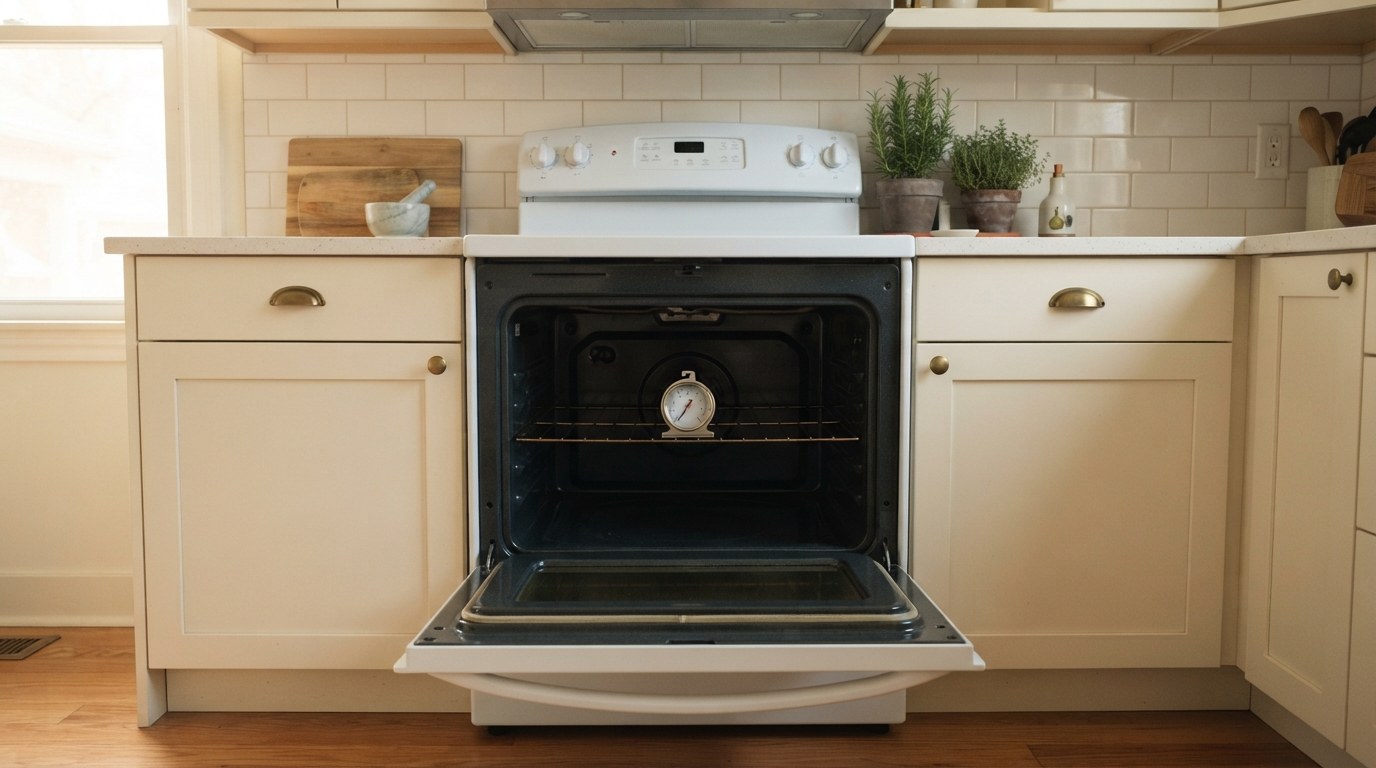
Put the thermometer in the center of the middle rack, close the door, set the oven to 350°F, and wait at least 20 minutes after the preheat signal before you read it. The preheat beep is the moment the sensor first touches the set point, not the moment the oven walls and racks have caught up, and reading then is the single most common way people decide their oven is 50°F cold when it is only slow. Then take three readings 10 minutes apart without opening the door longer than it takes to look, and average them; the swing between readings is the cycling GE describes, and the average is your oven's real 350°F. Repeat at 425°F if you roast at high heat, because a thermostat that is accurate at 350°F can drift further at the top of its range.
Advertisement
Test the corners too, once. Move the thermometer to the back left and the front right of the middle rack on two separate runs, and you will find the hot spot every oven has, usually the back corner nearest the element. That is the spot where one tray of cookies always browns first, and the reason a sheet pan gets rotated halfway through. With a two-probe digital you can read two positions in one run. A difference of 25°F between positions is ordinary; a difference of 50°F says the door seal or the convection fan needs attention before the calibration does.
| Step | What to do | Why |
|---|---|---|
| 1 | Middle rack, center; oven set to 350°F | The position recipes assume; the sensor is calibrated for it |
| 2 | Wait 20 minutes past the preheat signal | The beep is the sensor's first touch, not a settled oven |
| 3 | Three readings, 10 minutes apart, averaged | Averages out the ±30°F cycling |
| 4 | Repeat at 425°F | Drift is often worse at high heat |
| 5 | Test the corners once | Finds the hot spot; explains uneven trays |
| 6 | Adjust the oven's calibration by the average error | Most ovens allow ±30°F to ±35°F in 1°F steps |
Calibrating the Oven Once You Know the Number
Most electronic ovens let you correct the error from the control panel. GE's support pages describe an adjustment of up to 35°F hotter or 35°F cooler in 1-degree steps that survives a power failure and does not touch the broil or self-clean settings; Whirlpool's equivalent runs 30°F either way. The exact button sequence depends on the control type, which is why the owner's manual section titled something like Adjust the Oven Thermostat is the one to find, but the logic is the same on every brand: if the thermometer averaged 325°F at a 350°F setting, offset the oven by +25°F and retest. An oven that is more than 35°F out is past what calibration can fix and usually has a failing sensor, which is a part rather than a setting.
Leave the thermometer in after you have calibrated. It costs nothing to keep a dial on the rack, and it catches the next drift, the door seal that starts leaking, and the day the oven is set to 375°F when the recipe said 350°F. A thermometer also settles the argument between a recipe and an oven in the recipe's favor: the site's banana bread, which needs a true 350°F for an hour, and its turkey, which starts at 428°F, were both written for ovens that hold what they claim. Whether yours does is the one thing a cheap tool on the rack can tell you and the control panel cannot.
Advertisement
Oven Thermometer FAQs
The questions that come up most: whether an oven thermometer is worth it, where to put it in the oven, whether the readings can be trusted, how to test the oven with one, the difference between an oven thermometer and an oven-safe meat thermometer, whether a digital one is better, and whether it can stay in during self-clean.
Are oven thermometers worth it?
Yes, for the price of a bag of flour. Manufacturers themselves say a working oven cycles as much as 30°F above and below its set point, and a thermostat that has drifted can sit 25°F to 50°F off permanently. A thermometer on the rack is the only way to know, and it explains sunken cakes, pale roast potatoes and burnt cookie bottoms that get blamed on recipes.
Where should you put an oven thermometer?
In the center of the middle rack for the test, because that is the position recipes assume and the oven sensor is calibrated for. Hang it from the rack or stand it on its base where you can read it through the door glass. Test the back corners once to find the hot spot every oven has, then leave the thermometer wherever you can see it.
Are oven thermometers accurate?
The good ones are accurate to within a few degrees, but they are slow. A dial uses a bimetal coil that takes minutes to follow a change, so it reads an average rather than the instant, which is why Whirlpool warns that most thermometers are too slow to show the cycling itself. Read it 20 minutes after the preheat beep and average three readings; that average is the number that matters.
How do you test an oven with a thermometer?
Center of the middle rack, oven set to 350°F, wait 20 minutes after the preheat signal, then take three readings 10 minutes apart without holding the door open and average them. Repeat at 425°F. If the average is off by up to 30°F to 35°F, adjust the oven's calibration in the control panel by that amount; if it is off by more, the sensor is likely failing.
What is the difference between an oven thermometer and an oven-safe meat thermometer?
An oven thermometer reads the air in the oven; an oven-safe meat thermometer reads the inside of the food. Both can use the same bimetal coil, which is why they look alike, but the meat version has a probe meant to be pushed into a roast. A two-probe digital unit does both jobs at once: one probe clipped to the rack, one in the meat.
Is a digital oven thermometer better than a dial?
Better at different things. A digital probe updates every second or two, so it shows the cycling, reads a roast with the door shut and sounds an alarm; a dial is slower but needs no battery, survives any temperature the oven can reach and can stay on the rack for years. Many cooks keep a dial permanently and use a digital probe for roasts.
Can you leave an oven thermometer in during self-clean?
A stainless dial, yes, though its glass lens can cloud over time at self-clean temperatures, so most makers suggest removing it. A digital probe, never: self-clean runs far above the rating of any probe cable and will destroy it. Take the probe out before broiling as well.

About the Author
John Siracusa is the founder of Hell’s Kitchen Recipes. He focuses on technique-first, reproducible home cooking and researches recipes & kitchen equipment from published food science and professional chef methods since 2016.