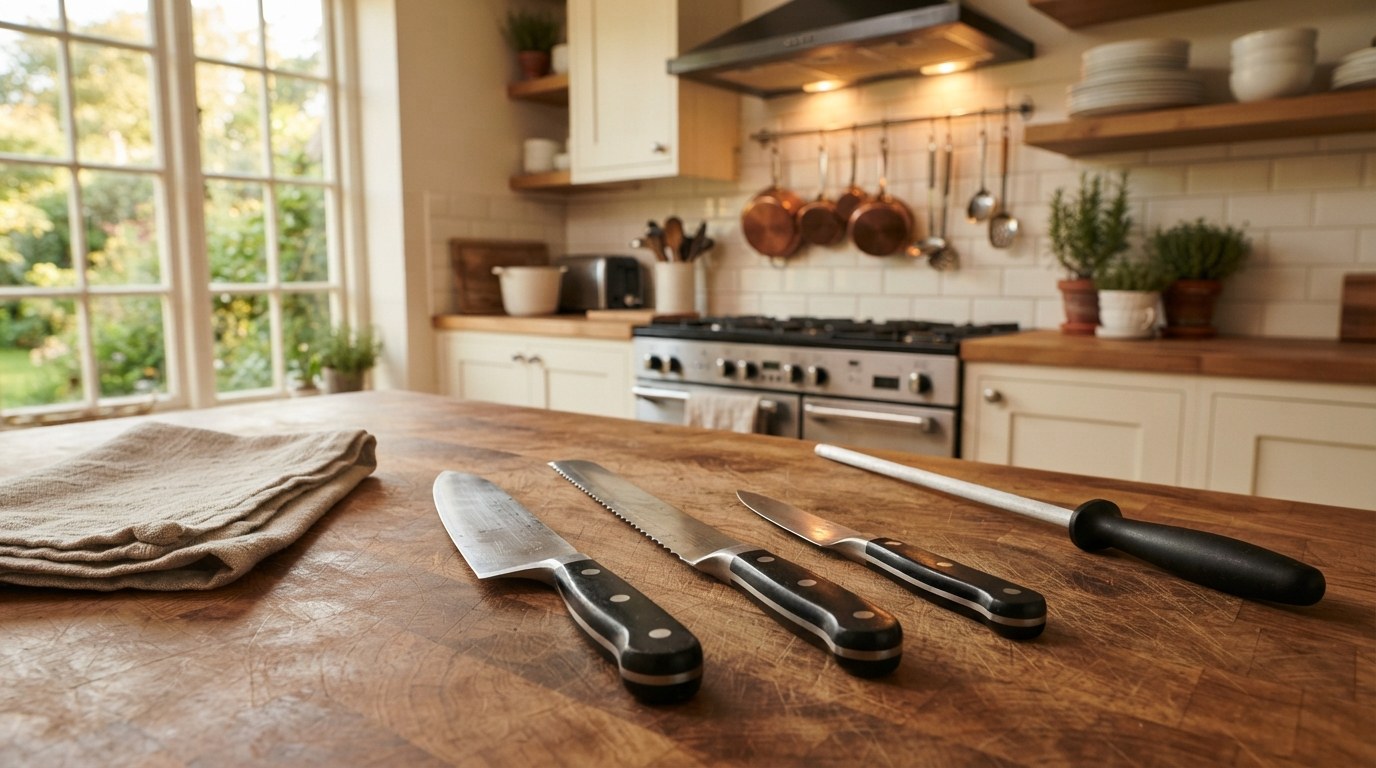
Gordon Ramsay's knives come from three brands, there is no single Gordon Ramsay knife set behind them, and which one you see depends on where you are watching him. Today he cooks with HexClad, the cookware company he officially partnered with, and its Japanese Damascus steel knives are the ones he has said he uses in his kitchens. In his online cooking lessons and much of his instructional video work the knife in his hand has been a forged German chef's knife, the Wüsthof Classic 8-inch. And on Hell's Kitchen, contestants are given a set of Zwilling J.A. Henckels knives, according to Chef Christina Wilson; our Hell's Kitchen knives guide has the details. None of the three is a "Gordon Ramsay knife" in the branded sense; the licensed Hell's Kitchen sets sold in stores and the Royal Doulton Gordon Ramsay line are separate products he does not cook with on camera.
This guide sorts those three lanes out, brand by brand, with what each knife is made of and who it suits, then covers the rules Ramsay himself teaches about buying and keeping knives, the forged-versus-stamped question, and how to hone and sharpen the one you buy. One in-stock pick per brand is carded along the way. If you want a whole set rather than one knife, the build your own Gordon Ramsay knife set section maps his four-knife kit onto each brand; if you specifically want the show's Henckels sets, see best Henckels knife sets.
Which Knives Gordon Ramsay Actually Uses
Three brands, three contexts. The table below is the short version; each brand gets its own section after it.
| Brand | Where you see it with Ramsay | What it is | Best for |
|---|---|---|---|
| HexClad Japanese Damascus | His own kitchens and social videos since the HexClad partnership; the HexClad "Chef Collection: Gordon Ramsay" | 67-layer Damascus steel, full tang, pakkawood handles | A sharp, hard, Japanese-style edge; buyers who want what he uses now |
| Wüsthof Classic | His online cooking lessons and instructional demos | Forged German high-carbon stainless, full bolster, triple-riveted handle, Solingen | A tough, forgiving workhorse chef's knife; the "one knife" buy |
| Henckels / Zwilling | Hell's Kitchen, the contestants' black-handled knives | German-engineered (Henckels) or Solingen-forged with FRIODUR ice-hardening (Zwilling) | The show look at two price tiers; block sets |
| Hell's Kitchen™ licensed sets, Royal Doulton Gordon Ramsay | Store shelves, not his hands | Licensed consumer lines that use the show or his name | Fans and gifts; not the knives he cooks with |
Wüsthof
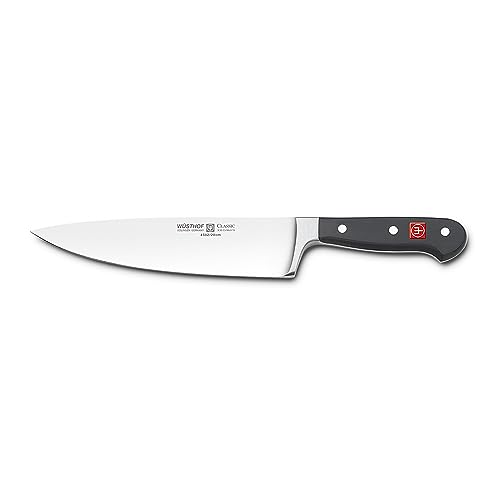
WÜSTHOF Classic 8-Inch Chef's Knife
- The all-purpose cook's knife of the Classic line: chopping, mincing, slicing and dicing
- Precision-forged from a single block of high-carbon stainless steel, full tang, triple-riveted handle
- Made in Solingen, Germany; the Classic series has been Wüsthof's best-selling line for generations
What Knife Set Does Gordon Ramsay Use?
Gordon Ramsay does not cook with a Gordon Ramsay-branded knife set, because no such set is his own. The set closest to what he uses today is HexClad's Japanese Damascus knife set, the line HexClad sells under its Gordon Ramsay chef collection. His MasterClass lessons show an older kit: in the knife-skills lesson he describes his knives as German-made ones he has worked with for many years, and in the kitchen-setup lesson he lays out four knives and a steel rather than a block of sixteen. Anything sold in a store as a "Chef Gordon Ramsay knife set" is a licensed product, either Royal Doulton's Gordon Ramsay line or Hell's Kitchen™ branded cutlery, and neither is what he cooks with on camera.
The 6-piece HexClad set lines up with that four-knife kit almost slot for slot. HexClad's own listing puts an 8-inch chef's knife, an 8-inch bread knife, a 6-inch boning knife, a 5-inch utility knife, a 3.5-inch paring knife and a 9-inch honing rod in the box: his bread, chef's, boning and paring knives plus the steel he runs the blade over before and after every use, with the utility knife as the extra. If you want one box that holds his working kit and the brand he uses now, that is the set. The build-your-own section below does the same job with German knives.
HexClad Damascus: The Knives He Uses Now
Since partnering with HexClad, Ramsay has put the brand's Japanese Damascus knives in front of the camera as the knives he uses in his kitchens; HexClad's Chef Collection: Gordon Ramsay page opens with his line that "a chef is only as good as their knives," and the company says the deal puts HexClad on Next Level Chef, in his cookbook and at his London cooking academy. The knives are HexClad's first move outside cookware: an 8-inch chef's knife, a santoku, a nakiri, a cleaver, a boning knife, a paring knife and steak knives, sold singly and in 6- and 7-piece sets with green or espresso pakkawood handles.
What you are buying is a Japanese-style blade: 67 layers of Damascus steel folded around a hard core, full-tang, thin behind the edge. Hard steel takes a keener, thinner edge and keeps it longer than the softer German steels, which is the appeal; the trade is that a harder edge is more brittle, so it chips rather than rolls if you twist it through a bone or drop it in the sink. Reviewed tested the 6-piece Japanese Damascus set and called the blades undeniably sharp and ready out of the box, with practical sizes, while marking it down for handle comfort, the lack of sheaths and the fact that it is not dishwasher safe. That matches how a hard Japanese edge should be treated: hand-washed, honed lightly, never run through a dishwasher. If you want the knives Ramsay is holding this year, this is the set.

HexClad
HexClad 6-Piece Japanese Damascus Steel Knife Set
- 67 layers of Damascus steel for a harder blade that holds its edge longer
- Full-tang construction for control; pakkawood handles with anti-shrink treatment
- The Japanese Damascus collection Gordon Ramsay says he uses in his kitchens
Wüsthof Classic: The Knife in His Cooking Lessons
For years the knife most often identified in Ramsay's instructional videos has been a Wüsthof Classic chef's knife, the black triple-riveted 8-inch that professional kitchens have run on for decades. Wüsthof has been a family company in Solingen, Germany since 1814, and still forges its knives only there; the Classic is precision-forged from a single block of high-carbon stainless steel with a full tang and a full bolster, the thick collar of steel between blade and handle that a forged knife has and a stamped one does not.
The reason chefs reach for it is the same reason a beginner should: it is forgiving. German steel is hardened to the mid-to-high 50s on the Rockwell C scale, a few points softer than a Japanese Damascus blade, so the edge rolls slightly under abuse instead of chipping, and a few strokes on a steel bring it back. The blade is thicker and heavier, with a curved belly that rocks through onions and herbs. It is the one-knife answer for a home cook who will prep everything from a chicken to a squash with it. The site's Wüsthof Classic sets guide compares the block sets built around it, and Wüsthof Classic vs Henckels Pro puts it head to head with the closest Henckels.
Henckels and Zwilling: The Hell's Kitchen Knives
Hell's Kitchen contestants are given Zwilling J.A. Henckels knives, according to Chef Christina Wilson, and the two names on the box confuse people. Zwilling J.A. Henckels has made knives in Solingen since 1731 and sells two brands: ZWILLING, the premium line forged in Solingen with FRIODUR ice-hardened blades and the SIGMAFORGE single-piece forging, and HENCKELS (the "Henckels International" of older boxes), a lower-priced line that is German-engineered but largely made outside Germany. The show's knives sit in the Henckels lane, which is why a full block set costs a fraction of a Zwilling one.
For a buyer that means a decision, not a brand loyalty. A Henckels Classic 8-inch chef's knife gives you the show's look and a forged, full-tang German-style blade at an entry price, and the hollow-edge version carded below adds a row of shallow dimples along the blade: they leave small air pockets between steel and food, which breaks the suction that makes wet potato, cheese and onion slices cling to a flat blade; a ZWILLING Pro or Gourmet gives you the Solingen forging and ice-hardened steel, which holds an edge longer, at two or three times the money. The best Henckels knife sets guide walks the block sets by line, and Wüsthof vs Zwilling settles the German-versus-German question for the premium tier.

HENCKELS
HENCKELS International Classic 8-Inch Hollow Edge Chef's Knife
- Forged full-tang blade of high-carbon, no-stain steel with a full bolster for balance
- Hollow-edge dimples along the blade so potato, cheese and onion slices release cleanly
- Triple-riveted Classic handle; the Henckels line closest to the black-handled knives seen on Hell's Kitchen
The Hell's Kitchen Knife Sets You Can Buy Are Not the Show's Knives
A search for a Hell's Kitchen knife set turns up licensed Hell's Kitchen™ branded cutlery: a Damascus steel collection the Hell's Kitchen Store describes as forged from 67 layers of Japanese Damascus steel with full-tang construction, plus stainless block sets sold through farm-and-home retailers. These are consumer lines that license the show's name, in the same way the Royal Doulton Gordon Ramsay knives license his. They are not what the contestants cook with, and Ramsay has not been shown using either on camera. If the goal is the knives from the show, buy Zwilling J.A. Henckels; if the goal is a gift with the logo on it, the licensed sets are exactly that, and the Hell's Kitchen knives guide covers the Zwilling and Henckels sets that come closest to the contestant kit.
Ramsay's Own Rules for Buying and Keeping Knives
In his knife skills lesson and the kitchen-setup lesson that precedes it, Ramsay is consistent about four things. Buy fewer, better knives: he would rather own a small collection of high-quality knives than a drawer full that "don't do the business." Spend the money on the knife and the pan before anything else in a small kitchen. Sharpen every time: he runs the blade over a steel before and after each use, holding the steel like a knife with the fingers behind it, and the longer the steel the easier the job. And judge a knife by its handle: he wants the weight in the handle, because that weight gives him direction and control on the slice, and a knife that is light in the hand is harder to gauge.
His working kit in those lessons is four knives, not a 16-slot block: a serrated bread knife for loaves and large vegetables, a chef's knife for chopping and slicing, a flexible boning or filleting knife, and a small paring knife. That is the honest shopping list behind every brand on this page. A chef's knife you will hone and a paring knife you will actually pick up beat a set of twelve you will not, which is also why most of the cards here are single knives and one compact set.
How to Build Your Own Chef Gordon Ramsay Knife Set
The way to get a chef Gordon Ramsay knife set is to build it from his own list: an 8-inch chef's knife, a serrated bread knife, a flexible boning knife, a paring knife and a long honing steel. Buy those five pieces in one lane, Japanese Damascus from HexClad or forged German steel from Wüsthof or Henckels, and you have the kit he teaches with. Everything else in a big block, the steak knives, the shears, the second utility knife, is extra you can add later.
| His kit | What he uses it for | HexClad route | Wüsthof Classic route | Henckels Classic route |
|---|---|---|---|---|
| Chef's knife | Chopping, slicing and dicing; most of the knife-skills lesson | 8-inch chef's knife (in the 6-pc set) | 8-inch Classic chef's knife (in the 9-pc block) | 8-inch Classic chef's knife, plain or hollow edge |
| Serrated bread knife | Bread, carving and large vegetables such as squash | 8-inch bread knife (in the set) | 8-inch Classic bread knife (in the 9-pc block) | Classic bread knife |
| Flexible boning knife | Boning chicken, duck and pigeon; filleting smaller fish | 6-inch boning knife (in the set) | Classic boning knife, bought singly | Classic boning knife, bought singly |
| Paring knife | Topping, tailing and trimming vegetables | 3.5-inch paring knife (in the set) | 3.5-inch Classic paring knife (in the 9-pc block) | Classic paring knife |
| Honing steel | Before and after every use; the longer, the easier | 9-inch honing rod (in the set) | 9-inch honing steel (in the 9-pc block) | Classic honing steel |
Three routes fall out of that table. The one-box route is the HexClad 6-piece, which already holds all five pieces. The German block route is the Wüsthof Classic 9-piece acacia block: it carries his chef's knife, bread knife, paring knife and steel, swaps the boning knife for a 6-inch kiritsuke prep knife and adds a utility, a serrated utility and shears, so a cook who breaks down whole chickens or fish should add a Classic boning knife to one of the empty slots. The budget route is the Henckels Classic line bought piece by piece, starting with the 8-inch chef's knife and a steel. The site's chef knife sets for beginners and best kitchen knife sets guides compare more blocks if you want to shop beyond these three makers.

Wüsthof
WÜSTHOF Classic 9-Piece Knife Block Set (Acacia)
- An 8-inch chef's knife, 8-inch bread knife, 3.5-inch paring knife, 4.5-inch utility, 5-inch serrated utility and 6-inch kiritsuke prep knife
- A 9-inch triple-rivet honing steel, come-apart kitchen shears and a 17-slot acacia block with room to add knives
- Precision-forged, full-tang high-carbon stainless steel with a bolster; 58 Rockwell hardness
One rule holds whichever route you pick: buy the chef's knife and the steel first, cook with them for a few weeks, and fill in the rest when a job calls for it. That is Ramsay's preference for a small collection of high-quality knives put into practice, and it keeps a block from filling up with knives that never leave it.
Forged vs Stamped, and Why Steel Hardness Matters
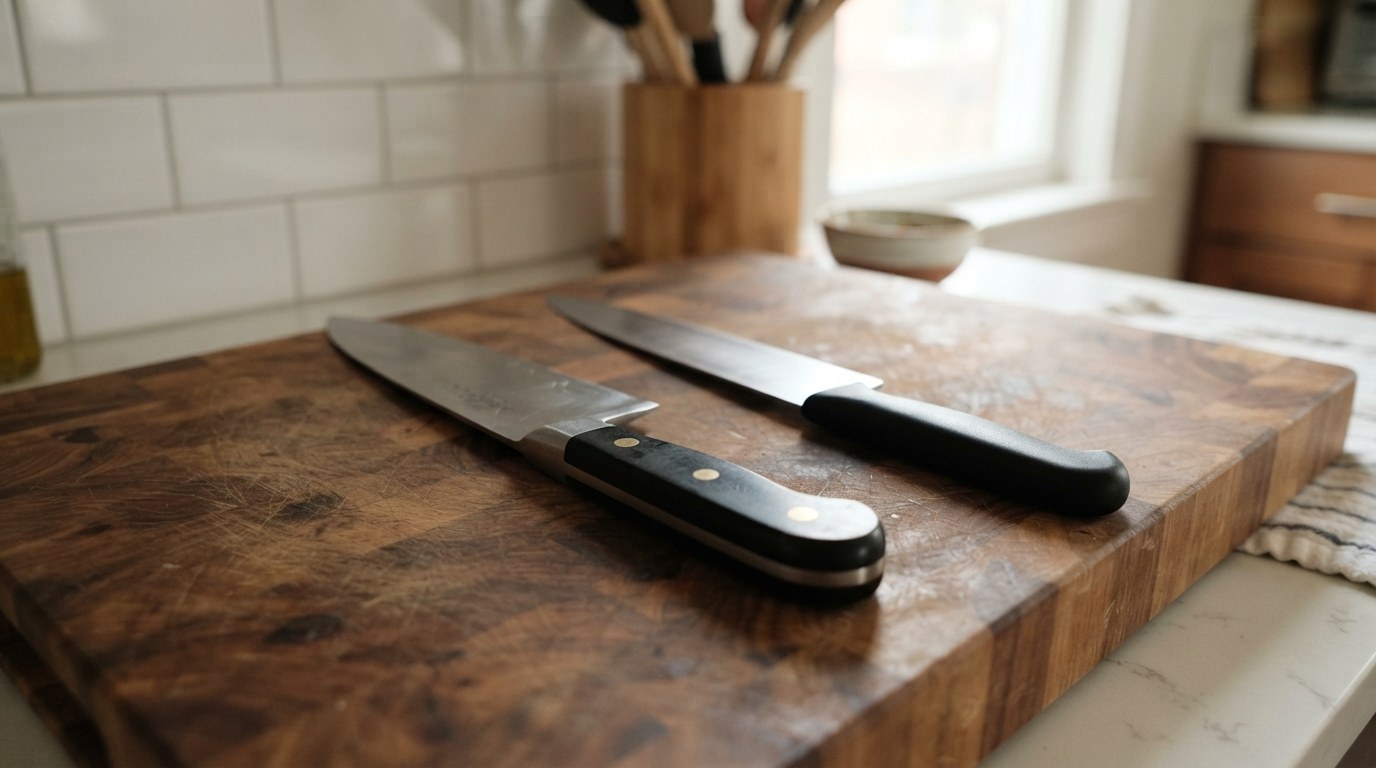
Every knife on this page except the licensed budget sets is forged: a single bar of steel heated and pressed into shape, then ground, hardened and tempered. Forging leaves the bolster, the thick steel collar at the heel that adds weight behind the edge and keeps your fingers off the blade, and it lets the maker put more steel at the heel and less at the tip. A stamped knife is cut from a flat sheet like a cookie, so it is thinner, lighter and cheaper, with no bolster and usually a molded handle. Stamped is not automatically bad, and some excellent Japanese knives are made that way, but at the prices most stamped block sets sell for the steel is soft and the edge is gone in weeks.
Hardness is the number that explains the rest. Blade steel is measured on the Rockwell C scale: German knives such as the Wüsthof Classic and Zwilling lines sit in the mid-to-high 50s, Japanese-style Damascus blades such as HexClad's a few points higher. Harder steel holds a thinner edge longer, because the edge deforms less with every cut; softer steel dulls sooner but bends rather than breaks, so it survives a twist through a chicken joint and comes back on a honing steel. Zwilling's FRIODUR process hardens the blade by deep-freezing it after heat treatment, which the company says leaves the steel harder and more corrosion-resistant without making it brittle. Pick the hardness for the cook: a Japanese edge for someone who slices carefully and hand-washes, a German edge for a kitchen where the knife gets used hard.
Honing, Sharpening and the Care That Keeps Them Sharp
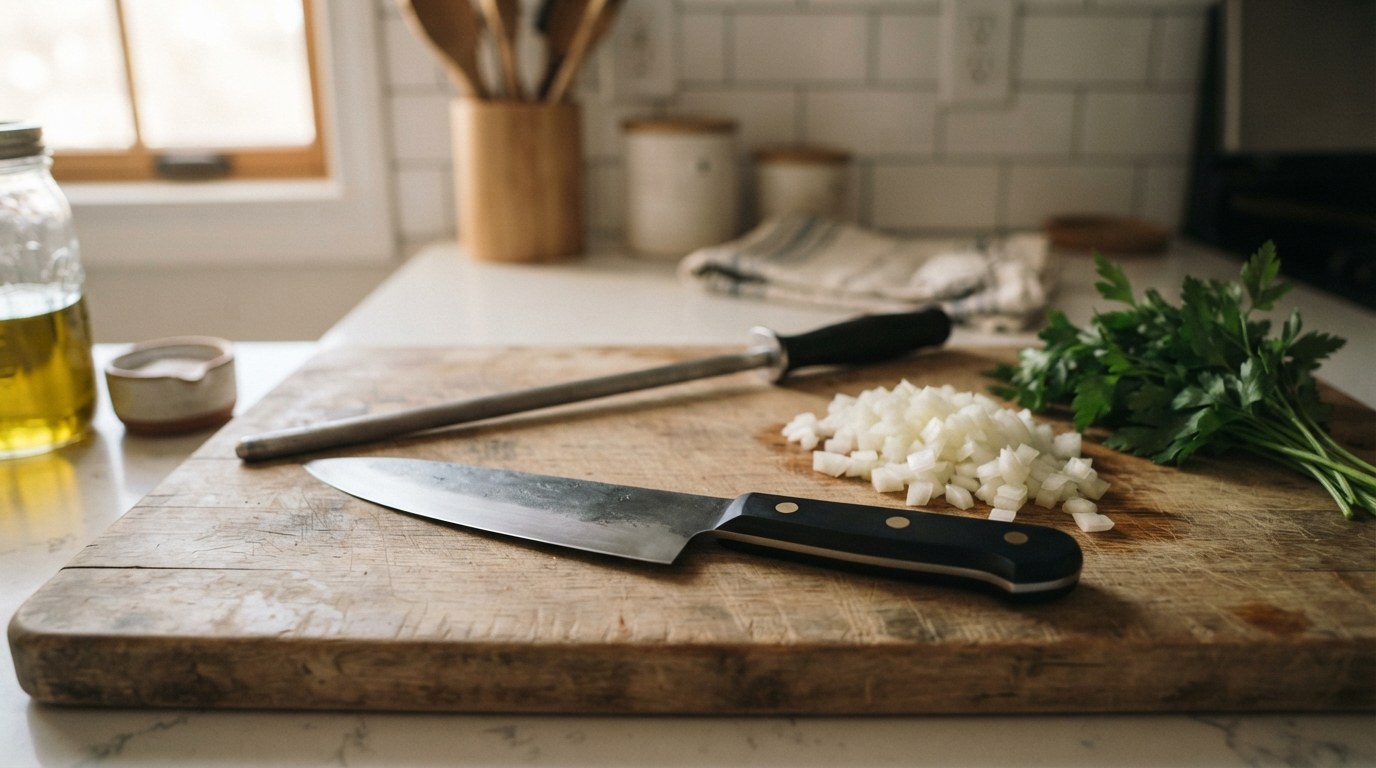
Honing and sharpening are different jobs. A knife edge is a fine ridge of steel that folds over microscopically as you cut; a honing steel stands that ridge back up without removing metal, which is why Ramsay steels before and after every use and the knife feels new again in ten strokes. Sharpening grinds a fresh bevel, removing steel, and a home cook needs it a few times a year on a whetstone or with a guided sharpener; German edges are ground around 14 to 15 degrees per side, Japanese ones closer to 12, and a pull-through sharpener set for one will chew the other. The site's self-sharpening knife sets guide covers the block-based option.
The care rules are the same for all three brands. Hand-wash and dry at once; dishwasher detergent is abrasive and the rack knocks the edge against other steel, and wooden and pakkawood handles swell and crack in the heat. Cut on wood or plastic, never glass, stone or a plate, which dull an edge faster than a month of onions. Store the knives in a block, on a magnetic strip or with edge guards rather than loose in a drawer. And keep the hard Japanese edge away from bones, frozen food and squash; that is what the German knife is for. Handled that way, a forged knife from any of these makers is a decades-long purchase, which is the whole point of Ramsay's "spend money on a knife."
Which Gordon Ramsay Knife to Buy
If you want what Ramsay uses right now, it is the HexClad Japanese Damascus set, and the 6-piece is the sensible size. If you want the knife he taught with and the most forgiving all-rounder for a family kitchen, it is the Wüsthof Classic 8-inch chef's knife, and adding the matching paring knife covers most jobs. If you want the Hell's Kitchen look for the least money, it is the Henckels Classic 8-inch, with the Zwilling Pro as the step up if the budget allows. If you want a whole Gordon Ramsay knife set in one purchase, the HexClad 6-piece holds his four-knife kit and a steel, and the Wüsthof Classic 9-piece block covers the German version once you add a boning knife. For a Japanese alternative that is not HexClad, the best gyuto knife guide compares six, and best kitchen knives ranks brands across the whole market. Whatever you pick, buy a honing steel with it and use it the way Ramsay does, before and after. The full kitchen gear section has the rest of the equipment guides.
Gordon Ramsay Knives FAQs
The questions that come up most: what knives Gordon Ramsay uses, what knife set he uses, whether he uses HexClad, Wüsthof or Henckels, what knife set Hell's Kitchen contestants get, whether he has his own knife brand, whether the HexClad knives are any good, and how he sharpens.
What knives does Gordon Ramsay use?
Three brands in three settings: HexClad Japanese Damascus knives in his own kitchens and videos since he partnered with the company; a Wüsthof Classic 8-inch chef's knife in his online cooking lessons and instructional demos; and Henckels knives on Hell's Kitchen, where the contestants cook with the brand's black-handled knives. None is a Gordon Ramsay-branded knife.
What knife set does Gordon Ramsay use?
No Gordon Ramsay-branded set. The set closest to what he uses now is HexClad's 6-piece Japanese Damascus set: an 8-inch chef's knife, 8-inch bread knife, 6-inch boning knife, 5-inch utility knife, 3.5-inch paring knife and 9-inch honing rod. In his MasterClass lessons his kit is four German-made knives (chef's, serrated bread, flexible boning and paring) plus a long steel, and you can build the same kit from the Wüsthof Classic or Henckels Classic lines.
Does Gordon Ramsay use HexClad knives?
Yes. Since partnering with HexClad he has said the brand's Japanese Damascus knives are the ones he uses in his kitchens, and HexClad sells them under a "Chef Collection: Gordon Ramsay" heading. They are 67-layer Damascus steel, full tang, with pakkawood handles, sold singly and in 6- and 7-piece sets.
Wüsthof or Henckels, which does Gordon Ramsay prefer?
He has used both. The Wüsthof Classic is the knife identified in his instructional videos; Henckels are the knives on Hell's Kitchen. For a buyer the practical difference is price and hardness: the Wüsthof Classic and Zwilling lines are Solingen-forged premium knives, while the Henckels brand is Zwilling's lower-priced, German-engineered line.
What knife set do Hell's Kitchen contestants get?
A set of Zwilling J.A. Henckels knives, according to Chef Christina Wilson, who still uses hers from 2011; the show has not published the exact line. The licensed Hell's Kitchen™ knife sets sold in stores are a separate consumer product that uses the show's name; they are not the contestants' knives. The Hell's Kitchen knife set guide on this site lists the Henckels sets closest to the kit.
Does Gordon Ramsay have his own knife brand?
No knife line of his own. Two licensed products carry his name or his show's: Royal Doulton sells a Gordon Ramsay knife collection, and Hell's Kitchen™ branded knives are sold through the Hell's Kitchen Store and retailers. HexClad's Damascus knives are the ones he actually endorses and uses, sold as HexClad's Gordon Ramsay chef collection.
Are the Gordon Ramsay HexClad knives good?
Reviewed tested the 6-piece Japanese Damascus set and found the blades sharp out of the box with practical sizes and durable construction, and marked it down for handle comfort, no sheaths and no dishwasher safety. That is the profile of a hard Japanese-style edge: keen and long-lasting if you hand-wash and hone it, chip-prone if you treat it like a German workhorse.
How does Gordon Ramsay sharpen his knives?
With a honing steel, before and after every use. He holds the steel like a knife with his fingers behind it and runs the blade down it in quick strokes; a longer steel makes the angle easier to hold. Honing realigns the edge without removing metal. True sharpening, on a stone or a guided sharpener, is only needed a few times a year.

About the Author
John Siracusa is the founder of Hell’s Kitchen Recipes. He focuses on technique-first, reproducible home cooking and researches recipes & kitchen equipment from published food science and professional chef methods since 2016.