Chocolate covered strawberry turkeys are the Thanksgiving kids'-table treat that adults quietly take too: a large strawberry dipped in dark chocolate, laid on its side, with five candy corn pressed into the wide end as a fan of tail feathers, two candy eyes and a candy beak at the tip, and two pretzel sticks for legs. They take about 30 minutes for a dozen, no oven, and children can do the feathers. What separates a tray of glossy, snappy turkeys from a tray of dull, streaky, weeping ones is not decorating skill; it is dry strawberries and chocolate that has been melted the right way, and both are explained below.
The recipe card at the bottom has the amounts and numbered steps for 12 turkeys. This guide covers the strawberries and why dry matters more than anything, melting the chocolate so it sets hard and shiny, the dip, building the turkey while the chocolate is tacky, what candy corn actually is, and why these are made the day they are served. It sits in the site's baking and desserts section with the hot cocoa cookies, the other kid-magnet on the holiday tray.
The Strawberries: Cold, Dry, and Caps On
Buy the largest, firmest, brightest strawberries you can find, with fresh green caps, because the cap is the turkey's tail-feather anchor and the berry's shape is the turkey's body. The California Strawberry Commission's advice is the whole handling method: choose berries with bright red color, a natural shine and fresh-looking green caps; keep them refrigerated and dry until just before use; rinse them with the green stems still on, under cool water, only when you are ready; and blot them dry. Every one of those instructions protects the same thing, which is the dry surface the chocolate needs.
Dry is not optional, for two reasons. Chocolate seizes on contact with water, so a wet berry turns the chocolate around it into a grainy paste and the coating streaks and slides. And a cold berry sweats: take strawberries straight from the refrigerator into a warm kitchen and condensation forms on the skin within minutes, so even a berry you dried carefully is wet again by the time it is dipped. Rinse, blot with paper towels, then leave the berries on a towel for 20 to 30 minutes to come to room temperature and dry completely; the film of condensation evaporates only once the berry is as warm as the room, and the chocolate cannot set on a surface that is still shedding water. Line up the rest of the parts while they sit: candy corn, candy eyes, something orange for beaks, and pretzel sticks snapped into inch-long legs.
| Ingredient | What it does | Do not substitute with |
|---|---|---|
| Large strawberries, caps on, bone dry | The turkey body; the cap anchors the feathers | Wet or cold-sweating berries (the chocolate seizes and slides) |
| Semisweet or dark chocolate bar, chopped | A coating that sets hard and glossy when handled right | Chocolate chips (made to hold their shape; melt thick) |
| Candy corn, 5 per turkey | Tail feathers; the classic look | Nothing; this is the whole joke |
| Candy eyes and an orange candy beak | The face | Drawn-on icing (runs on chocolate) |
| Pretzel sticks, snapped to 1 inch | Legs; salty against the sweet | Toothpicks (not edible; a hazard for children) |
| A teaspoon of coconut oil, optional | Thins the chocolate for a smoother dip if you skip tempering | Water or milk (seizes the chocolate) |
Melting the Chocolate So It Sets Hard and Shiny
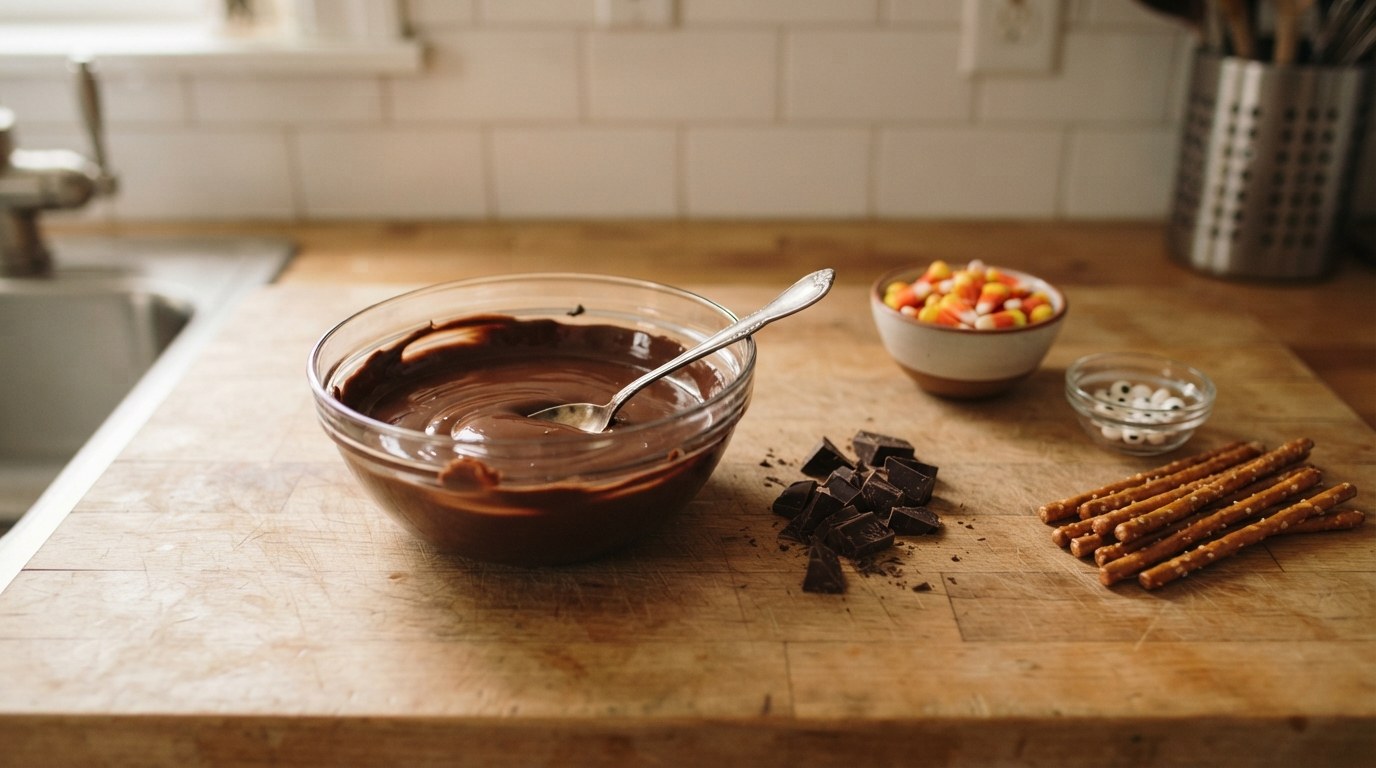
Chocolate sets on cocoa butter crystals, and cocoa butter can crystallize several ways; only one of them gives the hard, glossy, snappy coating you want, and getting there is called tempering. Guittard describes tempered chocolate as a solid mass of stable, fine-grained crystals, and gives the numbers: melt dark chocolate to 120°F, then bring it down and work it at 88 to 90°F, seeding it along the way with pieces of already-tempered chocolate stirred in so their stable crystals spread through the melt. Callebaut puts the payoff plainly: tempering ensures the chocolate becomes hard and shiny as it cools and pulls away from a mold on its own. Untempered chocolate crystallizes slowly and at random, so it sets soft, dull and streaky, and within a day it blooms, the grayish film of cocoa butter that has migrated to the surface.
Advertisement
The home version is simple. Chop a good bar of semisweet or dark chocolate; skip chips, which carry stabilizers that keep them from flowing. Melt two-thirds of it in a dry bowl in the microwave in 20-second bursts, stirring between, until it is smooth and reads about 115°F, then add the remaining third and stir until it melts and the whole bowl reads 88 to 90°F on an instant-read thermometer. That is tempered enough to dip. Keep water and steam away from it entirely; Guittard's warning is that exposure to water or steam makes chocolate seize and thicken, which is why a dry bowl, a dry spoon and dry berries are the rule. If you skip the thermometer, a teaspoon of coconut oil stirred into the melt thins it for a smoother coat, at the cost of a softer set.
The Dip and the Build: Work While It Is Tacky
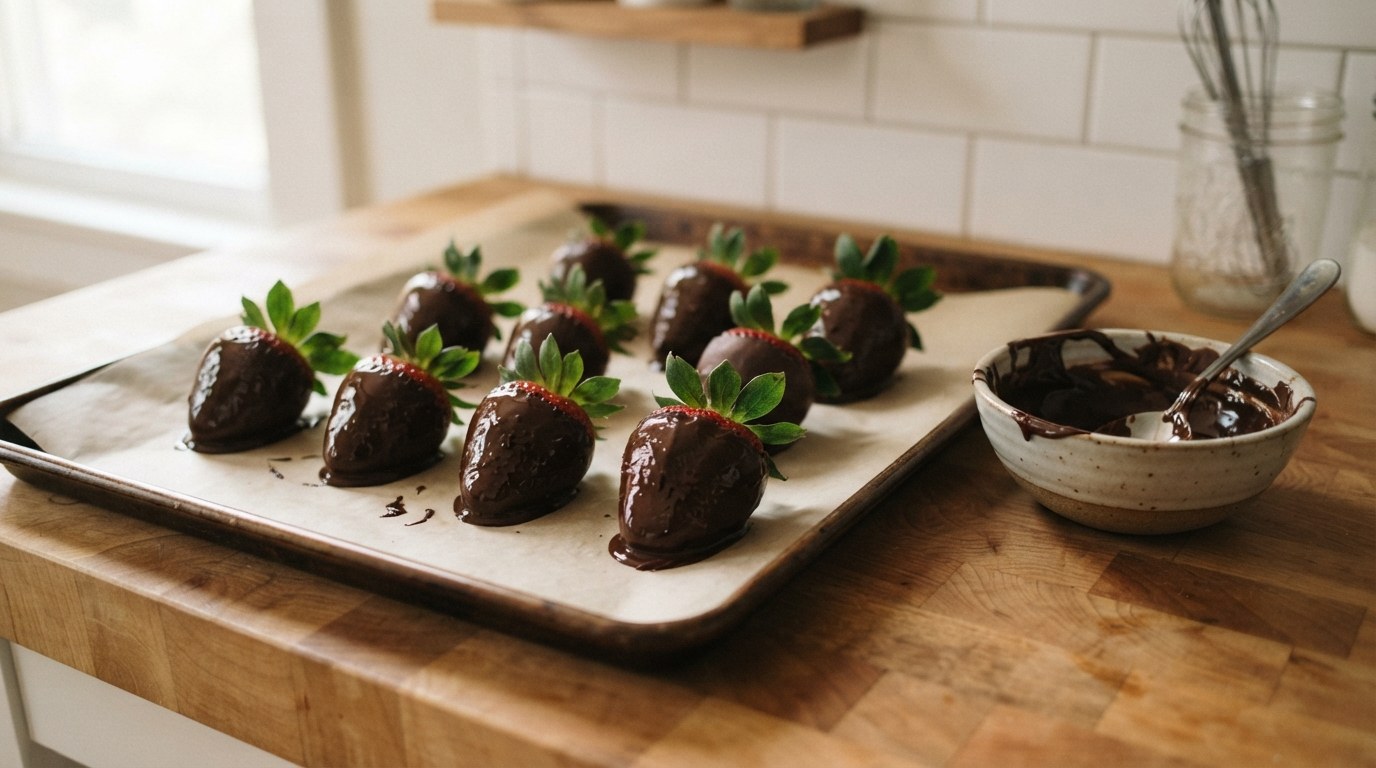
Hold each berry by its cap, dip it into the chocolate to the shoulder, let the excess run off for a few seconds, and scrape the bottom against the rim of the bowl so it does not pool. Set it on its side on a parchment-lined sheet pan, cap pointing away from you; the cap end is the tail and the pointed tip is the head. Then work fast, because tempered chocolate sets within a couple of minutes on a room-temperature berry: press five candy corn, points in, into the chocolate around the cap in a fan, put two candy eyes near the tip with a tiny dab of chocolate as glue if the surface has set, and fix a beak below them, a candy corn tip snipped off or an orange sprinkle. The pretzel legs go in last, pushed into the underside once the chocolate is firm enough to hold them but still soft enough to take them, about 5 minutes in.
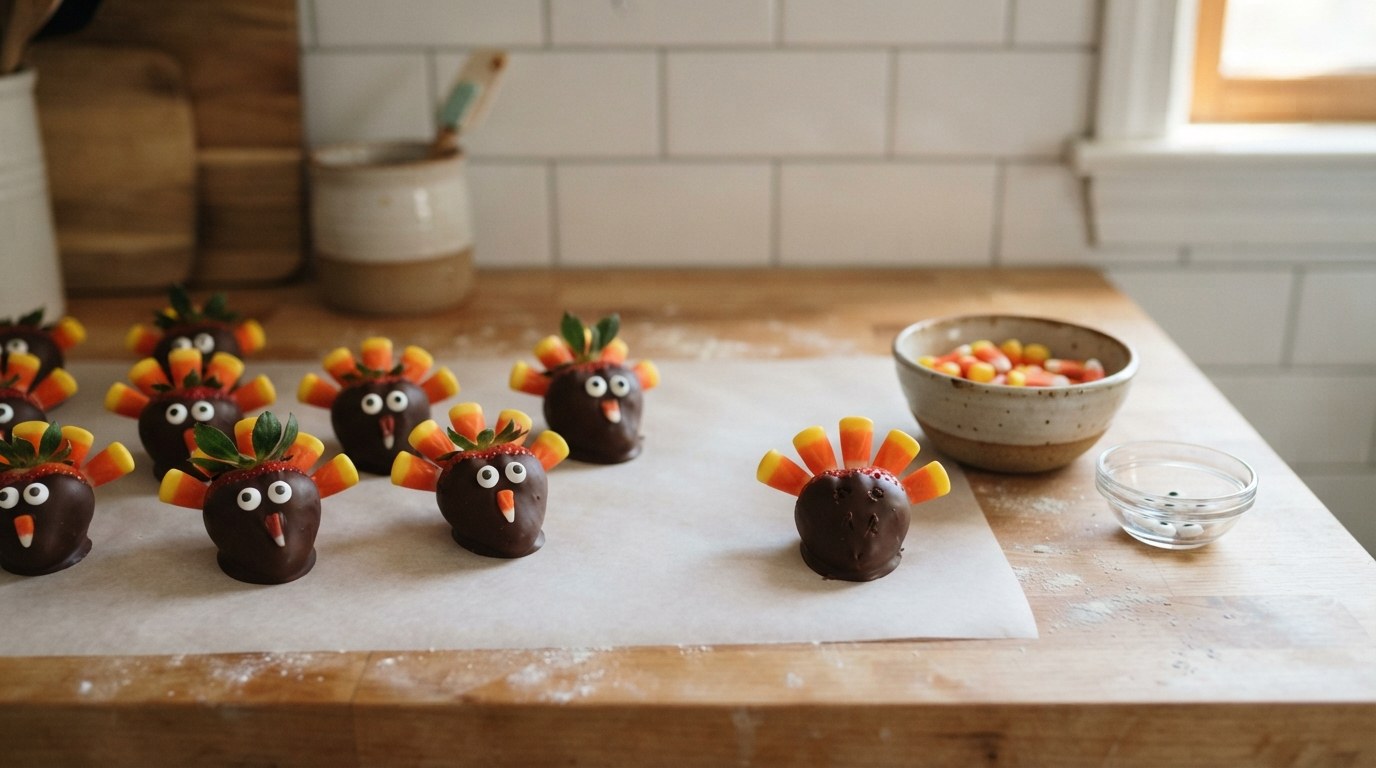
Dip and decorate two or three berries at a time rather than dipping the whole dozen and coming back, and keep the chocolate bowl warm over a bowl of warm, not hot, water if it starts to thicken, without letting a drop of water in. Refrigerate the finished turkeys 15 minutes to set the chocolate fully, then bring them out; they look best at room temperature, where the chocolate is glossy and the berry is sweet, and they will sweat if they go from refrigerator to warm table repeatedly.
| Stage | Number | What you see |
|---|---|---|
| Dry the berries | Blot, then 20 to 30 minutes on a towel | Room temperature, no condensation |
| Melt two-thirds of the chocolate | 20-second bursts, to about 115°F | Smooth and fluid |
| Seed with the rest | Stir to 88 to 90°F | Glossy; a test dab sets in 2 minutes |
| Dip and decorate | 2 to 3 berries at a time | Feathers and eyes pressed in while tacky |
| Legs | About 5 minutes after dipping | Chocolate firm enough to hold a pretzel |
| Set | 15 minutes refrigerated, then serve | Hard, shiny, no streaks |
What Candy Corn Is, and Why These Are a Same-Day Project
Candy corn is older than it looks. The University of Georgia's agricultural college traces it to George Renninger of the Wunderle Candy Company in Philadelphia in the 1880s, with the Goelitz Candy Company, now Jelly Belly, the first to sell it in 1898 under the name Chicken Feed, since corn was livestock feed before the First World War. It is sugar, corn syrup and, in the better versions, real honey, poured in three colored layers into cornstarch molds and finished in a tumbling drum with a confectioner's glaze that gives it the shine. That glaze is why candy corn holds up pressed into wet chocolate where a softer candy would dissolve; it is also why the pieces should go on dry, straight from the bag.
Advertisement
Make the turkeys the day you serve them, ideally within a few hours. A strawberry is alive and mostly water; under a chocolate shell it keeps releasing moisture that cannot evaporate, and by the next morning the berry has gone soft, sugar syrup has seeped out at the cap, and the chocolate is dull and sweating. Refrigerated overnight they survive but are noticeably worse. For a make-ahead schedule, prep the parts a day ahead, snapping pretzels and portioning the candy, and dip the berries the morning of the meal. The cookie brittle and hot cocoa cookies on the same tray are the make-ahead items; the turkeys are the fresh one. And they sit next to the real thing: Gordon Ramsay's turkey is the site's Thanksgiving centerpiece.

Chocolate Covered Strawberry Turkeys
Ingredients
- 12 large strawberries, caps on
- 6 oz semisweet or dark chocolate bar, finely chopped
- 1 tsp coconut oil (optional, if not tempering)
- 60 candy corn (5 per turkey), plus 12 more for beaks
- 24 candy eyes
- 12 pretzel sticks, snapped into 1-inch pieces (24 legs)
Instructions
- Rinse the strawberries with the caps on and blot dry with paper towels. Set them on a dry towel for 20 to 30 minutes to come to room temperature and dry completely. Snap the pretzels into 1-inch legs and snip the orange tips off 12 candy corn for beaks.
- Put two-thirds of the chopped chocolate in a dry microwave-safe bowl and melt in 20-second bursts, stirring between, until smooth and about 115°F. Add the remaining chocolate and stir until melted and the mixture reads 88 to 90°F on an instant-read thermometer. (If not tempering, melt all the chocolate gently with the coconut oil.)
- Holding a berry by its cap, dip it to the shoulder, let the excess drip off, scrape the bottom on the rim, and lay it on its side on a parchment-lined sheet pan with the cap pointing away. Work 2 or 3 berries at a time.
- While the chocolate is tacky, press 5 candy corn, points in, into the chocolate around the cap in a fan. Press on 2 candy eyes near the tip and a candy corn beak below them, using a dab of melted chocolate as glue if needed.
- After about 5 minutes, when the chocolate has firmed slightly, push 2 pretzel legs into the underside of each turkey. Refrigerate 15 minutes to set, then serve at room temperature the same day.
Notes
Advertisement
Chocolate Covered Strawberry Turkeys FAQs
The questions that come up most: how far ahead they can be made, why the chocolate turned grainy or slid off, what to use for the beak and eyes, whether chocolate chips work, how to keep the candy corn on, whether they need refrigerating, how to make them without candy corn, and what chocolate is best.
How far ahead can I make chocolate covered strawberry turkeys?
Same day, ideally within a few hours of serving. A strawberry keeps releasing moisture under its chocolate shell, so by the next day the berry is soft, syrup seeps at the cap and the chocolate sweats. Prep the candy and pretzels a day ahead and dip the berries the morning of the meal.
Why did my chocolate seize or slide off the strawberries?
Water. Chocolate seizes into a grainy paste on contact with water or steam, and a wet or cold-sweating strawberry is exactly that. Rinse the berries with caps on, blot them dry, and let them sit 20 to 30 minutes to reach room temperature so no condensation forms, and keep the melting bowl and spoon bone dry.
What do you use for the turkey's beak and eyes?
Candy eyes from the baking aisle, pressed into the chocolate while it is tacky or glued with a dab of melted chocolate. For the beak, snip the orange tip off a candy corn, or use an orange sprinkle or a sliver of orange candy. Icing drawn on runs off chocolate.
Can I use chocolate chips?
Bar chocolate is better. Chips carry stabilizers that help them hold their shape in cookies, so they melt thick and coat unevenly. Chop a semisweet or dark chocolate bar; if chips are all you have, stir in a teaspoon of coconut oil to thin the melt.
How do I get the candy corn to stay on?
Press the five pieces in, points first, while the chocolate is still wet, within a minute or two of dipping, and work two or three berries at a time so the chocolate does not set before the feathers go on. If a surface has set, a dab of melted chocolate on the candy corn glues it.
Do strawberry turkeys need to be refrigerated?
Fifteen minutes in the refrigerator sets the chocolate, then serve them at room temperature, where the chocolate is glossy and the berry is sweet. Moving them in and out of the cold repeatedly makes them sweat. Leftovers can be refrigerated overnight but will be softer and duller by morning.
Can I make them without candy corn?
Yes. Use five thin pretzel sticks or slivered almonds pressed into the chocolate as feathers, or mini candy-coated chocolates in fall colors. The candy corn is the traditional tail, but any small, dry, firm candy that can be pressed in works.
What chocolate is best for dipping strawberries?
A semisweet or dark chocolate bar, chopped, melted gently and seeded to 88 to 90°F so it sets hard and shiny. Milk chocolate works at a lower working temperature, about 86 to 88°F, and gives a sweeter, softer coat. Candy melts set hard without tempering but taste of little.

About the Author
John Siracusa is the founder of Hell’s Kitchen Recipes. He focuses on technique-first, reproducible home cooking and researches recipes & kitchen equipment from published food science and professional chef methods since 2016.