Hot cocoa cookies are a mug of cocoa turned into a cookie: a thick, chewy chocolate cookie with the milky, rounded flavor of a cocoa mix rather than the bitterness of a brownie, a marshmallow half melted onto the top in the last minutes of the bake until it puffs and toasts, and a zigzag of dark chocolate over the marshmallow. A pinch of crushed peppermint makes the December version. They are the cookie of the season on every platter and cookie swap from November on, and the reasons most versions fail, a flat cookie, a marshmallow that vanished into a puddle, a drizzle that went grainy, each come down to one ingredient decision explained below.
The recipe card at the bottom has the amounts and numbered steps for 20 cookies. This guide covers what gives a hot cocoa cookie its flavor and why it is not just a chocolate cookie, why the cocoa and the leavener have to match, the chew, the marshmallow timing and what a marshmallow does in the oven, the ganache drizzle, the peppermint variation, and storage. It sits in the site's baking and desserts section with Gordon Ramsay's chocolate chip cookies, which is the same chewy-cookie method without the cocoa.
What Makes It Taste Like Hot Cocoa, Not a Chocolate Cookie
The difference between hot cocoa and chocolate is milk and sugar. A packet of cocoa mix is mostly sugar and dried milk with a modest amount of cocoa, which is why a cup of it tastes soft and creamy where a square of dark chocolate tastes sharp. This cookie borrows that formula without the packet: a quarter cup of nonfat dry milk powder goes into the dough alongside a half cup of cocoa. The milk powder does two jobs. Its milk sugars and proteins round the cocoa's edge into that cocoa-mix flavor, and the same proteins and sugars brown in the oven through the Maillard reaction, which deepens the base of the cookie the way the milk solids in brown butter deepen a blondie. Many recipes stir packets of cocoa mix straight into the dough; the milk powder plus real cocoa gives the same flavor with control over the sweetness.
The cocoa itself has to be natural, not Dutch-process, and the reason is the leavener. King Arthur Baking explains that natural cocoa is acidic and Dutch-process cocoa has been treated with an alkali to neutralize that acid, which darkens it and smooths its flavor; because natural cocoa is acidic, it pairs with baking soda, a base, and the acid-base reaction makes the bubbles that let cookie dough spread into round cookies, while Dutch-process needs baking powder because it brings no acid of its own. King Arthur also notes what happens if you swap without adjusting: natural-cocoa recipes made with Dutch-process bake up thick and cake-like. This dough uses natural cocoa and baking soda, so it spreads to a proper thick disc with crackled edges. If Dutch-process is what you have, use a teaspoon of baking powder in place of the half teaspoon of soda.
| Ingredient | What it does | Do not substitute with |
|---|---|---|
| Natural cocoa, ½ cup | Chocolate flavor; its acid drives the baking soda | Dutch-process with the same soda (thick, cakey, flat flavor) |
| Nonfat dry milk powder, ¼ cup | The milky cocoa-mix flavor; browns in the oven | Skipping it (tastes like a plain chocolate cookie) |
| Brown sugar, mostly, plus some white | Moisture and chew; the white sugar for spread and crackle | All white sugar (crisp, not chewy) |
| Softened butter, one egg plus a yolk | Richness and a fudgy, bendable center | Melted butter (spreads too thin under the marshmallow) |
| Large marshmallows, halved | Puff and toast on top in the last minutes | Mini marshmallows (melt away to nothing) |
| Semisweet chocolate and cream for the drizzle | A glossy ganache that sets soft | Chocolate chips melted alone (thick, and they seize easily) |
The Chew: Brown Sugar, a Yolk, and a Short Chill
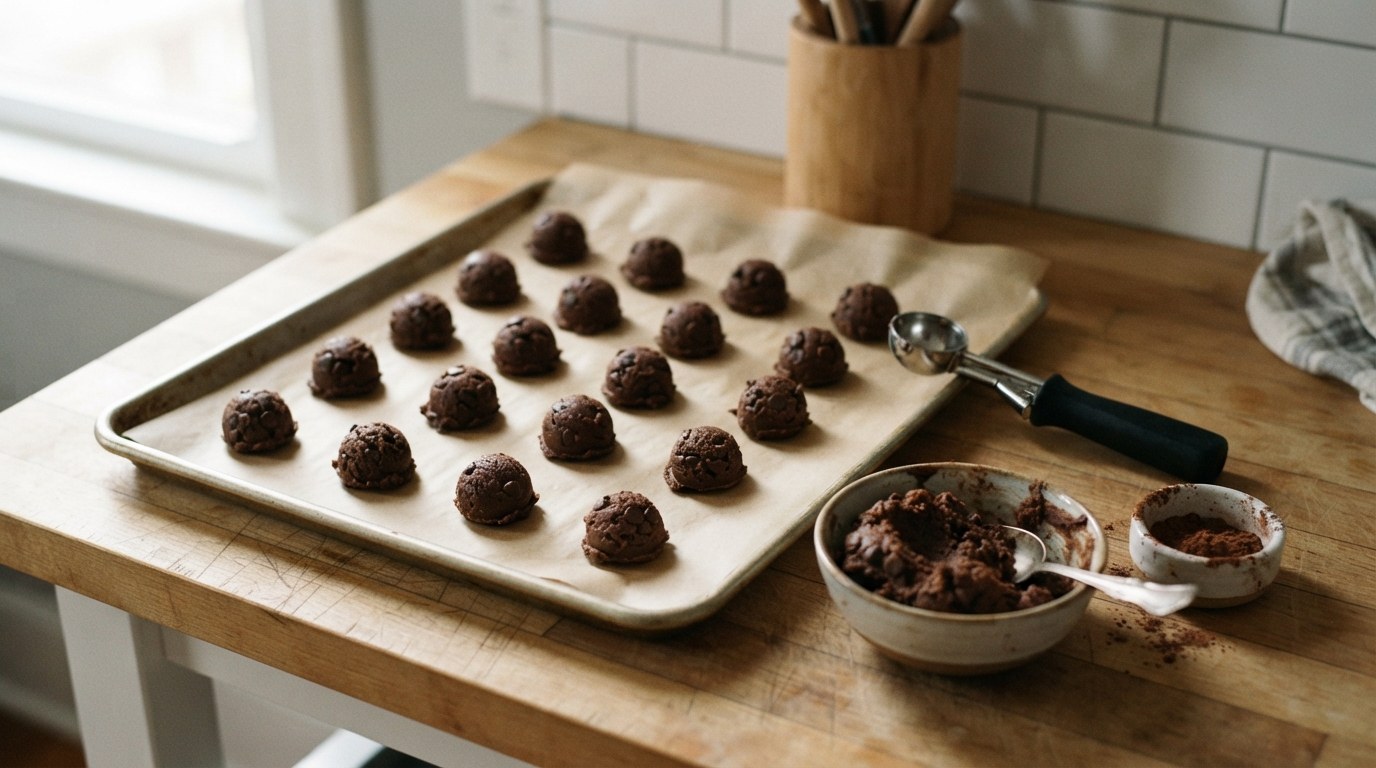
Chewy is a formula, and it is the opposite of the crisp one used for the site's cookie brittle. King Arthur's cookie chemistry test found that more brown sugar and butter, and a shorter bake, give a soft, chewy cookie, because brown sugar carries molasses and butter carries milk solids and water, and both are softeners. So this dough is three parts brown sugar to one part white, creamed with softened butter until light, with a whole egg for structure and an extra yolk for fat and a fudgy center. Beat the egg in well, then stir in the cocoa, milk powder, flour, soda and salt just until combined, and fold in a half cup of mini chocolate chips.
Advertisement
Chill the dough 30 minutes before scooping. Cold butter melts later in the oven, so the cookie sets its edges before it has spread thin, and a thicker cookie is a chewier one; it also gives the marshmallow a base to sit on instead of sliding off. Scoop two-tablespoon balls onto parchment-lined pans, three inches apart, and bake at 350°F for 9 minutes, until the edges are set and the tops are crackled but the centers still look slightly underdone. That is the moment the marshmallow goes on.
The Marshmallow: On for the Last 3 Minutes, Not the Whole Bake
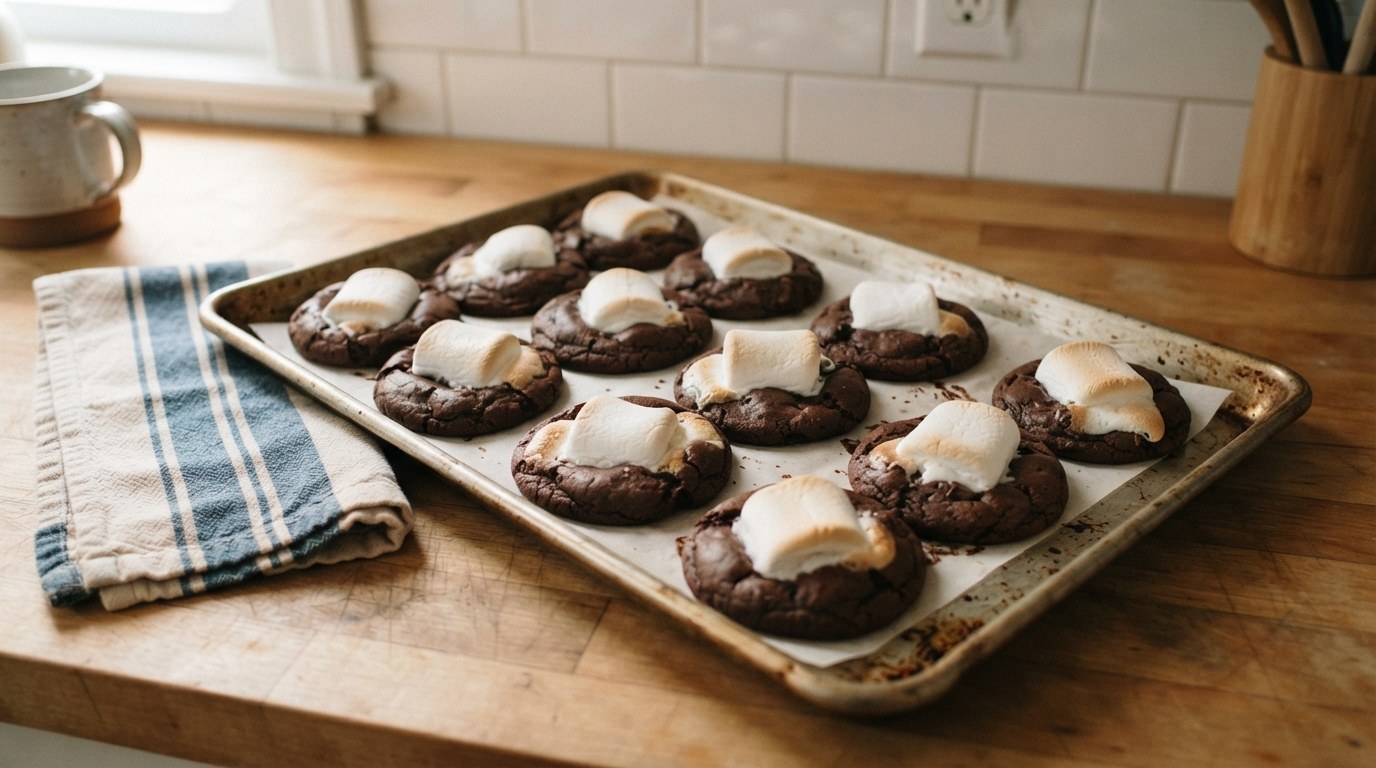
A marshmallow is a foam. Science News Explores describes it as air bubbles whipped into a hot sugar syrup and held in place by gelatin, which sets into a network as it cools and traps the bubbles. Heat undoes that. Gelatin melts at about body temperature, so in a 350°F oven the network softens within a minute while the trapped air expands, and the marshmallow swells to nearly twice its size; leave it longer and the softened gelatin cannot hold the expanded foam, the bubbles merge and escape, and the marshmallow collapses into a sticky, translucent puddle that spreads across the cookie. That is the failure in every recipe that bakes the marshmallow from the start.
So the marshmallow gets 2 to 3 minutes. Pull the pan at 9 minutes, press a marshmallow half, cut side down, onto the center of each cookie, and return the pan to the oven for 2 to 3 minutes, until the marshmallows have puffed and softened and their tops are just beginning to color. The color is the same browning that a campfire gives a s'more, the marshmallow's sugars caramelizing and its proteins browning at the surface, and it comes fast; for a deeper toast, 30 seconds under the broiler after baking, watched the whole time, does it. Cool the cookies on the pan 5 minutes so the marshmallow sets back into a soft dome, then move them to a rack.
| Stage | Number | What you see |
|---|---|---|
| Cream butter and sugars | 2 to 3 minutes | Lightened and fluffy |
| Chill the dough | 30 minutes | Firm enough to scoop cleanly |
| First bake | 350°F, 9 minutes | Edges set, tops crackled, centers slightly underdone |
| Marshmallow on, second bake | 2 to 3 minutes | Puffed and soft, tops just coloring |
| Cool | 5 minutes on the pan, then a rack | Marshmallow settles into a dome |
| Drizzle | Ganache at about 90°F | Thin lines that set in 20 minutes |
The Ganache Drizzle, and the Peppermint Version
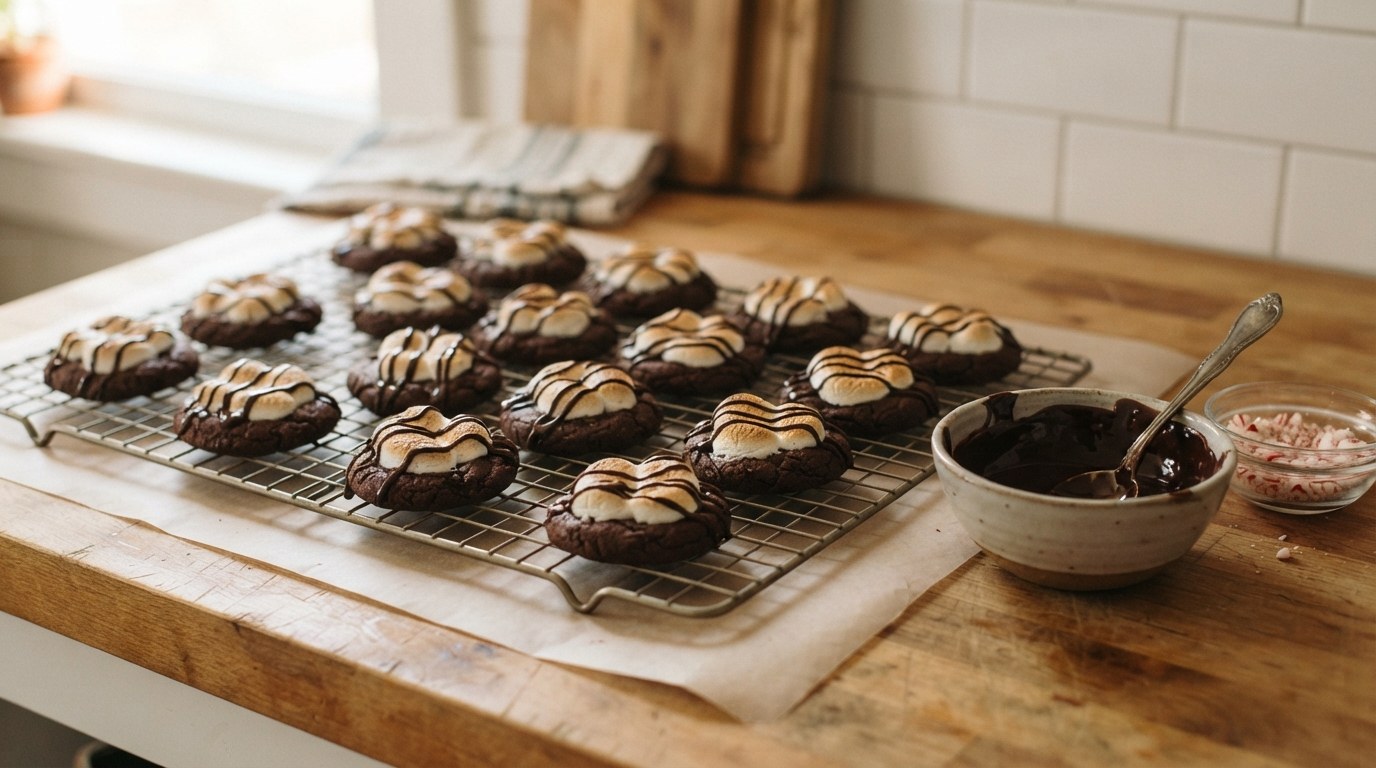
The drizzle is a small ganache, 3 ounces of chopped semisweet chocolate melted with 3 tablespoons of hot cream and stirred until glossy, which sets soft rather than hard and does not crack off the marshmallow. Semisweet means at least 35 percent chocolate liquor under the federal standard, enough cocoa to read as dark against a sweet marshmallow. Two rules keep it smooth. Heat gently: Guittard puts the melting ceiling for dark chocolate around 120°F, and past it the chocolate scorches and turns grainy, so pour the hot cream over the chopped chocolate off the heat and let it sit a minute before stirring. And keep water out: Guittard warns that exposure to water or steam makes chocolate seize and thicken, which is why a dry bowl and cream, a fat-and-water emulsion that the chocolate can absorb, work where a splash of water would ruin it. Let the ganache cool to about 90°F, thick enough to hold a line, and drizzle it from a spoon or a snipped bag in zigzags over each marshmallow.
Advertisement
For peppermint hot cocoa cookies, add a half teaspoon of peppermint extract to the dough with the vanilla and press crushed peppermint candy or candy canes into the ganache while it is wet. Add the candy on the day you serve: hard candy is hygroscopic and pulls moisture from the air and the marshmallow, so overnight it softens and weeps pink into the drizzle. The same rule keeps the crushed candy on the site's red velvet cheesecake brownies off until serving. For a Mexican hot cocoa version, a teaspoon of cinnamon and a pinch of cayenne in the dough; for a plain version, skip the drizzle and dust the toasted marshmallows with cocoa.
Storage and Make-Ahead
The cookies keep 3 days in an airtight container at room temperature, in a single layer or separated by parchment so the marshmallows do not glue to each other; they stay chewy because the brown sugar holds moisture, and they go stale faster in the refrigerator, where the starch firms. The dough freezes for 3 months, scooped into balls, and bakes from frozen with 2 extra minutes on the first bake. The ganache can be made a day ahead and rewarmed gently. Do not stack them for gifting until the drizzle has set fully, about 20 minutes, and keep any peppermint version dry. The pistachio brownies fill out the same holiday tray with a fudgier chocolate.

Hot Cocoa Cookies (Marshmallow Top, Chocolate Drizzle)
Ingredients
- For the cookies
- ½ cup unsalted butter, softened
- ¾ cup packed light brown sugar
- ¼ cup granulated sugar
- 1 large egg, plus 1 egg yolk
- 1 tsp vanilla extract
- 1¼ cups all-purpose flour
- ½ cup natural (non-alkalized) cocoa powder
- ¼ cup nonfat dry milk powder
- ½ tsp baking soda
- ½ tsp fine sea salt
- ½ cup mini semisweet chocolate chips
- 10 large marshmallows, halved crosswise
- For the drizzle
- 3 oz semisweet chocolate, finely chopped
- 3 Tbsp heavy cream
- Peppermint version (optional)
- ½ tsp peppermint extract, added with the vanilla
- ¼ cup crushed peppermint candy or candy canes, for the top
Instructions
- Beat the butter and both sugars until light and fluffy, 2 to 3 minutes. Beat in the egg, yolk and vanilla (and peppermint extract, if using). Whisk the flour, cocoa, milk powder, baking soda and salt together and stir into the butter mixture just until combined. Fold in the chocolate chips. Cover and chill 30 minutes.
- Heat the oven to 350°F (175°C). Line two sheet pans with parchment. Scoop 2-tablespoon balls of dough 3 inches apart.
- Bake 9 minutes, until the edges are set and the tops are crackled but the centers look slightly underdone.
- Remove the pan and press a marshmallow half, cut side down, onto the center of each cookie. Return to the oven for 2 to 3 minutes, until the marshmallows are puffed and soft and just beginning to color. Cool 5 minutes on the pan, then move to a rack to cool completely.
- Make the drizzle: heat the cream until steaming, pour it over the chopped chocolate in a dry bowl, let stand 1 minute, then stir until smooth and glossy. Cool until it holds a line, about 90°F, and drizzle in zigzags over the marshmallows. Press crushed peppermint into the wet drizzle if using. Let set 20 minutes.
Notes
Advertisement
Hot Cocoa Cookies FAQs
The questions that come up most: whether hot cocoa mix can go in the dough, why the marshmallow melted into a puddle, why the cookies spread flat, whether Dutch-process cocoa works, how to make the peppermint version, how to store them, whether the dough freezes, and why the chocolate drizzle went grainy.
Can I put hot cocoa mix in the cookie dough?
Yes; many recipes do, and this one gets the same flavor from a half cup of natural cocoa plus a quarter cup of nonfat dry milk powder, which is what a cocoa mix mostly is, minus the sugar. To use packets instead, replace the milk powder with a half cup of cocoa mix and cut the white sugar in half, since the mix is mostly sugar.
Why did my marshmallow melt into a puddle?
It baked too long. A marshmallow is a gelatin-stabilized foam; in the oven the gelatin softens and the air expands, so it puffs for a couple of minutes and then collapses as the bubbles escape. Bake the cookies 9 minutes first, then press the marshmallow half on and bake only 2 to 3 minutes more, until puffed and just coloring.
Why did my hot cocoa cookies spread flat?
Warm dough, or melted butter. Chill the dough 30 minutes so the butter melts later in the oven and the edges set before the cookie thins, and use softened butter creamed with the sugars rather than melted. A cookie that spreads flat also has nowhere to hold the marshmallow.
Can I use Dutch-process cocoa?
Yes, if you change the leavener. Natural cocoa is acidic and reacts with baking soda to make the cookies spread and rise; Dutch-process has had its acid neutralized, so with soda alone the cookies bake thick and cakey. Use a teaspoon of baking powder in place of the half teaspoon of soda, and expect a darker, milder cookie.
How do I make peppermint hot cocoa cookies?
Add a half teaspoon of peppermint extract to the dough with the vanilla, and press crushed candy canes or peppermint candy into the chocolate drizzle while it is wet. Add the candy the day you serve; it absorbs moisture overnight and weeps pink.
How do you store hot cocoa cookies?
Three days in an airtight container at room temperature, in a single layer or between sheets of parchment so the marshmallows do not stick together. Do not refrigerate; the cookie firms and stales faster cold. Keep peppermint versions dry.
Can I freeze the dough?
Yes. Scoop it into balls, freeze on a tray, then bag for up to 3 months. Bake from frozen at 350°F, adding about 2 minutes to the first bake before the marshmallow goes on. Finished cookies freeze less well; the marshmallow turns tacky when thawed.
Why did my chocolate drizzle turn grainy or stiff?
It overheated, or it met water. Dark chocolate melts smoothly only up to about 120°F and scorches past it, and a drop of water or steam makes it seize. Pour hot cream over chopped chocolate off the heat, wait a minute, and stir; a seized ganache can usually be saved with another tablespoon of hot cream stirred in.

About the Author
John Siracusa is the founder of Hell’s Kitchen Recipes. He focuses on technique-first, reproducible home cooking and researches recipes & kitchen equipment from published food science and professional chef methods since 2016.