Chocolate chip cookie brittle is a chocolate chip cookie taken to its crispest possible conclusion: one sheet of dough pressed thin across a whole baking pan, baked low and slow until it is golden all the way through, then cooled and snapped into shards like peanut brittle. It tastes like the crisp edge of a cookie, the part people fight over, and nothing else. It is also the easiest chocolate chip bake there is, with no scooping, no chilling and no eggs, and it keeps for two weeks in a jar, which is why it belongs on a holiday cookie tray and in a tin for shipping.
The recipe card at the bottom has the amounts and numbered steps for one half-sheet pan, about 40 shards. This guide covers what separates brittle from a cookie, why every ingredient choice here pushes toward crisp instead of chewy, how thin to press it, doneness, and storage. It sits in the site's baking and desserts section with Gordon Ramsay's chocolate chip cookies, which is the soft, chewy end of the same dough.
What Makes Cookie Brittle Snap Instead of Bend
A chewy cookie and a crisp one are made from the same handful of ingredients in different proportions, and cookie brittle is what happens when every proportion is pushed toward crisp at once. King Arthur Baking's cookie chemistry test lays out the levers: granulated sugar instead of brown, because brown sugar carries molasses and molasses is a softener; butter, which melts early and lets the dough spread thin; and a longer, slower bake, 30 minutes at 325°F for its crisp version against 14 minutes for its chewy one. The test also names moisture as the enemy of crisp, and that is where this recipe goes further than a crisp cookie: it has no eggs, because an egg is mostly water and its proteins set into a tender, cakey structure, and no baking soda or powder, because leavening lifts and opens a crumb, and an open crumb bends.
What is left is flour, sugar, melted butter, vanilla and salt, in a ratio with a lot of sugar and fat to flour. Melted butter, rather than creamed, matters twice: creaming beats air into solid butter and that air becomes the puff of a cookie, while melted butter coats the flour proteins in fat so they cannot link into much gluten. No air and no gluten means the sheet bakes dense and flat, and dense, flat and dry is what snaps. The chocolate is mini chips because a full-size chip is thicker than the sheet; mini chips sit flush and distribute so every shard gets some. Under the federal standard for sweet chocolate, chips labeled semisweet or bittersweet must contain at least 35 percent chocolate liquor, which is enough cocoa to stand up to a sweet, buttery dough.
| Ingredient | What it does | Do not substitute with |
|---|---|---|
| Unsalted butter, melted | Coats the flour (little gluten), no creamed air, spreads thin | Softened, creamed butter (aerates the dough into a cookie) |
| Granulated sugar only | Crisp; dries and caramelizes in the long bake | Brown sugar (molasses holds water; the sheet bends) |
| No eggs, no leavener | No water, no lift; the sheet stays dense and flat | Adding an egg "for richness" (it turns into a bar cookie) |
| All-purpose flour, 2 cups | Just enough structure to hold a sheet | Bread flour (more gluten, tougher snap) |
| Mini semisweet chips | Sit flush in a thin sheet; every shard gets chocolate | Regular chips (thicker than the sheet; the brittle breaks around them) |
| Flaky sea salt on top | Bursts of salt against the sweet | More fine salt in the dough (evenly salty, no contrast) |
The Dough and How Thin to Press It
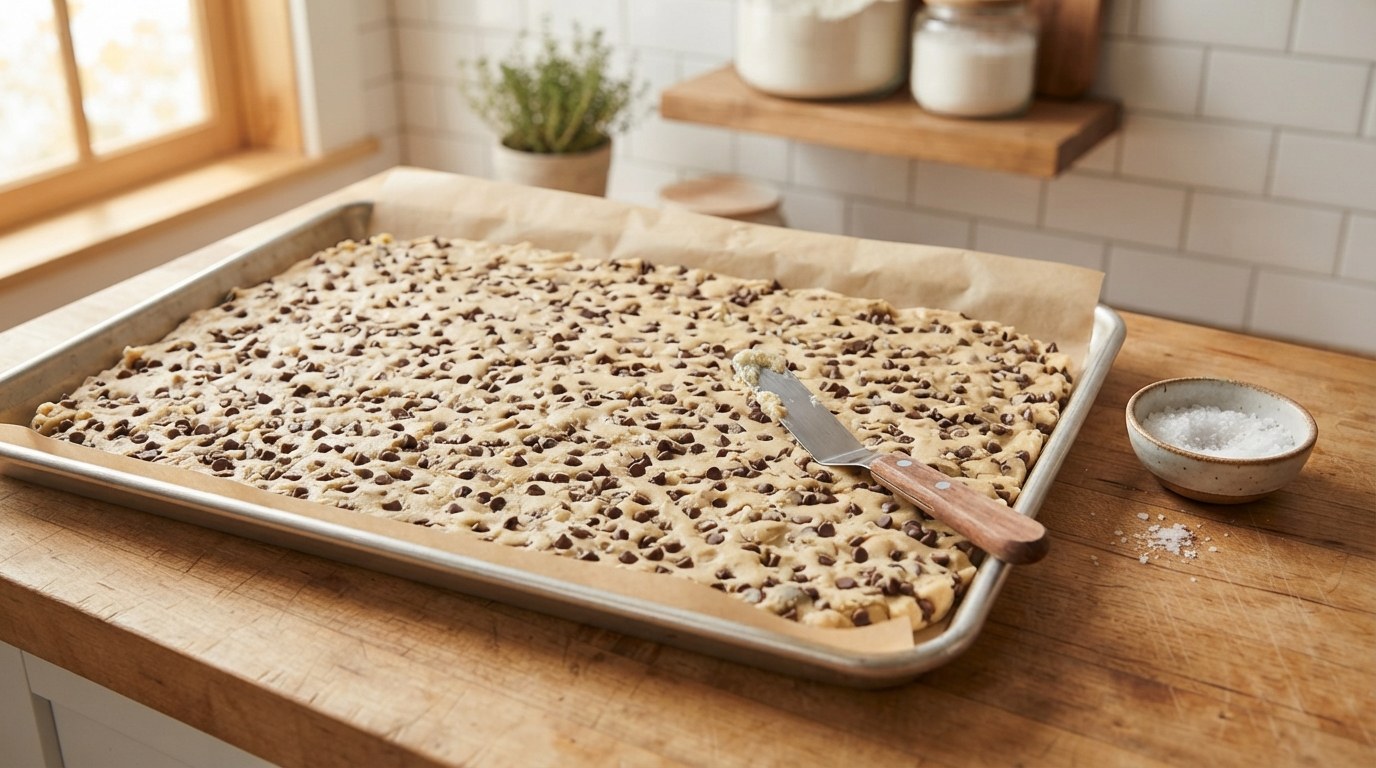
Whisk a cup of melted butter with a cup of sugar, two teaspoons of vanilla and a teaspoon of fine salt until glossy, then stir in two cups of flour until no dry streaks remain and fold in a cup of mini chips. The dough is stiff and a little greasy, which is right; there is no egg to bind it, so it holds together on fat alone. Tip it onto a parchment-lined 13-by-18-inch half sheet pan and press it out with an offset spatula or your palms until it reaches every edge in an even layer about a quarter inch thick. Even matters more than thin: a thick patch is still soft when the thin parts are done. Sprinkle with flaky salt and press it in lightly so it stays put.
Thickness is the reason the sheet bakes crisp all the way through where a drop cookie stays soft in the middle. Crispness is dryness, and in a quarter-inch sheet the oven's heat reaches every part of the dough at once, so its water evaporates evenly from top and bottom before the surface has gone past golden. Press the same dough into a smaller pan at half an inch and the center holds water long after the edges brown; you get a bar cookie with a burnt rim, not brittle. The same principle runs Ramsay's blondies in reverse: thick and pulled early for chew.
Baking and Doneness: Low, Slow, and Golden Throughout
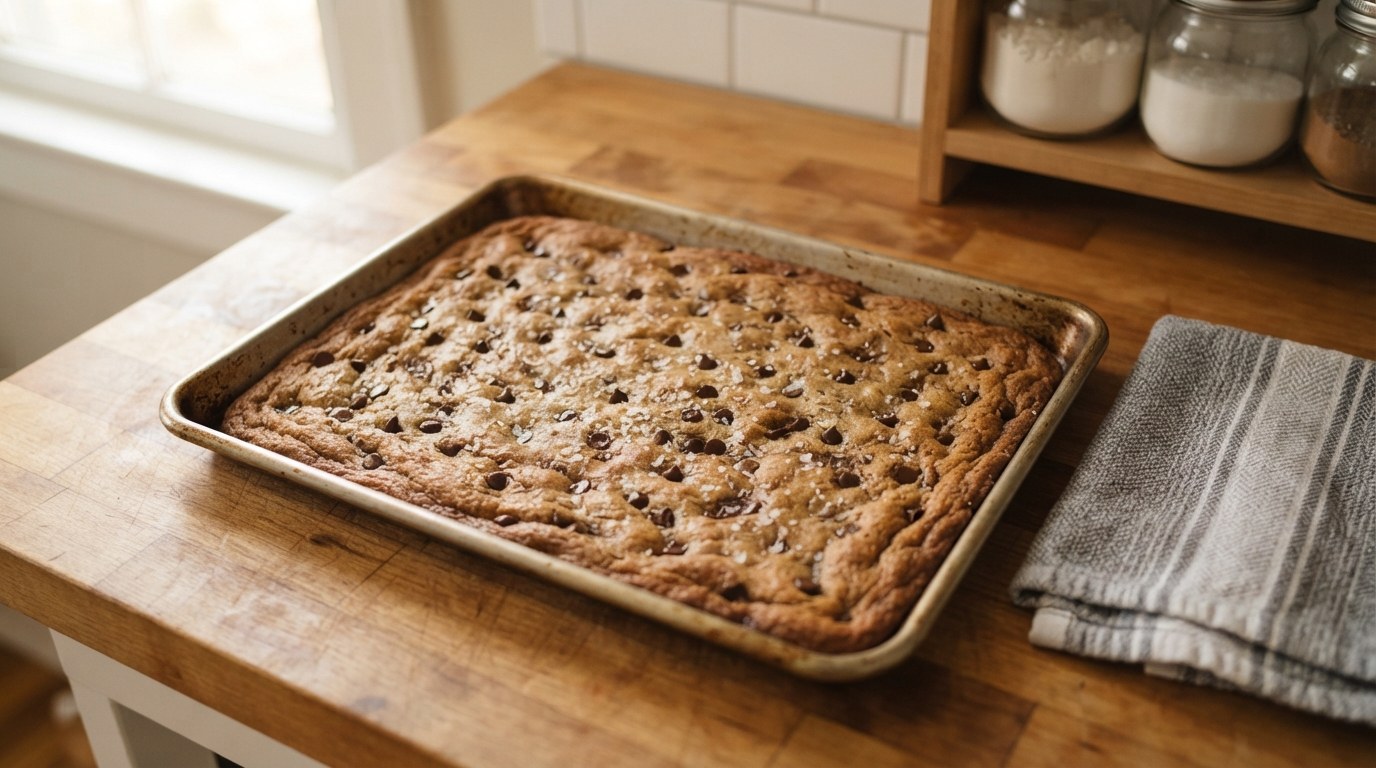
Bake at 325°F on the middle rack for 25 to 30 minutes, until the whole sheet is golden brown, not just the edges, and the center feels firm and dry when pressed with a fingertip. The low temperature is deliberate. A hot oven browns the surface before the interior has dried, and browning is a surface reaction, the Maillard browning between the flour's proteins and the sugars that begins around 284°F, with the sugar itself starting to caramelize a little higher; at 325°F the surface climbs through those thresholds slowly enough that the sheet dries out underneath in the same window. The edges will always be darker, because they lose water fastest, and a deeply browned edge is the best part.
| Stage | Number | What you see |
|---|---|---|
| Press | About ¼ inch, to the pan edges | Even layer, no thick patches |
| Bake | 325°F, 25 to 30 minutes | Golden across the whole sheet, edges deep brown, center firm and dry |
| Cool in the pan | 30 minutes, fully | Sheet hardens as the butter and sugar set |
| Snap | Cold, by hand | Clean breaks; a bend means it needed longer |
| Store | Airtight, room temperature, 2 weeks | Stays crisp; a stale sheet bends |
It will not be crisp when it comes out. Hot sugar and hot butter are both soft, and the sheet flexes on the pan like a warm cookie; it hardens as it cools, because the butter re-solidifies and the dissolved sugar sets into a glassy matrix through the dough. Leave it in the pan a full 30 minutes, until it is completely cold, then lift the parchment onto a board and break it by hand into shards. A piece that bends rather than snaps was underbaked in the middle; put the sheet back in a 300°F oven for 5 to 8 minutes and cool it again. The pistachio brownies on this site are the same logic run the opposite way, pulled early for fudge.
Storage, Gifting and Variations
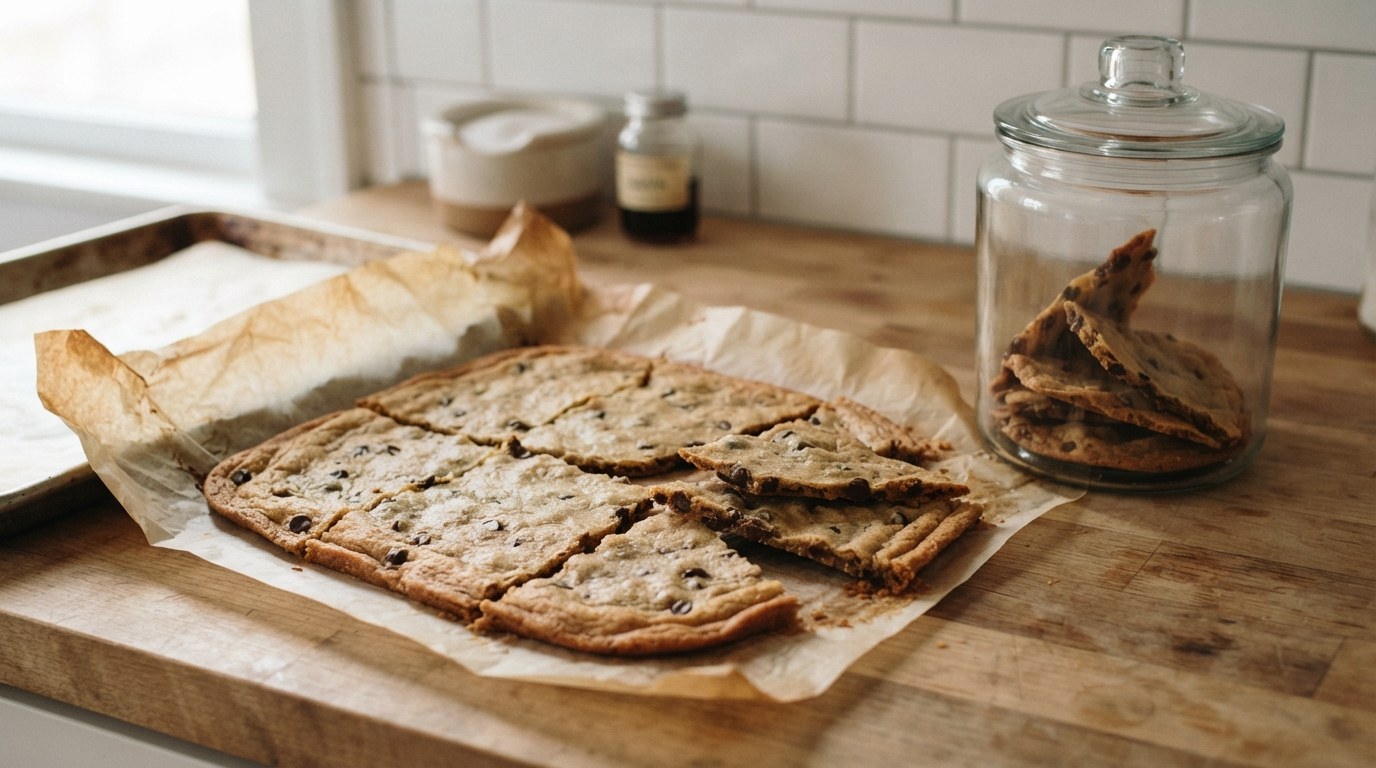
Brittle keeps because it is dry, and it fails for the same reason. Sugar is hygroscopic: it pulls water out of the air, which is why a crisp cookie left out overnight goes soft and why cookie brittle wants an airtight jar or tin at room temperature, where it keeps two weeks. King Arthur's one rule of cookie storage is never to store crisp cookies with chewy ones, because the crisp ones absorb the moisture the chewy ones give off and lose their snap within a day; on a holiday tray, keep the brittle in its own tin until serving. It ships well, layered between parchment, and it freezes for 3 months, thawed uncovered so condensation does not soften it.
The chocolate chip cookie this descends from was created on purpose. Framingham State University's library history of the cookie records that Ruth Wakefield, a graduate of its household arts program, added chopped Nestlé chocolate to a cookie dough at her Toll House Inn in Whitman, Massachusetts in 1938 to give her guests something new, and later sold the recipe and the Toll House name for a dollar and a lifetime of chocolate; the story that she ran out of nuts or expected the chocolate to melt is a myth. For variations: swap the mini chips for chopped toasted pecans, add a half cup of toffee bits, or press the sheet with a tablespoon of cinnamon sugar instead of flaky salt. Maldon's pyramid flakes are the salt to use on top, since their thin crystals dissolve on the tongue in a burst instead of grinding like rock salt. The red velvet cheesecake brownies fill out the same holiday tray.

Chocolate Chip Cookie Brittle (Thin and Crisp)
Ingredients
- 1 cup unsalted butter (2 sticks), melted and slightly cooled
- 1 cup granulated sugar
- 2 tsp vanilla extract
- 1 tsp fine sea salt
- 2 cups all-purpose flour
- 1 cup mini semisweet chocolate chips
- 1 tsp flaky sea salt, for the top
Instructions
- Heat the oven to 325°F (165°C) with a rack in the middle. Line a 13-by-18-inch half sheet pan with parchment.
- Whisk the melted butter, sugar, vanilla and fine salt in a large bowl until glossy. Stir in the flour until no dry streaks remain, then fold in the mini chips. The dough will be stiff.
- Tip the dough onto the pan and press it out with an offset spatula or your palms into an even layer about ¼ inch thick that reaches the edges. Sprinkle with the flaky salt and press it in lightly.
- Bake 25 to 30 minutes, until the whole sheet is golden brown, the edges are deep brown, and the center feels firm and dry to the touch.
- Cool completely in the pan, about 30 minutes; it hardens as it cools. Lift the parchment onto a board and snap the sheet into shards by hand. Store airtight at room temperature up to 2 weeks.
Notes
Chocolate Chip Cookie Brittle FAQs
The questions that come up most: what cookie brittle is, why it came out soft or bendy, whether it needs eggs, how thin to press it, how long it keeps, whether it can be frozen, whether regular chocolate chips work, and how to make it with brown butter.
What is cookie brittle?
A chocolate chip cookie dough made without eggs or leavening, pressed into one thin sheet, baked low and slow until it is golden and dry throughout, and snapped into shards once cool. It has the texture of the crisp edge of a cookie all the way through and keeps for two weeks in a jar.
Why is my cookie brittle soft or bendy?
It was pressed too thick, pulled too early, or stored badly. The sheet has to be about a quarter inch thick and golden across the whole pan, not just the edges, and it only hardens once completely cold. A bendy piece can go back into a 300°F oven for 5 to 8 minutes. Sugar also pulls moisture from the air, so it softens in an open dish or next to soft cookies.
Does cookie brittle need eggs?
No, and it is crisper without them. An egg is mostly water and its proteins set into a tender, cakey structure, which is the opposite of brittle. The dough holds together on melted butter alone, which also coats the flour so little gluten forms.
How thin should I press cookie brittle?
About a quarter inch, in an even layer that reaches the edges of a 13-by-18-inch half sheet pan. Evenness matters more than the exact number: a thick patch stays soft while the thin parts finish. Use an offset spatula or your palms over the parchment.
How long does cookie brittle last?
Two weeks in an airtight jar or tin at room temperature, kept away from soft cookies, whose moisture it absorbs. It ships well between layers of parchment.
Can you freeze cookie brittle?
Yes, for up to 3 months in an airtight container. Thaw it uncovered at room temperature so condensation evaporates instead of soaking in; a sealed container straight from the freezer traps moisture and softens the shards.
Can I use regular chocolate chips instead of mini?
You can, but a standard chip is thicker than the quarter-inch sheet, so the brittle breaks around the chips and the pieces are less even. Mini chips sit flush and spread through every shard; chopped chocolate works the same way if the pieces are small.
Can I make cookie brittle with brown butter?
Yes. Brown the cup of butter first until the milk solids turn hazelnut and it smells toasted, then use it as the melted butter; the toasted milk solids add a nutty depth. Let it cool a few minutes so it does not melt the chips on contact.

About the Author
John Siracusa is the founder of Hell’s Kitchen Recipes. He focuses on technique-first, reproducible home cooking and researches recipes & kitchen equipment from published food science and professional chef methods since 2016.