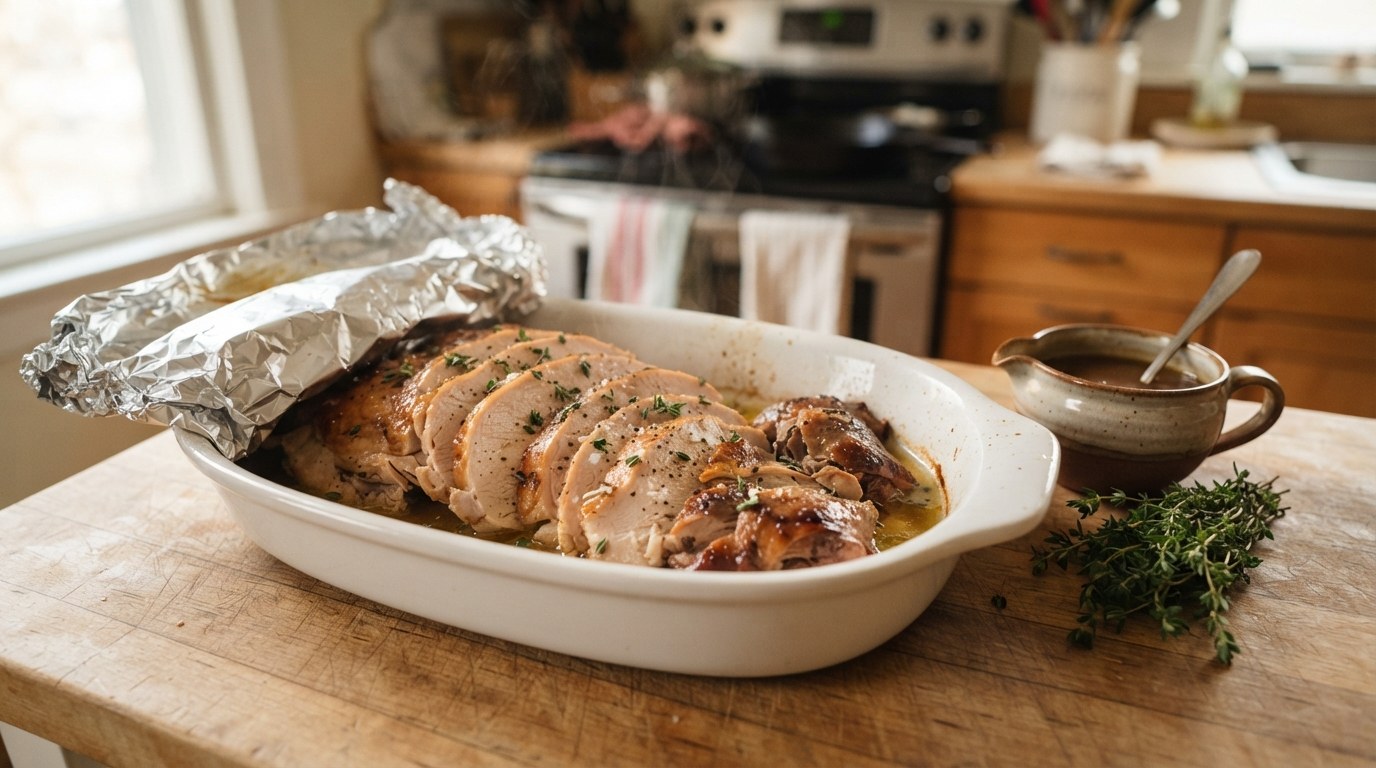
The way to reheat turkey without drying it out is to slice it, lay the slices in a baking dish with a few spoonfuls of stock or gravy, cover the dish tightly with foil, and warm it at 325°F until a thermometer in the thickest slice reads 165°F, which takes 20 to 30 minutes. That method works for a whole platter of leftovers, for a bone-in breast, for legs, and for a store-bought smoked turkey, with the times adjusted below. It works because it fixes the two things that ruin reheated turkey: dry oven air pulling water off the surface, and a second cook squeezing water out of meat that has already given up most of what it had.
This guide is the companion to the site's Gordon Ramsay turkey, which covers the roast itself, and it sits in the cooking techniques collection. It explains why reheated turkey dries out and tastes stale, gives the oven method step by step with the numbers for each cut, covers the stovetop and the microwave for a single plate, and sets out the USDA rules for how long turkey keeps and how hot it has to get.
Why Reheated Turkey Dries Out
Reheated turkey dries out because reheating is a second cook, and the meat has nothing left to spare. Muscle proteins in poultry unwind and bond to each other between about 122°F and 140°F, and from 136°F the connective tissue around the fibers contracts and wrings water out of them; that is what happened in the roasting pan the first time, and it is why a turkey that came out of the oven at 165°F has already lost a good share of its moisture. Every degree the meat climbs past that on the second trip pushes out more, and the breast suffers most: it is lean, fast-twitch muscle with almost no fat or connective tissue to lubricate it, which is the same reason it overcooks before the thighs during the roast. The legs and thighs carry more collagen, which had converted to gelatin above 154°F during the roast, and that gelatin is why dark meat reheats forgivingly and white meat does not.
Dry oven air makes it worse. A slice of turkey sitting uncovered in a 350°F oven loses water from its surface by evaporation the whole time, and the surface hardens and browns before the center is warm. Cover the dish and add liquid, and the space under the foil fills with steam, which holds the surface at or below 212°F and stops it drying; the slice warms through from all sides at once. The stock is not soaking into the meat. Liquid does not travel into cooked muscle any more than a marinade travels into raw meat. It coats the slices, replaces the juices lost in the cut, and keeps the dish humid, which is all it needs to do.
The stale, cardboard taste of day-old turkey has its own cause, and it is chemical rather than a matter of dryness. Food scientists call it warmed-over flavor, and the U.S. Pork Center of Excellence explains that it starts with oxidation of the meat's polyunsaturated fats, driven by iron freed from the muscle pigment during cooking, and shows up in refrigerated cooked meat within 48 hours; poultry is more prone to it than pork or beef because its fat is less saturated. The same source lists covering cooked meat in its drippings or gravy as a way to slow it, which is one more argument for reheating turkey in stock under foil rather than dry on a sheet pan.
The Oven Method: Sliced, Covered, 325°F to 165°F
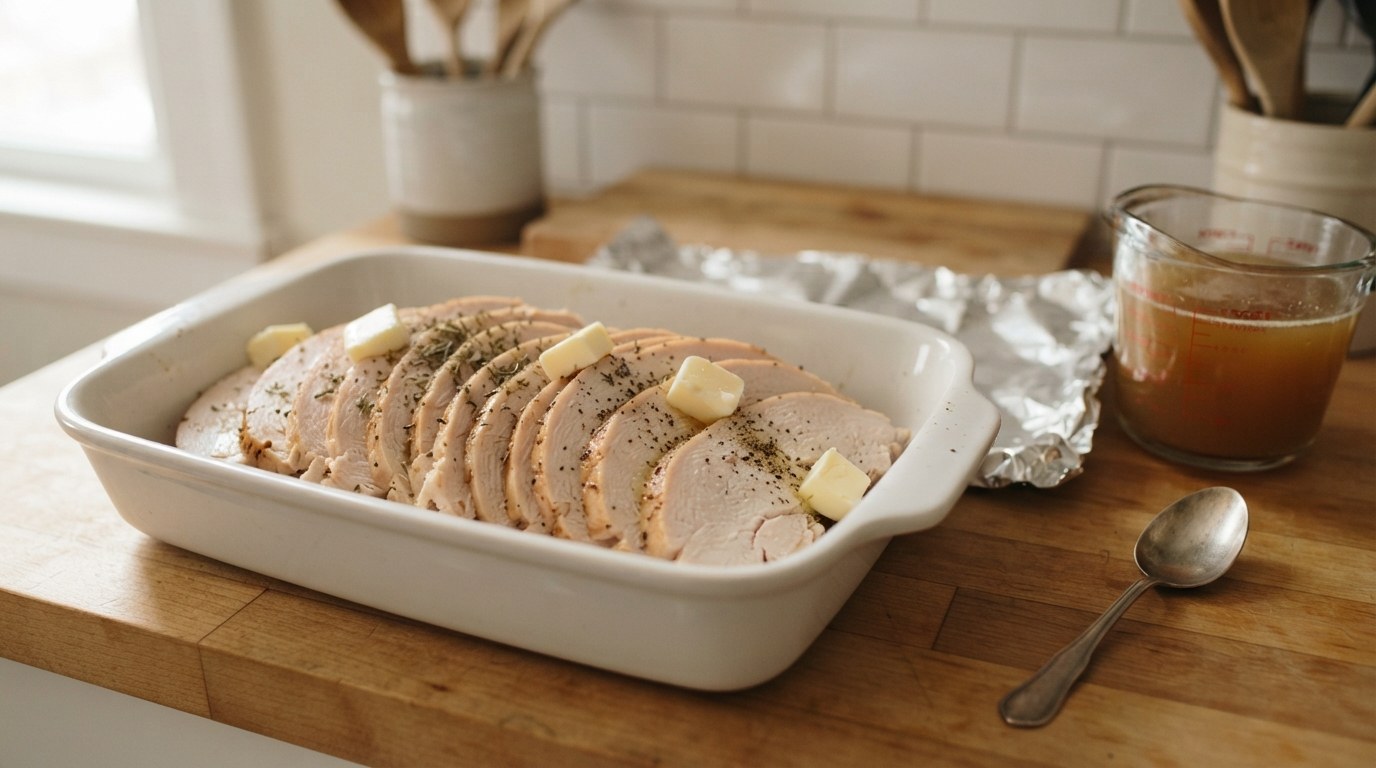
Slice the cold turkey first, about a quarter-inch thick, and lay the slices in a single overlapping layer in a baking dish; thin, even slices heat through in the time it takes the oven to warm the liquid, while a thick block of breast has to sit in the heat long enough to dry its outside before its center is safe. Pour in about a quarter-cup of turkey stock or thin gravy for every pound of meat, enough to wet the bottom of the dish and lap the edges of the slices without drowning them, and dot the top with a tablespoon of butter per pound. The stock is best if it came from the carcass; Ramsay's rule that nothing leaves the kitchen unused is the reason the bones went into a pot on the night of the roast, and the gelatin in a real stock gives the reheated slices the body that water or a bouillon cube cannot.
Advertisement
Cover the dish tightly with foil, crimped at the edges so the steam stays in, and put it in an oven heated to 325°F. The temperature is the USDA's floor, not a preference: its guidance for cooked turkey says to set the oven no lower than 325°F when reheating, cover the leftovers to hold moisture, and bring the meat to 165°F. Lower and slower sounds gentler but leaves the meat in the bacteria-friendly range too long, so the low-and-slow reheat some recipes suggest is out. Sliced meat in a shallow dish reaches 165°F in 20 to 30 minutes at 325°F; check at 20 with an instant-read thermometer pushed sideways into the thickest slice, the same way the University of Illinois Extension says to read the innermost thigh and thickest breast on the day of the roast. Pull it the moment it reads 165°F; there is no rest to wait for and every extra minute is water lost.
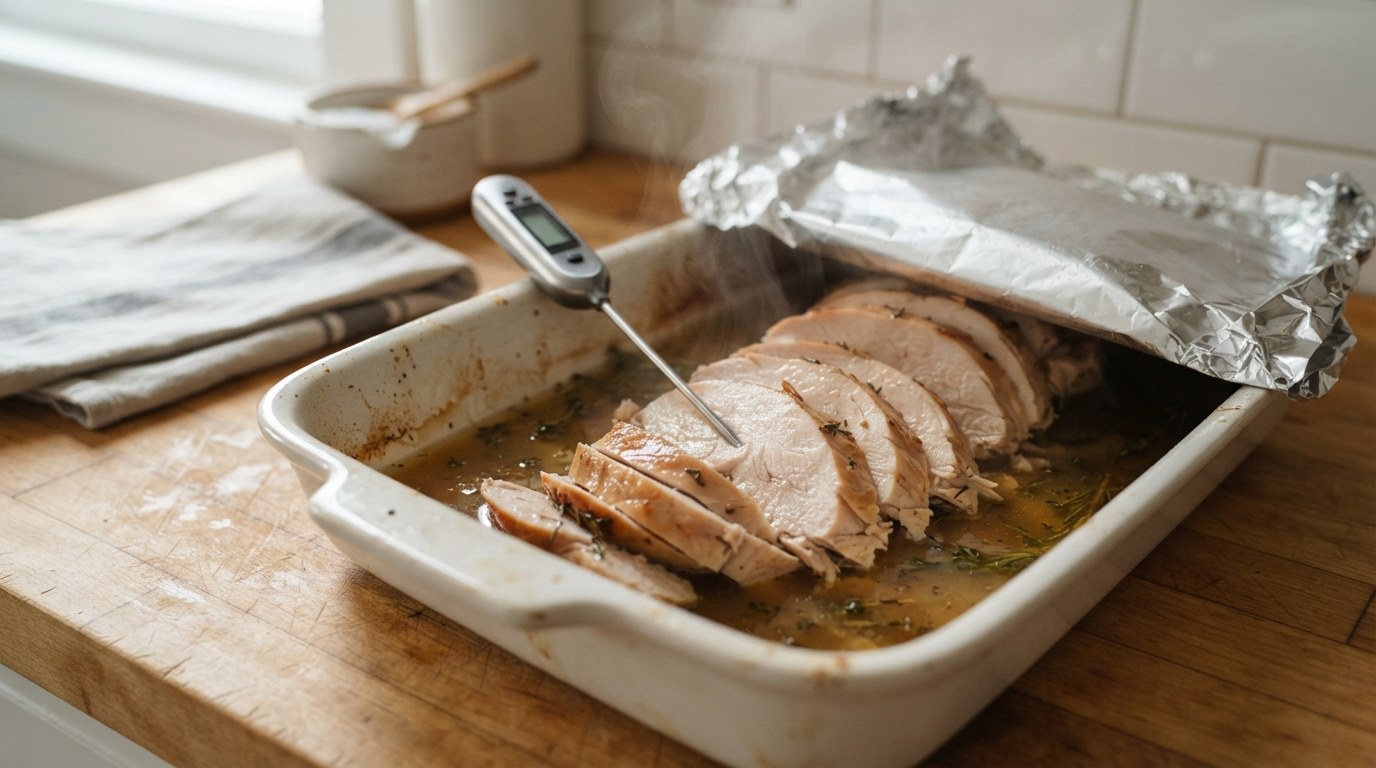
Serve straight from the dish or lift the slices onto a warm platter and spoon the dish liquid over them, then pass the gravy. If the slices are going onto a plate with mashed potatoes and glazed carrots, warm those under the same foil in their own dishes on the same rack, since 325°F suits them too. Skin does not survive this method; it comes out soft. If crisp skin matters, lift the skin off the cold breast before slicing, lay it flat on a sheet pan, and give it 8 to 10 minutes uncovered at 400°F while the meat reheats below, then lay it back over the slices. Skin crisps because it dries and its fat renders, which the humid dish prevents on purpose.
| Cut | Prep | Oven | Liquid | Time | Done at |
|---|---|---|---|---|---|
| Sliced breast or mixed slices | Quarter-inch slices, single overlapping layer | 325°F, covered | ¼ cup stock or gravy per lb, 1 Tbsp butter per lb | 20 to 30 min | 165°F in the thickest slice |
| Bone-in breast, whole | Leave on the bone; do not slice | 325°F, covered | ½ cup stock in the dish | 35 to 50 min, by weight | 165°F at the thickest part, off the bone |
| Legs and thighs | Whole; score the skin side once | 325°F, covered | ½ cup stock, a bay leaf | 25 to 35 min | 165°F at the bone; dark meat is fine to 175°F |
| Smoked turkey, store-bought, whole | Carve into breast halves and legs first | 325°F, covered | 1 cup stock in the pan | About 10 to 15 min per lb | 165°F; skin and bark stay soft |
| One plate, stovetop | Slices in a skillet with a lid | Low, covered | 3 to 4 Tbsp stock | 5 to 8 min | Steaming and 165°F |
| One plate, microwave | Slices on a plate, covered, damp paper towel | 50 percent power | 2 Tbsp stock or gravy | 1-min bursts, stir between | 165°F throughout, not just the edges |
The pattern in that table is that time scales with thickness and everything else stays the same: covered, moist, 325°F, done at 165°F. A whole bone-in breast takes longer only because heat has to travel through more meat, and a whole smoked turkey is best carved before it goes in, because reheating a whole bird takes so long that the outside dries before the deep breast is safe.
Reheating Turkey Legs, Breast and Smoked Turkey
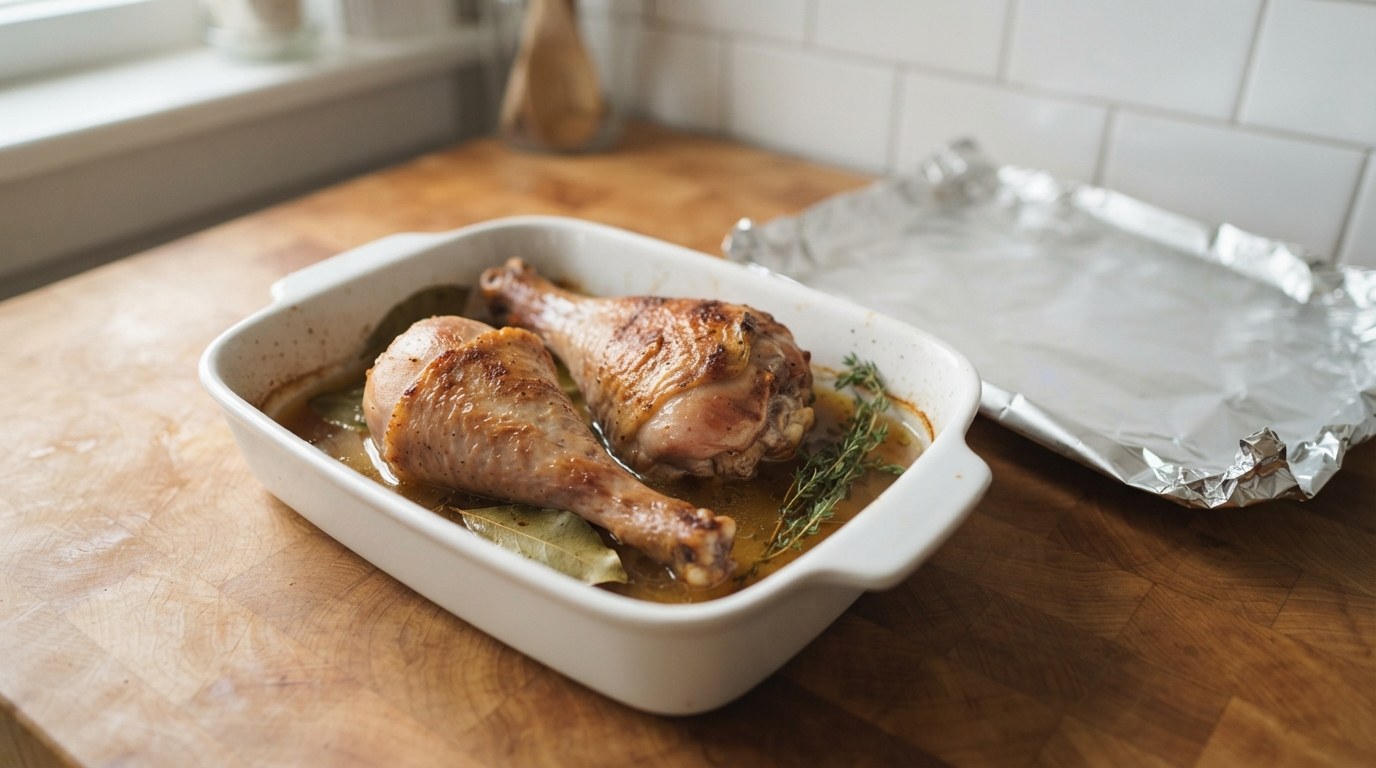
Turkey legs and thighs are the easy case. Dark meat is worked muscle, threaded with connective tissue that turned to gelatin during the roast, and that gelatin melts again as the leg warms and keeps every bite slick even at 175°F, well past the 165°F minimum. Set whole legs in a dish with half a cup of stock and a bay leaf, cover, and give them 25 to 35 minutes at 325°F; they can also go on a rack over a pan of water in the oven if you want the skin drier. A smoked turkey leg from a fair or a barbecue counter is already fully cooked, and the same covered method brings it back without turning the outside to jerky.
A bone-in turkey breast should be reheated whole and sliced after. The bone slows the heat, which sounds like a problem and is the point: a whole breast warms more evenly than a stack of slices from a large roast, and the bone side never dries. Give it half a cup of stock in a snug dish, cover it, and count on 35 to 50 minutes at 325°F depending on weight, reading the thermometer at the thickest point away from the bone. A boneless breast roast reheats the same way in a little less time. In either case, if the breast was cooked to 165°F on the day and rested, pulling it at exactly 165°F on the reheat keeps it juicy; the temperature guidance from ThermoWorks, which pulls a roasting breast at 157°F for carryover, does not apply to a reheat, where the meat is going straight to the plate and USDA's 165°F is the floor.
A store-bought smoked turkey is fully cooked and only needs warming, and the whole bird is where people go wrong. Reheating it whole at 325°F takes long enough, at roughly 10 to 15 minutes per pound, that the breast is dry before the thigh is warm. Carve it cold instead: take off the legs and thighs, lift the breast halves off the bone, and reheat the pieces covered in stock in one or two dishes. The bark and skin stay soft under the foil; if you want them back, uncover for the last 5 minutes. A spiral-sliced or pre-carved smoked breast is the simplest of all, since it is already in the shape the oven method wants.
Stovetop and Microwave for a Single Plate
One plate of turkey does not need the oven. Lay the slices in a skillet with 3 to 4 tablespoons of stock or gravy, cover with a lid, and warm over low heat for 5 to 8 minutes, turning the slices once; the lid traps the steam exactly as the foil did, and the slices are done when they are steaming and a thermometer reads 165°F. Hot pan then oil is Ramsay's rule for searing, and this is the opposite job, so the pan starts cool and stays low; the goal is to warm the meat without a crust.
Advertisement
The microwave can do it, but it needs handling. Microwaves penetrate only about an inch into food, so a heaped pile of turkey heats at the edges and stays cold in the middle while the edges dry and toughen. Spread the slices in one layer on a plate, add 2 tablespoons of stock or gravy, cover with a damp paper towel or a vented lid, and run it at 50 percent power in 1-minute bursts, moving the slices between bursts, until the whole plate reads 165°F. Half power lets heat spread inward between bursts instead of racing the edges past done. The stovetop gives a better result for the same 5 minutes of effort, but for one plate at midnight the microwave is fine if it is covered, wet and slow.
How Long Turkey Keeps, and Reheating It Safely
Cooked turkey goes into the refrigerator within 2 hours of coming out of the oven, in shallow containers or sliced off the bone so it cools quickly, and it keeps 3 to 4 days at 40°F or below; frozen, it holds its quality for 2 to 6 months. Those are the USDA's figures for leftover poultry, and its rule for the reheat is the one already used above: 165°F throughout, measured with a thermometer, in an oven set no lower than 325°F if that is the method. Reheat only what will be eaten; a second refrigerator-and-reheat cycle costs more moisture and more warmed-over flavor, and cold turkey on a sandwich is a better use of the rest.
The same rules make cooking the turkey a day ahead a sound plan rather than a compromise, and for a crowded oven it is often the better one. Roast the bird by the Ramsay method, rest it the full 45 minutes, carve it completely, cool the meat in shallow dishes with a ladle of the pan juices, refrigerate, and reheat the slices in stock under foil an hour before dinner while the oven is free for the sides. The turkey comes to the table at 165°F, moist, with its gravy already made from the carcass the night before, and the cook is out of the kitchen on the day. Deep-frozen turkey follows the same path after a night thawing in the refrigerator, never on the counter.
| Rule | Number | Why |
|---|---|---|
| Refrigerate cooked turkey | Within 2 hours; 1 hour if the room is above 90°F | Bacteria multiply fastest between 40°F and 140°F |
| Refrigerator life | 3 to 4 days at 40°F or below | USDA leftover poultry limit |
| Freezer life | 2 to 6 months for best quality | Safe indefinitely frozen; flavor and texture fade |
| Reheat to | 165°F throughout, by thermometer | The USDA safe temperature for poultry, first cook or second |
| Oven setting | No lower than 325°F | Keeps the meat out of the danger zone while it warms |
| Number of reheats | One; reheat only what you will eat | Each cycle loses water and adds warmed-over flavor |
Advertisement
Reheating Turkey FAQs
The questions that come up most: the best way to reheat turkey, how long it takes in the oven, how to reheat a smoked turkey, whether to slice it first, how to reheat turkey breast and legs, whether the microwave works, and whether the turkey can be cooked the day before.
What is the best way to reheat turkey?
Sliced, in a baking dish with a quarter-cup of stock or gravy per pound and a little butter, covered tightly with foil, at 325°F for 20 to 30 minutes until a thermometer in the thickest slice reads 165°F. The foil and liquid keep the surface in steam so it cannot dry or brown, and the slices warm through evenly. The USDA sets 325°F as the minimum oven temperature and 165°F as the target.
How long does it take to reheat turkey in the oven?
Sliced turkey in a covered dish takes 20 to 30 minutes at 325°F. A whole bone-in breast takes 35 to 50 minutes, legs and thighs 25 to 35 minutes, and a store-bought smoked turkey about 10 to 15 minutes per pound if it is carved into pieces first. In every case the clock is a guide and the thermometer decides: 165°F in the thickest part.
How do you reheat a smoked turkey?
Carve it cold into legs, thighs and breast halves, lay the pieces in a dish with a cup of stock, cover with foil, and warm at 325°F until they read 165°F, roughly 10 to 15 minutes per pound. Reheating a smoked turkey whole takes so long that the breast dries out before the thigh is warm. Uncover for the last 5 minutes if you want the skin and bark firmer.
Should you slice turkey before reheating?
Yes, for anything that came off the bone. Quarter-inch slices in a single overlapping layer heat through in the time it takes the liquid to warm, while a thick block sits in the oven long enough to dry its outside before the center is safe. The exception is a bone-in breast, which reheats more evenly whole and is sliced after.
How do you reheat turkey breast without drying it out?
Slice it thin, lay the slices in a dish with stock or gravy and a few pieces of butter, cover tightly, and bake at 325°F for 20 to 30 minutes to 165°F. Breast is lean muscle with no fat or gelatin to protect it, so it needs the liquid and the cover more than any other cut, and it needs to come out the moment it reaches temperature.
Can you reheat turkey in the microwave?
Yes, for a single plate. Spread the slices in one layer, add 2 tablespoons of stock or gravy, cover with a damp paper towel, and run at 50 percent power in 1-minute bursts, rearranging the slices between bursts, until the whole plate reads 165°F. Microwaves reach only about an inch into food, so a pile heats at the edges and stays cold in the middle; a single layer at half power fixes that.
Can I cook the turkey the day before and reheat it?
Yes, and it is often the better plan for a crowded oven. Roast it, rest it 45 minutes, carve it completely, cool the meat in shallow dishes with some of the pan juices, and refrigerate within 2 hours. The next day, reheat the slices in stock under foil at 325°F to 165°F, about 20 to 30 minutes, while the oven is free for the sides. Cooked turkey keeps 3 to 4 days refrigerated.

About the Author
John Siracusa is the founder of Hell’s Kitchen Recipes. He focuses on technique-first, reproducible home cooking and researches recipes & kitchen equipment from published food science and professional chef methods since 2016.