Boursin stuffed mushrooms are the two-ingredient party appetizer that everyone makes and almost everyone makes watery: a cremini cap, a spoon of garlic-and-herb Boursin, twenty minutes in the oven, and a puddle on the platter. The fix is not a different cheese. It is treating the mushroom like the 92-percent-water vegetable it is. Roast the caps alone first so they shed that water, cook the minced stems dry and fold them into the cheese, and finish under a buttered panko crust that browns while the filling only warms through. Creamy inside, crisp on top, and the platter stays dry.
The recipe card at the bottom has the amounts and numbered steps for 24 mushrooms, enough for eight as a starter. This guide covers what Boursin is and why it works here, why the caps roast before they are filled, how to build a filling that does not slide off, the panko crust, doneness, make-ahead, and the variations people search for most. It sits in the site's recipes collection with the Ramsay-style dinner party appetizers and the caramelized onion dip from the same holiday table.
What Boursin Is and Why It Makes the Best Stuffed Mushroom Filling
Boursin is a fresh, cream-enriched cow's milk cheese, soft enough to spread cold and crumbly at the edges, and its Garlic & Fine Herbs flavor is already seasoned: garlic, herbs, salt and pepper are in the puck, which is why a stuffed mushroom built on it needs almost nothing else. Boursin's own history puts the cheese in Croisy-sur-Eure, Normandy, where cheesemaker François Boursin opened his dairy in 1957 and, after a newspaper mistakenly announced a garlic version in 1961, spent two years developing the Garlic & Fine Herbs recipe he released in 1963. The company describes it as a Gournay cheese inspired by fromage frais blended with garlic, fresh cream, soft cheese, herbs, salt and pepper.
That composition is what makes it behave in the oven. Boursin is high in fat and low in moisture compared with a cream cheese or a ricotta, and a dairy emulsion with enough fat holds together under heat where a leaner one splits; the same rule that lets crème fraîche go into a hot pan while sour cream curdles. So the filling stays creamy through a 15-minute bake instead of turning grainy. The limit is that any soft cheese loosens as its fat warms, and past bubbling it starts to slick and separate; that is why the filling goes into caps that are already cooked and the oven time is short. One 5.2-ounce package fills 24 caps with a spoon of grated Parmesan and the cooked stems folded in, which stretches it, adds body, and keeps the filling from being pure cheese.
| Ingredient | What it does | Do not substitute with |
|---|---|---|
| Cremini (baby bella) caps, 1½ to 2 inches | Firmer and more flavorful than white buttons; the cavity holds a spoon of filling | Large portobellos (a different dish, and the gills weep) |
| Boursin Garlic & Fine Herbs, 5.2 oz | The seasoned, high-fat base that stays creamy in the oven | Whipped cream cheese (too wet and bland; a "Boursin-style" spread works) |
| The mushroom stems, minced and cooked dry | Stretch the filling, add mushroom flavor and body | Raw stems (they release water into the cheese) |
| Shallot, garlic and a splash of white wine | Aromatics cooked with the stems; the wine deglazes and cooks off | Skipping the cook-off (raw shallot and wine make it wet and sharp) |
| Grated Parmesan | Salt, body, and browning in both the filling and the crust | Pre-shredded mozzarella (it strings and pools) |
| Panko and melted butter | A dry, airy crumb that browns fast without soaking | Fine dry breadcrumbs (they pack and go pasty) |
Why the Caps Roast Before They Are Filled
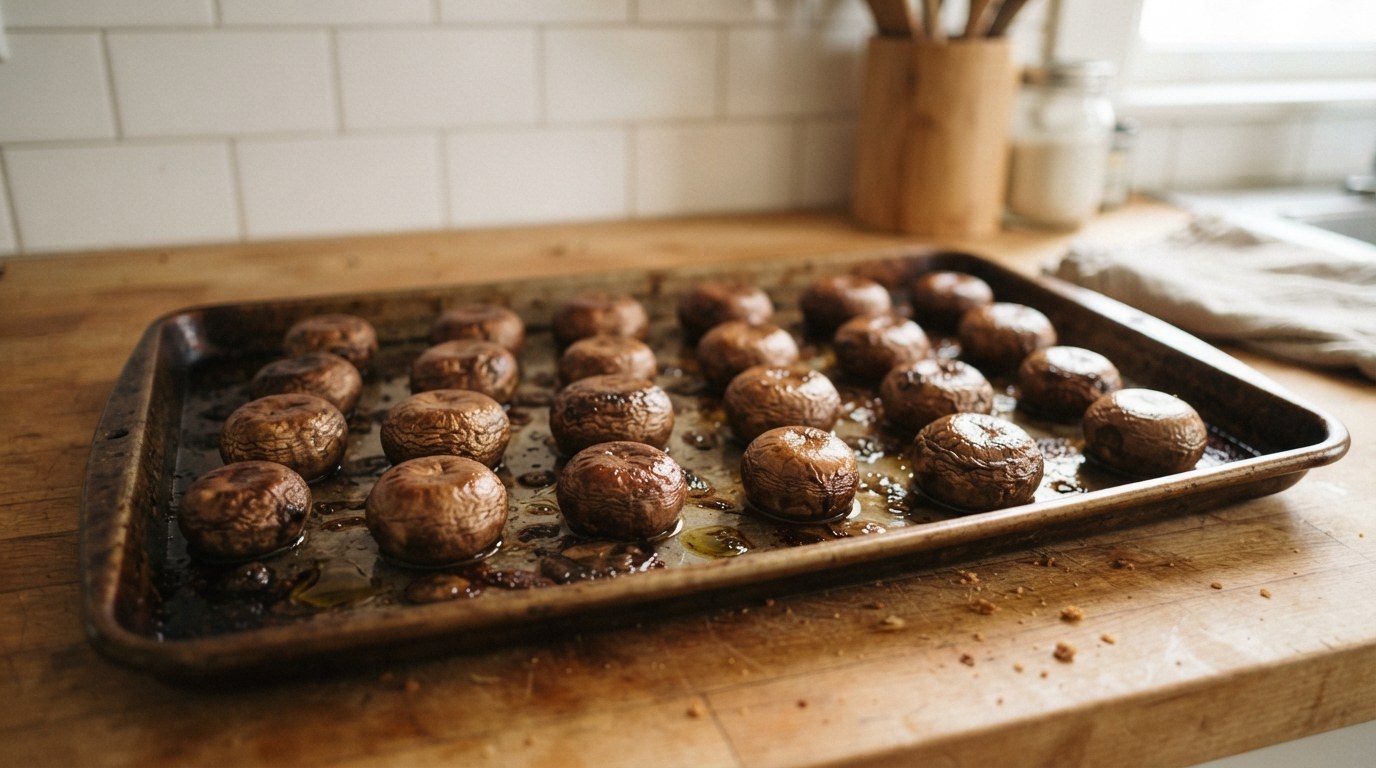
A raw mushroom is water in a sponge. In the USDA's own analysis of fresh mushrooms, white mushrooms measured 92.18 grams of water per 100 grams, and even a quick stir-fry drove off nearly 10 percent of their weight as moisture. Fill a raw cap with cheese and bake it and that water has one place to go: out through the cap, under the filling, and onto the platter, and it takes the cheese with it. So the caps go into a 400°F oven on their own first, tossed in olive oil and salt and set domed-side up, hollow-side down, for 10 minutes. The salt pulls water out of the cells by osmosis, the heat drives it off, and the hollow-down position lets what remains drain onto the pan instead of collecting in the cup. Tip the pan, blot the caps, and you have a mushroom that is already cooked, seasoned and dry enough to hold a filling.
Advertisement
Two things follow from the water. First, nothing browns wet: a surface covered in water cannot get past 212°F, and the Maillard browning that gives a roasted mushroom its flavor only starts around 284°F, so the caps only take on color once the water is gone. That is why the tops shrink and darken in the last minutes of the pre-roast. Second, you cannot overcook a mushroom into mush the way you can a zucchini. Mushroom cell walls are built of chitin, not the pectin that dissolves in plant vegetables, and a study of fungal cells under heat found their chitin walls stay intact through boiling; the authors note that mushrooms do not fall apart however long they are simmered. So the double cooking here, a pre-roast and then a second bake, costs nothing in texture. The caps get firmer and meatier, not softer.
On cleaning: the advice to never let water touch a mushroom is a myth. The Mushroom Council says to brush off debris with your fingers or a damp paper towel, or rinse briefly under running water and pat dry. A mushroom that is already 92 percent water does not soak up a meaningful amount more in a ten-second rinse; what matters is that the surface is dry when it goes into the oil, so pat them well. Pull the stems out with a twist, and save every one.
The Filling: Stems Cooked Dry, Then Folded Into the Cheese
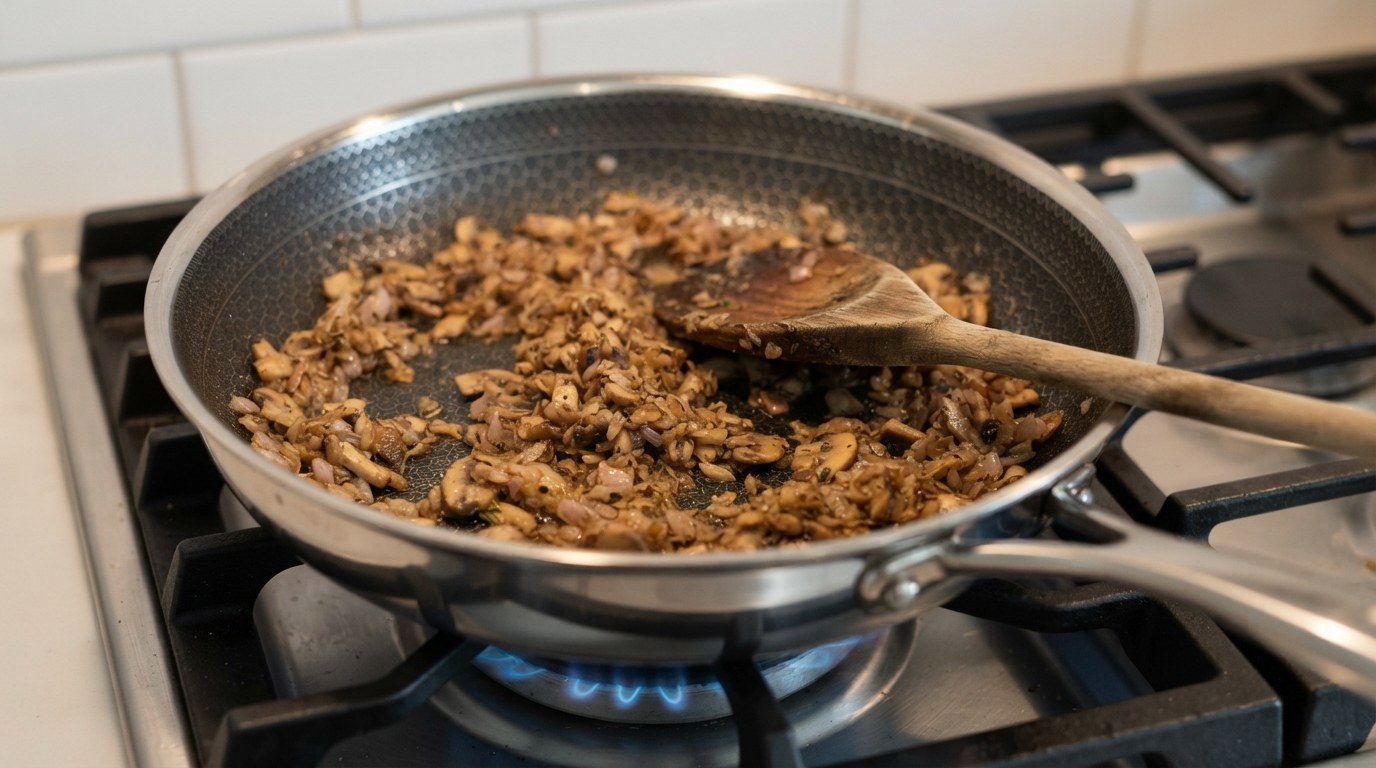
The stems are a third of the mushroom and most recipes throw them away. Mince them fine with a shallot and cook them in butter over medium-high heat until every trace of liquid has evaporated and they start to brown, 6 to 8 minutes. They will look like a lot at first and cook down to a few spoonfuls; that is the water leaving. Add the garlic for 30 seconds, then a splash of dry white wine and let it cook away to nothing. The wine dissolves the browned bits off the pan and its acidity cuts the richness of the cheese, but it has to reduce completely or it takes the filling back to wet. Spread the mixture on a plate and let it cool 5 minutes.
Cooling matters because Boursin is a fresh cheese held together by fat, and hot stems folded straight in melt it into a sauce that will not mound in a cap. Once the stems are warm rather than hot, fold them into the Boursin with the Parmesan, parsley and a grind of pepper. The filling should be thick enough to hold a peak on a spoon. Fill each cap with about two teaspoons, mounded, pressing it gently into the cavity so it grips the cooked mushroom rather than sitting on top of it. The mushroom risotto on this site uses the same cook-the-stems-dry logic for its base, and the chicken fricassee builds its sauce on the same principle of browning mushrooms before any liquid goes in.
The Panko Crust and Doneness
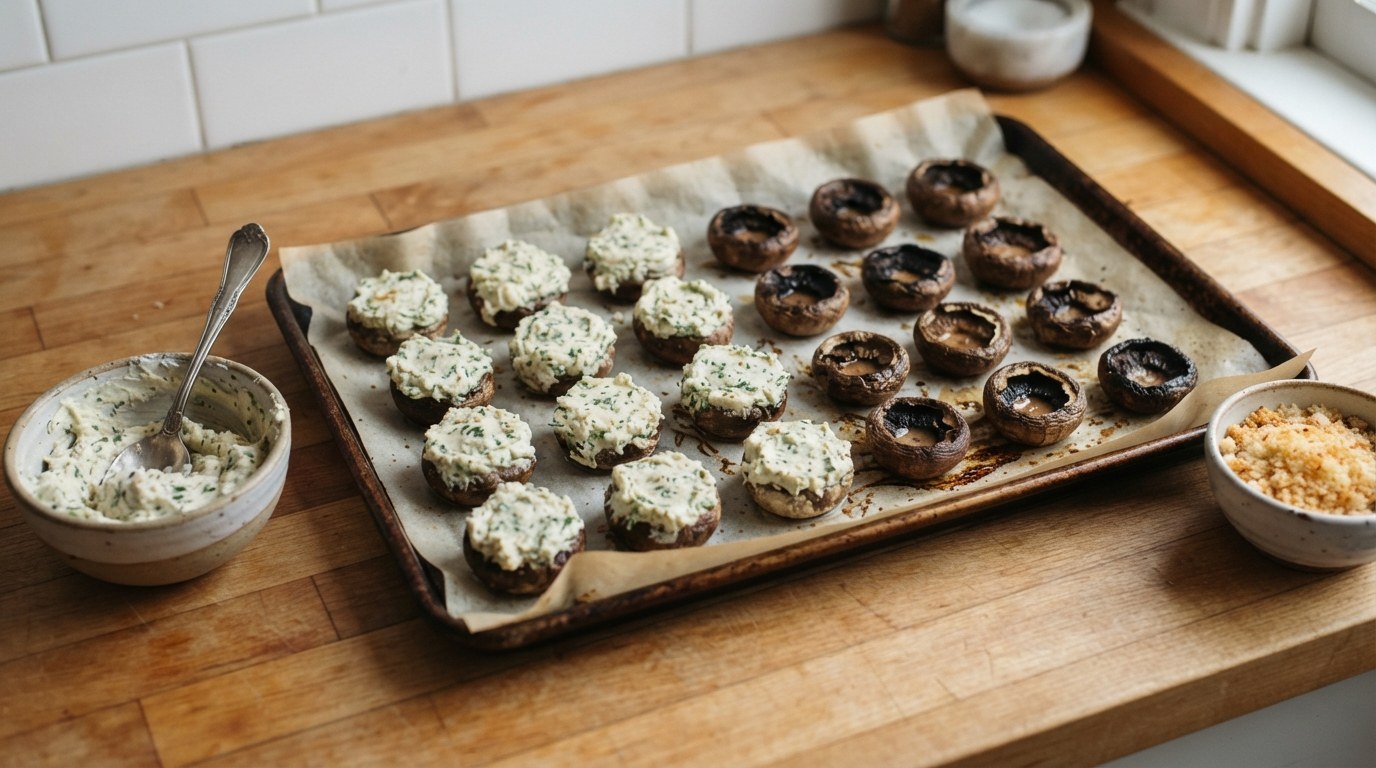
Toss a half cup of panko with two tablespoons of melted butter and two of grated Parmesan and press a pinch onto each filled cap. Panko is a coarse, airy crumb with far more surface and far less density than fine breadcrumbs, so it dries out and browns in minutes instead of soaking up fat and going pasty. The butter does two jobs: it conducts heat into the crumb evenly, and its milk solids and the Parmesan's proteins brown alongside the starch. The crust is what people photograph, and it is also the moisture insurance; a dry, hot crumb on top pulls a little steam out of the filling as it bakes.
Advertisement
| Stage | Number | What you see |
|---|---|---|
| Pre-roast the caps | 400°F, 10 minutes, hollow-side down | Caps shrink, tops darken, liquid on the pan; tip and blot |
| Cook the stems | Medium-high, 6 to 8 minutes | No liquid left, stems starting to brown; wine reduced to nothing |
| Cool before folding | 5 minutes on a plate | Warm, not hot; the cheese stays thick when folded |
| Second bake | 400°F, 12 to 15 minutes | Panko golden, filling bubbling only at the edges |
| Rest | 5 minutes | Filling firms enough to eat in one bite |
Bake at 400°F for 12 to 15 minutes, until the panko is golden and the filling is hot through and just beginning to bubble at the edges of the cap. That is the signal to stop. A soft cheese held longer starts to oil out, and there is no benefit in going further: the caps were fully cooked in the pre-roast, so the second bake is only about heating the filling and browning the crust. Rest 5 minutes on the pan; the filling firms as it cools from bubbling to eating temperature, and a stuffed mushroom that can be eaten in one bite without the filling sliding out is the goal. Finish with snipped chives and a little lemon zest, which lifts the garlic and cream.
Make-Ahead, Storage and Variations
These are built for a party because every step but the last is make-ahead. Pre-roast the caps, cook the filling and stuff them up to a day ahead, then cover and refrigerate on the sheet pan; add the buttered panko just before baking so it stays dry, and give cold mushrooms 2 or 3 extra minutes. Leftovers keep 3 days refrigerated and reheat at 375°F for 8 to 10 minutes; a microwave turns the crust soft. The Mushroom Council's storage advice applies to the raw caps: keep them in their original packaging or a paper bag, where they last up to a week, and never freeze them raw.
For a sausage version, cook a quarter pound of crumbled Italian sausage with the stems and cut the Boursin to a single package still; the fat from the sausage replaces the butter. Crumbled bacon folds in the same way. For spinach, wilt a cup of chopped leaves with the stems and squeeze it dry before it meets the cheese, because spinach is also mostly water. An air fryer does the job at 375°F, about 8 minutes for the pre-roast and 6 to 8 for the second bake, in a single layer. The caps also sit well next to the Hell's Kitchen scallops and deviled eggs on a starter table.

Boursin Stuffed Mushrooms (Crisp Panko, Never Soggy)
Ingredients
- For the mushrooms
- 24 cremini (baby bella) mushrooms, 1½ to 2 inches, about 1½ lb
- 2 Tbsp olive oil
- ½ tsp fine sea salt
- For the filling
- 2 Tbsp unsalted butter
- 1 shallot, finely minced
- 2 garlic cloves, minced
- 2 Tbsp dry white wine
- 1 package (5.2 oz) Boursin Garlic & Fine Herbs, room temperature
- ¼ cup finely grated Parmesan
- 2 Tbsp chopped flat-leaf parsley
- ¼ tsp black pepper
- For the topping
- ½ cup panko breadcrumbs
- 2 Tbsp unsalted butter, melted
- 2 Tbsp finely grated Parmesan
- 1 Tbsp snipped chives, plus a little lemon zest, to finish
Instructions
- Heat the oven to 400°F (205°C). Wipe or briefly rinse the mushrooms and pat them dry. Twist out the stems and set them aside; mince them finely.
- Toss the caps with the olive oil and salt and set them hollow-side down on a rimmed sheet pan. Roast 10 minutes, until they shrink and release their liquid. Tip off the liquid, blot the caps, and turn them hollow-side up on a parchment-lined pan. Leave the oven on.
- Melt the butter in a skillet over medium-high heat. Add the minced stems and shallot and cook, stirring, until all the liquid has evaporated and they begin to brown, 6 to 8 minutes. Add the garlic and cook 30 seconds, then add the wine and let it cook away completely. Spread on a plate and cool 5 minutes.
- In a bowl, mix the Boursin, ¼ cup Parmesan, parsley and pepper. Fold in the warm stem mixture until the filling is thick and holds a peak.
- Fill each cap with about 2 teaspoons of filling, mounded and pressed gently into the cavity. Toss the panko with the melted butter and 2 tablespoons Parmesan and press a pinch onto each mushroom.
- Bake 12 to 15 minutes, until the panko is golden and the filling is hot and just bubbling at the edges. Rest 5 minutes on the pan, then scatter with chives and lemon zest and serve warm.
Notes
Advertisement
Boursin Stuffed Mushrooms FAQs
The questions that come up most: how long to bake them, why they turn out watery, whether to wash the mushrooms, whether they can be made ahead, how to do them in an air fryer, what to add for a sausage or bacon version, which mushrooms to buy, and whether they are keto.
How long do you bake Boursin stuffed mushrooms?
Twice, at 400°F: 10 minutes for the empty caps alone, hollow-side down, so they shed their water, then 12 to 15 minutes once filled and topped with panko, until the crust is golden and the filling bubbles at the edges. From the refrigerator, add 2 or 3 minutes to the second bake.
Why are my stuffed mushrooms watery?
Because the caps went in raw. White mushrooms are about 92 percent water, and in the oven that water leaves the cap, pools under the filling and floods the platter. Roast the empty caps first, tip off the liquid and blot them, and cook the minced stems until dry before folding them into the cheese.
Should you wash mushrooms before stuffing them?
A brief rinse is fine. The Mushroom Council says to brush off debris with a damp paper towel or rinse briefly under running water and pat dry; a mushroom that is already 92 percent water does not absorb much more in a few seconds. What matters is patting the surface dry so the caps roast instead of steam.
Can Boursin stuffed mushrooms be made ahead?
Yes. Pre-roast the caps, cook the filling and stuff them up to a day ahead, then cover and refrigerate on the sheet pan. Add the buttered panko right before baking so it stays dry and crisp, and bake from cold with a few extra minutes.
Can you make Boursin stuffed mushrooms in an air fryer?
Yes, in a single layer at 375°F: about 8 minutes for the empty caps, then 6 to 8 minutes once filled and topped, until the panko is golden. The circulating air dries the caps quickly, which is exactly what this recipe wants; check early, because air fryers run hotter than their dial.
How do I make them with sausage or bacon?
Cook a quarter pound of crumbled Italian sausage with the minced stems and shallot, skipping the butter, then fold the cooled mixture into the Boursin as usual. For bacon, fold in 4 slices cooked crisp and crumbled. Either way keep the cheese at one package; the meat replaces some of the volume, not the binder.
What mushrooms are best for stuffing?
Cremini, sold as baby bella, about 1½ to 2 inches across. They are firmer and more flavorful than white buttons and hold a spoonful of filling without collapsing. Large portobellos work as a main course with a bigger filling, but their dark gills release more liquid and should be scraped out first.
Are Boursin stuffed mushrooms keto?
Without the panko, yes; the mushrooms, Boursin and Parmesan are low in carbohydrates. Replace the crust with a spoon of grated Parmesan pressed onto each cap, which browns into a crisp lid on its own.

About the Author
John Siracusa is the founder of Hell’s Kitchen Recipes. He focuses on technique-first, reproducible home cooking and researches recipes & kitchen equipment from published food science and professional chef methods since 2016.