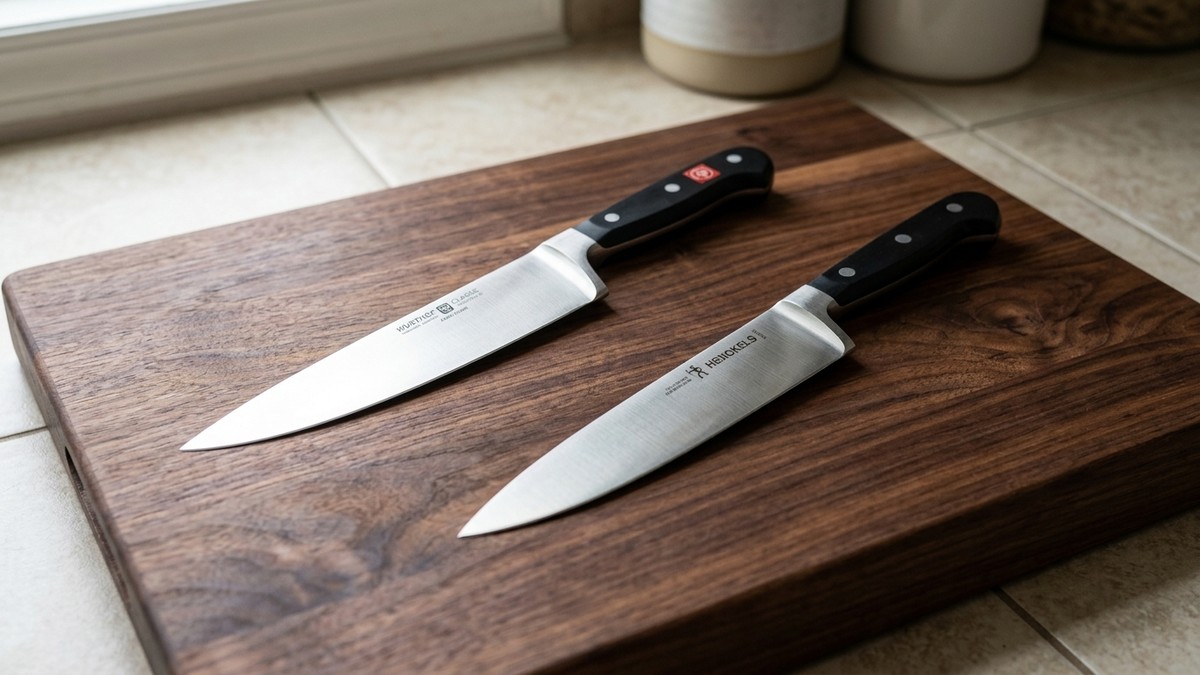
Shoppers searching “Wüsthof Classic vs Henckels Pro” want a straight answer on which German chef knife to buy. This kitchen equipment comparison puts the Wüsthof Classic 8-Inch Chef’s Knife against the HENCKELS Classic 8-Inch Chef’s Knife — the brand’s flagship forged knife and the #1 bestseller in its category on Amazon. We break down steel, hardness, edge angle, handle, weight, and manufacturing origin. One of them fits your kitchen better.
The Henckels Name: What Wüsthof Classic vs Henckels Pro Really Means
The Henckels brand operates under the Zwilling J.A. Henckels corporate umbrella, and that causes confusion. Zwilling J.A. Henckels runs two knife brands. The premium brand is Zwilling. The more accessible brand is HENCKELS — formerly labeled Henckels International or J.A. Henckels International.
The logos make it easy to tell them apart. Zwilling knives carry a twin-man silhouette stamped into the blade. HENCKELS knives carry a single-man silhouette. Check the logo, and you know which tier you are holding.
The HENCKELS Classic sits at the top of the HENCKELS line. It is fully forged from German stainless steel, built with a triple-riveted handle, and carries a lifetime warranty. It is not a budget stamped knife. When someone searches “Wüsthof Classic vs Henckels Pro,” this is the knife they are comparing — and it is a fair matchup. Both are forged, full-tang, full-bolster chef knives aimed at serious home cooks.
The key difference hiding in plain sight: the Wüsthof Classic is forged in Solingen, Germany. The HENCKELS Classic is forged from German steel but manufactured in Spain. That distinction matters to buyers who care about Solingen’s protected-origin status for blade making.
Wüsthof Classic vs HENCKELS Classic: Steel and Edge Geometry
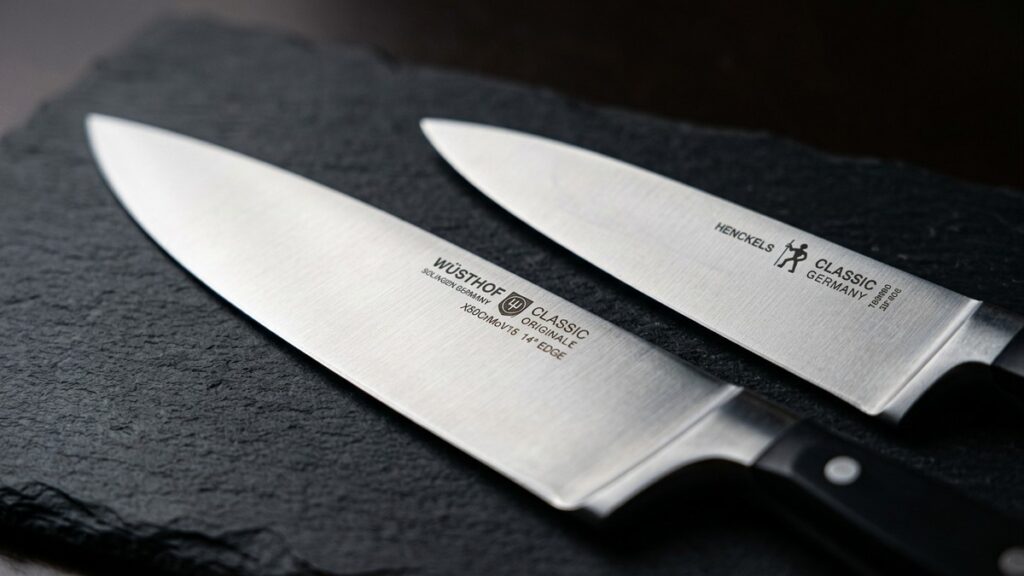
The Wüsthof Classic uses X50CrMoV15 steel — a chromium-molybdenum-vanadium alloy that has been the standard for Solingen knife making for decades. It resists corrosion and takes a sharp edge without chipping, unlike the way harder Japanese steels can. Wüsthof hardens the Classic line to 58 HRC on the Rockwell scale.
Advertisement
The HENCKELS Classic uses a high-carbon German stainless steel. HENCKELS does not publish a specific alloy designation the way Wüsthof does, but the composition is comparable — a chromium-vanadium blend designed for corrosion resistance and edge retention. Hardness lands around 56 HRC. Two Rockwell points below the Wüsthof.
That gap shows up in edge retention. A harder blade holds its working edge longer between honings. Wüsthof’s PEtec (Precision Edge Technology) process laser-measures each blade and hones it to a 14-degree angle per side, 28 degrees total. That narrow geometry bites into food with less resistance. You feel the difference on tomato skins and fresh herbs where a duller knife drags or tears.
HENCKELS hones the Classic at 15 degrees per side, 30 degrees total. One more degree per side puts slightly more steel behind the cutting edge. The trade-off: the wider angle handles lateral stress better on hard root vegetables. And the softer steel is easier to resharpen at home with a basic pull-through sharpener or whetstone.
Quick clarification for anyone new to knife maintenance: honing and sharpening are not the same thing. A honing steel straightens the microscopic edge that folds during normal cutting. Sharpening removes metal to create a new edge. Both knives need regular honing. Sharpening comes once or twice a year at most. Wüsthof’s Classic collection page publishes PEtec specs and hardness data for the full lineup.
For a deeper look at how blade geometry affects cutting technique, our santoku vs chef knife comparison breaks down Western rocking profiles against Japanese push-cut designs.
Handle, Weight, and the Full-Bolster Factor
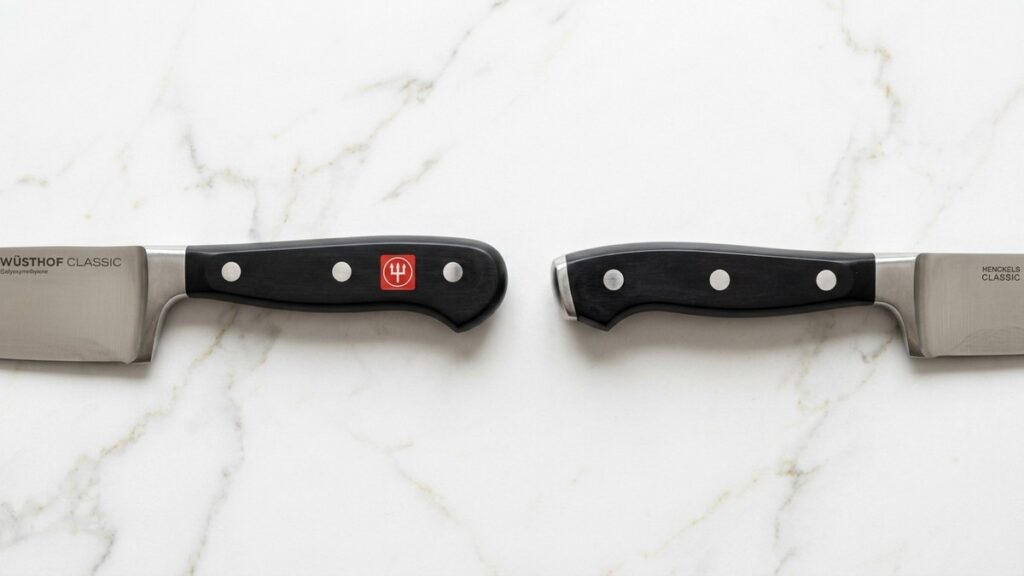
Both knives use the same construction template: a triple-riveted handle pinned to a full tang with a full bolster running from blade heel to handle. Pick up one, then the other, and the family resemblance is obvious. The differences are in the details.
The Wüsthof Classic handle is made from polyoxymethylene (POM), a synthetic resin that resists moisture and will not crack or warp over time. Three stainless steel rivets pin the handle scales to the tang. The handle profile is blocky and traditional — the same shape Wüsthof has used for decades.
The HENCKELS Classic handle uses a composite material with a slightly more contoured grip. The triple-rivet construction is the same. The handle sits a fraction narrower in the hand and tapers more toward the butt end. Some cooks prefer it. Others find the Wüsthof’s chunkier profile gives them a more secure grip during heavy rocking cuts.
Weight separates them. The Wüsthof Classic 8-inch runs around 8.5 ounces — dense and blade-heavy. That forward weight rewards the rocking chop motion most Western-trained home cooks rely on. The HENCKELS Classic is lighter, closer to 7 ounces. A lighter knife tires your hand less during long prep sessions but gives you less momentum through thick produce like butternut squash.
Both knives have a full bolster. That means a thick band of steel runs from the blade spine down to the cutting edge at the heel. The full bolster adds forward weight and protects your fingers from sliding onto the blade. But it creates a problem at the heel when sharpening on a whetstone — the bolster metal blocks full contact between the stone and the edge. After years of regular sharpening, the heel develops a slight recurve where the edge no longer sits flush with the cutting board.
Building a full set around one of these brands? Our best kitchen knives roundup covers how each manufacturer’s lineup fits together from paring knife to bread knife.
Wüsthof Classic vs Henckels Pro: Head-to-Head Specs
| Spec | Wüsthof Classic 8″ | HENCKELS Classic 8″ |
|---|---|---|
| Steel | X50CrMoV15 | High-carbon German stainless |
| Rockwell Hardness | 58 HRC | ~56 HRC |
| Edge Angle (per side) | 14° (PEtec) | 15° |
| Total Edge Angle | 28° | 30° |
| Handle Material | POM, triple-riveted | Composite, triple-riveted |
| Bolster Type | Full bolster | Full bolster |
| Approximate Weight | ~8.5 oz | ~7 oz |
| Country of Origin | Solingen, Germany | Spain (German steel) |
| Warranty | Lifetime | Lifetime |
| Best For | Edge retention, rocking chop | Lighter grip, everyday prep |
Both knives are forged from German steel and carry lifetime warranties. The differences come down to hardness, edge precision, weight, and where the blade is made. Kenji López-Alt wrote on Serious Eats that the best chef’s knife is the one that fits your hand and your cutting style, not the one with the highest spec on paper.
Advertisement
Which Knife Belongs in Your Kitchen: Wüsthof Classic or HENCKELS Classic
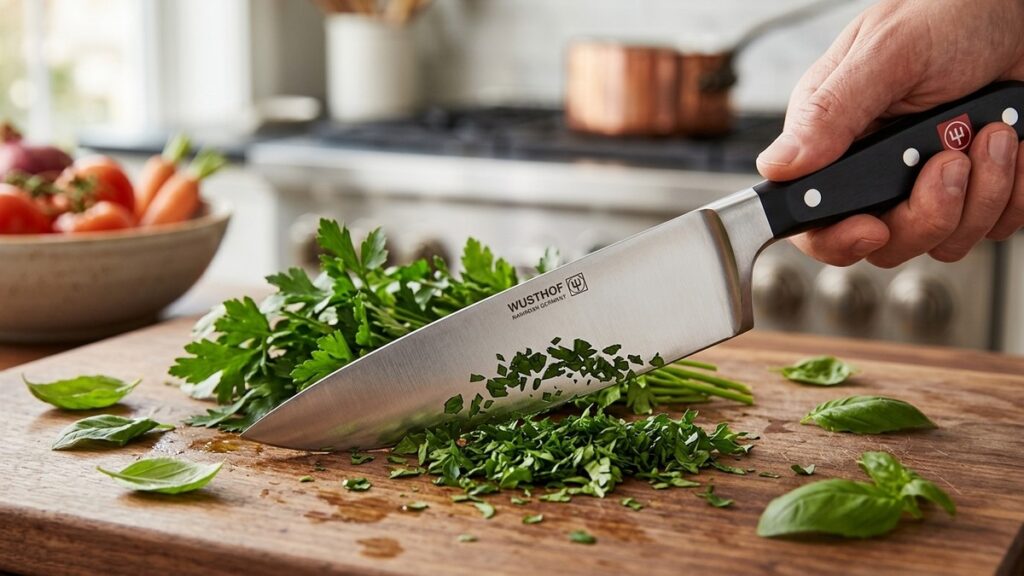
The Wüsthof Classic makes sense if you want a knife that holds its edge longer between honings and you rely on the rocking chop for most of your cutting. The 58 HRC blade and 14-degree edge angle deliver a sharper bite out of the box. The heavier build drives through dense produce without extra effort. And the Solingen manufacturing means every step — forging, grinding, hardening, and honing — happens in the same German city that has been making knife blades since the Middle Ages.
Wüsthof
WÜSTHOF Classic 8 Inch Chef’s Knife,Black,8-Inch
- KITCHEN WORKHORSE – The WÜSTHOF 8” Classic Chef’s Knife is essential for preparing any meal. This all-purpose cook’s knife can be used for chopping, mincing, slicing and dicing
- WÜSTHOF CLASSIC SERIES – The full Tang, Triple Riveted handles of the classic line offer the widest range of cutlery that can satisfy every home cook or professional chef. The WÜSTHOF classic series has been our best-selling series for generations
- CHEF’S KNIFE – Features an 8” long blade, 4.5” long handle and weighs 8.5 ounce Full Bolster and Finger Guard, German Made Cook’s Knife. Ergonomic handle design made from a long-lasting synthetic material to resist fading and discoloration
The HENCKELS Classic fits if you want forged German steel construction at a more accessible tier. The lighter weight reduces hand fatigue during long prep sessions. The 15-degree edge is more forgiving if you go a few weeks between honings — softer steel resharpens faster. And with over 7,600 reviews on Amazon and a 4.7-star rating, the long-term durability data is deep. Thousands of home cooks have put years into this knife and kept coming back.
HENCKELS
HENCKELS Classic 8-Inch Chef Knife, Razor-Sharp, German Engineered
- ULTRA-SHARP BLADES: Superior professional-level sharpness that ensures precision cutting.
- STAYS SHARP LONGER: Professional, satin-finished blade boasts precision cutting and is finely honed for long-lasting sharpness.
- EFFORTLESS CUTTING: Enjoy easy meal prep with minimal effort with this lightweight, easy-to-use knife.
Both knives carry a lifetime warranty. Both survive the dishwasher according to manufacturer specs, but hand washing extends the life of the handle and edge. Get in the habit of honing a steel rod before each cooking session. Two or three passes per side keep either knife performing close to factory sharpness for months.
If your cutting style leans toward Japanese technique with more push-cutting and less rocking, our guide on what a santoku knife is used for explains how Asian blade geometry compares to the Western profile of both these knives.
Frequently Asked Questions About Wüsthof Classic and Henckels Pro Knives
The two questions readers ask most about the Wüsthof Classic vs Henckels Pro matchup: whether these knives come from the same company (they do not), and which one holds a sharper edge longer (the Wüsthof Classic, by a measurable margin tied to its higher Rockwell hardness and thinner edge angle).
Advertisement
Is the HENCKELS Classic made in Germany?
The HENCKELS Classic is forged from German stainless steel but manufactured in Spain. Wüsthof makes the Classic line in Solingen, Germany. Only knives produced within Solingen city limits can carry the “Made in Solingen” designation. Both companies fall under German corporate headquarters, but the manufacturing locations differ.
What is the difference between Zwilling and Henckels?
Zwilling is the premium brand. HENCKELS is the more accessible brand. Both operate under the Zwilling J.A. Henckels AG corporate umbrella. Zwilling knives are forged in Solingen, Germany, and carry the twin-man logo. HENCKELS knives carry the single-man logo. The HENCKELS Classic is the top of the HENCKELS line — fully forged with a lifetime warranty — but it sits below Zwilling’s premium tiers like the Zwilling Pro and Zwilling Twin Fin.
Do professional chefs prefer Wüsthof or Henckels?
Professional kitchens lean toward Wüsthof or the premium Zwilling line rather than the HENCKELS Classic. Culinary school programs in the United States have historically partnered with Wüsthof for student knife kits, which builds brand loyalty early. But many working chefs choose based on handle feel and cutting style rather than brand name. A home cook who maintains a honing routine will get professional-level performance from either the Wüsthof Classic or the HENCKELS Classic.
Can you sharpen a Wüsthof Classic or HENCKELS Classic on a whetstone?
Yes, but both knives have the same limitation. The full bolster on each knife extends to the bottom of the blade edge and blocks full contact with a flat stone at the heel. After years of sharpening, this produces a slight recurve near the heel where the edge no longer sits flush with the cutting board. You can fix it by grinding down the bolster, but most home cooks will not bother. If full-blade whetstone contact matters to you, look at half-bolster models from either brand — the Wüsthof Classic Ikon or the Zwilling Pro.
Hell’s Kitchen Recipes is reader-supported. When you buy through links on this page, we may earn a commission. We only recommend products we would use ourselves.
Advertisement

About the Author
John Siracusa is the founder of Hell’s Kitchen Recipes. He focuses on technique-first, reproducible home cooking and researches recipes & kitchen equipment from published food science and professional chef methods since 2016.