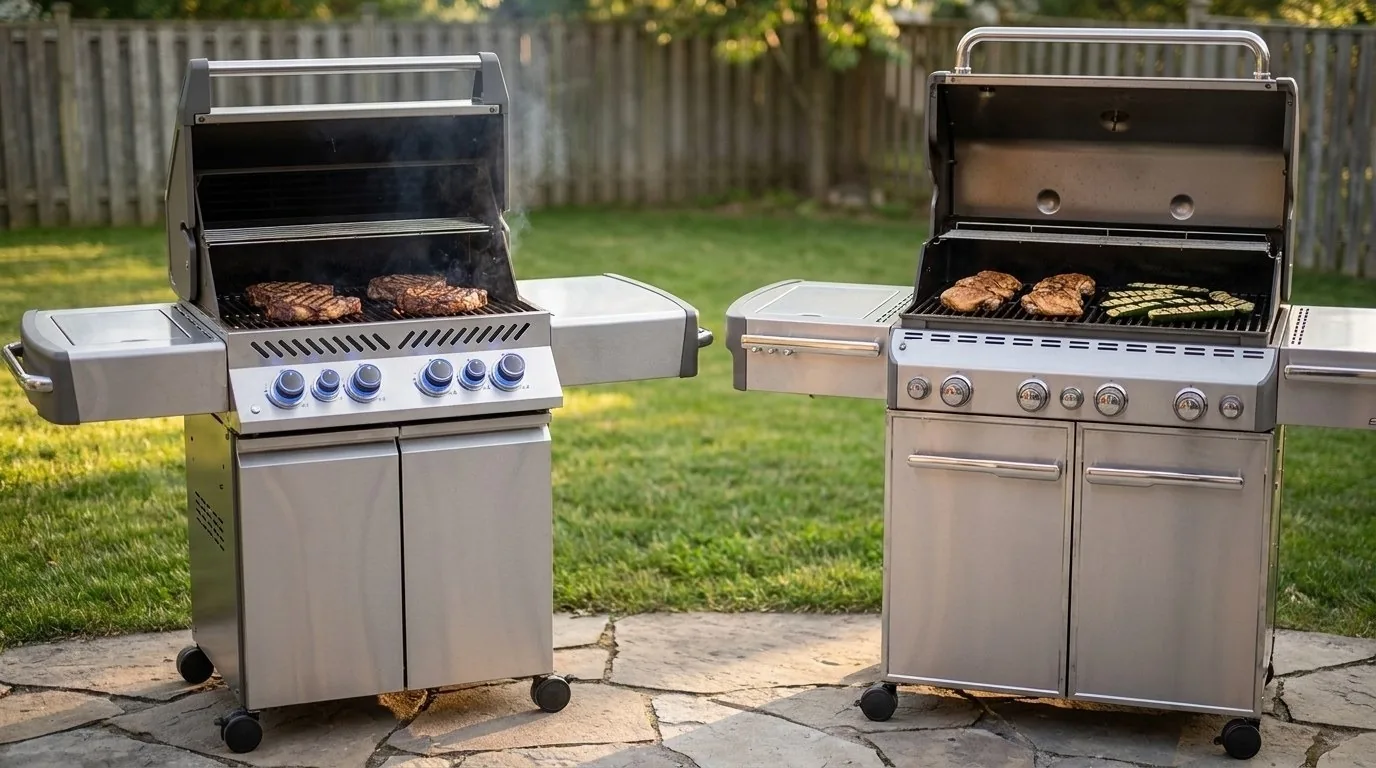
Napoleon vs Weber comes down to this: at the same size, Napoleon's gas grills put more burner input, more cooking area and a longer warranty on the spec sheet, while Weber's are simpler and easier to find in ordinary stores. Napoleon's Rogue 425 runs three burners at 42,000 BTU over a 23 3/4 by 18-inch grate against 31,000 BTU and 360 square inches on Weber's three-burner Spirit E-325. Higher up, Napoleon's Prestige line carries a lifetime limited warranty on its lid, burners and stainless grids, where Weber's Genesis and Summit cover the burners for 10 years. Napoleon also turns up in the promotional-consideration credits at the end of Hell's Kitchen Season 25, a paid sponsor listing covered in the Hell's Kitchen sponsors guide.
This comparison pairs the two brands line against line, Rogue against Spirit, Prestige against Genesis and Prestige PRO against Summit, using only the figures each maker publishes, then explains what the grates, the infrared burners and the warranties mean once a steak is on the fire. It belongs to the site's kitchen gear guides, and the Napoleon Prestige 500 review goes deeper on the grill most Napoleon buyers ask about.
| Matchup | Napoleon | Weber |
|---|---|---|
| Mid-size, 3 burners | Rogue 425: 42,000 BTU, 23.75 x 18 in main, 576 sq in total, porcelain cast-iron grids | Spirit E-325: 31,000 BTU, 360 sq in main, 450 sq in total, porcelain cast-iron grates |
| Upper mid, 4 burners | Prestige 500 RSIB: 4 burners + infrared rear and side burners, 82,000 BTU total, 28 x 17.75 in main, 900 sq in total, 8.5 mm stainless grids | Genesis E-415: 48,000 BTU, 646 sq in main, 820 sq in total, porcelain cast-iron grates, no side burner |
| Flagship, 5 burners | Prestige PRO 665 Elite: 94,000 BTU total, 37 x 18 in main, 1,141 sq in total, 9.5 mm stainless grids, infrared side and rear burners, app and probes | Summit FS38 S: 65,000 BTU main + 12,000 side + 16,000 infrared broiler, 681 sq in main, 9 mm stainless rod grates, rotisserie, smoker box |
| Warranty, burners | Rogue: 15 years; Prestige and PRO: lifetime limited | Spirit: 10 years; Genesis: 10 years; Summit: 10 years |
| Warranty, lid and cookbox | Rogue: 15 years; Prestige and PRO: lifetime limited | Spirit: 10 years; Genesis: 12 years; Summit: 15 years |
| Warranty, grates | Stainless grids lifetime (Prestige) or 15 years (Rogue); porcelain cast iron 15 years | Spirit: 5 years; Genesis and Summit: 10 years |
Read the table as two different bets. Napoleon spends its money on hardware per model: more BTU, more grate, an infrared burner on most of the Prestige range and a warranty measured in decades. Weber spends it on a narrower spec and a retail reach well beyond specialty grill dealers, and its warranty climbs with the line rather than starting high. Neither brand publishes grate-temperature data, so the honest comparison is the spec sheet plus the physics of how each part cooks.
Napoleon vs Weber at a Glance: Which Brand Is Better?
Napoleon is the better-equipped grill on paper at every size where the two meet, and Weber is the safer buy for a cook who wants a grill that is simple to service and easy to find parts for. Napoleon's lead shows up in three places: burner input per square inch at the low end, standard infrared burners in the Prestige range, and a warranty that covers the burners for life on Prestige models. Weber's lead is in its simpler builds, the cast-aluminum cookbox on the Spirit, and a retail network wide enough that replacement parts are rarely hard to find.
BTU needs one caution before it decides anything. A BTU rating is the burners' gas input per hour, not a temperature, and how hot the grate gets depends on how much of that heat the lid, firebox and grates keep in rather than losing to the air. Napoleon also publishes its heat output as a single total that includes the rear and side burners, while Weber lists the main burners on their own, so a Prestige 500's 82,000 BTU and a Genesis E-415's 48,000 BTU are not like for like: the Prestige 500's four main burners are listed at 48,000 BTU on BBQGuys' Prestige 500 page, the same as the Genesis.
Napoleon Rogue 425 vs Weber Spirit E-325
The Napoleon Rogue 425 gives you more grill than the Weber Spirit E-325 for the same three-burner footprint, and the Spirit answers with a dedicated sear zone and a more compact body. Napoleon's Rogue 425 page lists three main burners at 42,000 BTU, a 23.75 by 18-inch main grate (room for 26 burgers by Napoleon's count), 576 square inches including the warming rack, porcelainized cast-iron WAVE grids and stainless dual-level sear plates. Weber's Spirit E-325 page lists three burners at 31,000 BTU, 360 square inches of primary grate and 450 in total, porcelain-enameled cast-iron grates and a 98-pound weight.
Advertisement
Napoleon
Napoleon Rogue 425 3-Burner Propane Grill
- Three stainless steel main burners over a 23 3/4 x 18-inch main cooking area
- Porcelainized cast-iron WAVE cooking grids over stainless dual-level sear plates
- Black porcelain-enamel lid, folding side shelves, battery-free JETFIRE ignition
The Spirit's case rests on its Sear Zone: two red Boost Burner knobs that Weber says deliver 40% more power to that part of the grate, which is a gas-flow answer to the same problem Napoleon solves with infrared on its pricier lines. It also has a cast-aluminum cookbox, which cannot rust through, and Weber's Snap-Jet ignition lights each burner with one hand. The Rogue's case is area and warranty: about 19% more main grate and a 15-year warranty on its tiered table against the Spirit's 10 years on the cookbox, lid and burners and 5 on the grates. A buyer who cooks for four on weeknights is well served by either; a buyer who feeds a crowd on weekends gets more room from the Rogue. Napoleon's stainless Rogue 425 is sold through dealers such as BBQGuys.
Weber
Weber Spirit E-325 Gas Grill (Propane, Black)
- Three burners, 31,000 BTU-per-hour main-burner input, 450 square inches in total
- Two Boost Burners add 40% more power in the Sear Zone; porcelain-enameled cast-iron grates
- Snap-Jet ignition, cast-aluminum cookbox, 10-year limited warranty
Napoleon Prestige 500 vs Weber Genesis E-415
The Napoleon Prestige 500 is the more equipped grill and the Weber Genesis E-415 the more spacious main grate, and the warranty tips the decision toward Napoleon for anyone keeping a grill fifteen years or more. Napoleon's Prestige 500 RSIB page lists four main burners plus an infrared rear rotisserie burner and an infrared SIZZLE ZONE side burner, 82,000 BTU in total, a 28 by 17.75-inch main grate, 900 square inches including the warming rack, 8.5 mm stainless steel grids, an included rotisserie kit and a lifetime limited warranty. Weber's Genesis E-415 page lists four PureBlu burners at 48,000 BTU, 646 square inches of primary grate and 820 in total, porcelain-enameled cast-iron grates, no side burner and a 175-pound weight.
The burner design is where Weber makes its argument. The Genesis uses tapered PureBlu burner tubes that Weber says hold even gas pressure along their length, with the flame ports raised so debris falls below them instead of clogging them. Napoleon answers with cross-lighting, where a burner that fails to light catches from its neighbour, and stainless sear plates over the burners. The Genesis E-415 carries a 12-year warranty on its cookbox and lid and 10 years on its burners and grates; the Prestige 500 covers its lid, castings, stainless grids and tube burners for life. The Prestige 500 review covers its differences from the Prestige PRO 500.
Napoleon Prestige PRO 665 vs Weber Summit FS38
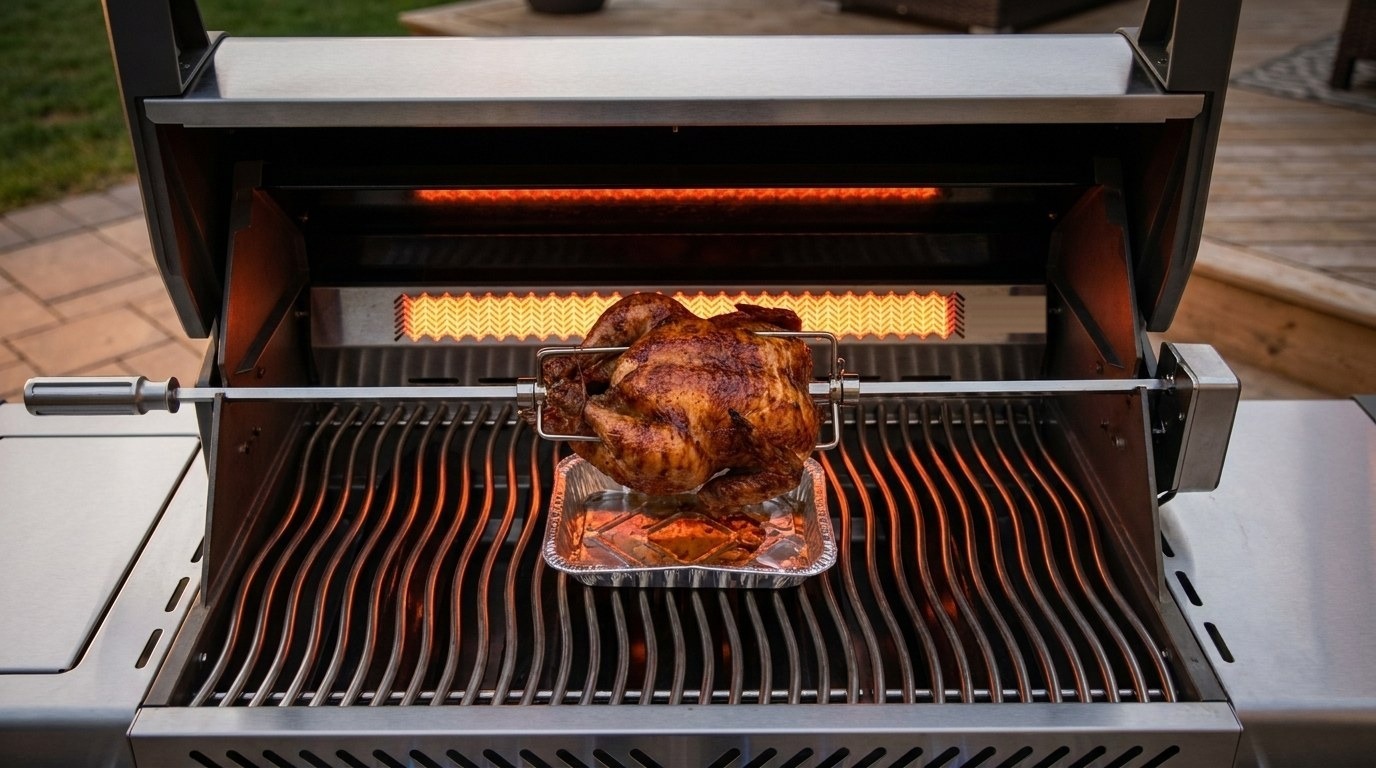
At the top of both ranges the Napoleon Prestige PRO 665 Elite is the bigger, more connected grill and the Weber Summit FS38 S the one with the more unusual searing tool. Napoleon's Prestige PRO 665 Elite page lists five main burners, 94,000 BTU in total, a 37 by 18-inch main grate, 1,141 square inches overall, 9.5 mm stainless WAVE grids, an infrared SIZZLE ZONE side burner that Napoleon says reaches up to 1,800°F in under 30 seconds, an infrared rear burner with a rotisserie kit, a built-in electric smoker box and app control with support for three wired and two wireless probes. It is carried by dealers including BBQGuys.
Advertisement
Weber's Summit FS38 S page lists five burners at 65,000 BTU, a 12,000 BTU side burner and a 16,000 BTU top-down infrared broiler, with 681 square inches of primary grate plus a 372-square-inch upper grate, 9 mm solid stainless rod grates, an integrated rotisserie, a stainless smoker box and a 247-pound weight. The broiler is the Summit's distinctive feature: Weber describes it as directing heat down onto the top of the food, so the crust forms from above while the grates mark the underside. The Summit's warranty runs 15 years on the cookbox and lid and 10 years on the burners and grates, against lifetime coverage on the same parts of the Napoleon.
Cast Iron vs Stainless Grates: Why the Grate Changes the Sear
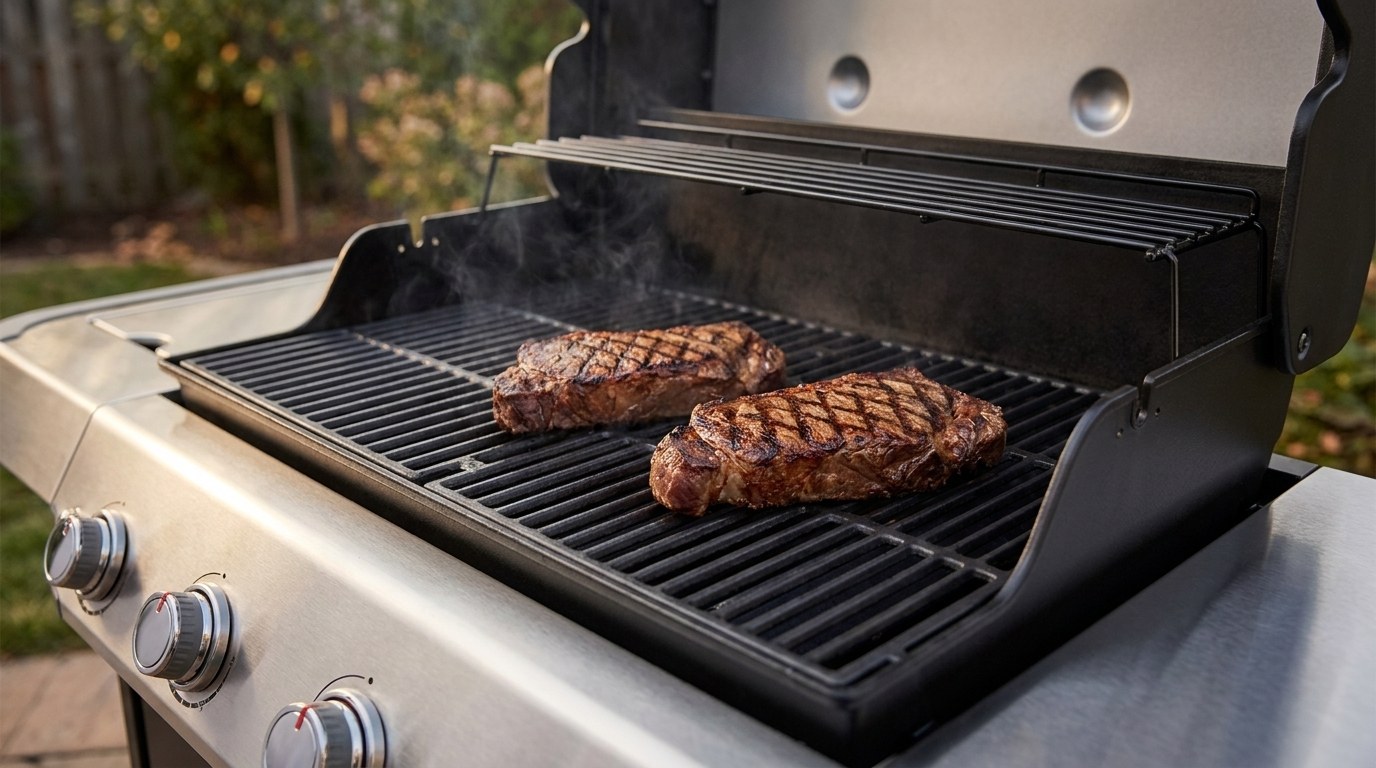
Cast-iron grates give the wider, darker sear marks and stainless grates last longer with less care, which is why both brands put cast iron on their mid-range grills and stainless on their flagships. The difference is how the metal moves heat: cast iron conducts at about 52 watts per metre-kelvin against roughly 14 for 304 stainless steel, per the Engineering ToolBox metals table, so a wide cast-iron bar spreads the burner's heat across its whole face and, because it is heavy, keeps that heat when a cold steak lands on it. The bar stays above 284°F (140°C), where Maillard browning starts, and the contact strip browns deeply toward 320°F (160°C), where browning flavor peaks.
Stainless grates make up for the lower conductivity with mass, which is why the makers quote thickness: 8.5 mm rods on the Prestige 500, 9.5 mm on the Prestige PRO and 9 mm on the Summit. A thick rod holds enough heat to mark a steak, and it has no porcelain coat to chip, which matters because Napoleon's warranty excludes chipping of porcelain-enameled parts and covers porcelain cast-iron grids for 15 years against lifetime for stainless. Napoleon's WAVE shape adds contact length per rod and keeps asparagus and shrimp from dropping through. Whichever grate you choose, the surface of the food is the limit: a wet steak cannot rise past 212°F (100°C) until its surface water evaporates, so pat it dry before it goes on and the grate does the rest. The most tender steaks guide covers which cuts reward a hard sear.
Infrared SIZZLE ZONE vs Weber Sear Zone
Napoleon sears with infrared burners and Weber, below the Summit, sears with extra gas in its regular burners, and the two methods heat a steak in different ways. A standard blue-flame burner heats the air and the grates, so the meat cooks by convection from hot air and conduction through the bars. An infrared burner pushes the flame through a ceramic plate until the plate glows, and the plate radiates energy straight onto the meat surface; radiant heat does not have to warm the air first, so it drives off surface moisture and pushes the crust past the browning threshold in seconds. That is the logic behind Napoleon's claim of up to 1,800°F on the SIZZLE ZONE.
Advertisement
The trade-off is control. Browning tips into burning above about 356°F (180°C) at the surface, and radiant heat gets there fast, so an infrared sear is a minute or two a side with the meat moved off as soon as the crust forms, then finished over the main burners. Weber's Boost Burners on the Spirit raise gas flow under one part of the grate and are gentler, which suits thinner steaks, chops and burgers; the Summit's top-down broiler is Weber's infrared answer. For doneness, the USDA FSIS safe temperature chart sets 145°F (63°C) with a three-minute rest for steaks and chops, 160°F (71°C) for ground meat and 165°F (74°C) for poultry. The skirt steak recipe is a good first cook on either kind of sear zone.
Sear Plates vs Flavorizer Bars: Flare-Ups and Flavor
Both brands put a metal shield between the food and the burner, Napoleon's stainless dual-level sear plates and Weber's stainless Flavorizer bars, and both do the same two jobs. Fat and juices that drip onto the hot metal vaporize into smoke that rises back into the food, which is where much of gas-grill flavor comes from, and the shield keeps drips off the burner ports so they do not clog or corrode. Fat that pools instead of vaporizing is what feeds a flare-up, so the grease tray and the shields need regular cleaning: the NFPA's grilling page reports that the grill had not been cleaned in about one-fifth of home grill fires, and recommends a soapy-water leak test on a propane hose and regulator before the season starts.
Lid-down cooking uses the same burners differently. With one side lit and the other off, the closed lid turns the firebox into an oven, and hot air circulates around food on the cool side; that indirect zone is how ribs and pork shoulder get the long time above 154°F (68°C) that converts collagen to gelatin, as the how to grill ribs guide explains. Both brands' four- and five-burner grills have room for a proper two-zone fire, and the backyard burger method uses the same split for thick patties.
Napoleon vs Weber Warranty Compared
Napoleon's warranty is longer than Weber's at every matching level, and the gap is widest on the burners and grates, the parts that actually wear out. Napoleon's warranty page sets out tiers by series: the Limited Lifetime tier used on the Prestige and Prestige PRO covers the hood, lid, aluminum castings, stainless cooking grids and stainless tube burners for life, sear plates, porcelain cast-iron grids, the infrared rotisserie burner and other parts for 15 years, the infrared side burner for 3 years (5 on PRO models) and electrical parts for 3. The 15-year tier used on the Rogue covers nearly every part for 15 years, with the infrared side burner at 3. Napoleon's terms cover the original purchaser buying through an authorized dealer, drop to two years for commercial or communal use, and exclude surface rust, discoloration, chipped porcelain and grease-fire damage short of a part rusting or burning through.
Advertisement
Weber publishes its warranty per model on each product page and on its warranties page, all on a no rust-through or burn-through basis. The Spirit E-325 covers its cookbox, lid and burner tubes for 10 years, its grates and Flavorizer bars for 5 and everything else for 2. The Genesis E-415 raises the cookbox and lid to 12 years, the burners, grates and bars to 10 and the remaining parts to 5. The Summit FS38 S covers the cookbox and lid for 15 years and the burners, grates and bars for 10. Weber's terms are shorter but simple to read, and the brand's wide retail reach makes a replacement burner tube or grate easy to source.
Who Makes Napoleon and Weber Grills
Napoleon and Weber are separate, unrelated companies from different countries. Napoleon's warranty names its maker as Wolf Steel Ltd. of Barrie, Ontario, Canada, a company that also builds fireplaces and heating products and says it has been making home comfort products for over 40 years. Weber is Weber-Stephen Products, which lists its address in Palatine, Illinois on weber.com. Neither maker prints a country of manufacture on the product pages cited here, and both source parts globally, so the reliable check for a specific grill is the country-of-origin line on the retailer listing or the rating plate on the grill itself.
Napoleon vs Weber: Which Gas Grill Should You Buy?
| If you want | Buy | Why |
|---|---|---|
| The most grill for a 3-burner footprint | Napoleon Rogue 425 | 42,000 BTU over a 23.75 x 18 in grate, 15-year warranty |
| A compact grill with a dedicated sear zone | Weber Spirit E-325 | Boost Burners, cast-aluminum cookbox, 98 lb |
| Infrared searing and a rotisserie out of the box | Napoleon Prestige 500 | Infrared rear and side burners, lifetime limited warranty |
| The biggest 4-burner primary grate | Weber Genesis E-415 | 646 sq in main grate, PureBlu burners |
| A connected flagship with probes and a smoker box | Napoleon Prestige PRO 665 Elite | App control, 3 wired + 2 wireless probes, 1,141 sq in |
| Top-down infrared and a two-level grate | Weber Summit FS38 S | 16,000 BTU infrared broiler, 372 sq in upper grate |
Napoleon vs Weber is a closer call than the forums suggest, and the answer depends on how long you plan to keep the grill and what you cook most. Buy a Napoleon if you want the most burner, grate and warranty for each size, and especially if an infrared sear burner and a rotisserie are on your list; the Prestige 500 is the sweet spot. Buy a Weber if you value a simpler grill, a cast-aluminum cookbox and parts you can pick up locally, with the Spirit E-325 for a small patio and the Genesis E-415 for the largest four-burner grate. Either way, dry the steak, preheat with the lid down, and let the thermometer, not the BTU number, tell you when it is done.
Advertisement
Napoleon vs Weber FAQs
The questions that come up most: whether Napoleon grills are better than Weber, how the Rogue compares with the Spirit, how the Prestige compares with the Genesis, which warranty is better, where Napoleon grills are made, whether Napoleon and Weber are the same company, how long a Napoleon grill lasts, and whether Hell's Kitchen uses Napoleon grills.
Are Napoleon grills better than Weber?
On the spec sheet, yes at every size where the two meet: the Napoleon Rogue 425 has more BTU and grate than the Weber Spirit E-325, the Prestige 500 adds infrared rear and side burners the Genesis E-415 lacks, and Prestige models carry a lifetime limited warranty on the burners. Weber is simpler and easier to find parts for locally.
Is the Napoleon Rogue better than the Weber Spirit?
The Rogue 425 has three burners at 42,000 BTU over a 23.75 by 18-inch main grate and a 15-year warranty; the Spirit E-325 has three burners at 31,000 BTU over 360 square inches, a Boost Burner sear zone and a 10-year warranty on its cookbox, lid and burners. The Rogue gives more room; the Spirit is more compact.
Napoleon Prestige vs Weber Genesis: which should I buy?
Choose the Prestige 500 for infrared rear and side burners, an included rotisserie, stainless grids and lifetime coverage on its burners and grids. Choose the Genesis E-415 for a larger 646-square-inch primary grate, porcelain cast-iron grates and Weber's PureBlu burners, backed by 12 years on the cookbox and 10 on the burners.
Which has the better warranty, Napoleon or Weber?
Napoleon. Its Prestige and Prestige PRO grills cover the lid, castings, stainless grids and tube burners for life and most other parts for 15 years; the Rogue covers nearly everything for 15 years. Weber covers burners for 10 years on Spirit, Genesis and Summit, with cookbox coverage of 10, 12 or 15 years by line.
Where are Napoleon grills made?
Napoleon is Wolf Steel Ltd., headquartered in Barrie, Ontario, Canada, the company named in its warranty. Napoleon does not print a country of manufacture on its US product pages, so check the country-of-origin line on the retailer listing or the rating plate for a specific model.
Are Napoleon and Weber the same company?
No. Napoleon is made by Wolf Steel Ltd. of Barrie, Ontario, a Canadian company that also builds fireplaces. Weber is Weber-Stephen Products of Palatine, Illinois. The two compete directly and share no ownership.
How long do Napoleon grills last?
Napoleon backs its Prestige and Prestige PRO grills' lid, castings, stainless grids and burners for life and the Rogue for 15 years, and how long one lasts in practice depends on care: clean the grease tray and sear plates, keep a cover on it, and rinse it regularly near a pool or the coast, which Napoleon's warranty treats as required maintenance.
Does Hell's Kitchen use Napoleon grills?
Napoleon is listed in the promotional-consideration credits at the end of Hell's Kitchen Season 25 episodes, which is a paid sponsor credit. The credit itself does not say which equipment the show's kitchen or chefs cook on.

About the Author
John Siracusa is the founder of Hell’s Kitchen Recipes. He focuses on technique-first, reproducible home cooking and researches recipes & kitchen equipment from published food science and professional chef methods since 2016.