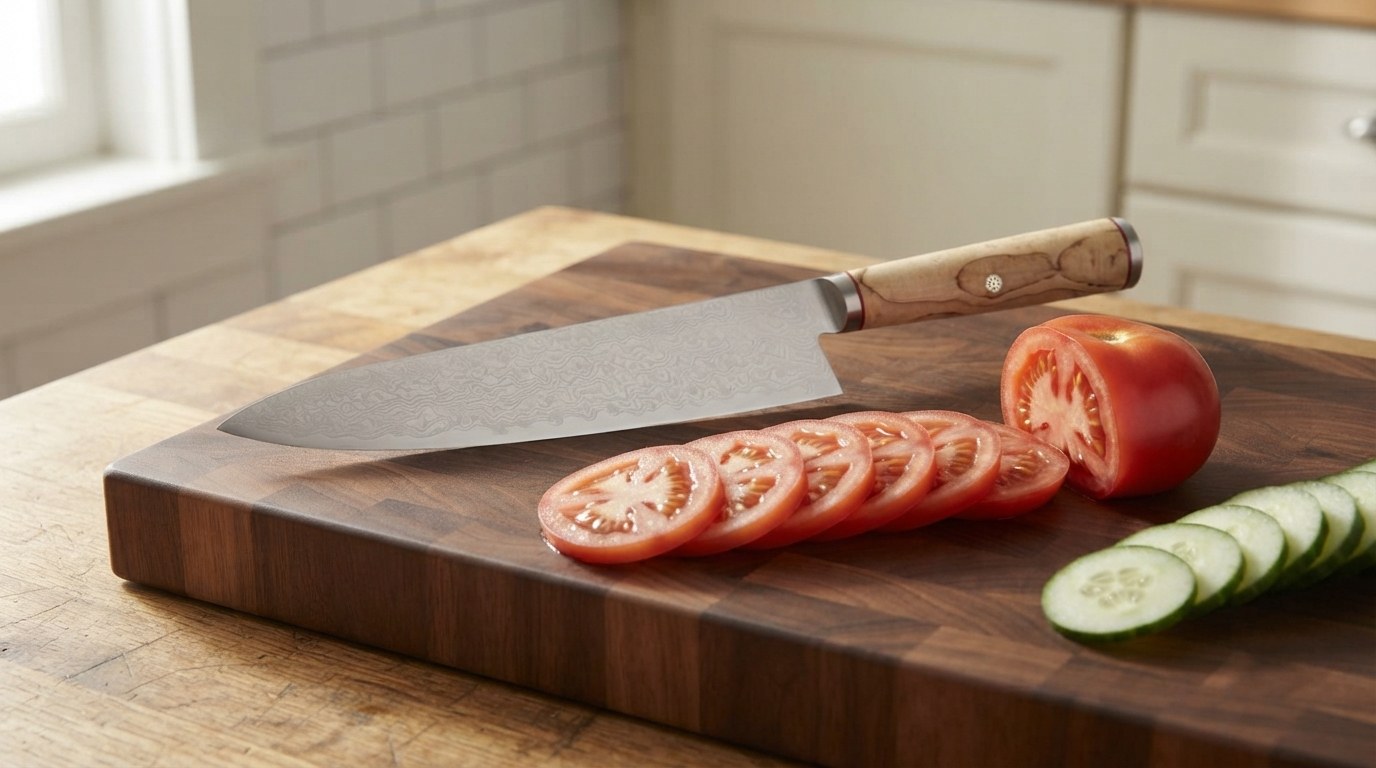
Miyabi knives are good knives for a specific kind of cook. This Miyabi knives review comes down to one trade: every Miyabi is handcrafted in Seki, Japan, from steel hardened to between 60 and 66 on the Rockwell C scale and hand-honed to an edge of 9.5 to 12 degrees per side, which makes the blades thinner and sharper than a German chef's knife and also easier to chip. If you slice and dice with push and pull strokes, wash by hand and cut on wood or plastic, a Miyabi will hold a keen edge for a long time. If you split chicken bones, hack through winter squash or run knives through the dishwasher, buy a German knife instead.
Miyabi is Zwilling J.A. Henckels' Japanese brand, so it comes from the same company as the Henckels knives Hell's Kitchen contestants are given, which the Hell's Kitchen knives guide covers along with the rest of the Hell's Kitchen sponsors. This guide compares the current Miyabi lines from the specifications Zwilling publishes, explains what the steel numbers mean in the kitchen, sets Miyabi against Shun, and covers sharpening and care. For the wider field, see the best Japanese knife brands and the kitchen gear hub.
Miyabi Knives Review: Every Current Line Compared
Every current Miyabi line pairs one of four core steels with a different blade finish and handle, and the steel sets the hardness. Zwilling lists FC61 fine-carbide steel at about 61 HRC (Kaizen II, Koh, Evolution, Hibana), VG10, which Zwilling calls CMV60, at 60 HRC (Kaizen), SG2 micro-carbide powder steel, called MC63, at 63 HRC (Birchwood and Artisan), and MC66, a ZDP-189 powder steel, at 66 HRC (Black). All of them are hand-honed with the three-step Honbazuke process, and Zwilling lists a 9.5 to 12 degree edge on each line whose product page gives an angle. The table sets the eight lines Zwilling and Sur La Table currently sell side by side.
| Miyabi line | Core steel | Hardness (HRC) | Blade layers and finish | Handle | Best for |
|---|---|---|---|---|---|
| Kaizen II (5000FCD) | FC61 fine carbide | 61 | 49 layers, flower Damascus darkened by acid dipping | Black pakkawood D-shape, thicker rounded bolster | A first Miyabi for everyday cooking |
| Kaizen (5000DP) | VG10 (CMV60) | 60 | 65 layers, flower Damascus | Black linen Micarta D-shape | A slightly tougher edge and a moisture-proof handle |
| Koh (4000FC) | FC61 fine carbide | 61 | Mirror polish, sandblasted katana edge, no Damascus | Octagonal pakkawood | A plain blade and a heavier, Western feel (0.62 lb in 8 in) |
| Evolution (400FC) | FC61 fine carbide | 61 | Mirror finish, sandblasted katana edge, no Damascus | Triple-rivet POM with red spacers | Cooks who want a German-style handle |
| Hibana (800DP) | FC61 fine carbide | 60-62 | 49 layers, acid-dipped Damascus | Triple-rivet Western handle, curved bolster | A pinch grip on a Western handle |
| Artisan (6000MCT) | SG2 (MC63) powder steel | 63 | Hand-hammered tsuchime finish | Cocobolo rosewood pakkawood D-shape | SG2 edge retention with a larger handle |
| Birchwood (5000MCD) | SG2 (MC63) powder steel | 63 | 101 layers, flower Damascus | Karelian (masur) birch D-shape | Long edge life and the classic Miyabi look |
| Black (5000MCD67) | MC66 (ZDP-189) powder steel | 66 | 133 layers, flower Damascus | Black-dyed bigleaf maple burl D-shape | The hardest, keenest edge; the most care |
Read the table from the top down as a trade between toughness and edge life. The FC61 and VG10 lines at 60 to 61 HRC are the forgiving end, which is why the Kaizen II 8-inch chef's knife is the usual first Miyabi; the SG2 lines at 63 HRC stay sharp longer between sharpenings, and the Black 8-inch chef's knife at 66 HRC holds the finest edge and asks the most of its owner. Weight follows the handle more than the blade: Zwilling lists the 8-inch Birchwood at 0.38 lb, the Kaizen II, Kaizen and Black at 0.44 lb, and the Koh at 0.62 lb.
Miyabi
Miyabi Kaizen 8-Inch Chef's Knife
- VG10 steel core, CRYODUR ice-hardened to Rockwell 60, inside a 65-layer flower Damascus blade
- Hand-honed with the three-step Honbazuke process to a 9.5 to 12 degree edge
- D-shaped black linen Micarta handle with a mosaic pin and red spacers; handcrafted in Seki, Japan
The original Kaizen, carded above, has a VG10 core at 60 HRC, the softest steel in the range, which in practice means the most resistance to small chips. The Birchwood SG2 8-inch chef's knife is the line most people picture when they search for Miyabi: a 101-layer blade around an SG2 core at 63 HRC with a Karelian birch handle, a concealed tang and a rounded spine and heel. America's Test Kitchen put the SG2 Miyabi Artisan 8-inch in its chef's knife review and reported it among the top choices of everyone who tried it, ultrasharp on every food, with one caveat: the long, full-bellied, smooth handle is harder for small hands to grip securely.
What Miyabi Steel Numbers Mean: Hardness, Edge Angle and Chipping
Hardness is what lets a Miyabi hold a thinner edge, and it is also why that edge can chip. On the Rockwell C scale, America's Test Kitchen reports that the Japanese gyuto it reviewed run 58 to 65 HRC against about 55 to 58 for the Western chef's knives it has tested (ATK gyuto review). Harder steel resists the edge bending and rolling over in use, so a fine apex stays fine for longer. The cost is toughness: the same hardness makes the steel more brittle, so a sideways twist, a bone or a frozen block cracks tiny pieces out of the edge instead of bending it. ATK's advice for thin, hard Japanese blades is to skip scraping, twisting, frozen food, bones and dense squash and stick to push and pull cuts.
Advertisement
The edge angle is the second number. Miyabi lists 9.5 to 12 degrees per side; Shun lists 16 degrees, and Western knives are commonly sharpened at 20 to 22 degrees, according to the knife sharpening entry on Wikipedia, which also states the trade plainly: the smaller the angle, the sharper the knife and the less side force it takes to bend the edge or chip it off. A narrower wedge needs less force to push food apart, so a tomato skin parts under the weight of the knife and an onion slices instead of splitting. That matters for the food as well as the effort: a keen edge severs cells cleanly, so a tomato slice keeps its juice and jelly on the board, while a dull edge crushes the cells on either side of the cut. In basil, crushed cells let the browning enzyme polyphenol oxidase meet oxygen, which is why chiffonade from a dull knife darkens at the cut edges.
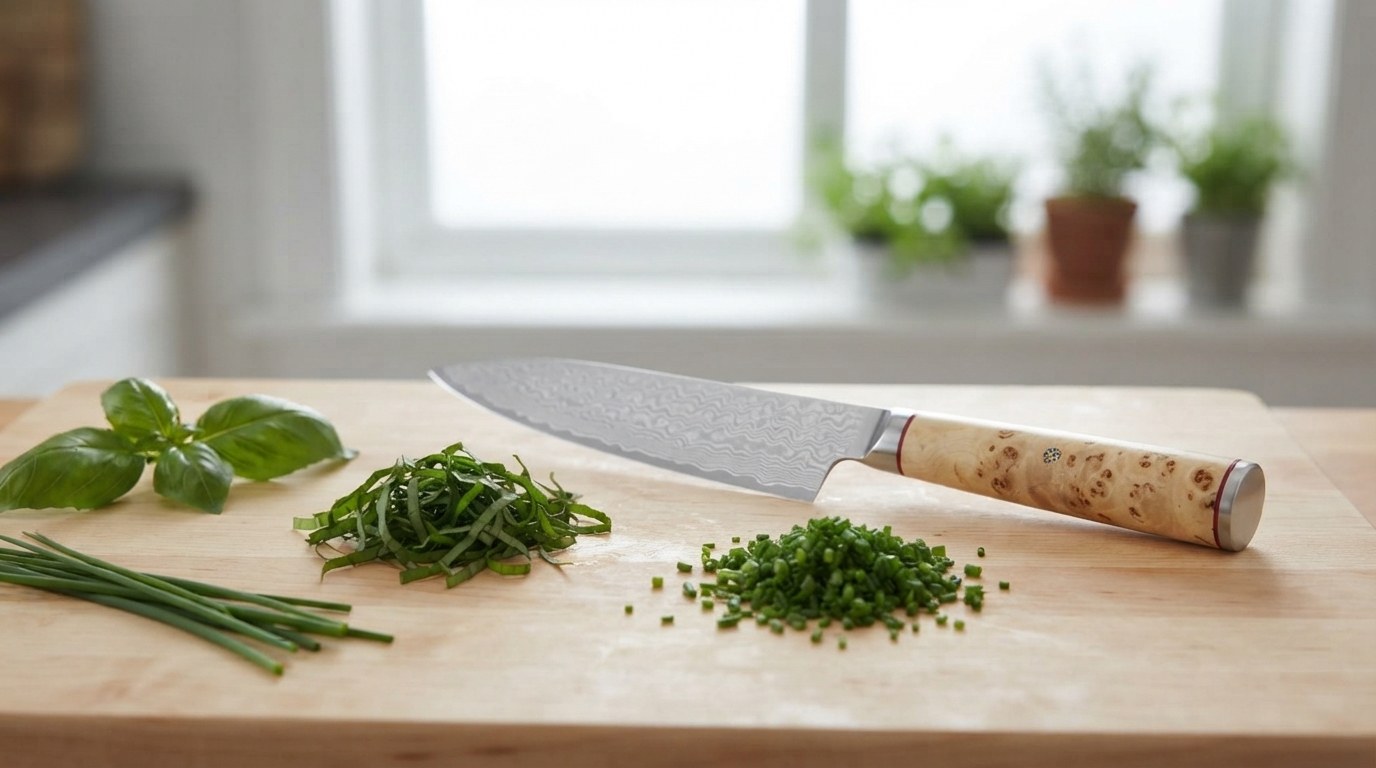
The Damascus pattern is cladding around a hard core. Zwilling's MIYABI production page describes the layers being folded and welded around the core, which is exposed only at the cutting edge, so the core steel cuts while the stainless layers protect it from corrosion and breakage. The ripple you see comes from etching: acid darkens some layers more than others, the same effect described in the pattern welding article, and Zwilling says the Kaizen II and Hibana blades are darkened by acid dipping. Zwilling also ice-hardens every Miyabi blade straight after forging (CRYODUR, or FRIODUR twice over on the FC61 lines), which it credits for the mix of hardness, flexibility and corrosion resistance.
Miyabi Knife Sets: What Comes in Each and Which to Buy
Miyabi knife sets are mostly seven-piece block sets built around an 8-inch chef's knife, a paring knife, a bread knife, kitchen shears, a honing steel and a bamboo block. The Birchwood SG2 7-piece set adds a 7-inch santoku and comes in a 12-slot block, so there is room to grow; the Kaizen II 7-piece set swaps the santoku for a 4.5-inch utility knife in a 10-slot block. Sur La Table sells the Artisan 7-piece block set as an exclusive (8-inch chef's, 7-inch santoku, 9-inch bread, 3.5-inch paring, shears, steel and bamboo block), and a smaller Kaizen II 4-piece easel set with a magnetic easel block. Zwilling's Evolution 7-piece set covers the same jobs with triple-rivet handles.
For most cooks, a Miyabi set is worth it only if you will use the bread knife and santoku; the chef's knife and paring knife cover nearly every cut, and buying those two alone lets you pick the line you like best, such as the Kaizen II chef's knife at Sur La Table or the Evolution chef's knife for a Western handle. Whichever set you choose, treat the included steel as a honing tool, never a sharpener, and hold the knife's own shallow angle on it. For other Japanese sets in the same range, see Japanese knife sets; for the German side of the Zwilling family, the best Zwilling knives.
Miyabi vs Shun: How the Two Seki Brands Differ
Miyabi and Shun are both made in Seki, Japan, both wrap a hard core in Damascus cladding and both put D-shaped handles on their core lines, so the real differences are edge angle, steel range and after-sale service. Miyabi grinds a more acute 9.5 to 12 degree edge and reaches higher hardness on its powder-steel lines (63 to 66 HRC); the Shun Classic 8-inch chef's knife has a VG-MAX core inside 34 layers of stainless Damascus on each side (68 in total), a 16 degree edge per side, an ebony-finished pakkawood D-handle that Shun says suits left- and right-handed cooks, and a weight of 6.7 ounces. Shun also offers free sharpening for as long as you own the knife, with the owner paying shipping and processing.
Advertisement
| Spec | Miyabi Kaizen II 8" | Miyabi Birchwood SG2 8" | Shun Classic 8" |
|---|---|---|---|
| Core steel | FC61 fine carbide | SG2 (MC63) powder steel | VG-MAX |
| Hardness | 61 HRC | 63 HRC | Not stated on the product page |
| Edge angle per side | 9.5 to 12° | 9.5 to 12° | 16° |
| Layers | 49 (48-layer Damascus cladding) | 101 (100-layer cladding) | 69 (34 each side around the core) |
| Handle | Black pakkawood D-shape | Karelian birch D-shape | Ebony pakkawood D-shape |
| Weight | 0.44 lb (about 7 oz) | 0.38 lb (about 6 oz) | 6.7 oz |
| Made in | Seki, Japan | Seki, Japan | Seki, Japan |
| Service | Lifetime warranty | Lifetime warranty | Limited lifetime warranty plus free sharpening |
The reading of that table: pick Miyabi if you want the keener factory edge and the option of harder steel, and plan to sharpen at home or pay a sharpener; pick Shun if a slightly sturdier 16 degree edge and the free factory sharpening matter more to you than the last bit of sharpness. Both cut the same foods and both need the same care. For Shun against German steel instead, see Shun vs Zwilling, and for gyuto beyond these two brands, the best gyuto knife guide.
How to Sharpen Miyabi Knives
Sharpen a Miyabi on a whetstone at its factory angle of roughly 10 degrees per side, or send it to a sharpener who works on Japanese knives. Zwilling's sharpening guide has you soak the stone for about five minutes, keep it wet, hold a steady angle and work in strokes until a burr forms along the edge, then grind both sides alternately; for honing, it says the rod must be harder than the knife, so a 63 to 66 HRC Miyabi needs a ceramic or diamond rod rather than an ordinary steel. On a whetstone, the abrasive grit wears steel off both faces until they meet in a new apex, and the burr, a thin curl of loose metal on the far side, is the sign the two faces have met; a 1000-grit side sets the edge and a finer side polishes it.
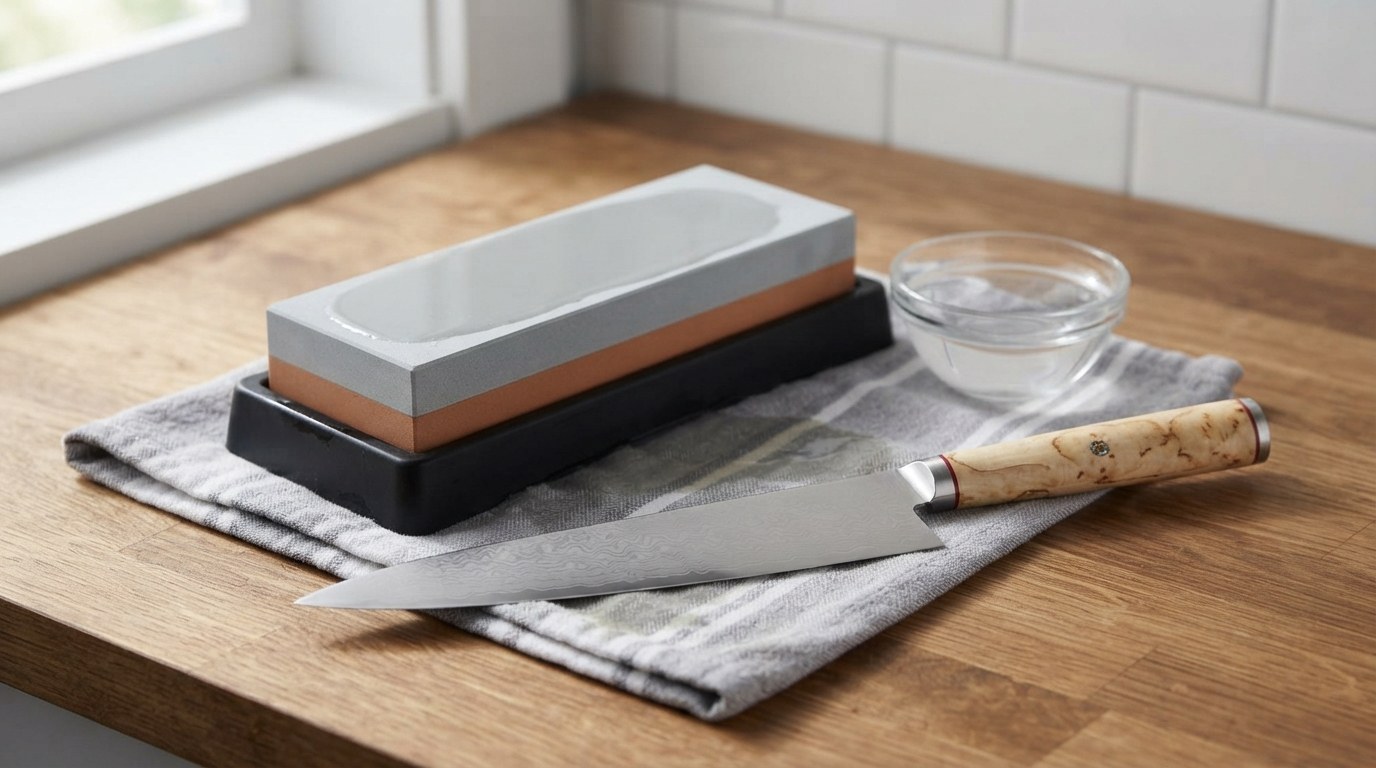
Pull-through and electric sharpeners are the risk. One set for a Western knife's wider angle grinds a thicker bevel onto a Miyabi and takes away the very thinness you paid for, and MSU Extension warns in Knife Sharpeners 101 that electric sharpeners make it easy to remove too much of the blade. Honing is a different job: a honing rod pushes a rolled edge back into line without removing much metal, which is why a few light strokes between sharpenings keep a Miyabi cutting. MSU's honing figure of 22 degrees suits a Western edge; on a Miyabi, hold the shallow angle the edge was ground at. Miyabi edges are honed on both sides within the same 9.5 to 12 degree range, and ATK's gyuto guide notes that a double bevel like that can go straight onto a whetstone without the left-right ratio work an asymmetrical blade needs.
King
KING Whetstone Starter Set, 1000/6000 Grit Combination Stone
- Japanese-made combination water stone: 1000 grit to sharpen, 6000 grit to refine the edge
- Comes with a clip-on knife angle holder and a plastic base that keeps the stone steady
- Water stone, so no honing oil; includes a wiping cloth
Miyabi Knife Care: Dishwasher, Cutting Boards and Storage
Miyabi knives are hand-wash only; Zwilling's product pages say so, and its Birchwood page puts it bluntly: the blade was never meant to be tossed into a dishwasher. A dishwasher knocks a thin edge against racks and other utensils, and the long hot, wet cycle is hard on wooden handles such as birch and cocobolo pakkawood. Wash with warm soapy water, dry the blade and handle straight away, and store it in a block, on a magnetic strip or in a sheath, never loose in a drawer.
Advertisement
The cutting board matters as much as the washing. MSU Extension notes that glass and stone cutting boards dull knives quickly, and the University of Maine Cooperative Extension lists the same drawback for glass, marble and stone; a hard surface rolls or chips a 63 HRC edge at the bottom of every stroke. Use end-grain or edge-grain wood, or a plastic board, and see the best wood for a cutting board for the options. Scrape chopped food off the board with the spine, not the edge, since a sideways drag across the board is the lateral force ATK warns hard Japanese blades against.
Where Are Miyabi Knives Made, and Who Owns Miyabi?
Miyabi knives are made in Seki, Japan, and the brand is owned by Zwilling J.A. Henckels, the Solingen, Germany, knife maker founded in 1731. Wikipedia's Zwilling J. A. Henckels entry lists Miyabi, formerly Nippa, among the group's brands alongside Staub and Demeyere, and the Seki, Gifu entry describes the city as home to Japan's major kitchen-cutlery makers and a centuries-old swordsmithing tradition. Zwilling says each Miyabi goes through more than 100 production steps, that the knives are ice-hardened straight after forging, and that only five trained craftspeople at the factory perform the final Honbazuke edge, each with more than five years of training behind them.
So "German or Japanese?" has a two-part answer: the design and the ice-hardening know-how come from Zwilling, and the forging, finishing and edge work happen in Seki. That combination is why Miyabi lines read like a bridge between the two traditions, from the Japanese D-handles of Birchwood and Kaizen to the triple-rivet Western handles of Evolution and Hibana. For the purely German Zwilling and Henckels lines, see Wüsthof vs Zwilling.
Are Miyabi Knives Worth It? Who Should Buy Them and Who Should Skip Them
Miyabi knives are worth it for a cook who wants a very sharp, long-lasting edge and will look after it. The evidence for the edge is consistent: Zwilling's published steels and angles put Miyabi at the hard, acute end of the market, and ATK reported the Artisan among the top choices of everyone who tried it in its chef's knife review. The weak points are the ones every thin, hard Japanese blade shares: chips from bones, frozen food and twisting, a dislike of glass boards and dishwashers, and the need for a whetstone or a sharpening service in place of a pull-through.
Advertisement
Buy the Kaizen or Kaizen II if this is your first Japanese knife; buy Birchwood or Artisan if you want SG2's longer edge life and will sharpen on stones; buy Black only if you want the hardest edge Miyabi makes and accept that it needs the gentlest use; pick Evolution or Hibana for a Western-style riveted handle. Skip Miyabi if your knife has to split chicken backbones, cleave squash and live in the dishwasher; a German knife at 55 to 58 HRC, or a santoku or chef's knife from a softer-steel line, is the better tool for that kitchen. Of the Miyabi knives reviewed here, the Kaizen II is the safest first buy and the Birchwood the one most cooks keep for life.
Miyabi Knives FAQs
The questions that come up most: whether Miyabi knives are worth it, where they are made, how Miyabi compares with Shun, what angle to sharpen them at, whether they are dishwasher safe, whether the Damascus is real, which Miyabi to buy first, and who owns Miyabi.
Are Miyabi knives good and worth it?
Yes, for a cook who wants a very sharp edge and will care for it. Every Miyabi is handcrafted in Seki, Japan, from steel hardened to 60 to 66 HRC and hand-honed to 9.5 to 12 degrees per side, and America's Test Kitchen reported the Miyabi Artisan 8-inch among the top choices of everyone who tried it. The thin, hard edge can chip on bones, frozen food or glass boards, so they suit push-and-pull slicing, not heavy chopping.
Where are Miyabi knives made?
In Seki, Japan, a city known for kitchen cutlery and, before that, swords. Zwilling J.A. Henckels of Solingen, Germany, owns the brand and contributes the design and ice-hardening process; the forging, finishing and Honbazuke edge work are done in Seki.
Is Miyabi better than Shun?
Neither is better across the board. Miyabi grinds a more acute 9.5 to 12 degree edge and offers harder steels (up to 66 HRC on the Black line), so it starts sharper and holds a finer edge. Shun uses a 16 degree edge, which is a little sturdier, and offers free sharpening for as long as you own the knife (you pay shipping and processing). Both are made in Seki with Damascus-clad blades.
What angle are Miyabi knives sharpened at?
Zwilling lists 9.5 to 12 degrees per side for its Miyabi lines, honed by hand with the three-step Honbazuke method. Sharpen at roughly the same angle on a whetstone; a pull-through sharpener set for a Western knife's wider angle grinds a thicker bevel.
Are Miyabi knives dishwasher safe?
No. Zwilling marks Miyabi knives hand-wash only. The dishwasher knocks the thin edge against racks and utensils, and the long hot, wet cycle is hard on the wooden handles. Wash by hand, dry right away and store the knife in a block, on a magnetic strip or in a sheath.
Is the Damascus on Miyabi knives real?
Yes, it is real layered steel, not a printed or laser-etched pattern. Zwilling builds the blades from many layers of steel (49 on Kaizen II, 101 on Birchwood, 133 on Black) welded around a hard core that is exposed only at the cutting edge; etching then darkens some layers more than others to show the ripple. The layers protect the core; the core does the cutting.
Which Miyabi knife should I buy first?
The Kaizen II or the original Kaizen 8-inch chef's knife. Their FC61 and VG10 cores at 60 to 61 HRC are the most forgiving steels in the range, the D-shaped handles suit most hands, and they sit below the SG2 Birchwood and Artisan and the MC66 Black in Miyabi's range. Move up to Birchwood once you are comfortable sharpening on a whetstone.
Who owns Miyabi knives?
Zwilling J.A. Henckels, the German knife maker founded in Solingen in 1731, which also owns Staub and Demeyere. The same company makes the Henckels knives covered in the Hell's Kitchen knives guide.

About the Author
John Siracusa is the founder of Hell’s Kitchen Recipes. He focuses on technique-first, reproducible home cooking and researches recipes & kitchen equipment from published food science and professional chef methods since 2016.