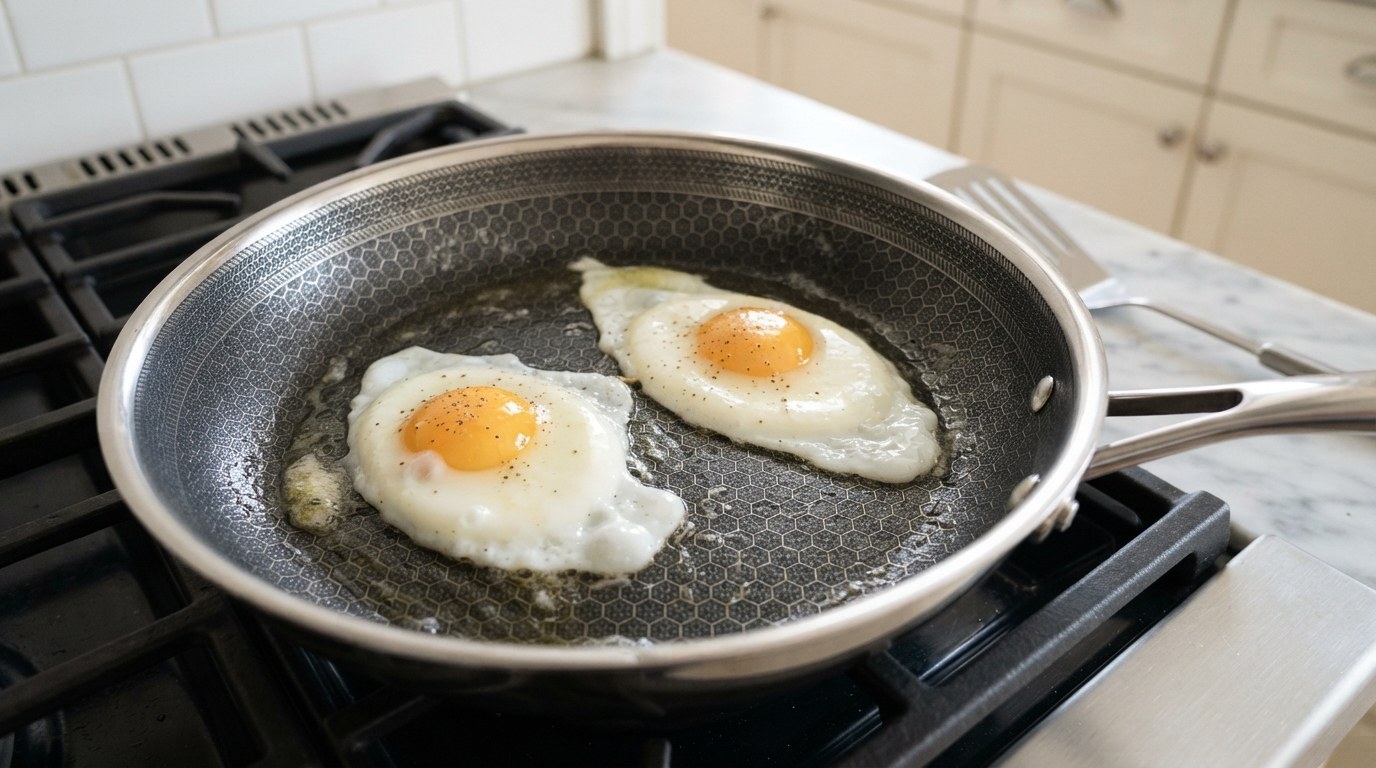
Eggs stick to a HexClad pan for four reasons: the pan went in too hot or was never preheated, there was too little fat, the seasoning was never done or has worn off, or the surface carries residue from cooking spray, burnt oil or the dishwasher. The fix is to preheat on medium-low to medium, add about a tablespoon of butter or oil for every two eggs, wait until the fat shimmers or the butter foams, then put the eggs in and leave them alone until they let go.
That short answer covers most cases, and the rest of this page explains why it works on a hybrid surface, what each kind of sticking looks like, how hot to run the pan for each egg style, and how to reseason a HexClad that has started grabbing. HexClad's own care pages are the source for every instruction about the pan; the food science comes from the Royal Society of Chemistry, the American Egg Board and America's Test Kitchen. For the pan itself, the Ramsay partnership and the model range, see Gordon Ramsay cookware, the site's HexClad pillar, and the HexClad cookware reviews.
Why Is My HexClad Pan Sticking? The Four Causes
A HexClad pan sticks when egg protein reaches bare steel through a missing or broken layer of fat, and each of the four causes below is a different way that layer goes missing. HexClad's own cooking-mistakes guide puts the usual culprit in one line: the pan was not hot enough, or there was not enough oil.
- Heat: a cold pan lets the egg settle onto the steel before it starts to set.
- Heat, the other way: a pan run hot bakes oil into a brown film that grips the next egg.
- Fat: under about 1 tablespoon per 2 eggs, the white touches dry metal between the drops of fat.
- Seasoning: HexClad says to season before first use; a pan that skipped it, or was scrubbed bare, has no oil layer in the valleys.
- Residue: aerosol cooking spray and dishwasher detergent both leave or strip a layer that changes how the surface releases.
Why Eggs Grab the Steel Hexagons
Eggs stick to a HexClad because the raised hexagon grid is bare stainless steel, and egg protein bonds to bare metal. The Royal Society of Chemistry explains sticking as chemical bonds forming between food and the pan's metal, and says protein-rich foods such as egg are especially prone because their proteins form complexes with metal atoms like iron. On a fully coated nonstick pan the egg never meets metal. On a hybrid, the steel peaks are the first thing the egg touches and the ceramic sits down in the valleys, which is why a hybrid needs a film of fat every time and a full nonstick does not.
Heat decides how fast that contact turns into a bond. Egg white starts to set at 144 to 149°F and yolk at 149 to 158°F, per the American Egg Board, as the proteins denature and coagulate into a solid, a change the Institute of Food Science and Technology describes as irreversible. If the white lands on a cold pan, it sits wet against the steel while it slowly warms through that range and sets in place, glued to the grid. If it lands on fat that is already hot, the bottom sets in seconds on a cushion of oil and lifts away. The RSC describes the second protection: oil, being liquid, fills the tiny hills and valleys of the metal surface, so the food rests on fat instead of steel.
How to Cook Eggs in a HexClad Without Sticking
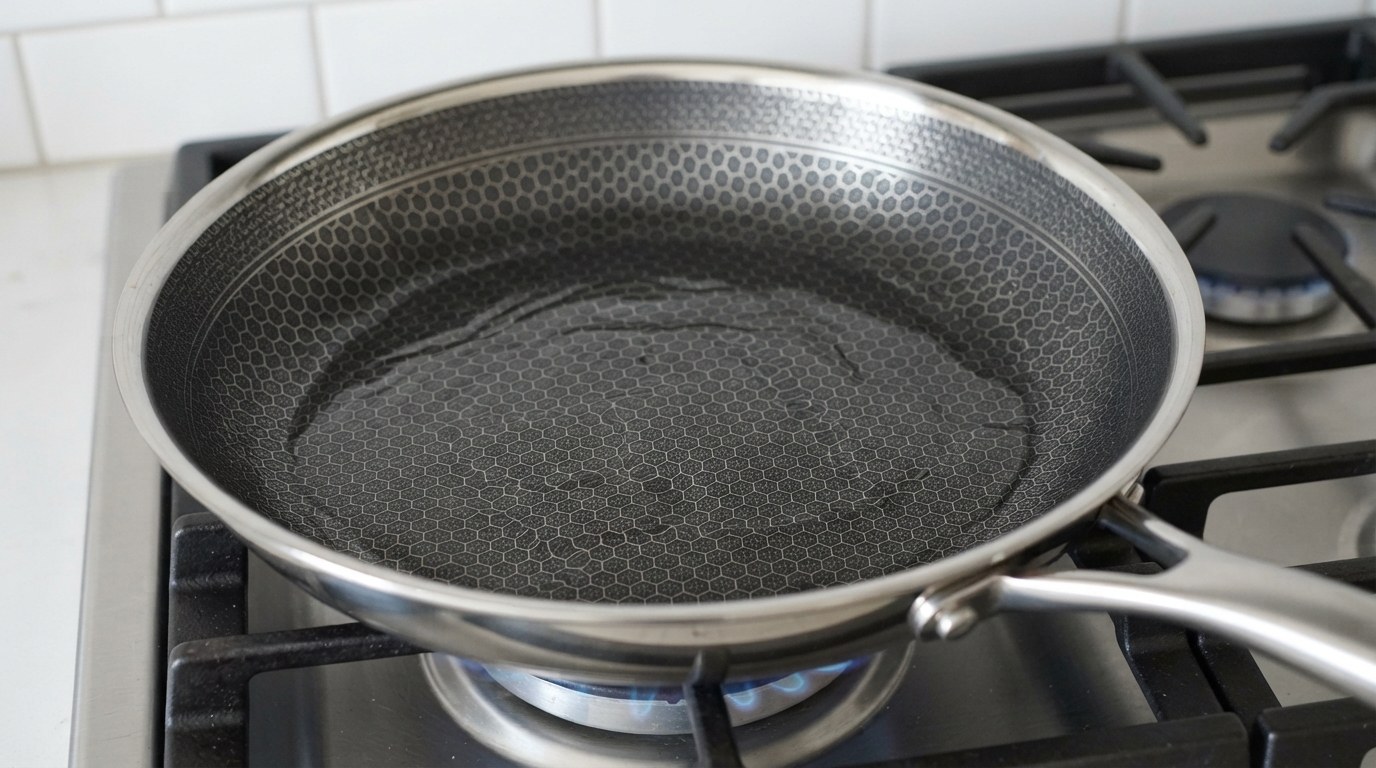
To stop eggs sticking in a HexClad, preheat the dry pan on medium-low for a minute or two, add the fat, wait for it to shimmer or foam, add the eggs, and do not touch them until the edges release on their own. Heat runs higher than the dial suggests on this pan: HexClad's care and use page says medium on a HexClad is similar to medium-high on other brands, and to start lower and turn it up only if needed.
- Set the dry pan on medium-low to medium and let it heat for 1 to 2 minutes.
- Add about 1 tablespoon of butter or oil for every 2 eggs and tilt it across the whole base.
- Wait until oil shimmers or butter melts and foams; butter that browns means the pan is too hot.
- Crack the eggs in low, close to the fat, and leave them for the first 1 to 2 minutes.
- Slide a thin spatula under the edge only once it moves freely; if it resists, give it another 30 seconds.
The water-drop trick needs a different reading on a hybrid. A drop that sizzles and disappears in a second or two means the surface is past 212°F, the boiling point, and ready for fat. A drop that balls up and skates around is the Leidenfrost effect, a cushion of steam under the drop, and Emory University physicists measured that cushion forming at around 240°C, about 464°F. That dancing bead is the stainless-steel cook's searing signal; for eggs on a HexClad it means the pan has gone well past where HexClad says it performs best, low to medium heat, so take it off the burner for a minute before the fat goes in.
Waiting for the release is the step most people skip. The RSC teaching sheet notes that once the surface proteins of a food have cooked and reacted, sticking stops being a problem, which is what a pan-fried egg does on its own when the base is set. Pushing at it early tears the white and leaves a layer of egg welded to the steel. The other route, used in Ramsay's own method for soft scrambled eggs, is constant motion: stirring keeps the egg from resting on any one spot long enough to bond, which is why that style of scramble works even from a cold pan.
Heat, Fat and Timing for Each Egg Style
Each egg style needs its own heat and fat, and HexClad's own guide to cooking eggs in a HexClad gives the settings for fried and scrambled eggs; the omelette row follows the same low-heat logic. The settings are for the dial on your stove, read with HexClad's rule that its medium behaves like other pans' medium-high.
| Egg style | Heat setting | Fat | Timing |
|---|---|---|---|
| Sunny-side up | Medium | At least 1 tbsp butter or oil per 2 eggs, butter gently foaming | About 3 minutes, until the whites are just set and the yolk is glossy |
| Over-easy / medium / hard | Medium | At least 1 tbsp per 2 eggs | About 2 minutes, flip, then 30 seconds (easy), 45 to 60 seconds (medium) or 60 to 90 seconds (hard) |
| Crispy-edged fried | Medium-high, pan preheated 30 seconds before the fat | About 1 tbsp oil or butter per egg, spooned over the whites | Until the whites set and begin to brown; cover briefly for a firmer yolk |
| Scrambled, custardy | Low | Butter melted to foamy, not browned | Stir constantly until small curds set; off the heat while still moist |
| Scrambled, fluffy | Medium-high | Butter melted to foamy, not browned | Pull the edges to the center as they set; off the heat while still moist |
| Omelette | Medium-low to medium | About 1 tbsp butter for 2 to 3 eggs | Stir until soft curds form, then leave 30 to 60 seconds to set the base before folding |
The only high-heat row is the crispy fried egg, where the browning is the point: the Maillard reaction needs the egg's edge above about 284°F, which a medium pan does not reach. For every other style, more heat only shortens the window between set and stuck. Runny yolks are a choice, not a safety standard: the FDA advises cooking eggs until both the yolk and the white are firm and egg dishes to 160°F, and recommends pasteurized eggs for anyone who should avoid undercooked egg.
HexClad Sticking: Symptom, Cause and Fix
The way a HexClad sticks tells you which cause you have, so match the symptom before you scrub. The table pairs each common complaint with its likely cause and HexClad's own remedy.
| Symptom | Likely cause | Fix |
|---|---|---|
| Eggs welded to the steel ridges | Pan not preheated or too little fat, so the white set directly on bare steel | Preheat 1 to 2 minutes on medium-low to medium, 1 tbsp fat per 2 eggs, wait for the shimmer, do not move the eggs until they release |
| Sticking only in the middle | The center over the flame runs hottest: fat thins or runs to the edges there and burnt residue builds up where the flame hits | Use a burner close to the pan's base size, drop to medium, deep clean the center and reseason |
| Sticking after months of use | A thin film of burnt oil from high heat, or seasoning worn away by scrubbing | HexClad: deep clean, then re-season (steps below) |
| Brown film or discoloration | Inside: burnt residue from high heat. Rim and base: staining on the exposed stainless steel | Inside: soak 10 to 15 minutes in warm soapy water, soft sponge. Rim and base only: steel wool or a stainless scouring pad |
| Sticking after the dishwasher | Detergent strips the oil seasoning; HexClad says dishwasher use can dull or darken the pan and phosphate-free detergents can etch the steel | Hand wash; re-season after any dishwasher cycle |
| Tacky, gummy feel | Aerosol cooking-spray residue baked onto the surface | Stop using spray, deep clean, use oil from a bottle or a pump mister |
Two of those rows come straight from HexClad's FAQ, which says its pans perform best on low to medium heat, that cooking at high temperatures can cause a buildup of burnt residue, and that sticking which persists after long ownership calls for a deep clean followed by re-seasoning.
Do HexClad Pans Need to Be Seasoned?
Yes, HexClad pans need to be seasoned before their first use, but not before every use. HexClad's FAQ gives the method: heat the pan to medium-low, spread 1 teaspoon of vegetable oil around the inside, and leave it on the heat for 1 to 2 minutes (the care page says 2 to 3). Over the first few weeks, HexClad says, the pan re-seasons itself from the fats in the food you cook.
The seasoning is a thin layer of oil that heat has turned into a solid. The Royal Society of Chemistry describes how fats break apart at high temperature into shorter chains with reactive double bonds, which polymerise into much longer molecules that stay solid even at frying temperatures, the same patina that makes a well-used iron pan slick. On a hybrid that layer settles into the ceramic valleys and around the base of the steel peaks, filling the texture the egg would otherwise grip. HexClad's seasoning guide says to use a neutral oil such as vegetable, avocado, grapeseed or light olive, not butter or flavored oils, because those do not polymerize as well.
- Wash and dry the pan.
- Warm it on medium-low for about 30 seconds.
- Add about 1 teaspoon of neutral oil and spread it over the base and sides.
- Raise to medium for 1 to 2 minutes, until the oil shimmers but does not smoke.
- Turn off the heat, let the pan cool slightly, and wipe out the excess with a paper towel.
Wiping out the excess matters. Oil left pooled in the pan does not cure into a hard film; it turns tacky, which is why "HexClad sticky after seasoning" is a common search. A thin wipe that leaves the surface looking dry and slightly satin is the right amount.
How to Reseason a HexClad Pan That Has Started Sticking
To reseason a HexClad that has started sticking, deep clean it first so the new oil bonds to the surface instead of to old residue, then season it exactly as you did when it was new. HexClad's deep clean is a 10 to 15 minute soak in warm, soapy water followed by a soft sponge. Its FAQ also suggests a more abrasive sponge for stubborn sticking, while the same page warns against abrasive sponges on the cooking surface; the careful reading is a non-scratch scrub sponge on the inside and steel wool only on the exposed stainless rim and base.
Go gently with the cleaners as well. HexClad's pan-care guidance says to wash the cooking surface with mild dish soap and keeps Bar Keepers Friend and other abrasive cleaners off it, because they can damage the TerraBond ceramic. After the clean, dry the pan fully, season it with a teaspoon of neutral oil on medium-low, wipe out the excess, and cook the next few meals with a normal amount of fat so the layer rebuilds.
Can You Use Cooking Spray on a HexClad?
No, HexClad advises against aerosol cooking spray. Its seasoning guide says to avoid cooking sprays, and its cooking-mistakes guide says the propellants leave a residue that builds up over time and dulls the cookware, recommending an oil mister or a small squeeze bottle instead.
The residue has a specific cause. Most nonstick sprays contain an emulsifier, usually lecithin, and America's Test Kitchen reports that lecithin leaves a sticky film that builds up on nonstick pans, citing OXO's product team that it forms a dark, sticky residue at much lower temperatures than the oil alone. That film is gummy enough to hold onto egg, and scrubbing it off hard can wear the coating. A teaspoon of oil from a bottle, or a pump mister filled with plain oil, does the job without the additives.
Why Is My HexClad Pan Turning Brown?
A HexClad turns brown for two different reasons, and only one of them affects cooking. Brown or rainbow staining on the rim and the base is the exposed stainless steel reacting to heat, which HexClad calls temporary and removable with steel wool or a stainless scouring pad on those outer areas. A brown film on the cooking surface itself is burnt oil from cooking too hot, and that is the layer that makes eggs stick.
- Rim and base staining: cosmetic; steel wool or a stainless scouring pad on the outside only.
- Brown film inside: burnt residue from high heat; soak 10 to 15 minutes, soft sponge, then reseason.
- Dull or black look after the dishwasher: HexClad says dishwasher use can cause it over time.
- Pitting on the steel: HexClad says phosphate-free dishwasher detergents can etch or pockmark the metal.
Is a HexClad the Right Egg Pan?
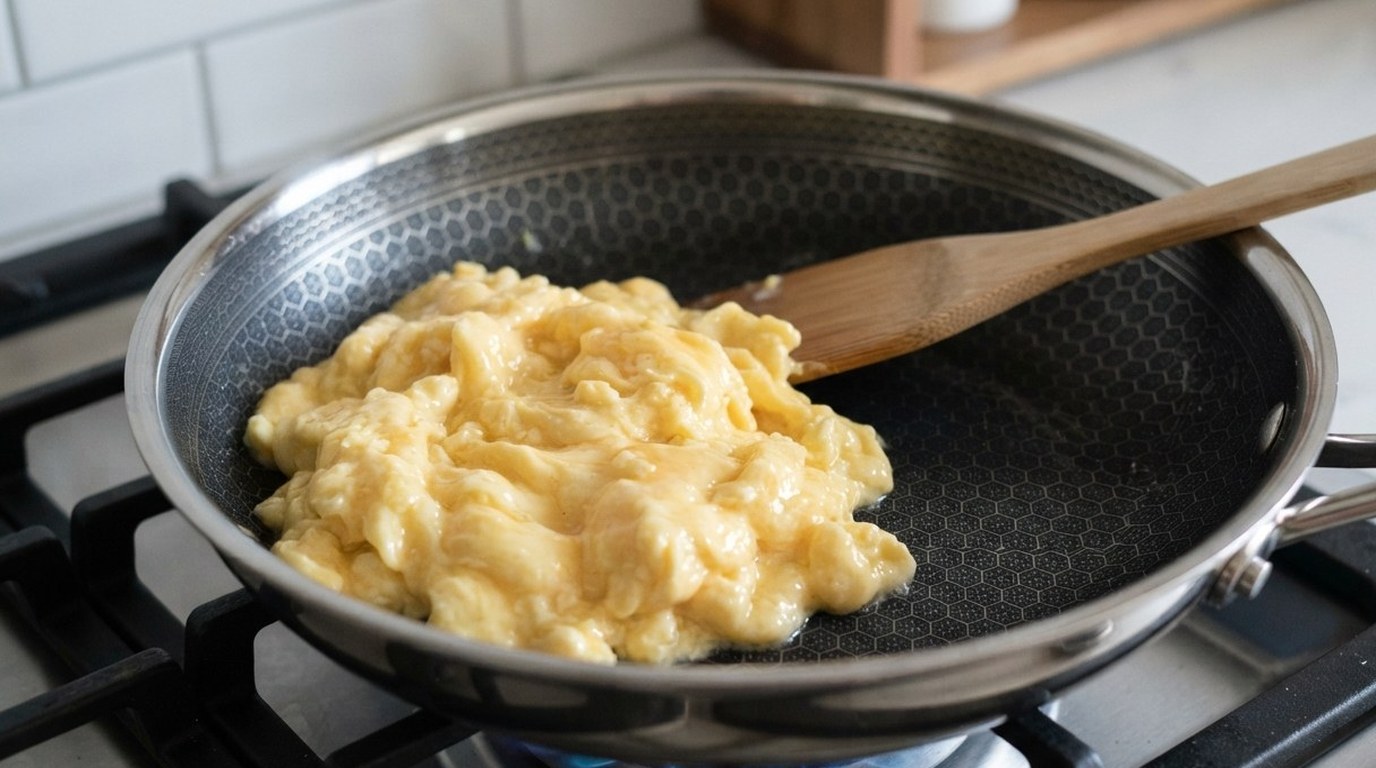
A HexClad is a good egg pan for a cook who will use a spoonful of fat and preheat it, and the wrong one for a cook who wants eggs to slide with no fat at all. The steel hexagons that let a HexClad sear a steak and take a metal spatula are the same steel the egg touches first, so a hybrid releases eggs less easily than a pan coated edge to edge. That trade is built in, and the site's Gordon Ramsay cookware guide reaches the same verdict: for a cook who mainly wants eggs to glide, a plain nonstick releases better.
The plain recommendation: if most of what you cook in a skillet is eggs, made fast on weekday mornings with little or no butter, keep an inexpensive nonstick pan just for eggs and use the HexClad for everything else. If you want one pan for searing, sautéing and eggs, and you are happy to preheat and add a tablespoon of butter, a HexClad does eggs well once it is seasoned and kept out of the dishwasher. HexClad is also the cookware brand named in the Hell's Kitchen sponsors credits, and for the practical questions of origin and buying there are guides to where HexClad is made and where to buy HexClad cookware.

HexClad
HexClad 12-Inch Hybrid Nonstick Frying Pan
- Stainless steel and ceramic nonstick hybrid surface, built to sear hard and release easily
- Tri-ply with an aluminum core for quick, even heat; works on induction
- Oven safe to 900°F and metal-utensil safe (lid not included)
In short, eggs stick to a HexClad pan when protein meets bare steel, so the fix is always some version of putting fat back between them: a seasoned surface, a pan preheated on medium-low to medium, a tablespoon of fat for two eggs, and the patience to let the egg release on its own. Keep the spray and the dishwasher away from it, deep clean and reseason when it starts to grab, and a HexClad will turn out eggs that slide. More pan and knife guides live in the kitchen gear section.
HexClad Eggs Sticking FAQs
The questions that come up most: why a HexClad pan sticks, why eggs stick to it, whether HexClad pans need seasoning, how to reseason one, whether you can use cooking spray, why the pan turns brown, whether the dishwasher causes sticking, and what heat to use for eggs.
Why is my HexClad pan sticking?
A HexClad sticks when food reaches the bare steel hexagons without a layer of fat in between. The usual causes are a pan that was not preheated, too little oil or butter, seasoning that was never done or has worn off, and residue from high heat, cooking spray or the dishwasher. HexClad's own guidance is to preheat, use enough oil, cook on low to medium heat, and deep clean and re-season a pan that keeps sticking.
Why do eggs stick to my HexClad pan?
Egg protein bonds to bare metal, and the raised hexagons on a HexClad are stainless steel. If the eggs go into a cold pan or onto too little fat, the white sets directly on the steel and grips it. Preheat on medium-low to medium, add about 1 tablespoon of fat per 2 eggs, wait for it to shimmer or foam, and leave the eggs until they release.
Do HexClad pans need to be seasoned?
Yes, before the first use. HexClad says to heat the pan on medium-low, spread 1 teaspoon of vegetable oil around the inside, and leave it on the heat for 1 to 2 minutes. You do not need to season before every use; the pan re-seasons from the fats you cook with over the first few weeks.
How do you reseason a HexClad pan?
Deep clean it first: soak it in warm, soapy water for 10 to 15 minutes and wash it with a soft or non-scratch sponge. Dry it, warm it on medium-low, spread about 1 teaspoon of neutral oil over the base and sides, heat until the oil shimmers without smoking, then turn off the heat and wipe out the excess.
Can you use cooking spray on HexClad?
HexClad advises against aerosol cooking sprays. It says the propellants leave a residue that builds up and dulls the pan, and America's Test Kitchen reports that the lecithin in most sprays leaves a sticky film on nonstick surfaces. Use oil from a bottle or a pump mister filled with plain oil instead.
Why is my HexClad pan turning brown?
Brown staining on the rim and base is the exposed stainless steel reacting to heat, which HexClad says is temporary and comes off with steel wool or a stainless scouring pad on those outer areas only. A brown film on the cooking surface is burnt residue from cooking too hot; soak and wash it with a soft sponge, then reseason.
Does the dishwasher make a HexClad pan sticky?
It can. HexClad pans are dishwasher safe, but HexClad says dishwasher use may make them look dull or black over time and that phosphate-free detergents can etch or pockmark the metal. Detergent also strips the oil seasoning, so hand wash with warm soapy water and re-season after any dishwasher cycle.
What heat should I cook eggs on in a HexClad?
Medium for fried eggs and low for soft, custardy scrambled eggs. HexClad says medium on its pans is similar to medium-high on other brands, so start lower than you would on another pan. The one exception is a crispy-edged fried egg, which HexClad cooks on medium-high with about a tablespoon of fat per egg.

About the Author
John Siracusa is the founder of Hell’s Kitchen Recipes. He focuses on technique-first, reproducible home cooking and researches recipes & kitchen equipment from published food science and professional chef methods since 2016.