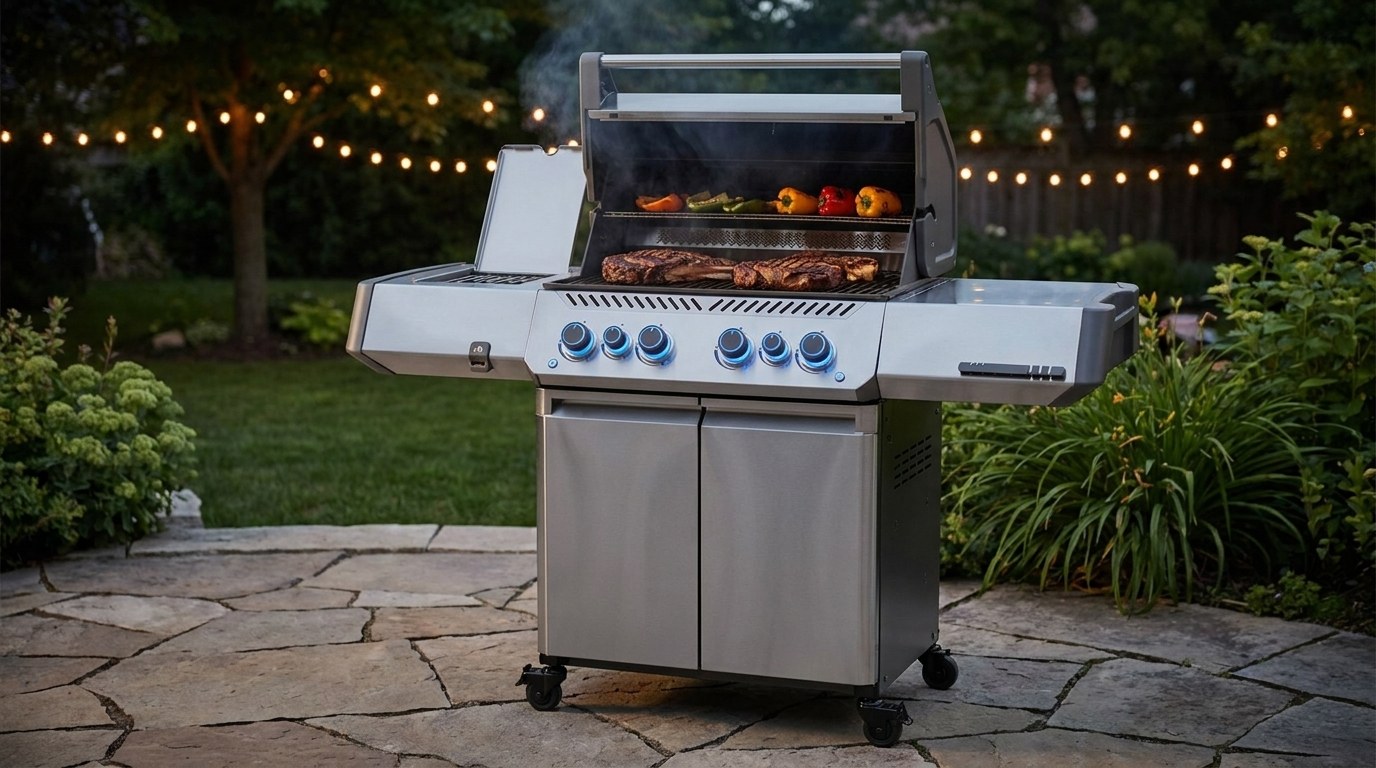
The Napoleon Prestige 500 is a four-burner stainless-steel gas grill rated at 82,000 BTU, with 900 square inches of total cooking space, an infrared rear burner for the included rotisserie kit, and an infrared SIZZLE ZONE side burner for searing, all built in Canada and covered by Napoleon's Lifetime Limited Warranty on its main stainless parts. It sits one step below the Prestige PRO 500, which shares the same 28 by 17.75-inch main grilling area and the same heat output but adds thicker 9.5 mm cooking grids, a heat reflector, hood lights and, on the 2026 model, app control and food probes. For a home cook who grills several nights a week and wants a rotisserie and a dedicated sear burner without moving up to a built-in, the Prestige 500 is the sensible size; for someone who grills a few burgers a month, it is more grill than the job needs.
This review is built from what Napoleon publishes (spec sheets, the warranty, where the grills are made) and what established testers report, with the physics behind each feature explained so the marketing terms mean something. Napoleon is also one of the brands credited under "Promotional Consideration" at the end of Hell's Kitchen Season 25 episodes, which is a paid sponsor credit, not a statement about what the chefs cook on; the full list is in the Hell's Kitchen sponsors guide. For the head-to-head with the obvious rival, see Napoleon vs Weber gas grills, and for more equipment, the kitchen gear hub.
Napoleon Prestige 500 Specs at a Glance
The current Napoleon Prestige 500 RSIB (model P500VRSIBPSS for propane, P500VRSIBNSS for natural gas) is a 65.5-inch-wide cart grill with four stainless tube burners under a 28 by 17.75-inch main grilling area, which Napoleon says fits 31 burgers, plus a warming rack and the side burner for 900 square inches in total. The Napoleon product page lists 82,000 BTU of heat output, 8.5 mm stainless cooking grids, a large infrared SIZZLE ZONE side burner, a larger rear rotisserie burner than earlier Prestige models with a heavy-duty rotisserie kit included, battery-free JETFIRE ignition that fires a jet of flame at each burner, LED control knobs that glow red when the gas is on, and locking casters. The grill stands 51 inches tall with the lid shut and ships at 240 pounds. The Amazon listing for the earlier P500RSIBPSS-3 version breaks the heat down as 48,000 BTU across the four main burners and 18,000 BTU for the rear infrared burner.
Cross-lighting is the detail that matters on a cold or windy evening: Napoleon says brackets between the main burners light a burner from its neighbor if one fails to catch, which is why the grill keeps working when one igniter fouls. In the model names, "RSIB" refers to the rear and side infrared burners, and the Prestige 500 Connected (P500VXRSIB) is the version with Wi-Fi and Bluetooth monitoring. BBQGuys lists the propane Prestige 500 with the same 48,000 BTU main-burner and 18,000 BTU rotisserie-burner figures and 304 stainless exterior.
Napoleon
Napoleon Prestige 500 RSIB Propane Gas Grill (P500RSIBPSS-3)
- Four stainless main burners (48,000 BTU) over stainless sear plates; 500 sq in main grilling area, 900 sq in in total
- Infrared SIZZLE ZONE side burner and an 18,000 BTU infrared rear burner, with the rotisserie kit in the box
- JETFIRE ignition on each main burner; propane model (the natural gas version is a separate listing)
How the Napoleon Prestige 500 Cooks: Burners, Sear Plates and Grates
On the main grates, the Napoleon Prestige 500 cooks like a well-built conventional gas grill: four tube burners heat stainless sear plates and the steel grids above them, and the closed lid turns the box into an oven for indirect cooking. Consumer Reports, in its test of the Prestige P500RSIB, rated the grill very good for evenness, for temperature range and for indirect cooking, and good for preheating, and it singled out the construction materials and the useful accessory burner under convenience. Those are the results that matter for everyday cooking, because they describe whether a rack of chicken thighs browns at the same rate on the left and the right.
Advertisement
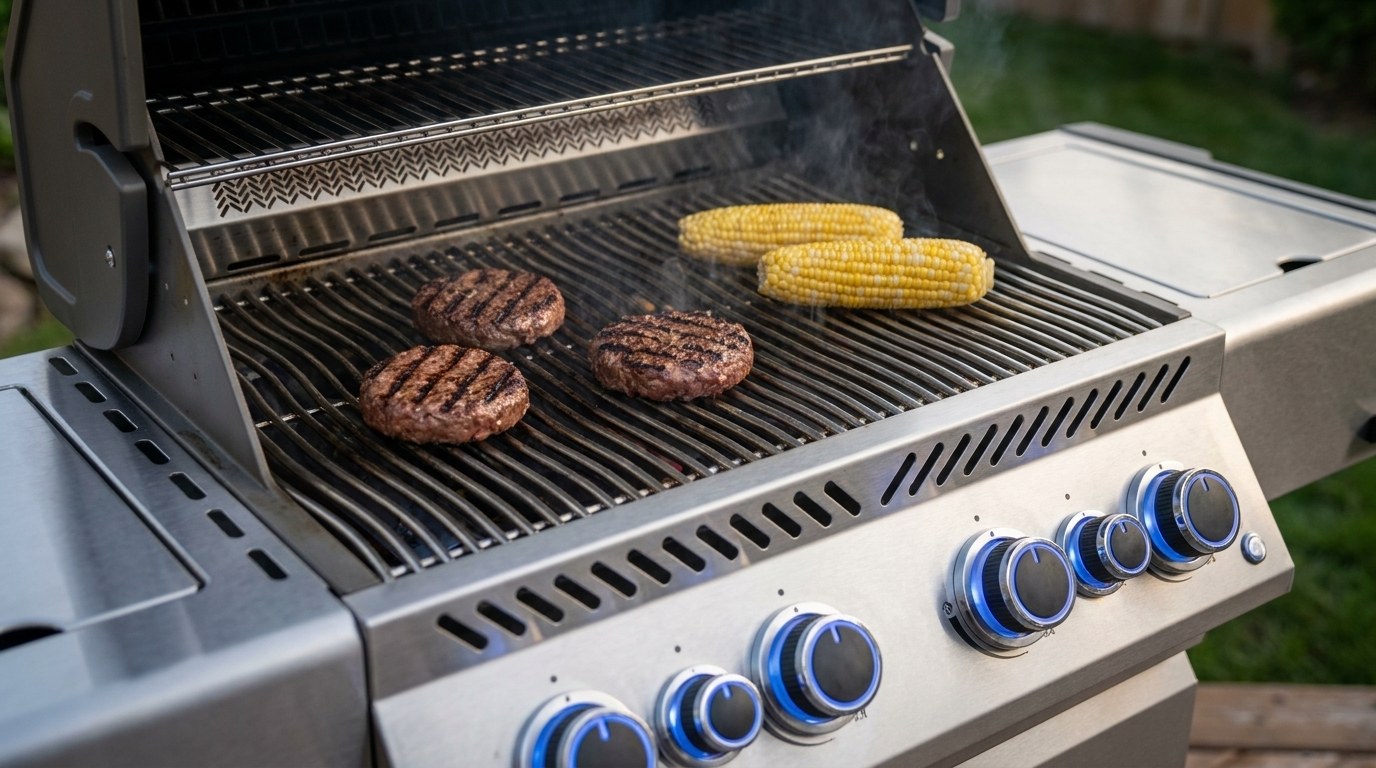
The sear plates do two physical jobs. They sit between each flame and the food, so fat dripping from a burger lands on hot steel instead of an open flame, where it vaporizes into smoke that carries flavor back up to the meat; fat that reaches a flame directly can ignite and flare, which is the soot and char nobody wants. They also spread the heat from a narrow tube burner across a wider strip of the grate. Napoleon's staggered layout adds plates between the burners as well as over them, and AmazingRibs, reviewing an earlier P500RSIB, noted the extra plates reduce hot spots while still finding that grill ran hotter toward the back, a pattern worth knowing when you decide where the thick cuts go.
Grate thickness is about stored heat. Stainless steel conducts heat slowly, roughly 16 watts per meter-kelvin against about 50 for carbon steel, per the Engineering ToolBox, so a stainless grid cannot pull heat in from the burner as fast as cast iron does; it compensates with mass. A thicker rod holds more heat per inch, so when a cold steak lands on it the steel where it touches stays above 284°F, the point where Maillard browning begins, and prints a dark line instead of dropping toward the 212°F ceiling that a wet surface imposes. That is why the step from the Prestige 500's 8.5 mm grids to the PRO 500's 9.5 mm WAVE grids is a meaningful difference for grill marks, and why patting meat dry before it goes on matters more than any grate. Burgers still need the thermometer: the USDA's safe minimum temperature chart puts ground beef at 160°F, and steaks at 145°F with a three-minute rest.
The SIZZLE ZONE Side Burner and the Infrared Rotisserie Burner
The two infrared burners are what separate the Napoleon Prestige 500 from a plain four-burner grill, and both work by radiation rather than hot air. In a ceramic infrared burner the gas flame heats a ceramic tile until it glows, and the glowing surface sends energy straight to the food the way a broiler does, instead of first heating the air around it; Consumer Reports describes the same principle. Napoleon rates its SIZZLE ZONE at up to 1,800°F, so a dry steak surface passes the 284°F browning threshold in seconds and builds a crust before the center overcooks, which is the case for a dedicated sear station on a thick ribeye or a reverse-seared strip.
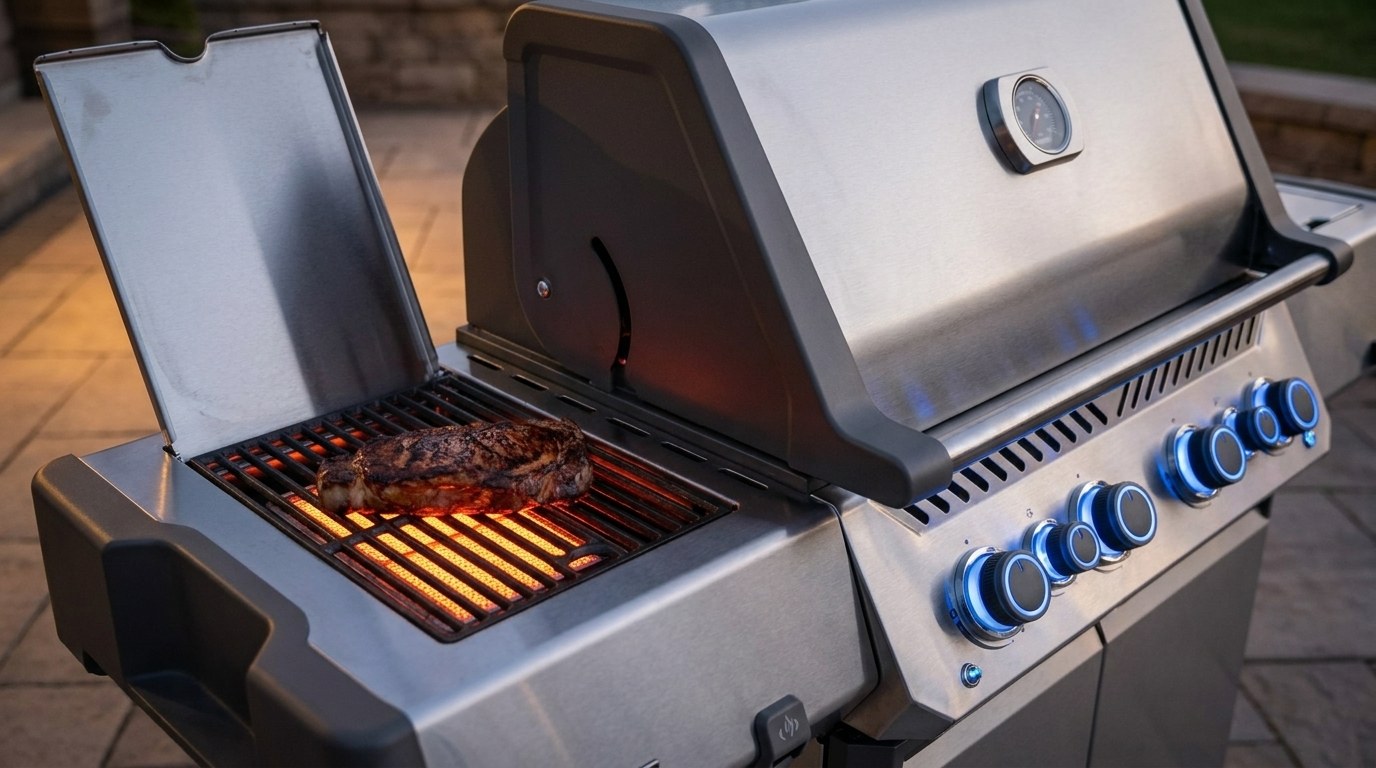
The same intensity is the catch. Browning turns to burning from about 356°F, so on an 1,800°F radiant source the window between crust and char is short, and AmazingRibs reported that the heavy cast-iron grate on the older model's side burner tended to scorch meat before it browned evenly; its fix was to flip often. Consumer Reports' broader finding is a useful brake on the marketing: in its gas-grill testing it has not found infrared grills or infrared elements better overall than standard burners, and all its top grills cook evenly. Treat the SIZZLE ZONE as a fast searing tool for steaks and chops, which is the job it was built for. For the technique, the crust-then-gentle-heat method in Gordon Ramsay's pan-seared steak transfers directly to a side burner.
The rear infrared burner is for the rotisserie, and the kit is in the box on every Prestige 500 RSIB. A spit turning in front of a radiant burner browns the surface evenly as each side passes the heat, while the fat that renders out rolls over the meat as it turns; that coating crisps the skin, though it does not push moisture back into the muscle, which is a myth worth dropping. Pull a rotisserie chicken at 165°F in the thickest part of the thigh, the FSIS figure for poultry. AmazingRibs noted that Napoleon's manual tells owners to remove the warming rack when the rotisserie burner is on, because the rack sits right in its heat.
Napoleon Prestige 500 vs Prestige PRO 500: What Changes
The Prestige PRO 500 is the same size and heat output as the Napoleon Prestige 500, so the money goes into build and features rather than cooking area. Both list 82,000 BTU, four main burners, a 28 by 17.75-inch main area and 900 square inches in total on Napoleon's spec sheets. The 2026 Prestige PRO 500 adds 9.5 mm stainless WAVE grids, a HeatBoost reflector that Napoleon says reflects heat back up so less is lost when the lid opens, JETFIRE 2.0 ignition, metal knobs with LED rings, hood lights and cabinet lighting, and a smart system: an app and LCD screen for set-and-monitor cooking, support for three wired and two wireless probes, flame-out alerts with automatic gas shut-off after 30 seconds, and a Smart Mode for hands-free temperature control. BBQGuys carries the PRO 500 with smart technology as model PRO500VXRSIBPSS.
Advertisement
| Feature | Prestige 500 RSIB (P500VRSIB) | Prestige PRO 500 (PRO500VXRSIB, 2026) |
|---|---|---|
| Main burners / heat output | 4 stainless burners / 82,000 BTU | 4 stainless burners / 82,000 BTU |
| Main and total cooking area | 28 x 17.75 in / 900 sq in | 28 x 17.75 in / 900 sq in |
| Cooking grids | 8.5 mm stainless | 9.5 mm stainless WAVE |
| Side burner | Large infrared SIZZLE ZONE | Infrared SIZZLE ZONE, 1,800°F in about 30 seconds |
| Rear burner and rotisserie | Infrared rear burner, kit included | Infrared rear burner, high-capacity kit included |
| Heat management | Stainless sear plates | Stainless sear plates plus HeatBoost reflector |
| Ignition | JETFIRE, battery-free | JETFIRE 2.0 one-spark |
| Lighting | LED knobs with SafetyGlow | Metal knobs with dual LED rings, hood and cabinet lights |
| Smart features | None (the Prestige 500 Connected adds Wi-Fi and Bluetooth) | App and LCD control, 3 wired + 2 wireless probes, flame-out shut-off |
| Size (W x H x D, lid closed) | 65.5 x 51 x 26 in | 65.5 x 52.75 x 26.5 in |
| Shipping weight | 240 lb | 301 lb |
| Made in | Canada | Canada |
| Best for | Rotisserie and searing on a cart grill without the tech | Cooks who want probes, alerts and the thicker grids |
The reading of that table is that the PRO 500 is worth it for one of two reasons: the thicker grids and reflector, if heavy searing on the main grates is the priority, or the probe-and-app system, if long cooks such as a rotisserie turkey or a pork shoulder are, since alerts and an automatic shut-off let the cook walk away. A cook who checks doneness with an instant-read thermometer and mostly grills steaks, chops and burgers gets the same footprint, burners and infrared tools from the Prestige 500.
Where Napoleon Grills Are Made
Napoleon Prestige 500 grills are made in Canada. Napoleon's Made in Canada page lists the Prestige and Prestige PRO gas grills, and their built-in versions, among the products manufactured at its facilities in Barrie, Ontario, and says every Napoleon product is designed and engineered in Canada wherever it is built. The company behind the brand is Wolf Steel Ltd., founded in Barrie in 1976 by Wolfgang and Ingrid Schroeter as a steel fabrication shop; it began making grills in the 1990s, is still family-owned, and runs production in North America, Europe and Asia, according to its Wikipedia entry.
Not every Napoleon grill comes from Barrie. Napoleon itself says it owns manufacturing operations outside Canada, and Wolf Steel also builds Napoleon grills and fireplaces at a plant in Crittenden, Kentucky, which it expanded in 2019, as the Northern Kentucky Tribune reported. So "Napoleon is Canadian" is true of the company and of the Prestige lines, while a lower-priced Napoleon model can come from elsewhere; check the specific product page before assuming. The Prestige 500 itself is not a made-in-USA grill; BBQGuys marks it "Made in USA: No" on its spec sheet.
The Napoleon Prestige 500 Warranty, in Plain Terms
Napoleon's warranty on the Prestige 500 is lifetime on the parts that usually fail first on cheaper grills and 15 years on most of the rest. The Lifetime Limited Warranty for Prestige, Prestige PRO and built-in models covers the hood, the stainless lid, the aluminum castings, the stainless cooking grids and the stainless tube burners for life; the stainless sear plates, the infrared rotisserie burner and the infrared side burner for 15 years; electrical components for 3 years; and all other parts for 15 years.
Advertisement
The conditions matter as much as the table. Coverage applies to the original buyer of a grill bought from an authorized Napoleon dealer, for normal private use; commercial or communal use cuts it to two years. It excludes surface corrosion, discoloration from heat, damage from grease fires, wind blowouts and lack of cleaning, and it asks owners near the coast or a pool to wash the exterior regularly. A gas conversion not authorized by Napoleon and done by its technician voids it. Napoleon replaces the failed part and does not pay labor or shipping, so registering the grill and keeping the receipt, serial and model numbers is the practical step.
Is the Napoleon Prestige 500 Worth It? Who Should Buy It and Who Should Skip It
The Napoleon Prestige 500 is worth it for a cook who will use what it adds: the rotisserie, the side sear burner and a lifetime warranty on the burners and grids. The evidence supports the core grill, with very good evenness and indirect-cooking results from Consumer Reports and solid fit and finish from AmazingRibs, and the infrared tools do what radiant heat does, even if Consumer Reports does not find infrared makes a grill better overall. The weaker points reported on earlier versions are small: a modest grease cup that needs emptying often, a warming rack that must come out for the rotisserie, and a side-burner grate that rewards frequent flipping.
Buy it if you grill most weeks, cook for six or more, want rotisserie chicken or a crusted steak without a second appliance, and like the idea of a grill made in Canada with lifetime coverage on the burners. Buy the PRO 500 instead if probes, app alerts and thicker grids are worth more to you than the difference. Skip both if you grill occasionally, have a small balcony (the grill is 65.5 inches wide with the shelves up), or want real smoke flavor, which comes from wood breaking down at about 338°F and is easier to get from a charcoal or pellet grill. For a flat-top alternative, see how long Blackstone griddles last.
Natural gas buyers should order the natural-gas model from the start, sold as the Prestige 500 natural gas grill (P500VRSIBNSS), rather than plan a conversion later. Whichever grill you choose, a fitted cover is the cheapest protection for the stainless finish the warranty does not cover against corrosion.
Napoleon
Napoleon Grill Cover for Prestige 500 and Prestige PRO 500 (61500)
- Napoleon's own cover, sized for the Prestige 500 and Prestige PRO 500 cart grills
- Water-resistant fabric with UV inhibitors and air vents
- Hook-and-loop closures, adjustable buckled straps and hanging loops
Once it is set up, the Napoleon Prestige 500 handles the grill recipes on this site from start to finish: the two-zone fire in the Gordon Ramsay backyard burger, a hot sear for skirt steak with chimichurri, and low indirect heat for grilled ribs, where the closed lid and the sear plates hold the steady temperature that lets collagen turn to gelatin from about 154°F.
Advertisement
Napoleon Prestige 500 FAQs
The questions that come up most: whether the Prestige 500 is worth it, how it differs from the Prestige PRO 500, where Napoleon grills are made, how big and how powerful it is, whether it comes with a rotisserie, whether it can run on natural gas, what the warranty covers, and whether Napoleon sponsors Hell's Kitchen.
Is the Napoleon Prestige 500 worth it?
For a cook who grills often and will use the rotisserie and infrared side burner, yes. Consumer Reports rated the Prestige P500RSIB very good for evenness, temperature range and indirect cooking, the grill is made in Canada, and Napoleon covers the burners, grids and lid for life. For occasional grilling, a simpler four-burner grill does the same everyday cooking.
What is the difference between the Napoleon Prestige 500 and the Prestige PRO 500?
Both have four main burners, 82,000 BTU and 900 square inches of cooking area. The 2026 Prestige PRO 500 adds thicker 9.5 mm WAVE grids (the Prestige 500 has 8.5 mm), a HeatBoost reflector, hood and cabinet lights, metal knobs with LED rings, and a smart system with app control, wired and wireless probes, and automatic gas shut-off if the flame goes out.
Where are Napoleon grills made?
Napoleon is a Canadian company based in Barrie, Ontario, and it lists the Prestige and Prestige PRO gas grills as made in Canada. It also owns plants outside Canada, including a Wolf Steel factory in Crittenden, Kentucky, so check the product page for other Napoleon models. Napoleon says all of its products are designed and engineered in Canada.
How many BTU is the Napoleon Prestige 500, and how big is it?
Napoleon lists 82,000 BTU in total, with 48,000 BTU across the four main burners on the Amazon listing for the earlier P500RSIBPSS-3 version. The main grilling area is 28 by 17.75 inches (about 31 burgers), and total cooking area is 900 square inches including the warming rack and side burner. The grill is 65.5 inches wide, 51 inches tall and 26 inches deep.
Does the Napoleon Prestige 500 come with a rotisserie?
Yes. Every Prestige 500 RSIB includes a heavy-duty rotisserie kit, and the infrared rear burner is there to drive it. Remove the warming rack when the rear burner is on, and take poultry to 165°F in the thickest part.
Can the Napoleon Prestige 500 run on natural gas?
Yes, as its own model: the Prestige 500 RSIB is sold in propane (P500VRSIBPSS) and natural gas (P500VRSIBNSS) versions. Buy the version that matches your fuel. Napoleon's warranty is void after any gas conversion not authorized by Napoleon and carried out by its authorized technician.
What does the Napoleon warranty cover on the Prestige 500?
Lifetime coverage on the hood, stainless lid, aluminum castings, stainless cooking grids and stainless tube burners; 15 years on the sear plates, infrared rotisserie and side burners and all other parts; 3 years on electrical components. It applies to the original owner, through an authorized dealer, for private use, and it excludes surface rust, heat discoloration and grease-fire damage.
Is Napoleon a Hell's Kitchen sponsor?
Napoleon appears under "Promotional Consideration" in the end credits of Hell's Kitchen Season 25 episodes, which is a paid sponsor credit. That credit does not tell you which grills the show or its chefs use. The other credited brands are covered in the Hell's Kitchen sponsors guide.

About the Author
John Siracusa is the founder of Hell’s Kitchen Recipes. He focuses on technique-first, reproducible home cooking and researches recipes & kitchen equipment from published food science and professional chef methods since 2016.