The Gordon Ramsay Ultimate Cheeseburger is a three-cheese burger: sharp aged provolone, sweet and nutty Dubliner, and garlic-and-herb Boursin on a seared 80/20 beef patty. The catch is that two of those cheeses are aged, and aged cheese is some of the worst cheese for burgers if you just lay a slice on the patty; it sweats oil before it ever flows. So this version melts them into a silky sauce with a pinch of sodium citrate, the same salt that makes American cheese melt so smoothly, and spreads the Boursin on the toasted bun. Below is the recipe, a chart of the best cheese for burgers and the science that decides which ones melt.
What Goes on the Ultimate Cheeseburger?
The Ultimate Cheeseburger is a single 6-ounce beef patty topped with a smooth Dubliner and aged provolone cheese sauce, with Boursin spread on the toasted top bun and butter lettuce and dill pickles underneath. No current Gordon Ramsay Burger menu lists a burger by this name; the Las Vegas menu puts American cheese on its Backyard Burger and Dubliner on the Farmhouse and Luxe Royale. Ramsay's own home recipe, Gordon's Burger in 10 Minutes, melts a slice of cheddar with a knob of butter under an upturned bowl.
Each cheese here has one job. Dubliner, which Kerrygold describes as an aged cow's milk cheese with a cheddar-like texture and a sweet, nutty flavor, brings the depth; aged provolone brings the sharp bite; together they make the sauce. Boursin is fresh and creamy, so it stays cool and soft on the bun and adds garlic and herbs. Pickles bring acid to cut all that richness, and the lettuce adds crunch. If you like the Dubliner flavor, it shows up again on our Gordon Ramsay Farmhouse burger, and the whole lineup lives in Gordon Ramsay's signature burgers.
The Best Cheese for Burgers, and Why American Cheese Melts So Smoothly
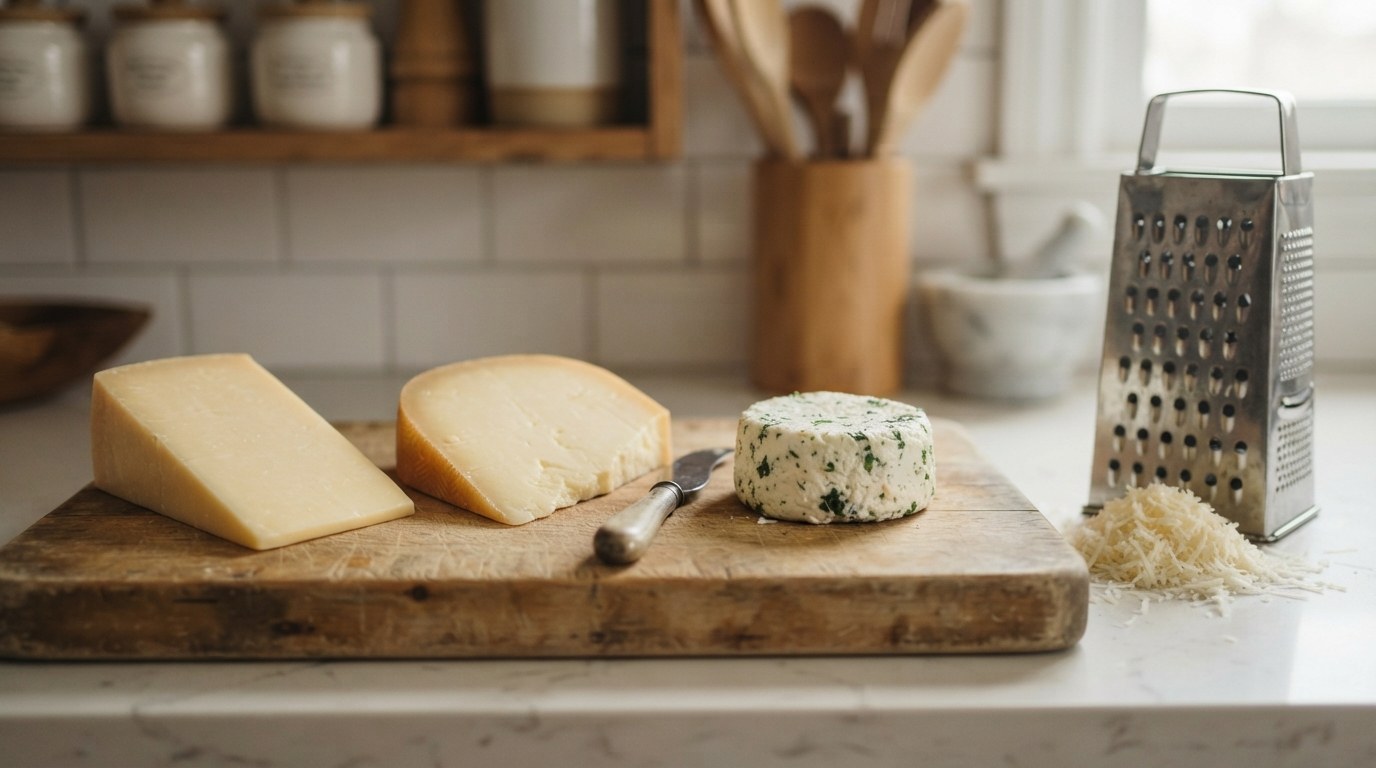
The best cheese for burgers depends on the job: for a slice that melts smooth and glossy, American cheese is the easiest; for flavor, a young cheddar, Jack or young Gouda melts well; and for aged cheeses like sharp cheddar, Dubliner or provolone, a cheese sauce gives you the flavor without the grease. American melts so well because it is built to. It's a pasteurized process cheese, and the federal standard for it (21 CFR 133.169) allows emulsifying agents, sodium citrate among them, up to 3% of the cheese's weight, with the mix heated to at least 150°F for 30 seconds.
Those salts change how the proteins behave. Any cheese is an emulsion: tiny droplets of milkfat and water held in a mesh of casein proteins, and calcium is the glue tying that mesh together. America's Test Kitchen explains that sodium citrate swaps sodium in for some of that calcium, so the proteins let go of each other and wrap around the fat instead. The fat stays emulsified as the cheese heats, which is why a slice of American slumps into a smooth sheet and never leaves a puddle of oil.
| Cheese | Age and moisture | How it melts on a hot patty | Best job on a burger |
|---|---|---|---|
| American (process cheese) | Emulsifying salts added; moisture capped at 43% by the federal standard | Flows smooth and glossy, no oil | The classic melted slice |
| Young cheddar or Colby | A few months old, fairly moist | Melts evenly with a little stretch | A melted slice with real cheddar flavor |
| Monterey Jack or young Gouda | Young, high moisture | Melts fast and soft | Mild, creamy melt; pepper jack for heat |
| Aged sharp cheddar | Drier; long aging breaks down the protein mesh | Softens late, often sweats oil and turns grainy | Grate it into a sodium citrate sauce |
| Dubliner | Aged, firm and cheddar-like, sweet and nutty | Behaves like aged cheddar: slow and oily if rushed | The flavor base of this burger's sauce |
| Aged provolone | Aged, firm, sharp and tangy | Oils out at the edges under hard heat | Sharpness in the sauce |
| Parmesan | Very aged and dry | Barely melts; browns and crisps instead | A crisp frico, never the main melt |
| Blue cheese | Soft to crumbly, strong | Softens and slumps without sheeting | Crumbled on, with something sweet |
| Boursin (garlic and herbs) | Fresh and unaged, soft and creamy | Softens into a spread, never flows | Spread on the toasted top bun |
Read down the second column and the pattern is plain: the younger and moister the cheese, the better it melts on its own, and the older and drier it gets, the more it needs help. Flavor runs the other way, which is exactly why this burger turns its aged cheeses into a sauce. For a blue cheese build, see our Gordon Ramsay blue cheeseburger.
Why Aged Cheddar and Provolone Break and Oil Out
Aged cheddar, Dubliner and aged provolone oil out because aging dries them and weakens the protein mesh that holds their fat in place. The Cheese Science Toolkit explains that high-moisture cheeses like young Gouda melt well while drier ones like aged Gouda and Parmigiano don't, and that as a cheese ages its proteins get chopped up (proteolysis), which leaves lots of free oil when it melts. Acid matters too: calcium is the glue in the mesh, and a cheese with too much of it, or one so acidic it barely holds any, won't melt smoothly either.
Heat sets the order of events. ThermoWorks notes that the fat in cheese starts softening around 90°F, that cheddar melts at roughly 150°F, and that pushed well past its melting point the proteins firm up and squeeze out fat and moisture, leaving rubbery clumps in a greasy slick. On a sizzling patty an aged slice gets both problems at once: its fat runs early, and the edge touching the pan overheats before the middle has softened. Grating it fine helps, and melting a slice under a lid with steam is covered on our Luxe Royale burger and in how to melt cheese on a burger. For three cheeses at once, the sauce is the surer route.
How to Make a Smooth Cheese Sauce for the Ultimate Cheeseburger
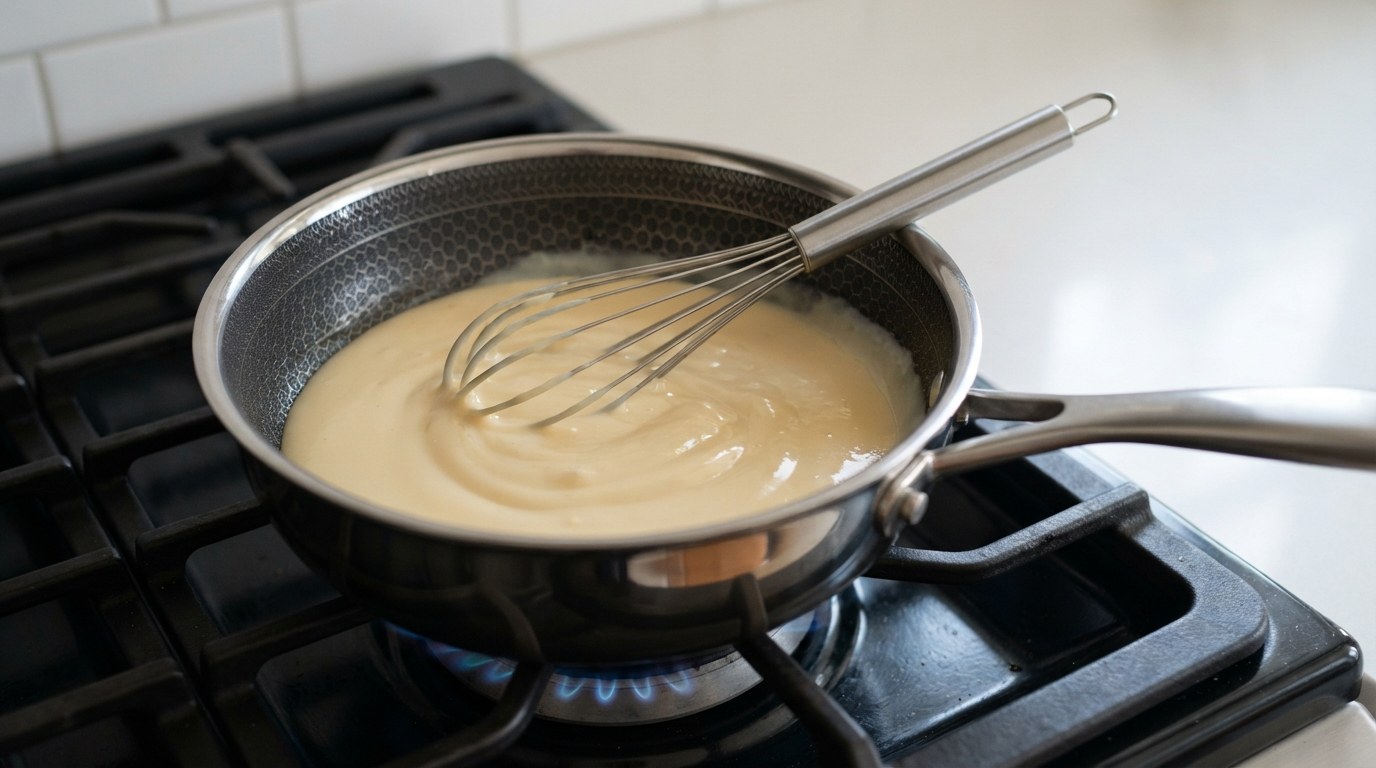
Make the sauce with sodium citrate at Modernist Cuisine's ratio: 4 grams of sodium citrate for every 100 grams of finely grated cheese and 93 grams of water or milk. For four burgers that works out to 140 grams of cheese (Dubliner and aged provolone), 1/2 cup of whole milk and 5 to 6 grams of sodium citrate. Whisk the sodium citrate into the milk first, warm it until it steams, then add the cheese a handful at a time. The salt does to your Dubliner what the factory does to American cheese, pulling calcium off the proteins so they emulsify the fat, and you get a pourable, glossy sauce from cheeses that would split on their own.
Keep it gentle. ThermoWorks recommends holding a sodium citrate cheese sauce below 170°F; a bare steam and the lowest flame are enough, and boiling it risks a grainy texture. Grate from the block for the smoothest result; our cheese-melting guide explains what the coating on pre-shredded cheese does to a melt. The sauce thickens as it sits, so whisk in a splash of milk if it gets stiff, and any left over is very good with fries.
No sodium citrate? Use starch. Toss the grated cheese with 2 teaspoons of cornstarch and melt it into 1/2 cup of evaporated milk over low heat. ThermoWorks explains that the starch granules swell and thicken the liquid while the concentrated milk proteins in evaporated milk help hold the sauce together. It's a little thicker and less glossy, but it won't break. A roux does the same job in our Gordon Ramsay mac and cheese, where the starch from the flour keeps the cheese proteins apart.
Cooking the Ultimate Cheeseburger Patty to 160°F
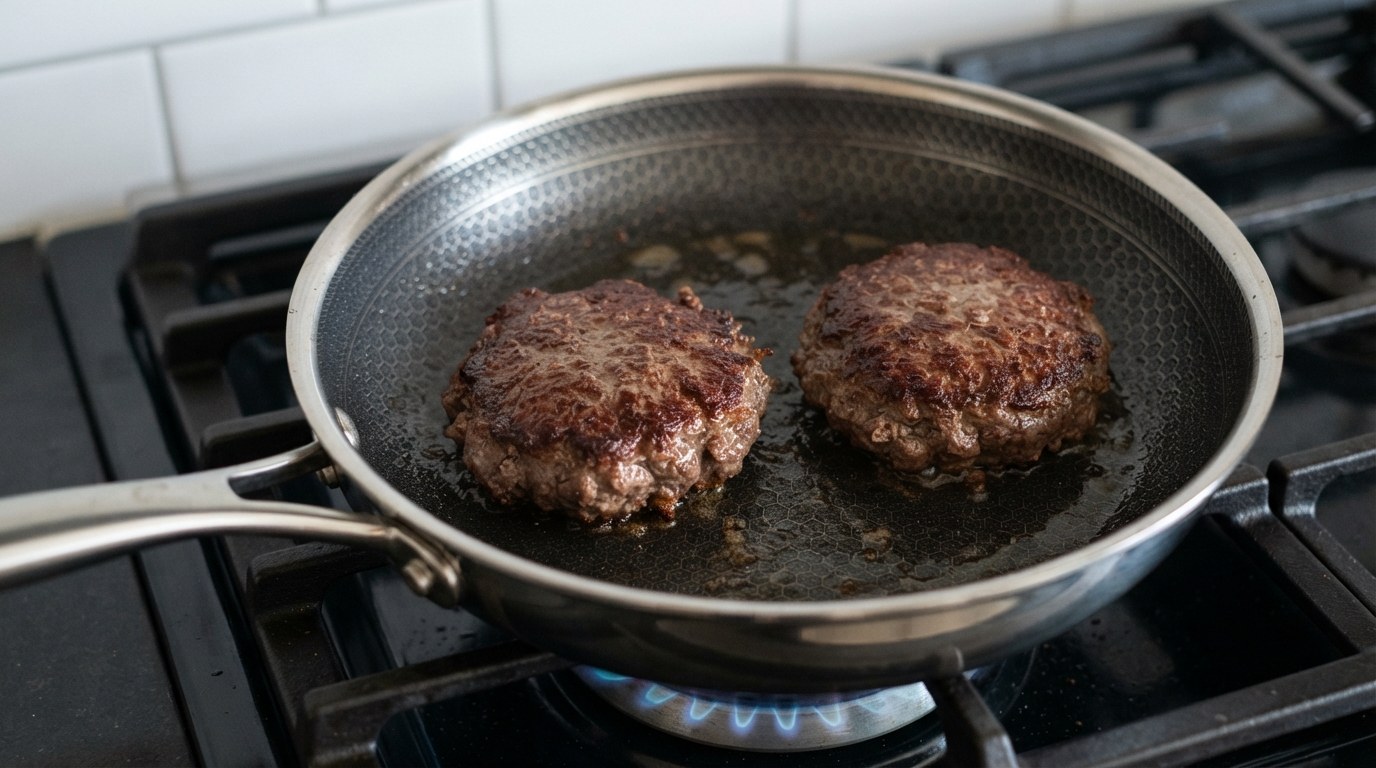
Cook the Ultimate Cheeseburger patty to 160°F in the thickest part. That's the USDA safe minimum for ground beef, and it applies to every burger because grinding mixes whatever bacteria sat on the surface of the meat all the way through the patty. A 6-ounce patty about 3/4 inch thick gets there in 7 to 8 minutes in a hot pan, and at that size the center stays juicy while the outside browns.
Do it the Ramsay way: heat the pan first, then add a thin film of grapeseed oil, and lay the cold patties in only when the oil shimmers. Sear 4 minutes without touching them, flip once and give them 3 to 4 minutes more, then check with an instant-read thermometer; color is a poor guide in ground beef. The hard brown crust is the Maillard reaction, which needs the surface above about 284°F, and our Gordon Ramsay truffle burger goes deeper on that sear. When to salt (the outside only, right before cooking) is covered on the Celebration burger.
ThermoPro
ThermoPro TempSwift Instant-Read Digital Thermometer
- Reads in about 1 second, accurate to ±0.9°F, with a 4.3-inch food-grade stainless probe
- Hold and calibration functions, so you can lock a reading away from the heat
- NSF certified and IP65 waterproof, rinse it clean under the tap
Leave the rendered fat in the pan. Pour off all but a thin film, add a little butter and toast the buns cut side down while the patties sit for a couple of minutes. Nothing goes to waste, and the bread picks up the beef flavor.
Boursin on the Bun: The Ultimate Cheeseburger's Cool Cheese Layer
Boursin goes on the toasted top bun, not the patty, because it is a fresh cheese that softens into a spread instead of melting into a sheet. Boursin describes it as a Gournay cheese with garlic and fine herbs, first made in Normandy in 1963. It's unaged, soft and creamy, so the heat rising off the patty and sauce warms it just enough to loosen, and its garlic and herbs land in every bite. Let it sit out for 20 minutes so it spreads without tearing the bread.
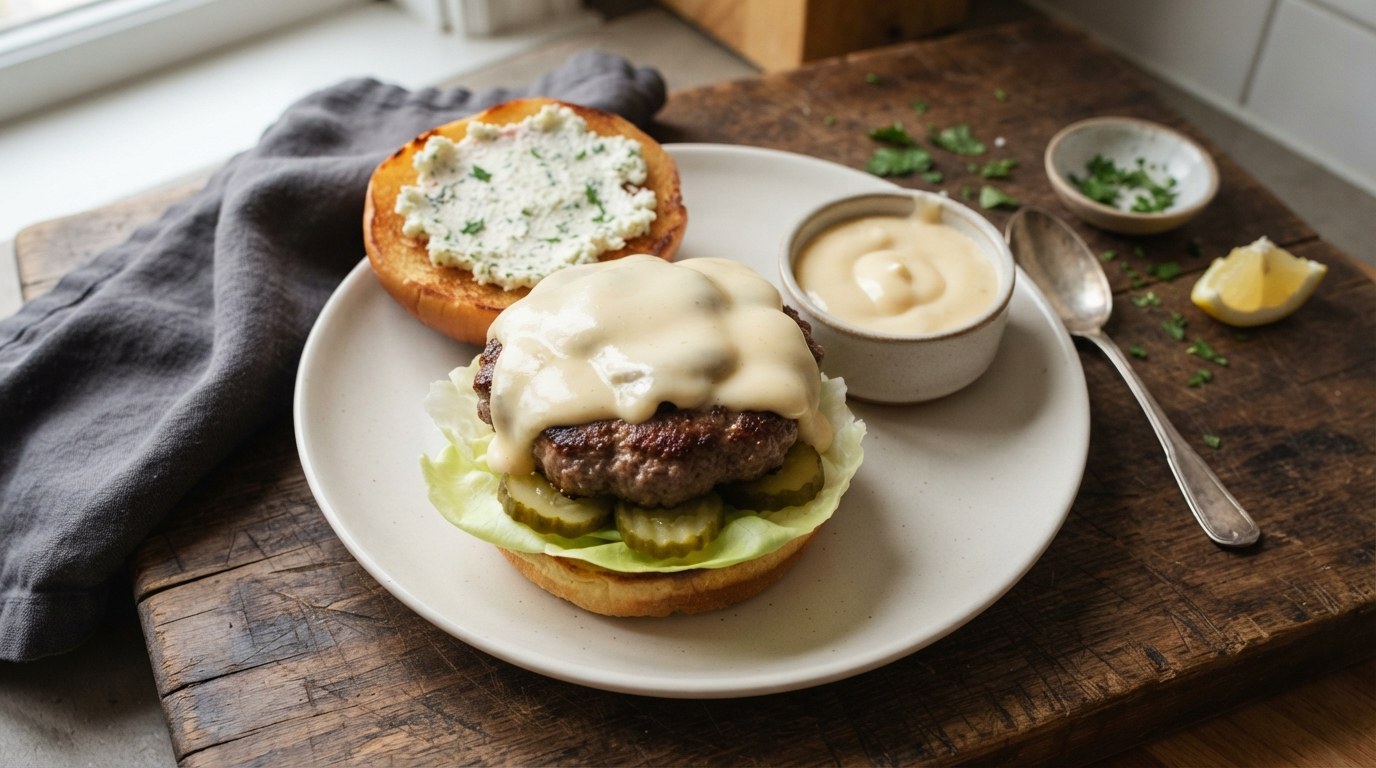
Toast both halves of the bun well. A dry, browned cut face holds up far longer under a runny sauce than soft bread does, and the Luxe Royale page explains why a toasted, fat-coated crumb resists soaking. Build it bottom to top: lettuce, pickles, the patty, a generous 3 to 4 tablespoons of warm cheese sauce, then the Boursin-spread top bun.
Ultimate Cheeseburger Variations and Cheese Swaps
The easiest way to change this burger is to swap the cheeses in the sauce; the sodium citrate ratio stays the same whatever you use. An aged white cheddar gives a sharper sauce, Gruyère a nuttier one, and a handful of pepper jack in the mix adds heat. Keep one aged cheese in the blend for flavor and the sauce will carry it. For a quicker weeknight version, lay a slice of American cheese on the patty in the last minute and spoon a little sauce over it; the slice melts on its own and the sauce adds the aged-cheese taste. And if you'd rather have a classic single-cheese build, our Gordon Ramsay burger recipe breaks down the restaurant's approach.
Serve the Ultimate Cheeseburger with fries and the leftover sauce for dipping, or with a crisp green salad dressed sharply to balance the richness. For the next burger night, try the slow-braised 24-hour burger. Turn the aged cheeses into a sauce, take the patty to 160°F and toast the bun hard, and the Gordon Ramsay Ultimate Cheeseburger delivers all three cheeses at their best, with none of the grease.
Gordon Ramsay Ultimate Cheeseburger
Ingredients
Cheese sauce
- 1/2 cup whole milk (120 ml)
- 5 to 6 g sodium citrate (about 1 level teaspoon)
- 3 oz Dubliner cheese, finely grated (85 g)
- 2 oz aged provolone, finely grated (55 g)
Burgers
- 1 1/2 lb 80/20 ground chuck (680 g), kept cold
- Kosher salt and freshly ground black pepper
- 1 tbsp grapeseed oil
- 1 tbsp unsalted butter
- 4 brioche burger buns, split
- 4 tbsp Boursin Garlic & Fine Herbs cheese, softened (about half a 5.2 oz package)
- 4 butter lettuce leaves
- 12 dill pickle chips
Instructions
- Take the Boursin out of the fridge 20 minutes ahead so it spreads easily. Finely grate the Dubliner and aged provolone from the block and toss them together.
- Pour the milk into a small saucepan, whisk in the sodium citrate and warm over medium-low until it dissolves and the milk steams.
- Turn the heat to low and add the cheese a handful at a time, whisking until each addition melts before adding the next, until the sauce is smooth and glossy. Keep it below 170°F, never boiling. Hold it over the lowest heat, whisking now and then; loosen with a splash of milk if it thickens.
- Divide the cold beef into four 6 oz portions and shape each into a patty about 3/4 inch thick and 4 1/2 inches wide. Refrigerate until the pan is hot, then season the outside with salt and pepper.
- Heat a 12-inch skillet over medium-high until hot, then add the grapeseed oil. Add the patties and sear without moving them for 4 minutes. Flip and cook 3 to 4 minutes more, until an instant-read thermometer in the center reads 160°F.
- Move the patties to a plate. Pour off all but a thin film of fat, add the butter and toast the buns cut side down over medium for 1 to 2 minutes, until golden and crisp.
- Spread 1 tablespoon of Boursin on the cut side of each top bun.
- Build each burger: bottom bun, lettuce, 3 pickle chips, the patty and 3 to 4 tablespoons of warm cheese sauce, then the top bun. Serve right away with any extra sauce on the side.
Notes
Ultimate Cheeseburger FAQs
The questions that come up most: what the best cheese for burgers is, why American cheese melts better than cheddar, why cheddar turns greasy on a burger, how much sodium citrate a cheese sauce needs, how to make one without it, whether provolone is good on burgers, and what goes on the Ultimate Cheeseburger.
What is the best cheese for burgers?
For a smooth melted slice, American cheese is the easiest because emulsifying salts keep it from breaking. For more flavor, young cheddar, Colby, Monterey Jack or young Gouda melt well on their own. Aged cheeses like sharp cheddar, Dubliner and provolone taste best but melt poorly, so turn them into a sodium citrate cheese sauce.
Why does American cheese melt better than cheddar?
American is a process cheese made with emulsifying salts such as sodium citrate, which the federal standard allows at up to 3% of its weight. The salts pull calcium away from the milk proteins so they hold the fat in an emulsion, and the cheese melts smooth instead of separating.
Why does cheddar get greasy when it melts on a burger?
Aged cheddar is drier and its protein network has broken down with age, so its fat runs out as it warms (the fat softens around 90°F) while the proteins tighten and squeeze out more fat if they overheat. Grate it fine and melt it gently, or make it into a cheese sauce with sodium citrate.
How much sodium citrate do you need for cheese sauce?
About 4 grams of sodium citrate for every 100 grams of grated cheese, with 93 grams of milk or water, which is Modernist Cuisine's ratio. For four burgers: 140 grams of cheese, 1/2 cup of whole milk and 5 to 6 grams of sodium citrate. Keep the sauce below 170°F.
Can you make a smooth cheese sauce without sodium citrate?
Yes. Toss the grated cheese with 2 teaspoons of cornstarch and melt it into 1/2 cup of evaporated milk over low heat. The starch thickens the sauce and keeps it from splitting; it is a bit thicker and less glossy than the sodium citrate version.
Is provolone good on burgers?
Yes. Mild provolone melts well on a patty. Aged provolone is sharper and drier, so it can oil out under hard heat; it is best grated into a cheese sauce, as in this burger, where it adds a tangy bite.
What cheeses are on the Gordon Ramsay Ultimate Cheeseburger?
Three: Dubliner and aged provolone melted together into a smooth sauce over the patty, and garlic and herb Boursin spread on the toasted top bun. Butter lettuce and dill pickles round it out.

About the Author
John Siracusa is the founder of Hell’s Kitchen Recipes. He focuses on technique-first, reproducible home cooking and researches recipes & kitchen equipment from published food science and professional chef methods since 2016.