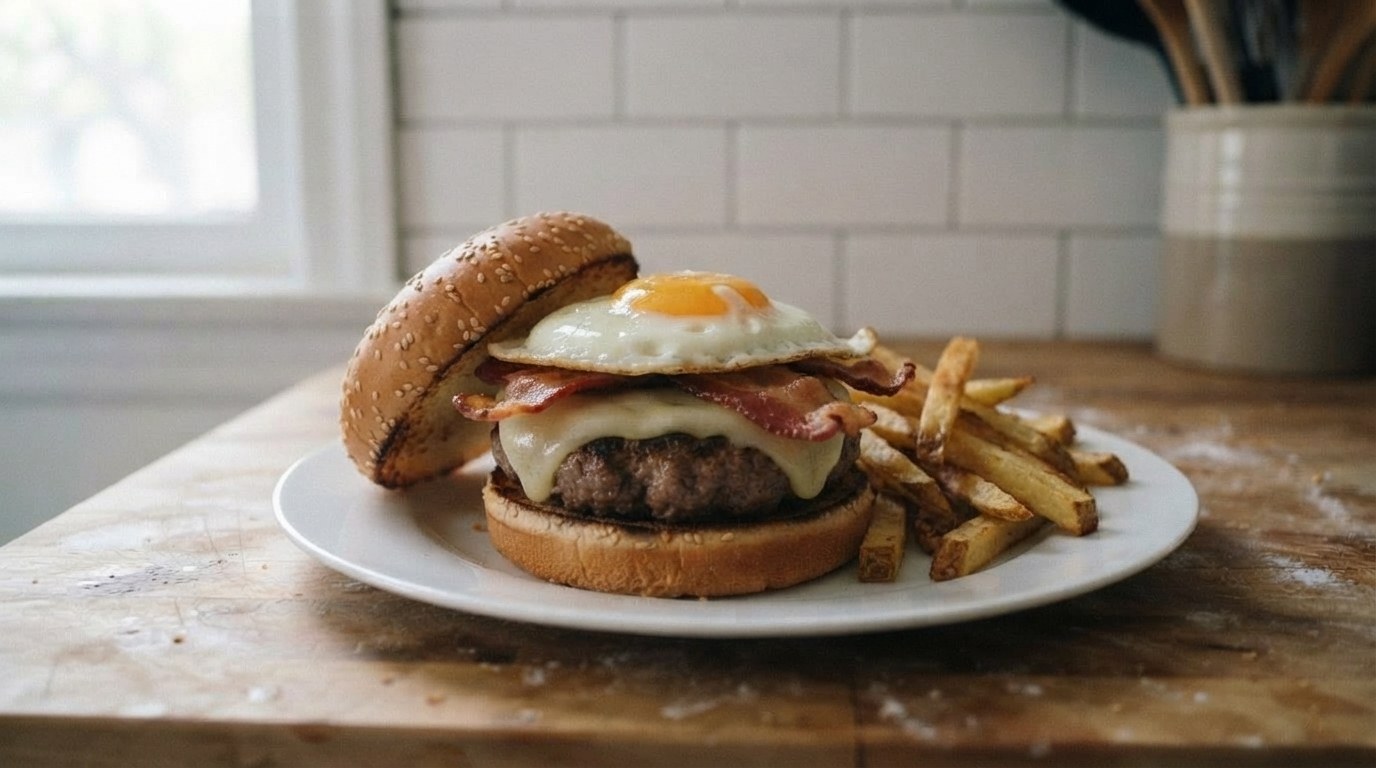
The Gordon Ramsay Farmhouse Burger keeps it short: a beef patty, melted Dubliner cheese, crisp bacon and a fried egg on a toasted sesame brioche bun. With only three toppings, the egg carries the whole burger. A set white and a warm, runny yolk that soaks into the bacon makes it; a rubbery, grey-edged egg sinks it. So this farmhouse burger recipe spends most of its time on the egg: the temperatures that set the white before the yolk, butter versus hot oil, how to cook the top of the white without touching the yolk, and when a runny yolk is and isn't a good idea.
What's on the Gordon Ramsay Farmhouse Burger?
On the Gordon Ramsay Burger menus in Las Vegas, the Farmhouse Burger is a beef burger with Dubliner cheese, bacon and a fried egg, served with fries. That's the whole list on the Planet Hollywood menu and at the Flamingo. The Vancouver restaurant makes its own version with aged white cheddar and a garlic mayo, and the Vancouver menu spells out the bun: toasted sesame seed brioche. The Chicago and Boston menus don't carry it, so the Las Vegas build is the one to copy.
Dubliner is an aged Irish cow's milk cheese, firm like a cheddar with a sweet, nutty finish, sold by Kerrygold. It's the same cheese that goes on the Luxe Royale Burger, which covers how to melt a hard aged cheese so it flows instead of oiling out. An aged white cheddar is the easy swap, and it's the one Vancouver uses anyway.
Why the Egg White Sets Before the Yolk
Egg white sets at a lower temperature than the yolk, and that gap is the whole trick to a runny-yolk fried egg. According to the American Egg Board, egg white proteins coagulate between 144°F and 149°F, while yolk proteins coagulate between 149°F and 158°F. Canada's egg farmers put it in kitchen terms on eggs.ca: the white turns jelly-like at 140°F and firms at about 149°F, and the yolk is fully set at 158°F. Get the white past 149°F while the yolk stays under the 150s and you have the egg you want.
The frying pan makes that harder than it sounds. All the heat comes from underneath, so the bottom of the white sets first and the thick white piled up around the yolk sets last. The yolk sits highest of all, cushioned by the white. Leave the egg alone until that top layer of white is firm and the heat has had time to climb into the yolk, which is how you end up with an over-medium egg you never flipped. The fix is to put heat on top of the egg for the last minute, with hot butter or with steam, as you'll see below.

| Egg style | How to cook it | White | Yolk | On a Farmhouse Burger |
|---|---|---|---|---|
| Butter-basted sunny side up | Medium-low heat, butter spooned over the white for the last minute | Tender and fully set, pale edges | Runny and warm | The classic drape; the yolk breaks over the bacon |
| Crispy lacy-edge | Hot oil, shimmering; oil spooned over the top | Crisp, brown, frilly edges; soft center | Runny if you move fast | Adds crunch next to soft Dubliner |
| Steam-covered | Medium-low, a teaspoon of water and a lid for about 1 minute | Evenly set, top included | Runny under a thin white veil | The most forgiving way to set the top |
| Over easy | Flipped for 20 to 30 seconds | Fully set on both sides | Runny | Neater to stack; less drip |
| Over hard | Flipped and cooked 2 to 3 minutes more, or covered until the yolk is firm | Fully set | Firm | The choice for kids, pregnancy and anyone at higher risk |
For a Farmhouse Burger, the butter-basted egg gives the soft, restaurant-style drape, the lacy egg adds crunch, and the over-hard egg is the one to make when the yolk has to be firm. Pick one and stick with it for the whole batch so every burger lands the same.
Butter or Hot Oil: Two Ways to Fry the Farmhouse Burger Egg
Fry the Farmhouse Burger egg in butter over medium-low heat for a tender white, or in hot oil for crisp, lacy edges. Both give a runny yolk; they just feel different in the bite. Gordon's egg habits apply to both: a non-stick pan, gentle control of the heat, and no salt on the egg until it's cooked, then salt and pepper straight onto the set white and yolk as it comes out.
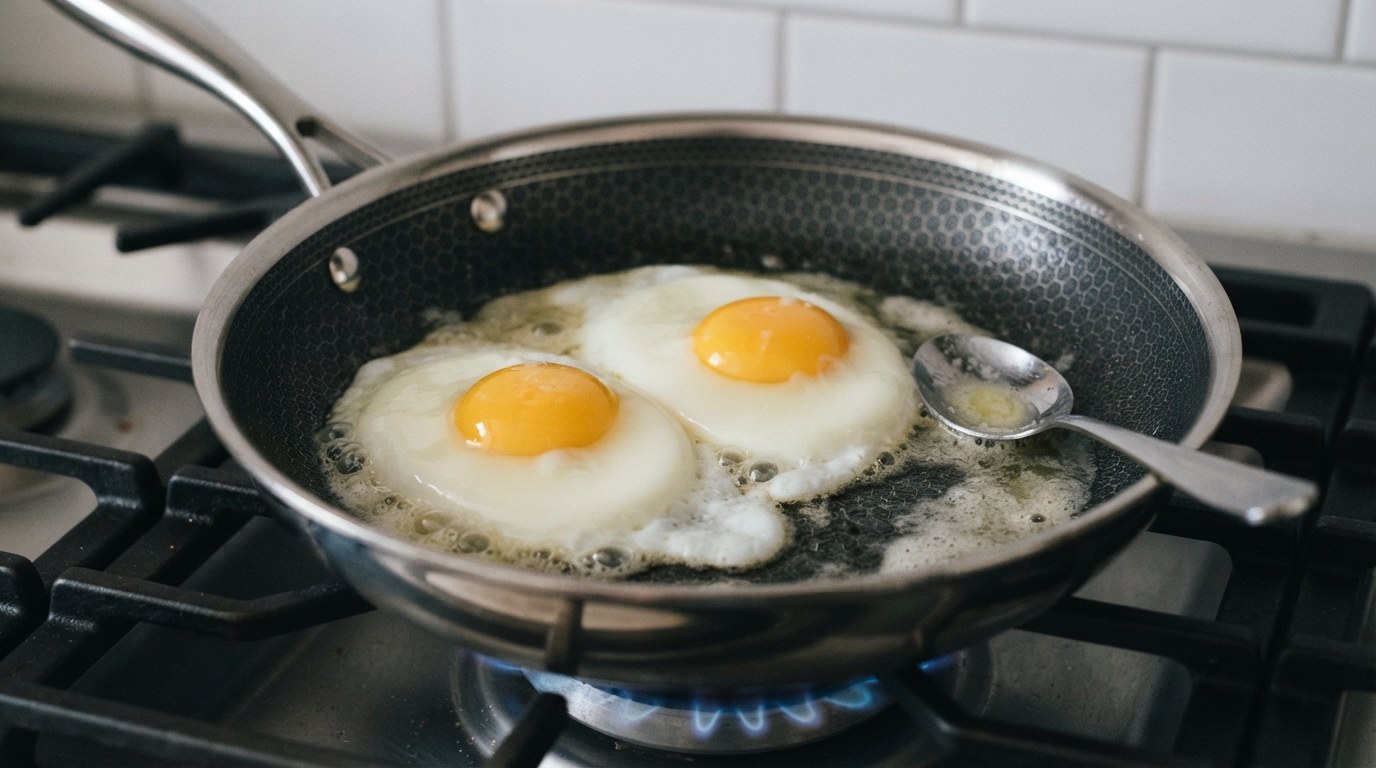
Butter keeps you honest. Melt a tablespoon over medium-low and wait for the foam to settle: the foaming is the water in the butter boiling off by evaporation, and once it quiets the pan is ready. Butter's milk solids scorch well before a neutral oil would smoke, so if the butter starts to brown fast, the pan is too hot for this egg. At that gentle heat the white sets smooth and even in about 3 minutes, with barely any color on the edges.
Hot oil does the opposite. Heat a couple of tablespoons of neutral oil until it shimmers, then slide the egg in. The thin outer edge of the white dries out in seconds, and once it's dry it climbs past the roughly 284°F where Maillard browning starts, puffing and crisping into a golden lace. Tilt the pan, spoon the hot oil over the white around the yolk, and it's done in 1 to 2 minutes. Crack each egg into a small cup first either way, so a broken yolk never lands in the pan.
HexClad
HexClad 12-Inch Hybrid Nonstick Frying Pan
- Stainless steel and ceramic nonstick hybrid surface, built to sear hard and release easily
- Tri-ply with an aluminum core for quick, even heat; works on induction
- Oven safe to 900°F and metal-utensil safe (lid not included)
Basting or a Lid: Setting the Top of the White
To set the top of the white without cooking the yolk, spoon hot fat over it or trap steam under a lid for the last minute. Both bring heat down onto the egg from above, which is exactly what the pan can't do. For the butter egg, tilt the pan so the butter pools at one side, then spoon it over the white around the yolk for 30 to 60 seconds, until the clear, glassy patches turn opaque white. Aim at the white; a spoonful straight on the yolk starts to set its surface.
A lid is the easier route when you're cooking four eggs at once. Add a teaspoon of water to the pan beside the eggs, cover it and give it about a minute. The water turns to steam at 212°F, which is hotter than the white needs, so the top sets quickly. You'll see a thin white film over each yolk: that's the layer of white sitting on top of it, and the yolk under it stays runny. Lift the lid as soon as the white is set.
Why an Overcooked Egg Smells Like Sulfur
That eggy, sulfur smell means the egg has been cooked too long or too hot. The white is rich in sulfur, and from about 140°F some of it starts to break free from the white's proteins as they cook. The Exploratorium explains the rest: heated long enough, sulfur from the white and iron from the yolk combine into grey-green ferrous sulfide and hydrogen sulfide gas, the smell of an overdone egg. The same overcooking tightens the white's proteins until they squeeze out their water, which is what makes an overdone white rubbery.
The fix is timing. Take the egg off the heat the moment the white is set and the yolk still wobbles, and put it straight onto the burger. It keeps cooking a little from carryover on a hot patty, so an egg that looks just right in the pan will be a shade firmer by the time you bite into it. Frying the eggs last, after the patties are resting, keeps them from sitting around.
Runny Yolk or Firm? Egg Safety on a Farmhouse Burger
Food safety agencies advise cooking eggs until both the white and the yolk are firm, so a runny yolk is a choice you make knowing the risk. The FDA's egg safety guidance says to cook eggs until yolk and white are firm and to take egg dishes to 160°F, and it names the people at greater risk of serious illness from Salmonella: young children, older adults, pregnant women and anyone with a weakened immune system. For them, cook the egg over hard, or use pasteurized eggs.
Pasteurized in-shell eggs are the way to keep the runny yolk for everyone. The USDA notes in Shell Eggs from Farm to Table that in-shell pasteurized eggs can be used safely without cooking. For healthy adults who like a runny yolk and use fresh, refrigerated eggs with clean, uncracked shells, the butter-basted egg above is the one to make.
How to Build the Farmhouse Burger
Build the Farmhouse Burger from the bottom up: toasted bun, the patty with its melted Dubliner, two strips of bacon, the fried egg, then the top bun. The egg goes last and goes on hot, so the yolk runs down over the bacon and cheese when you cut into it. The bacon under the egg gives the yolk something to soak into instead of running straight onto the plate.
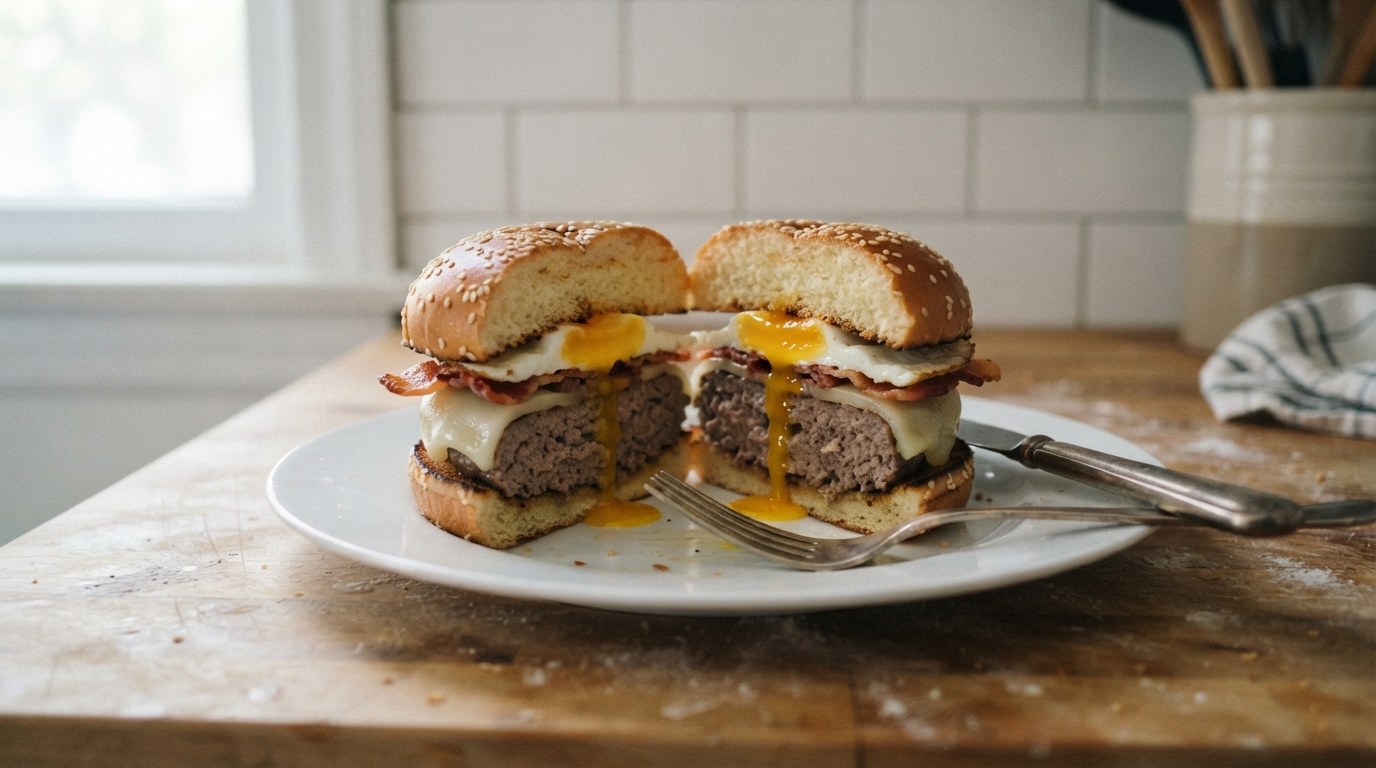
The patty itself needs to reach 160°F in the center, the USDA minimum for ground beef on the FSIS safe temperature chart, because grinding spreads surface bacteria all the way through the meat. A thermometer is the only reliable check; FSIS has found that ground beef can turn brown inside before it's actually cooked to a safe temperature. The rest of the beef is covered elsewhere: when to salt the patty and why to dimple it on the Celebration Burger page, and crisp bacon from a cold pan on the Truffle Burger page.
Toast the cut sides of the sesame brioche in a little butter until golden, since a dry, toasted face holds up to the yolk far longer than soft bread. The Vancouver-style garlic mayo is optional: stir a grated garlic clove into a quarter cup of mayonnaise and spread it on the bottom bun. If you like the egg-on-a-burger idea, the Celebration Burger cooks its egg right inside a portobello cap instead, and the whole lineup lives on the Gordon Ramsay signature burgers hub.
What to Serve With a Farmhouse Burger
Serve the Farmhouse Burger the way the restaurant does, with fries, and eat it straight away while the yolk is still warm. For a weekend brunch plate, crispy hash browns or roasted potatoes suit the bacon-and-egg side of it, and a sharp green salad with a mustard vinaigrette cuts through the richness. Want more heat? The Hellfire Chicken Burger is the spicy one in the lineup. The pans for the job are in our Gordon Ramsay cookware guide, and a good non-stick skillet is what makes a clean-edged Gordon Ramsay Farmhouse Burger egg easy, four at a time.
Gordon Ramsay's Farmhouse Burger
Ingredients
Patties
- 1 1/2 lb 80/20 ground chuck (680 g), kept cold
- 1 1/2 tsp kosher salt
- 1 tsp freshly cracked black pepper
- 1 tbsp neutral oil, such as grapeseed
- 4 slices Dubliner cheese (about 3 oz), or aged white cheddar
Toppings
- 8 slices thick-cut bacon
- 4 large eggs (pasteurized in-shell eggs for anyone at higher risk)
- 2 tbsp unsalted butter, for the eggs
- Flaky salt and black pepper, for the eggs
Buns
- 4 sesame seed brioche buns, split
- 1 tbsp softened butter, for the buns
Garlic Mayo
- 1/4 cup mayonnaise (optional)
- 1 small garlic clove, finely grated (optional)
Instructions
- Divide the cold beef into 4 equal portions. Shape each loosely into a patty about 3/4 inch thick and 1/2 inch wider than the buns, press a shallow dimple into the center with your thumb, and chill on a tray while you cook the bacon.
- Cook the bacon in a large skillet over medium heat until crisp, 8 to 10 minutes. Drain on paper towels. If using the garlic mayo, stir the grated garlic into the mayonnaise and set aside.
- Heat a cast-iron or heavy skillet over medium-high. Season the patties all over with the salt and pepper just before cooking and brush them with the oil.
- Cook the patties 4 to 5 minutes per side without pressing, until an instant-read thermometer in the center reads 160°F. Lay a slice of Dubliner on each for the last minute and cover to melt. Move to a board to rest.
- Butter the cut sides of the buns and toast them in a pan for about 1 minute, until golden.
- Wipe out a large non-stick skillet and melt the 2 tablespoons of butter over medium-low until the foaming settles. Crack each egg into a small cup and slide it into the pan. Cook about 3 minutes, until the bottom of the white is set.
- Tilt the pan and spoon the butter over the white around each yolk for 30 to 60 seconds, or add a teaspoon of water and cover for about 1 minute, until the whites are fully opaque and the yolks still runny. For firm yolks, flip and cook 2 to 3 minutes more. Season the eggs with flaky salt and pepper.
- Spread garlic mayo on the bottom buns if using. Add the cheese-topped patties, two slices of bacon each and a fried egg, then the top buns. Serve right away with fries.
Notes
Gordon Ramsay Farmhouse Burger FAQs
The questions that come up most: what's on the Farmhouse Burger, what a farmhouse burger is, how to fry an egg with a runny yolk, butter or oil, whether to flip the egg, why eggs smell of sulfur, and runny yolks in pregnancy.
What is on Gordon Ramsay's Farmhouse Burger?
On the Gordon Ramsay Burger menus in Las Vegas it is a beef burger with Dubliner cheese, bacon and a fried egg, served with fries. The Vancouver restaurant swaps in aged white cheddar and adds a garlic mayo, on a toasted sesame brioche bun.
What is a farmhouse burger?
At Gordon Ramsay Burger it is the bacon, cheese and fried-egg burger. Other restaurants use the name for their own builds, so the toppings change from menu to menu, but a fried egg and bacon are the parts that make this one a farmhouse burger.
How do you fry an egg for a burger with a runny yolk?
Melt butter over medium-low, crack in the egg and cook about 3 minutes until the bottom of the white sets. Then spoon the hot butter over the white around the yolk, or cover the pan with a teaspoon of water for about a minute, until the white is opaque and the yolk still wobbles.
Is it better to fry an egg in butter or oil for a burger?
Butter over medium-low gives a tender, evenly set white and a mild, rich flavor. Hot oil gives crisp, lacy brown edges because the thin edge dries out and browns. Both leave the yolk runny if you take the egg off as soon as the white sets.
Should you flip the egg on a burger?
You can. An over-easy egg, flipped for 20 to 30 seconds, is neater to stack and still runny. For a sunny-side-up look, baste or cover the egg instead of flipping, and for a firm yolk flip it and cook 2 to 3 minutes more.
Why does my fried egg smell like sulfur?
It is overcooked. Heat frees sulfur from the egg white, and with long or hot cooking it forms hydrogen sulfide gas and a grey-green tinge where it meets iron from the yolk. Pull the egg as soon as the white is set.
Can you eat a burger with a runny egg when pregnant?
The FDA lists pregnant women among the groups at higher risk from Salmonella and advises cooking eggs until the yolk and white are firm. Cook the egg over hard, or use pasteurized in-shell eggs if you want the yolk runny.

About the Author
John Siracusa is the founder of Hell’s Kitchen Recipes. He focuses on technique-first, reproducible home cooking and researches recipes & kitchen equipment from published food science and professional chef methods since 2016.