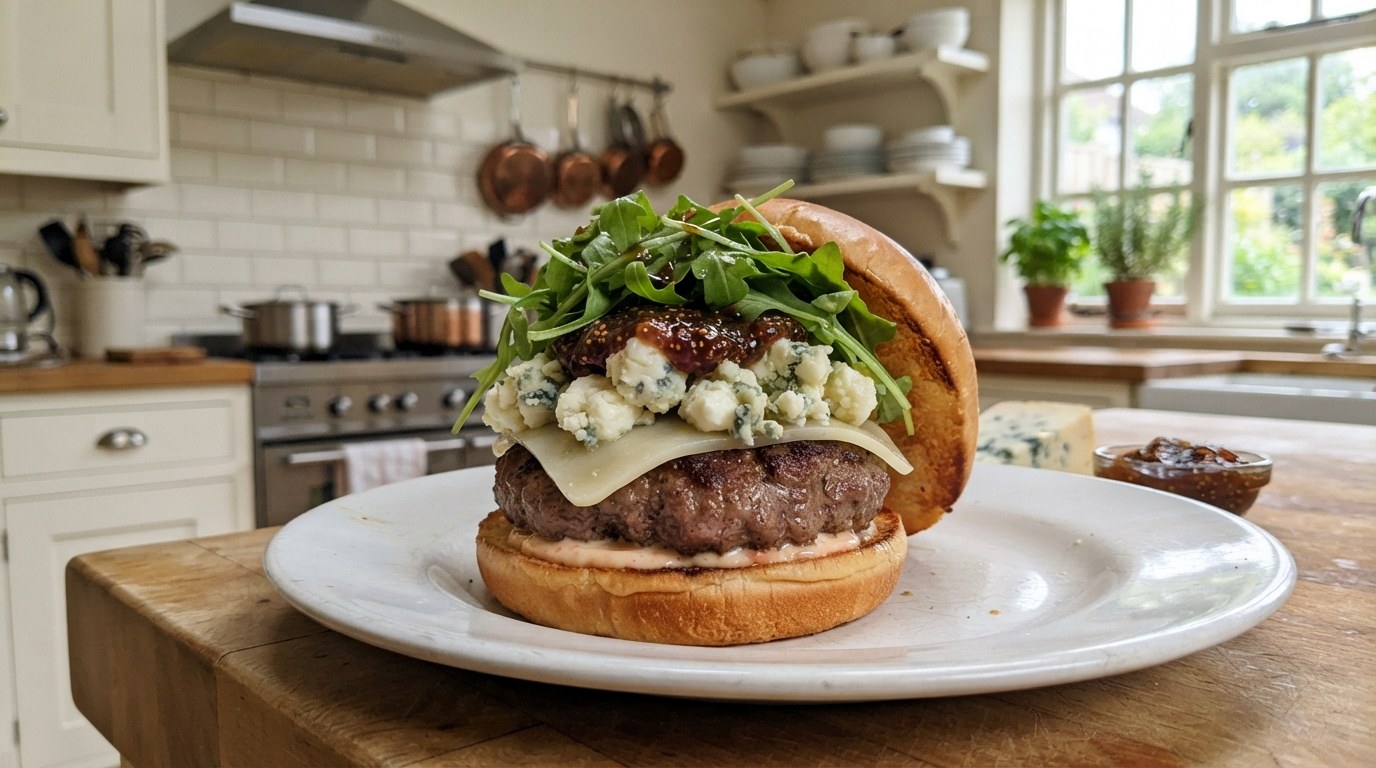
This blue cheese burger recipe is the Blue Cheeseburger from the Gordon Ramsay Burger menu, made for a home kitchen: a seared beef patty under a slice of nutty Manchego and a heap of blue cheese, with figgy jam, peppery arugula, a sharp cider vinegar reduction and hot mayo. It's a burger built on contrast, salty and funky against sweet and sour. The patty is the easy part and the blue cheese takes more care, so this page is about the cheese: how it behaves in the pan, why it belongs on top rather than inside, and how the jam and vinegar keep it in check.
What's on Gordon Ramsay's Blue Cheese Burger?
Gordon Ramsay's Blue Cheeseburger carries six toppings: blue cheese, Manchego cheese, figgy jam, arugula, a cider vinegar reduction and hot mayo, over a beef patty. That's the line on the Gordon Ramsay Burger Las Vegas menu, where it sits in the Specialties list next to the Hell's Kitchen Burger and the Farmhouse Burger. There's no bacon, onion or lettuce on it.
This home version keeps all six and makes four burgers. The fig jam can come from a jar (look for fig spread or fig preserves), the reduction takes about 8 minutes in a small saucepan, and the hot mayo is a stir-together. Everything else is about getting the cheese right.
Does Blue Cheese Melt on a Burger?
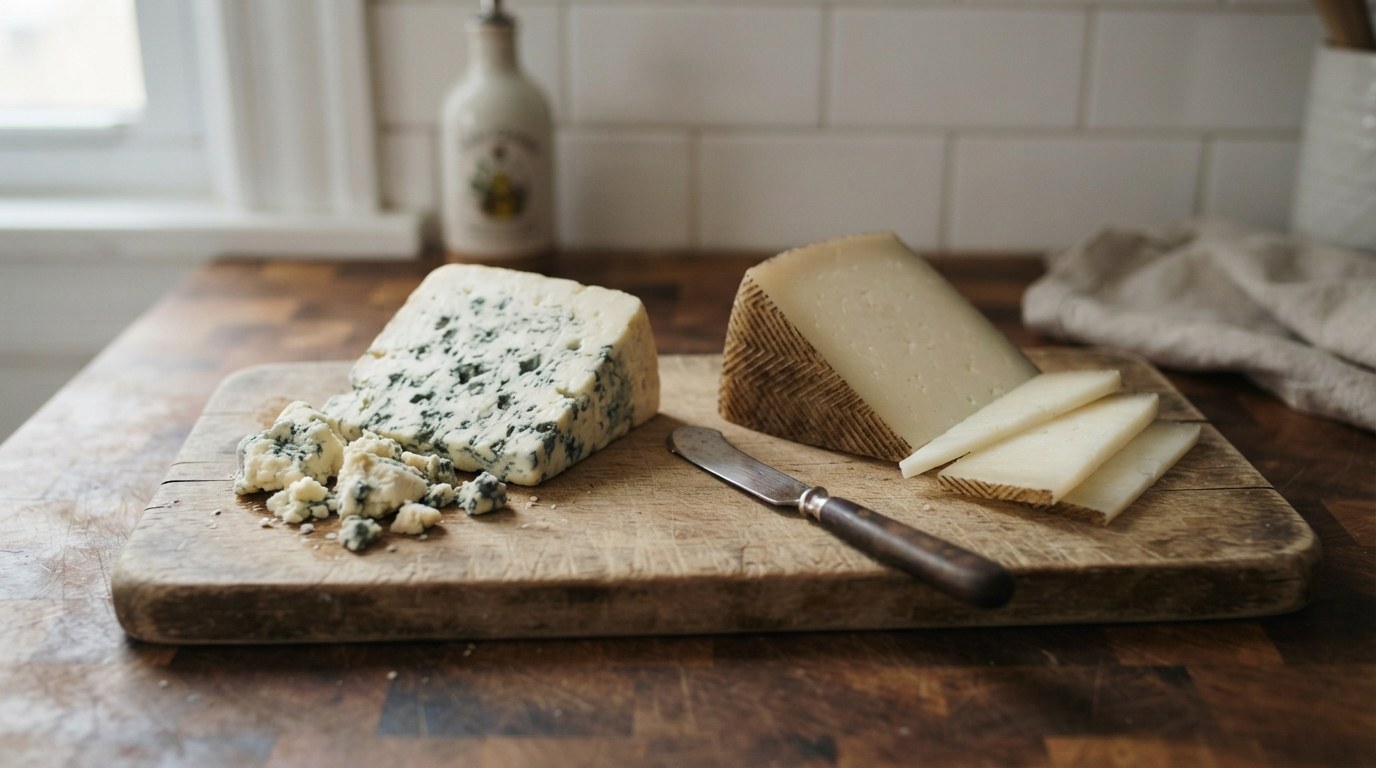
Blue cheese melts on a burger, but it never stretches. It softens and slumps into creamy lumps that run into the meat, and it won't give you the long cheese pull of American or mozzarella. The reason sits in the curd. The University of Wisconsin Center for Dairy Research explains that Blue and Camembert start out at a low pH of about 4.8, too acidic for the casein network to stay stretchy. As the cheese ripens, the mold chops up those proteins and the casein takes on more water, so the cheese flows readily when warm. The Cheese Science Toolkit's melt wheel rates blue cheese as a high melter for exactly that reason: mold enzymes have broken the protein down.
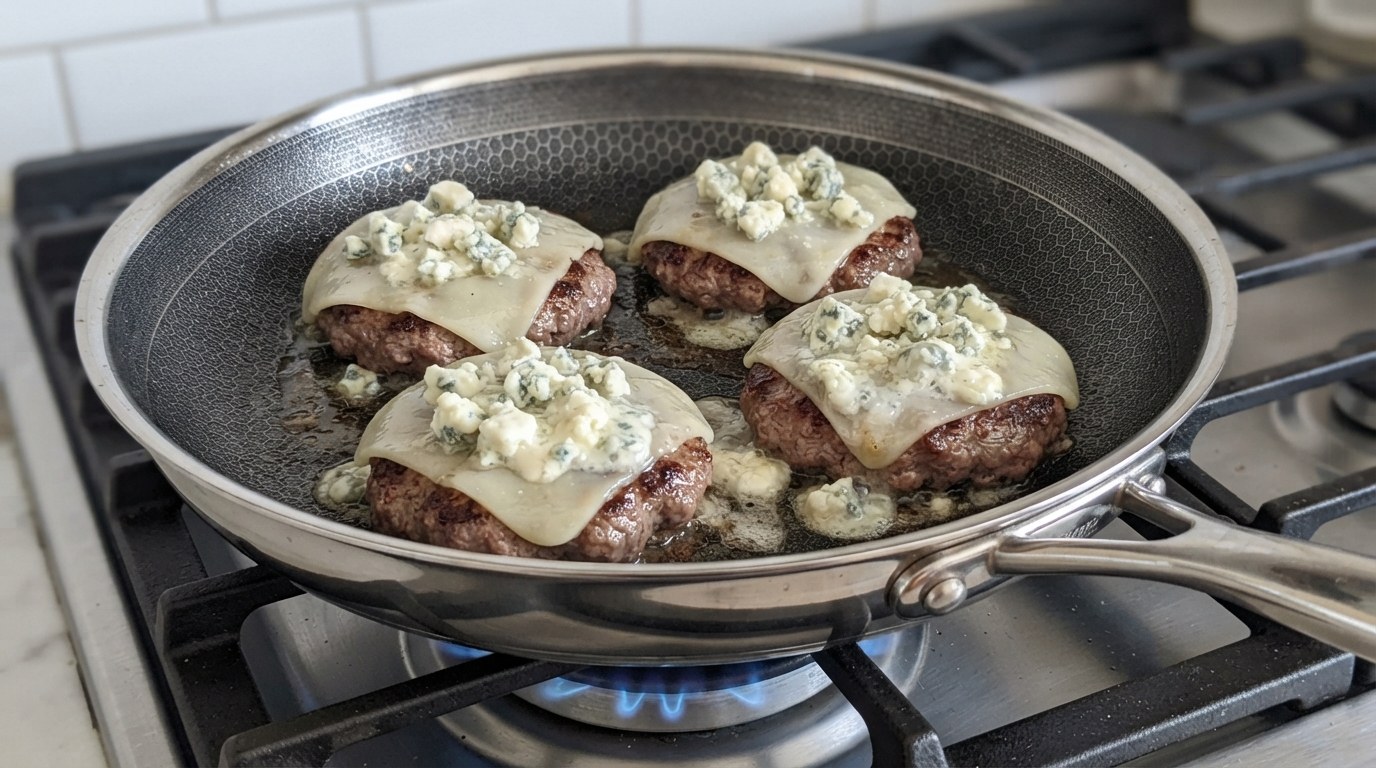
The same CDR bulletin notes that the faster a cheese flows, the more milkfat it releases, which shows up as oiling-off. Give blue crumbles a long blast on a very hot patty and they collapse into a greasy puddle and some slides off into the pan. Put them on for the last 2 minutes of cooking, when the patty is close to done, so they soften without breaking down. A lid over the pan for that last stretch helps, and our guide to melting cheese on a burger covers the lid trick in full.
| Blue cheese | Texture | On a hot patty | Best for |
|---|---|---|---|
| Gorgonzola dolce | Soft, spoonable, mild | Turns saucy within a minute; watch it or it runs off | The creamiest, gentlest blue cheese burger |
| Danish blue | Moist, creamy, easy to crumble | Slumps into soft lumps with a little fat; the easiest all-rounder | A classic blue cheese burger |
| Domestic blue from a wedge | Firm but moist | Softens and slumps, keeps some shape | Everyday burgers, bacon and blue |
| Pre-crumbled blue (tub) | Dry, small crumbs | Softens slowly and stays crumbly | Convenience; crumble a wedge if you can |
| Roquefort | Crumbly, sheep's milk, sharp and salty | Softens and weeps fat; strong flavor | Big blue flavor; use a little less |
| Stilton | Firm, dense, crumbly | Softens slowly in lumps | A firmer, nuttier topping |
For a burger, a creamy, higher-moisture blue melts the most evenly, and the CDR bulletin explains why: fat spreads the casein apart, so richer cheeses melt at cooler temperatures. Dry crumbles from a tub stay crumbly. Buy a wedge and break it by hand into big half-inch pieces; they sit on the patty better and soften more evenly.
Why the Manchego Goes Down Before the Blue Cheese
Lay the Manchego on the patty first and pile the blue cheese on top of it. Manchego is a pressed sheep's-milk cheese made only from the milk of Manchega sheep and aged at least 30 to 60 days, per the Manchego cheese PDO council. Pressed and aged, it softens into a sheet over the beef that catches the blue crumbles and stops them tumbling off, and its mellow, nutty flavor gives the sharp blue something to rest on.
Slice the Manchego thin, about an eighth of an inch, so it softens in the time the blue needs. A thick slab of an older, firmer Manchego sweats oil before it goes soft; the Luxe Royale Burger page covers how aged cheese behaves under a lid if yours is well aged.
Should You Stuff Blue Cheese Inside the Burger?
Put the blue cheese on top of the burger, not inside it. A stuffed blue cheese burger seals the cheese in a pocket of raw beef, and as the patty cooks that cheese turns molten and gives off steam with nowhere to go. The first bite can squirt scalding cheese, a real burn risk with any stuffed burger, and the pocket often splits open on the grill, so the cheese you paid for ends up in the pan.
A stuffed patty also makes the temperature reading harder. Ground beef needs to reach 160°F in the center, the USDA safe minimum, because grinding spreads surface bacteria through the whole patty. If the thermometer tip lands in the cheese pocket, you're reading cheese, and the meat around it could still be short. Slide the probe in from the side and into the thickest band of meat, beside the pocket rather than into it, and check it in two spots. On a topped burger it's simple: probe straight into the middle of the beef before the cheese goes on.
ThermoPro
ThermoPro TempSwift Instant-Read Digital Thermometer
- Reads in about 1 second, accurate to ±0.9°F, with a 4.3-inch food-grade stainless probe
- Hold and calibration functions, so you can lock a reading away from the heat
- NSF certified and IP65 waterproof, rinse it clean under the tap
If you still want a stuffed blue cheese burger, use two thin patties per burger, put a tablespoon of crumbled blue in the middle of one, cover with the other and pinch the edges tightly. Let it rest 2 minutes off the heat before anyone bites in, so the molten center settles. For the patty itself, cold beef and salt only on the outside matter as much here as anywhere; the Celebration Burger explains why.
How Fig Jam and Cider Vinegar Balance a Blue Cheese Burger
Blue cheese is salty and sharp, so a good blue cheese burger pairs it with something sweet and something sour. The numbers explain the salt: USDA's FoodData Central lists blue cheese at about 1,150 mg of sodium per 100 grams, against about 640 mg for sharp cheddar. The funk comes from fermentation. The Cheese Science Toolkit explains that the blue mold breaks milkfat into fatty acids and then into methyl ketones, and one of them, heptan-2-one, is the compound that smells like blue cheese.
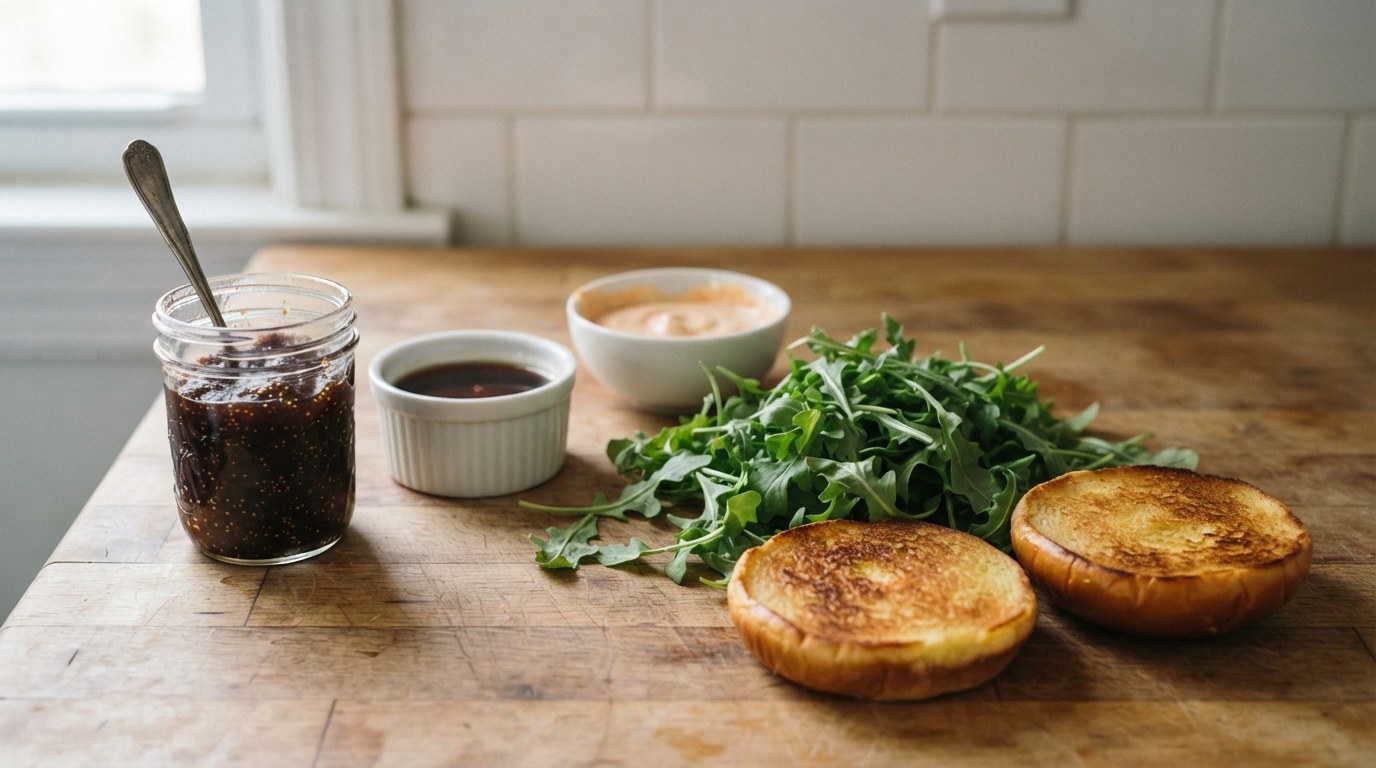
The menu build answers both. The figgy jam puts sugar right on top of the cheese, and sweetness softens how salty and bitter a mouthful tastes. The cider vinegar reduction brings acid, which cuts through the fat from the beef, the Manchego and the mayo. To make it, simmer apple cider vinegar with a little brown sugar until about two-thirds has boiled away. Water leaves by evaporation at 212°F, so the sugar and apple flavor concentrate into a thin syrup, and the harshest sharp fumes cook off with the steam (open a window). Taste it before it goes on: it should be sweet-sour and just coat a spoon, and it thickens more as it cools.
Arugula is the third balancing act, a peppery, bitter green that keeps the sweet jam from tipping the burger into dessert. Add it last, right before the top bun, so it stays fresh. The hot mayo is an emulsion of oil and egg yolk, so the fat carries the chile heat evenly across the bun instead of leaving hot spots. Stir the hot sauce into the mayo a teaspoon at a time and taste as you go; you want a warm hum under the blue cheese, not a burn.
For the beef, get a cast-iron or heavy skillet properly hot, then oil the patties. Browning needs a dry surface above 284°F, and the Truffle Burger page covers how to build that crust. Give each side about 4 minutes over medium-high without pressing, and let the rendered fat stay in the pan to toast the buns.
Is the Mold in Blue Cheese Safe to Eat?
Yes. The blue veins are an intentional food mold, Penicillium roqueforti, added during cheesemaking. The USDA's Food Safety and Inspection Service says the molds used to make Roquefort, blue, Gorgonzola and Stilton are safe to eat. The Cheese Science Toolkit notes that the strains sold under other names for Gorgonzola and Stilton are all forms of that same species.
Mold that isn't part of the cheese is another story. Fuzzy white, green or pink spots on the surface, or anything growing on a tub of crumbles, mean the cheese goes in the trash; FSIS says to discard soft and crumbled cheese with mold. On a firm wedge of Gorgonzola or Stilton, FSIS allows cutting away at least an inch around and below the spot. If you're pregnant, check the label: the FDA's Listeria guidance for moms-to-be lists cheeses made with pasteurized milk as fine and raw-milk cheeses as ones to avoid, and some imported blues are raw-milk cheeses.
Blue Cheese Burger Variations and Sides
The Gordon Ramsay blue cheese burger has plenty of room to change. For a bacon and blue cheese burger, add two strips of crisp bacon per burger and cut the fig jam to a teaspoon, since the bacon brings its own salt and fat. For a mushroom blue cheese burger, sauté sliced cremini in the pan after the patties, until their water cooks off and they brown. Thin slices of ripe pear or quick-pickled red onion both stand in for the fig jam if you want the sweet or the sour without the jar.
Serve it with fries, sweet potato fries or a crisp apple slaw; something sweet or sharp on the side keeps a rich blue cheese burger from wearing you out. For more of the lineup, the Gordon Ramsay burger breakdown covers how his restaurant burgers come together, and the Gordon Ramsay signature burgers hub has all of them. Get the cheese timing right and this blue cheese burger recipe gives you the creamy, salty, sweet and sharp bite the restaurant version is built on, in about 35 minutes.
Gordon Ramsay's Blue Cheese Burger
Ingredients
Patties
- 1 1/2 lb 80/20 ground chuck (680 g), kept cold
- 1 1/2 tsp kosher salt
- 1 tsp freshly cracked black pepper
- 1 tbsp grapeseed or other neutral oil
Cheese
- 4 oz blue cheese from a wedge (about 1 cup, broken into large crumbles)
- 4 thin slices Manchego cheese (about 2 oz)
Cider Vinegar Reduction
- 1/2 cup apple cider vinegar
- 2 tbsp light brown sugar
Hot Mayo
- 1/2 cup mayonnaise
- 1 to 2 tbsp vinegar-based hot sauce, to taste
Toppings
- 1/4 cup fig jam or fig spread
- 2 cups baby arugula
Buns
- 4 brioche or potato burger buns, split
- 2 tbsp softened butter
Instructions
- Take the blue cheese out of the fridge and break it into large, roughly 1/2-inch crumbles so it can lose its chill while you cook.
- Make the reduction: simmer the cider vinegar and brown sugar in a small saucepan over medium heat, with the kitchen window open, for 6 to 8 minutes, until reduced to about 3 tablespoons and it just coats a spoon. Set aside; it thickens as it cools.
- Stir the mayonnaise and hot sauce together, starting with 1 tablespoon and adding more to taste.
- Divide the cold beef into 4 equal portions and shape each into a loose patty about 3/4 inch thick and 1/2 inch wider than the buns, without kneading. Press a shallow dimple into the center of each and chill for 15 minutes.
- Heat a cast-iron or heavy skillet over medium-high until very hot. Season the patties all over with the salt and pepper, brush them with the oil and cook for 4 minutes without pressing, until well browned.
- Flip the patties and cook 2 minutes. Lay a slice of Manchego on each, pile the blue cheese on top, cover the pan and cook 1 to 2 minutes more, until the cheese softens and an instant-read thermometer in the center of the beef reads 160°F.
- Move the burgers to a plate. Butter the cut sides of the buns and toast them in the skillet for about 1 minute, until golden.
- Spread hot mayo on the bottom buns and add the patties. Spoon about 1 tablespoon of fig jam over the blue cheese on each, top with a handful of arugula, drizzle with the cider vinegar reduction and finish with the top buns. Serve right away.
Notes
Blue Cheese Burger FAQs
The questions that come up most: what's on Gordon Ramsay's Blue Cheeseburger, whether blue cheese melts, which blue cheese to use, when to add it, stuffing versus topping, what goes on a blue cheese burger, and whether the mold is safe.
What is on Gordon Ramsay's Blue Cheeseburger?
On the Gordon Ramsay Burger menu in Las Vegas it is a beef burger with blue cheese, Manchego cheese, figgy jam, arugula, a cider vinegar reduction and hot mayo. There is no bacon, onion or lettuce on it.
Does blue cheese melt on a burger?
Yes, but it does not stretch. Blue cheese starts out quite acidic and its mold breaks down the milk proteins, so it softens and slumps into creamy lumps instead of forming strings. Too much heat makes it oil out, so add it in the last 2 minutes of cooking.
What kind of blue cheese is best for burgers?
A creamy, moist blue such as Danish blue or Gorgonzola dolce melts most evenly. Firmer blues like Stilton and Roquefort soften in lumps and taste stronger. Break a wedge into large crumbles yourself; tub crumbles are drier and stay crumbly.
When do you put blue cheese on a burger?
After the flip, once the patty is close to done. Lay a thin slice of Manchego on the patty, pile the blue cheese on top and cover the pan for the last 1 to 2 minutes, then check that the beef reads 160°F.
Is it better to stuff blue cheese inside a burger or put it on top?
On top. A stuffed patty traps molten cheese and steam, which can burn your mouth and often splits open on the grill, and it makes it easy to take a temperature reading in the cheese instead of the meat. If you do stuff one, probe the meat beside the pocket and make sure it reaches 160°F.
What goes on a blue cheese burger?
Something sweet and something sharp to balance the salt: fig jam, pear, caramelized or pickled onion, a vinegar reduction or balsamic glaze, plus a peppery green like arugula. Bacon and mushrooms are the other classic pairings.
Is the mold in blue cheese safe to eat?
Yes. The blue veins are Penicillium roqueforti, a mold added on purpose, and USDA FSIS lists the molds used to make blue cheese as safe. Any other mold, like fuzzy spots on crumbles or a soft blue, means the cheese should be thrown out.

About the Author
John Siracusa is the founder of Hell’s Kitchen Recipes. He focuses on technique-first, reproducible home cooking and researches recipes & kitchen equipment from published food science and professional chef methods since 2016.