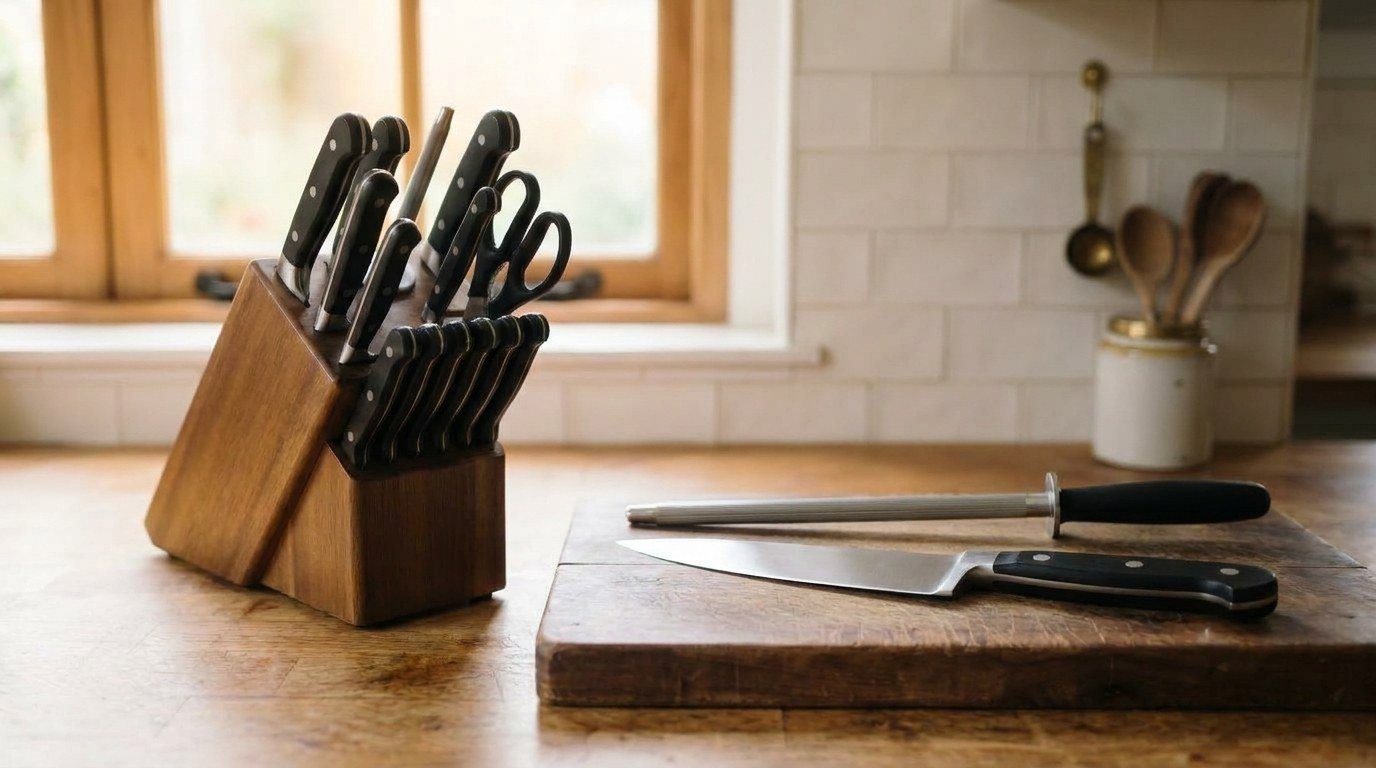
The best kitchen knife set for most home cooks is the Wüsthof Classic 15-piece: forged German steel at 58 HRC, a 14-degree edge, and every knife a home kitchen uses in one block. If you want the same German build with a slightly softer, easier-to-hone steel, the Zwilling Four Star 14-piece is the alternative. If you push-cut more than you rock-chop, the Shun Classic 6-piece gives you harder Japanese steel in fewer pieces, and if the budget is tight, the Victorinox Swiss Classic 14-piece is the set to buy.
The guide below compares six kitchen knife sets on the numbers the makers publish: steel, Rockwell hardness, edge angle and what is actually in the block. It sits with the site's kitchen gear guides and is the broad answer; when your question is narrower, the beginner knife sets, Japanese knife sets and self-sharpening knife sets guides go deeper on one kind of set.
Best Kitchen Knife Sets Compared
Six sets cover the real choices: German forged, Japanese layered steel, a self-sharpening block, a Swiss budget block and a small forged set. Hardness and edge angle come from each maker or its listing; where a maker publishes no figure, the table says so rather than guess.
| Set | Pieces | Steel | Hardness / edge angle | Best for |
|---|---|---|---|---|
| Wüsthof Classic 15-Piece | 15 | Forged high-carbon stainless (Germany) | 58 HRC / 14° per side | Best overall |
| Zwilling Four Star 14-Piece | 14 | FRIODUR ice-hardened, SIGMAFORGE (Germany) | 57 HRC / 15° per side | German alternative |
| Shun Classic 6-Piece | 6 | VG-MAX core, 68-layer Damascus (Japan) | 60-61 HRC / 16° per side | Japanese push-cutting |
| Calphalon Classic Self-Sharpening 15-Piece | 15 | Forged high-carbon no-stain German steel | Not published | Low maintenance |
| Victorinox Swiss Classic 14-Piece | 14 | High-carbon stainless (Switzerland) | 56 HRC / 15° per side | Best budget set |
| Mercer Genesis 6-Piece | 6 | Forged high-carbon German steel | 56 ±1 HRC / 15° | Small forged set |
Read the hardness column as a trade, not a ranking. A higher Rockwell number holds a fine edge longer; a lower one is tougher and quicker to bring back on a steel. The two German sets sit in the middle, Shun at the hard end, Victorinox at the forgiving end.
What a Good Kitchen Knife Set Needs
A good kitchen knife set is built around three knives: an 8-inch chef's knife for most of the chopping, a 3- to 4-inch paring knife for anything held in the hand, and a serrated bread knife for crusts and tomato skins. Everything else in a block (utility knives, a santoku, steak knives, shears, a honing steel) is useful, but those three do almost all the work at home, so judge any set by how good its chef's knife is.
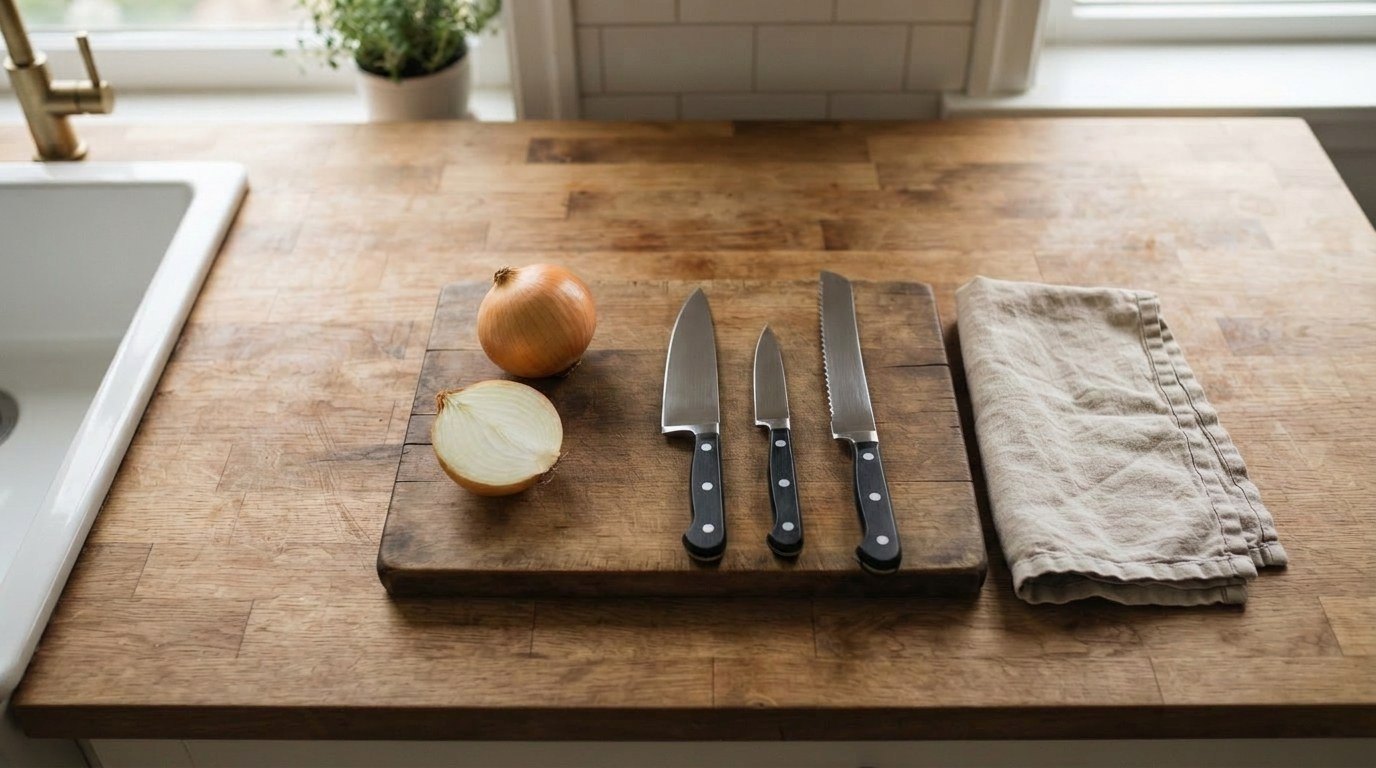
Gordon Ramsay's knife-skills lesson in his MasterClass makes the same case in practice: a long, heavy chopping knife does the dicing, a small knife handles peeling and trimming, and a flexible blade follows the curve of a squash or a joint so less goes in the bin. He works with German knives that carry their weight in the handle because the heft gives him control. If you want to see which ones he uses, the Gordon Ramsay knives page covers them, and the santoku vs chef's knife guide explains why some sets add a santoku next to the chef's knife.
Wüsthof Classic 15-Piece: Best Kitchen Knife Set Overall
Wüsthof
WÜSTHOF Classic 15-Piece Knife Block Set
- 3.5-inch paring, 4.5- and 6-inch utility, 5-inch santoku, 8-inch chef's and 8-inch bread knives, six steak knives, 9-inch honing steel, come-apart shears, 17-slot acacia block
- Forged high-carbon stainless steel tempered to 58 HRC; full tang, triple-riveted synthetic handles
- Made in Solingen, Germany; limited lifetime warranty; hand wash
The Wüsthof Classic 15-piece is the best kitchen knife set for most people because all of its knives come from the forged Classic line rather than a cheaper filler range. Wüsthof's listing puts a 3.5-inch paring knife, 4.5- and 6-inch utility knives, a 5-inch santoku, an 8-inch chef's knife, an 8-inch bread knife, six steak knives, a 9-inch honing steel and come-apart shears in a 17-slot acacia block, with the knives made in Germany. The Classic line is forged, full tang and triple-riveted, and Wüsthof rates its Classic steel at 58 HRC.
The edge is the other reason. Wüsthof's FAQ gives 14 degrees per side for its standard blades and 10 degrees for Asian-style blades like the santoku, set by its computer-guided PEtec process. Fourteen degrees is a fairly acute Western edge: there is less steel behind the cutting line, so it slides into an onion with less push. The full-length tang and bolster put the balance near the handle, which is the feel Ramsay describes wanting when he chops. For a smaller block in the same line, the Wüsthof Classic set guide compares the 5-, 7-, 9- and 15-piece blocks and the Classic Ikon upgrade.
Zwilling Four Star 14-Piece: Best German Alternative
ZWILLING
ZWILLING Four Star 14-Piece Knife Block Set
- 4-inch paring, 5-inch serrated utility, 5.5-inch prep, 8-inch bread and 8-inch chef's knives, six steak knives, 9-inch honing steel, shears, 16-slot acacia block
- SIGMAFORGE blades forged from one piece of steel, ice-hardened FRIODUR to 57 Rockwell
- 15-degree edge on each side; made in Germany
The Zwilling Four Star 14-piece is the German alternative for a cook who wants forged Solingen-style knives with a different grip. Zwilling describes the Four Star line as SIGMAFORGE knives forged from a single piece of steel, ice-hardened through its FRIODUR process, with a V-edge of about 30 degrees overall, and made in Germany. The set listing gives 57 Rockwell and 15 degrees on each side, and the block holds a 4-inch paring knife, a 5-inch serrated utility, a 5.5-inch prep knife, 8-inch bread and chef's knives, six steak knives, a 9-inch steel and shears.
One Rockwell point below the Wüsthof sounds small, and it is: the slightly softer steel rolls a touch sooner and comes back a touch faster on the steel, which suits a cook who hones often. The bigger difference is the handle, a molded synthetic grip with no rivets that many cooks find softer in the hand during a long prep. The Wüsthof vs Zwilling guide puts the two brands side by side, and the Zwilling Pro knife sets guide covers Zwilling's Pro and Professional S blocks.
Shun Classic 6-Piece: Best Japanese Knife Set
Shun
Shun Classic 6-Piece Knife Block Set
- 3.5-inch paring, 7-inch santoku and 8-inch chef's knives, kitchen shears, 9-inch combination honing steel, 8-slot slim block
- VG-MAX steel core clad in 68 layers of stainless Damascus, sharpened to 16 degrees
- D-shaped Pakkawood handles; handcrafted in Japan
The Shun Classic 6-piece is the best Japanese kitchen knife set here for a cook who slices more than chops. Shun's Classic page describes a VG-MAX cutting core clad in 34 layers of stainless Damascus on each side, 68 in total, ground to 16 degrees each side, with a D-shaped Pakkawood handle and the knives made in Japan. The Shun FAQ puts VG-MAX at 60 to 61 Rockwell, the hardest steel in this comparison. The block holds a paring knife, a 7-inch santoku, an 8-inch chef's knife, shears and a combination honing steel.
Note what that means and what it does not. Shun's 16 degrees is actually a slightly wider angle than Wüsthof's 14, so the extra sharpness people feel comes from the harder steel holding a fine apex longer and from the thin blade, not from a more acute grind. The cost of that hardness is chipping: twist the blade in a squash or drop it on bone and a hard edge cracks where a German one would bend. Six pieces also means no bread or steak knives. For more Japanese options the Japanese knife sets guide goes further, and Shun vs Zwilling compares the two styles one knife at a time.
Calphalon Classic Self-Sharpening 15-Piece: Best Low-Maintenance Set
Calphalon
Calphalon Classic Self-Sharpening 15-Piece Knife Block Set
- Ceramic sharpeners built into the block slots touch up the edge every time a knife goes in or out
- Forged high-carbon no-stain German steel with a full tang (steak knives are stamped)
- Labeled handle ends, so you can find each knife without pulling it
The Calphalon Classic self-sharpening set is for the cook who will never pick up a honing steel. Its block has ceramic sharpeners built into the slots, so the straight-edged knives are touched up each time they go in or come out, and the listing describes forged high-carbon no-stain German steel with a full tang, stamped steak knives, and labeled handle ends so you can find each knife without pulling it. Calphalon does not publish a Rockwell figure, so the table leaves it blank.
A self-sharpening block keeps a working edge on a knife that would otherwise go dull in the drawer, but it is a light touch-up, not a full regrind. Once the edge has really worn down, a stone or a pull-through sharpener still has to cut a new one. The self-sharpening knife sets guide compares the Henckels self-sharpening blocks against it.
Victorinox Swiss Classic 14-Piece: Best Budget Kitchen Knife Set
Victorinox
Victorinox Swiss Classic 14-Piece Swivel Knife Block Set
- 3.25-inch paring, 4.5-inch serrated utility, 7-inch santoku, 8.25-inch bread and 8-inch chef's knives, six serrated steak knives, 10-inch honing steel, shears
- High-carbon stainless blades at 56 Rockwell with a 15-degree edge on both sides
- Slip-resistant handles, 13-slot swivel block; made in Switzerland with a lifetime warranty
The Victorinox Swiss Classic 14-piece is the best budget kitchen knife set because it is one of the few at this level whose maker publishes real numbers: 56 Rockwell and a 15-degree edge on both sides, made in Switzerland with a lifetime warranty. The swivel block holds a paring knife, a serrated utility, a santoku, a bread knife, an 8-inch chef's knife, six serrated steak knives, a 10-inch honing steel and shears. The Swiss Classic line uses the textured, slip-resistant handle style of Victorinox's Fibrox professional knives.
The lighter, softer steel is the honest trade. At 56 Rockwell the edge rolls sooner than a Wüsthof's, so it needs the steel more often, but it also comes back faster and forgives a cook still learning. If the set is for a first kitchen or a culinary student, the beginner knife set guide and the knife sets with a carrying case cover those cases directly.
Mercer Genesis 6-Piece: Best Small Forged Set
Mercer Culinary
Mercer Culinary Genesis 6-Piece Forged Knife Block Set
- 3.5-inch paring, 5-inch utility, 6-inch stiff boning, 8-inch wavy-edge bread and 8-inch chef's knives
- Precision-forged high-carbon German steel with a taper-ground edge
- Stainless steel and tempered glass block; hand wash and dry
The Mercer Genesis 6-piece suits the cook who agrees that three good knives matter more than fifteen. It holds five forged knives, a 3.5-inch paring, 5-inch utility, 6-inch stiff boning, 8-inch wavy-edge bread and 8-inch chef's knife, in a stainless and tempered glass block. Mercer's listing gives precision-forged high-carbon German steel at 56 ±1 HRC, a 15-degree edge, Santoprene handles and NSF certification. The boning knife is the piece most bigger blocks leave out, and it is the one you reach for to take a chicken apart. Mercer asks for hand washing and drying after each use.
German vs Japanese Kitchen Knife Sets
German kitchen knife sets are softer, tougher and heavier; Japanese sets are harder, thinner and lighter. In this comparison the German and Swiss sets run 56 to 58 HRC with 14- to 15-degree edges, and the Shun runs 60 to 61 HRC at 16 degrees. Pick German if you rock-chop and cut through squash and chicken joints; pick Japanese if you slice with a clean push and look after the edge.
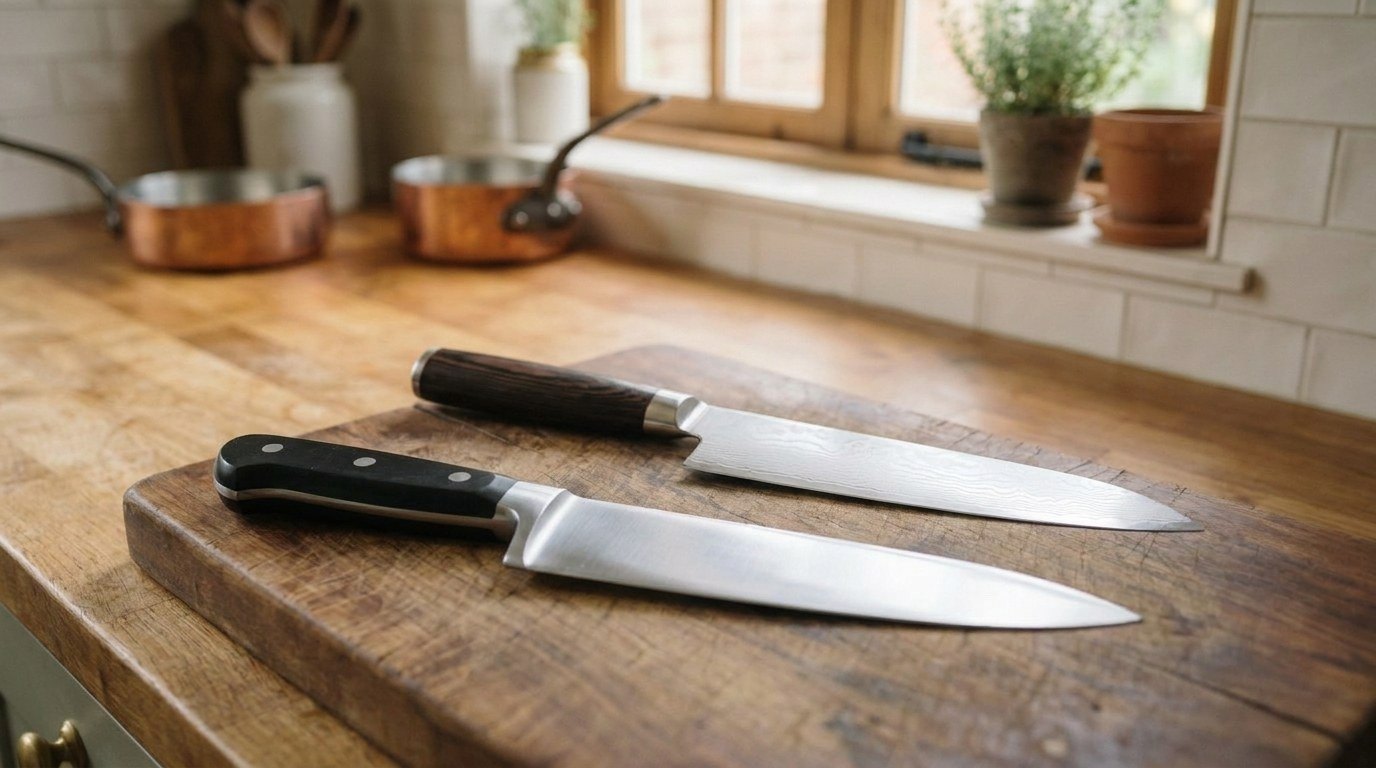
Hardness and toughness pull in opposite directions. The Rockwell C number comes from pressing a diamond cone into the steel and measuring how far it sinks, so a higher figure means the steel resists denting; Shun's FAQ puts each Rockwell point at roughly 10 percent more hardness. A harder edge can be ground thinner and resists rolling over, so it stays keen longer. Toughness, the steel's ability to flex instead of crack, drops as hardness rises, which is why a 61 HRC edge chips on a frozen block or a bone while a 57 HRC edge just bends and can be honed straight again.
| Factor | German and Swiss sets | Japanese set (Shun) |
|---|---|---|
| Hardness | 56-58 HRC | 60-61 HRC |
| Edge angle | 14-15° per side | 16° per side, thinner blade |
| Cutting style | Rock-chop friendly | Push and pull cuts |
| Chip resistance | High, the edge bends instead | Lower on bone, frozen food or twisting |
| Upkeep | Hone often, sharpen less | Hone gently, sharpen on a stone |
| Weight | Heavier, bolstered | Lighter, nimble |
How to Keep a Kitchen Knife Set Sharp
Keep a kitchen knife set sharp by honing the straight-edged knives on the steel every time you use them and sharpening them once or twice a year. Honing and sharpening are two different jobs: a steel straightens the edge you already have, while a stone or sharpener grinds away steel to make a new one.
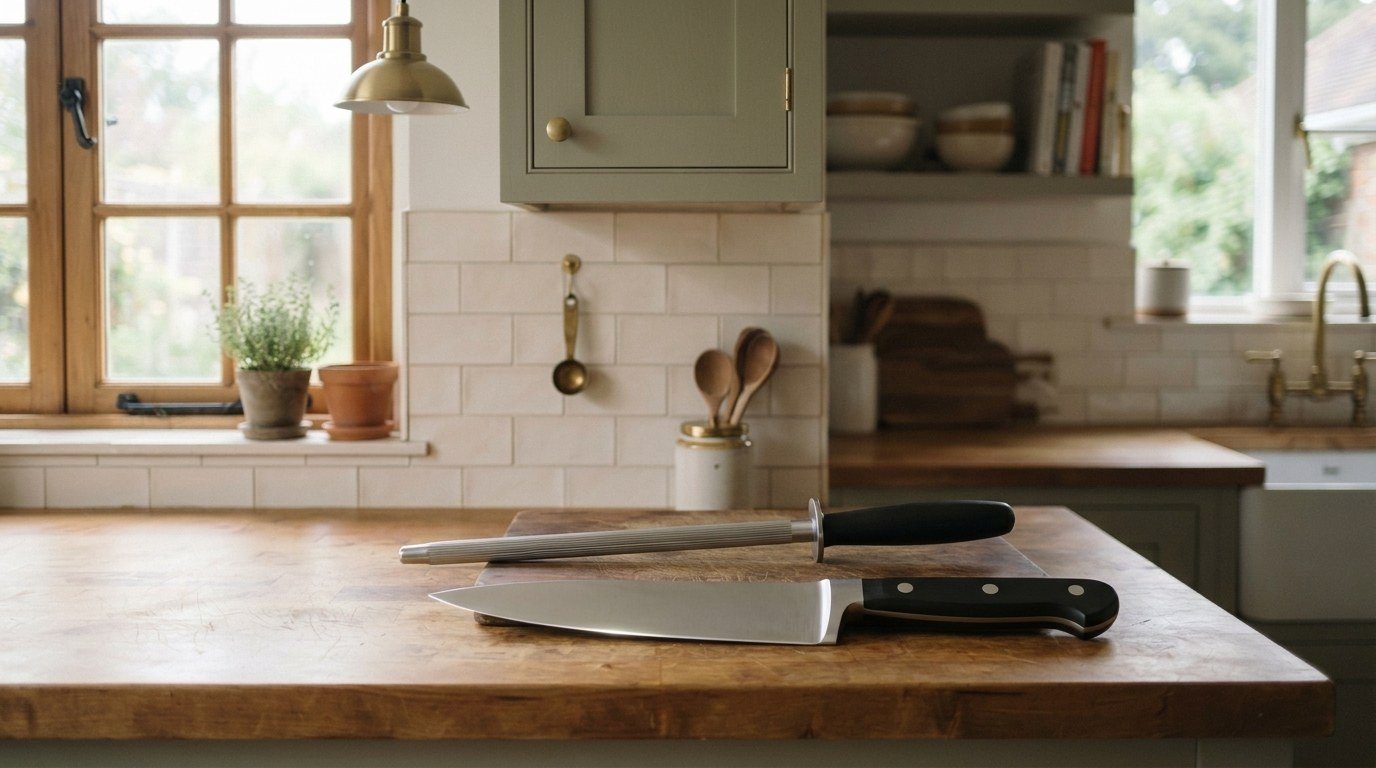
Here is why honing works. In use, the very thin apex of the edge bends over to one side, so the knife skates on a tomato even though almost no metal is gone. A few light strokes on the steel push that rolled edge back in line. Ramsay hones every time he picks up a knife so the edge never runs down to the point where it is hard to bring back, and he holds the blade almost flat to the steel with a slight lift, stroking the full length away and back. Match the angle to the knife: about 14 to 15 degrees for the German and Swiss sets, 16 for the Shun, and 10 for a Wüsthof santoku. Leave the serrated bread and steak knives alone; their teeth do the cutting and a steel cannot reach into them.
A dull knife is also the more dangerous one. It needs more downward force to start a cut, so it is more likely to skid off a round onion or a tomato skin and keep going into the hand that is holding the food. It also crushes instead of cutting: a blunt edge breaks more onion cells, which releases more of the sulfur compound that makes your eyes sting, and it bruises herbs so they darken. Ramsay's other safety habit costs nothing: a damp paper towel under the board so it cannot slide.
Cutting Boards and Care for Your Knife Set
Cut on wood or plastic and wash your knives by hand. The USDA's Food Safety and Inspection Service says either wood or a nonporous plastic board is fine for food safety, as long as you wash it in hot, soapy water after each use, sanitize it with 1 tablespoon of unscented liquid chlorine bleach per gallon of water, keep one board for raw meat, poultry and seafood and another for produce and bread, and throw a board out once it has deep grooves you cannot clean.
For the knife itself, the board's hardness matters more than its safety. FSIS also lists glass and marble as nonporous surfaces, but both are far harder than a steel edge, so every cut rolls or chips the apex against them. Wood and plastic give slightly under the blade, which is why they keep an edge longest; the best wood for a cutting board and end grain vs edge grain guides cover which wood boards are gentlest. Wüsthof's care instruction is to wash by hand and towel-dry right away: dishwasher detergent is abrasive, the heat cycle is hard on handles over years, and knives knock against other things in the basket. Store them in the block or on a magnetic strip, never loose in a drawer.
Which Knife Set Guide to Read Next
This page is the broad comparison; the sibling guides answer the narrower questions. For a first set, the beginner knife set guide. For culinary school or work, knife sets with a carrying case and professional knife sets with a case. For one brand's lineup, Henckels knife sets, Zwilling Pro sets and the Wüsthof Classic sets. If you are here because of the show, the Hell's Kitchen knives page covers what contestants are given, and Gordon Ramsay's knife set covers how to build his kit.
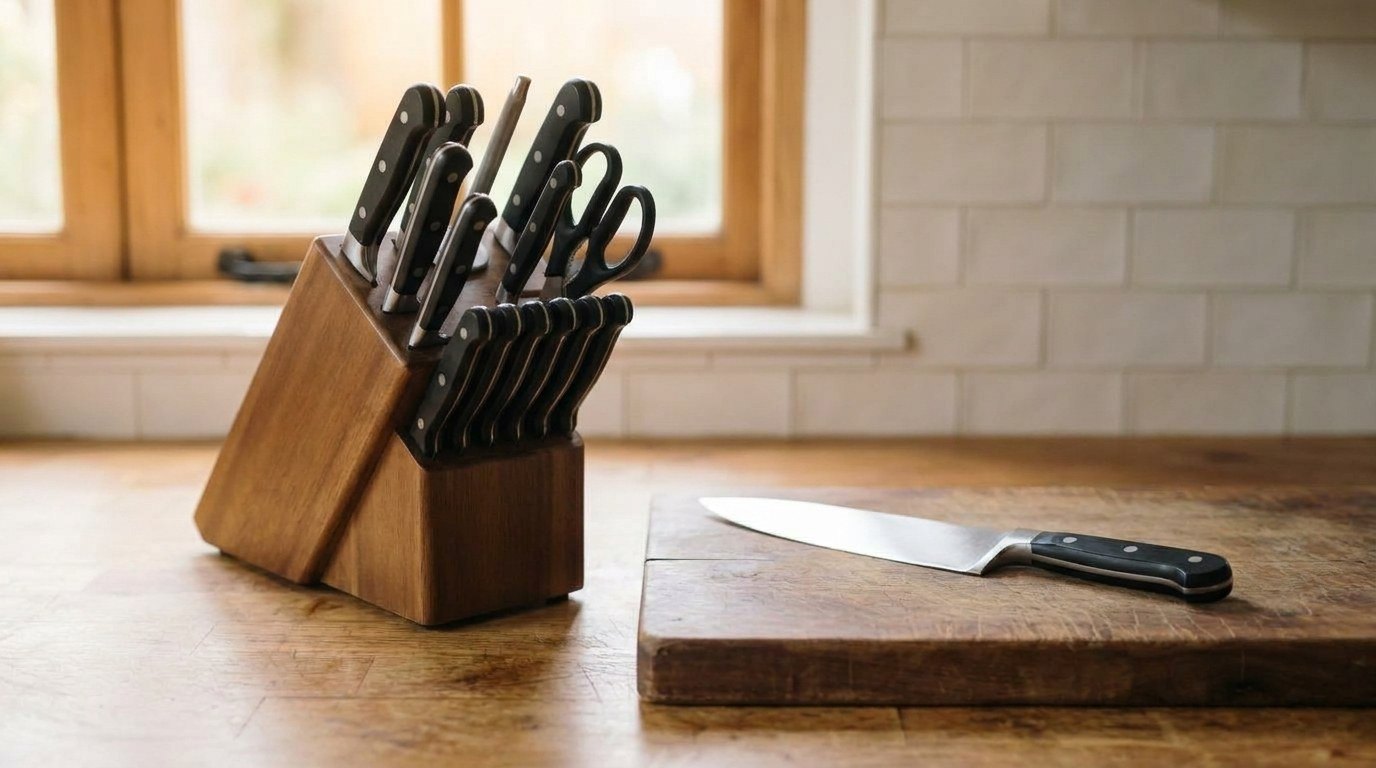
The short version of the best kitchen knife sets for 2026: the Wüsthof Classic 15-piece if you want the best all-round German block, the Zwilling Four Star if you prefer its softer handle and steel, the Shun Classic for harder Japanese steel, the Calphalon if you will never hone, the Victorinox on a budget and the Mercer Genesis if you only want the knives you will use. Whichever you buy, the steel and a wooden board will matter as much as the brand.
Best Kitchen Knife Sets FAQs
The questions that come up most: how much a good kitchen knife set costs, how many knives you need, whether a set is worth it, German versus Japanese steel, whether knife sets are dishwasher safe, how often to sharpen, how long a set lasts, and which knives Hell's Kitchen uses.
How much should a good kitchen knife set cost?
It depends on construction more than piece count. Budget blocks like the Victorinox Swiss Classic sit at the low end, forged mid-range sets like the Calphalon and Mercer Genesis in the middle, and forged German (Wüsthof, Zwilling) or layered Japanese (Shun) sets at the top. Spend on the chef's knife you will use every day before you pay for steak knives. Prices change often, so check the current price at the retailer.
How many knives do you really need in a set?
Three do almost all the work: an 8-inch chef's knife, a 3- to 4-inch paring knife and a serrated bread knife. A boning knife, a utility knife, shears and a honing steel are useful extras. That is why a small set like the Mercer Genesis 6-piece covers a home kitchen, and why a 15-piece block is mostly about steak knives and convenience.
Is a knife set worth it, or should I buy individual knives?
A set is worth it if you are starting from nothing: it is usually cheaper per knife, every handle matches and you get a block to store them. Buy individual knives if you already own a chef's knife you like, or you want a different steel for a single job, for example a hard Japanese slicer beside a tough German chef's knife.
Is German or Japanese steel better for a knife set?
Neither is better for everyone. German steel at 56 to 58 HRC is tougher and forgives rock-chopping and bones; Japanese steel like Shun's VG-MAX at 60 to 61 HRC holds a fine edge longer but can chip if twisted or used on frozen food. Choose by how you cut, not by which sounds more serious.
Are kitchen knife sets dishwasher safe?
Some are rated dishwasher safe, but hand washing keeps them sharp longer. Wüsthof tells owners to wash by hand and towel-dry right away; detergent dulls the edge, heat is hard on handles, and knives chip knocking against other cutlery. Wash, dry and put them back in the block.
How often should kitchen knives be sharpened?
Hone the straight-edged knives on a steel every time you use them, and sharpen on a stone or sharpener about once or twice a year for a home cook, sooner when honing no longer brings the edge back. Honing realigns a rolled edge; sharpening removes steel to make a new one. Serrated knives rarely need either.
How long should a good knife set last?
A forged set like the Wüsthof Classic or Zwilling Four Star that is hand washed, honed and stored in its block can last decades; Wüsthof backs the Classic with a limited lifetime warranty and Victorinox gives the Swiss Classic a lifetime warranty. Replace a knife when the blade is chipped or bent beyond what sharpening can fix, or when the handle comes loose.
What knife set is used on Hell's Kitchen?
Hell's Kitchen contestants are given a set of Zwilling J.A. Henckels knives, according to former winner Christina Wilson, but there is no official Hell's Kitchen knife set for sale. The Hell's Kitchen knives page covers what is in the kit and the Zwilling sets that come closest.

About the Author
John Siracusa is the founder of Hell’s Kitchen Recipes. He focuses on technique-first, reproducible home cooking and researches recipes & kitchen equipment from published food science and professional chef methods since 2016.