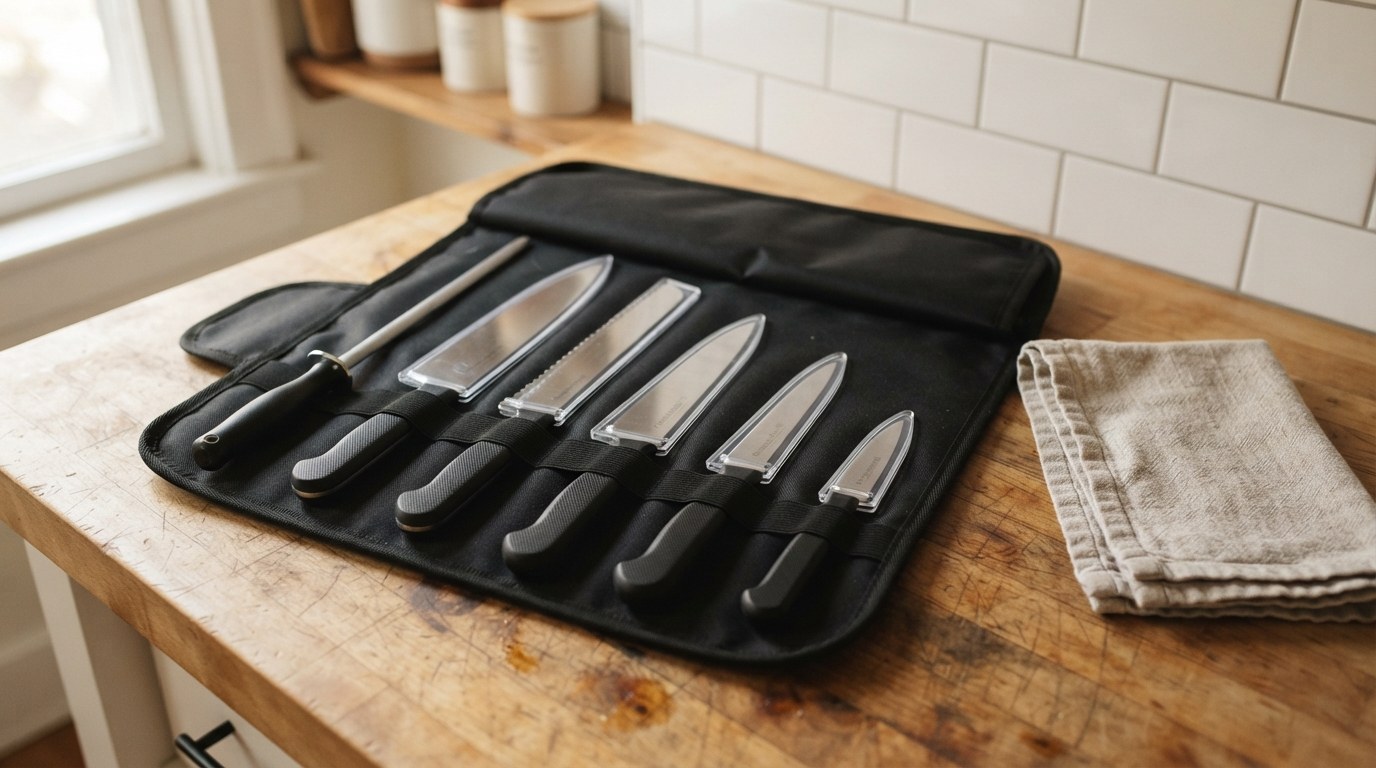
A professional chef knife set with case is a working kit rather than a kitchen decoration: the five or six knives a cook actually reaches for, a honing steel, and a roll or zip case built so the whole thing can go into a locker, a car or a checked bag without an edge touching anything. It is what a culinary school issues on the first day, what a line cook carries between jobs, and what a caterer or competition pitmaster hauls to a site where the house knives cannot be trusted. Two pro chef knife sets cover the market well and are in stock as of this writing: the Mercer Culinary Genesis 7-piece in its roll, the forged German-steel kit built on the same line many culinary programs specify, and the Victorinox Fibrox Pro 7-piece in a roll, the Swiss-made stamped kit that has been the value pick in professional kitchens for decades. This guide explains what belongs in the case and why, what the steel and handle claims mean, which kits suit students and tight budgets, how to choose between a roll and a hard case, and how to travel with knives legally.
It sits in the site's kitchen gear guides alongside the best kitchen knife sets for block sets that stay home, the best chef knife set for beginners for a first set, Gordon Ramsay knives for the brands he uses, and the best Zwilling knives and Wüsthof vs Zwilling for anyone building a case from individual German blades.
What a Professional Chef Knife Set With Case Should Hold
A professional chef knife set with case should hold the same five blades and a steel, because they divide the work of a kitchen between them with almost no overlap: an 8-inch chef's knife for nearly everything, a serrated bread knife, a flexible boning knife, a paring knife and a long slicer or utility knife, plus a steel to keep the chef's knife honed between sharpenings. Gordon Ramsay's advice in his MasterClass on cooking is to spend on a few high-quality knives and keep them sharp rather than buy a showroom of blades, and a good travel kit is that advice in a bag. The 10-piece and larger sets add a santoku, a carving fork and a longer carving knife, which are useful on a carving station or a catering job and dead weight for a student; the 15-piece kits with a nakiri, a cleaver and a 13-pocket roll are heavier still, and most of those extra pockets end up holding knives that never leave the bag.
| Knife | What it does in a working kit | Why the shape matters |
|---|---|---|
| 8-inch chef's knife | Ninety percent of prep: onions, herbs, meat, rock-chopping | A curved belly lets the edge rock; the width keeps knuckles off the board |
| Serrated bread knife, 8 to 9 inches | Crusty loaves, tomatoes, cakes | Serrations cut by sawing, so a hard crust does not crush the crumb |
| Flexible boning knife, 6 inches | Breaking down chicken, trimming silverskin, filleting | A narrow, flexible blade follows bone and skin instead of cutting through them |
| Paring knife, 3 to 3½ inches | In-hand work: peeling, coring, garnish | Short enough to control with the thumb against the blade |
| Granton slicer, 10 inches, or a 5-inch utility | Roasts and brisket (slicer); sandwiches and small fruit (utility) | Hollow-ground scallops trap air so slices release instead of clinging |
| Honing steel, 9 to 10 inches | Realigning the edge before every shift | Straightens a rolled edge; it does not remove metal or sharpen |

Mercer Culinary
Mercer Culinary Genesis 7-Piece Forged Knife Roll Set
- 8-inch chef's, 8-inch wavy-edge bread, 6-inch flexible boning, 5-inch utility, 3½-inch paring, 10-inch steel
- Precision-forged high-carbon German steel (HRC 56 ±1 per Mercer), taper-ground edge; Santoprene non-slip handles
- 7-pocket 600D polyester roll with a detachable shoulder strap
Forged German vs Stamped Swiss Steel in a Pro Chef Knife Set
A pro chef knife set is either forged or stamped, and both are respectable. Mercer's Genesis line is precision-forged from high-carbon German steel with a taper-ground edge and a Santoprene handle, and Mercer lists the 7-piece roll set at HRC 56 ±1; forging shapes the bolster and tang from a single billet, which is where the heft and the finger guard of a forged knife come from. Victorinox's Fibrox Pro blades are stamped from a sheet of Swiss high-carbon stainless and finished in Switzerland, thinner and lighter with no bolster, on a textured thermoplastic handle. The difference a cook feels is weight and balance, not sharpness: how sharp a knife gets and how long it stays that way depends on the steel's hardness and the edge angle, which are set by heat treatment and grinding, not by whether the blank was forged or stamped.
Hardness is the number to ask about. A blade's Rockwell hardness sets the trade between edge retention and toughness, and Knife Steel Nerds, the metallurgist Larrin Thomas's site, describes what a thin kitchen edge needs as edge stability: high hardness to avoid rolling and high toughness to avoid chipping. Harder steel holds a thin edge longer but chips more easily; softer steel rolls sooner and is easier to hone back. Most German-style kits sit around HRC 56 to 58, and the cheaper stamped lines go lower: Mercer lists its stamped Millennia roll set at HRC 53 to 54, soft enough to need the steel often and forgiving enough to survive a student's first semester. Makers get to their numbers by heat treatment; ZWILLING's Pro line, for example, is forged in one piece in its SIGMAFORGE process and then FRIODUR ice-hardened, a cold treatment that converts more of the steel's soft retained austenite into hard martensite, which the maker credits for edge retention, corrosion resistance and flexibility.
The bolster matters for sharpening as much as for balance. A full bolster runs down to the heel of the edge, and after a few years of stone work it stands proud of the worn edge and stops the last inch from meeting the board. A half or semi-bolster, or a bolsterless stamped blade like the Victorinox, lets the stone run heel to tip, so the whole edge stays usable. Handles matter as much as steel on a knife that leaves the kitchen: Santoprene and Fibrox are both grippy when wet and, in Victorinox's case, NSF-listed for commercial use because the one-piece molded handle leaves no crevice for bacteria. Pakkawood, the resin-stabilized wood composite on many budget sets, resists water far better than plain wood but still wants hand-washing and a quick dry; a plain wood handle is a poor traveller, since it soaks, swells and cracks.
| Set | Blades | Construction | Case | Best for |
|---|---|---|---|---|
| Mercer Culinary Genesis 7-piece | 5 knives, steel | Forged high-carbon German steel, HRC 56 ±1; Santoprene handles | 7-pocket polyester roll with strap | Culinary students and line cooks who want forged knives |
| Victorinox Fibrox Pro 7-piece | 5 knives, steel | Stamped Swiss high-carbon stainless; Fibrox Pro handles, NSF | Polyester roll | Line cooks; the lightest full kit |
| Mercer Millennia 13-piece school kit | 4 knives, steel, guards, peeler, thermometer | Stamped high-carbon Japanese steel; Santoprene handles | 7-pocket roll | First-semester culinary students |
| Dfito 9-piece | Knives, honing rod | 5Cr15MoV stainless, HRC 56 to 58 per the listing | Roll bag | A tight budget |
| Victorinox Fibrox Pro BBQ 8-piece | 6 knives, steel | Same Swiss blades in butchery shapes (breaking knife, cimeter, wide slicer) | Knife roll | Whole primals, competition barbecue |
| ZWILLING 8-pocket bag + your own knives | Whatever you own | Forged German (ZWILLING Pro, Wüsthof) or anything else | 8-pocket zip bag | Cooks who already own good blades |
Read across the table and the choice is about the job. A student who wants forged knives buys the Mercer Genesis; a cook who walks to work wants the Victorinox, the lightest full kit; a pitmaster wants the butchery shapes in the BBQ set; and anyone who already owns a Wüsthof Classic or ZWILLING Pro chef's knife should buy the bag, not a second set.
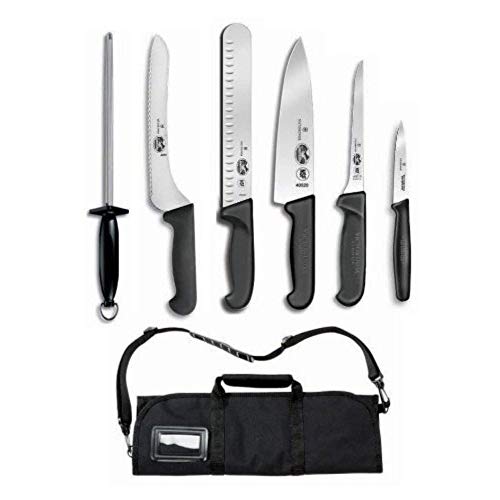
Victorinox
Victorinox Fibrox Pro 7-Piece Culinary Knife Roll Set
- 8-inch chef's (40520), 10-inch Granton slicer (40633), 9-inch offset bread (40550), 6-inch boning (40513), 3¼-inch paring (40600), 9-inch steel (40687)
- Swiss-made stamped high-carbon stainless blades; NSF-listed Fibrox Pro handles
- Black polyester roll bag included
Culinary School Kits and Budget Professional Knife Sets for Chefs
The cheapest professional knife sets for chefs worth carrying are a maker's school kit and a budget roll set that states its steel. Mercer, which equips many culinary programs, sells its Millennia culinary school kit as a 13-piece roll: an 8-inch chef's knife, a slim paring knife, a boning knife and a wavy-edge bread knife, each with its own edge guard, a 10-inch steel, a swivel peeler, a pocket thermometer and a measuring guide. That is close to what most first-semester equipment lists ask for, and the guards answer the case question before it comes up. Check your program's list before buying anything, since some schools issue their own kit and others want a fish spatula or a fluted knife the sets do not include.
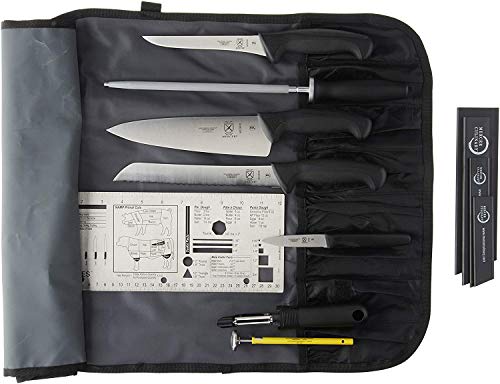
Mercer Culinary
Mercer Culinary 13-Piece Millennia Culinary School Kit
- 8-inch chef's, 3-inch slim paring, 6-inch boning, 8-inch wavy-edge bread, 10-inch steel, each knife with its own guard
- Swivel peeler, pocket thermometer and a Mercer Rules measuring guide for class
- 7-pocket knife roll included
Below Mercer and Victorinox, read the listing for two numbers: the steel grade and the hardness. The Dfito 9-piece roll set states 5Cr15MoV stainless at HRC 56 to 58, which is the same hardness band as a German-style forged kit, and it comes with a honing rod and a roll bag. A set that says only "German stainless" or "professional grade" without a grade or a hardness tells you nothing about how long the edge will last, and those are the sets that arrive sharp and go dull in a week.

Dfito
Dfito 9-Piece Professional Chef Knife Set With Roll Bag
- Listing states 5Cr15MoV stainless steel at HRC 56 to 58
- Bolstered blades with a finger guard built into the handle
- Honing rod and roll bag included
Knife Roll vs Hard Case, and Flying With a Chef Knife Set
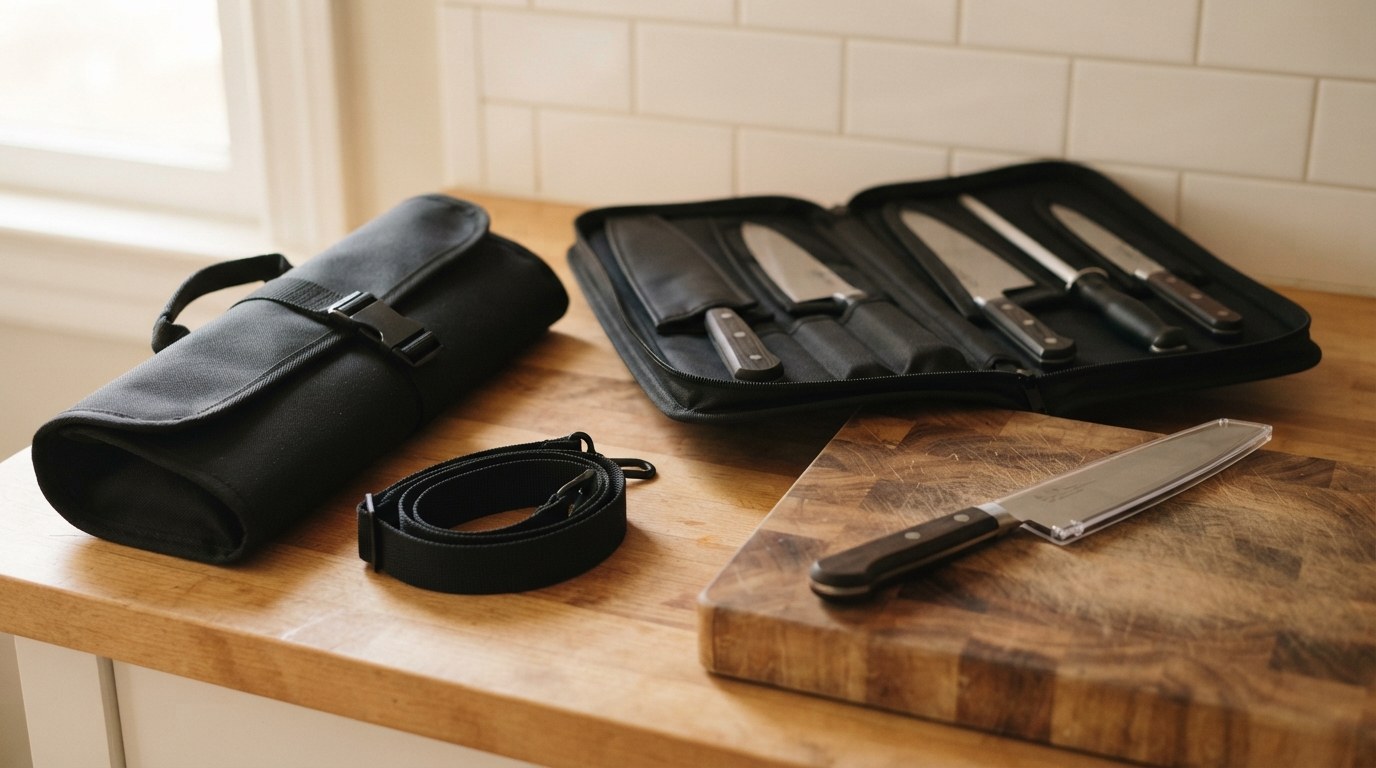
The case on a chef knife set has one job, keeping edges from touching steel, and the two designs do it differently. A roll holds each knife in an elastic loop against a padded panel, rolls up and buckles; it is light, flat, and fits a locker or a backpack, and it is what most cooks carry. A zippered hard or semi-rigid case holds the knives in sleeves inside a shell, protects them from crushing under other bags, and stands up to the back of a catering van; it weighs more and takes more room. Either way, every blade should wear an edge guard inside the case, since a loop or sleeve stops knives clanking together but does not stop a tip from working through fabric, and a guard is also what keeps a 10-inch slicer from cutting the case itself.
Flying with the kit is legal only one way. The Transportation Security Administration bars knives from carry-on bags, with the only exception being rounded-blade, blunt-edged, unserrated butter-type knives, and allows them in checked bags provided sharp objects are sheathed or securely wrapped so they cannot injure baggage handlers and inspectors. In practice that means guards on every blade, the roll buckled or the case zipped, and the whole thing inside a checked suitcase. On the road between jobs, the same rule of thumb protects the knives themselves: a kit that rides loose in a car trunk arrives with rolled edges and a bent boning knife. Pitmasters hauling to competitions have the same problem with longer blades, which is where the BBQ roll and the site's BBQ knives guide come in.

Victorinox
Victorinox Fibrox Pro Ultimate BBQ Set, 8 Pieces With Knife Roll
- Paring, semi-stiff boning, chef's, breaking knife, Granton cimeter, wide Granton roast slicer, round steel
- Built for whole primals and competition barbecue; Fibrox Pro non-slip handles
- Knife roll included
Keeping a Professional Knife Set Sharp on the Road
A professional knife set that lives in a case stays sharp with two habits: hone before every shift and sharpen on a stone when honing stops bringing the edge back. Honing on the steel realigns an edge that has rolled over microscopically in use; it removes no metal, so it cannot sharpen a dull knife, and a kit that has been honed for months without seeing a stone is dull no matter how often the steel comes out. Sharpening, on a whetstone or a guided system, grinds a fresh edge. For a line cook that is often every few weeks, for a home cook a few times a year, and Ramsay's habit of sharpening before and after every use is closer to what a professional kit needs than the once-a-year sharpening most home knives get. Wash the knives by hand with hot water and dry them at once; even dishwasher-rated handles do not protect a thin edge from being knocked against a rack, and a knife put away damp inside a nylon case will spot with rust by the next shift, since the fabric holds the water against the steel.
The case needs care too. Empty it and let it air out weekly, wash a roll on a gentle cycle when it starts to smell, and replace any elastic loop that has stretched enough to let a knife slide; a chef's knife that shifts inside a rolled-up roll is the usual way a cook gets cut reaching into a bag. Replace edge guards when they split. Kept this way, the blades in a Mercer or Victorinox professional chef knife set with case outlast several rolls, and Victorinox backs its kits with a lifetime guarantee against defects in material and workmanship.

ZWILLING
ZWILLING 8-Pocket Knife Carrying Bag
- Holds 8 knives plus accessories; black nylon with zip closure
- The case for a kit built from your own knives
- Pairs with any ZWILLING Pro or Wüsthof Classic blades you already own
Professional Chef Knife Set With Case FAQs
The questions that come up most: what a professional chef knife set with case should include, whether a knife roll or a hard case is better, whether forged or stamped knives are better for a pro chef knife set, whether you can fly with a chef knife set, what culinary students actually need, how often to sharpen, whether these knives can go in the dishwasher, and whether cheap knife sets with cases are worth buying.
What should a professional chef knife set with case include?
An 8-inch chef's knife, a serrated bread knife, a flexible boning knife, a paring knife, a long slicer or a utility knife and a honing steel, in a roll or zip case with an edge guard on every blade. Ten-piece and larger sets add a santoku, a carving knife and a fork, which are useful for carving and catering and unnecessary for most students.
Is a knife roll or a hard case better?
A roll is lighter, flatter and fits a locker or backpack, and it is what most line cooks carry. A zippered hard or semi-rigid case protects knives from being crushed under other bags and suits catering work and checked luggage. Either one needs edge guards on every blade; the case stops knives clanking together, the guards stop tips working through fabric.
Forged or stamped knives for a pro chef knife set?
Both work. Forged knives (Mercer Genesis, ZWILLING Pro, Wüsthof Classic) are heavier with a bolster and finger guard; stamped knives (Victorinox Fibrox Pro, Mercer Millennia) are lighter and thinner, and a bolsterless blade is easier to sharpen heel to tip. Sharpness and edge life come from the steel's hardness and heat treatment, not from forging, so choose by weight and budget.
Can you fly with a chef knife set?
Only in checked baggage. The TSA bars knives from carry-on bags, except rounded-blade, blunt, unserrated butter-type knives, and allows them checked if they are sheathed or securely wrapped. Put a guard on every blade, buckle the roll or zip the case, and pack it inside a checked suitcase.
What knife set do culinary students need?
Most programs issue or specify a kit with a chef's knife, a paring knife, a boning knife, a bread knife, a steel and a roll. Mercer's 13-piece Millennia culinary school kit covers that list with an edge guard for each knife, a peeler and a pocket thermometer; the Mercer Genesis 7-piece roll is the forged step up. Check the program's list first, since some schools issue their own kit.
How often should you sharpen a professional knife set?
Hone on the steel before every shift or cooking session, and sharpen on a stone or guided sharpener when honing no longer brings the edge back. For a line cook that is often every few weeks; for a home cook a few times a year. A steel removes no metal, so it keeps a sharp knife sharp but cannot fix a dull one.
Are Mercer and Victorinox knives dishwasher safe?
Wash them by hand: Mercer says not to put its knives in the dishwasher, and even Victorinox's dishwasher-tolerant handles do not stop a rack knocking the thin edge against metal. Wash in hot water, dry immediately, and store the knives in the roll with guards on; never put a damp knife back in the case, where nylon holds water against the steel and causes rust spots.
Are cheap professional knife sets with cases worth buying?
Only if the listing states the steel grade and hardness. The Dfito 9-piece roll set lists 5Cr15MoV at HRC 56 to 58, the same hardness band as German-style kits; sets that say only "German stainless" or "professional grade" are usually soft steel that will not hold an edge through a shift. The Victorinox Fibrox Pro roll set remains the reliable low-cost kit, Swiss-made and NSF-listed.

About the Author
John Siracusa is the founder of Hell’s Kitchen Recipes. He focuses on technique-first, reproducible home cooking and researches recipes & kitchen equipment from published food science and professional chef methods since 2016.