Baked caprese bites take the tomato, mozzarella and basil of a caprese salad and put them in a two-bite puff pastry cup: a cherry tomato half roasted until it blisters, a pearl of fresh mozzarella melted soft beside it, flaky golden pastry around both, and basil ribbons and a streak of balsamic glaze added at the end. They are a mini-muffin-tin appetizer, 24 from one sheet of frozen puff pastry, and the whole thing goes from freezer to platter in about 40 minutes. What separates a crisp, tall cup from a pale, soggy one is three decisions about water and cold, and each is explained below.
The recipe card at the bottom has the amounts and numbered steps for 24 bites, enough for eight as a starter. This guide covers what makes a baked caprese bite different from the skewer version, how puff pastry rises and why it has to be cold going into a hot oven, the water problem with fresh mozzarella and tomatoes and how the cup handles it, why the basil and glaze go on after baking, doneness, and make-ahead. It sits in the site's recipes collection with the Ramsay-style dinner party appetizers and the Boursin stuffed mushrooms from the same holiday table.
What Makes a Baked Caprese Bite Different From the Skewer
A caprese skewer is a cold salad on a toothpick and lives or dies by the tomato. A baked caprese bite cooks the tomato, and roasting is what makes it work in October, when the cherry tomatoes at the store are firm and thin on flavor. Twenty minutes at 400°F drives water out of a halved cherry tomato, concentrates its sugars and acids, and browns its cut face; the same heat melts a mozzarella pearl into a soft pool and puffs the pastry around both. The basil is the one part that stays raw, because it is the one part heat ruins. So the bite has a hot, savory, cooked layer and a cold, green, sharp layer, and the contrast is the point.
The cup matters as much as the filling. Puff pastry pressed into a mini-muffin well bakes into a container with a crisp floor and four flaky corners, and that floor catches what the tomato and cheese release instead of letting it run across a baking sheet. A caprese on a crostini gets wet because the bread absorbs the liquid; a puff pastry cup holds it in a rich, fat-layered dough that crisps from below. It is the same reason the site's beef Wellington wraps a wet duxelles in puff pastry and not in bread.
| Ingredient | What it does | Do not substitute with |
|---|---|---|
| Frozen puff pastry, one sheet, thawed cold | Bakes into a flaky, self-supporting cup | Crescent roll dough (no lamination; it bakes bready) |
| Cherry or grape tomatoes, halved | Small enough to roast through in the bake; the cut face browns | Sliced large tomatoes (too much water, no structure) |
| Fresh mozzarella pearls, patted dry | Melt into a soft pool without stringing | Shredded low-moisture mozzarella (strings and skins over) |
| Olive oil and grated garlic | Brushed in the cup; seasons the pastry and the tomato | Garlic powder (burns bitter at 400°F) |
| Fresh basil, added after baking | The aroma and the color of caprese | Dried basil, or fresh basil baked in (it blackens and goes dull) |
| Balsamic glaze | A sweet-sour streak that ties tomato and cheese | Straight balsamic vinegar (too thin; it soaks the pastry) |
Puff Pastry: Cold Dough, Hot Oven, No Rolling
Puff pastry has no leavener. Every bit of its rise is steam: the dough is hundreds of alternating layers of butter and flour, and when it hits a hot oven the water in the butter turns to steam and pushes the layers apart. King Arthur Baking describes the mechanism plainly, no yeast, all the leavening comes from the layers of butter, and builds over 500 layers in its bakery through four folds; Pepperidge Farm, whose sheets are the ones in most American freezers, says the same thing in its FAQ: the pastry puffs because the moisture in the fat creates steam between the layers and separates them, and it wants a preheated 400°F oven. That number is the floor. In a cooler oven the butter melts and runs out of the layers before the water can flash to steam, and the pastry bakes flat and greasy.
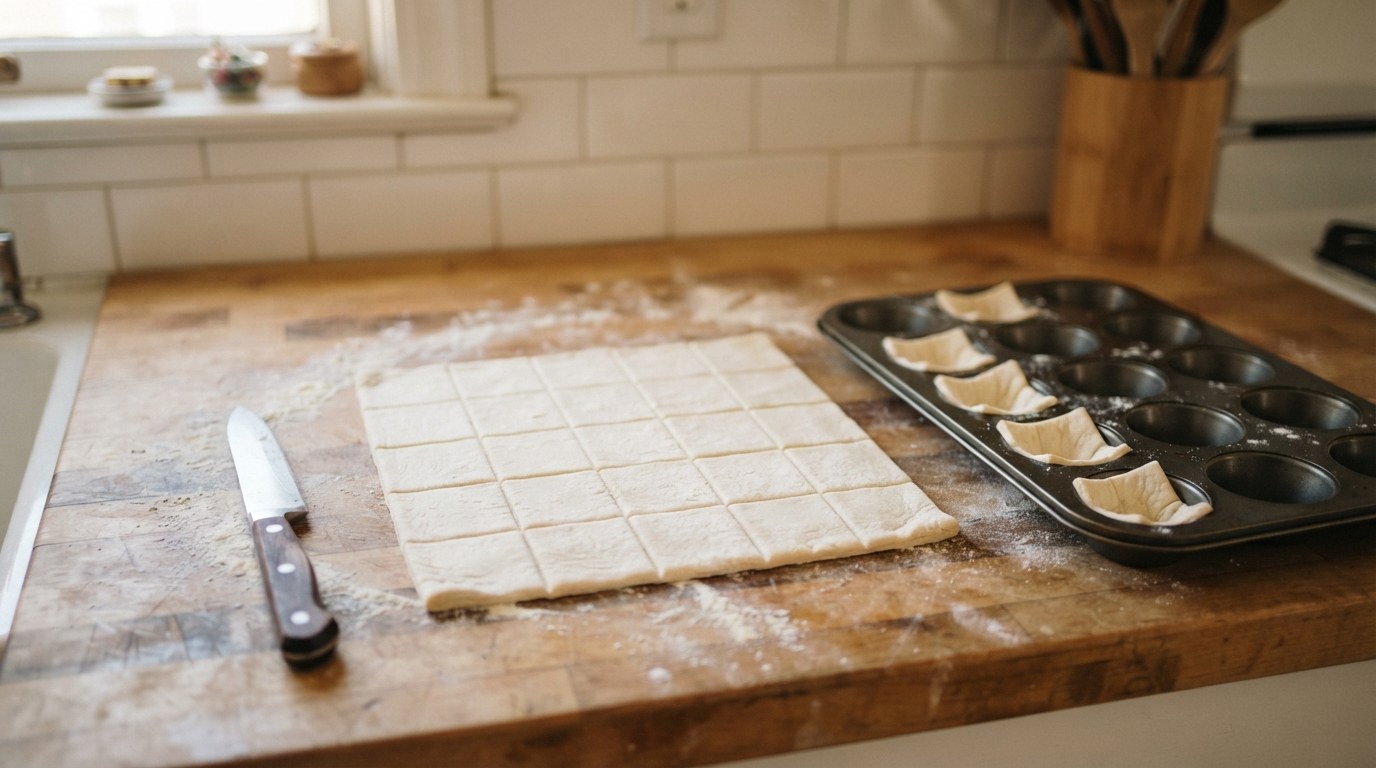
Cold is the other half. Thaw the sheet in the refrigerator, or on the counter just until it unfolds without cracking, and work fast; if the butter softens, it oozes into the dough instead of staying in its own layer, and King Arthur notes that soft butter melts into the dough or oozes out during layering. Never thaw it in the microwave. Cut the sheet into 24 squares with a sharp knife straight down, not dragged, so the layers stay separate at the edge, and press each square into a mini-muffin well with the corners standing up; do not roll the sheet thinner, because rolling compresses the layers you paid for. If the kitchen is warm, put the filled tin in the refrigerator for 10 minutes before it goes into the oven. Docking, the pricking of pastry with a fork, is for a base you want flat, not a cup; leave these alone and let them rise.
The Water Problem: Mozzarella, Tomatoes and the Cup
Fresh mozzarella is roughly half water, and it gives that water up in the oven faster than any aged cheese. A study of moisture loss from cheese during baking found that mozzarella, the wettest cheese tested, lost moisture fastest, that oven temperature was by far the biggest factor in how quickly it lost it, and that it began to brown at a lower temperature than the others, around 284°F, the same threshold at which Maillard browning starts on anything. Two things follow. Pat the pearls dry on a paper towel before they go in, because the brine on the outside is free water that would soak straight into the pastry floor. And use one small pearl per cup, not a slab; a small piece loses its water and melts in the same 18 minutes the pastry needs, while a large one is still weeping when the cup is done.
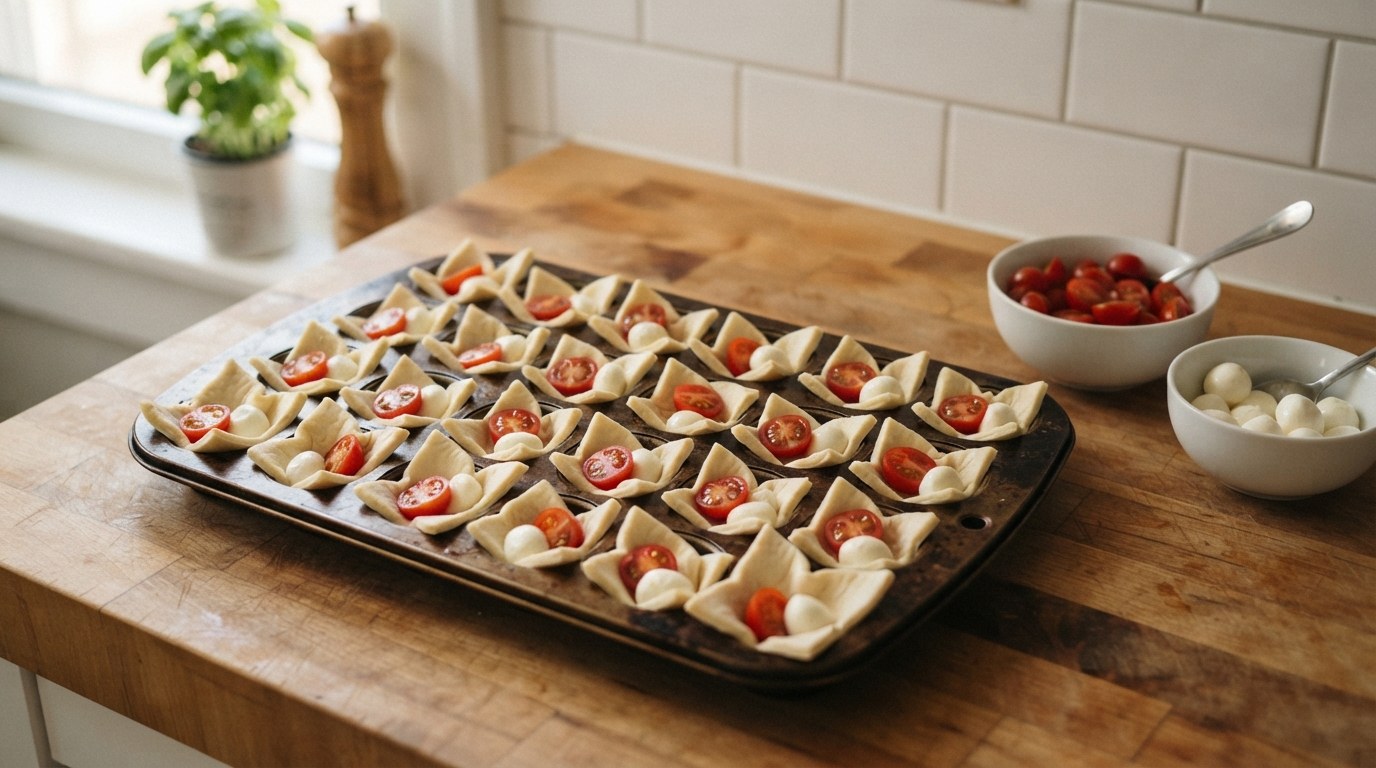
The tomato goes in cut-side up. A cherry tomato is mostly water too, and set cut-side down it seals against the pastry and steams it; set cut-side up, the cut face is exposed to the oven's dry heat, the water evaporates upward, and the sugars on the surface concentrate and brown. A surface that is wet cannot get above 212°F, so nothing on it browns or crisps; the cut-side-up position is how the tomato dries enough to roast in the time it has. A light brush of olive oil with grated garlic in each cup before the filling goes in does the last job: fat on the pastry floor is a barrier against the little liquid the cup does collect, and it seasons the tomato from below.
Baking and Doneness
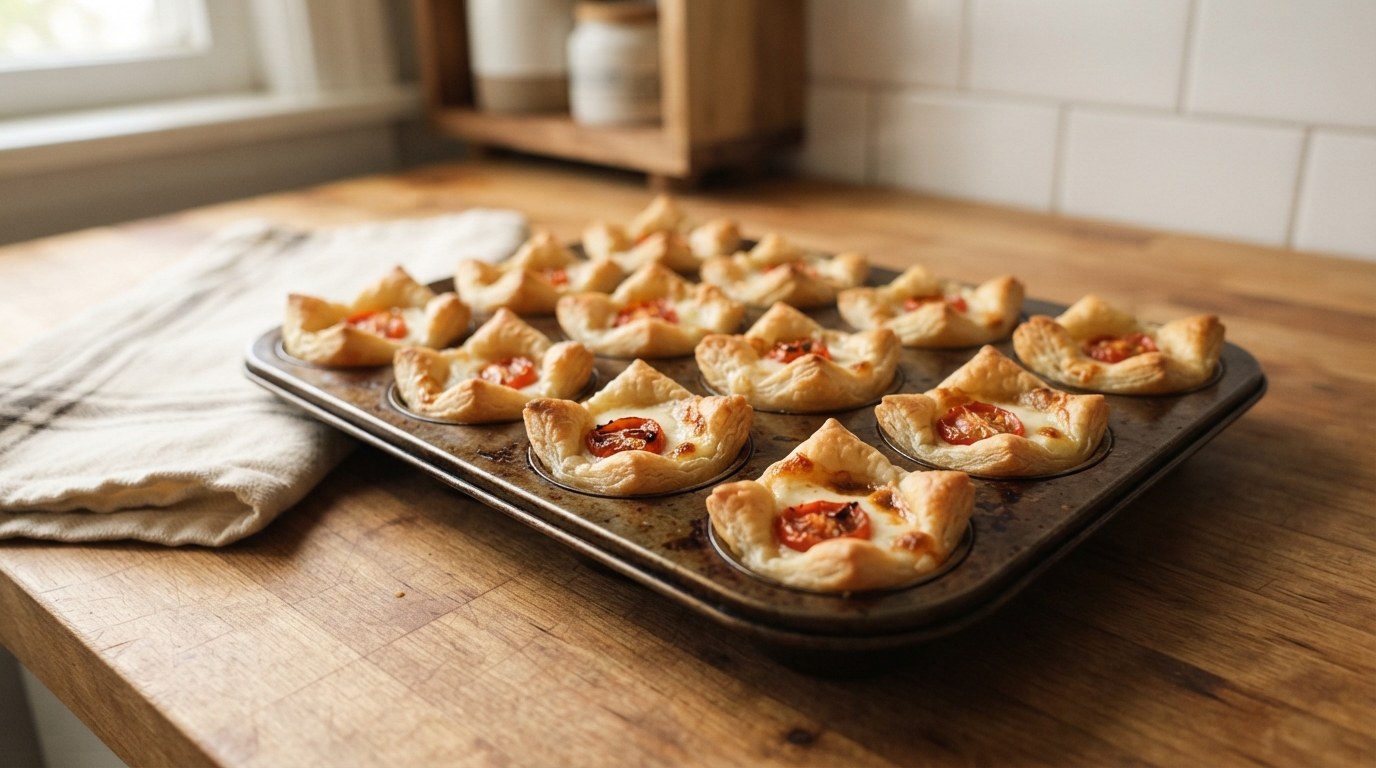
Bake at 400°F on the middle rack for 16 to 18 minutes, until the pastry corners are deep golden and risen, the floor of the cup is set and browned when you lift one with a small offset spatula, the tomatoes have blistered and slumped, and the mozzarella has melted into a soft pool with a few golden spots. Pale pastry is underbaked pastry: the layers have puffed but the starch and the outside have not set, and the cup will soften within minutes of coming out. Give them the extra 2 minutes.
| Stage | Number | What you see |
|---|---|---|
| Thaw the pastry | Refrigerator overnight, or counter until it unfolds | Cold and pliable; no cracks, no soft spots |
| Chill the filled tin (warm kitchen) | 10 minutes | Pastry firm to the touch before the oven |
| Bake | 400°F, 16 to 18 minutes | Corners deep golden and risen, tomatoes blistered, cheese pooled |
| Rest in the tin | 5 minutes | Cheese firms from liquid to soft; cups lift out clean |
| Finish | After resting, not before | Basil ribbons, glaze, flaky salt |
Rest the bites 5 minutes in the tin. Melted mozzarella is liquid at oven temperature and firms as it cools toward eating temperature, and a bite lifted out immediately loses its cheese down the side. Then run a small knife around any cup that has stuck and lift them onto a board. They are best warm, within 30 minutes, when the pastry is still crisp; the cups soften as the tomato's moisture migrates into them, which is why the finishing happens on the board and not in advance.
Basil and Balsamic Go On After
Basil is added after baking for two reasons. Its aroma lives in volatile oils that heat drives off, so basil baked inside the cup smells like nothing, and its cut edges blacken. Cutting or bruising a basil leaf breaks its cells and lets an enzyme react with the leaf's own phenolic compounds and oxygen, which is the same enzymatic browning that darkens a cut apple; heat and cold both make it worse. Rutgers' postharvest guide to basil lists blackening of the leaves as the sign of chilling injury and puts the ideal storage temperature at 55°F, which is warmer than any refrigerator, so keep the bunch in a glass of water on the counter, not in the crisper. Stack the leaves, roll them, and slice them into ribbons with a sharp knife at the last minute, then toss the ribbons in a teaspoon of olive oil, which coats the cut edges and slows the browning long enough to serve.
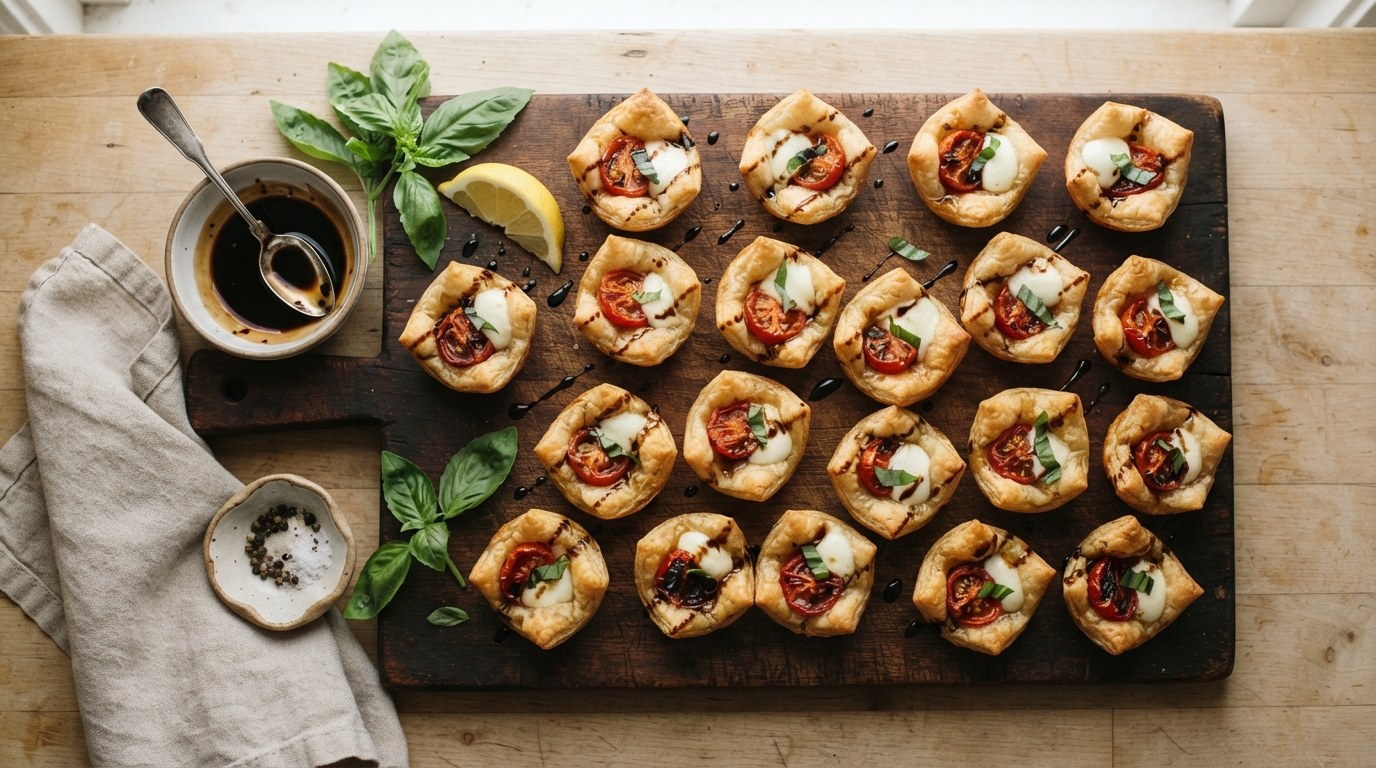
Balsamic glaze is balsamic vinegar reduced until it coats a spoon, and the reduction is simple evaporation: the water leaves, the grape sugars and acids stay, and the vinegar thickens and sweetens. Store-bought glaze is fine; to make it, simmer a half cup of balsamic vinegar in a small pan over medium-low heat until it has reduced to about 2 tablespoons and coats the back of a spoon, 8 to 12 minutes, and pull it before it turns to candy, because it thickens further as it cools. The vinegar itself, Aceto Balsamico di Modena under its protected geographical indication, is a blend of cooked or concentrated grape must and wine vinegar aged in wood, and the consortium that oversees it publishes the production rules that govern what can carry the name; the grape must is why it reduces to a syrup where plain wine vinegar would just get sharper. Drizzle thinly over the finished bites with a spoon, add flaky salt and black pepper, and serve. On the same table, the caramelized onion dip covers the cold side and the Hell's Kitchen scallops the plated course.
Make-ahead: line the tin with pastry, cover, and refrigerate up to 8 hours; add the tomato and cheese and bake from cold, adding a minute or two. Baked bites can be re-crisped on a sheet pan at 375°F for 5 minutes, but hold the basil and glaze until after. For a heartier bite, tuck a folded ribbon of prosciutto under the tomato before baking; for a pesto version, brush a quarter teaspoon of pesto in the cup in place of the garlic oil.
Baked Caprese Bites (Puff Pastry Cups)
Ingredients
- 1 sheet frozen puff pastry (half of a 17.3 oz box), thawed but cold
- 1 Tbsp olive oil, plus 1 tsp for the basil
- 1 small garlic clove, finely grated
- 12 cherry or grape tomatoes, halved
- 24 fresh mozzarella pearls (about 4 oz), drained and patted dry
- 1 large egg, beaten with 1 tsp water
- ¼ tsp fine sea salt, plus flaky salt to finish
- 12 fresh basil leaves
- 2 Tbsp balsamic glaze (store-bought, or ½ cup balsamic vinegar reduced)
- Freshly ground black pepper
Instructions
- Heat the oven to 400°F (205°C) with a rack in the middle. Lightly oil a 24-well mini-muffin tin. Stir the 1 tablespoon olive oil with the grated garlic.
- Unfold the cold pastry on a lightly floured counter and cut it into 24 squares (6 by 4) with a sharp knife pressed straight down. Press one square into each well so the four corners stand up. If the pastry has softened, refrigerate the tin 10 minutes.
- Brush the inside of each cup with the garlic oil. Set a tomato half cut-side up in each cup, add one mozzarella pearl beside it, and sprinkle with the fine salt and pepper. Brush the pastry corners with the egg wash.
- Bake 16 to 18 minutes, until the pastry corners are deep golden and risen, the tomatoes have blistered, and the mozzarella has melted into a soft pool. Rest in the tin 5 minutes, then lift the bites onto a board.
- Stack the basil leaves, roll them, and slice into thin ribbons; toss with the 1 teaspoon olive oil. Scatter over the bites, drizzle thinly with the balsamic glaze, and finish with flaky salt and pepper. Serve warm.
Notes
Baked Caprese Bites FAQs
The questions that come up most: whether they can be made ahead, why the pastry came out flat or soggy, whether the basil can be baked in, what mozzarella to use, whether crescent dough works, how to make the balsamic glaze, how long they keep, and how many to plan per person.
Can baked caprese bites be made ahead of time?
Partly. Line the mini-muffin tin with the pastry squares, cover, and refrigerate up to 8 hours, then fill and bake from cold with an extra minute or two. Bake them no more than 30 minutes before serving for a crisp cup, and add the basil, glaze and salt on the board, never in advance; a baked batch can be re-crisped at 375°F for 5 minutes.
Why did my puff pastry cups come out flat or soggy?
The pastry was warm, the oven was not hot enough, or the filling was wet. Puff pastry rises on steam from the water in its butter layers, so it needs cold dough going into a preheated 400°F oven; soft butter runs out of the layers before the steam forms. Pat the mozzarella pearls dry, set the tomato cut-side up, and bake until the corners are deep golden, not pale.
Can I bake the basil inside the cups?
No. Heat drives off the volatile oils that give basil its aroma, and the cut leaves blacken from enzymatic browning, so baked-in basil tastes and looks like nothing. Slice it into ribbons at the last minute, toss it in a little olive oil to slow the browning, and scatter it over the warm bites.
What kind of mozzarella is best for caprese bites?
Fresh mozzarella pearls, the small balls sold in brine as perline or ciliegine, one per cup and patted dry. They melt into a soft pool without stringing. Shredded low-moisture mozzarella strings and forms a skin, and a large slab of fresh mozzarella is still releasing water when the pastry is done.
Can I use crescent roll dough instead of puff pastry?
It will hold the filling but it is a different appetizer. Crescent dough is not laminated, so it bakes soft and bready rather than flaky and crisp, and it browns faster, so cut the bake to about 12 minutes. Puff pastry is what makes the cup crisp enough to stand up to the tomato.
How do I make balsamic glaze at home?
Simmer a half cup of balsamic vinegar in a small saucepan over medium-low heat until it has reduced to about 2 tablespoons and coats the back of a spoon, 8 to 12 minutes. Pull it early; it thickens more as it cools, and past that point it sets to candy. The grape must in true balsamic is what lets it reduce to a syrup.
How long do baked caprese bites keep?
They are best within 30 minutes of baking, while the cup is crisp. Refrigerate leftovers up to 2 days and re-crisp on a sheet pan at 375°F for 5 minutes; the pastry softens as the tomato's moisture migrates into it, and a microwave makes that worse. Store fresh basil on the counter in water, not the refrigerator, where it blackens below about 55°F.
How many caprese bites per person?
Three per person as one of several appetizers, four or five if they are the only starter. One sheet of puff pastry makes 24, so a two-sheet box covers a party of twelve to sixteen; bake the second tin while the first is on the board.

About the Author
John Siracusa is the founder of Hell’s Kitchen Recipes. He focuses on technique-first, reproducible home cooking and researches recipes & kitchen equipment from published food science and professional chef methods since 2016.