This Gordon Ramsay omelette is a soft, pale three-egg omelette folded around melting mozzarella, then topped with thin slices of asparagus and shiitake mushrooms in a quick white wine and crème fraîche sauce, finished with fresh basil and a little Parmesan. It comes from his cookbook Ramsay in 10, where every recipe is built to be on the table in about ten minutes, and it serves one. It is gluten-free, and vegetarian too if you swap the Parmesan for a vegetarian hard cheese.
The whole thing takes two small pans and about 15 minutes, start to finish. Below is why each step works: why the eggs get beaten with a fork until frothy, why the heat stays at medium, why the mozzarella has to be at room temperature, and why crème fraîche holds together in the pan where sour cream can split. Then the variations, the fixes for a rubbery or torn omelette, and the food-safety facts on soft eggs. For more of Ramsay's egg cooking, start with his soft scrambled eggs, or browse every dish in Recipes.
How Gordon Ramsay Makes His Mozzarella Omelette
Gordon Ramsay makes this omelette in two pans at once. The vegetables go first: thin slices of asparagus cook for 2 minutes in olive oil, then the sliced shiitake and a little butter join them, then garlic for a minute, then a splash of white wine (or water) that bubbles down by half before a spoon of crème fraîche turns it into a light sauce that sits at a low simmer. Meanwhile three eggs, beaten with a fork until frothy, go into a second small nonstick pan over medium heat and cook for about 2 minutes, until they are almost set. Mozzarella goes down the middle, the two sides fold over it, and the omelette slides onto a plate. Basil goes into the vegetables at the last second, the vegetables go on top, and Parmesan finishes it.
Ramsay's point in the book is that a plain omelette is about a three-minute job once you have made a few, and that the filling and topping are what stretch it. That is worth keeping in mind, because the eggs here need only those 2 minutes; the rest of the time is the vegetables. He also has a sensible prep shortcut: trim the woody ends off the asparagus with one knife cut while the bunch is still held together by its rubber band, instead of snapping each spear by hand.
Why You Beat the Eggs With a Fork Until Frothy
Beating the eggs with a fork until frothy mixes the whites and yolks into one even liquid, so the omelette sets at the same rate all over and comes out an even, pale yellow. Egg whites and yolks set at different temperatures: America's Test Kitchen puts the start of the white at 144°F (62°C) and the yolk at 149°F (65°C), because the yolk's fat slows its proteins down. Leave streaks of white in the bowl and those streaks set first, showing up as rubbery white flecks in a yellow omelette. Beat until the color is uniform and a light froth covers the top, about 30 seconds of brisk forking.
The froth is a side benefit. The small air bubbles expand a little as the eggs heat, which gives the omelette a softer, lighter bite, but this is not a soufflé omelette, and a fork is all it needs. Ramsay's recipe uses no milk or cream in the eggs. Liquid dairy is mostly water, it dilutes the egg proteins, and that water seeps out as the eggs cook. If you want richness, it comes from the cheese inside and the crème fraîche sauce on top.
Medium Heat and a Nonstick Pan: Why a Gordon Ramsay Omelette Stays Pale and Tender
A Gordon Ramsay omelette cooks over medium heat in a small nonstick pan so the eggs set into a soft, tender layer before the bottom has time to brown. Egg proteins unwind and link into a gel from about 144°F (62°C), but if they keep heating well past 160°F (71°C) they tighten, squeeze out their water and turn rubbery. Maillard browning, the reaction behind a golden crust, starts at around 284°F (140°C) on a dry surface, and a pan on high heat reaches that in seconds, so the underside goes brown and leathery while the top is still raw. Medium heat gives you the 2 minutes the recipe needs to move the eggs and bring them to an even set.
The nonstick surface matters as much as the heat. As eggs coagulate, their proteins grip bare metal, which is why an omelette tears in a stainless pan when you try to fold it. A nonstick coating lets the omelette slide, fold and roll onto the plate in one piece with just the tablespoon of olive oil the recipe calls for; our explainer on why eggs stick to a HexClad pan covers what to do when even a nonstick surface starts to grab. Size matters too: an 8-inch pan spreads three eggs into a layer thin enough to set in 2 minutes and fold neatly. In a 12-inch pan the same eggs spread too thin and overcook before you can fold them.
Move the eggs while they cook. As the base starts to set, push the edges toward the center with a spatula and tilt the pan so the liquid egg runs into the gaps. That builds soft, even folds and stops any one layer from overcooking. Stop when the top is still slightly glossy. The heat held in the eggs keeps cooking them after the fold, the same carryover that finishes a steak as it rests, so an omelette that looks fully dry in the pan will be tough on the plate.
Why the Mozzarella Goes in at Room Temperature
The mozzarella goes in at room temperature because the only heat it gets is what is left in the eggs after you fold, and cold cheese can't warm through in that time. Cheese straight from a 40°F (4°C) fridge has a long way to climb, and wrapped inside an omelette that is already off the heat it stays firm and cool in the middle. Taken out of the fridge 20 to 30 minutes ahead, while you prep the vegetables, it softens into creamy, melting pockets within a minute of the fold.
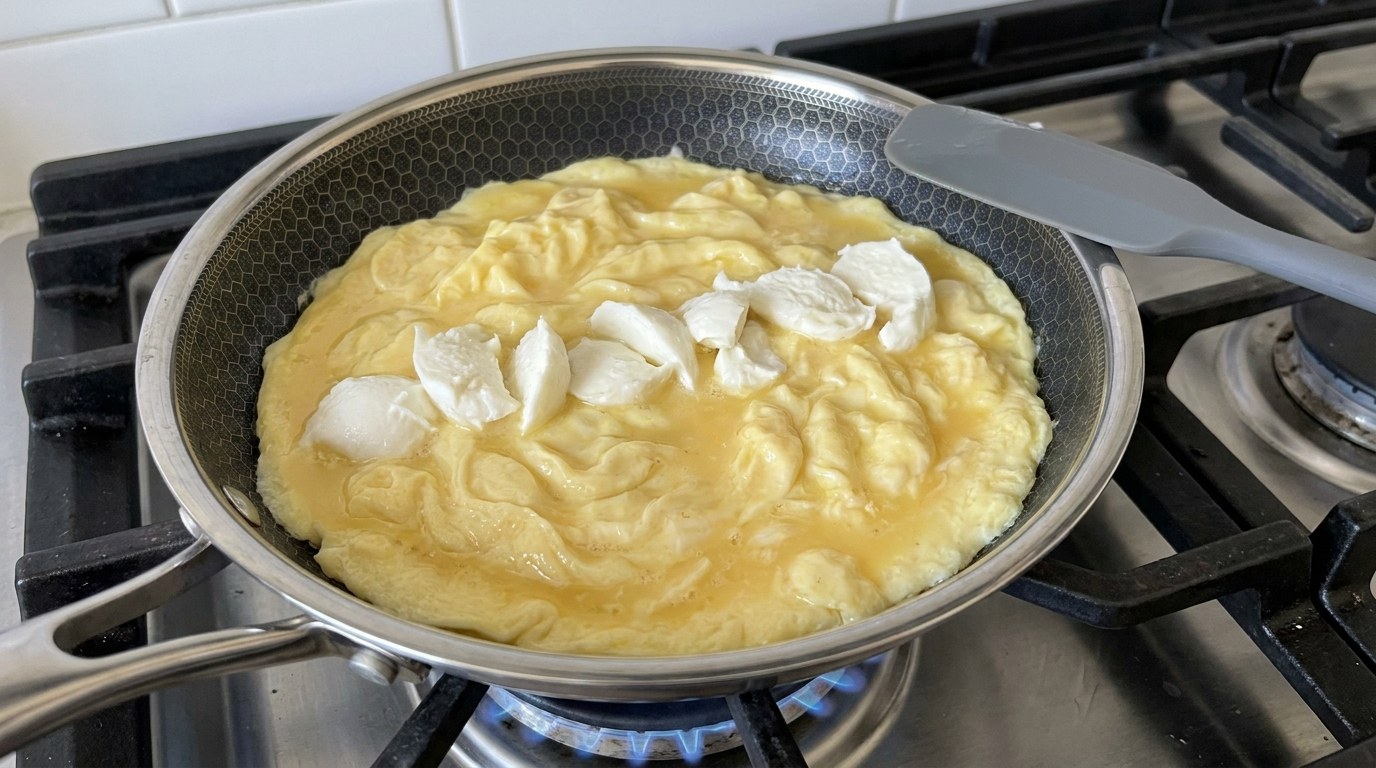
Can you put mozzarella in an omelette? Yes, and it is one of the best melting cheeses for one. Under the federal standard, mozzarella (21 CFR 133.155) holds more than 52 percent water, far more than a hard cheese, which is why it melts soft and milky instead of turning oily. Chop it roughly into small pieces so it melts evenly, and pat fresh mozzarella dry on a paper towel first so its liquid doesn't make the omelette soggy. Low-moisture shredded mozzarella works too; it melts a little stringier and saltier.
Lay the cheese in a line down the middle, fold one third of the omelette over it, then fold the other side on top, and tip it onto the plate with the seam underneath. Folding into thirds traps the heat around the cheese and gives that classic oval shape. If the omelette tears, it was either too dry or the pan was gripping it; the troubleshooting section below covers both.
The Asparagus and Shiitake Topping: Wine, Crème Fraîche and Basil
The topping is a two-minute pan sauce: thinly sliced asparagus and shiitake cooked in oil and butter, a splash of white wine reduced by half, and a spoon of crème fraîche to make it creamy. Slicing the asparagus thinly is what lets it cook in 2 minutes. Heat softens pectin, the glue between the plant's cells, from the outside in, and a thin slice has almost no inside, so it turns tender while staying bright green and a little crisp. Whole spears would need several minutes and lose that snap.
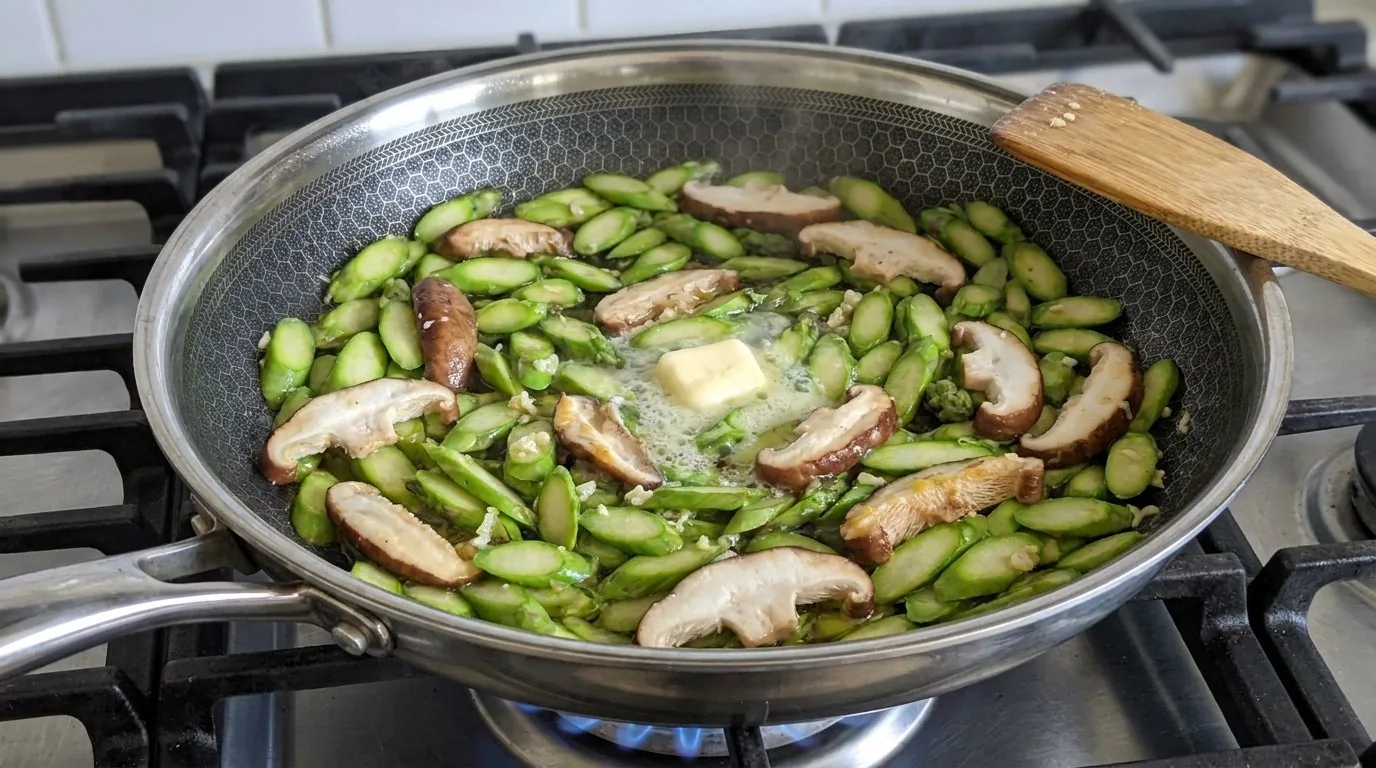
Mushrooms are mostly water, and Ramsay's rule for them is to give them enough heat to drive that water off so they take on color instead of stewing. Spread the shiitake slices out, add the butter with them and let them sit for a moment between stirs. While their surface is wet it can't get hotter than water's boiling point of 212°F (100°C); once the water evaporates, the browning starts. Use the shiitake caps only. The stems are tough and woody, though they are good in a stock. A wide pan helps here, because crowded mushrooms steam. A 12-inch skillet gives the vegetables room while the eggs cook in the small pan.

HexClad
HexClad 12-Inch Hybrid Nonstick Frying Pan
- Stainless steel and ceramic nonstick hybrid surface, built to sear hard and release easily
- Tri-ply with an aluminum core for quick, even heat; works on induction
- Oven safe to 900°F and metal-utensil safe (lid not included)
The white wine adds acidity and depth, and reducing it by half concentrates both. Alcohol boils at about 173°F (78°C), so it evaporates faster than water, but a quick reduction doesn't remove all of it: Idaho State University, citing the USDA, puts what remains at about 85 percent when alcohol goes into a boiling liquid that then comes off the heat, and about 40 percent after 15 minutes of simmering. If you are cooking for someone who avoids alcohol entirely, use water, which the recipe allows; a squeeze of lemon at the end brings back some of the brightness.
Crème fraîche is the right finish because it doesn't split. Dairy with more than about 25 percent fat holds together under heat, because the fat keeps the milk proteins apart, and crème fraîche is around 30 percent. Sour cream is leaner, with a legal minimum of 18 percent milkfat, and at a simmer its proteins can clump into grainy specks. If sour cream is what you have, take the pan off the heat before stirring it in and don't let it bubble. The basil goes in at the very end, off the heat. Soft herbs lose their fragrance and darken quickly in a hot pan, and Ramsay treats them as a last-second seasoning, never something to cook.
French Omelette vs American Omelette (and Where Ramsay's Fits)
A French omelette is cooked gently, stays pale with no browning, and is rolled or folded into thirds while the inside is still soft; an American omelette is cooked through, often lightly browned, and folded in half over a filling. Ramsay's mozzarella omelette sits in between: French in how it is cooked and folded, but with a melting filling inside and a sauce on top.
| Style | How it cooks | Color | Inside | Fold | Filling |
|---|---|---|---|---|---|
| French omelette | Medium-low heat, eggs stirred constantly | Pale yellow, no browning | Soft, slightly creamy | Rolled or folded in thirds | Usually none, or fine herbs |
| American omelette | Medium to medium-high heat, eggs set as a sheet | Often lightly golden | Cooked through | Folded in half | Cheese, ham, peppers, onions |
| Ramsay's mozzarella omelette | Medium heat, edges pushed in, about 2 minutes | Pale yellow, barely colored | Just set, glossy center | Folded in thirds | Mozzarella inside; asparagus, shiitake and basil on top |
| Plain 3-minute omelette | Medium heat, eggs moved until almost set | Pale yellow | Soft | Folded in thirds | Grated cheese or soft herbs |
The practical difference is temperature. The French and Ramsay styles keep the eggs below the point where they brown and toughen, and the American style trades some tenderness for a sturdier omelette that holds a heavy filling. Ramsay's version gets around that by putting most of the filling on top, so the omelette itself only has to hold a little cheese.
Gordon Ramsay Omelette Variations
The simplest variation is the one Ramsay suggests himself: skip the vegetables and make a plain omelette with grated cheese or soft herbs, which takes about 3 minutes. Beat three eggs with a fork, cook them in the small pan exactly as above, scatter a handful of grated Cheddar, Gruyère or Parmesan, or a spoon of chopped chives, parsley, tarragon or basil, over the middle, and fold. It is the omelette to learn first, since it is the same egg technique without the second pan.
The topping takes other mushrooms well. Cremini or button mushrooms swap in one for one and need a little longer to give up their water; oyster mushrooms tear by hand and brown fast. Out of asparagus season, use thinly sliced zucchini, a handful of baby spinach wilted in at the end, or frozen peas. Goat cheese or feta can replace the mozzarella if you want a sharper, saltier filling, though neither melts the same way. For a breakfast with no folding at all, Ramsay's no-whisk scrambled eggs use the same soft-egg thinking, and the crème fraîche finish shows up again in his scrambled eggs without crème fraîche, which covers what to use when the tub is empty.
Why Your Omelette Is Rubbery, Brown or Tearing
A rubbery or brown omelette was cooked too hot or too long, a torn one was too dry or stuck to the pan, and cold mozzarella went in straight from the fridge. Each has a quick fix:
- Rubbery or watery: the eggs went well past their setting point and the proteins squeezed out their water. Take the pan off the heat while the top is still glossy, and let carryover finish the job.
- Brown and crusty underneath: the heat was too high. Turn it down to medium, and if your burner runs hot, lift the pan off for a few seconds at a time.
- Tears when you fold: either it was overcooked and brittle, or it was sticking. Fold sooner, use a nonstick pan with a thin film of oil, and loosen the edges with a spatula before folding.
- Mozzarella still cold or firm: it went in cold, or in large chunks. Let it sit out while you cook the vegetables and chop it small.
- Sauce split or grainy: sour cream or a low-fat substitute boiled. Use crème fraîche, or stir sour cream in off the heat.
- Vegetables soggy and grey: the pan was crowded or not hot enough for the mushrooms. Use a wider pan and give them time before stirring.
Are Soft Omelettes Safe to Eat?
A soft omelette with a glossy center is a known trade-off: the FDA advises cooking eggs until both the yolk and the white are firm, and cooking dishes that contain eggs to 160°F (71°C). The 2-minute omelette here is folded slightly before that point and finishes in its own heat, so it may not reach 160°F all the way through. Most healthy adults eat soft omelettes without a problem, but children, older adults, pregnant women and anyone with a weakened immune system are at greater risk from Salmonella. For them, use pasteurized eggs, which the FDA recommends for any dish served soft, or cook the omelette a little longer until no liquid egg remains.
Keep raw eggs refrigerated until you use them, discard any with cracked shells, and wash your hands and the bowl after handling them. Those habits matter more than the last few seconds in the pan.
What to Serve With a Gordon Ramsay Omelette
A Gordon Ramsay omelette with this topping is a full meal for one, so it needs very little alongside it: a slice of toasted sourdough or a few leaves of dressed salad, or roasted cherry tomatoes if you want color on the plate. Serve it straight away on a warm plate, since the mozzarella firms as it cools. For a weekend brunch, it sits well next to his eggs Benedict, and if asparagus is in season and you have more of the bunch to use, his creamy asparagus risotto makes a good dinner.
Make the Gordon Ramsay omelette once and the technique sticks: forked eggs, medium heat, a small nonstick pan, pull it while the top still shines. To pick the pan, see what frying pan Gordon Ramsay uses and the wider guide to Gordon Ramsay cookware.
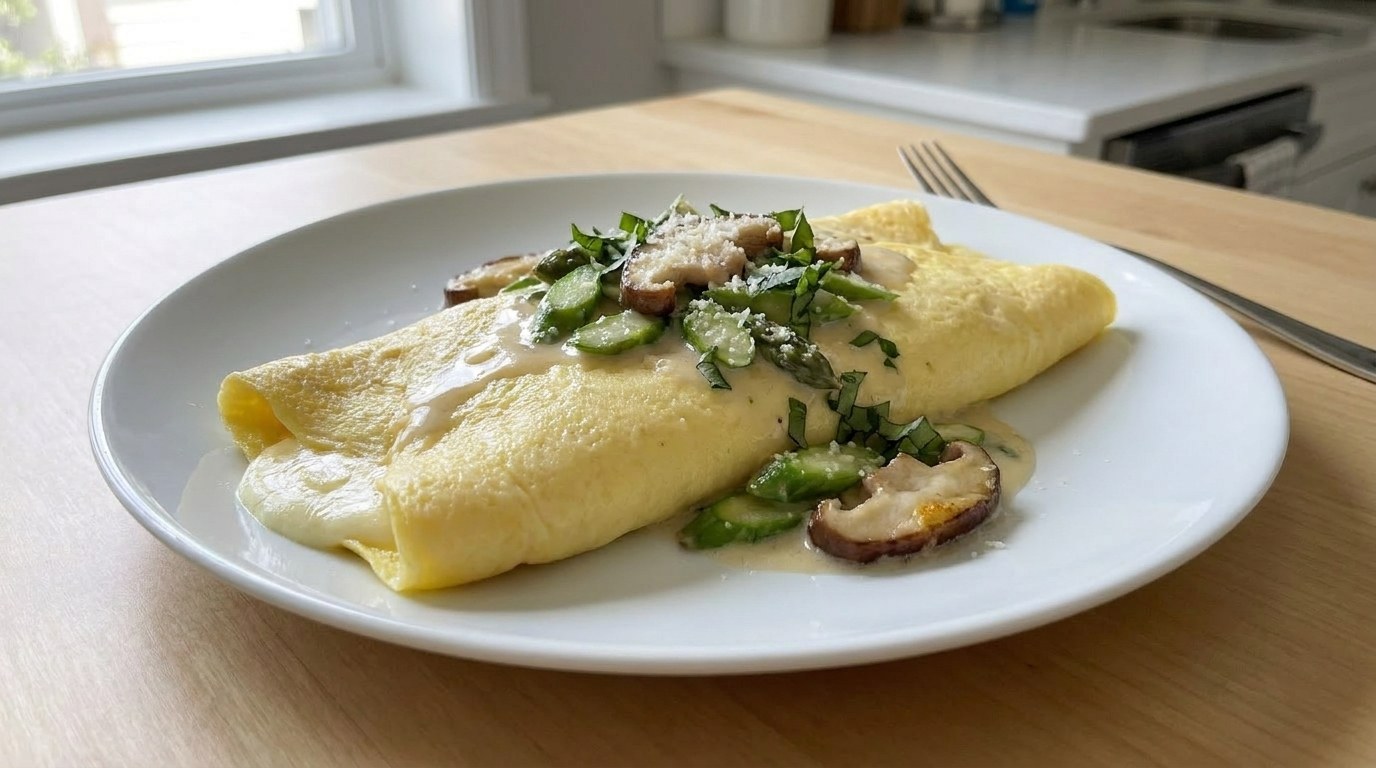
Gordon Ramsay Mozzarella and Basil Omelette with Asparagus and Shiitake
Ingredients
Asparagus and shiitake topping
- 2 tbsp olive oil (30 ml), divided
- 3 asparagus spears, woody ends trimmed
- 1 1/2 oz shiitake mushrooms (40 g), stems removed, caps sliced
- 1 tbsp butter (15 g)
- 1 garlic clove, crushed or finely grated
- 2 tbsp dry white wine or water (30 ml)
- 1 tbsp crème fraîche (or sour cream, stirred in off the heat)
- 1 sprig basil, leaves chopped
Omelette
- 3 large eggs
- 1/2 cup mozzarella (60 g), at room temperature, roughly chopped
- 1 tbsp finely grated Parmesan or vegetarian hard cheese (optional)
- Salt and freshly ground black pepper
Instructions
- Take the mozzarella out of the fridge 20 to 30 minutes ahead, or as you start, and chop it roughly. Slice the trimmed asparagus thinly on a slight angle, slice the shiitake caps and crush or grate the garlic.
- Heat 1 tbsp of the olive oil in a medium nonstick skillet over medium heat. Add the asparagus and cook for 2 minutes, stirring now and then.
- Add the shiitake and the butter and cook for about 2 minutes, until the mushrooms soften and color at the edges. Add the garlic and cook for 1 minute more.
- Pour in the wine or water and let it bubble until reduced by half. Stir in the crème fraîche, season with salt and pepper, and turn the heat to its lowest setting so the sauce just simmers. (If using sour cream, take the pan off the heat before stirring it in.)
- Crack the eggs into a bowl and beat them with a fork until evenly yellow and frothy on top, with no streaks of white. Season lightly.
- Heat the remaining 1 tbsp olive oil in a small 8-inch nonstick pan over medium heat. Pour in the eggs. As the base sets, push the edges toward the center with a spatula and tilt the pan so the liquid egg runs into the gaps. Cook for about 2 minutes, until almost set and still slightly glossy on top.
- Scatter the mozzarella in a line down the middle. Fold one side of the omelette over the cheese, then the other side over that, and slide it onto a warm plate, seam side down.
- Stir the basil into the vegetables, spoon them over the omelette and finish with the grated Parmesan, if using. Serve straight away.
Notes
Gordon Ramsay Omelette FAQs
The questions that come up most: how Gordon Ramsay makes an omelette, what he puts in it, whether you can put mozzarella in an omelette, whether to add milk, what size pan to use, why an omelette turns rubbery, whether a soft omelette is safe, and the difference between a French and an American omelette.
How does Gordon Ramsay make an omelette?
He beats three eggs with a fork until frothy, cooks them in a small nonstick pan over medium heat for about 2 minutes, moving the eggs until they are almost set, then folds the sides over the filling and slides it onto a plate. In his Ramsay in 10 version the filling is mozzarella, and the omelette is topped with asparagus and shiitake in a crème fraîche sauce with basil and Parmesan.
What does Gordon Ramsay put in his omelette?
In the mozzarella and basil omelette from Ramsay in 10: three eggs, olive oil, room-temperature mozzarella inside, and a topping of asparagus, shiitake mushrooms, butter, garlic, white wine or water, crème fraîche, basil and grated Parmesan. For a plain version he suggests just grated cheese or soft herbs.
Can you put mozzarella in an omelette?
Yes. Mozzarella is high in moisture, so it melts soft and creamy rather than oily. Use it at room temperature and chop it roughly, because the only heat it gets is what is left in the eggs after folding. Pat fresh mozzarella dry first so it does not make the omelette soggy.
Should you add milk to omelette eggs?
Ramsay does not. Milk is mostly water, which dilutes the eggs and seeps out as they cook. Beat the eggs on their own with a fork until frothy, and get richness from the cheese and the sauce instead.
What size pan is best for a 3-egg omelette?
An 8-inch nonstick pan. It spreads three eggs into a layer that sets evenly in about 2 minutes and folds neatly. A bigger pan spreads them too thin, so they overcook and tear before you can fold them.
Why is my omelette rubbery?
It was cooked too hot or too long. Egg proteins set from about 144°F, but heated well past that they tighten and squeeze out water. Use medium heat and take the pan off while the top is still slightly glossy; the omelette finishes cooking from its own heat.
Is a soft omelette safe to eat?
The FDA advises cooking eggs until the yolk and white are firm and egg dishes to 160°F, so a soft omelette is a trade-off. Most healthy adults eat them without trouble, but for children, older adults, pregnant women or anyone with a weakened immune system, use pasteurized eggs or cook it until no liquid egg remains.
What is the difference between a French and an American omelette?
A French omelette is cooked gently, stays pale and soft inside, and is rolled or folded into thirds. An American omelette is cooked through, often lightly browned, and folded in half over a filling. Ramsay's mozzarella omelette is cooked and folded the French way, with the cheese inside and the vegetables on top.

About the Author
John Siracusa is the founder of Hell’s Kitchen Recipes. He focuses on technique-first, reproducible home cooking and researches recipes & kitchen equipment from published food science and professional chef methods since 2016.