Pull-apart Christmas tree bread is a tray of cheese-stuffed dough balls arranged in the shape of a tree, baked until they fuse into one golden pull-apart loaf, brushed with garlic-herb butter and served with marinara for dipping. Each ball hides a cube of mozzarella that pulls into a string when it is torn off. Most versions are built from a can of crescent dough; this one uses pizza dough, homemade or from the store, because pizza dough bakes into a real, chewy, bread-like ball that holds its shape and its cheese, and because it costs a dollar. It feeds eight as an appetizer and it is the dish children carry to the table.
The recipe card at the bottom has the amounts and numbered steps for one tree of 18 balls. This guide covers the dough and why it fights you until it rests, the cheese and why it must be low-moisture, stuffing and shaping the tree, the egg wash and the bake, doneness by temperature, the garlic-herb butter that goes on after, and make-ahead. It sits in the site's recipes collection with the rosemary garlic dinner rolls and the rest of the holiday and seasonal table.
The Dough: Yeast, Gluten, and the 15-Minute Rest
A pound of pizza dough is a yeast dough, and everything it does comes from two things working against each other. The yeast, Fleischmann's explains, is a living organism, the strain Saccharomyces cerevisiae, that feeds on the flour's sugars and releases carbon dioxide, and that gas is what expands the gluten proteins and makes the dough rise. The gluten is the net that holds the gas, and it is built by kneading and tightened by every fold and shape you put the dough through. A dough ball that has just been kneaded, or just come out of its bag, has a tight net, and that is why it fights back.
King Arthur Baking's answer to dough that snaps back when you shape it is the one this recipe uses: walk away and let it rest for 15 minutes, covered, so the tight gluten strands relax and settle into their new shape. Cold dough from the refrigerator gets 30 minutes on the counter instead, because cold gluten is stiff as well as tight. So divide the pound of dough into 18 pieces, roll each into a rough ball, cover them with a towel, and leave them alone; when you come back they will flatten under your palm without springing back, which is what you need for stuffing. Homemade pizza dough works the same way, and the site's rosemary dinner rolls are the from-scratch dough to use if you want one.
| Ingredient | What it does | Do not substitute with |
|---|---|---|
| Pizza dough, 1 lb, rested | Bakes into chewy, bread-like balls that hold their shape | Crescent dough (soft and sweet; melts into a slab) |
| Low-moisture mozzarella, cut into 18 cubes | Melts and strings without flooding the dough | Fresh mozzarella (weeps water and blows the seams) |
| One egg, beaten with water | Gloss and browning on the crust | Milk wash (pale) |
| Butter, garlic, parsley, brushed on after | Flavor and shine without scorched garlic | Garlic butter before the bake (garlic burns) |
| Parmigiano Reggiano, grated, on top | Salty, aged depth over the butter | Pre-grated Parmesan in a can (dusty) |
| Warm marinara, for dipping | The acid that cuts the cheese and butter | Cold sauce from the jar (flat; warm it) |
The Cheese: Why Low-Moisture Mozzarella
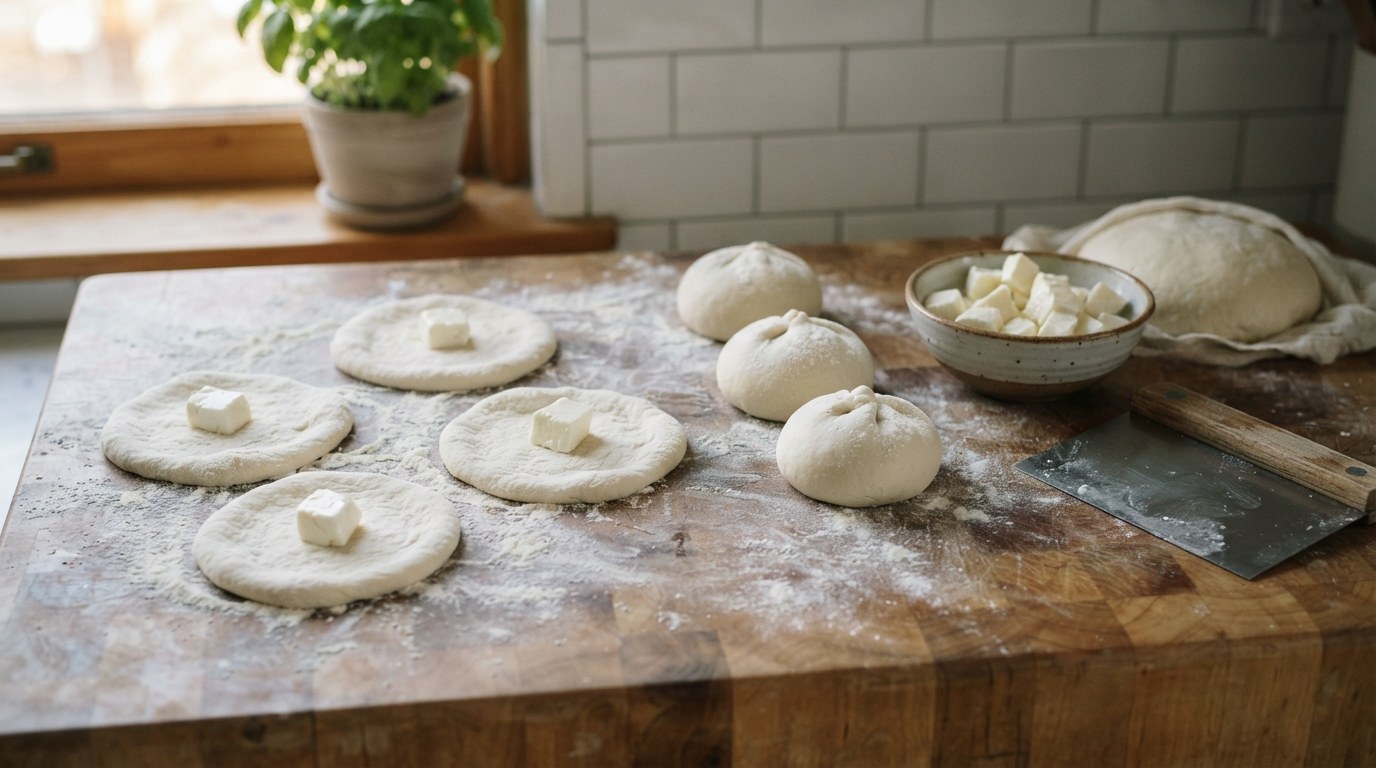
The cheese inside has to melt without leaking, and that is a water question. A study of moisture loss from cheese during baking measured its mozzarella at about 47 percent water and found that it lost moisture faster than any aged cheese tested, and that it began to brown at a lower temperature than the others, around 284°F. Sealed inside a dough ball, that water turns to steam, and steam wants out; a cube of low-moisture mozzarella gives up a manageable amount and stays put, while a cube of fresh mozzarella, which is wetter still, floods the seam, bursts the ball and leaves a hollow with a puddle at the bottom. Use the low-moisture block, cut into 18 cubes of about a half inch, and keep them cold until they go in.
Advertisement
To stuff, flatten each rested ball into a 3-inch round, set a cube in the center, gather the edges up over it and pinch them firmly closed, then roll the ball seam-side down between your palms to smooth it. The pinch matters: a seam that is only folded opens in the oven as the dough expands and the steam pushes, and the cheese runs onto the pan. Roll each finished ball briefly on the counter so the seam disappears into the bottom.
Shaping the Tree and the Egg Wash
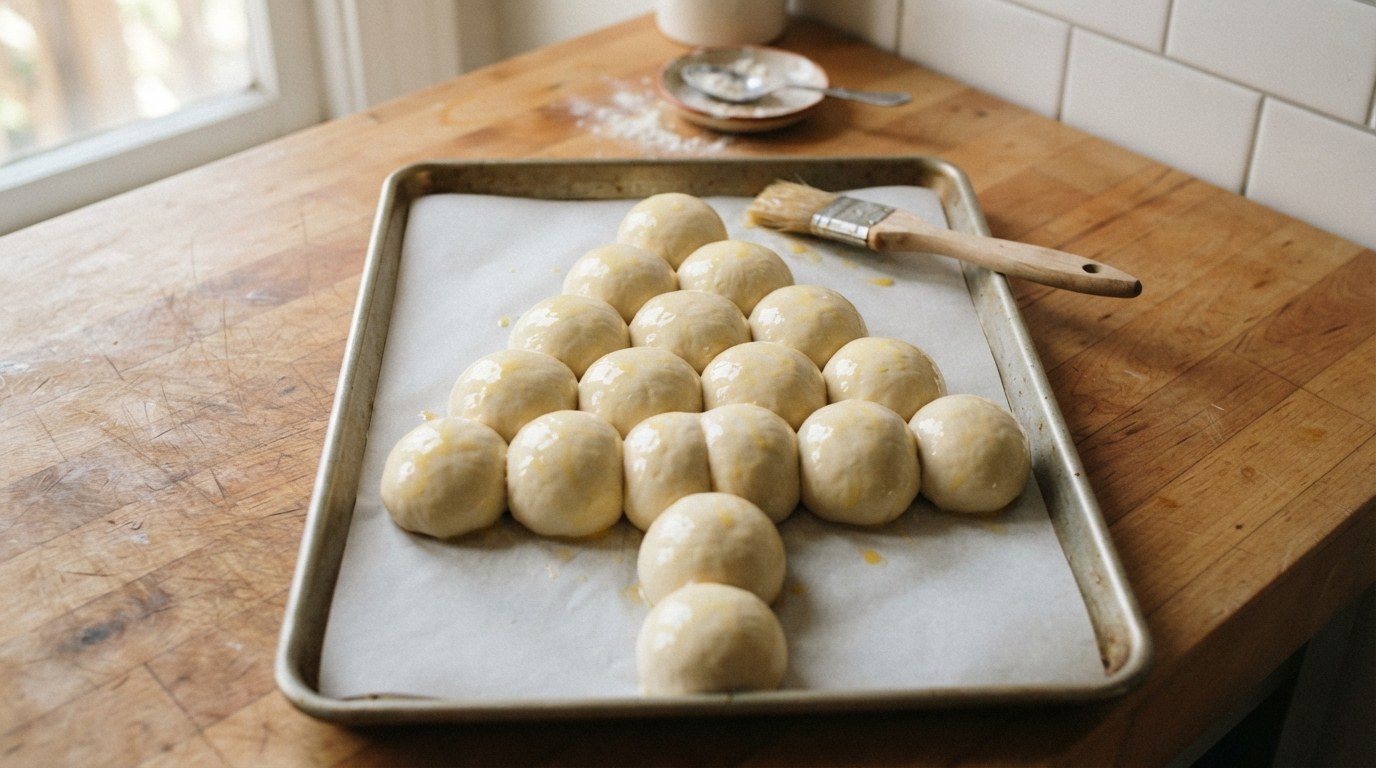
On a parchment-lined sheet pan, set one ball at the top, then rows of two, three, four and five beneath it, each ball touching its neighbors, to make a triangle of 15; the last three go in a column below the center as the trunk. Touching is the point. As the balls rise and bake they expand into each other, and their crusts fuse where they meet, which is what turns eighteen rolls into a single loaf that tears apart in the hand. Leave them to rise, loosely covered, for 20 to 30 minutes, until puffy; that second rise is where the yeast fills the balls with gas before the oven sets them.
Brush the tree all over with a beaten egg thinned with a tablespoon of water. The wash does two things: its proteins and the trace of sugar in it brown faster and darker than bare dough through the Maillard reaction, so the tree comes out deep golden instead of pale, and it dries into a gloss. A few flakes of salt on the wet egg season the crust. Then it goes straight into the oven; a tree that sits egg-washed for long slumps.
Baking and Doneness: Golden Outside, 190°F Inside
Bake at 400°F on the middle rack for 20 to 24 minutes, until the tops are deep golden brown, the balls have fused, and the seams between them are no longer doughy. The first minutes are oven spring: the heat drives the yeast into a last burst of gas and expands the steam in the dough until the temperature inside climbs past what the yeast can survive, in the first several minutes, and then the gluten and starch set from around 180°F and the balls stop growing. Doneness is inside, not on top, because the crust colors before the center of a stuffed ball is cooked; push an instant-read thermometer into a center ball, avoiding the cheese, and pull the pan at 190°F or a little above. Under that, the dough around the cheese is gummy.
Advertisement
| Stage | Number | What you see |
|---|---|---|
| Rest the divided dough | 15 minutes covered (30 if cold) | Flattens without springing back |
| Stuff and seal | One ½-inch cube per ball | Seam pinched shut and rolled under |
| Second rise | 20 to 30 minutes, covered | Balls puffy and touching |
| Bake | 400°F, 20 to 24 minutes | Deep golden, fused, seams set |
| Doneness | 190°F in a center ball | No gummy dough around the cheese |
| Butter and cheese | Right out of the oven | Glossy; Parmesan melts into the butter |
If the top is browning fast at 15 minutes, tent it with foil and finish the time; the cheese inside needs the full bake to melt through. Let the tree rest 5 minutes before it is moved, so the fused seams firm up, then slide the parchment onto a board.
The Garlic-Herb Butter Goes On After
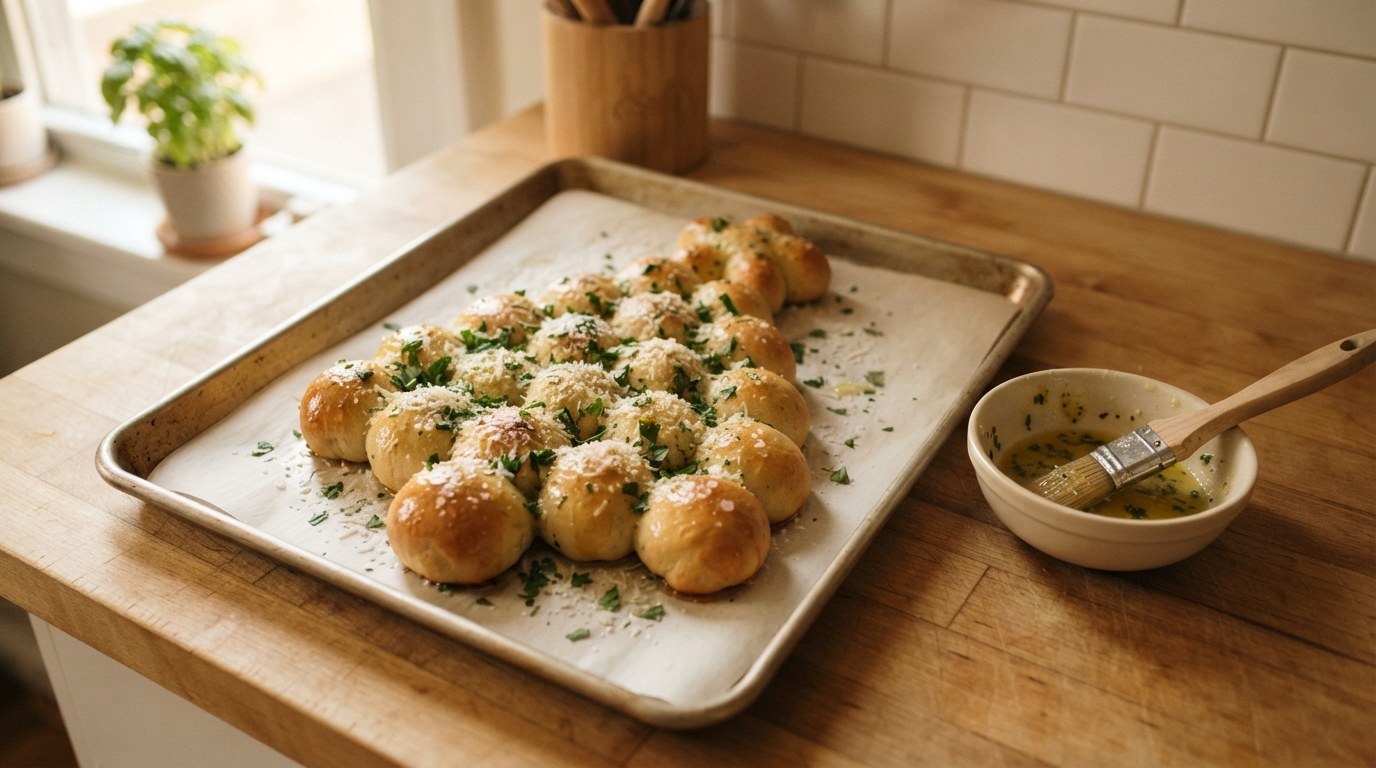
Melt four tablespoons of butter with two grated garlic cloves, a pinch of salt and a handful of chopped parsley, and brush it generously over the hot tree the moment it comes out. The butter goes on after, not before, because garlic is mostly sugar and water with almost no fat to protect it, and at 400°F in a dry oven a brushed-on layer of it scorches to bitter brown specks in the time the bread takes to bake; brushed onto hot bread, the garlic warms through in the butter and stays sweet and sharp. The heat of the bread does the rest, pulling the butter into the crust. Then grate Parmigiano Reggiano over the top while the butter is wet so it clings and half melts. The Parmigiano Reggiano consortium specifies that the cheese is made of milk, salt and rennet only and aged a minimum of 12 months, and that aging is where its crystalline, savory depth comes from; pre-grated canned cheese is a different, drier product.
Serve warm with a bowl of warm marinara, and let people pull the balls off the tree. It is at its best in the first 20 minutes, while the mozzarella is molten; a ball torn off an hour later still has cheese inside, but set rather than stringy. Alongside, the Boursin stuffed mushrooms and the whipped mozzarella dip keep the same Italian-American register, and the caprese bites cover the cold side.
Make-Ahead and Variations
The tree can be stuffed, shaped and refrigerated on its sheet pan, covered, up to 8 hours ahead; take it out 30 minutes before baking so the dough warms and puffs, then egg-wash and bake. Leftovers keep 2 days and reheat in a 350°F oven for 8 to 10 minutes, wrapped loosely in foil so the cheese softens again; a microwave makes the crust leathery. For a pepperoni version, tuck a slice of pepperoni around each cheese cube; for a pesto tree, brush pesto instead of garlic butter; for a sweet tree, stuff with a square of chocolate, skip the garlic, and brush with cinnamon-sugar butter. A double batch on two pans feeds a party of sixteen.
Advertisement

Pull-Apart Christmas Tree Bread (Mozzarella-Stuffed)
Ingredients
- 1 lb pizza dough, store-bought or homemade, at room temperature
- 5 oz low-moisture mozzarella, cut into 18 half-inch cubes
- 1 large egg, beaten with 1 Tbsp water
- ½ tsp flaky salt
- 4 Tbsp unsalted butter
- 2 garlic cloves, finely grated
- 2 Tbsp chopped flat-leaf parsley
- ¼ tsp fine sea salt
- ¼ cup finely grated Parmigiano Reggiano
- 1 cup marinara sauce, warmed, for dipping
Instructions
- Divide the dough into 18 equal pieces and roll each into a rough ball. Cover with a towel and rest 15 minutes (30 minutes if the dough was cold), until a ball flattens under your palm without springing back.
- Flatten each ball into a 3-inch round, set a mozzarella cube in the center, gather the edges over it and pinch firmly closed. Roll seam-side down between your palms to smooth.
- On a parchment-lined sheet pan, arrange the balls seam-side down in a tree: one at the top, then rows of two, three, four and five, each ball touching its neighbors, with the last three in a column beneath the center as the trunk. Cover loosely and rise 20 to 30 minutes, until puffy.
- Heat the oven to 400°F (205°C). Brush the tree all over with the egg wash and sprinkle with the flaky salt. Bake 20 to 24 minutes, until deep golden, fused, and 190°F on a thermometer in a center ball. Tent with foil if the top browns early.
- Meanwhile, melt the butter with the garlic, parsley and fine salt. Brush it generously over the hot tree the moment it comes out, then grate the Parmigiano Reggiano over the wet butter. Rest 5 minutes, slide onto a board, and serve warm with the marinara.
Notes
Advertisement
Pull-Apart Christmas Tree Bread FAQs
The questions that come up most: whether crescent or biscuit dough works, why the cheese leaked out, whether it can be made ahead, how to tell when it is done, what cheese to use, why the dough kept springing back, how to reheat it, and what to serve with it.
Can I use crescent roll or biscuit dough instead of pizza dough?
You can, and many versions do, but they bake softer and sweeter and tend to melt into a slab rather than distinct balls; crescent dough also needs a shorter bake, about 15 minutes at 375°F. Pizza dough gives chewy, bread-like balls that hold their shape and their cheese, which is the point of a pull-apart.
Why did the cheese leak out of my dough balls?
A seam that was folded rather than pinched, or fresh mozzarella. Steam from the melting cheese pushes on the seam as the dough expands, so pinch it firmly shut and roll the ball seam-side down. Fresh mozzarella carries far more water than the low-moisture block and floods the seam; use low-moisture mozzarella in half-inch cubes.
Can Christmas tree bread be made ahead?
Yes. Stuff and shape the tree on its sheet pan, cover, and refrigerate up to 8 hours. Take it out 30 minutes before baking so the dough warms and puffs, then egg-wash and bake. Bake it to serve within 20 minutes for the stringiest cheese.
How do I know when pull-apart bread is done?
Deep golden on top, fused between the balls, and 190°F or above on an instant-read thermometer pushed into a center ball away from the cheese. The crust colors before the stuffed centers are cooked, so the thermometer is the test; below 190°F the dough around the cheese is gummy. Tent with foil if the top darkens early.
What cheese is best for stuffing?
Low-moisture mozzarella, the block kind, cut into half-inch cubes; it melts and strings without releasing much water. String cheese cut into chunks works the same way. Cheddar and Gruyère melt well but do not string; fresh mozzarella and burrata weep and burst the seams.
Why does my dough keep springing back when I shape it?
The gluten is tight from kneading and handling. Divide the dough into balls, cover them, and let them rest 15 minutes; the gluten relaxes and the balls flatten without fighting. Cold dough needs 30 minutes on the counter first.
How do I reheat pull-apart bread?
Wrapped loosely in foil in a 350°F oven for 8 to 10 minutes, until the cheese inside softens again; unwrap for the last 2 minutes to re-crisp the tops. A microwave makes the crust leathery. Leftovers keep 2 days covered.
What do you serve with Christmas tree bread?
Warm marinara for dipping is the classic, and its acidity cuts the cheese and butter. Ranch or a garlic-Parmesan dip work too. As an appetizer it feeds eight; alongside a soup or salad it makes a meal for four.

About the Author
John Siracusa is the founder of Hell’s Kitchen Recipes. He focuses on technique-first, reproducible home cooking and researches recipes & kitchen equipment from published food science and professional chef methods since 2016.