Sweet potato puree is the Thanksgiving side that replaces the marshmallow casserole with something a restaurant would plate, and it is built the way Gordon Ramsay builds any purée: cook the vegetable until it is soft all the way through, blend it with warm cream and butter, and pass it through a fine sieve so nothing fibrous survives. The sweet potatoes are roasted whole rather than boiled, which is where most of the flavor comes from, and the finish is a spoonful of brown butter over the top. There is no sugar, no cinnamon and no marshmallow in it; the roasted potatoes are sweet enough on their own, and salt and white pepper are the only seasoning. It serves six as a side and takes about an hour and a quarter, most of it the potatoes in the oven.
The recipe card at the bottom has the amounts and the numbered steps. The guide covers which sweet potatoes to buy and why the ones labeled yams are not yams, why roasting makes them sweeter than boiling ever could, the warm cream and the sieve, the brown butter, and serving, make-ahead and freezing. It sits in the site's holiday and seasonal section and its recipes with the other purées, Ramsay's pomme purée that this method comes from, the cauliflower purée and the Yukon Gold mashed potatoes.
The Sweet Potatoes: Which to Buy, and Why "Yams" Are Sweet Potatoes
Buy orange-fleshed sweet potatoes, and do not be put off if the sign says yams: in American markets the two words describe the same root. The Library of Congress explains that a true yam is a starchy, rough-skinned tuber from a different plant family, imported from the Caribbean and West Africa and rarely seen in a supermarket, while the "yams" on the produce shelf are orange sweet potatoes named that way by Louisiana growers in the 1930s to set their moist varieties apart from the drier white ones; the USDA requires any label reading "yam" to say "sweet potato" as well. Covington, the light-rose, orange-fleshed cultivar released by North Carolina State University in 2005, is now the main table variety from North Carolina, which grows more sweet potatoes than any other state, and Beauregard from Louisiana is the other one most stores carry; NC State's variety guide describes Covington as a moist, sweet, nicely flavored baker, which is exactly what a purée wants.
Pick roots that are heavy, firm and unbroken, of a similar medium size so they finish roasting together, and keep them out of the refrigerator. Sweet potatoes are cured after harvest at 80 to 85°F for several days to heal their skins, then held at 55°F, and NC State Extension's postharvest guide gives 55°F with high humidity as the storage standard; below that the root suffers chilling injury, which shows up as a hard core, off flavors and flesh that will not soften properly. A cool cupboard, not the fridge, for up to two weeks.
| Ingredient | What it does | Do not substitute with |
|---|---|---|
| Orange sweet potatoes, 3 lb (about 4 large) | Roasted whole; starch turned to sugar in the oven | Canned sweet potato purée (boiled, wet, often sweetened) |
| Heavy cream, ½ cup, warmed | Richness and a stable emulsion at 36 percent fat | Milk (thin, and it can curdle) |
| Unsalted butter, 6 tbsp: 4 in, 2 browned on top | Body in the purée; nutty beurre noisette to finish | Margarine |
| Kosher salt and white pepper | Seasoning that lets the sweetness read as savory | Cinnamon, brown sugar, marshmallows |
| Fresh nutmeg, a few gratings (optional) | The classic purée spice, barely there | Pumpkin pie spice |
Roast, Do Not Boil: Where the Sweetness Comes From
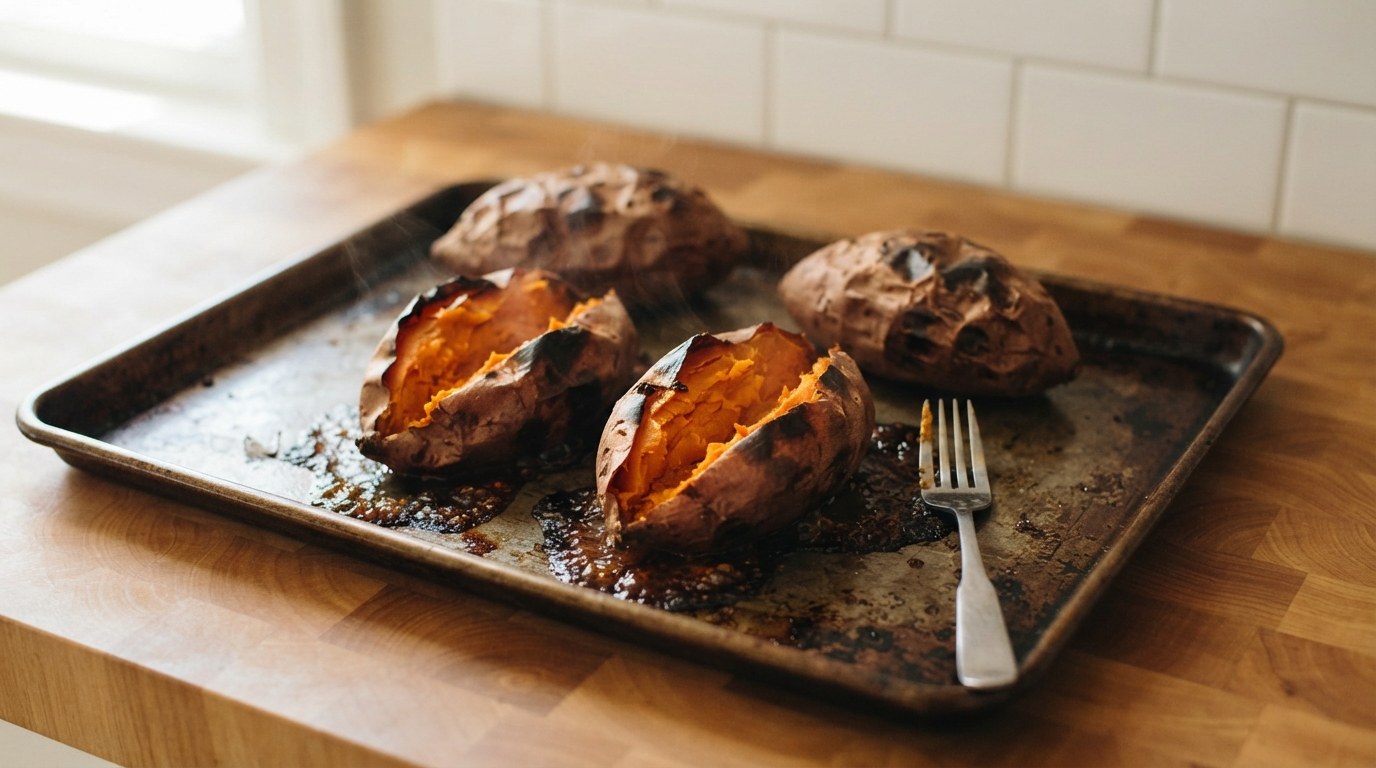
A sweet potato roasted whole tastes sweeter than one boiled, and the reason is an enzyme, not the oven's browning. Raw sweet potato is largely starch; as it heats, the starch granules gelatinize and the root's own amylase enzymes, switched on by the heat, cut that starch into sugars, mainly maltose, before the temperature climbs high enough to destroy them. A review in Food Chemistry: X puts it plainly: during cooking, starch gelatinizes and thermally activated amylases hydrolyze it into dextrins and maltose, and the maltose generated during baking tracks the starch content of the raw root; varieties with more sugar and more beta-amylase activity come out sweet, soft and moist, those with more starch and less enzyme come out dry and firm. A whole potato in a 400°F oven warms slowly from the outside in, so the flesh spends a long stretch in the range where the enzyme works, and the sugars it makes stay in the root because no water carries them away.
Boiling does the opposite twice over. Cut sweet potato in water rushes through the enzyme's working range, leaks sugar and flavor into the pot, and soaks up water that has to be beaten back out with more butter than the purée should need. Roasting also adds what boiling cannot: where the juices run out through the skin and hit the hot pan they caramelize, sugar breaking down from about 320°F, and the exposed flesh at any split browns in the Maillard reaction from about 284°F, which is why a whole roasted sweet potato tastes toasty as well as sweet. Pierce each potato a few times, roast at 400°F on a lined sheet pan for 45 to 60 minutes until a knife meets no resistance and the skins have wrinkled and slumped, and let them sit 10 minutes before handling. The lined pan matters because the sugars that drip out set like candy.
Warm Cream, Butter and the Sieve
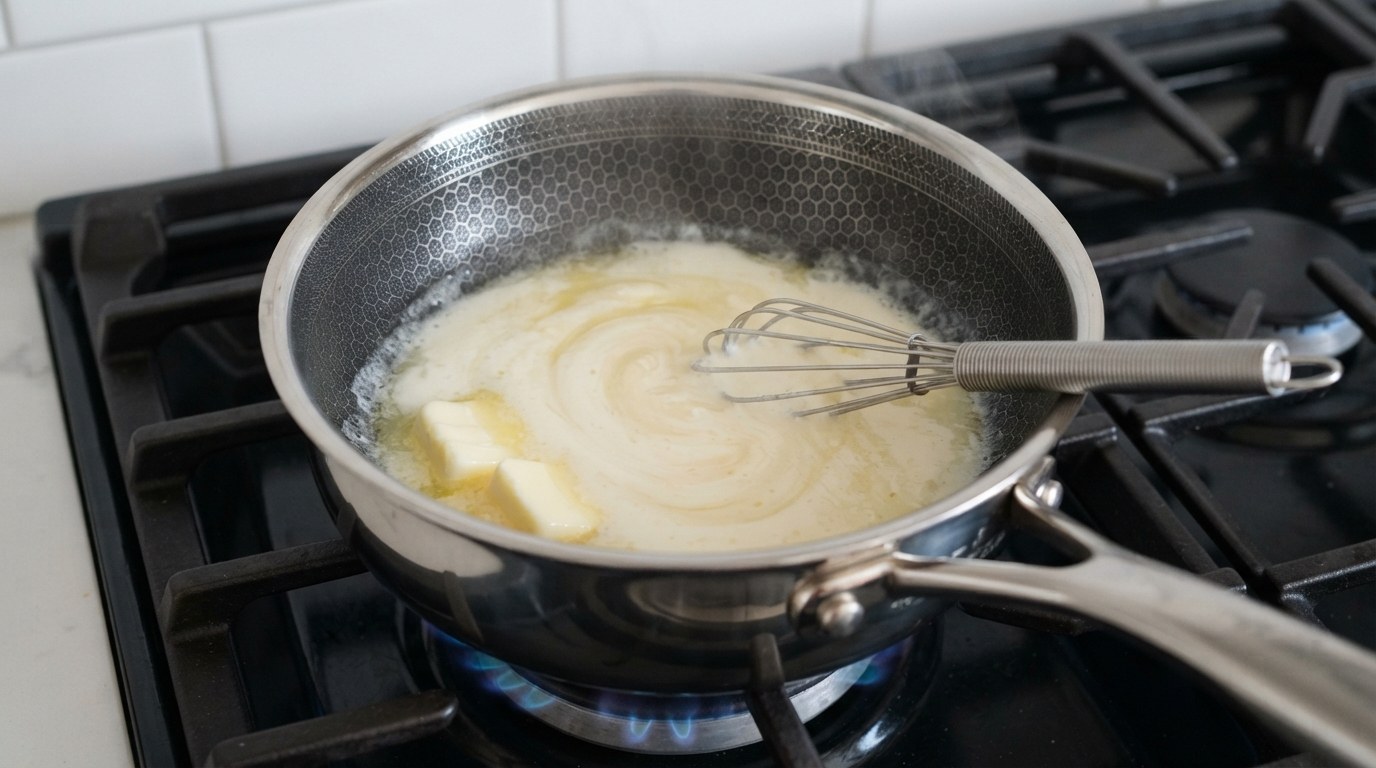
The cream and four tablespoons of the butter are warmed together until the butter has melted and the cream steams, and they go into the potatoes hot, which is the rule Ramsay applies to his pomme purée and the one that separates a silky purée from a stiff, pasty one. Hot roasted flesh is a mass of swollen, gelatinized starch that takes up warm fat and liquid evenly; cold cream chills the starch on contact, the purée seizes and tightens, and the fat streaks rather than blends. Heavy cream is the right dairy because it is about 36 percent fat, per the USDA FoodData Central entry, and dairy above roughly 25 percent fat holds its emulsion under heat, so the finished purée stays glossy when reheated where a milk-thinned one turns grainy and weeps.
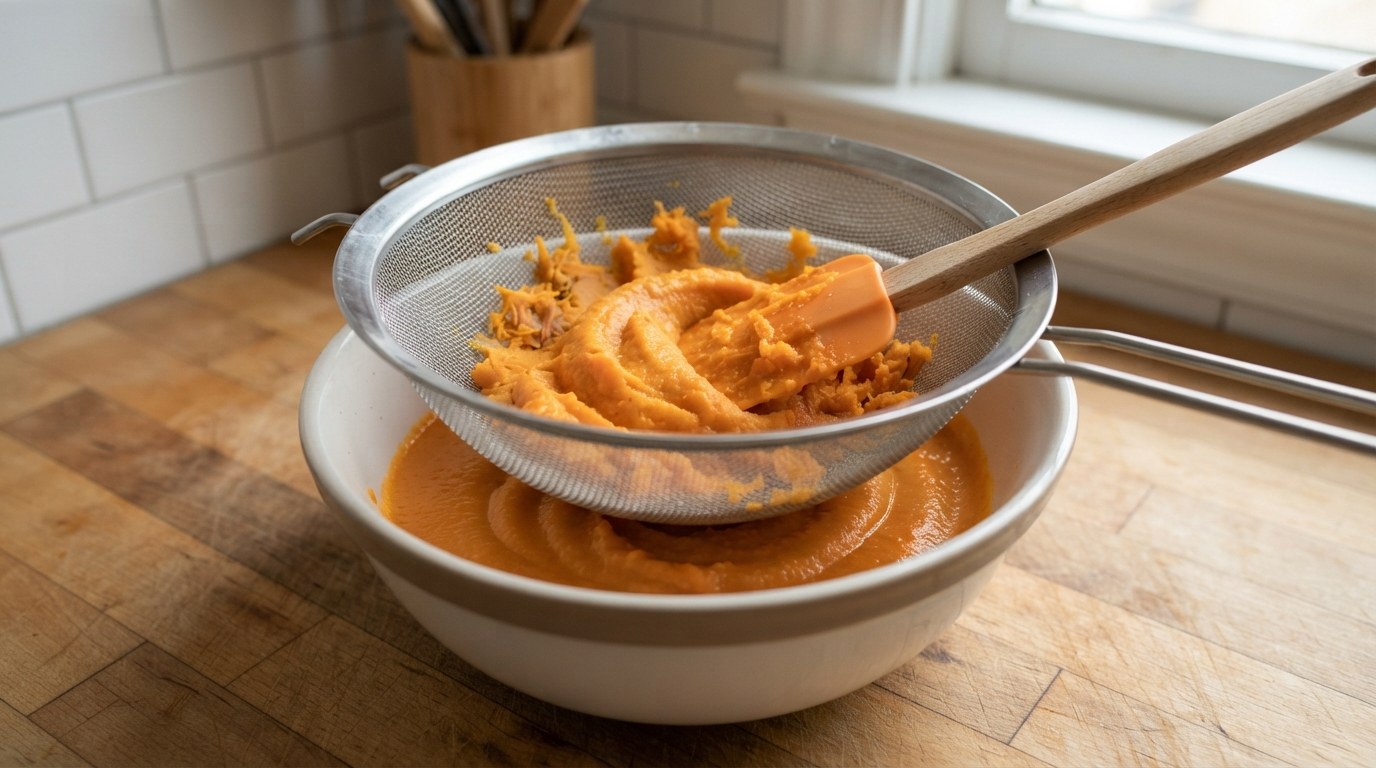
Scoop the flesh out of the skins into a food processor, add the hot cream and butter, the salt and white pepper, and run it until smooth, a minute or two. A processor is safe here where it would ruin a white-potato mash: overworked white potatoes turn gluey because their starch cells rupture and release long amylose molecules into a paste, while roasted sweet potato has already had much of its starch broken down to sugar in the oven and is far more forgiving. Then the sieve. Sweet potatoes carry long vascular fibers that no blade breaks, and pressing the purée through a fine-mesh sieve with a spatula, in batches, catches every one; it is the step Ramsay never skips on a purée and the difference between smooth and restaurant-smooth. Taste last and salt again if needed: white pepper for warmth without black flecks, and a few gratings of nutmeg if you want the classic purée note, but nothing sweet.
| Stage | Number | What you see |
|---|---|---|
| Roast whole | 400°F, 45 to 60 minutes, pierced, on a lined pan | Skins wrinkled and slumped; juices caramelized on the pan |
| Rest | 10 minutes | Cool enough to handle, still hot inside |
| Warm the dairy | Cream and 4 tbsp butter until steaming, not boiling | Butter fully melted |
| Blend | 1 to 2 minutes in the processor | Uniform, glossy, no chunks |
| Sieve | Fine mesh, spatula, in batches | Fibers left on the mesh; purée like satin |
| Brown the butter | 2 tbsp, medium heat, 3 to 4 minutes | Foam subsides; brown flecks; nutty smell |
Cuisinart
Cuisinart Mesh Strainers, Stainless Steel, 3-Count
- Set of three fine-mesh sieves (3⅛″, 5½″, 7⅞″) for small or large batches
- Fine stainless mesh presses purees silky and catches every fiber
- Stainless steel build, dishwasher safe for quick cleanup
The Brown Butter Finish, Serving and Make-Ahead
Brown butter is the finish because it does for a sweet purée what the marshmallows were pretending to do, add depth, without adding sugar. Melt the last two tablespoons of butter in a small pan over medium heat and keep it moving as it foams; when the foam subsides the milk solids at the bottom brown and the butter smells nutty, which is the Maillard reaction again, on the proteins and sugars in the milk solids as the water boils off and the temperature climbs past the browning threshold. Pull it the moment it is hazelnut-colored, since it goes from brown to burnt in seconds, and spoon it over the purée on the plate with a few flakes of sea salt.
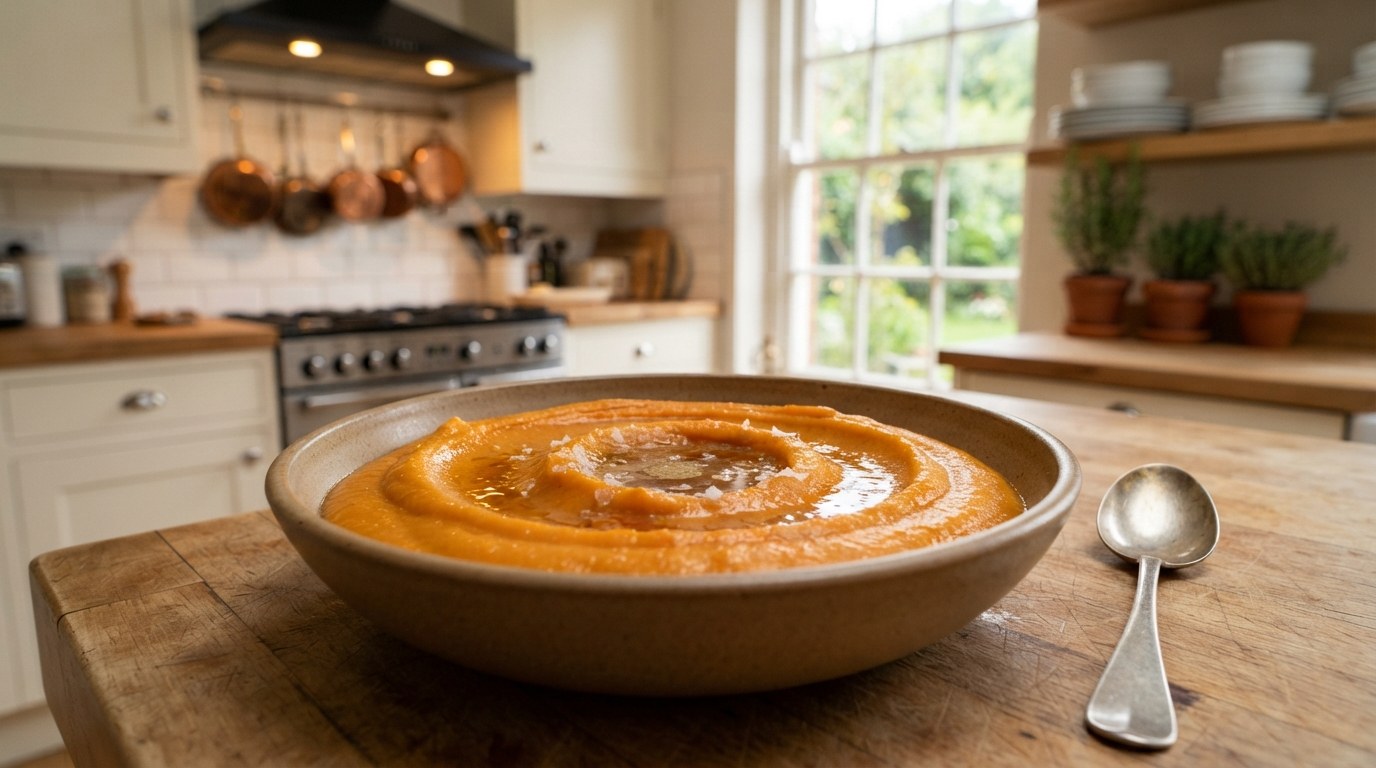
Serve it in a warm bowl with a swirl on top, or piped in a tight round under seared scallops or a filet mignon, where it does the job of a starch and a sauce at once. It suits roast turkey, pork, duck and salmon as well as beef, which is why it shows up on steakhouse menus year round and not only in November. The purée keeps three days in the refrigerator and can be made two days ahead of Thanksgiving; reheat it gently in a saucepan over low heat with a splash of warm cream, stirring, and brown the butter fresh. It freezes better than a mashed potato does, since there is little intact starch left to turn grainy, for up to three months; thaw it overnight and warm it the same way, whisking in a spoon of cream if it has separated.
Sweet Potato Puree with Brown Butter (Gordon Ramsay's Method)
Ingredients
- 3 lb orange sweet potatoes (about 4 large), scrubbed
- ½ cup heavy cream
- 6 tbsp unsalted butter, divided
- 1 tsp kosher salt, plus more to taste
- ¼ tsp ground white pepper
- a few gratings of fresh nutmeg (optional)
- flaky sea salt, to serve
Instructions
- Heat the oven to 400°F. Pierce each sweet potato several times with a fork and set them on a parchment-lined sheet pan. Roast until a knife slides in with no resistance and the skins have wrinkled and slumped, 45 to 60 minutes depending on size. Let them rest 10 minutes.
- While they rest, warm the cream with 4 tablespoons of the butter in a small saucepan over low heat until the butter has melted and the cream is steaming. Do not boil.
- Split the potatoes and scoop the flesh into a food processor, discarding the skins. Add the hot cream and butter, the salt and the white pepper, and process until completely smooth, 1 to 2 minutes, scraping down the bowl once.
- Set a fine-mesh sieve over a bowl and press the purée through it with a silicone spatula, in batches, discarding the fibers left on the mesh. Taste and add salt, and the nutmeg if using. Keep warm.
- Melt the remaining 2 tablespoons of butter in a small skillet over medium heat, swirling, until the foam subsides and the milk solids turn hazelnut brown and smell nutty, 3 to 4 minutes. Take it off the heat at once.
- Spoon the purée into a warm bowl, swirl the top with the back of a spoon, pour the brown butter into the swirl and finish with flaky salt. Serve hot.
Notes
Sweet Potato Puree FAQs
The questions that come up most: the difference between sweet potato puree and mashed sweet potatoes, whether the potatoes can be boiled instead of roasted, whether a food processor makes it gluey, why a purée comes out stringy or watery, whether canned purée works, what to serve it with, and whether it can be made ahead or frozen.
What is the difference between sweet potato puree and mashed sweet potatoes?
Texture and method. A mash is broken up with a masher or ricer and stays slightly coarse; a purée is blended with warm cream and butter and pressed through a fine sieve until it is completely smooth, the way a restaurant makes it. This recipe is a purée: roasted whole, processed, sieved and finished with brown butter, with no sugar or spice added.
Can I boil the sweet potatoes instead of roasting them?
You can, but the purée will be paler, wetter and less sweet. Roasting a whole sweet potato slowly lets its own amylase enzymes turn starch into maltose before they are destroyed, and the sugars stay in the root; boiling cut pieces rushes that window, leaches sugar into the water and soaks the flesh. If you must boil, steam instead, and drive off the moisture in the pan before adding the cream.
Will a food processor make sweet potato puree gluey?
No, unlike white potatoes. White potato starch cells rupture under a blade and release amylose that turns the mash into paste; roasted sweet potato has already had much of its starch converted to sugar and blends smooth without turning gluey. Process it a minute or two with the warm cream and butter, then sieve it.
Why is my sweet potato puree stringy or watery?
Stringy means the fibers were not sieved out; sweet potatoes carry long vascular strands that no blender breaks, so press the purée through a fine-mesh sieve. Watery means the potatoes were boiled, or under-roasted so their juices never concentrated; roast whole at 400°F until the skins slump, and warm the cream rather than adding it cold.
Can I use canned sweet potato puree?
For baking, yes; for this side, it is a compromise. Canned purée is made from boiled or steamed roots and is wetter and flatter than roasted flesh, and some brands add sugar or syrup. If you use it, cook it down in a pan to drive off water before adding the warm cream and butter, and skip any added sugar.
What do you serve sweet potato puree with?
Roast turkey and ham at Thanksgiving and Christmas, and year round under seared scallops, salmon, pork chops, duck breast or a filet mignon, where it acts as both starch and sauce. Brown butter, a few sage leaves fried in it, or toasted pecans are the finishes that suit it; avoid anything sweet on top.
Can sweet potato puree be made ahead?
Yes, up to two days ahead. Refrigerate it in a covered container and reheat gently in a saucepan over low heat with a splash of warm cream, stirring until smooth; brown the butter fresh at serving time. Taste for salt again after reheating.
Can you freeze sweet potato puree?
Yes, for up to three months. Because little intact starch is left after roasting and sieving, it freezes better than mashed potatoes, which turn grainy. Thaw overnight in the refrigerator and reheat over low heat, whisking in a spoon of warm cream if it has separated.

About the Author
John Siracusa is the founder of Hell’s Kitchen Recipes. He focuses on technique-first, reproducible home cooking and researches recipes & kitchen equipment from published food science and professional chef methods since 2016.