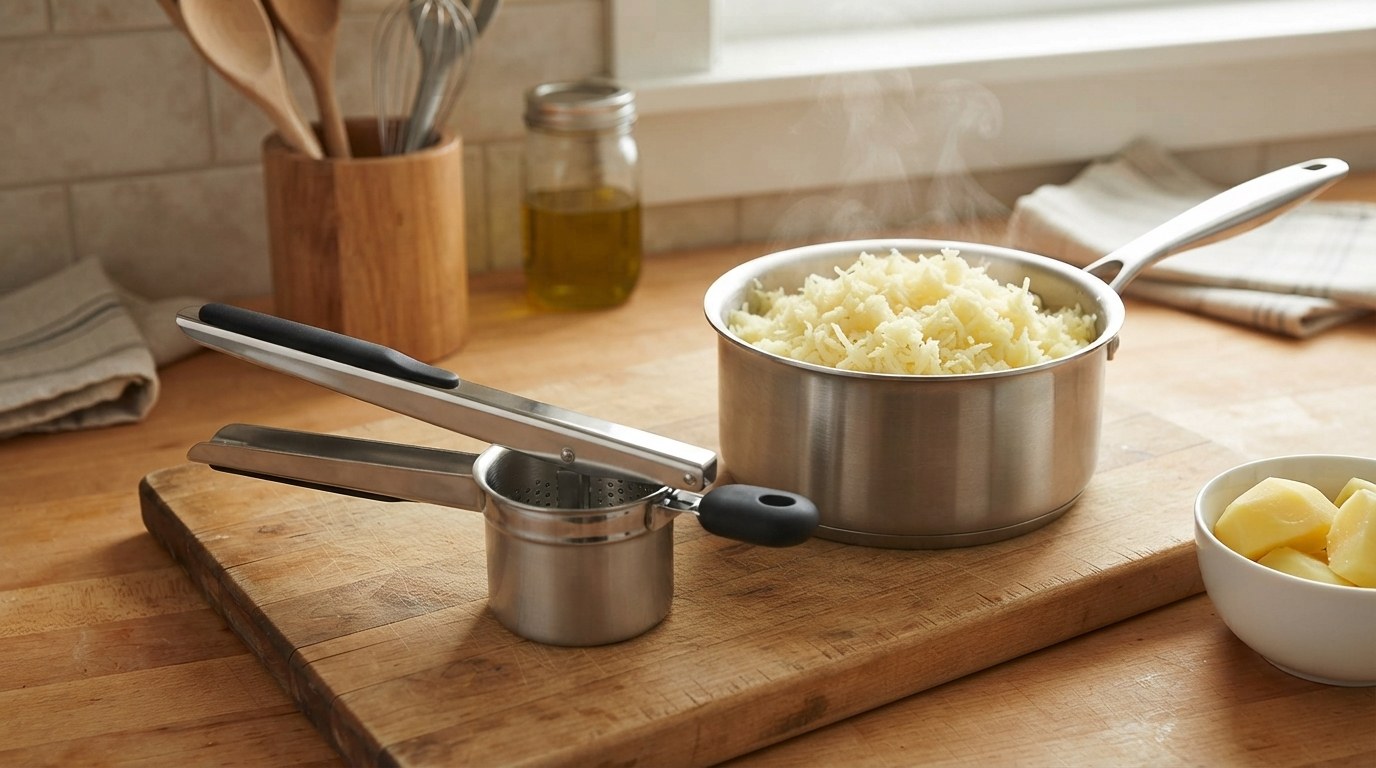
The OXO Good Grips potato ricer is a stainless-steel press: you drop cooked potato into its basket, squeeze the two long handles, and the potato comes out the bottom as fine, fluffy strands in a single pass. That one gentle press is why riced potatoes turn silky with butter and cream instead of gluey, and it is the tool behind every smooth mash and pomme purée on this site. OXO sells two versions, the standard Good Grips Potato Ricer and a 3-in-1 Adjustable Potato Ricer with fine, medium and coarse settings; this guide compares them, sets them beside a food mill and a hand masher, and covers how to use and clean one.
OXO is also one of the brands credited under "Promotional Consideration" at the end of Hell's Kitchen episodes, a paid sponsor listing alongside names like HexClad and Vitamix; the Hell's Kitchen sponsors guide covers the full list. That credit says nothing about which tools the show's kitchen uses, so the case for the ricer here rests on what it does to a potato. More gear lives in the kitchen gear section.
OXO Potato Ricer vs 3-in-1 Adjustable Ricer vs Food Mill vs Masher
For silky mashed potatoes, either OXO ricer is the right tool; the standard model is the simpler buy, the 3-in-1 adds coarser settings for gnocchi and spaetzle, a food mill suits big batches, and a masher suits rustic, chunky mash. The table sets out what each one does to a cooked potato, using the specifications OXO publishes.
| Tool | How it breaks up potato | Settings | Build | Cleanup | Best for |
|---|---|---|---|---|---|
| OXO Good Grips Potato Ricer | One squeeze pushes it through a perforated basket | One fixed basket | Stainless steel, 11.5 x 5 x 4 in, soft handles, non-slip pot-rest knob | Dishwasher safe | Silky mash and pomme purée |
| OXO Good Grips 3-in-1 Adjustable Ricer | Same single press | Rotating disk: fine, medium, coarse | Brushed stainless, soft grips, grooved pot rest | Disk lifts out; top-rack dishwasher safe | Gnocchi, spaetzle, one tool for several textures |
| OXO Good Grips Food Mill | A crank turns a blade that pushes food through a disc | Three discs: fine, medium, coarse | 2.3-quart stainless bowl, folding legs that sit over pots up to 11 in | Several parts to wash | Big holiday batches, tomato sauce, applesauce |
| Hand masher | Crushes the potato in the pot, stroke after stroke | None | Wire loop or perforated plate | One piece | Rustic, chunky or skin-on mash |
The ricers and the mill all press each piece of potato once through holes, which is the gentle part; the masher works by repetition, and every extra stroke on hot potato breaks more cells. That difference decides the texture, and the next section explains why.
Why a Potato Ricer Makes Smoother Mash Than a Masher
A potato ricer makes smoother mash because it separates the cooked potato's cells without bursting them, and burst cells are what make mash gluey. Each potato cell is packed with starch granules. As the potato cooks, those granules soak up water and swell into a soft gel, a change called gelatinization that potato starch goes through at roughly 136 to 155°F (58 to 68°C), according to calorimetry measurements published in the journal Molecules. At the same time heat softens the pectin that glues neighbouring cells together, which is why a properly cooked chunk falls apart at a touch.
Advertisement
Pressing that potato through small holes once pulls the cells apart along the softened pectin, so each strand is a loose cluster of whole, swollen cells. Beat it instead, with an electric mixer, a food processor or a masher worked too long, and the cell walls tear open. The released gelatinized starch, mostly the long amylose chains, grabs the free water and binds it into a sticky, elastic paste. The Idaho Potato Commission describes over-mashing as breaking the cells down one step too many, and its holiday mashed-potato tips put the rule plainly: crush and smash, never whip or blend, because over-mixing breaks the starch cells and the mash goes gummy. Once that paste forms, no amount of butter or cream reverses it.
The potato matters as much as the tool. University of Minnesota Extension recommends mealy, dry-fleshed potatoes such as russets for mashing because they do not turn gluey, notes that waxy potatoes can go sticky, and places Yukon Gold in between with a balance of waxy and mealy starches. Potatoes USA calls russets the pick for light, fluffy mash and credits yellow potatoes with a naturally smooth, buttery texture. Russet through a ricer gives the lightest mash; Yukon Gold through a ricer gives the dense, glossy purée Gordon Ramsay favours, which is the version in our Yukon Gold mashed potatoes.
The OXO Good Grips Potato Ricer: What You Get
OXO
OXO Good Grips Stainless Steel Potato Ricer
- Stainless steel body and basket, pressed by two long lever handles
- Soft, non-slip handles and a non-slip knob that hooks the ricer over a pot or bowl
- Rices potatoes, carrots, cauliflower and yams; dishwasher safe
The standard OXO Good Grips potato ricer is a stainless-steel lever press with a cylindrical basket, and OXO's product page lists the parts that matter: a strong stainless-steel body, soft non-slip handles, a non-slip knob that holds it in place on a pot or bowl, a dishwasher-safe build, and an overall size of 11.5 x 5 x 4 inches (model 26981). The knob sits opposite the handles, so the ricer hooks over the far rim of the pot and the pot takes the downward push instead of your wrist. OXO also suggests it for carrots, cauliflower, yams and home-made baby food.
What OXO does not publish is a capacity figure, and a hand-held basket takes a modest load per press, so a family batch means several refills. That is the main trade against a food mill. The single fixed basket is the other: it gives one texture, the fine strands you want for mash, and that is all most cooks need from it.
OXO 3-in-1 Adjustable Potato Ricer: Fine, Medium or Coarse
OXO
OXO Good Grips 3-in-1 Adjustable Potato Ricer
- Rotating stainless disk with three settings: fine, medium and coarse
- Fine for mashed potatoes and gnocchi, medium for spaetzle, coarse for chunky applesauce
- Grooved pot rest; the disk lifts out for cleaning and is top-rack dishwasher safe
The OXO Good Grips 3-in-1 Adjustable Potato Ricer is the same lever press with a rotating stainless-steel disk under the basket, and turning the disk switches between three hole sizes. OXO's 3-in-1 product page pairs each setting with a job: fine for fluffy mashed potatoes and gnocchi, medium for spaetzle, coarse for chunky applesauce. The disks are built in, so there are no loose plates to lose, and the use and care booklet explains how to line up the notch on the disk with the icons on the ricer to pick a setting and with the arrow icon to lift the disk out for washing. It also notes that hard-boiled eggs can go into the barrel whole, which makes quick work of egg salad.
Choose the 3-in-1 if you make gnocchi or spaetzle as often as mash, since one tool covers all three. If smooth mashed potatoes and purée are the whole plan, the standard OXO potato ricer gives the same fine result with one fewer part to wash.
Potato Ricer vs Food Mill: Which One for Mashed Potatoes?
For a weeknight pot of mash a potato ricer is faster to set up and wash, and for a holiday-size batch a food mill is faster to run. Both press potato through holes without shearing it, so the texture is close. The OXO Good Grips Food Mill holds about 2.3 quarts, sits on folding legs over a pot or bowl, and comes with fine, medium and coarse discs; OXO's instruction sheet suggests the medium or coarse disc for mashed potatoes and the medium disc for ricing potatoes for gnocchi, and says to reverse the crank often to keep food from sticking. The same sheet notes that tomato skins and seeds stay behind in the mill, which is what makes it the better tool for sauces and applesauce.
For pomme purée the ricer usually wins, because the finest silk comes from ricing and then pushing the purée through a fine sieve, the method in our Gordon Ramsay pomme purée guide. A mill on its fine disc gets close and handles more potato per turn. If you own one already, there is no need to buy a ricer for everyday mash.
How to Use a Potato Ricer for Silky Mashed Potatoes
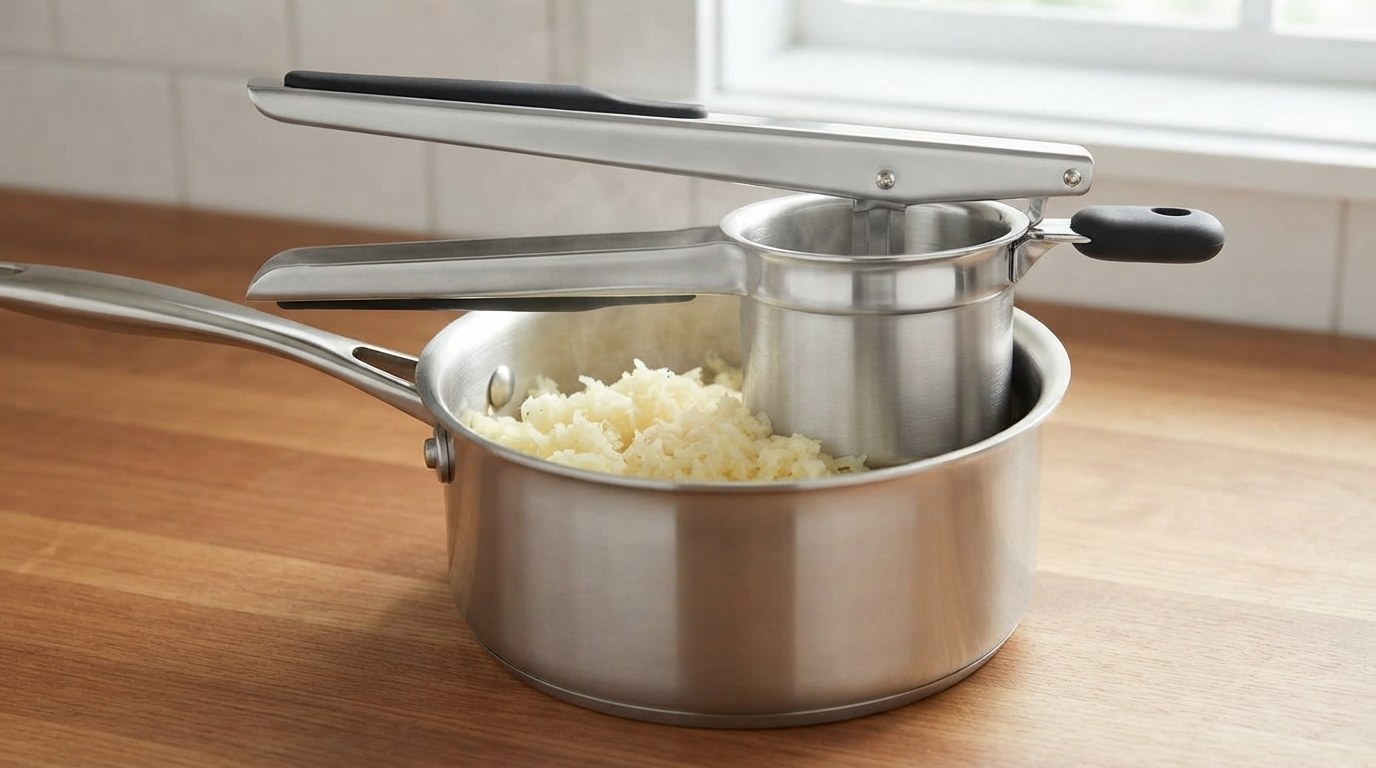
To use a potato ricer, rice the potatoes hot, straight back into the dry pot they cooked in, then fold in the fat before the liquid. Cook peeled, evenly cut chunks until a fork crushes them with no resistance; the Idaho Potato Commission sets the bar at an internal temperature of at least 185°F (85°C), and up to 210°F (99°C) for a drier, fluffier result, because an undercooked centre will not press smoothly. Drain them, return them to the hot pot for a minute so the surface water steams off, then hook the ricer over the pot by its knob and press a few chunks at a time.
Advertisement
Speed matters here for a physical reason. As cooked potato cools, its gelatinized starch starts to firm back up, a process called retrogradation, and the cells stick to one another more tightly, so a cold potato needs more force and tears more cells on its way through the holes. Rice everything within a few minutes of draining. Then add melted butter first and stir gently so the fat coats the separated cells, and only then add warm milk or cream; the Idaho Potato Commission's holiday tips warn against adding cold liquid to hot potatoes. A fat-rich mash also reheats better, because the butter slows that same starch firming. The cottage pie topping uses this exact sequence before the mash goes on the filling.
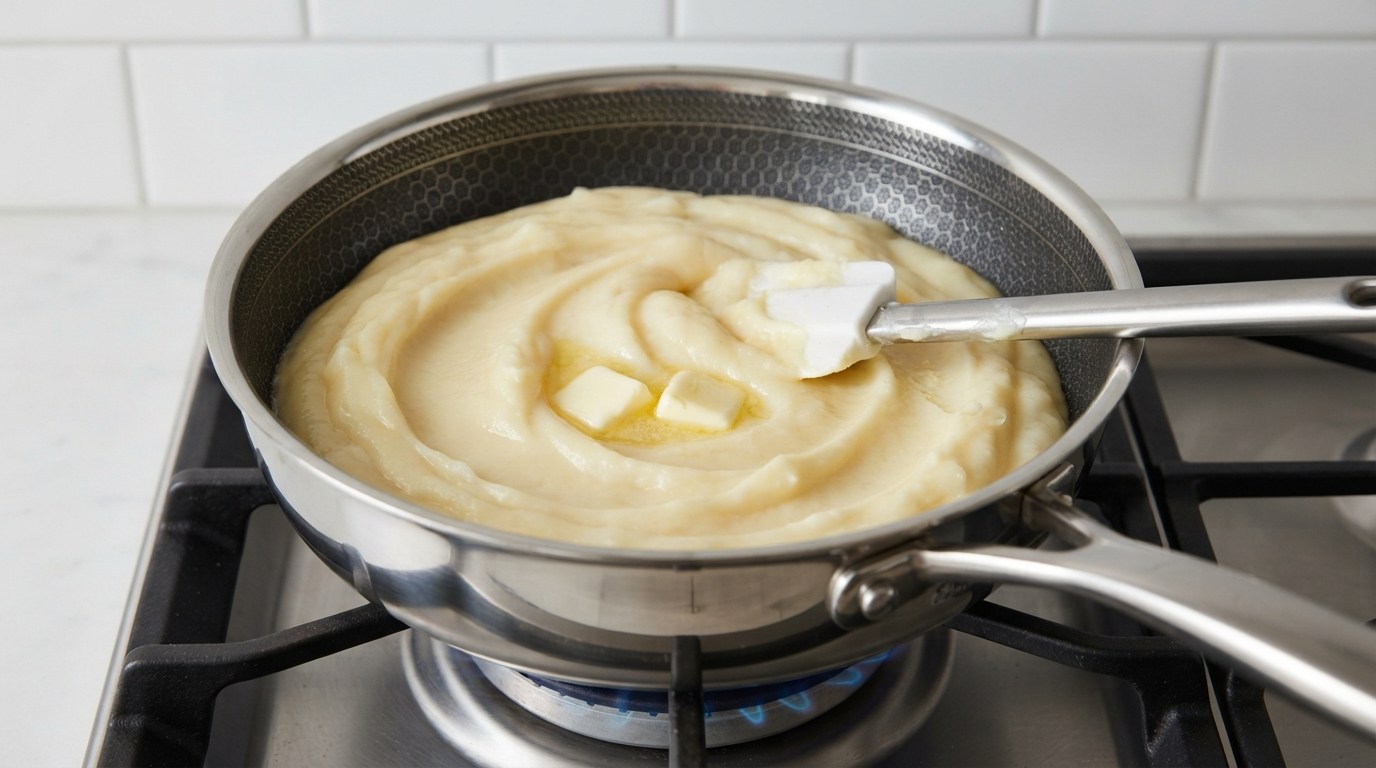
Hold finished mash safely if dinner runs late. The USDA danger zone guidance is to keep hot food at 140°F (60°C) or above, or to refrigerate it within 2 hours, since bacteria multiply fastest between 40 and 140°F. Leftover mash keeps 3 to 4 days in the fridge, and the USDA's leftovers guide says to reheat it to 165°F (74°C); a splash of warm cream and low heat bring the texture back.
How to Clean a Potato Ricer Before the Starch Sets
Clean a potato ricer right after the last press, before the starch dries in the holes. Wet potato starch rinses off in seconds, but once the water evaporates the gelatinized starch dries into a hard film that glues itself to the steel, just as a starchy sauce dries onto a plate. Run the basket and plunger under warm water and push a small brush through the holes. If it has already dried, a few minutes soaking in warm soapy water softens it again. Both OXO ricers are rated dishwasher safe (the 3-in-1's disk goes on the top rack once removed), so after a rinse they can go straight in. A food mill takes longer, since the disc, bar and bowl come apart and each part needs a wash.
Which OXO Potato Ricer Should You Buy?
Most home cooks should buy the standard OXO Good Grips potato ricer; buy the 3-in-1 if gnocchi and spaetzle are on the menu, a food mill if you cook for a crowd, and a masher only if you like lumps.
Advertisement
| If you want… | Buy | Why |
|---|---|---|
| Silky mash and pomme purée, nothing else | OXO Good Grips Potato Ricer | One fine basket, fewest parts, dishwasher safe |
| Mash plus gnocchi or spaetzle | OXO 3-in-1 Adjustable Ricer | Fine, medium and coarse settings built into one disk |
| Mash for ten, or tomato sauce and applesauce | A food mill | 2.3-quart bowl, holds back skins and seeds |
| Rustic, skin-on, chunky mash | A hand masher | Leaves texture on purpose |
Whichever you pick, the rule behind it is the same: press the potato once, while it is hot, and never beat it. That is the whole reason an OXO Good Grips potato ricer turns out smoother mash than a masher, and why it pays for its drawer space the first time you make pomme purée, a Beef Wellington side, or a cottage pie topping.
Advertisement
OXO Good Grips Potato Ricer FAQs
The questions that come up most: whether the OXO potato ricer is dishwasher safe, how it differs from the 3-in-1, whether a ricer beats a masher, ricer vs food mill, how to use one, gnocchi, what to use instead, and whether OXO sponsors Hell's Kitchen.
Is the OXO Good Grips potato ricer dishwasher safe?
Yes. OXO lists the standard Good Grips Potato Ricer as dishwasher safe, and the 3-in-1 Adjustable Potato Ricer's disk lifts out and goes on the top rack. Rinse the basket right after use anyway, because dried potato starch sets hard in the holes.
What is the difference between the OXO potato ricer and the 3-in-1 adjustable ricer?
The standard ricer has one fixed basket that gives fine strands for mash. The 3-in-1 has a rotating stainless disk with fine, medium and coarse settings, which OXO pairs with mashed potatoes and gnocchi, spaetzle, and chunky applesauce. For mash alone, the standard model does the same job with one fewer part.
Is a potato ricer better than a masher?
For smooth mash, yes. A ricer presses each piece once through small holes and separates the cells without bursting them; a masher crushes the potato over and over, and every extra stroke ruptures more cells and releases sticky starch. A masher is still the better tool for rustic, chunky or skin-on mash.
Potato ricer vs food mill: which is better for mashed potatoes?
Both give a similar smooth texture because both press rather than shear. A ricer is quicker to set up and clean for a normal pot; a food mill such as OXO's 2.3-quart model handles big batches faster and also makes tomato sauce and applesauce, since it holds back skins and seeds.
How do you use a potato ricer?
Cook peeled chunks until fork-tender (at least 185°F inside), drain, steam them dry in the hot pot for a minute, then hook the ricer over the pot and press a few chunks at a time while they are hot. Stir in melted butter first, then warm milk or cream.
Can you use a potato ricer for gnocchi?
Yes, and it is the usual tool, since gnocchi need dry, fluffy potato with no gluey starch. OXO names the fine setting of the 3-in-1 ricer for gnocchi, the standard ricer gives the same fine strands, and OXO suggests the medium disc of its food mill for gnocchi potatoes.
What can I use instead of a potato ricer?
A food mill is the closest substitute. Without either, push the cooked potato through a fine-mesh sieve with a flexible scraper, or use a hand masher with a light touch. Avoid a food processor, blender or electric mixer, which turn potatoes gluey.
Is OXO a Hell's Kitchen sponsor?
OXO is one of the brands credited under "Promotional Consideration" at the end of Hell's Kitchen episodes, a paid sponsor credit. The show has not said which tools its kitchen uses, so the credit is not a statement that Gordon Ramsay or the contestants cook with OXO.

About the Author
John Siracusa is the founder of Hell’s Kitchen Recipes. He focuses on technique-first, reproducible home cooking and researches recipes & kitchen equipment from published food science and professional chef methods since 2016.