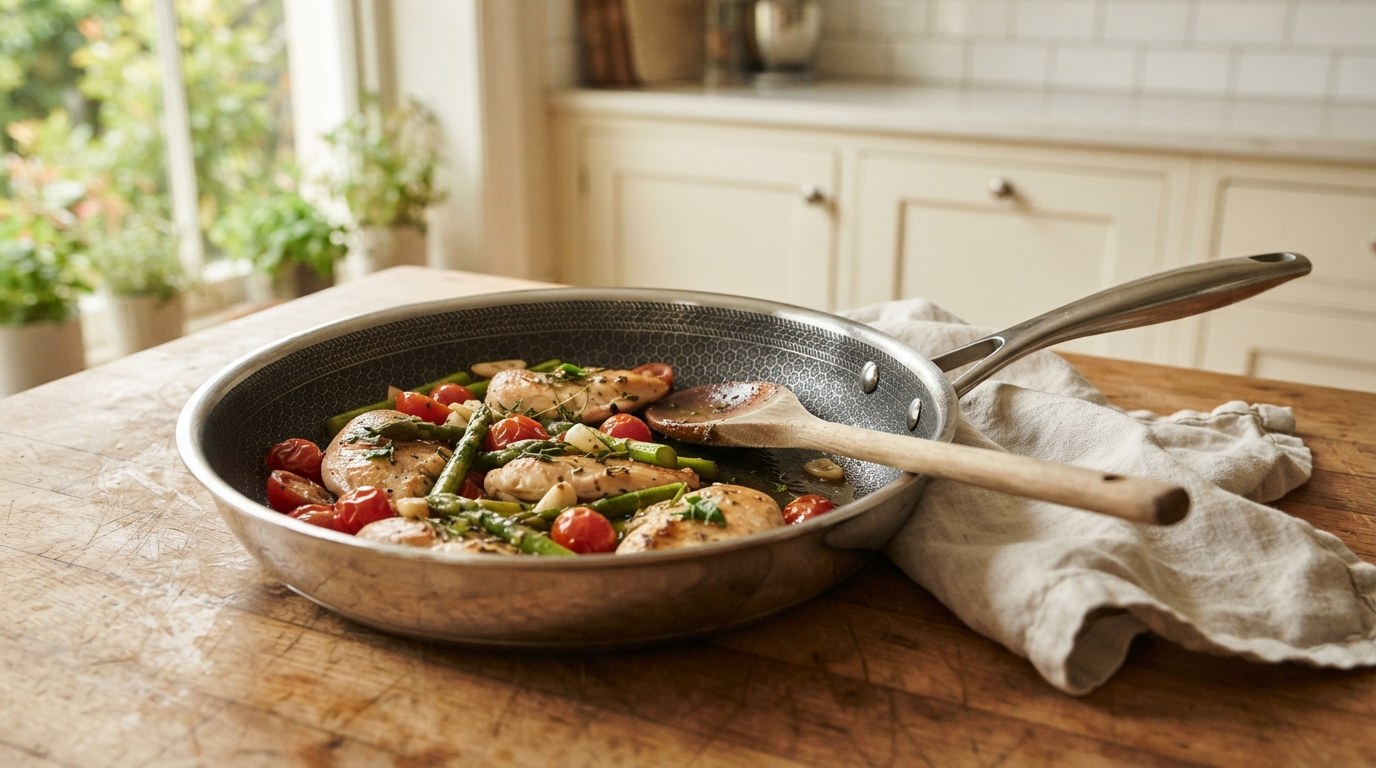
HexClad is not made in the USA. The company is American, headquartered in Los Angeles, and it designs its cookware there and in South Korea, but every HexClad pan, pot and lid is manufactured in China, which HexClad states plainly on its own support site and explains by saying Chinese factories are the only ones able to produce its laser-etched hybrid surface at scale. That puts HexClad in the same position as nearly every nonstick and hybrid pan sold in the United States, and in a different one from the handful of American makers, All-Clad, Lodge, Nordic Ware and Heritage Steel among them, whose pieces qualify for the label under the Federal Trade Commission's "all or virtually all" rule.
This guide gives HexClad's answer in its own words, explains what "Made in USA" legally means and why HexClad does not claim it, breaks down what the pan is built from and why that build is hard to make, covers the 2023 class action that changed the company's marketing, and lists the cookware that is made in America for anyone who wants that on the label. It belongs to the site's kitchen gear guides alongside Gordon Ramsay cookware, which covers the Ramsay partnership and the pans themselves, the HexClad cookware review, and where to buy HexClad.
Where HexClad Is Made, in HexClad's Own Words
"Our products are designed in Los Angeles and South Korea. Like the vast majority of cookware and other products today, our products are manufactured in China. At this time, it's the only location where factories are skilled enough to manufacture our technology."
HexClad, "Where is HexClad made?", HexClad Support
That paragraph is the complete answer, and it comes from the company rather than from a reviewer guessing at a shipping label. Design is split between the Los Angeles headquarters and South Korea; production is in China; and the reason given is capability, not only cost, since the hybrid surface is cut into every pan by laser and then coated, a process HexClad says its Chinese partners are uniquely set up to run. An AllAmerican.org investigation into the brand reached the same conclusion and quotes co-founder Daniel Winer describing HexClad as a "designed and distributed in Los Angeles" company, which is the precise claim: designed and distributed, never made.
The American part of the story is real. HexClad was founded in Los Angeles in 2016, and Gordon Ramsay joined it as lead ambassador and equity partner in July 2021, announced on PR Newswire, which is why the pans turn up in every search for Ramsay's cookware. The design, the marketing, the warranty service and the company are in California. The metal is formed, etched, coated and boxed in China, the same way it is for most of the cookware in an American kitchen store.
What "Made in USA" Legally Means, and Why HexClad Does Not Claim It
A pan can only be labeled "Made in USA" without qualification if it is "all or virtually all" made here, and HexClad does not come close, which is why the phrase appears nowhere on its packaging or site. The Federal Trade Commission, which polices the claim, requires that final assembly or processing happen in the United States and that all significant parts and processing be of U.S. origin, with no more than a negligible amount of foreign content; its 2021 Made in USA Labeling Rule codified that standard for product labels and lets the agency seek civil penalties for false claims. A company may make a qualified claim instead, "Designed in USA" or "Assembled in USA from imported parts," and HexClad's "designed in Los Angeles" is exactly that kind of statement.
The distinction matters for the buyer because the label is a promise about factories, not about quality. The FTC rule says nothing about how good a pan is; it says where the value was added. A HexClad made in China and an All-Clad made in Pennsylvania are both sold under accurate labels, and the choice between them is about construction, cooking behavior, price and whether domestic manufacturing matters to the person buying, which the rest of this page lays out.
HexClad
HexClad 12-Inch Hybrid Nonstick Frying Pan
- Laser-etched stainless hexagon peaks over TerraBond ceramic nonstick valleys; tri-ply with an aluminum core
- Gas, electric and induction; oven-safe to 900°F; metal-utensil safe
- Designed in Los Angeles, manufactured in China; lifetime warranty
What a HexClad Pan Is Made Of, and Why the Etching Is Done Overseas
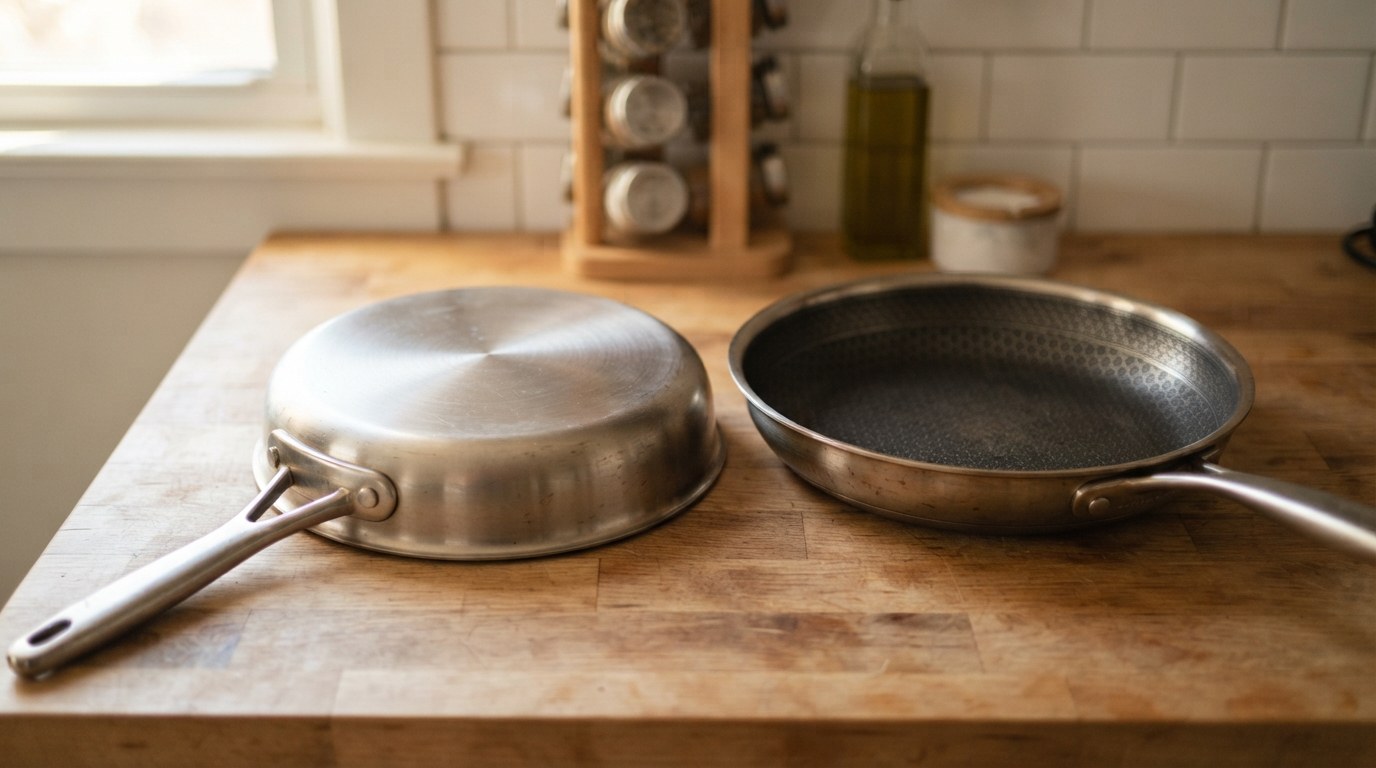
A HexClad pan is a tri-ply disc of stainless steel over an aluminum core over a magnetic stainless base, with a cooking surface of laser-etched stainless hexagons standing over valleys of ceramic nonstick, and each of those layers explains part of the manufacturing question. HexClad's technology page describes the surface as steel hexagon "peaks" that take the heat and the sear and protected "valleys" holding its proprietary ceramic nonstick, TerraBond, which the company says is PTFE-free and free of forever chemicals. The aluminum core is there because aluminum conducts heat at roughly 200 watts per meter-kelvin against about 16 for stainless steel, per the Engineering ToolBox, so a stainless pan with an aluminum layer heats across its whole base instead of only over the burner; the stainless skin is there because aluminum alone is soft, reactive with acidic food and useless on induction, which needs a magnetic base.
Bonding those three metals is ordinary cookware manufacturing; the etching is not. The hexagon grid is cut into the steel by laser to a depth that leaves the peaks standing proud of the coating, then the valleys are coated and cured, and the pan must come out with the steel edges and the ceramic meeting at a consistent height across thousands of units. That is a specialized production line, and it is the capability HexClad points to when it says China is currently the only place equipped to build the pans. It is also why the hybrid design behaves the way it does in use: food browns on the steel peaks, which can exceed the 284°F where Maillard browning begins because they are bare metal, while a fried egg releases from the ceramic valleys, and metal utensils ride on the steel rather than scraping the coating. The trade is that the steel peaks touch the food first, so a hybrid pan is never as slick as a fully coated nonstick and needs a film of fat.
| Layer | Material | What it does | Where it is made |
|---|---|---|---|
| Cooking surface | Laser-etched stainless hexagons over TerraBond ceramic | Steel peaks sear and take metal utensils; ceramic valleys release food | China |
| Core | Aluminum | Spreads heat across the base (about 12× the conductivity of stainless) | China |
| Base | Magnetic stainless steel | Induction compatible; protects the aluminum | China |
| Handle | Riveted stainless steel | Oven-safe to 900°F with the pan | China |
| Design, warranty, distribution | HexClad, Los Angeles (design also in South Korea) | Product development, customer service, lifetime warranty | United States |
The 2023 Lawsuit and What It Changed
HexClad's manufacturing has never been the subject of a lawsuit; its marketing language was. In 2023 a class action, Cliburn v. One Source to Market, LLC, was filed against HexClad's parent company over advertising that described the pans as non-toxic and free of harmful chemicals while the nonstick of that era used PTFE, and ClassAction.org reports the case settled for two and a half million dollars, with the company agreeing to change how it describes the coating. The pans that reached buyers were not recalled and were not found unsafe; the settlement was about the words on the box.
The coating itself has since changed. HexClad now ships its hybrid line with TerraBond, the ceramic nonstick described on its technology page as PTFE-free, so the question "is HexClad made with Teflon?" has a different answer for a pan bought today than for one bought in 2022. What has not changed is the country of manufacture. Both generations of the pan were made in China, and a buyer who wants to know which coating a particular pan carries should check the product page or the box, since older stock and the current line look identical from above.
Cookware That Is Made in the USA
If the label is the deciding factor, the American options are fewer, mostly heavier, and concentrated in three materials: bonded stainless, cast iron and cast aluminum. All-Clad has bonded its stainless cookware in Canonsburg, Pennsylvania since 1971 and stamps the base of every qualifying piece with the town's name; its D3, D5 and Copper Core lines are the closest American equivalent to a tri-ply HexClad, without the nonstick valleys. Lodge has cast iron in South Pittsburg, Tennessee since 1896 and still runs two foundries there. Nordic Ware casts its aluminum bakeware in Minneapolis. Heritage Steel builds five-ply stainless cookware in Clarksville, Tennessee. Each of those companies makes some imported items too, so the rule is to check the individual product page, not the brand.
| Maker | Where it is made | What | Closest HexClad comparison |
|---|---|---|---|
| All-Clad (D3, D5, Copper Core) | Canonsburg, Pennsylvania | Bonded stainless with an aluminum or copper core | Same tri-ply idea, no nonstick; needs more fat and technique |
| Lodge | South Pittsburg, Tennessee | Cast iron and carbon steel | Heavier, slower to heat, sears harder, seasoning instead of a coating |
| Nordic Ware | Minneapolis, Minnesota | Cast aluminum bakeware and some cookware | Bakeware rather than a frying pan |
| Heritage Steel | Clarksville, Tennessee | Five-ply stainless | Same use as All-Clad; no nonstick surface |
| HexClad | China (designed in Los Angeles and South Korea) | Tri-ply hybrid with ceramic nonstick valleys | The pan itself |
The reading of that table is that no American maker builds a hybrid stainless-over-nonstick pan; a buyer who wants HexClad's specific combination of a searing surface and easy release buys a pan made in China, and a buyer who wants "Made in USA" chooses between bare stainless and cast iron and learns to manage sticking with heat and fat. Ramsay's own advice on tools, from his MasterClass on cooking, is to spend on a few good pieces, a heavy pan and a nonstick among them, rather than a matching set, which argues for mixing: an American-made stainless or cast-iron pan for searing, and a nonstick of whatever origin for eggs and fish.
HexClad
HexClad 6-Piece Hybrid Fry Pan Set (8, 10 and 12-Inch With Lids)
- 8-, 10- and 12-inch hybrid pans, each with a tempered glass lid
- Same tri-ply aluminum-core build and TerraBond ceramic as the single pan; induction ready
- Pans oven-safe to 900°F, glass lids to 400°F; lifetime warranty
Does the Country of Origin Change What You Get?
For the warranty and the service, no: HexClad's lifetime warranty is administered from the United States, covers manufacturing defects for the life of the pan when it is bought from an authorized seller, and excludes damage from misuse, which is the same structure All-Clad and Lodge offer on their American-made pieces. For the cooking, the answer is that the design decides more than the factory: the hexagon surface behaves the same whichever continent etched it, and its strengths and limits, a real sear on the steel, a coating that needs oil, no dishwasher or high-heat abuse if the ceramic is to last, are properties of the design. Where origin shows up is price and supply. Chinese manufacturing is what lets a tri-ply, laser-etched, induction-ready 12-inch pan sell where it does, and it is why HexClad's stock, tariffs and delivery times move with trade policy in a way All-Clad's do not.
The honest summary for a buyer is three lines. HexClad is an American company whose pans are made in China, and it says so. The pan's build is a sound tri-ply with a genuinely different surface, and the lawsuit was about marketing words, not manufacturing. If "Made in USA" is the requirement, the pan to buy is an All-Clad, a Lodge or a Heritage Steel, and the hybrid surface is not available with that label from anyone.
HexClad Made in the USA FAQs
The questions that come up most: where HexClad is made, whether it is made in China, what the pans are made of, whether they use Teflon or PFAS, who owns HexClad and whether it is Gordon Ramsay's company, what the lawsuit was about, which cookware is made in the USA, and how the warranty works.
Where is HexClad made?
HexClad cookware is manufactured in China. The company, which is headquartered in Los Angeles, says on its support site that its products are designed in Los Angeles and South Korea and manufactured in China, the only location it says has factories skilled enough to produce its laser-etched hybrid surface.
Is HexClad made in China?
Yes. Every HexClad pan, pot, wok and lid is made in China, by HexClad's own statement. The design, marketing, warranty service and headquarters are in Los Angeles, which is why the brand is often described as American.
What is HexClad made of?
Tri-ply construction: a stainless-steel cooking surface, an aluminum core for heat spread, and a magnetic stainless base for induction. The cooking surface is laser-etched into stainless hexagon peaks with valleys of TerraBond ceramic nonstick between them, and the handles are riveted stainless steel, oven-safe to 900°F.
Is HexClad made with Teflon or PFAS?
Current HexClad pans use TerraBond, a ceramic nonstick the company describes as PTFE-free and free of forever chemicals. Earlier HexClad pans, sold through roughly 2023, used a PTFE-based nonstick, which was the subject of the 2023 marketing lawsuit. Check the product page or box for the coating on a specific pan.
Who owns HexClad, and is it Gordon Ramsay's company?
HexClad was founded in Los Angeles in 2016 by Daniel Winer and Cole Mecray, and Winer remains its chief executive. Gordon Ramsay joined in July 2021 as lead ambassador and equity partner; he is an investor and the face of the brand, not its founder or majority owner.
What was the HexClad lawsuit about?
Marketing language. A 2023 class action, Cliburn v. One Source to Market, LLC, alleged that HexClad advertised its PTFE-coated pans as non-toxic and chemical-free. It settled for two and a half million dollars and the company changed how it describes its coatings. The suit did not concern where the pans are made or find them unsafe.
Which cookware is actually made in the USA?
All-Clad bonded stainless (D3, D5, Copper Core) in Canonsburg, Pennsylvania; Lodge cast iron in South Pittsburg, Tennessee; Nordic Ware cast aluminum in Minneapolis; and Heritage Steel five-ply stainless in Clarksville, Tennessee. No American maker currently produces a hybrid stainless-over-nonstick pan like HexClad's.
Does HexClad's warranty depend on where it is made?
No. The lifetime warranty is administered from the United States and covers manufacturing defects for the life of the pan when it is bought from HexClad or an authorized retailer such as Amazon or Costco. It excludes damage from misuse, overheating or dishwasher abuse, and it is void on pans bought from unauthorized sellers.
About the Author
John Siracusa is the founder of Hell’s Kitchen Recipes. He focuses on technique-first, reproducible home cooking and researches recipes & kitchen equipment from published food science and professional chef methods since 2016.