Asparagus risotto is the spring risotto, and the version on this page is built the way Gordon Ramsay builds a vegetable risotto: the asparagus goes in twice. The stalks are blanched and blended into a bright green purée that is stirred through the rice at the end, so every grain is tinted and tastes of asparagus, and the tips are blanched separately and laid on top so they stay whole, green and crisp-tender. Under that is a classic risotto, arborio toasted in olive oil and onion, deglazed with white wine, fed hot stock a ladle at a time for about 20 minutes, and finished off the heat with Parmesan, a spoon of mascarpone and a squeeze of lemon. It serves four as a starter or two as a main and takes 45 minutes.
This guide covers choosing and prepping the asparagus, why the tips are blanched and shocked, what makes risotto creamy and why the stock has to be hot, the finish and why the lemon goes in last, and what to serve it with. It sits in the site's recipes section with the other risottos: the Hell's Kitchen risotto, the mushroom risotto and the shrimp and scallop risotto, all of which share the base method here.
The Asparagus: Buying, Trimming, and Using the Whole Spear
Buy firm, straight spears with tight, closed tips, because an open, feathery tip means the spear is past its best; Penn State Extension gives that selection rule and the storage that keeps asparagus at its peak for two to three days: trim a quarter inch off the ends, stand the bunch in two inches of cold water in the refrigerator, and cover the tops with a bag. Medium spears, about the thickness of a pencil and a half, are the best size for risotto; pencil-thin ones cook to nothing in the purée and thick ones need peeling. One pound is enough for four, and nothing is wasted: the tips go on top, the tender middle of the stalks becomes the purée, and only the woody inch or two at the base is discarded, or saved for stock.
Trim by bending a spear near the base until it snaps; it breaks where the tough, fibrous part ends. Cut the top two inches off each spear as the tips, and slice the remaining stalks into half-inch pieces for the blender. If the stalks are thick, peel the bottom half with a vegetable peeler first, because the outer skin of a fat spear stays fibrous even after blanching and will leave strings in the purée.
| Ingredient | What it does | Do not substitute with |
|---|---|---|
| Asparagus, 1 lb, medium spears | Tips for the top, stalks for the purée | Canned asparagus (gray, soft, no snap) |
| Arborio rice, 1⅓ cups | Short grain, high in the starch that makes the risotto creamy | Long-grain rice (stays separate; no cream) |
| Stock, about 5 cups, kept simmering | Cooks the rice a ladle at a time | Cold stock (stalls the cooking every ladle) |
| Dry white wine, ⅓ cup | Acidity that cuts the richness; cooks off fast | Sweet wine or skipping the acid entirely |
| Parmigiano Reggiano, ⅓ cup grated | The savory finish; part of the final emulsion | Pre-grated "Parmesan" with anti-caking starch |
| Mascarpone, 1 tbsp, and cold butter | Fat that binds the finish glossy | Heavy cream poured in (thins it) |
| Lemon juice and zest | Brightness, added off the heat and last | Adding it early (dulls the green) |
Blanch and Shock: Why the Tips Stay Green
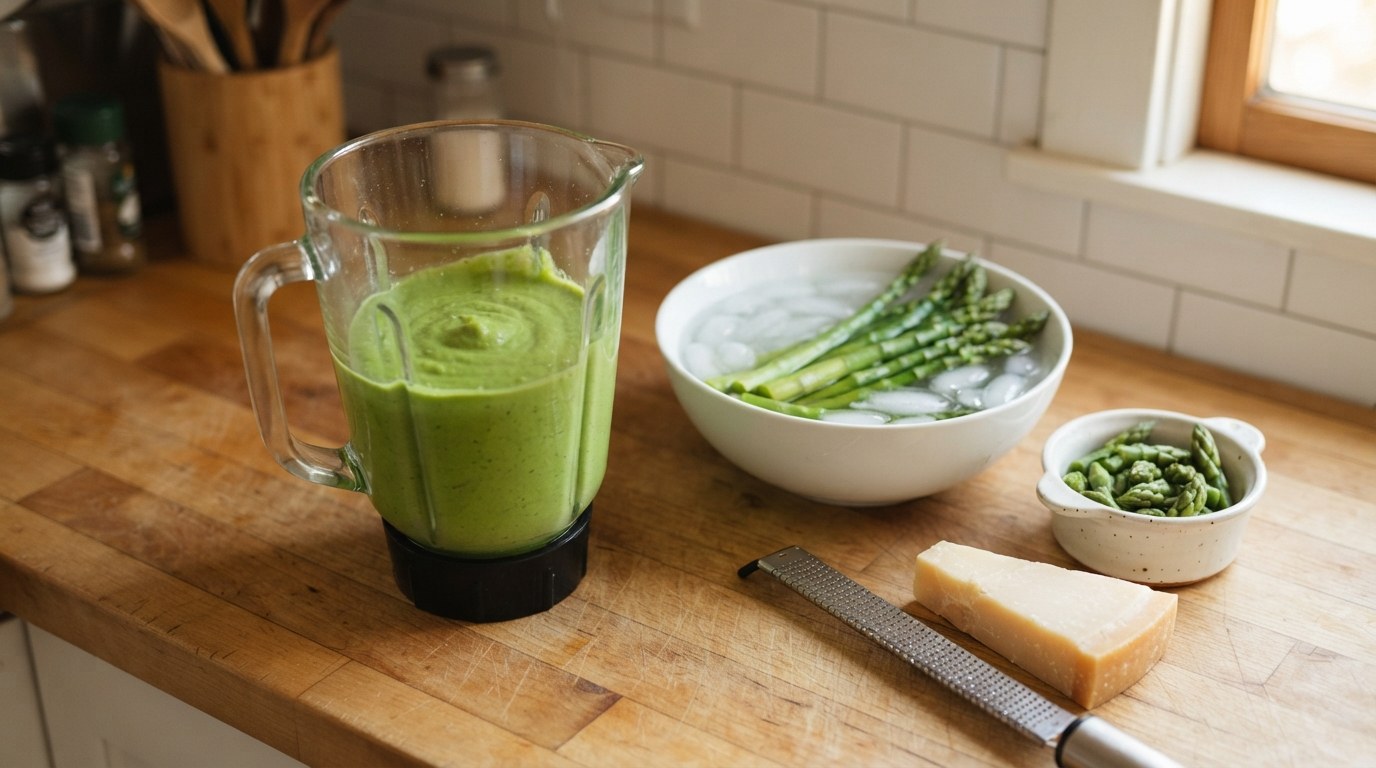
Both the tips and the stalks are cooked briefly in boiling salted water and pulled straight into ice water, and the reason is chemistry rather than habit. Heat above about 194°F knocks out the enzymes that dull and soften cut vegetables, and it drives trapped air out of the tissue so the green chlorophyll reads brighter; the National Center for Home Food Preservation gives 2 minutes for small spears, 3 for medium and 4 for large, which is exactly the range here. The ice bath matters as much as the boil. Asparagus keeps cooking in its own heat once it is out of the pot, and 30 seconds too long turns the tips olive and limp; plunging them into ice water stops the cooking within seconds and locks the color. Salt the water well, about a tablespoon per quart, because salt loosens the pectin that holds the cells together and the spears cook faster and more evenly.
The purée is the stalks blended smooth with a little of the blanching water, seasoned, and set aside. Blend it while the stalks are still cold from the ice bath and add only enough liquid to get the blades moving; a thin purée waters the risotto down at the end. Save half a cup of the blanching water too. It is lightly flavored with asparagus and is the right thing to loosen the finished risotto if it tightens.
What Makes Risotto Creamy, and Why the Stock Is Hot
Risotto is creamy because of the rice, not because of cream. Arborio and carnaroli are short-grain varieties whose starch is high in amylopectin, the branched starch molecule that swells and leaks out of the grain into the surrounding liquid as it cooks; the constant stirring rubs that surface starch off and turns the stock into a sauce. Riso Scotti, one of Italy's big rice mills, describes arborio's large, pearly grains that swell during cooking and release starch to make the risotto especially creamy, and carnaroli as richer in amylose, the straight starch, so it stays firmer and absorbs sauce better. Either works here; arborio gives the creamier result most people want from an asparagus risotto, and carnaroli is more forgiving if you tend to overcook.
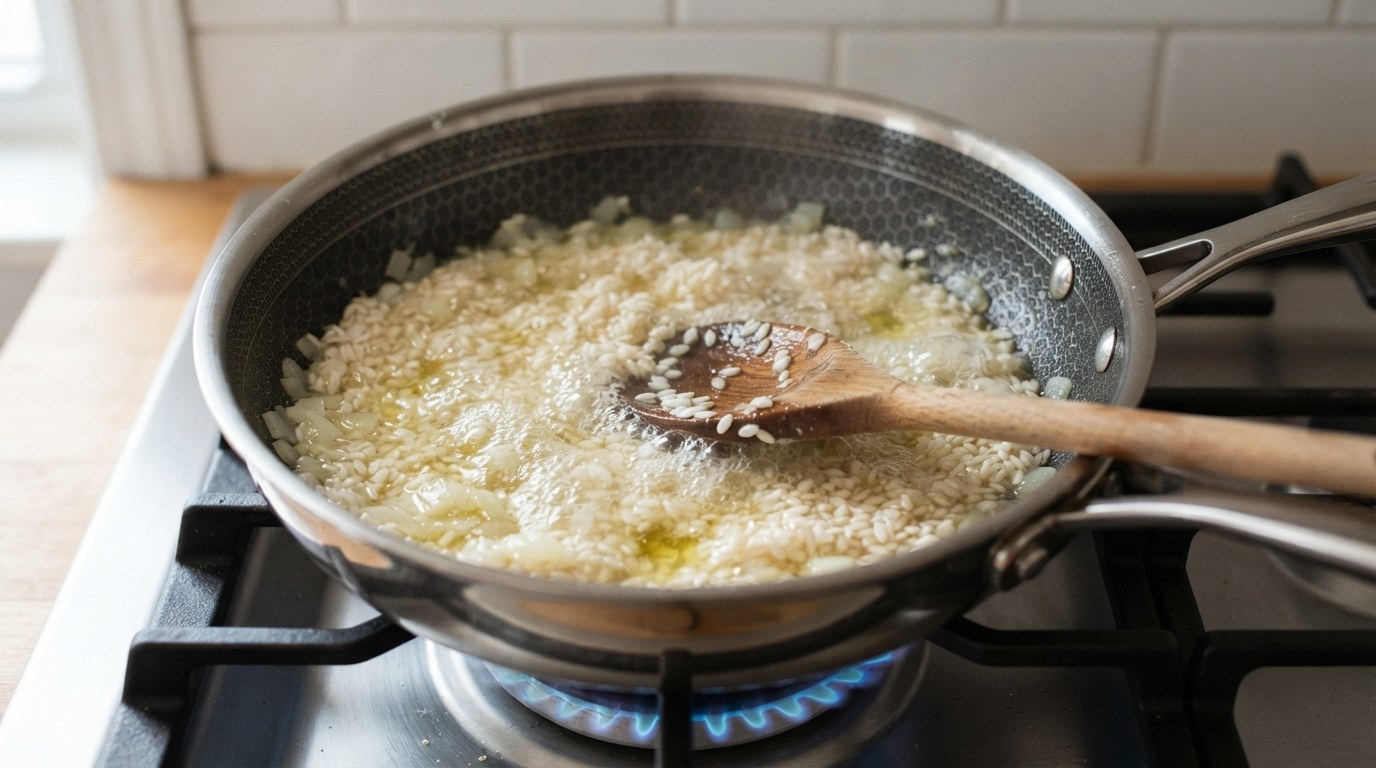
The starch only does its job above about 150°F, where the granules take up water and gelatinize, which is why the stock is kept at a simmer in a second pan and added hot. A ladle of cold stock drops the pan below that threshold and the rice stops cooking until the pan recovers, which makes the process longer and the grains cook unevenly, chalky in the middle and blown out at the edges. Toast the rice in the oil and onion for a minute first, until the edges of the grains turn translucent with a white dot at the center; that light toasting firms the outside of each grain so it holds its shape through 20 minutes of stirring instead of dissolving.
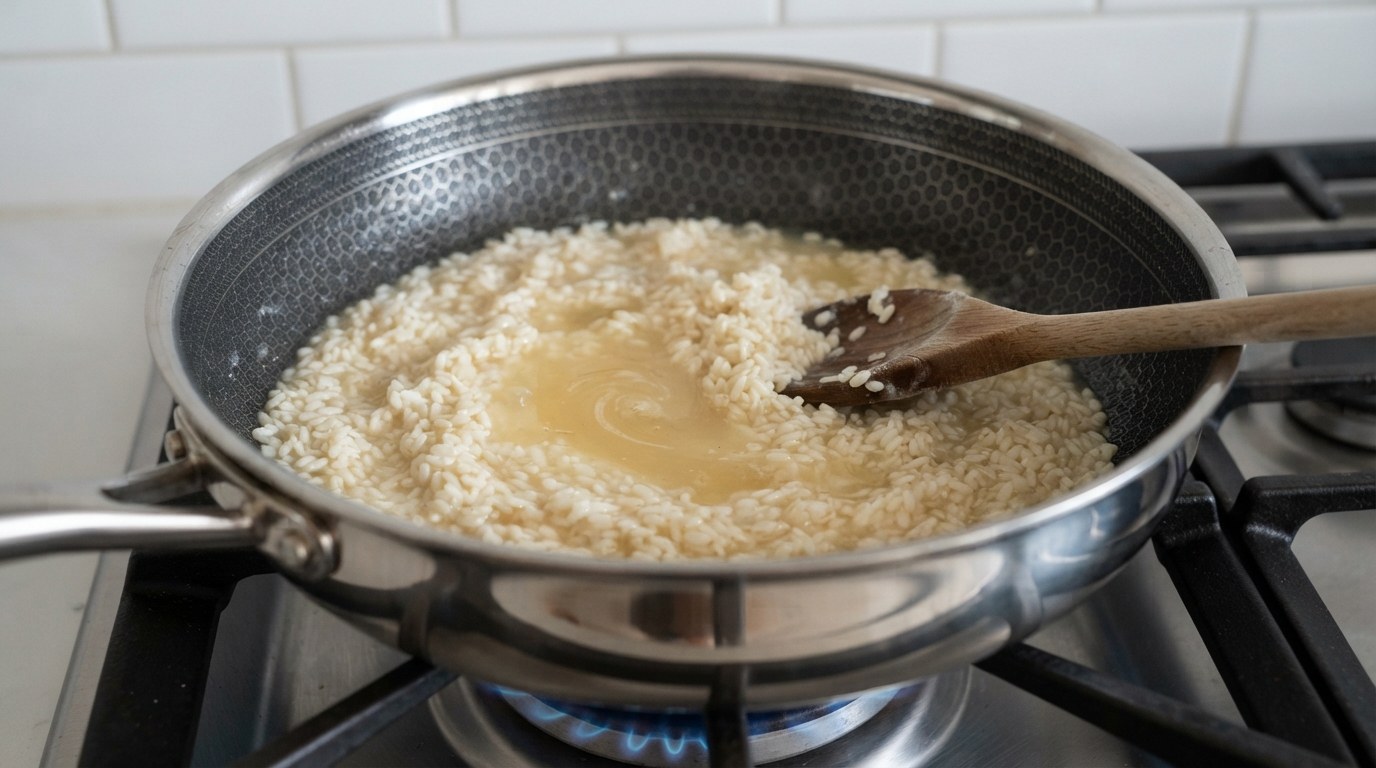
Add the wine first and let it cook off almost completely; its acidity brightens the whole dish and the alcohol is gone within a minute or two. Then the stock, half a cup at a time, stirring often and adding the next ladle only when a spoon dragged across the bottom of the pan leaves a trail that fills in slowly. Ramsay's rule is to keep the rice moving and the pan at a steady simmer, never a boil, and to taste from 15 minutes on. The rice is done when it is tender with a faint firm bite at the center, al dente, usually 18 to 22 minutes from the first ladle. It should be loose enough that it spreads when spooned onto a plate, all'onda, "like a wave," which is the texture the mill above and every Italian cook means by risotto. If it mounds, it needs another splash of stock.
| Stage | Number | What you see |
|---|---|---|
| Blanch the tips and stalks | 2 to 3 minutes in salted boiling water; ice bath | Bright green, crisp-tender |
| Toast the rice | 1 minute in oil with the onion | Translucent edges, white center |
| Wine | ⅓ cup, cooked almost dry | Sharp smell gone |
| Hot stock | ½ cup at a time, 18 to 22 minutes | A spoon trail that fills in slowly |
| Purée, tips, cheese, mascarpone | Off the heat | Pale green, glossy, spreads on the plate |
| Lemon | Juice and zest, last | Bright, still green |
The Finish: Purée, Parmesan, Mascarpone, Then Lemon
The last two minutes decide the dish, and they happen off the heat. Stir in the asparagus purée and the tips, then the grated Parmesan, the mascarpone and a knob of cold butter, beating hard with the spoon for 30 seconds. Italians call this the mantecatura, and it is an emulsion: the fat from the butter, cheese and mascarpone is whipped into the starchy liquid around the grains, which thickens it to a gloss and holds it there. Cold butter emulsifies better than soft because it melts slowly into the sauce instead of pooling. Mascarpone is the richer cousin of that butter; BelGioioso, the first American producer, makes it from pasteurized milk and cream set with citric acid and nothing else, so a tablespoon adds cream's body without thinning the risotto the way pouring cream would. Use real Parmigiano Reggiano, grated fresh; the consortium ages it a minimum of 12 months, and the pre-grated tubs carry anti-caking starch that turns the finish gritty.
The lemon goes in last for a reason. Acid degrades chlorophyll, turning green vegetables olive-brown, and it does so faster with heat, which is why the wine went in at the start when there was no asparagus in the pan and the lemon juice goes in at the very end when the pan is off the heat. Add the juice, taste for salt, and serve within a minute or two on warm plates. Risotto waits for no one; it tightens as the starch cools and sets, and a risotto that sat five minutes needs a splash of the reserved blanching water and a stir to loosen it again.
Serving, Variations and Leftovers
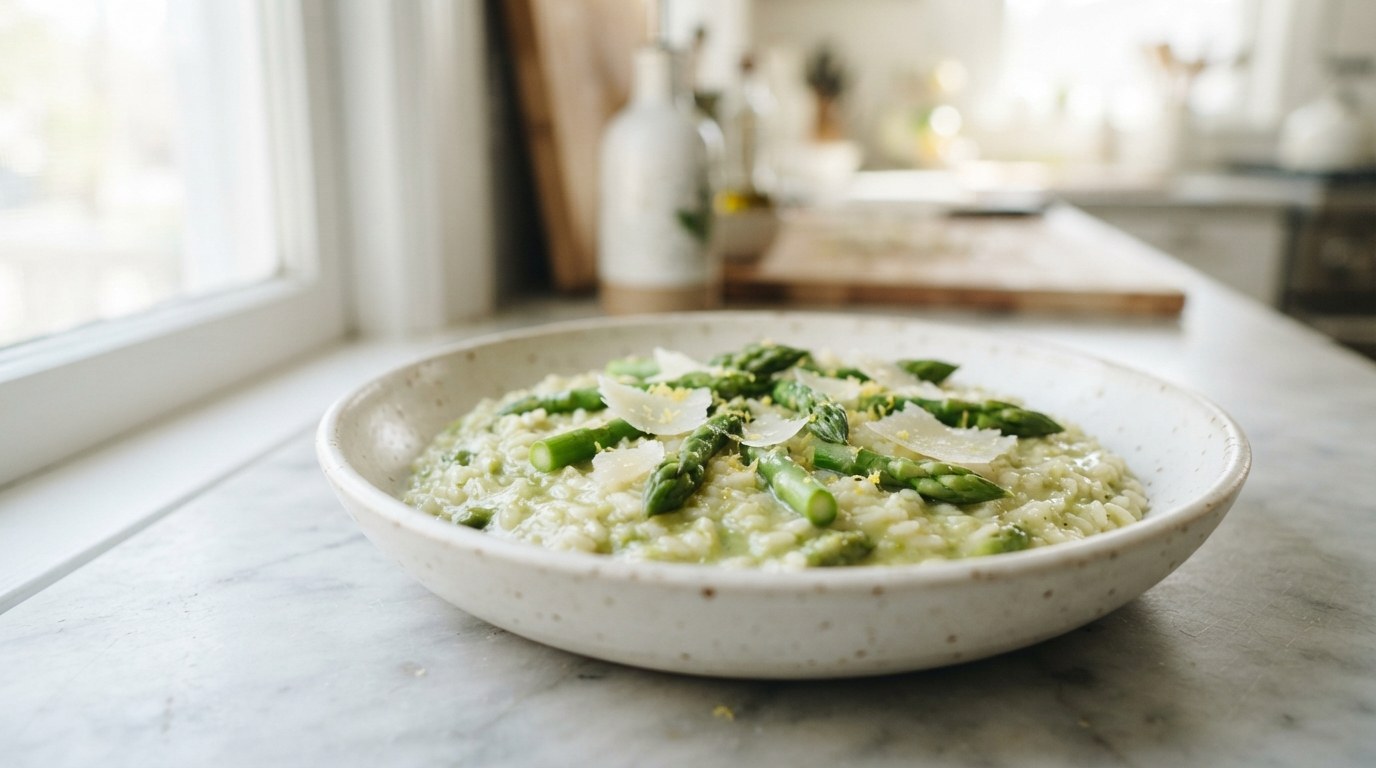
Serve the risotto spread flat in shallow bowls with the tips arranged on top, more Parmesan shaved over, and the zest of half a lemon. It is a starter in Italy and a main course almost everywhere else; as a main it carries seared scallops, a piece of pan-roasted salmon, or grilled shrimp well, and the pan-seared scallops are the natural partner. A dry, unoaked white with acidity, a Sauvignon Blanc or a Pinot Grigio, works with asparagus where oaky whites and most reds fight it.
Variations that keep the method: fold in a cup of peas with the tips for a spring green risotto; add a handful of mint or basil torn in at the end; swap the mascarpone for goat cheese; or use the same purée-and-tips technique with broccoli. Leftover risotto keeps two days in the refrigerator and reheats over low heat with a splash of stock, stirred until loose again, though the tips lose their snap. The best use of leftovers is arancini: chill the risotto, roll it into balls around a cube of mozzarella, bread and fry them, which is what Italian kitchens have always done with yesterday's risotto.
Creamy Asparagus Risotto (Gordon Ramsay's Method)
Ingredients
- For the asparagus
- 1 lb medium asparagus, woody ends snapped off
- 1 tbsp kosher salt, for the blanching water
- For the risotto
- 5 cups chicken or vegetable stock
- 1 tbsp olive oil
- ⅔ cup white onion, finely diced
- 1⅓ cups arborio rice
- ⅓ cup dry white wine
- ⅓ cup Parmigiano Reggiano, finely grated, plus more to serve
- 1 tbsp mascarpone
- 1 tbsp cold unsalted butter
- 1 lemon, juice of half and zest of half
- kosher salt and freshly ground black pepper
Instructions
- Cut the top 2 inches off each asparagus spear and set the tips aside. Slice the stalks into ½-inch pieces (peel the lower halves first if the spears are thick). Bring a pot of water to a boil with the tablespoon of salt and have a bowl of ice water ready.
- Blanch the tips 2 minutes, lift them into the ice water, then blanch the stalk pieces 3 minutes and shock them too. Reserve ½ cup of the blanching water. Drain the stalks, blend them smooth with 2 to 3 tablespoons of the blanching water, season with salt and pepper, and set the purée aside. Drain the tips.
- Bring the stock to a simmer in a saucepan and keep it there. In a wide, heavy saucepan, heat the olive oil over medium heat and cook the onion until soft and translucent, 4 to 5 minutes. Add the rice and stir 1 minute, until the edges of the grains look translucent. Add the wine and stir until almost fully absorbed, 1 to 2 minutes.
- Add ½ cup of hot stock and stir often until it is nearly absorbed, 2 to 3 minutes. Continue adding stock ½ cup at a time, stirring often and waiting until each addition is nearly absorbed before the next, until the rice is tender with a slight bite and the risotto is loose and creamy, 18 to 22 minutes. You may not need all the stock.
- Take the pan off the heat. Stir in the asparagus purée and tips, then the Parmesan, mascarpone and cold butter, beating vigorously for 30 seconds until glossy. Add the lemon juice, season with salt and pepper, and loosen with a splash of the reserved blanching water if the risotto mounds on a spoon.
- Spoon into warm shallow bowls so it spreads, and finish with the lemon zest and more Parmesan. Serve at once.
Notes
Asparagus Risotto FAQs
The questions that come up most: what makes risotto creamy, whether asparagus can go in raw, why the risotto is gluey or the asparagus went gray, whether it needs wine, what to serve with it, how to keep it green, and whether it can be made ahead or frozen.
What makes asparagus risotto creamy?
The rice. Arborio and carnaroli are short-grain varieties high in amylopectin starch, which swells and leaks out of the grains as they cook in hot stock; stirring rubs that starch into the liquid and turns it into a sauce. The finish of cold butter, Parmesan and a spoon of mascarpone whipped in off the heat is an emulsion that makes it glossy. No cream is needed.
Can I add raw asparagus to risotto instead of blanching?
You can stir raw tips in for the last 5 minutes, but they cook unevenly and the purée needs cooked stalks. Blanching 2 to 3 minutes in salted boiling water and shocking in ice water gives bright green, crisp-tender tips and a smooth purée, and it takes 5 minutes.
Why is my risotto gluey or stiff?
It was overcooked, over-stirred at the end, or left to sit. Pull the rice while it still has a faint bite, keep it loose with stock so it spreads on the plate, and serve within a minute or two; the starch sets as it cools. A splash of the reserved asparagus blanching water and a stir loosens a risotto that has tightened.
Why did my asparagus turn gray-green in the risotto?
Acid and time. Lemon juice, wine or tomato added while the asparagus is in the pan degrades its chlorophyll, and long heat does the same. Add the wine before the asparagus, the lemon after the pan is off the heat, and stir the purée and tips in only at the end.
Do I need wine in asparagus risotto?
No. The wine adds acidity and cooks off in a minute; replace it with 2 tablespoons of lemon juice added at the end, or a splash of white wine vinegar in the first ladle of stock. Do not skip the acid entirely, or the finished risotto tastes flat and heavy.
What do you serve with asparagus risotto?
As a starter, nothing; as a main, seared scallops, pan-roasted salmon, grilled shrimp or a piece of roast chicken on top. A crisp, unoaked white such as Sauvignon Blanc suits asparagus, which clashes with oaky whites and most reds.
Can asparagus risotto be made ahead?
Partly. Blanch the asparagus and make the purée up to a day ahead and keep both cold. The risotto itself is best cooked to serve, but restaurants par-cook it: cook to 12 minutes, spread it on a tray to cool, refrigerate, then finish with hot stock and the additions in 8 minutes at service.
Can I freeze asparagus risotto?
It survives freezing but the texture suffers; the starch retrogrades and the rice turns firm and grainy on thawing. Reheat frozen risotto with plenty of stock over low heat, or use it for arancini, which is what leftover risotto is for. Fresh, it keeps 2 days in the refrigerator.

About the Author
John Siracusa is the founder of Hell’s Kitchen Recipes. He focuses on technique-first, reproducible home cooking and researches recipes & kitchen equipment from published food science and professional chef methods since 2016.