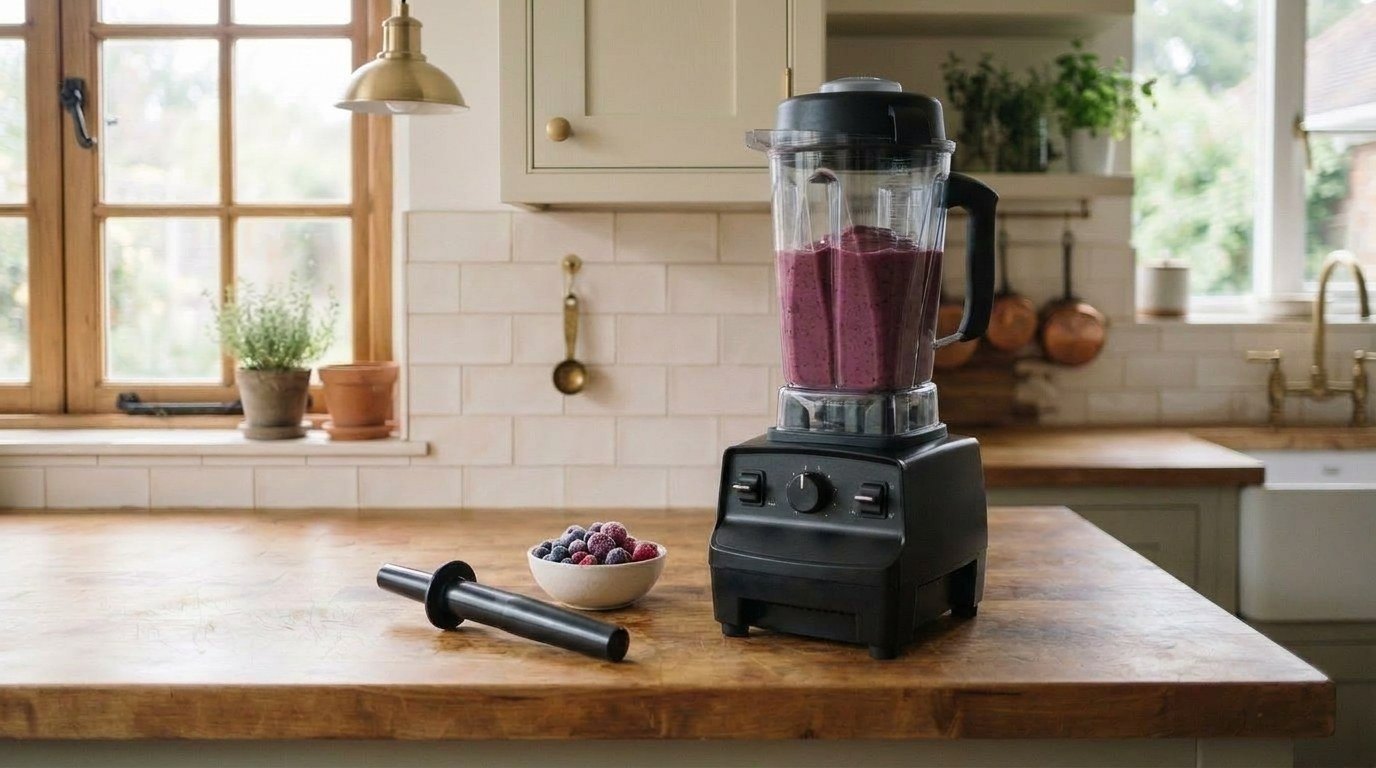
For most home kitchens the best heavy-duty blender is the Vitamix 5200: a 2 HP motor with its own cooling fan, a 64-ounce jar, a tamper and a 7-year warranty, which is the longest coverage in this group. If you want a true commercial machine on your counter, the Waring Commercial MX1000XTX is NSF listed and rated for 75 or more drinks a day. On a tighter budget, the Cleanblend 3HP and the Ninja BN701 put a lot of motor on the counter for less money, with shorter warranties.
A heavy-duty blender, also sold as a high-performance or commercial-grade blender, is built to run thick, frozen and fibrous loads for minutes at a time without stalling or overheating: nut butter, frozen-fruit bowls, ice for a crowd, hot soup straight from raw vegetables. Below are six machines compared on the numbers their makers publish, then what those numbers mean and why the physics favors a big motor and a fast blade.
Best Heavy-Duty Blenders Compared (2026)
The six heavy-duty blenders below split into three groups: two Vitamix household machines with long warranties, two commercial-style motors (Waring and Cleanblend) with the highest power ratings, and two one-touch machines (Blendtec and Ninja) built around preset cycles. Motor figures are the maker's own rating, and "peak" figures run higher than what the motor delivers continuously (more on that below).
| Blender | Motor (maker's rating) | Jar | Warranty | Best for |
|---|---|---|---|---|
| Vitamix 5200 | 2 HP | 64 oz | 7 years | Best overall |
| Waring MX1000XTX | 3.5 peak HP, 1,560 W | 64 oz | 3 yr motor, 2 yr parts | Commercial duty at home |
| Blendtec Total Classic | 1,560 W | 75 oz (32 oz blend) | 2 years | One-touch cycles |
| Cleanblend 3HP | 3 HP, 1,800 W | 64 oz | 5 yr home, 1 yr business | Budget power |
| Vitamix E310 | 2 HP | 48 oz | 5 years | Smaller batches |
| Ninja BN701 | 1,400 peak W | 72 oz (64 oz liquid) | 1 year | Ice and frozen drinks |
Read the warranty column as the maker's own forecast of how long the motor should last. It runs from seven years down to one, and it tracks the price of the machine more closely than any wattage figure does.
Vitamix 5200: Best Heavy-Duty Blender Overall
The Vitamix 5200 is the best heavy-duty blender for most people because it pairs a strong motor with the parts that keep a motor alive under load. Vitamix lists a 2 HP motor drawing 11.5 amps, a radial cooling fan and a thermal protection system, 3-inch laser-cut stainless blades, a 64-ounce container and a 7-year limited warranty on its 5200 product page. The tamper comes in the box, and the variable speed dial lets you start slow and climb, which matters for hot soup and thick blends.
It has no presets and no timer. You turn the dial and decide when it is done, which suits cooks who want to watch a purée go from coarse to glossy rather than press a button and walk away.
Vitamix
Vitamix 5200 Professional-Grade Blender, 64 oz. Container
- 2 HP motor with a radial cooling fan and thermal protection
- 64-ounce container, 3-inch laser-cut stainless hammermill and cutting blades, tamper included
- Variable speed dial plus a High switch; 7-year limited warranty; made in Cleveland, Ohio
Waring Commercial MX1000XTX: Best Commercial Blender for Home Use
The Waring MX1000XTX is the pick if you want a real commercial blender at home, and it is the machine most "Vitamix vs Waring" shoppers are weighing. Waring's MX1000XTX spec page lists a 3.5 peak-HP motor rated at 1,560 watts and 13 amps, a 45,000 RPM motor speed, a 64-ounce stackable copolyester jar, NSF and cTUVus approvals, and a rating of 75 or more drinks per day. The controls are paddle switches (HIGH, LOW, OFF and PULSE), so you trade the Vitamix's fine speed control for two speeds that are easy to hit in a hurry.
The warranty is the tell that it was built for a bar, not a home: three years on the motor and two on parts and labor. The drive coupling and blade assembly are user-replaceable, and Waring sells a sound enclosure that retro-fits to the base if the noise bothers you.
Waring Commercial
Waring Commercial MX1000XTX Xtreme 3.5 HP Blender, 64 oz. Copolyester Container
- 3.5 peak-HP, 1,560-watt motor; Waring rates it for 75+ drinks a day
- HIGH, LOW, OFF and PULSE paddle switches; stainless metal-on-metal drive coupling
- NSF listed; 3-year motor and 2-year parts and labor warranty
Blendtec Total Classic: Best for One-Touch Cycles
The Blendtec Total Classic is the heavy-duty blender for cooks who want presets. Blendtec's product page lists a 1,560-watt motor, 10 speeds plus pulse and six preprogrammed cycles, including Hot Soup, Smoothie and Ice Crush, each of which runs and shuts itself off. The FourSide jar is 75 ounces in total, with a 32-ounce blending capacity and a 3-inch blade, so the blending line sits well below the jar's printed size.
The catch is coverage. Blendtec's warranty page gives the Classic and Total lines two years on parts and labor, against eight years for its Designer series, so weigh that against the Vitamix's seven if you plan to blend daily.
Blendtec
Blendtec Total Blender Classic with 75 oz. FourSide Jar
- 1,560-watt motor, 10 speeds plus pulse
- Six one-touch cycles, including Hot Soup, Smoothie and Ice Crush
- FourSide jar: 75 oz total, 32 oz blending capacity, 3-inch blade
Cleanblend 3HP: Best Budget High-Performance Blender
The Cleanblend is the budget route to a commercial-size motor. Cleanblend's product page lists a 3 HP, 1,800-watt motor, a BPA-free 64-ounce container, a stainless steel drive train and a tamper, which on paper out-rates both Vitamix machines here. Read its warranty policy before you put it in a business, though: it is five years for household use and one year in a professional or commercial setting.
Cleanblend
Cleanblend Commercial Blender, 3 HP, 1800W, 64 oz.
- 3 HP, 1,800-watt motor with a stainless steel drive train
- BPA-free 64-ounce container, variable speed and pulse, tamper included
- 5-year warranty for household use (1 year if used commercially)
Vitamix E310 Explorian: Best for Smaller Batches
The E310 is the Vitamix to buy if you blend for one to four people. Vitamix lists the same 2 HP rating as the 5200, ten variable speeds plus pulse, a 48-ounce container and a 5-year full warranty that covers parts, performance and labor on its E310 page. A narrower, smaller jar keeps a single smoothie or a cup of dressing down where the blades can reach it, instead of spreading it thin across a wide floor.
Vitamix
Vitamix E310 Explorian Blender, 48 oz. Container
- 2 HP motor, ten variable speeds plus pulse
- 48-ounce container sized for one to four servings
- 5-year full warranty covering parts, performance and labor
Ninja Professional Plus BN701: Best for Ice on a Budget
The Ninja BN701 is the cheapest way into heavy-duty ice crushing. Ninja's BN701 page lists 1,400 peak watts, a 72-ounce pitcher with a 64-ounce maximum liquid line, stacked Total Crushing blades and three Auto-iQ presets for smoothies, frozen drinks and ice cream, with a one-year limited warranty. The blades are stacked up the center of the pitcher, so they reach ice at the top of a full load instead of only the layer at the bottom.
It has no hot-soup program and no tamper, and the stacked blades are built around frozen drinks rather than nut butter or silky purées. For more Ninja options see our best Ninja blenders, or the head-to-head in Ninja vs Vitamix.
Ninja
Ninja Professional Plus Blender with Auto-iQ, BN701
- 1,400 peak watts driving stacked Total Crushing blades
- 72-ounce pitcher (64 oz max liquid) for big batches of frozen drinks
- Three Auto-iQ presets: smoothies, frozen drinks and ice cream
Commercial Blender vs Home Blender: What Changes
A commercial blender works fine at home; what changes is the warranty, the controls and the noise, not some secret extra power. The Waring MX1000XTX and the Vitamix 5200 both use 64-ounce jars and both plug into an ordinary 120-volt outlet. The differences that matter come down to five things.
Motor rating. Commercial makers like to quote peak horsepower, home makers often quote watts, and the two are not the same measurement. Blendtec's own fine print says peak horsepower is a laboratory figure that includes the motor's inertial contribution, and that its motors do not run at that number in use. The arithmetic shows why: one horsepower is 746 watts, so 3.5 peak HP works out to about 2,600 watts, while Waring rates the same MX1000XTX at 1,560 watts and 13 amps. A standard 15-amp, 120-volt kitchen circuit can only supply 1,800 watts (120 x 15), so no plug-in blender sustains more than that.
Warranty. Commercial coverage is shorter because commercial duty is harder. Waring gives the MX1000XTX three years on the motor and two on parts and labor; Vitamix gives the household 5200 seven years. Cleanblend states the gap outright: five years at home, one year in a business.
NSF certification. NSF listing is what a health inspector looks for in a restaurant, and it means little in a home kitchen. NSF's food equipment certification checks that the materials will not leach chemicals into food, that the design is cleanable and unlikely to harbor bacteria, and how the product performs. Waring lists NSF on the MX1000XTX; the Vitamix 5200's spec sheet lists it for household use.
Controls and noise. Bar blenders use two speeds and pulse because a busy bartender needs a switch, not a dial. Home cooks get more from variable speed for soups and purées. Every high-power blender is loud; commercial makers sell sound enclosures (Waring offers one that bolts onto the MX1000XTX), and our quiet blenders guide covers the enclosed models.
Jar size. Most heavy-duty jars are 48 to 75 ounces, but the usable number is smaller. Ninja caps the BN701's 72-ounce pitcher at 64 ounces of liquid, and Blendtec's 75-ounce FourSide jar blends 32 ounces. A wide jar also needs more food in it before the blades are covered, which is why the 48-ounce E310 handles a single smoothie better. If you want metal instead of plastic, see our stainless steel jar blenders.
What Makes a High-Performance Blender Work
A high-performance blender works by moving its blade tips fast enough to shred cell walls, then circulating the jar so every bit of food passes through that zone again and again. Speed does the cutting; jar shape and the tamper keep the food coming back.
Tip speed is the blade's circumference times its RPM. A 3-inch blade (the size Vitamix lists for the 5200) travels about 9.4 inches per revolution, so at 20,000 RPM its tips are moving at roughly 180 mph. At that speed the blades tear open the plant cells and break apart the pectin that glues them together, which is why a high-speed blender turns kale or raw cashews silky while a weaker one leaves grit. The same shear splits oil into smaller droplets, so a blender vinaigrette or mayonnaise holds together longer than a whisked one; an emulsion only breaks when its droplets merge, and small droplets merge more slowly.
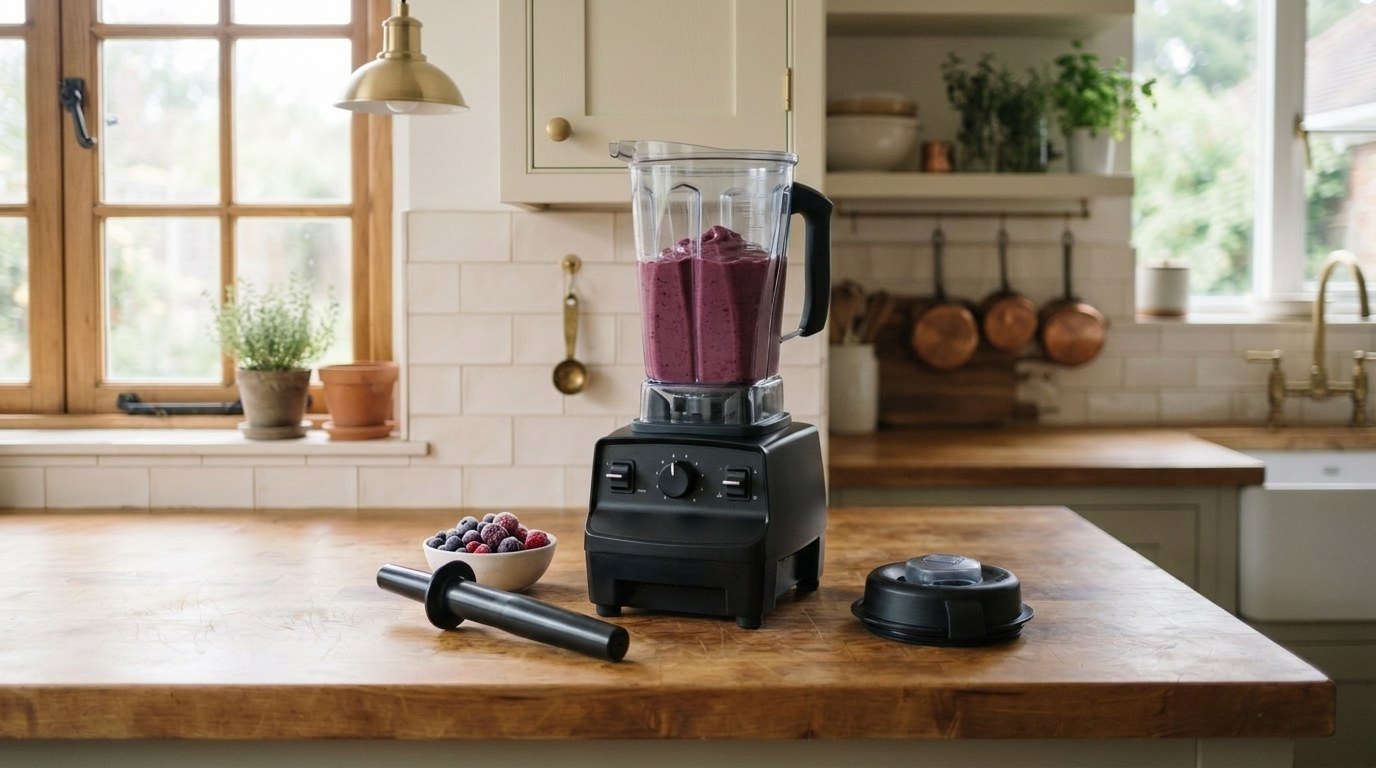
Thick loads stall the vortex. With frozen fruit or nut butter, the blades carve a hollow and spin in air while the food sits above them. The square, ribbed jars on these machines break up the swirl so food tumbles back down, and the tamper pushes the rest into the blades; Vitamix's 5200 page says the tamper keeps ingredients moving and shortens blend time. Ice and frozen fruit also need torque more than speed, a motor that keeps turning under a heavy load instead of bogging down, which is the real case for 2 HP and up.
One more piece of chemistry: a green smoothie darkens as it sits because blending whips air into the crushed produce, and the browning enzyme in fruit and vegetables (polyphenol oxidase) goes to work. That enzyme is destroyed at about 194°F (90°C), which is why a hot blended soup keeps its color and a cold smoothie does not. Drink smoothies fresh, or add a squeeze of lemon.
Hot Soup in a Heavy-Duty Blender: Friction Heat and Venting
A heavy-duty blender can heat soup by itself, because the energy that turns the blades ends up as heat in the liquid. Vitamix's FAQ says its blades create enough friction to bring ingredients to steaming hot in four to six minutes, and Blendtec builds a Hot Soup cycle into the Total Classic.
The numbers line up. Water absorbs 4,184 joules per kilogram for each degree Celsius, per the USGS Water Science School, so warming about 1.5 kilograms of soup (a little over six cups) from room temperature to 160°F (71°C), a 50-degree Celsius rise, takes about 314,000 joules. If roughly 1,000 watts of the motor's draw ends up in the soup, that is about five minutes, right inside the range Vitamix quotes. It also explains why a blender that stalls or overheats cannot do it: the motor has to run flat out for several minutes.
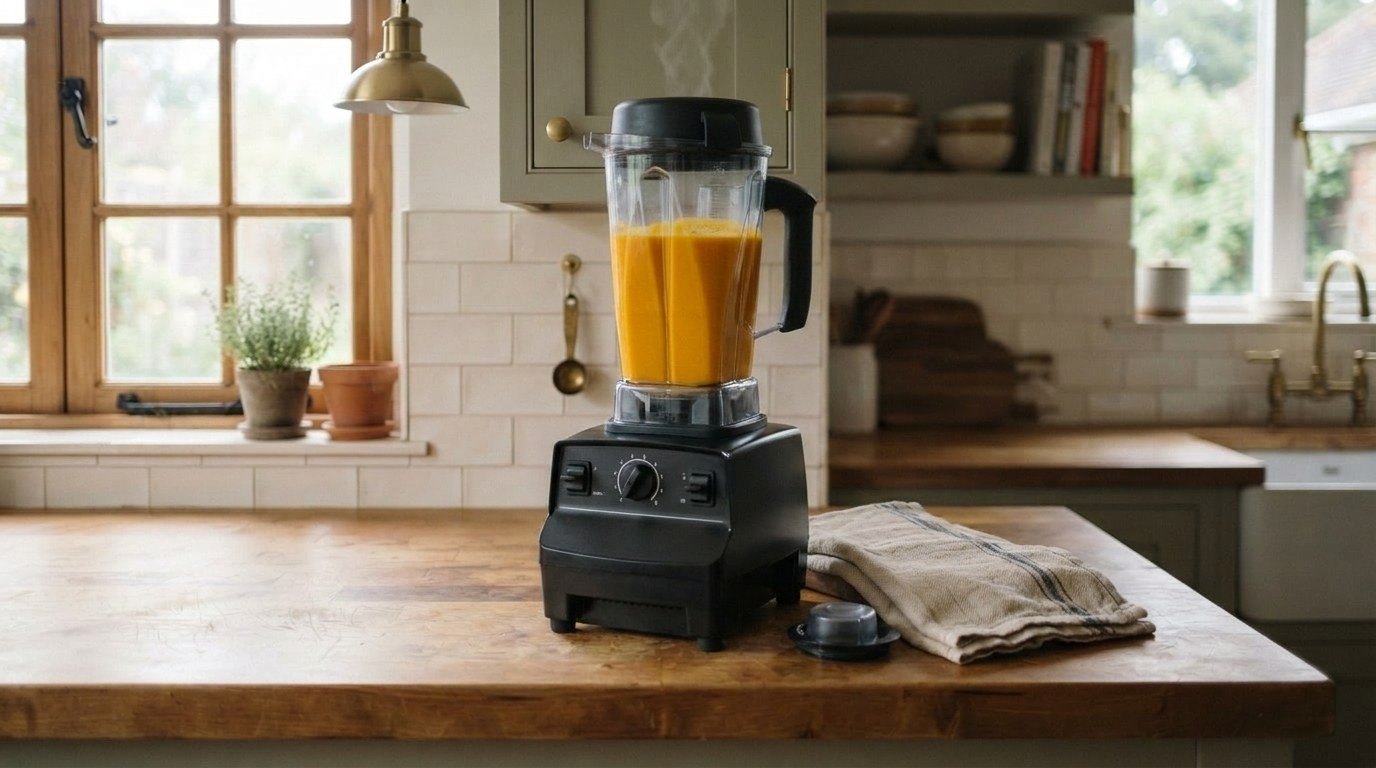
Blending soup that is already hot is the bigger safety question. Steam takes up far more room than the water it came from, so a sealed jar of hot liquid can push its lid off. Fill no more than halfway, start on the lowest speed, and vent: Waring describes the MX1000XTX's removable jar cap as the way to relieve pressure during hot food blending, and a folded towel over the opening catches splashes. Friction heat is for warming, not for making food safe: if the soup holds leftover meat or chicken, the USDA says to reheat leftovers to 165°F and bring soups to a boil on the stove.
Potato soups are the one place a powerful blender works against you. Cooked potato starch has already swollen with water, and high-speed blades burst those swollen granules, turning a leek and potato soup gluey. Blend potato soups briefly on low; save full speed for vegetables like cauliflower, where it gives you the glossy finish of a restaurant cauliflower purée.
How to Choose a Heavy-Duty Blender
Choose a heavy-duty blender by warranty first, then jar size, then motor rating, because the warranty tells you the most about the motor and the motor ratings are the least comparable numbers on the box.
Warranty. Seven years (Vitamix 5200) or five (Vitamix E310, Cleanblend at home) means the maker expects the motor to survive daily use; one or two years (Ninja, Blendtec Total Classic) means you are paying less up front for less protection.
Jar. Match the jar to your batch. A 64-ounce jar suits families and soup; a 48-ounce jar suits one or two people and small blends. Check the usable line, not the printed capacity.
Motor. Compare watts with watts and look for a cooling fan or thermal protection, which is what lets a motor run a six-minute soup without cutting out. Treat peak horsepower as a marketing figure.
Controls. Variable speed for purées, sauces and hot soup; presets if you want to press a button and walk away; paddle switches only if you blend frozen drinks in volume. For more options, see our best Vitamix blenders and best Ninja blenders.
For most kitchens the best heavy-duty blender is still the Vitamix 5200, with the Waring MX1000XTX for anyone who wants commercial duty and NSF listing at home, and the Cleanblend or Ninja BN701 when the budget comes first.
Heavy-Duty Blender FAQs
The questions that come up most: what makes a blender heavy duty, how many watts it needs, whether a commercial blender works at home, Vitamix vs Waring, Cleanblend vs Vitamix, blending hot soup, which blender is the strongest, and how long one lasts.
What makes a blender heavy duty?
A heavy-duty blender has a motor and drive built to run thick, frozen or hot loads for several minutes without stalling or overheating: usually around 2 HP or 1,400 watts and up, a cooling fan or thermal protection, a metal drive coupling, a tamper, and a warranty of five years or more. The Vitamix 5200, for example, pairs a 2 HP motor with a radial cooling fan and a 7-year warranty.
How many watts does a heavy-duty blender need?
Look for roughly 1,400 to 1,800 watts. A standard 15-amp, 120-volt outlet tops out at 1,800 watts, so no plug-in home blender runs continuously above that, whatever its peak rating says. Peak horsepower and peak watts are lab figures that include a short burst from the spinning motor, so compare rated watts with rated watts.
Can you use a commercial blender at home?
Yes. Commercial blenders like the Waring MX1000XTX plug into a normal 120-volt outlet and work fine at home. You get a strong motor, NSF listing and two-speed paddle switches, but a shorter warranty (three years on the motor, two on parts) than a household Vitamix, fewer speed settings, and more noise.
Which is better, Vitamix or Waring?
For home cooking, the Vitamix 5200: variable speed for soups and purées, a tamper, and a 7-year warranty. The Waring MX1000XTX has the bigger motor rating (3.5 peak HP, 1,560 watts), NSF listing and a rating of 75+ drinks a day, so it suits a home bar, a heavy frozen-drink habit or a small business.
Is Cleanblend as good as Vitamix?
On paper the Cleanblend's motor rating is higher (3 HP and 1,800 watts against the Vitamix 5200's 2 HP), and both use 64-ounce jars with a tamper. The Vitamix's edge is the warranty: seven years against Cleanblend's five for household use, and Cleanblend covers commercial use for only one year.
Can you blend hot soup in a heavy-duty blender?
Yes. High-performance blenders can even heat soup by friction; Vitamix says its blades bring ingredients to steaming hot in four to six minutes. When blending soup that is already hot, fill the jar no more than halfway, start on low, remove the lid cap to vent steam and cover the opening with a towel. Reheat soups with leftover meat to 165°F on the stove.
What is the most powerful blender for home use?
By the makers' own ratings, the Waring MX1000XTX (3.5 peak HP) and the Cleanblend 3HP (3 HP, 1,800 watts) are the strongest in this guide. In practice, any home blender is capped at about 1,800 watts by a standard 15-amp outlet, so cooling, blade design and jar shape matter as much as the headline number.
How long should a heavy-duty blender last?
The warranty is the best guide, since it is the maker's own estimate: seven years on the Vitamix 5200, five on the Vitamix E310 and on the Cleanblend at home, three on the Waring motor, two on the Blendtec Total Classic and one on the Ninja BN701. Replaceable drive couplings and blade assemblies, like Waring's, extend that further.

About the Author
John Siracusa is the founder of Hell’s Kitchen Recipes. He focuses on technique-first, reproducible home cooking and researches recipes & kitchen equipment from published food science and professional chef methods since 2016.