Red velvet cheesecake brownies are a fudgy red velvet brownie, cocoa-dark under the red and tangy from a spoon of vinegar, with a vanilla cheesecake batter marbled through the top so every square has ribbons of white against the red. They are built from scratch here, not from a cake mix, because the from-scratch version is denser, redder and less sweet, and because the two things that go wrong with this bake, a cheesecake swirl that sinks or cracks and a red that bakes out to brown, both have a cause you can control. This page explains both and gives a 9-inch pan of 16 squares.
The recipe card at the bottom has the amounts and numbered steps. This guide covers what red velvet is and where its color comes from, why this brownie uses natural cocoa and vinegar, how to make a cheesecake batter that swirls instead of sinking, the doneness temperature that keeps the cheesecake creamy and crack-free, and how to cool, cut and store them. It sits in the site's baking and desserts section next to the pistachio brownies and Gordon Ramsay's blondies.
What Red Velvet Is and Where the Red Comes From
Red velvet is not chocolate cake with dye in it. It is a lightly cocoa-flavored, acidic batter, and the acid is the point. Cocoa contains anthocyanins, the same class of pigment that colors red cabbage and blueberries, and like those pigments it shifts color with acidity; the Virginia Tech library's chocolate history exhibit explains that anthocyanin turns dark red-brown in acidic conditions, which is why early twentieth-century cooks who mixed cocoa with sour milk or vinegar got a reddish devil's food cake. The exhibit also traces the name: when the Adams Extract company released its red food dye in the 1920s, it advertised it with recipe cards for red velvet cake, and that is the bright red the dessert has meant since.
So a red velvet brownie has three color decisions. First, use natural cocoa, not Dutch-process. Dutch-process cocoa is treated with an alkali, which neutralizes its acidity and darkens it toward black; in an acidic batter it goes muddy and swallows the red. Natural cocoa is acidic to begin with and stays on the red-brown side. Second, add a teaspoon of white vinegar, which keeps the batter acidic without the volume of buttermilk a cake would use. Third, the red itself is food coloring, and in the United States that means FD&C Red No. 40, which the federal color-additive regulation lists as safe for coloring foods in amounts consistent with good manufacturing practice. Use a gel, not the liquid from the four-bottle box: gel is far more concentrated, so a tablespoon gives a deep red where the liquid needs three times as much and adds water that loosens the batter.
| Ingredient | What it does | Do not substitute with |
|---|---|---|
| Natural (non-alkalized) cocoa, ¼ cup | Mild chocolate flavor; stays reddish in acid | Dutch-process cocoa (alkalized; turns the batter dark and dull) |
| White vinegar, 1 tsp | Keeps the batter acidic for the color and the tang | Skipping it (the classic red velvet tang disappears) |
| Red gel food coloring, 1 Tbsp | Concentrated red without extra water | Liquid coloring in the same amount (too pale, too wet) |
| Melted butter and 1¼ cups sugar, no leavener | The fudgy brownie base: high fat and sugar, low flour | Baking powder (turns it into cake) |
| Full-fat block cream cheese, room temperature | A smooth cheesecake batter that swirls | Whipped or tub cream cheese (too soft; sinks and weeps) |
| One egg yolk in the cheesecake | Sets the layer without making it stiff | A whole egg (thin batter that spreads and cracks) |
The Brownie Base: Fudgy on Purpose
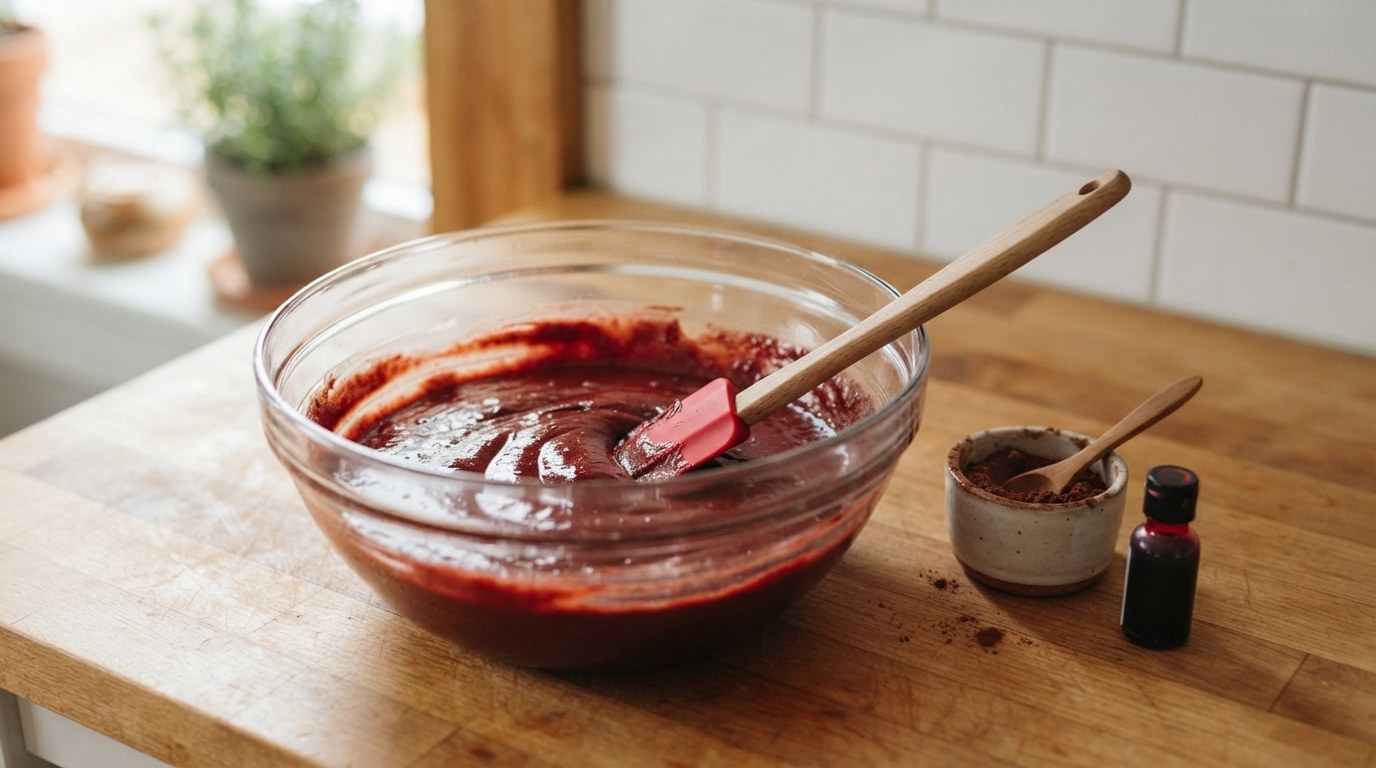
The base is a fudgy brownie, and fudgy is a ratio, not a mood. King Arthur Baking's breakdown of its brownie styles puts it simply: fudgy brownies run on a high proportion of fat and sugar to flour and use no leavener, while cakey brownies add flour, eggs and a rising agent. This batter is 10 tablespoons of melted butter and 1¼ cups of sugar against one cup of flour, with no baking powder or soda, so there is nothing to open the crumb; what sets it is the eggs coagulating from about 158°F and the butter firming as it cools, which is why the squares are soft warm and dense the next day. Melted butter, not creamed, keeps air out for the same reason.
Whisk the sugar into the warm melted butter until glossy, then beat in the eggs, vanilla, vinegar and coloring for a full minute until the batter is thick and satiny; that dissolves the sugar and is what gives the red base its thin crackly top where it shows between the swirls. Fold in the cocoa, flour and salt just until no dry streaks remain, because working the flour builds gluten and gluten is the difference between fudgy and tough. Reserve a half cup of the red batter for the swirl and spread the rest into a parchment-lined 9-inch square pan.
The Cheesecake Batter and How to Swirl It
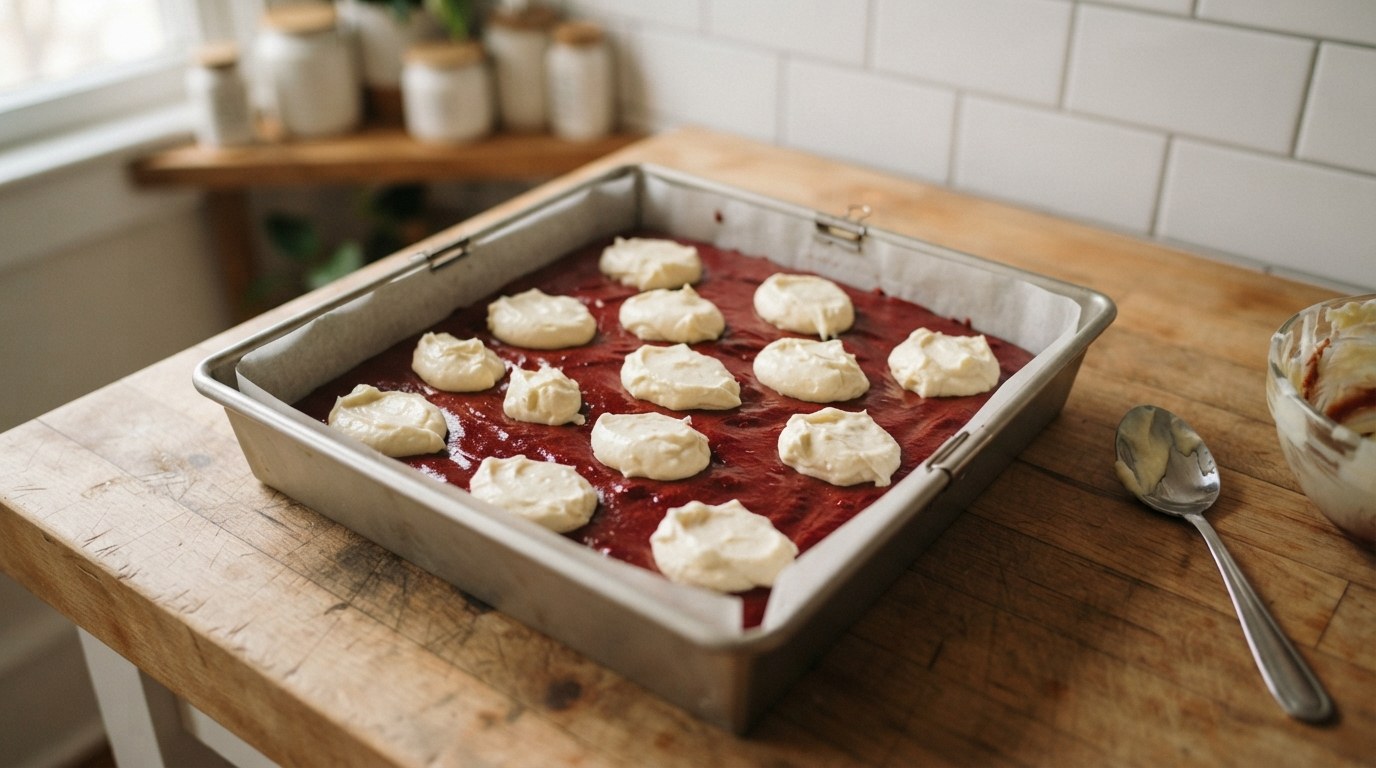
A cheesecake swirl is a small custard: cream cheese, sugar, an egg yolk and vanilla. The cream cheese must be a full-fat block at room temperature, because cold cream cheese beats into lumps that never smooth out, and the batter should be mixed by hand or on low speed just until combined. King Arthur's cheesecake troubleshooting warns that beating on high whips in air pockets that turn to steam in the oven and break the surface, so mix the filling slowly. One yolk rather than a whole egg keeps the batter thick; the white would thin it, and a thin cheesecake batter is the one that sinks.
Swirling is a matter of matching thickness. Two batters of similar consistency stay side by side and marble; a runny one poured onto a stiff one slides under it. So the cheesecake batter should mound on a spoon like the brownie batter does. Dollop it over the red in a grid, dollop the reserved half cup of red batter between, then drag a butter knife through in a loose figure-eight pattern, four or five passes and no more. Overswirling blends the two into pink; the goal is bold red and white ribbons you can see from across the room. The same custard logic runs the site's pumpkin crème brûlée, and the same fold-don't-beat rule runs the chocolate chip cookies.
Baking and Doneness: The 150°F Rule
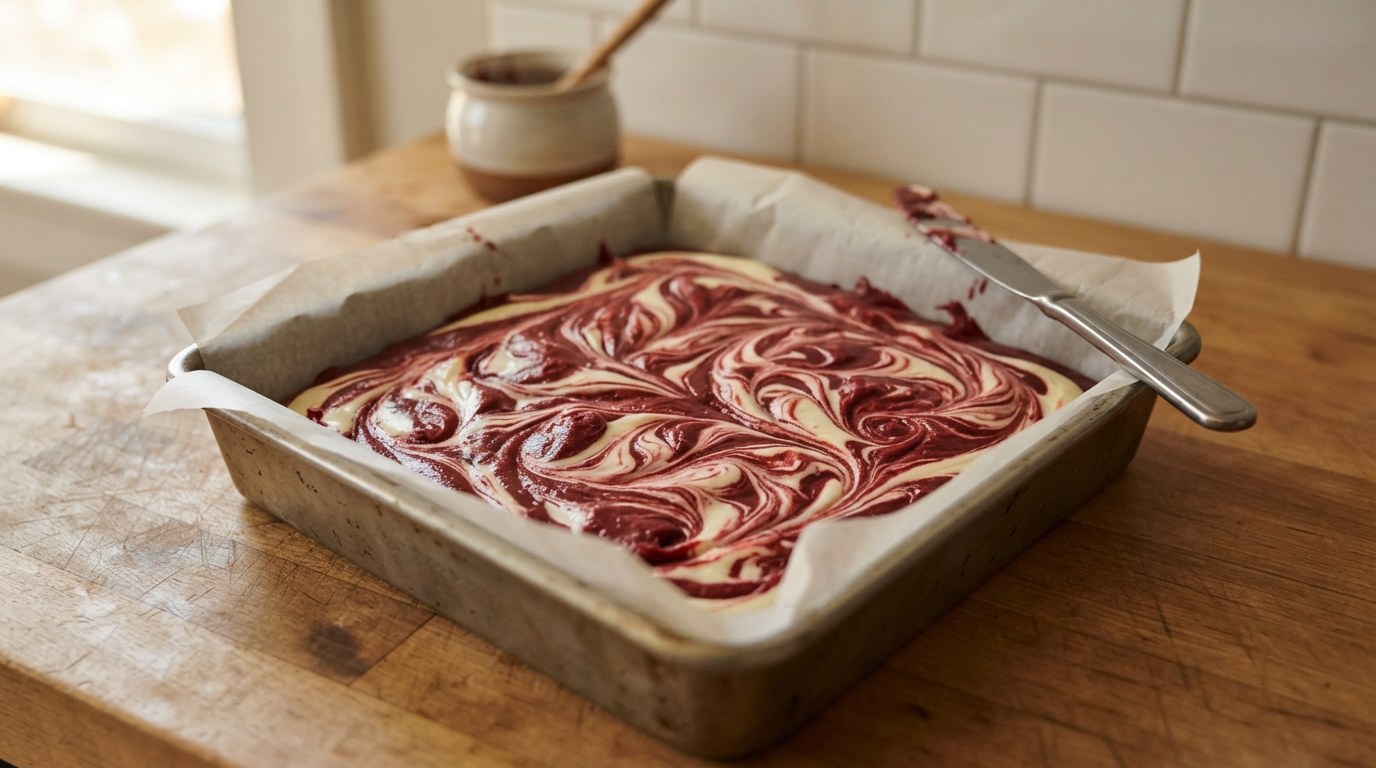
Bake at 350°F for 30 to 35 minutes, until the edges are set and pulling from the parchment, the cheesecake swirl is pale and just matte with no browning, and the center wobbles as a single piece when the pan is nudged rather than sloshing. An instant-read thermometer settles it: push it into a cheesecake ribbon near the center and pull the pan at 150 to 155°F. King Arthur puts the creamy target for a cheesecake center at 150 to 155°F and says that if any part of the cake reaches 185°F it will almost certainly crack, because overheated egg proteins tighten into a stiff, inelastic network that splits as the cake rises and then sinks. A thin swirl over a brownie heats faster than a whole cheesecake, so the temperature matters more here, not less.
| Stage | Number | What you see |
|---|---|---|
| Sugar into warm butter, then eggs | Beat 1 minute | Batter thick, glossy, satiny red |
| Cheesecake batter | Low speed, just combined | Smooth, thick, mounds on a spoon |
| Swirl | 4 to 5 knife passes | Bold red and white ribbons, not pink |
| Bake | 350°F, 30 to 35 minutes | Edges set, swirl pale, center wobbles as one piece |
| Pull temperature | 150 to 155°F in the cheesecake | Creamy set; above 185°F it cracks |
| Cool, then chill | 1 hour, then 2 hours refrigerated | Clean, sharp squares |
The center will look slightly underdone at the toothpick; that is right. The pan's stored heat carries the cheesecake several degrees further after it comes out, and the brownie firms as its butter cools. Run a thin knife around the edge within the first few minutes so the cheesecake can shrink away from the pan without tearing, which is the other common cause of a crack. Cool completely in the pan, about an hour, then refrigerate at least 2 hours before cutting.
Cutting, Storage and Variations
Cold is what makes the squares clean. Lift the chilled slab out by the parchment, cut four by four with a long knife wiped between cuts, and serve cool or at room temperature; a warm cheesecake layer smears. These are a dairy-and-egg custard as much as a brownie, so they live in the refrigerator. Iowa State University Extension gives cheesecake 4 days refrigerated in a tightly covered container, and that is the rule here: 4 days in the refrigerator, or freeze the cut squares, wrapped, for up to a month and thaw overnight in the refrigerator. They should not sit out for a party longer than 2 hours.
For a 9-by-13 pan, double everything and bake 35 to 40 minutes, checking the cheesecake temperature the same way. For a deeper chocolate flavor, add 2 ounces of chopped dark chocolate to the warm butter; the red will lean darker. For no artificial color, leave the dye out entirely and you will have a tangy, reddish-brown cocoa brownie with a white swirl, which is closer to what the 1920s recipes produced; beet powder tints the raw batter but bakes out to brown, and it adds an earthy note.

Red Velvet Cheesecake Brownies (From Scratch)
Ingredients
- For the red velvet brownie
- 10 Tbsp unsalted butter, melted and still warm
- 1¼ cups granulated sugar
- 2 large eggs, room temperature
- 2 tsp vanilla extract
- 1 tsp white vinegar
- 1 Tbsp red gel food coloring
- ¼ cup natural (non-alkalized) cocoa powder
- 1 cup all-purpose flour
- ½ tsp fine sea salt
- For the cheesecake swirl
- 8 oz full-fat block cream cheese, room temperature
- ⅓ cup granulated sugar
- 1 large egg yolk
- 1 tsp vanilla extract
- 1 pinch fine sea salt
Instructions
- Heat the oven to 350°F (175°C). Line a 9-inch square pan with parchment, leaving overhang on two sides.
- Whisk the sugar into the warm melted butter until glossy. Add the eggs, vanilla, vinegar and red gel coloring and beat with the whisk for a full minute, until thick and satiny. Sift in the cocoa, flour and salt and fold just until no dry streaks remain. Reserve ½ cup of the batter; spread the rest evenly in the pan.
- Make the cheesecake batter: beat the cream cheese and sugar by hand or on low speed until smooth, then mix in the egg yolk, vanilla and salt just until combined. It should be thick enough to mound on a spoon.
- Dollop the cheesecake batter over the red batter in a grid, then dollop the reserved red batter in the gaps. Drag a butter knife through in loose figure-eights, 4 or 5 passes, until bold red and white ribbons show. Do not overswirl.
- Bake 30 to 35 minutes, until the edges are set and pulling from the parchment, the cheesecake is pale with no browning, the center wobbles as one piece, and a thermometer in a cheesecake ribbon near the center reads 150 to 155°F. Run a thin knife around the edge right away.
- Cool completely in the pan, about 1 hour, then refrigerate at least 2 hours. Lift out by the parchment and cut into 16 squares with a long knife wiped between cuts. Keep refrigerated.
Notes
Red Velvet Cheesecake Brownies FAQs
The questions that come up most: whether they need to be refrigerated, why the cheesecake cracked or sank, whether a box mix works, how to make them without food coloring, how to know when they are done, whether they can be frozen, how to scale to a 9-by-13 pan, and why the red baked out brown.
Do red velvet cheesecake brownies need to be refrigerated?
Yes. The swirl is a cream cheese and egg custard, so treat them like cheesecake: refrigerate in a covered container for up to 4 days and do not leave them out longer than 2 hours. Chilling also firms the cheesecake so the squares cut clean.
Why did my cheesecake swirl crack?
It overheated. Egg proteins tighten into a stiff network above about 185°F and split as the bake rises and settles, so pull the pan when a thermometer in a cheesecake ribbon reads 150 to 155°F and the center wobbles as one piece. Beating the cheesecake batter on high speed also whips in air that turns to steam and breaks the surface; mix it slowly, just until smooth.
Why did the cheesecake sink into the brownie?
The cheesecake batter was thinner than the brownie batter. A runny batter slides under a stiff one instead of marbling beside it. Use a full-fat block of cream cheese at room temperature, one egg yolk rather than a whole egg, and no extra liquid, so both batters mound on a spoon before you swirl.
Can I make red velvet cheesecake brownies with a box mix?
You can, with a red velvet cake mix prepared as brownies (the box's "fudgy" instructions, or the mix plus melted butter and eggs only), and the same cheesecake swirl and 150°F doneness apply. The from-scratch version here is denser, redder and less sweet, because a cake mix carries leavener and more sugar.
How do I make them without red food coloring?
Leave it out. Natural cocoa plus the vinegar still gives a tangy, reddish-brown brownie with the white swirl, close to what early red velvet recipes produced before red dye. Beet powder colors the raw batter but bakes out to brown and adds an earthy flavor, so it is not a true substitute.
How do I know when they are done?
Edges set and pulling from the parchment, the cheesecake swirl pale and matte with no browning, and the center wobbling as a single piece when nudged. A thermometer in a cheesecake ribbon should read 150 to 155°F; the pan's heat carries it a few degrees further as it cools. A toothpick in the red part comes out with moist crumbs, not clean.
Can you freeze red velvet cheesecake brownies?
Yes. Chill, cut, wrap the squares individually, and freeze for up to a month. Thaw overnight in the refrigerator, not on the counter, so the cheesecake layer stays firm and safe.
Why did my red velvet bake out brown?
Usually Dutch-process cocoa, which is alkalized and turns dark in the oven, or liquid food coloring, which is too dilute. Use natural cocoa, keep the teaspoon of vinegar, and use a tablespoon of red gel coloring, which is concentrated enough to hold its color through the bake.

About the Author
John Siracusa is the founder of Hell’s Kitchen Recipes. He focuses on technique-first, reproducible home cooking and researches recipes & kitchen equipment from published food science and professional chef methods since 2016.