Eggplant involtini are thin lengthwise slices of eggplant rolled around a soft ricotta, mozzarella and Parmigiano filling, set seam-down in a baking dish and baked in sauce until bubbling. This version skips the frying most recipes use: the slices are salted, brushed with olive oil and roasted at 450°F until golden, so the dish comes out lighter and far less greasy. In place of tomato sauce, the rolls bake in a smooth, spicy red pepper sauce made from sweet bell peppers, a little tomato and a pinch of crushed red pepper. It serves 4 as a main course.
The whole job takes about an hour and a half, and half an hour of that is the eggplant sitting in salt while you make the sauce. Below is why each step is there: what the salt does, why the slices bake instead of fry, why the oven drops to 350°F for the final bake, and why the egg in the filling matters. Then the vegetarian swaps, make-ahead and freezing, the fixes for watery or cracked rolls, and what to serve alongside. For more vegetable mains and Italian bakes, browse Recipes.
What Is Eggplant Involtini?
Eggplant involtini is an Italian dish of eggplant slices rolled around a cheese filling and baked in sauce. Involtini means "little bundles," and in Italian cooking the word usually describes thin slices of veal, beef, pork or chicken rolled around a stuffing. Eggplant takes the place of the meat in the vegetarian version because its flesh turns soft and meaty when cooked but still holds together when you roll it, which is what makes it work as a wrapper. The Italian name for the dish is involtini di melanzane.
What sets this eggplant involtini apart is the method. The slices are baked, not breaded and fried, and the sauce is a pureed red pepper sauce instead of marinara. The filling is the familiar one: whole-milk ricotta, shredded fresh mozzarella, a little grated Parmigiano-Reggiano, one egg and a spoon of chopped basil or flat-leaf parsley.
Eggplant Involtini vs Eggplant Rollatini (and Eggplant Parm)
Eggplant involtini and eggplant rollatini are the same idea under two names: rolled eggplant slices filled with ricotta and baked in sauce. Rollatini is the Italian-American name, and the rollatini served in most American Italian restaurants is breaded, fried, baked in marinara and topped with melted mozzarella. Involtini is the Italian name, and recipes that use it more often keep the eggplant unbreaded and bake or grill it. Eggplant parmigiana is a different dish: the slices are layered flat with sauce and cheese, never rolled.
| Dish | Eggplant | Shape | Sauce | Cheese | Gluten |
|---|---|---|---|---|---|
| This eggplant involtini | Salted, brushed with oil, baked at 450°F | Rolled around the filling | Spicy red pepper puree | Ricotta, mozzarella and Parmigiano inside; Parmigiano on top | None in the recipe |
| Restaurant eggplant rollatini | Breaded and fried | Rolled around the filling | Marinara | Ricotta inside; melted mozzarella on top | Breadcrumbs and flour |
| Grilled eggplant involtini | Brushed with oil and grilled | Rolled around the filling | Tomato sauce or none | Ricotta or goat cheese | Usually none |
| Eggplant parmigiana | Fried, sometimes breaded | Layered flat in a dish | Tomato sauce | Mozzarella and Parmigiano between the layers | Often breaded |
The practical difference is oil and time. Frying gives rollatini its rich, soft texture but soaks the eggplant in oil and adds a breading station to the job. Baking takes about the same oven time and uses a few tablespoons of oil for the whole tray, which is why this eggplant involtini comes out lighter. If you want the restaurant rollatini taste with less fat, this is the version to make.
Why You Salt the Eggplant Slices First
Salting the eggplant slices pulls water out of them so they brown in the oven instead of steaming, and it seasons them all the way through. Eggplant is mostly water held in a spongy network of cells and air pockets. Salt on the cut surface sets off osmosis: water moves out of the cells toward the salty surface, and you can watch beads of liquid form within minutes. As the Exploratorium's Inquisitive Cooks explain, the salt draws out excess moisture (and any bitterness with it), and pressing the slices collapses some of their air cells so they take up less oil.
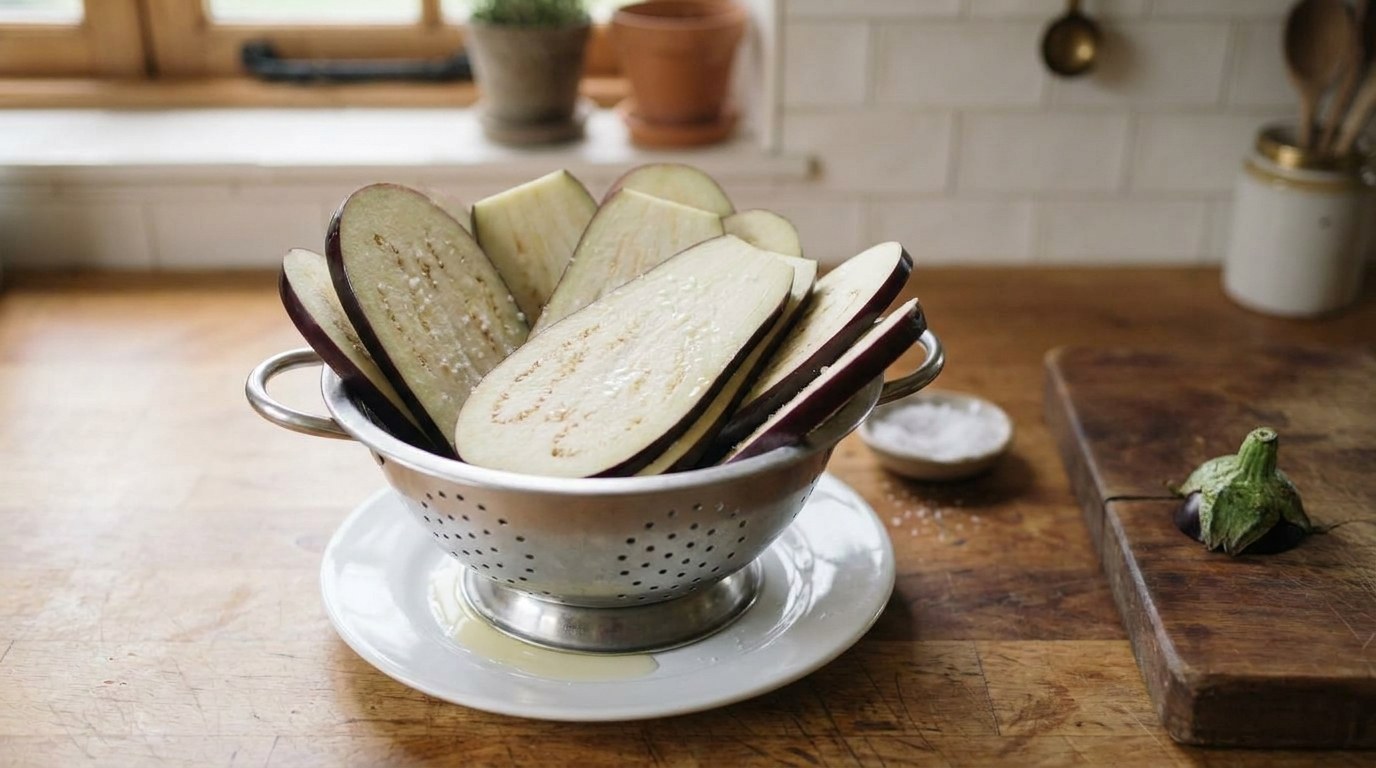
That water matters for browning. A wet surface can't get hotter than 212°F (100°C), the boiling point of water, and the Maillard reaction that turns the slices golden and savory only gets going around 284°F (140°C). So a slice that goes into the oven still wet spends its first minutes steaming. Thirty minutes in a colander, salting each layer, then a firm wipe and a pat dry with paper towels, gets the surface dry enough to color fast. Wipe off the salt rather than rinsing it; rinsing puts the water straight back.
Cut the eggplant lengthwise into eight even slices about 1/4 inch thick. Thicker slices crack when you roll them; thinner ones tear. A large eggplant of about 1 1/2 pounds gives eight good slices once you set the two skin-covered end pieces aside (they are good chopped into the sauce or a stir-fry). A mandoline makes the slices perfectly even, and our review of the OXO Good Grips mandoline covers which model handles a whole eggplant; a long, sharp knife works too, and the guide to the best knife for cutting vegetables explains why a thin blade slices cleaner. Leave the skin on. The thin rim of skin around each slice is what keeps the roll in one piece.
Why the Eggplant Bakes at 450°F Instead of Frying
Baking the eggplant at 450°F gives it the soft, golden texture of fried eggplant with a fraction of the oil. Eggplant's spongy flesh drinks up whatever fat it meets: in a frying pan, the Exploratorium notes, fried slices absorb a surprising amount of oil, and they keep adding more as long as there is oil in the pan. Brushing each slice on both sides with olive oil puts a measured amount on the surface, enough to help it brown and turn silky, and no more.
The hot oven does the rest. At 450°F the dried surface passes the browning point quickly, and the slices sit on a parchment-lined rimmed baking sheet in the lower third of the oven, close to the heat, so the side touching the pan colors first. Bake them for 8 to 10 minutes, turn them, and give them another 8 to 10 minutes until both sides are golden and the slices are soft. Lay them in a single layer with a little space between them. Crowded slices trap their own steam and stay pale.
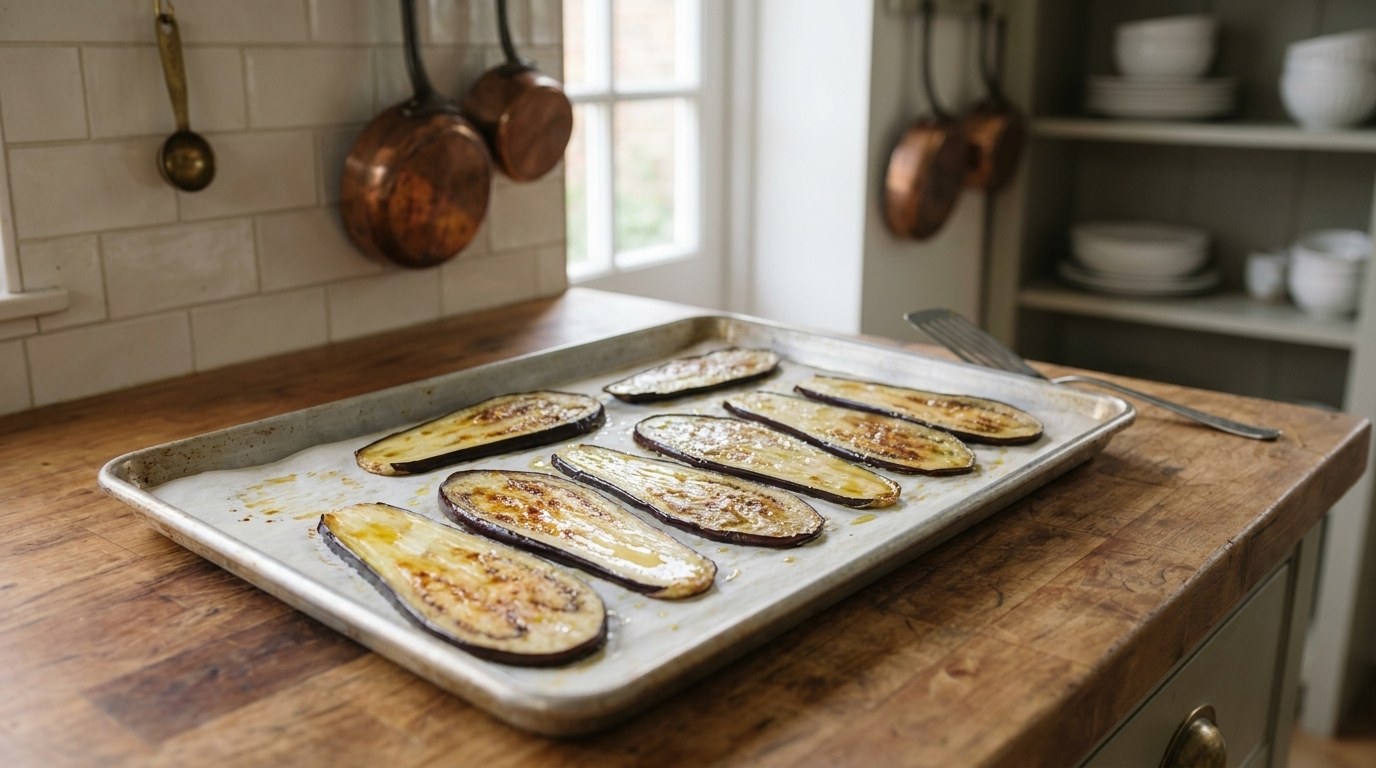
Tenderness is what makes them rollable. Heat breaks down pectin, the glue that holds plant cells together, and once it softens the cells slide apart and the slice turns limp and flexible. An underbaked slice is still springy and splits when you roll it, so check one: it should fold over on itself without cracking. When the slices come out, turn the oven down to 350°F for the final bake.
The Spicy Red Pepper Sauce (the "Emulsion")
The spicy red pepper sauce is a puree of sweet red bell peppers cooked with garlic, shallot, stock and a little crushed tomato, then blended smooth and spiked with crushed red pepper. It is called an emulsion because blending breaks the olive oil into tiny droplets that stay suspended in the sauce, but its body comes from the vegetables: pureed pepper flesh, softened pectin and tomato solids thicken it and hold the oil in place, the way they do in a blended soup. That makes it far sturdier than a true emulsion like mayonnaise. It won't break in the oven.
The order of the steps matters. Garlic goes into the oil over medium-low heat for about a minute, just until it smells sweet, then the shallot until it turns translucent; higher heat scorches the garlic and makes the sauce bitter. The peppers go in with salt and a little sugar, and the lid goes on for 5 minutes. The salt draws juice out of the peppers, and the lid traps that steam, so the pieces soften in their own moisture at no more than 212°F instead of browning. Then the stock and crushed tomatoes go in and the sauce simmers, partly covered, for about 8 minutes until the peppers are completely tender. Leaving the lid ajar lets some water evaporate, which concentrates the flavor.
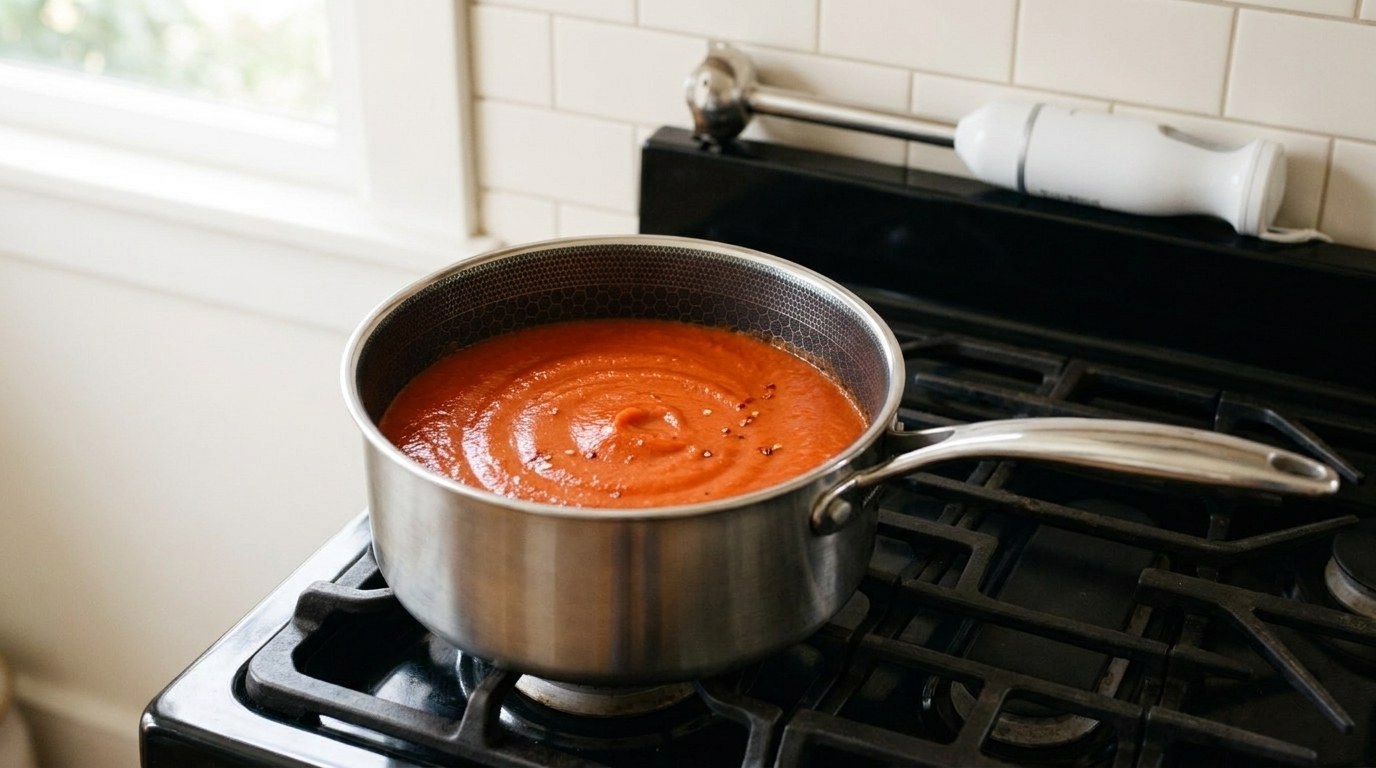
Puree it right in the saucepan with an immersion blender until it is completely smooth, then season it with crushed red pepper and salt. Taste it at this point, because the sauce is the main seasoning for the whole dish. Blending in the pot saves pouring hot sauce into a jug blender, and the same tool purees soups like the roasted tomato soup and the silky cauliflower puree.

KitchenAid
KitchenAid Variable Speed Corded Hand Blender, KHBV53
- Removable 8-inch blending arm with a 4-point stainless blade for soups and purees
- Variable speed trigger, so you can start slow and stop the moment it is smooth
- Removable pan guard protects your pot while you blend in it
Red pepper sauce is useful beyond this dish. It is good spooned over grilled fish or chicken, tossed with pasta, or served as a dip, and it keeps in a covered container in the fridge for up to 3 days. If you only want a milder sauce, leave out the crushed red pepper and add a squeeze of lemon instead.
The Ricotta Filling: Why the Egg Is There
The egg in the ricotta filling sets as the involtini bake, so the filling holds its shape inside the roll instead of running out into the sauce. Egg proteins unwind and link into a firm network as they heat: America's Test Kitchen puts the start of the egg white's set at 144°F (62°C) and the yolk at 149°F (65°C). Spread through the cheese, that network gives the filling the texture of a soft, sliceable custard. Without the egg, the ricotta and melting mozzarella slump and leak.
Use whole-milk ricotta; low-fat ricotta is wetter and turns grainy in the oven. Shred the fresh mozzarella and pat it dry if it is very moist. Two tablespoons of the Parmigiano go into the filling for seasoning, and the rest goes on top. Season the filling with pepper only, since the salted eggplant and the cheeses bring plenty of salt.
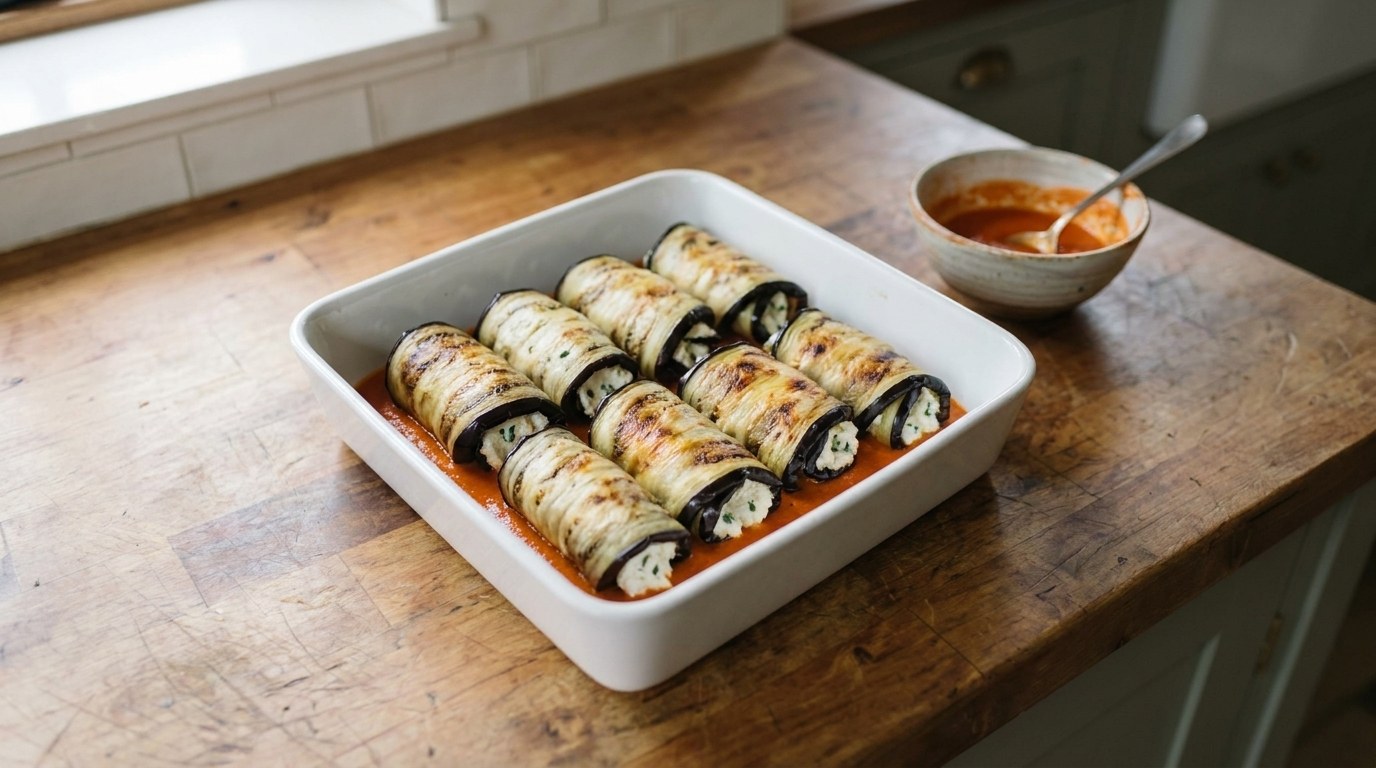
To roll, lay a slice flat, put a heaping spoonful of filling near one short end and roll it up toward the other end. Set each roll seam-side down in the dish on a thin layer of the sauce. Eight rolls fit snugly in two rows in an 8-inch square baking dish, which keeps them from unrolling as they bake.
Why the Final Bake Drops to 350°F
The final bake runs at 350°F because its job is to heat the rolls through and set the filling, not to brown them further. Ricotta is fresh cheese held together by delicate milk proteins. Heated too fast, those proteins tighten and squeeze out their whey, and the filling turns grainy and leaves a watery puddle in the dish. A moderate oven heats the rolls from the outside in gently enough that the center reaches temperature while the cheese stays creamy.
Spoon the rest of the sauce over the rolls, scatter the remaining Parmigiano on top and bake for about 25 minutes, until the sauce bubbles at the edges and the rolls are hot in the middle. Because the filling contains a raw egg, the FDA guidance for egg dishes is 160°F (71°C); an instant-read thermometer pushed into the center of a roll is the surest check. Let the dish rest for 5 minutes before serving. The filling keeps cooking from its own heat and firms up, so the rolls lift out cleanly.
How to Make Eggplant Involtini Fully Vegetarian
Eggplant involtini is meant as a vegetarian main, but two ingredients in the original recipe aren't: the chicken stock in the sauce and the Parmigiano-Reggiano. Swap the chicken stock for vegetable stock one for one. Parmigiano-Reggiano is made with calf rennet, as the Vegetarian Society points out, so use a vegetarian hard Italian-style cheese made with microbial rennet in both the filling and the topping. Our vegetarian carbonara covers the rennet question and how to spot a vegetarian cheese on the label.
The dish is naturally gluten-free, because the eggplant isn't breaded. Check the stock label if you are cooking for someone with celiac disease. For a vegan version you would need to replace the ricotta, mozzarella, Parmigiano and egg; a firm tofu or cashew ricotta works in the rolls, though the filling won't set as firmly without the egg.
Can You Make Eggplant Involtini Ahead or Freeze It?
Yes, eggplant involtini can be made ahead. Assemble the rolls in the dish with all the sauce and cheese, cover and refrigerate for up to a day, then bake straight from the fridge at 350°F, adding about 10 minutes and checking that the center reaches 160°F. The sauce alone can be made up to 3 days ahead, and the eggplant slices can be baked a day ahead and stored flat between sheets of parchment.
Leftovers keep for 3 to 4 days in the refrigerator, and USDA FSIS advises reheating leftovers to 165°F (74°C). Baked involtini also freeze well for 3 to 4 months. Freeze them in a covered dish, thaw overnight in the fridge and reheat at 350°F, covered with foil for the first 15 minutes so the tops don't dry out. The ricotta comes back slightly softer and grainier after freezing, which the sauce hides well.
Troubleshooting Eggplant Involtini
Most eggplant involtini problems come back to water or underbaking: watery rolls weren't drained enough, cracked rolls weren't baked long enough, and a runny filling was missing its egg or got too hot. The fixes:
- Slices crack when you roll them: they were too thick or underbaked. Cut them 1/4 inch thick and bake until a slice folds over on itself without splitting.
- Watery dish: the eggplant wasn't salted and dried, the ricotta was a wet low-fat type, or the mozzarella was dripping. Salt for the full 30 minutes, pat dry, use whole-milk ricotta and blot the mozzarella.
- Filling runs out of the rolls: the egg was left out, the rolls were overfilled or the oven was too hot. Use a heaping spoonful per roll and keep the final bake at 350°F.
- Greasy eggplant: too much oil on the brush. A thin coat on each side is plenty; the slices will look matte before baking.
- Pale, soft eggplant with no color: the slices were wet or crowded on the tray. Dry them well and leave space between them.
- Sauce too thin: simmer it uncovered for a few more minutes before blending.
- Too spicy or too mild: add crushed red pepper a pinch at a time after blending and taste between additions.
What to Serve With Eggplant Involtini
Eggplant involtini is rich enough to serve as a main course with just a green salad and crusty bread for the sauce. Two rolls make a serving. For a bigger meal, set them on a bed of spaghetti or angel hair tossed with a little of the red pepper sauce, or start with a strawberry caprese salad with burrata. If some of the table wants meat, it sits comfortably next to a crisp chicken Parmesan, which uses the same mozzarella-and-Parmigiano thinking.
Make eggplant involtini once and the method sticks: salt and dry the slices, bake them hot until they bend, roll them around an egg-bound ricotta filling, and finish them gently in a bright red pepper sauce. It is the lighter, baked answer to restaurant eggplant rollatini, and it reheats well the next day.
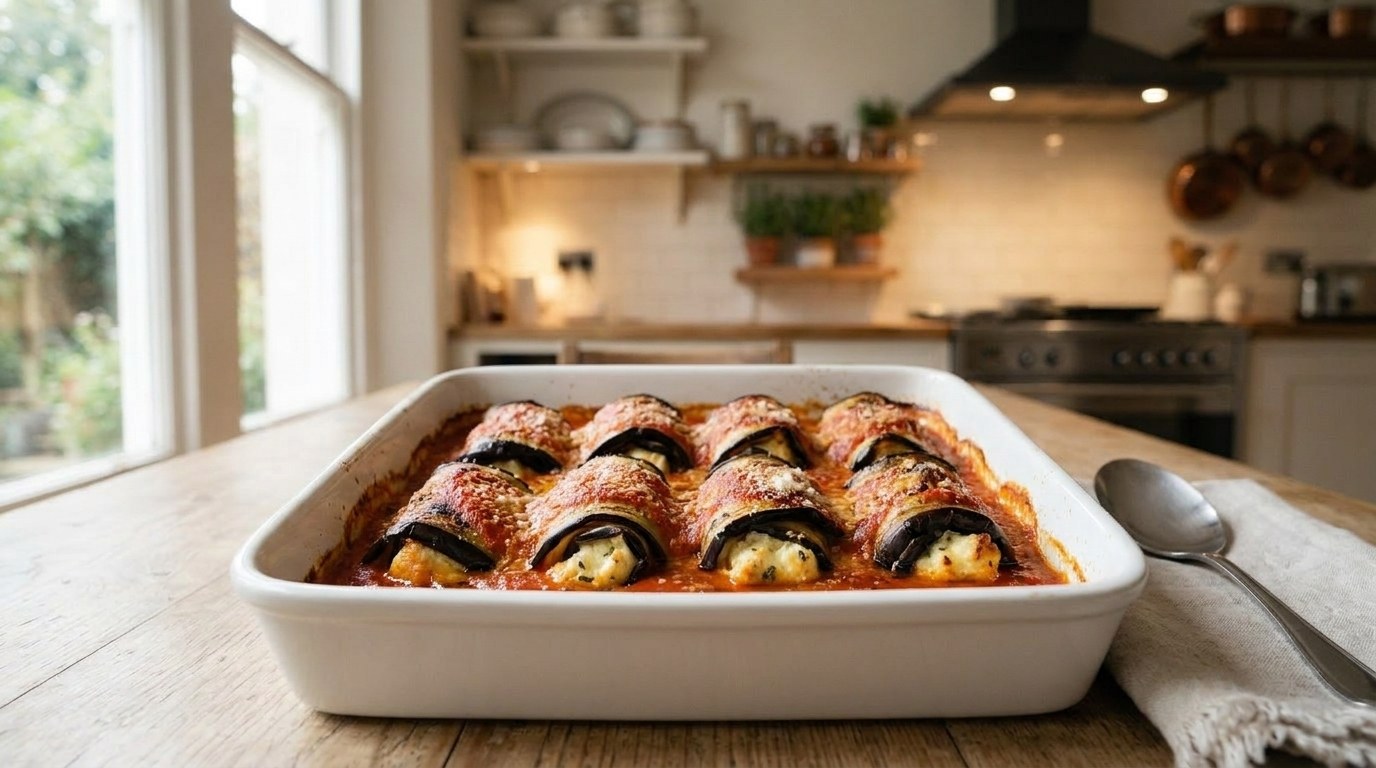
Eggplant Involtini with Spicy Red Pepper Sauce
Ingredients
Spicy red pepper sauce
- 1 tbsp olive oil
- 1 garlic clove, thinly sliced
- 1/2 small shallot, thinly sliced
- 2 large red bell peppers, cored, seeded and cut into 1/2-inch pieces
- 1/2 tsp kosher salt, plus more to taste
- 1/2 tsp sugar
- 1/2 cup chicken stock (or vegetable stock for a vegetarian dish)
- 1/4 cup crushed tomatoes, with their juices
- Crushed red pepper, to taste
- Freshly ground black pepper
Eggplant involtini
- 1 large eggplant (about 1 1/2 lb)
- Kosher salt and freshly ground black pepper
- 1 cup whole-milk ricotta
- 1/4 lb fresh mozzarella (about 1 cup), shredded
- 1 large egg, lightly beaten
- 1/2 cup grated Parmigiano-Reggiano (or a vegetarian hard cheese), divided
- 1 tbsp chopped fresh basil and/or flat-leaf parsley
- Olive oil, for brushing
Instructions
- Trim the ends off the eggplant and cut it lengthwise into eight slices about 1/4 inch thick (set aside the two skin-covered outer pieces for another use). Layer the slices in a colander set over a plate, sprinkling each layer with salt, and leave them to drain for 30 minutes.
- Meanwhile, make the sauce. Warm the olive oil and garlic in a medium saucepan over medium-low heat and cook for about 1 minute, until fragrant. Add the shallot and cook until translucent.
- Stir in the red peppers, 1/2 tsp salt and the sugar. Cover and cook for 5 minutes, until the peppers start to soften.
- Add the stock and crushed tomatoes. Simmer with the lid partly on for about 8 minutes, until the peppers are very tender.
- Puree the sauce in the pan with an immersion blender until smooth. Transfer it to a bowl and season with crushed red pepper, salt and black pepper to taste.
- Heat the oven to 450°F (230°C) with a rack in the lower third. In a bowl, stir together the ricotta, mozzarella, egg, 2 tbsp of the Parmigiano and the basil or parsley, and season with black pepper.
- Wipe the salt off the eggplant and pat the slices dry. Brush both sides with olive oil and lay them in a single layer on a parchment-lined rimmed baking sheet.
- Bake for 8 to 10 minutes, until lightly browned underneath. Turn the slices and bake 8 to 10 minutes more, until browned on the second side and tender enough to fold without cracking. Lower the oven to 350°F (175°C).
- Spread a thin layer of the pepper sauce over the bottom of an 8-inch square baking dish. Place a heaping spoonful of the cheese mixture near one end of each eggplant slice, roll it up and set it seam-side down in the dish. Repeat with the rest.
- Spoon the remaining sauce over the rolls and sprinkle with the remaining Parmigiano. Bake for about 25 minutes, until the sauce is bubbling and the rolls are hot through (160°F in the center of a roll).
- Let the involtini rest for 5 minutes, then divide among four plates and serve straight away.
Notes
Eggplant Involtini FAQs
The questions that come up most: what eggplant involtini is, how it differs from eggplant rollatini, whether rollatini is breaded or fried, whether to peel the eggplant, whether the dish is vegetarian, how long to bake it, whether you can make it ahead or freeze it, and what to serve with it.
What is eggplant involtini?
Eggplant involtini (involtini di melanzane) is an Italian dish of thin lengthwise eggplant slices rolled around a cheese filling, usually ricotta, and baked in sauce. Involtini means little bundles; the same word is used for rolled slices of meat, and eggplant stands in for the meat in the vegetarian version.
What is the difference between eggplant involtini and eggplant rollatini?
They are the same rolled, ricotta-filled eggplant under two names. Rollatini is the Italian-American name, and restaurant rollatini is usually breaded, fried and baked in marinara with melted mozzarella on top. Involtini is the Italian name, and those recipes more often bake or grill the eggplant without breading. This version is baked, unbreaded, in a red pepper sauce.
Is eggplant rollatini breaded or fried?
Restaurant eggplant rollatini usually is both: the slices are breaded and fried before they are rolled. You don't have to. Salting the slices, brushing them with olive oil and baking them at 450°F for 8 to 10 minutes a side gives soft, golden slices that roll easily, with far less oil and no breadcrumbs.
Do you peel eggplant for involtini?
No. When you slice the eggplant lengthwise, each slice keeps a thin rim of skin around its edge, and that rim holds the roll together. The skin softens in the oven. Set aside only the two end slices that are covered in skin.
Is eggplant involtini vegetarian?
It can be, with two swaps. Use vegetable stock instead of chicken stock in the sauce, and use a vegetarian hard cheese instead of Parmigiano-Reggiano, which is made with calf rennet. The rest of the dish (eggplant, ricotta, mozzarella, egg, peppers) is vegetarian, and it is naturally gluten-free.
How long do you bake eggplant involtini?
Bake the salted, oiled eggplant slices at 450°F for 8 to 10 minutes per side until golden and tender. After rolling, bake the involtini in the sauce at 350°F for about 25 minutes, until the sauce bubbles and the center of a roll reaches 160°F, then rest them for 5 minutes.
Can you make eggplant involtini ahead or freeze it?
Yes. Assemble the dish, cover and refrigerate it for up to a day, then bake it about 10 minutes longer than usual. Baked involtini freeze for 3 to 4 months; thaw them overnight in the fridge and reheat at 350°F until they reach 165°F.
What do you serve with eggplant involtini?
Two rolls with a green salad and crusty bread make a full meal. For something bigger, serve them over spaghetti or angel hair tossed with a little of the red pepper sauce.

About the Author
John Siracusa is the founder of Hell’s Kitchen Recipes. He focuses on technique-first, reproducible home cooking and researches recipes & kitchen equipment from published food science and professional chef methods since 2016.