Saltine toffee is the candy everyone calls Christmas crack: a single layer of saltine crackers on a sheet pan, a butter and brown sugar toffee boiled for three minutes and poured over them, a few minutes in a hot oven, then chocolate chips melted on top by the toffee's own heat and spread, and chopped pecans and flaky salt pressed in before it cools and gets snapped into shards. It is salty, buttery, bittersweet and loud, and it costs about four dollars a batch. It is also the holiday candy most likely to go wrong in one of two ways, a toffee that stays chewy and sticks to the teeth, or one that turns grainy and separates into a slick of butter, and both failures have a cause in the pan that this page explains.
The recipe card at the bottom has the amounts and numbered steps for one half-sheet pan, about 40 pieces. This guide covers what toffee is in candy-making terms and why the temperature decides the texture, the boil and the oven and how they work together, the two failures and their fixes, the chocolate layer, doneness, and storage. It sits in the site's baking and desserts section with the cookie brittle, the other snap-and-shatter bake on the holiday list.
What Toffee Is: The Hard-Crack Stage
Every sugar candy is the same syrup stopped at a different temperature. As a sugar syrup boils, its water boils off, its sugar concentration climbs, and its temperature climbs with it, and the highest temperature it reaches decides what it will be when it cools: soft and chewy at the lower stages, hard and brittle at the top. The Exploratorium puts toffee, nut brittles and lollipops at the hard-crack stage, 300 to 310°F, where the syrup is about 99 percent sugar and forms hard, brittle threads in cold water. Below that, at the soft-crack stage around 270 to 290°F, the University of Florida's extension guide to candy stages describes threads that bend before they break, the texture of taffy and butterscotch. A saltine toffee that stays chewy is a toffee that stopped at soft crack.
This recipe gets to hard crack in two steps rather than one, which is what makes it forgiving. The butter and brown sugar boil on the stove for a timed 3 minutes, which brings a two-stick, one-cup batch to roughly the soft-crack range, and then the sheet pan goes into a 400°F oven for 5 to 6 minutes, where the thin layer of toffee keeps losing water and climbs the rest of the way while it soaks into the crackers. The oven step is not decoration: it is the second half of the cook, and skipping or shortening it is the single most common reason the finished candy chews instead of snaps.
| Ingredient | What it does | Do not substitute with |
|---|---|---|
| Saltine crackers, one sleeve plus a few | The salty, crisp base that soaks up the toffee | Graham crackers (sweeter, softer; a different candy) or Ritz (fine, but buttery-sweet) |
| Unsalted butter, 1 cup | The fat of the toffee; keeps the sugar from crystallizing | Margarine (water and emulsifiers; separates) |
| Packed brown sugar, 1 cup | The sugar; its molasses adds flavor and resists graining | White sugar (works, paler and more prone to graining) |
| Vanilla and a pinch of salt, off the heat | Flavor; added late so the vanilla is not boiled away | Adding vanilla to the boiling pan (the alcohol and aroma flash off) |
| Semisweet chocolate chips, 2 cups | Melt on the residual heat into the top layer | Chocolate bar chopped fine (works; chips are simply sized for this) |
| Toasted pecans and flaky salt | Crunch and the salt that makes it addictive | Raw nuts (soft; toast them first) |
The Boil: Three Minutes, and Two Ways It Goes Wrong
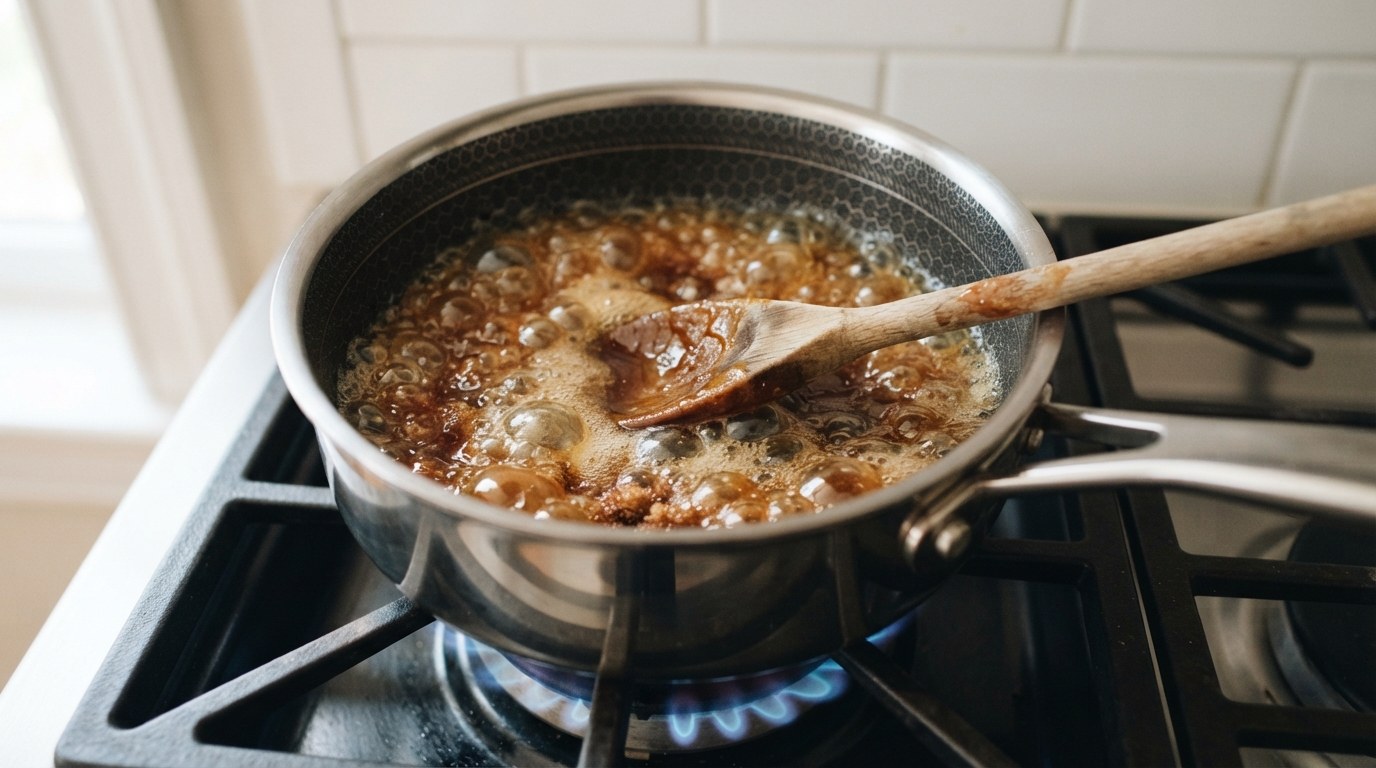
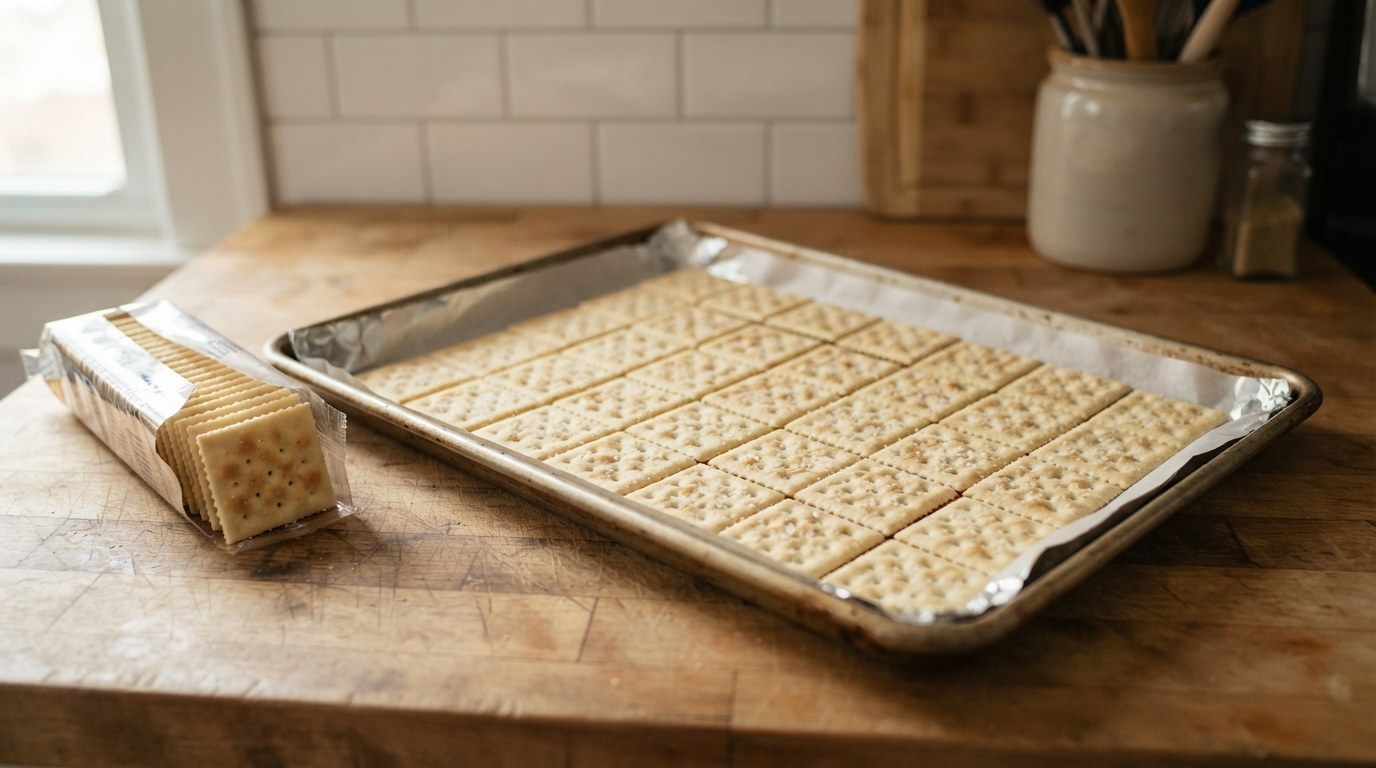
Line a rimmed half-sheet pan with foil and then parchment, lay the saltines in a single layer edge to edge, salted side up, and heat the oven to 400°F. Melt the butter and brown sugar together in a heavy saucepan over medium-high heat, stirring until the sugar dissolves and the mixture comes to a full rolling boil, then let it boil for exactly 3 minutes, stirring only occasionally and gently. It will foam up and turn glossy and amber. Off the heat, stir in the vanilla and salt, pour it over the crackers, and spread it quickly with an offset spatula to cover them.
Advertisement
The first failure is separation: the butter pools on top as a clear slick and the sugar sinks into a grainy sludge. A California State University toffee page written by a chemistry faculty member names the cause, phase separation between sugar and butter when the heating is too slow, and gives the fix: do not panic, turn the flame down a little and keep stirring gently, and the butter and sugar phases go back together as the temperature rises. That is why this recipe uses medium-high heat and a proper rolling boil rather than a timid simmer, and why unsalted butter is used rather than margarine, whose extra water and emulsifiers split more readily.
The second failure is graining, a toffee that sets dull and sandy instead of glassy, and its cause is crystals. Sugar wants to recrystallize as it concentrates, and butter is the reason toffee is smooth: its fat gets between the sugar molecules and keeps them from locking into crystals. But a few seed crystals, from hard stirring after the boil or from sugar dried on the pan sides, can set off a chain reaction through the whole batch. Iowa State University Extension's candy rules cover it: stop stirring hard once the syrup boils and the sugar has dissolved, because extra stirring can induce crystal formation, and wash the sugar crystals off the pan sides with a wet pastry brush. Brown sugar helps here too; its molasses carries sugars that interfere with crystallization the way corn syrup does in a brittle.
The Oven Finish, the Chocolate, and Doneness
Bake the toffee-covered crackers at 400°F for 5 to 6 minutes, until the toffee is bubbling vigorously across the entire pan, not just at the edges. The bubbling is the water leaving, and it is the visual proof that the thin layer is climbing toward hard crack; a pan pulled while the center is still smooth and quiet will be chewy there. The crackers soften and drink up the toffee during these minutes, which is why saltine toffee shatters as one layer instead of separating into a cracker and a candy lid. Pull the pan, wait 30 seconds for the bubbling to subside, and scatter the chocolate chips evenly over the surface.
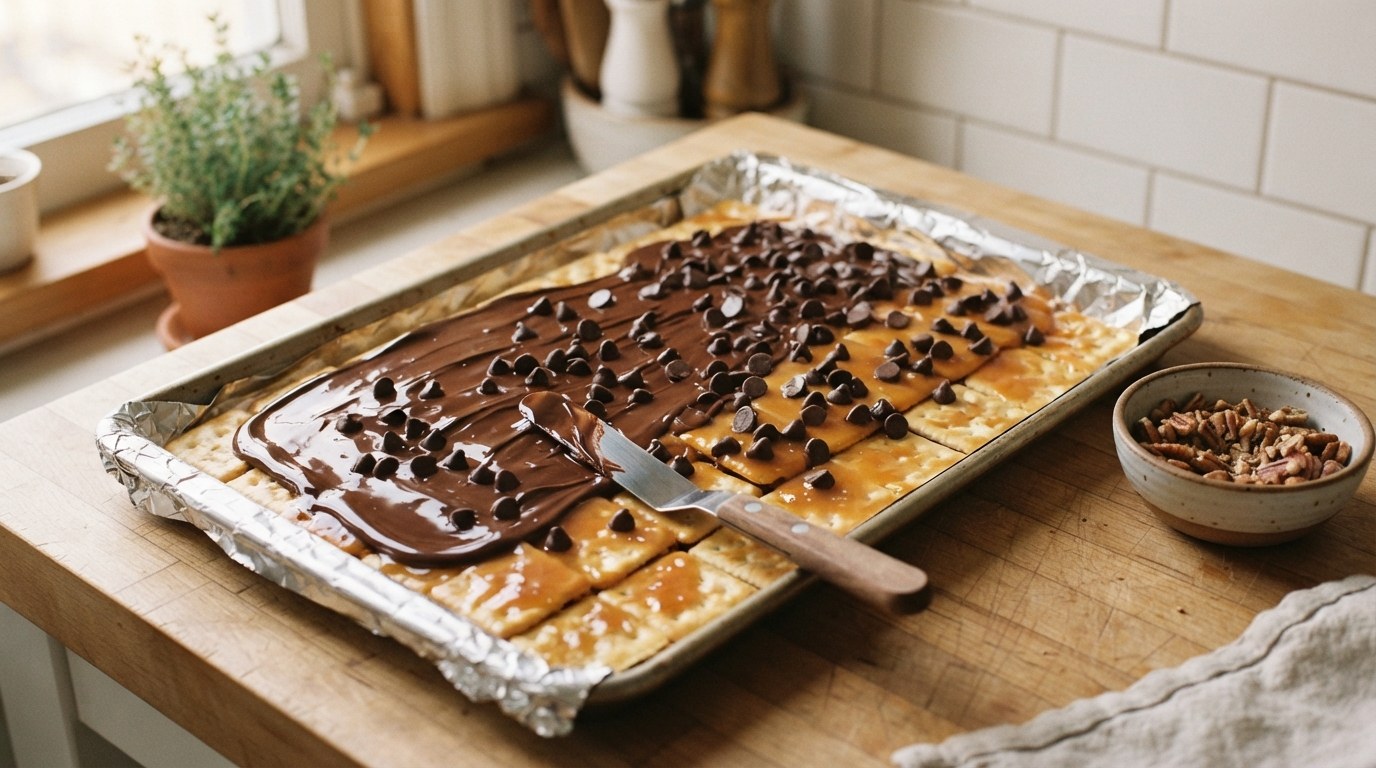
Leave the chips alone for 3 minutes. The toffee comes out of the oven far hotter than chocolate needs; chocolate melts well below the boiling point of water, and the residual heat in the candy layer softens the chips from below without any risk of scorching them the way a saucepan or microwave can. Chips are made with just enough stabilizer to hold their shape in a cookie, so they look intact until you touch them; after 3 minutes, spread them with the offset spatula and they collapse into a smooth, glossy sheet. If a few stubborn chips remain, a minute back in the turned-off oven finishes them. Scatter the toasted pecans and flaky salt over the wet chocolate and press them in lightly so they stick.
| Stage | Number | What you see |
|---|---|---|
| Boil | Medium-high, 3 minutes at a full rolling boil | Foaming, glossy, amber; butter and sugar together |
| Oven | 400°F, 5 to 6 minutes | Bubbling across the whole pan, not just the edges |
| Chocolate | 3 minutes on the hot toffee, then spread | Chips collapse into a smooth glossy sheet |
| Cool | 1 hour at room temperature, then 30 minutes refrigerated | Chocolate set matte; toffee snaps |
| Break | By hand, cold | Clean shards along the cracker lines; a bend means undercooked |
Cool the pan at room temperature for an hour, then refrigerate it 30 minutes to set the chocolate hard, lift the whole slab out by the foil, peel it off, and break the toffee into shards along the cracker lines. Properly cooked, it snaps with a click; a piece that bends or sticks to the teeth was pulled from the oven before the toffee finished, and the only fix is to cook the next batch longer. Two more of the ISU rules matter on the day: check a candy thermometer in boiling water, where it should read 212°F, if you use one to confirm the syrup; and pick a dry day, because on a humid or rainy day the candy pulls moisture from the air and turns sticky, and it may need to cook a degree or two higher.
Storage and Variations
Sugar is hygroscopic, so saltine toffee lives in an airtight container. It keeps a week at room temperature and two weeks in the refrigerator, layered between parchment so the chocolate does not scuff, and it freezes for 2 months, thawed still sealed so condensation forms on the container rather than the candy. Cold from the refrigerator is how most people like it, with the hardest snap. It ships well and is the usual candidate for a cookie tin alongside the pecan pie truffles and the hot cocoa cookies.
Advertisement
Variations that hold up: Ritz or club crackers for a buttery, less salty base; white chocolate chips with crushed peppermint for the December version, spread while the chips are just soft, since white chocolate scorches easily; a half-and-half top of semisweet and butterscotch chips; a sprinkle of cinnamon in the toffee; or toasted almonds or pretzel pieces in place of the pecans. The one thing not to change is the two-step cook. The Christmas fudge is the other five-ingredient holiday candy on this site, and it works on the opposite principle, a sugar that never crystallizes because it is never boiled.

Saltine Toffee (Christmas Crack)
Ingredients
- 40 saltine crackers (about one sleeve plus a few)
- 1 cup unsalted butter (2 sticks)
- 1 cup packed dark brown sugar
- 1 tsp vanilla extract
- ¼ tsp fine sea salt
- 2 cups semisweet chocolate chips (12 oz)
- ¾ cup pecans, toasted and chopped
- 1 tsp flaky sea salt
Instructions
- Heat the oven to 400°F (205°C). Line a rimmed half-sheet pan with foil, then parchment. Lay the saltines in a single layer edge to edge, salted side up.
- Melt the butter and brown sugar in a heavy saucepan over medium-high heat, stirring until the sugar dissolves. Bring to a full rolling boil and boil 3 minutes, stirring only occasionally and gently. If the butter separates, lower the heat slightly and keep stirring gently until it comes back together.
- Off the heat, stir in the vanilla and fine salt. Pour evenly over the crackers and spread quickly with an offset spatula to cover them.
- Bake 5 to 6 minutes, until the toffee is bubbling vigorously across the entire pan. Remove, wait 30 seconds, and scatter the chocolate chips evenly over the top. Let stand 3 minutes, then spread the softened chips into a smooth layer.
- Scatter the pecans and flaky salt over the chocolate and press in lightly. Cool 1 hour at room temperature, then refrigerate 30 minutes until the chocolate is set. Lift out by the foil, peel it away, and break into shards. Store airtight.
Notes
Advertisement
Saltine Toffee FAQs
The questions that come up most: why the toffee came out chewy, why the butter separated, why it turned grainy, what temperature it should reach, whether it needs the oven step, whether it needs refrigerating, how long it keeps, and what crackers and toppings work.
Why is my saltine toffee chewy?
It did not reach the hard-crack stage. Toffee snaps only when the syrup has climbed to about 300 to 310°F, where it is nearly all sugar; a batch that stopped in the soft-crack range, 270 to 290°F, bends and sticks. Boil the butter and brown sugar a full 3 minutes at a rolling boil, then bake 5 to 6 minutes at 400°F until the toffee bubbles across the entire pan, not just the edges.
Why did the butter separate from the sugar?
The pan was heated too slowly, which lets the butter and sugar split into two phases. Use medium-high heat and a real rolling boil, and if it does separate, turn the heat down slightly and keep stirring gently; the two phases rejoin as the temperature climbs. Margarine, with its extra water, separates more easily than butter.
Why did my toffee turn grainy or sandy?
Sugar crystals seeded the batch. Hard stirring after the syrup boils, or dried sugar on the pan sides falling back in, starts a chain of crystallization through the whole pan. Stir only gently once it boils, brush the pan sides with a wet pastry brush, and use brown sugar, whose molasses helps interfere with crystals. Butter is what makes toffee smooth in the first place.
What temperature should saltine toffee reach?
Hard crack, 300 to 310°F, though most recipes, including this one, time the boil at 3 minutes and let the 400°F oven finish it rather than using a thermometer. If you do use one, check it first in boiling water, where it should read 212°F, and cook a degree or two higher on a humid day.
Do I have to bake saltine toffee?
Yes. The oven is the second half of the cook: the thin layer of toffee keeps losing water at 400°F and climbs to hard crack while it soaks into the crackers, which is why the finished candy snaps as one piece. Skip it and you get a chewy toffee sitting on top of loose crackers.
Does saltine toffee need to be refrigerated?
Not for safety, but 30 minutes in the refrigerator sets the chocolate hard for a clean break, and many people prefer it kept cold for the sharpest snap. At room temperature it keeps a week in an airtight container; sugar pulls moisture from the air and the candy goes tacky if left open.
How long does saltine toffee last?
A week at room temperature or two in the refrigerator, airtight and layered between parchment, and 2 months frozen. Thaw frozen toffee without opening the container so the condensation lands on the box and not the chocolate.
What crackers and toppings can I use?
Saltines are the classic for their salt and crispness; Ritz or club crackers give a buttery, less salty base; graham crackers make a sweeter, softer candy. On top, toasted pecans, almonds, pretzel pieces, crushed peppermint over white chocolate, or a half-and-half layer of semisweet and butterscotch chips all work.

About the Author
John Siracusa is the founder of Hell’s Kitchen Recipes. He focuses on technique-first, reproducible home cooking and researches recipes & kitchen equipment from published food science and professional chef methods since 2016.