This seared ahi tuna is a thick yellowfin steak brushed with egg white and lime zest, pressed into black and white sesame seeds and seared for 30 to 45 seconds a side in a very hot pan, so the crust turns golden while the center stays deep red. Sliced across the grain and fanned over cold soba noodles with a soy, ginger and lime dressing, it makes a 25-minute dinner for four. The method follows the sesame-crusted tuna Gordon Ramsay teaches on MasterClass, and the same quick sear, sliced and served barely cooked, is what most menus call tuna tataki.
Two things decide how good your seared tuna turns out: the fish you buy and how hot the pan is. Thick, very fresh tuna sold for raw use gives you a rare center to protect; a pan hot enough to toast the seeds in seconds gives you a crust before the heat has time to reach the middle. Both are explained below, along with the safety rules for eating tuna rare, a doneness chart and the fixes when it goes wrong. For more fish dishes, see our Gordon Ramsay fish recipes, and every dish on the site lives in Recipes.
How to Make Seared Ahi Tuna
Seared ahi tuna takes four short stages: make the dressing and cook the soba first, then coat the tuna, sear it hard and fast, and slice it. Whisk soy sauce, rice vinegar, lime juice, honey and grated ginger, then the oils, and toss a third of it through soba that has boiled for 4 to 5 minutes and been rinsed cold. Keep the tuna in the fridge until the noodles are done, because everything after that point moves quickly.
Pat the steaks dry, season them lightly with salt and pepper, brush every side with frothy egg white, grate lime zest over them and press them into a plate of mixed sesame seeds. Heat a 12-inch skillet over high heat for about 2 minutes, add the oil, turn the heat down to medium-high and lay the tuna in. Sear 30 to 45 seconds a side for a 1 1/4-inch steak, lift it onto a rack for a minute or two, then slice it 1/4 inch thick and serve it on the noodles with the rest of the dressing, scallions and a pinch of toasted seeds.
Gordon Ramsay's Sesame-Crusted Tuna: Where This Method Comes From
This seared ahi tuna is built on the sesame-crusted tuna Gordon Ramsay cooks in Sesame Crusted Tuna With Cucumber Salad, lesson 12 of his second MasterClass, Teaches Cooking II: Restaurant Recipes at Home. The lesson description sums up his attitude: treat tuna with the respect you would give a great wagyu steak, which is why the cooking is measured in seconds, much like the hard sear on our Gordon Ramsay steak.
His method is simple and very specific. He seasons the loin lightly, brushes it with whisked egg white so the seeds stick, grates lime zest straight onto the fish before the crust goes on, and rolls it in an even mix of white and black sesame seeds, half and half, because the contrast looks good on the plate. The crust is there to protect a lean fish, and he uses the same coating for swordfish and mahi-mahi. He heats a nonstick pan until it is very hot, turns the gas down so he stays in control, adds the oil and lays the tuna in away from him. Then it is 30 seconds a side, and he does not walk away. Overcooked tuna, he points out, goes grey and will not slice cleanly.
Ramsay plates his on cucumber "noodles" quick-pickled in rice vinegar with a yuzu dressing. This version keeps his crust and sear and serves the tuna on soba with a soy, ginger and lime dressing, a fuller dinner; his cucumber plate is under the variations below. His fish rule from the first Gordon Ramsay Teaches Cooking class fits tuna best of all: meat has several doneness levels, fish has one, and it has to be right.
Why Egg White, Lime Zest and Two Colors of Sesame Make the Crust
A sesame crust on seared tuna only works if the seeds stick and the surface is dry. Pat the steaks very dry first: water on the surface cannot get hotter than 212°F (100°C), and browning (the Maillard reaction) does not start until about 284°F (140°C), so a wet steak steams under its seeds instead of toasting them. The egg white is the glue. Brushed on thin, it holds the seeds while you coat the fish, and its proteins start to set from about 140°F (60°C), which happens within seconds on the hot pan, locking the seeds to the surface before you turn it.
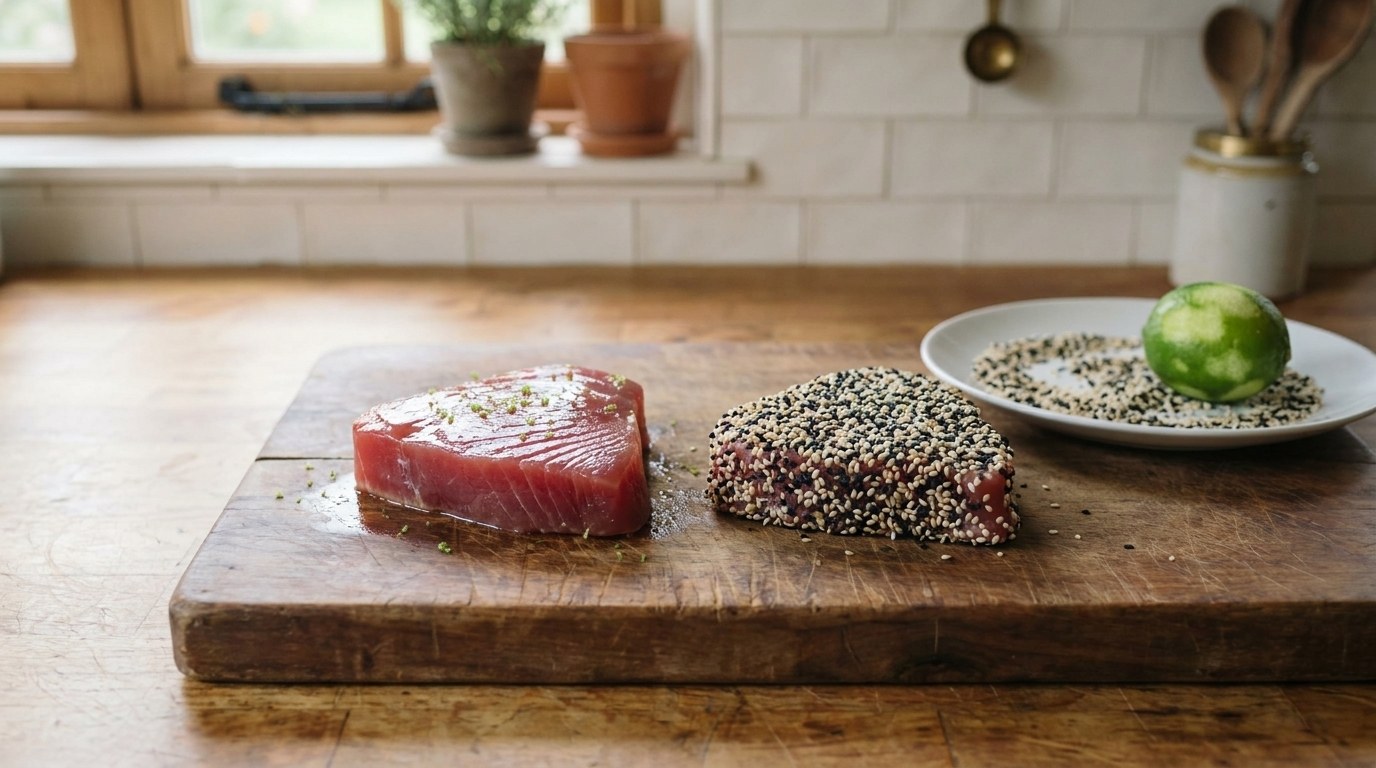
Lime zest goes on under the crust because the fragrant oils in the peel dissolve into fat, so the toasting seeds carry the citrus right into each slice; Ramsay zests the tuna again at the end for a fresh hit. The seeds need watching. They are oily and small, so they toast fast, and once the pan surface passes about 356°F (180°C) they start to burn (pyrolysis) and turn bitter. That is the reason for his order of work: get the pan very hot, then turn it down before the oil and the fish go in. Black sesame seeds hide their color as they toast, so the white seeds are your gauge; you want them light golden brown, never dark.
How Long to Sear Ahi Tuna (and Why the Center Stays Red)
Sear ahi tuna for 30 to 45 seconds a side for a rare center in a steak about 1 1/4 inches thick, or about 30 seconds a side for a 1-inch steak. That short time works because fish proteins set at a far lower temperature than meat: they start to denature at 104 to 122°F (40 to 50°C), compared with 122 to 140°F (50 to 60°C) for beef. A minute on a very hot pan cooks a thin outer layer through while the cold center barely warms, and that steep temperature gradient is what gives the sliced tuna its thin cooked edge and deep red middle.
You can see the change happen. NOAA Fisheries describes yellowfin tuna as bright red when raw and brown to grayish-tan when cooked. The red comes from myoglobin, and ThermoWorks notes that tuna myoglobin turns grey-brown at around 140 to 160°F (60 to 70°C), much like beef. Watch the side of the steak as it sears: a pale band creeps up from the pan, and when it is about 1/8 inch deep, it is time to turn it.
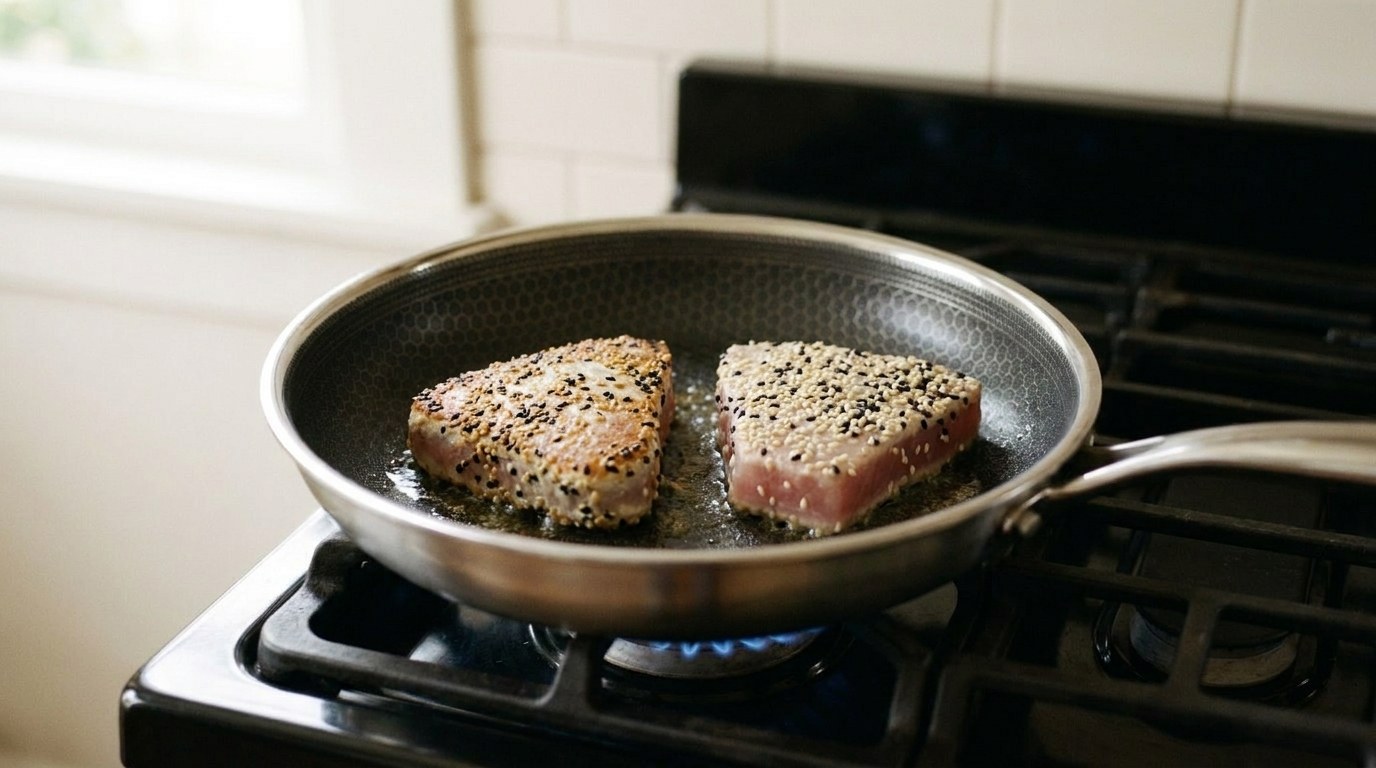
ThermoWorks recommends a pan surface of 425 to 450°F (218 to 232°C) for tuna, and a heavy 12-inch pan holds that heat when two cold steaks land in it. A nonstick surface also lets the egg-white crust release cleanly when you turn it, which is why Ramsay reaches for one.
HexClad
HexClad 12-Inch Hybrid Nonstick Frying Pan
- Stainless steel and ceramic nonstick hybrid surface, built to sear hard and release easily
- Tri-ply with an aluminum core for quick, even heat; works on induction
- Oven safe to 900°F and metal-utensil safe (lid not included)
Leave the tuna in the fridge until you coat it. The old advice to bring fish to room temperature works against you here, because a cold center is your safety margin for a rare middle. Heat keeps moving inward after the pan, too: ThermoWorks found the inside of a tuna steak can climb by as much as 25°F after it comes off the heat. Lift it onto a rack or a cool board rather than a hot plate, and slice after a minute or two. One myth worth dropping: searing does not seal in juices. The sear is there for the crust and flavor, and the short time is what keeps the tuna moist.
| Doneness | Sear per side (1 1/4-inch steak) | What the slice looks like | Best for |
|---|---|---|---|
| Rare (tataki-style) | 30 to 45 seconds, high heat turned to medium-high | Thin cooked band of 1 to 2 mm under the crust, deep ruby-red center | The classic seared ahi tuna; very fresh tuna sold for raw use |
| Medium-rare | About 1 minute, medium-high | Cooked band about 1/4 inch, red to rosy center | A little more cooked edge, still moist |
| Medium | About 1 1/2 minutes, medium heat so the seeds do not burn | Mostly opaque with a pink stripe through the middle | Diners who want only a hint of pink; firmer and drier |
| Cooked through (145°F) | 45 seconds to set the crust, then a 400°F oven until 145°F | Opaque grayish-tan all the way through | Pregnant diners, young children, older adults, anyone told to avoid undercooked fish |
Rare is where seared ahi tuna is at its best, because tuna is very lean and dries out quickly past medium-rare. If anyone at the table should not eat undercooked fish, cook their steak through to the FDA's 145°F and serve it with extra dressing rather than serving everyone well done.
How to Slice Seared Tuna Against the Grain
Slice seared tuna across the grain, about 1/4 inch thick, with the sharpest knife you own and one long stroke per slice. Look at the side of the steak and you will see faint pale lines running through the red: those are thin sheets of connective tissue between the layers of muscle. Cutting straight across them leaves each slice with short fibers that are tender to bite; cutting along them gives long, stringy pieces that shred.
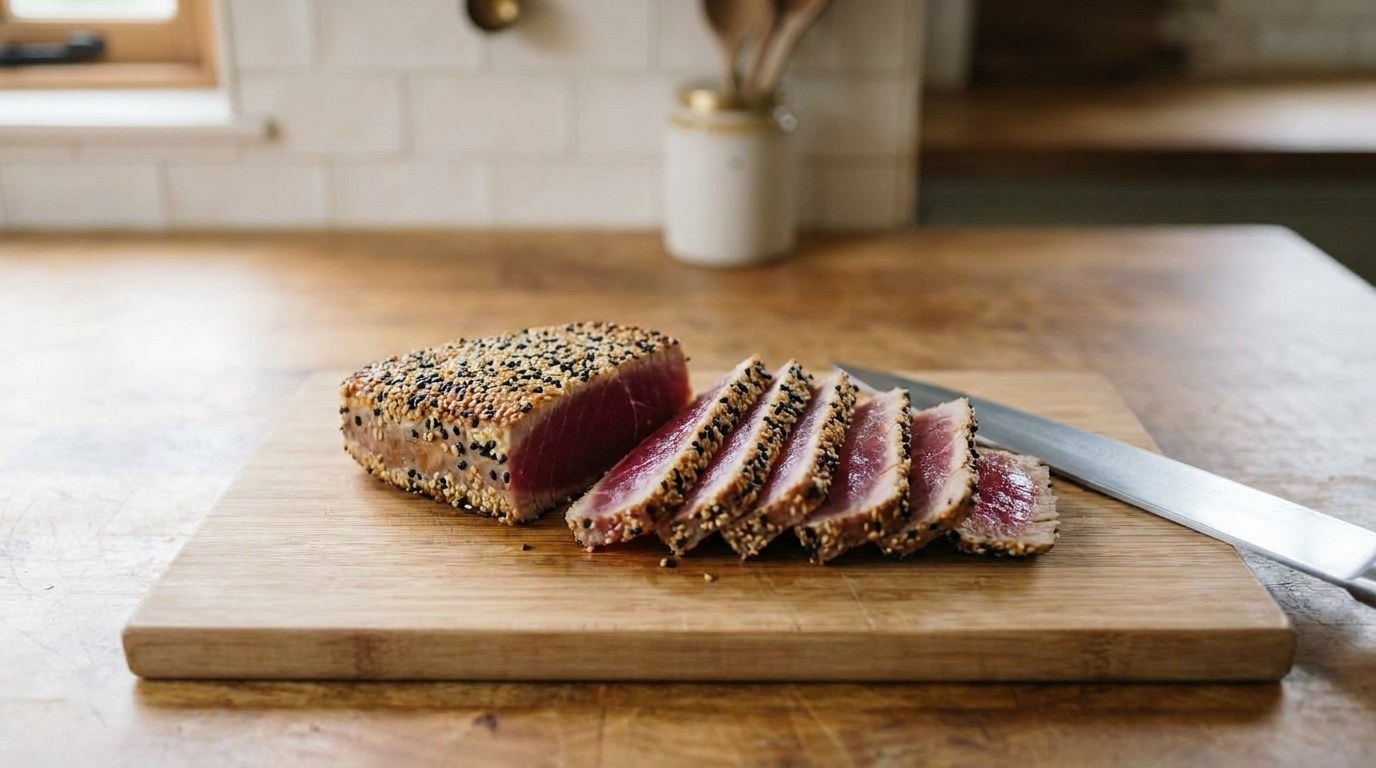
Ramsay's advice is to let a very sharp knife glide through rather than sawing, and not to slice too thin, or the pieces fall apart. Sawing tears the crust off the edge and drags the soft center out of shape. A long, thin blade such as a gyuto or slicer makes the cleanest cut; our guide to the best gyuto knife covers the Japanese chef's knives built for this kind of slicing.
Tuna Tataki vs Seared Ahi Tuna: What Is the Difference?
Tuna tataki is a Japanese way of serving tuna that is seared quickly on the outside, left raw inside, sliced and eaten with a citrus-soy sauce and fresh aromatics; seared ahi tuna is the broader Western name for the same quick sear, often with a sesame or pepper crust. The technique comes from katsuo no tataki, the seared bonito of Kochi in southern Japan. The Japan National Tourism Organization describes it as seared on the outside and still raw on the inside, sliced and eaten like sashimi with ponzu and toppings such as ginger, onions or garlic.
| Dish | How it is cooked | Inside | Usually served with | Fish you need |
|---|---|---|---|---|
| Tuna tataki | Seared seconds per side, often plain or lightly salted | Raw beyond a thin seared rim | Ponzu, grated ginger, garlic, scallions | Tuna sold for raw use |
| Sesame-crusted seared ahi tuna (this recipe) | Egg white and sesame crust, 30 to 45 seconds a side | Rare, with a 1 to 2 mm cooked band | Soba and soy-ginger dressing, or a salad | Tuna sold for raw use |
| Tuna sashimi | Not cooked at all | Raw | Soy sauce, wasabi, pickled ginger | Tuna sold for raw use |
| Tuna steak cooked through | Seared then finished in the oven or on the grill | Opaque at 145°F | Any sauce; it needs moisture | Any fresh or frozen tuna steak |
In practice the line is blurry, and plenty of restaurants call a sesame-crusted tuna "tataki." To make this recipe a classic tuna tataki, skip the egg white and seeds, salt the tuna and sear it plain for 20 to 30 seconds a side, then serve the slices with ponzu, a little grated ginger and garlic and sliced scallions. The rare-tuna safety rules below apply to all three of the raw and rare styles.
Is Seared Ahi Tuna Safe to Eat Rare?
Seared ahi tuna is eaten rare all the time, but a rare center is undercooked fish, and the FDA is plain about the risk. Its guide to selecting and serving seafood safely says most seafood should be cooked to 145°F, that freezing does not kill all harmful germs, and that the safest route is to cook seafood. It lists pregnant women, young children, older adults and people with weakened immune systems as groups who should avoid raw or undercooked fish and shellfish. For them, cook the tuna through.
"Sushi grade" and "sashimi grade" are sellers' terms, not a federal grade. The closest official rule is the FDA Food Code used by restaurant inspectors: fish served raw or partly cooked must first be frozen to kill parasites, at -4°F (-20°C) or below for 7 days or at -31°F (-35°C) under the faster options. Section 3-402.11 exempts the main tuna species from that freezing step, yellowfin and bigeye included. So with tuna, the bigger risks are freshness and temperature, and the label only tells you the seller intends it for raw use. Buy from a fishmonger who sells tuna for raw use and can tell you how it was handled.
Temperature is what prevents scombroid poisoning, the most common illness tied to tuna. A CDC report on outbreaks traced to tuna steaks explains that bacteria turn the histidine in tuna muscle into histamine when fish is held too warm, and that histamine is not destroyed by freezing or cooking. Symptoms such as flushing, sweating, a rash and a peppery taste can start within an hour of eating. The CDC's prevention is keeping fish below 40°F (4.4°C) from the boat to the plate. At home that means a cold bag from the store, the coldest part of the fridge, cooking within 2 days, and never leaving cooked tuna out for more than 2 hours (1 hour above 90°F), as the FDA advises.
Mercury is the other question with ahi, because the name covers two species. NOAA Fisheries lists "ahi" as a name for both yellowfin and bigeye, and bigeye is richer, with more fat than yellowfin. The FDA and EPA advice about eating fish, written for people who are or might become pregnant, are breastfeeding, and children 1 to 11, puts yellowfin among its Good Choices and bigeye among the Choices to Avoid for its higher mercury. If that advice applies to you, ask for yellowfin.
Soba Noodles and Sesame-Ginger Dressing for Seared Tuna
Cold soba noodles with a soy, ginger and lime dressing are a natural base for seared ahi tuna: nutty buckwheat, a little sweetness and enough acid to cut the rich crust. Cook the soba in plenty of boiling water and stir it in the first minute, while the surface starch is soft and sticky from gelatinization, then drain it and rinse it under cold running water, rubbing the strands gently. The rinse stops the cooking and washes off the loose starch that would otherwise glue the noodles into a block as they cool. Green tea soba (cha soba) works the same way and adds a pale green color.
For the dressing, dissolve the honey in the soy sauce, rice vinegar and lime juice before the oils go in, then whisk in the oil and sesame oil to make a loose, temporary emulsion. It separates again as it sits, so give it another whisk before you spoon it over the tuna. Toss only a third into the noodles, so the rest can go over the slices at the table. Soy, rice vinegar and ginger with sesame is also a good dipping sauce for seared ahi tuna if you would rather serve the slices as a starter.
Seared Ahi Tuna Variations
Seared ahi tuna takes other crusts and bases well as long as the sear stays short:
- Ramsay's cucumber plate: spiralize a cucumber with the skin on and quick-pickle it in rice vinegar, an equal amount of water and a couple of spoonfuls of sugar for a few minutes, then drain and serve the tuna on top with a dressing of yuzu or lime juice, a little sesame oil and olive oil.
- Classic tuna tataki: no crust, a plain salted sear of 20 to 30 seconds a side, served with ponzu, grated ginger, garlic and scallions.
- Seared ahi tuna salad: slice it over greens, cucumber and avocado with the same dressing for a lighter lunch.
- Pepper-crusted tuna: swap half the sesame for coarsely cracked black pepper; it scorches even faster, so keep the heat at medium-high.
- Swordfish or mahi-mahi: Ramsay uses the same sesame coating on both, but cook these through to 145°F rather than rare.
For more seared seafood with the same hot-pan approach, try our pan-seared halibut, Ramsay-style crispy skin salmon or the Hell's Kitchen scallops, which give you even less time than tuna.
Why Seared Tuna Goes Wrong (and How to Fix It)
Most seared ahi tuna problems come down to heat, time or a wet surface. The fixes:
- Grey all the way through: the steak was too thin, sat out too long or stayed in the pan too long. Buy steaks at least 1 inch thick, keep them cold and turn them as soon as the pale band is about 1/8 inch up the side.
- Burnt, bitter seeds: the pan stayed at full heat after the oil went in. Turn it down to medium-high before the tuna goes in, and watch the white seeds.
- Seeds fall off: the surface was wet, the egg white was skipped, or the steak was moved before the crust set. Pat dry, brush on egg white, and turn it once with a thin spatula.
- Pale, soft crust: the pan was not hot enough, or the tuna rested in its own juices on a plate. Preheat the pan for a full 2 minutes and rest the tuna on a rack.
- Ragged slices: a dull knife or a sawing motion. Use one long stroke of a sharp blade and cut 1/4 inch thick.
- Sour or strong fishy smell before cooking: do not cook it. Fresh tuna smells clean and briny, and cooking will not make spoiled tuna safe.
What to Serve With Seared Ahi Tuna
Seared ahi tuna on soba is a full meal, but it also goes well with simple, fresh sides: a cucumber salad, steamed edamame, sautéed bok choy or a bowl of miso soup. For a bigger spread, our Gordon Ramsay fried rice sits well next to it, and a crisp, dry white wine or a cold lager suits the sesame and ginger.
Make seared ahi tuna once and the pattern is yours: buy thick tuna sold for raw use, keep it cold, crust it with egg white, lime and two colors of sesame, and give it no more than 30 to 45 seconds a side in a very hot pan. Slice it across the grain, and the deep red center does the rest of the talking on the plate.
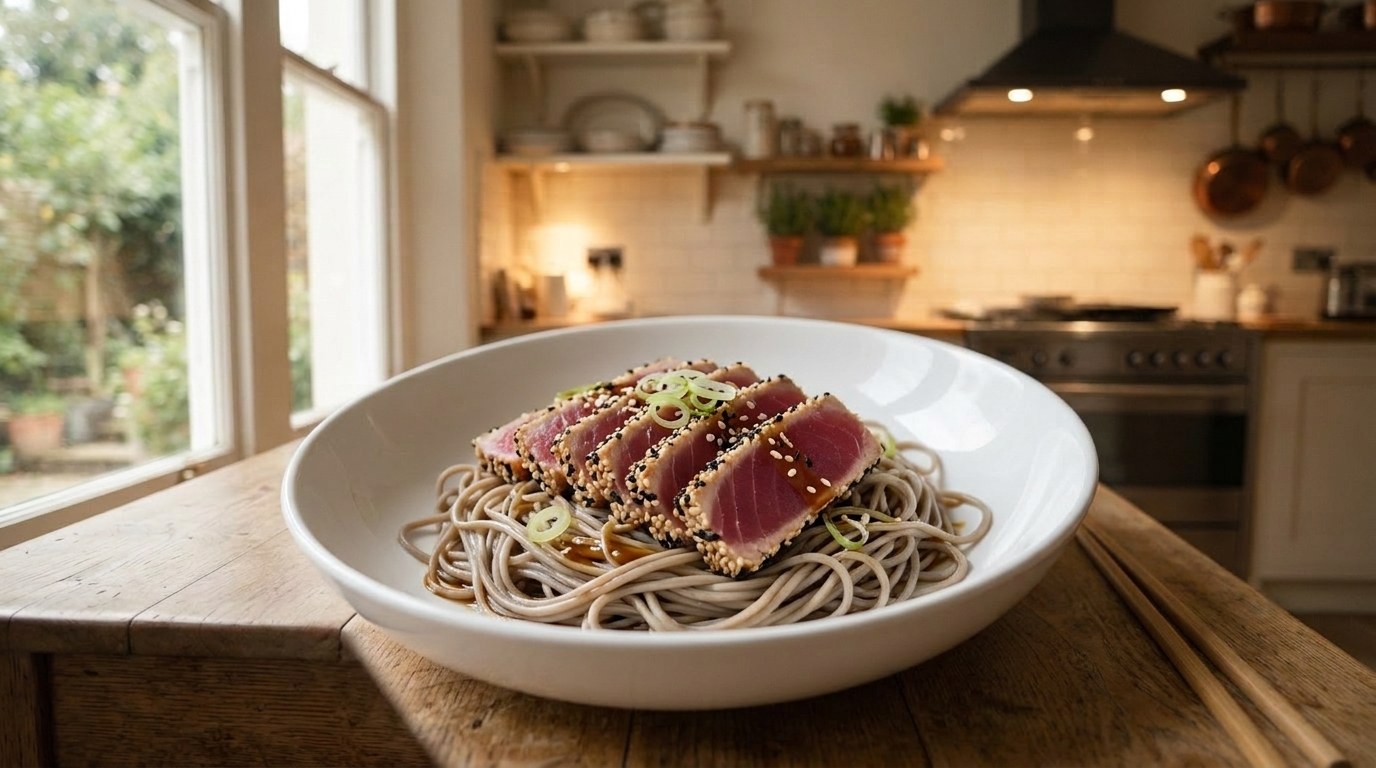
Sesame-Crusted Seared Ahi Tuna with Soba Noodles
Ingredients
Tuna
- 2 ahi (yellowfin) tuna steaks, about 8 oz (225 g) each and 1 1/4 inches thick, sold for raw or undercooked use
- 1/2 tsp kosher salt
- 1/4 tsp freshly ground black pepper
- 1 large egg white
- 1 lime, zested (juice it for the dressing)
- 3 tbsp white sesame seeds
- 3 tbsp black sesame seeds
- 1 1/2 tbsp grapeseed or avocado oil
Soba noodles
- 6 oz dried soba noodles (170 g), or green tea cha soba
- 1 tsp toasted sesame seeds, to finish
Sesame-ginger dressing
- 3 tbsp soy sauce or tamari
- 1 1/2 tbsp rice vinegar
- 1 tbsp fresh lime juice (from the zested lime)
- 2 tsp honey
- 2 tsp finely grated fresh ginger
- 3 tbsp neutral oil, such as grapeseed
- 2 tsp toasted sesame oil
- 3 scallions, thinly sliced, divided
Instructions
- Make the dressing: whisk the soy sauce, rice vinegar, lime juice, honey and ginger until the honey dissolves, then whisk in the neutral oil and sesame oil. Stir in half the scallions.
- Bring a large pot of water to a boil. Add the soba, stir right away and keep stirring for the first minute, then cook according to the package, usually 4 to 5 minutes. Drain, rinse under cold running water while rubbing the noodles gently until cool, and drain well. Toss with about a third of the dressing.
- Take the tuna out of the fridge only now. Pat it very dry with paper towels and season it lightly on all sides with the salt and pepper.
- Whisk the egg white until frothy. Brush a thin layer over every side of the tuna, then grate the lime zest over it. Mix the white and black sesame seeds on a plate and press the tuna into them on all sides until evenly coated.
- Heat a 12-inch skillet over high heat for about 2 minutes, until very hot. Add the oil, swirl it, then turn the heat down to medium-high. Lay the tuna in the pan, away from you.
- Sear without moving for 30 to 45 seconds, until the white seeds underneath are light golden brown. Turn the steaks with a thin spatula and sear the second side for 30 to 45 seconds. For sealed edges, hold each narrow side against the pan for about 10 seconds.
- Lift the tuna onto a rack or a cool board and rest it for 1 to 2 minutes. Slice it across the grain into 1/4-inch slices with a very sharp knife, using one long stroke for each slice.
- Divide the soba among 4 plates or shallow bowls and fan the tuna slices on top. Whisk the remaining dressing, spoon it over, and finish with the rest of the scallions and the toasted sesame seeds. Serve right away.
Notes
Seared Ahi Tuna FAQs
The questions that come up most: how long to sear ahi tuna on each side, whether seared ahi tuna is safe to eat rare, the difference between tuna tataki and seared tuna, whether you need sushi-grade tuna, how to make sesame seeds stick, which oil to use, whether tuna should be at room temperature first, and how long leftovers keep.
How long do you sear ahi tuna on each side?
For a rare center, sear a 1 1/4-inch ahi tuna steak for 30 to 45 seconds a side in a very hot pan, or about 30 seconds a side if it is 1 inch thick. Gordon Ramsay sears his sesame-crusted tuna for 30 seconds a side. Go to about 1 minute a side for medium-rare.
Is seared ahi tuna safe to eat rare?
Rare seared tuna is undercooked fish, so it carries some risk. The FDA says most seafood should be cooked to 145°F and advises pregnant women, young children, older adults and people with weakened immune systems to avoid raw or undercooked fish. For everyone else, buy tuna sold for raw use, keep it below 40°F and cook it within 2 days.
What is the difference between tuna tataki and seared tuna?
Tuna tataki is the Japanese style: tuna seared for seconds outside, left raw inside, sliced and served with ponzu, ginger, garlic and scallions. Seared ahi tuna is the broader Western name for the same quick sear, often with a sesame or pepper crust and served on noodles, rice or salad.
Do you need sushi-grade tuna for seared ahi tuna?
You need tuna the seller says is fit to eat raw, because the center stays raw. "Sushi grade" is not a federal grade; the FDA Food Code requires freezing to kill parasites in most fish served raw but exempts the main tuna species, so freshness and cold handling matter most. Ask the fishmonger whether the tuna is sold for raw use.
How do you get sesame seeds to stick to tuna?
Pat the tuna dry, brush every side with lightly whisked egg white, then press it firmly into the seeds. The egg white holds the seeds while you coat it and sets within seconds in the hot pan. Turn the steak only once, with a thin spatula, so the crust stays on.
What oil is best for searing tuna?
Use a neutral oil with a high smoke point, such as grapeseed, avocado or peanut oil, because the pan needs to be around 425 to 450°F. Save toasted sesame oil for the dressing; it burns at searing heat.
Should tuna be at room temperature before searing?
No. For rare seared tuna, keep it in the fridge until you coat it. A cold center gives you more time to brown the crust before the heat reaches the middle, and the inside can still rise by up to 25°F after it leaves the pan.
How long does seared ahi tuna last in the fridge?
Refrigerate leftovers within 2 hours and eat them within a day, cold, sliced over salad or noodles. Reheating cooks the rare center through and turns it dry and grey, so it is best eaten chilled.

About the Author
John Siracusa is the founder of Hell’s Kitchen Recipes. He focuses on technique-first, reproducible home cooking and researches recipes & kitchen equipment from published food science and professional chef methods since 2016.